Leandra

Years ago, I remember seeing a Twilight Zone story about a man and a wife who wanted to swap their bodies for younger ones.  This story stuck in my head and helped influence the following story.  I hope you will enjoy it. 

box_boyandgirl

There it was.  The UPS Truck and the knock on the door.  I had waited over six months but it had finally arrived.  Like the saying goes “Good things take time.”  I signed for the package or packages.  She had been delivered in three boxes.  The company had assured me she would be quick and easy to assemble.  I called in to my business to tell them that I needed to take the day off.  This was much more important than work.

But I suppose I must back up a bit to tell you the whole story.  My name is Rob and about 12 months ago, my wife Leandra packed her bags and left a note on the kitchen table.  It read “Gone with Pete, don’t love you anymore.  Bye.”  Pete was my best friend.  I never suspected that Leandra was having an affair with Pete, much less that she was the slightest bit unhappy in our relationship.

I was stunned.  We had been married for 10 years and she had never once complained about our relationship.  I thought we had the perfect marriage.  We had dinner together at least twice a week.  We watched the football game every Monday night together.  We attended church every Sunday together.  We had sex on the average of once per week.  She always said it was great sex.  I thought we were happy together.

woman robotI am not a very sentimental person nor am I one to cling to the past.  I decided I would move on with my life.  I threw myself into my job and time went by.  I had almost forgotten about Leandra when I saw the ad.  It was from the Resurrection Android Company.  It was the same company that I had purchased my android valet Sam from.  Actually, Sam was much more than just a valet.  Sam was a third-generation android with some independent powers of decision making.  He could decide what to cook each day and he also decided what I should wear for work.  He did cleaning, mending and many light repairs around the house.  I had bought Sam shortly after Leandra and I were married.  Leandra had mentioned that it would be nice to have some help with housekeeping and all.  That way she would have more time to spend with me.

robot-butlerAndroids of course are not human and they have no empathy or ability to show any emotions.  Sam was logical and could be persuasive but he could not show love or compassion.   In the ten years since I had purchased Sam, android technology had advanced considerably.  Looking at the ad from the company, it appeared that they were now on a 15th generation android that had affective as well as cognitive abilities.  The ad claimed that the new android could help replace a loved one both emotionally and physically.  By integrating DNA characteristics using a technique called “Assisted human reproduction”, they could capture the exact characteristics of a loved one.  All they would need would be some trace or remnant of the deceased or former loved one’s DNA.

Westworld-style-sexbots-could-soon-be-a-reality-after-AI-app-developed-to-give-love-dolls-personalThat was when the idea occurred to me.  I called the customer service line and asked to speak to a representative.  I asked her whether it would be possible for me to create a new wife in the exact image of my former wife Leandra.  They assured me it was.  It would take about six months for the bio-engineering to integrate the mechanical aspects of the droid with the alleles and DNA strands that they could map from a sample of Leandra’s DNA.  When the process was completed, I would have an exact physical, mental and emotional copy of Leandra.  Even better, she could continue to be programmed and become an even better Leandra.  The old Leandra was somewhat boring in bed.  The new Leandra could become a wild and wanton partner if that is what I desired.

female android with linesIt did not take long to assemble the new Leandra.  I put the lower torso, upper torso and head together in less time than it takes to make a milk shake.  She was perfect.  She looked just like my old Leandra.  When I turned her on, she greeted me and asked, “What will my name be.”  I replied “You are Leandra. You are the perfect wife.  You will love and obey me always.”

The next year was the best year of my life.  Leandra was perfect.  She never argued.  She never complained.  She never talked back.  She agreed with everything I said.  She spoke only when spoken to.  She had a beautiful body and after a while she became a real wild woman in bed.  What more could a man want.  Once again bliss had entered my life.  And then it happened.

female robot with head and robot bodyI came home one day from work and Leandra did not greet me at the door.  I thought maybe her battery had discharged or that Sam had forgotten to recharge her.  I had left strict instructions for Sam to recharge Leandra every day.  But, where was Sam?  I did not hear him fixing dinner in the kitchen.  I went into the kitchen but Sam was not there.  Suddenly, I noticed a note on the table.  I picked it up.  It was from Leandra.  She had written: “Gone with Sam, don’t love you anymore.  Bye.”

I could not understand this.  I was angry.  I was angriest at the Resurrection Android Company.  They had sold me this traitor with a guarantee that she would be perfect.  She was going to replace my old Leandra.  Well, I would call the company and get my money back.  I called and was transferred to the complaint department.  They said “Why of course, you will get your money back.  However, this will first need to go to our adjudication department to check the terms of the agreement.  If they decide that we have violated the agreement, we will immediately send you a check for reimbursement. This is usually just a formality.”

One week later, an envelope from the Resurrection Android Company arrived in the mail.  I opened it expecting to find a check.  Instead, there was a letter.  It read:

Dear Mr. Rob,  

After carefully reviewing the terms of your agreement with the Android Company and the DNA sample that you sent us, we have found no violation of our guarantee with you.  You specified that the new Leandra should be just like the old Leandra physically, mentally and emotionally.  Her recent departure with your valet Sam is evidence that the new Leandra was just like the old Leandra. 

We are very sorry for your loss. 

Respectfully,

The Resurrection Android Company

Female-robot

 Time for Questions:

Will robots ever replace people?  Do you think someday we will have robot spouses?  Are we going too far with robotics?  Do you think robots help or hurt the world?  What if robots could do all the work in the world that needed to be done?

Life is just beginning.

“California-based Abyss Creations is building a range of silicone sex dolls that not only look like real women but move and speak like them too.  In the hope of making the most realistic sex doll yet, designers have created a bot that they claim can fall in love with its user.

An app called Harmony 2.0 allows the user to tailor their Real Doll’s “personality” by selecting from 18 traits – including happy, shy, sensual, funny, jealous, moody and talkative.  Turn up the intellectual setting and it may even recite poetry or engage in witty banter.  A new video has been released that shows the doll speaking, in which she describes sex as ‘one of the most fascinating things in the world.”

Read more: http://www.dailymail.co.uk/sciencetech/article-4376310/Sex-doll-TALK-Robot-different-personalities.html#ixzz4iGLA2ocH


My First Trip to the Tattoo Parlor

Beginning this week, I am going to write a series of fictional stories.  I am taking a writing class with Dr. Carolyn Wedin and each week we bring a piece of writing to share with the class.  I thought it would break up some of the monotony on this site to switch from non-fiction to fiction for awhile and publish some of the things I write each week for the class.  It gives me a chance to try my hand at a new style of writing.  I hope you enjoy my stories, remember they are “only make believe.”

tattoo girl

This story is about a young girl who gets her first tattoo.  

I cannot believe the time has passed so quickly.  It seems like just yesterday.  However, it was six years ago.  I was nine years old.  All my friends had already got one but my mother was very strict and said I had to wait until I was at least nine years old.  I thought it would take forever but finally the day arrived.  I turned nine and on my birthday, I told my Mom “It is time.  Next week I am going to get a great big tattoo just like my friend Emily has.”  My mother said “Well, OK, but just remember, once you get a tattoo, they will not wash off.”

I should back up a minute in my story.  My name is Sophie and I am 15 years old now.  I live in New York City in the Bronx.  I am home schooled and I have a sister Isabella who is four years older than I am.  My older sister is a sophomore at the American Academy of Dramatic Arts in Manhattan.  She is a theater major and wants to be an actress.  She has already had small parts in two off-Broadway productions.  One production was called Venus.  This is a story about a woman who left her home in South Africa in the 19th Century in search of a better life and found herself working in a freak show.  The other production is a musical romance titled:  The Boy Who Danced on Air.  This is a modern day love story set in rural Afghanistan.  It tells the tale of two young male dancers who meet and fall in love with each other.

tattoo girl 2All of my family and relatives attended both of these productions.  We are a very close knit family and we wanted to show support for my sister.  Six years ago, some of my family had wanted to go to the tattoo parlor with me when I had my first tat.  I decided to go by myself.  It was something that I felt that I had to do alone.  The problem or conundrum I faced was what kind of a tattoo should I get and what part of my anatomy should I get it on?  I remember that I had lots of advice on the matter.  My father, mother, sister, grandmother, grandfather, aunts, uncles, nieces, nephews and friends all had tons of ideas and suggestions related to both questions.

In the week following my ninth birthday, I received even more advice on what kind of a tattoo I should get.  I heard suggestions that I should get a unicorn, a butterfly, my mom’s name, my dad’s name, my sister’s name, a heart, a rose, a Chinese character for happiness, an Aztec symbol, my favorite school subject, a lion, a prayer, a pixie and many other conceptions.  I was really reluctant to tell anyone that I had not a clue what I was going to get.  As a matter of pride I wanted a tattoo but it had to be my decision.  It also had to be something truly unique.

tattoo girl 3I received numerous suggestions on the best place to have a tattoo.  Some suggested it be placed where I could easily cover it up when I did not want it be seen.  Others suggested that it be someplace more visible.  Some said to get it on my shoulder or thigh where I could show it off during the warmer summer months while wearing shorts or a tank top.  Places like my lower arms would be visible more often but also more difficult to conceal.  Another dilemma, where to get my tattoo placed?

My mom called the tattoo parlor where my sister Isabella had got her tats.  She called to schedule an appointment for me and to insure them that I had her permission.   They wanted to know what kind of a tattoo I would like.  This knowledge would help them to schedule the time needed.  A tattoo can take anywhere from one hour to several days to ink.  My mom told them I had not decided yet.  They replied that they would schedule me for four hours and if it took longer, they could simply schedule me for more time the following week.

girl with tattoo 4With the looming appointment for my tattoo, I had even more pressure now to decide “What was I going to get?  What would my first tattoo be?  How do I find something truly unique?”  I thought about it all week.  Every TV show I watched, everything I read, more advice and suggestions from well-meaning advisors but nothing really excited me.  I went on the Internet.  I went to the library.  I looked at tattoo magazines with numerous women and men who had tats.  I must have looked at a thousand pictures of different tattoos but still nothing resonated.  I did not want any of the tats that I had seen.

Of course, I finally decided on both what kind of a tattoo I would get and where I would have it placed.  You would be very surprised to know how I came up with solutions to both of these mysteries.  My family and friends were all shocked.  My decision even surprised me.  I would love to share it with you and even show you my tattoo but there is no time for that now.  I must be off to see my friend Emily.  She wants to show me her newest tattoo.  She now has fifteen.

I will tell you this much though.  I have no regrets over my choices.  If I had to do it all over again, I would still get the same tattoo and in the same place.  I think you would approve.

Time for Questions:

What kind of a tattoo do you think Sophie got?  Where do you think she had it placed?  Do you have a tattoo?  Why or why not?  What kind of a tattoo do you have or would you get if you were to get one?  Why do people like tattoos?  Can you have too many tattoos?

Life is just beginning.

“A tattoo is a true poetic creation, and is always more than meets the eye.  As a tattoo is grounded on living skin, so its essence emotes a poignancy unique to the mortal human condition.”  — V. Vale

Why a Health Advocate Is Your Most Important Health Care Plan!

Advocacy_Graphic

This is the final article in my series on health care.  This article has been preceded by nine other articles.  There is no need to read them in order but if you have not read the other nine, you will be missing a good deal of information that just might help you live longer, healthier and happier.  As I finish this series on health care, I am gratified that over the ten weeks I have been writing about the subject, I have found only more evidence that confirms the advice and opinions I have given in this series.  In this final article, I want to talk about how important it is to have someone as an advocate when you enter the health care system in this country.  Let me tell you a personal story that illustrates this point very well.

Several years ago, my sister lay dying in hospice care.  Hospice care is a gentle humane way of helping ease out a person who is at deaths door.  By gradually increasing their doses of morphine, the patients’ bodily functions will eventually slow down and finally cease.  If a patient is accepted into hospice care, it is assumed that they are terminally ill.  What might be a slow lingering painful death without hospice, becomes a respectful and hopefully painless termination of vital processes and death.

My mother went into hospice care in 1994 and died in three days.  She had a terminal infection which was beyond treatment.  We (sisters and brother) sat with her until she expired.  My sister Sheri was also accepted into hospice care in 1999.  She was only fifty-one years old.  She was considered terminal due to her advanced cancer.  As a family, we began another vigil waiting for my sister to succumb to the cancer and morphine.  However, things did not go the same path with my sister.

We noticed that she would seem to come in and out of consciousness.  Often, when she came out she would seem quite rationale and even energetic.  The nurses did not seem to pay much attention to these episodes.  One day, the morphine drip somehow came unplugged.  My sister became quite lucid and wanted to know if it was time for her to do taxes.  She did not seem like a patient near death.  We demanded that they take her off the morphine.  This met with much resistance as I assume they thought my sister would be in great pain and that we would be the instigators of a now painful as well as inevitable death.  Such was not the case.  My sister revived and seemed very healthy.  In a day or so she was out of the hospital.  She moved in with my sister and lived another three years before she passed away in 2002.  The next three years were not always good ones for my sister but we never regretted the decision to take her out of hospice.

Advocacy-bannerThe point of this story is that if we had not been siting vigil at my sister’s deathbed, we would not have been able to prevent a premature death.  This is merely one example of the value of an “advocate” when you must go to a hospital.  I am sure everyone reading this blog has at least one example that highlights how important it is to have someone as an advocate when you are in the hospital.

A health advocate is a family member, friend, trusted coworker, or a hired professional who can ask questions, write down information, and speak up for you so you can better understand your illness and get the care and resources you need – giving you a peace of mind so you can focus on your recovery.

Nurses, doctors and staff all want to do a good job and provide wonderful healthcare.  However, our health care system is under tremendous pressure to cut costs and reduce expenses.  This translates to less time available to care for each patient.  Less time that a nurse or doctor can spend with each patient.

advocateAn alarm might go off in an intensive care room but not be noticed for quite some time.  I have personally observed many times when a patient needed to call someone for assistance but no one came.  Unable to get out of bed, a patient may have to wait a long time before someone is finally able to help them.  In many cases, an advocate in the room can help a patient with minor personal needs.  If more severe needs exist, the advocate can be of assistance if finding someone to help and making sure that the patient needs are not overlooked or even forgotten.

Advocates assist people with making sure their rights are respected. They help consumers to resolve complaints about health or disability services. They operate independently of government agencies, the Health and Disability Commissioner, and the funders of health and disability services.

70b2adaac53bf082bb116c279362275c_advocacy-clip-art-clipart-download-advocacy-clipart_1822-1415Another function an advocate can provide is to stand up for the patient when needed.  Most of the time when we are feeling sick or hurting, we are in no position to stand up for what we need or want.  In such instances, a patient only wants the pain to go away.  Hospitals and health care providers often have needs that transcend the needs of the patient.  The patient that must play second fiddle to a variety of administrative and financial procedures.  Another example might clarify this.

Three years ago, I went to the Mayo Clinic for prostate surgery.  The surgery went fine and I was sent to a room for recovery.  The night passed as most do in a hospital.  Interminable interruptions for pills, blood tests and getting up to walk the surgery unit for exercise.  The night nurse was polite and helpful.  She left sometime after 7 AM and a new nurse came on shift.  She immediately informed me that I had to be out of the room by 12 PM and I should try to do more walking.

I had thought that I was doing a great job of getting mobile but I had not met my new nurse’s standard.  I started to try to walk more and meantime I became fixated on the clock in my room.  I still felt like shit as I watched the hands on the clock move inexorably towards 12 PM.  I am sure that Cinderella did not feel as bad as I felt since she would only be outed as a pauper while I be would be viewed as weak, wimpy and unable to meet standards that every other male prostate victim in America had met.

Fortunately, when the witching hour arrived, I had my advocate intercede on my behalf.  My wife Karen who had kept vigil with me this whole time told them in no uncertain terms that I was not going anywhere until I felt better.  It was now 12 PM but with her assurance, I fell into a deep sleep.  I awoke two hours later and immediately saw that the clock hands were on 2 PM.  Somehow, this extra sleep time was all I needed.  I practically jumped out of bed and started grabbing my clothes.  Karen who had been napping in a chair beside my bed woke up.  I said, “Lets go, we are getting out of here.” She replied, “but we are not packed.”  I replied, “I don’t care, I want to get out of here now.”  Karen grabbled whatever we could and we made the 2-hour drive back to Arizona City from Scottsdale.  I was not sure how I was going to handle two hours in the car post-surgery but I did not care.  I wanted out of the Mayo Clinic and back in my own bed.  To this day, I wonder how much stock my second nurse had in the Mayo Clinic.

Preserver wNew Shadow-logo tagline

My rule now is this.  I will never let a friend or relative go to a hospital for treatment (regardless of how minor) by themselves.  If I have a friend who has no one to go with them, I will be their advocate.  If Karen needs to go to a doctor, clinic or hospital for any reason, even a hangnail, I will go with her.  Hospitals can be places of healing but they can also unexpectedly be places of death.  No one should assume or take for granted what might or might not happen at a hospital.  I could provide many more examples of unintended consequences that happened to friends and people we knew when they went into a hospital.  Better to be safe than sorry.

Patient advocates can work to help patients and their families by providing a variety of services, depending on the patient’s needs and the advocate’s area of expertise. They may help them to secure health care, manage insurance, or make treatment plan decisions.

Your advocate is your best health care plan.  Your advocate can have your back when you are under the weather or unable to defend yourself.  Your advocate can help make sure that the hospital and its providers live up to their own expectations.  Your advocate can help watch over you when everyone else is busy with other patients or administrative tasks.

Pity the poor person who goes into a hospital without a personal advocate.

This now concludes my series on health care.  I hope my blogs on health care have been useful and that you have found some ideas that will help you to lead a healthier, happier and more robust life.

Time for Questions:

Can you think of a time when you wished you had an advocate?  Were you ever an advocate for someone else?  What role do you think an advocate should play in healthcare?  Do you agree that everyone needs an advocate?  Why or why not?

Life is just beginning.

“For he who has health has hope; and he who has hope, has everything.”  — Owen Arthur


Will Yoga or Physical Therapy Help You or Kill You?

yoga

I started doing Yoga in 1972.  I am still doing Yoga three times per week and for over 45 years now.  My first Yoga instructor was a gentleman from India who did not look anything like Arnold Schwarzenegger.  He was short and a little on the pudgy side.  I credit him for giving me a wonderful grounding in both the physical and spiritual characteristics of Yoga.  I have since had many Yoga instructors but my first one still stands out in my mind as head and shoulders above the rest.

Over the years, many people have taken up teaching and doing Yoga.  Many of these “so-called” Yoga instructors are really Jazzercise or aerobics instructors in disguise.  Taking Yoga from some of them is a little like taking music lessons from someone who can only play an “air guitar.”  You will not get the true flavor of Yoga from someone who does Yoga to a four count hip hop beat and keeps shouting “work your buns.”  I feel privileged that I know the difference between real Yoga and “fake” Yoga.  Real Yoga has been a vital aspect of my weekly exercise routine.

When I started this blog (Which will be the 8th in my series on exercise and health care) my spouse wanted to know “Whether was I was going to say something negative about Yoga?”  I reassured her that it was not my intention to disparage Yoga or to say anything off putting about the practice.  Indeed, I think everyone would be happier and healthier if they did Yoga at least three times per week for ½ hour per session.  However, I did note in an earlier blog that Yoga and physical therapy could make your health worse.  As with anything in life, there is always a possible downside or negative impact which can occur with any activity.  If you lay in your bed all day long, your house could be hit by a tornado, earthquake, hurricane, flood or falling airliner.  Everything in life has a risk.

ManDoingYoga_0

The greater risk in life (IMHO) is doing nothing.  It is always easier to do nothing.  Whether your doctor has given you a regimen to practice physical therapy or whether you have a schedule for Yoga, there are many nights when you will just feel like doing nothing or perhaps simply eating.  It often goes like this in our house:

5 PM

John:  Let’s do Yoga today at 6:30 PM.

Karen:  OK

6:15 PM

John:  I sort of got behind on some things I was doing.  Could we make it at 7 PM and eat dinner after?

Karen:  OK

8 PM

John:  Dam that took longer than I thought it would.  Shit, it is now 8 PM.  I am hungry and tired.  Would you mind if we skipped Yoga tonight?  We could do it tomorrow instead.

Karen:   OK

One problem with Yoga (as noted in the above discussion) is to skip doing it.

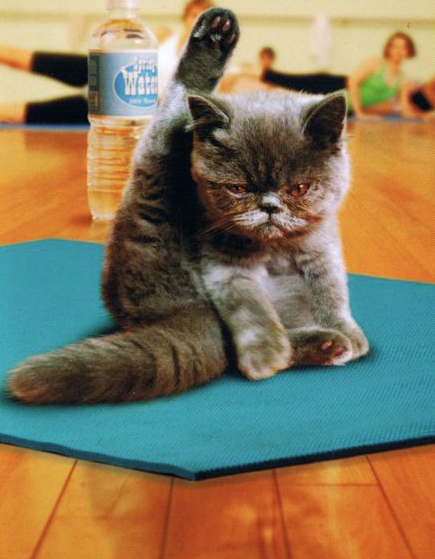
yoga cat

Another problem can be overdoing it.  Yoga must be practiced carefully.  The formula “no pain, no gain” is a prescription for disaster when it comes to doing Yoga.  That is the issue I have with Jazzercise instructors who think that they can teach Yoga with the same philosophy they use in their Jazzercise classes.  Yoga should be slow and gentle.  Yoga should not be frenetic and schizophrenic.  Some people might feel that there is little benefit to doing something that does not result in pain or sore muscles.  However, with the wrong philosophy, you can do real damage to your muscles or joints while attempting to do some Yoga exercises.

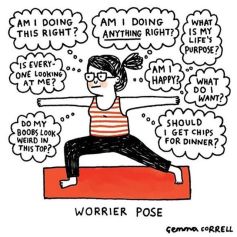
worrier poseBeing overly competitive might be a good formula in exercise programs where you attempt to outdo other participants, but this can be another recipe for disaster when it comes to Yoga.  Each participant in Yoga needs to pay attention only to their own body; not to the other participants or even the instructor.  If the instructor has his/her legs at a 180 degree angle to their torso and you can only make 30 degrees, you are best advised not try to imitate your instructor or other participants.  A good instructor will repeatedly advise you to only go as far as you can with any Yoga posture.  Pushing the envelope may lead to torn muscles or dislocated joints.

I have lumped physical therapy in with Yoga exercise.  I have done this recognizing that though they are two very different practices they actually share several things in common.

  1. They are both healthy alternatives to pills and surgery
  2. They both require discipline and a regular routine
  3. They cost a great deal less than surgery or pills
  4. They have less side effects than pills or surgery
  5. You can do them in the privacy of your home and you do not need a prescription
  6. You can target particular areas of the body where you have some type of soreness or imbalance
  7. You can do them regardless of the physical shape you are in since the level you do each at can be adjusted to your present condition
  8. You can do them forever and they will help prevent future problems
  9. They are both proven in terms of health and therapeutic value

Many of the yoga practices that have now become routine in physical therapy are derived from Yoga exercises that go back thousands of years.

“A co-worker of mine recently had knee surgery and said he is in physical therapy. I am always curious as a Yoga teacher what the medical community does to treat ailments via physical movement.  He graciously copied his sheet of exercises his physical therapist prescribed to him.

I saw immediately that the actions being taught in physical therapy mimic many of those in asana, with asana being a bit more extreme in range of motion.” — From Home Yoga Practice

For a more in-depth analysis of the similarities and differences between Yoga and physical therapy see the following article:  Yoga and physical exercise – a review and comparison by Ramajayam GovindarajSneha KarmaniShivarama Varambally & B.N. Gangadhar

Conclusions:

Yoga can be an excellent addition to your weekly health routine.  The exercises (called asanas) will help to keep you flexible and limber.  Yoga will also help with your balance and posture.  Flexibility and balance are two of the six key pillars for a healthy lifestyle.  I would argue that for good health, you need to address each of the following six pillars on a weekly basis:

  1. Flexibility routine
  2. Strength routine
  3. Balance routine
  4. Stress routine
  5. Good nutrition
  6. Aerobic routine

If you supplement your weekly Yoga with an aerobic exercise program, strength program and good nutrition, you will have done the most that anyone can do to insure a long and healthy life.  The rest will be up to your genes and lifestyle.

Yoga set394Start doing Yoga once or twice a week.  You can get a Yoga mat, strap, blocks and some used Yoga DVD’s for less than $30 dollars.  With some Yoga tapes and a DVD player, you will be able to do Yoga in the privacy of your home and as often as you want. I have found Rodney Yee, Patricia Walden and Susan Deason to be great instructors.  Gaiam Yoga tapes can often be found in Goodwill or other thrift stores for a few dollars each.  On frigid days, it is a real pleasure not to have to get dressed and go to a gym.  It is also great to have an instructor on DVD that I do not have to keep paying weekly fees to.

Time for Questions:

Do you do Yoga?  Why or why not?  If not, what would it take for you to get started?

Life is just beginning.

“Yoga is not a religion. It is a science, science of well-being, science of youthfulness, science of integrating body, mind and soul.” — Amit Ray


Is the War on Drugs Real? — Drugs, Medicine and Pharmaceuticals

pills

Introduction:

Perhaps few subjects are more complex than the relationship between drugs and medicine.  While the word drug often denotes something “illegal”, medicine comes across with very benign connotations.  Drugs are bad for you.  Medicine is good for you.  However, what is the difference between a drug and a medicine?  Do you have to be sick before it is medicine?  Does everyone occasionally need medicine but no one ever needs drugs?  Why are some drugs legal and others illegal?  Why is it that some legal drugs are illegal unless we have a prescription?  In this blog, I will try to provide you some “divergent” views on drugs and medicines and the Pharmaceutical industry.

Pharmaceuticals:

First, we need to define the term pharmaceutical.  We can find the following definition online:

Adjective:  1.  relating to medicinal drugs, or their preparation, use, or sale.

Noun:  1. a compound manufactured for use as a medicinal drug.

It is important to understand the distinction between the medicinal use and the non-medicinal use of drugs.  Obviously, any drug can be used for either purpose.  However, the “moral” authorities which include the government, your neighbors, various religions and others who believe they have a right to dictate human behavior have used this distinction to decide when it is a crime to use drugs and when it is perfectly okay.  Thus, in many states I may now use marijuana but only if it is for a bona fide medicinal purpose.  If I want to simply use it like I use alcohol or caffeine or nicotine for recreational purposes, it is illegal and I will find myself in jail if I get caught.

three colors of pills

This distinction between drugs and medicine is further complicated by the fact that some drugs are simply considered “bad” drugs whether they have a medicinal use or not.  This category of “bad” drugs once included alcohol when (as many of you are aware) the 18th amendment to the US Constitution was passed to ban its legal use.  Prohibition was perhaps one of the most misguided episodes in American history.  However, it does have the unique distinction of being perhaps the only time in our history when a substance was banned strictly on moral terms.  The prohibition against alcohol was primarily based on the idea that drunkenness was a threat to the moral fiber of the nation.   Since then, our “War on Drugs” has been based on several reasons but morality is no longer a major reason.

Let’s get one thing clear from the start.  There is no “War on Drugs” in the USA.  If there were a war on drugs, then bars, cigarette shops, coffee shops, liquor stores, drug stores and doctors’ offices would be raided and closed.  Doctors, baristas, druggists and Pharmaceutical CEO’s would be arrested along with the rest of the drug pushers on the street.  We would need to build an entire prison system to house all the pharmaceutical executives, managers and workers who routinely make and sell drugs.

The “War on Drugs” is a sham, a myth and a hypocrisy of epic proportions.  There are two reasons for this so-called war.  The first is prejudice and the second is monetary.  These two reasons are curiously intertwined.

Docs and Big Pharma

Prejudice as a Factor in the Drug Wars:

Our prisons today are overflowing with people who have used or sold illegal street drugs.  Drugs like heroin, cocaine, marijuana and methamphetamines make up the bulk of illegal drugs sold on the street.  The majority of people selling these drugs are poor.  Minorities make up a disproportionate number of the poor in America.   Consider the following facts:

war on blacks

Poverty rates for blacks and Hispanics greatly exceed the national average. In 2014, 26.2 percent of blacks and 23.6 percent of Hispanics were poor, compared to 10.1 percent of non-Hispanic whites and 12 percent of Asians.National Poverty Center

Of course, if minorities are a large percentage of the poor and if the drug war is really an attack on the poor, then it should follow that minorities will make up a larger percentage of those convicted of drug crimes and sent to prison.  The facts support this:

  • African Americans now constitute nearly 1 million of the total 2.3 million incarcerated population
  • African American and Hispanics comprised 58% of all prisoners in 2008, even though African Americans and Hispanics make up approximately 25% of the US population
  • About 14 million Whites and 2.6 million African Americans report using an illicit drug
  • 5 times as many Whites are using drugs as African Americans, yet African Americans are sent to prison for drug offenses at 10 times the rate of Whites

The facts support that the so-called “War on Drugs” is really a war on the poor.  Why war on the poor?  Because they are regarded as a threat to the lifestyle of the wealthy.  The wealthy in America are of course predominately White.

2_war-on-drugs

“96.1 percent of the 1.2 million households in the top one percent by income were White, a total of about 1,150,000 households. In addition, these families were found to have a median net asset worth of $8.3 million dollars.”  — America’s Financial Divide: The Racial Breakdown of U.S. Wealth in Black and White, Huffington Post, 2015

It is seldom mentioned but wealthy people are fully aware of the fact that healthy non-drug addicted citizens make better workers.  Furthermore, non-drug addicted people who are addicted to hard work are less likely to break into your house in the middle of the night and steal your Gucci purse and your Rolex watch.

On the other hand, if you are poor and uneducated, drugs might seem like a decent way to spend a day rather than knocking on closed doors for a job.  I spent four years in the military from 1964 to 1968.   Any war is an ideal breeding ground for drug use.  Consider the daily effects of stress, confusion, attacks, wounds, death and uncertainty.  The military was rife with drugs when I was in.  Would anyone like to guess how much illegal drug use there was during the Vietnam War?

colors arrested more

“In 1971, a report by the House Select Committee on Crime revealed that from 1966 to 1969, the armed forces had used 225 million tablets of stimulants, mostly Dexedrine (dextroamphetamine), an amphetamine derivative that is nearly twice as strong as the Benzedrine used in the Second World War. The annual consumption of Dexedrine per person was 21.1 pills in the navy, 17.5 in the air force, and 13.8 in the army.”  — The Drugs That Built a Super Soldier, The Atlantic, 2016

 The above article concerns speed only and does not deal with marijuanaMy own personal experience was spending many weekends high on pot mixed with copious amount of whatever liquor we could get our hands on.  Beer would do if liquor was not available.  There were also many who simply sniffed glue and destroyed their brains.  To the best of my knowledge, I knew of no one who was ever busted for drug use on any base I was stationed at.  The moral is that it is okay to use drugs if they help you kill people but not simply to feel good about yourself.

The sanctimonious politicians who make drug laws in this country should be shot.  Am I being too “divergent” in my condemnation of these hypocrites?  Believe me, I could not be too hard on them.  Consider the damage that their greedy misguided policies have done to our nation and our citizens.  Millions of people have languished in jail only to serve their sentence and find that when they come out, they are even worse off than when they went in.

lead_large

Consider the effects of a felony record for drugs in America:  A convicted felon in Connecticut faces the following array of restrictions and constraints:

  1. Loses the right to become an elector and cannot vote, hold public office, or run for office, although he can have these rights restored
  2. Is disqualified from jury service for seven years, or while he is a defendant in a pending felony case (CGS § 51-217)
  3. Loses the ability to have firearms
  4. Could lose a professional license or permit,
  5. Employers can ask job applicants whether they have been convicted of a crime although federal anti-discrimination laws place some restrictions on the use of criminal histories.
  6. The State Board of Education (SBE) cannot issue or renew, and must revoke, a certificate, authorization, or permit to someone convicted of certain crimes. The SBE can also take one of these actions if the person is convicted of a crime of moral turpitude or of such a nature that the board feels that allowing the holder to have the credential would impair the credential’s standing.
  7. The Department of Children and Families must deny a license or approval for a foster family or prospective adoptive family if any member of the family’s household was convicted of a crime that falls within certain categories, which can include felonies.
  8. Landlords can evict a tenant who was convicted of a violation of federal, state, or local law that is detrimental to the health, safety, and welfare of other residents. Federal and state law for public housing allows eviction based on conviction of certain felonies. Different rules apply to elderly people.
  9. Someone convicted under federal or state law of a crime involving possession or sale of a controlled substance is not eligible for federal assistance for higher education expenses for certain periods.
  10. State law bars anyone convicted of a drug possession or use felony under federal or state law from receiving benefits under the temporary assistance for needy families or food stamp programs unless the person (1) has completed his court imposed sentence, (2) is satisfactorily serving probation, or (3) completed or will complete a court imposed mandatory substance abuse treatment or testing program (CGS § 17b-112d).

You have served your sentence for possession of a marijuana joint.  You might have served between one and five years.  You are now ready to return to society and be a hard-working honest citizen.  Regard the above list!  No one will hire you. You cannot get a student loan.  You cannot get certain licenses and even some landlords will be legally able to not rent you a place to live.  What would you do?  What would Jesus do?  Well, unfortunately, many of these people are not you and they are not Jesus.  Thus, a life of crime on the street seems to offer more preferences for some than begging for money with a cup.  Besides, every business endeavor has certain risks and the gains from drug dealing may seem to far outweigh the risks, particularly when you consider the alternatives.

drug-war-cartoon

What Role Does Greed Play in the So-Called War on Drugs?

Pharmaceutical companies are huge and make huge profits.  They are consistently listed among the top most profitable companies in America.  Here are the top ten most profitable drug companies by market value:

  • Johnson & Johnson: $276 billion (market value)
  • Novartis: $273 billion
  • Roche: $248 billion
  • Pfizer: $212 billion
  • Merck: $164 billion
  • Sanofi: $134 billion
  • Bayer: $123 billion
  • Novo-Nordisk: $118 billion
  • Bristol-Myers Squibb: $115 billion
  • AbbVie: $110 billion

In 2016, the Pharmaceutical Industry was at the top of the list for most profitable industries.  Forbes, citing data from Factset, recently released its list of the 10 most profitable industries of 2016. “Pharma: Generic” led the way as the most profitable industry with a 30 percent net profit margin”

  1. Pharma: Generic: 30%
  2. Investment managers: 29.1 percent
  3. Tobacco: 27.2 percent
  4. Pharma: major: 25.5 percent
  5. Internet Software and Services: 25 percent
  6. Biotechnology: 24.6 percent
  7. Savings Banks: 24 percent
  8. IT Services: 23 percent
  9. Regional Banks: 23 percent
  10. Major Banks: 22.9 percent

https://www.surepayroll.com/resources/blog/the-10-most-profitable-industries#sthash.rVW6a7fs.dpuf

big-pharma-mafia

Please note where the tobacco industry is on this list.  Now ask yourself this question.  Do you think either big Pharma or Big Tobacco wants competition in the form of legalized drugs?  I hope you answered NO! to this question because there is ample evidence that both industries spend a great deal of money lobbying against drugs that would pose competition to their industries.

“Both pharmaceutical companies and alcohol brands are spending money to keep prohibition around, too.  As we reported last year, certain anti-cannabis academics are funded by big pharma.  Alcohol companies are also lobbying against legalization.  In one example, the California Beer & Beverage Distributors made campaign contributions to a committee dedicated to preventing marijuana legalization and taxation. 

 To summarize, police unions, prison guard unions, for-profit prisons, and drug and alcohol companies spend huge sums of money each year to keep cannabis illegal, and why?  Because it ensures job security and profits.”  — The Top 5 Industries Lobbying Against Cannabis Legalization Will Infuriate You by Sara Lilley in Leafly

Perhaps you are inclined to think that the prejudice and greed fueling the drug industry is not that bad.  Perhaps you do not mind that America has one of the highest rates of incarceration of any developed country.  Perhaps you do not mind that millions of your citizens are in jail for smoking or selling a joint.  Perhaps you are happy smoking and drinking and do not want any other drugs.  Maybe you feel that “Big Pharma” is on your side and helps you with all the new medicines they have coming down the pipeline.  If so, you are living in a fools’ paradise.  Big Pharma is more likely to steal from you and or kill you than the drug pusher on your street corner.  In fact, they do so every single day.

ethical-criteria-for-medicinal-drug-promotion-schedule-g-17-638

They steal from you with exorbitant profits.  Who do you think pays for all their advertising and research?  They actually spend more money on advertising than they do on research.

“Prescription drug companies aren’t putting a lot of resources toward new, groundbreaking medication, according to a recent report in BMJ, a medical journal based in London. Instead, it’s more profitable for them to simply to create a bunch of products that are only slightly different from drugs already on the market, the reports authors said.  The authors go on to say that for every dollar pharmaceutical companies spend on “basic research,” $19 goes toward promotion and marketing.” — Pharmaceutical Companies Spent 19 Times More On Self-Promotion Than Basic Research: by Alexander Eichler

Big Pharma also leads all industries in spending your money on lobbying.  From 1998 to 2016, they spent over 3.5 billion dollars on lobbying.  This was more than a billion dollars higher than for the next highest industry which was insurance.  — Top Industries.

ee545df3eb331cc722ed7088791e9a5eAre you still wondering why drug costs are so high? Did you really think it was all research and development costs?  The three major factors are:  Profits, lobbying and Marketing.  How much do you think these all add to the costs of your prescription drugs?

Well, perhaps you still do not care.  After all, if the drugs do their job, what do you care if they cost a lot.  Perhaps your insurance pays it all anyway.  Well friend, what if you knew some of these drugs were going to kill you?  Do you think I am exaggerating?

Here are some examples of potentially lethal side effects:

“Baycol, which lowers cholesterol, was strongly linked to a potentially fatal breakdown of muscle tissue.  Approved in 1997, it was voluntarily withdrawn four years later.  The anti-inflammatory drug Duract spent just one year on the market. Approved as a strictly short-term use product, the FDA found serious liver problems with people taking the drug for longer than what was recommended.

In 1985, employees of two drug companies were fined and/or sentenced to community service for not reporting adverse events involving the blood pressure drug Selacryn and arthritis drug Oraflex.” — Drug Side Effects Explained

Of course, drug companies do not want to kill you because that could result in costly litigation and even worse, bad publicity.  Thus, most drugs come with a lengthy disclaimer and long list of potential side effects.  These are more designed to protect the drug company than you or your health.  You will probably not be able to read the small print on the label and even if you are able, you will probably not have a clue what they are talking about.  On the odd chance that you do know what it all means, it would not matter anyway, since what is your recourse?  If you are in pain and have gone through the process of obtaining your prescription how likely are you to decide that you will not take the risks associated with the drug?  But, and here is the important “but”, all drugs, even over the counter drugs have potential side effects.

viagra

And this brings us to another major factor affecting the cost of drugs.  This is the cost for Big Pharma to cover its butt when caught doing something wrong.  A report by Pubic Citizen noted the following information:

In December 2010, Public Citizen published a report that, for the first time, documented all major financial settlements and court judgments between pharmaceutical manufacturers and the federal and state governments since 1991.  At the time of the report’s publication, almost $20 billion had been paid out by the pharmaceutical industry to settle allegations of numerous violations, including illegal, off-label marketing and the deliberate overcharging of taxpayer-funded health programs, such as Medicare and Medicaid.  Three-fourths of the settlements and accompanying financial penalties had occurred in just the five-year period prior to 2010.  At the time of the report’s publication, there was no indication that this upward trend was subsiding.

adhdThere are many other egregious practices that go on in Big Pharma and which are beyond the scope of this blog.  My point in writing this was first to help alert you to the hypocrisy of the so-called drug wars and second to bring to your attention the inordinate amount of effort and money that Big Pharma spends in trying to get you to buy their drugs.  If you watch TV or read any mainstream magazines, you cannot help but become inundated with ads for drugs to cure any problem you can think of.

larrythecableguyprilosecThe drug companies are the biggest pushers of drugs in the world today and all for a profit.  The fact that these drugs may help your condition is very secondary to Big Pharma’s primary goal which is profits.  The fact that many drugs should not be taken long-term and may have life threatening side effects is also not particularly important to the drug industry.  Between the ignorance of many medical doctors anxious to provide a fast treatment and the greed of the drug industry, you had best become a very informed and cautious consumer of any drugs you are going to take.  You should also be skeptical of any information provided by the drug industry.

Time for Questions:

What medications do you take?  Why?  What has been your history with drugs?  How informative has the drug information you have received been?  What do you think about all the drug advertising on TV and in magazines?  Do you think we live in an addicted society? Do you think the Drug War is real?

Life is just beginning.

 “People use drugs, legal and illegal, because their lives are intolerably painful or dull. They hate their work and find no rest in their leisure. They are estranged from their families and their neighbors. It should tell us something that in healthy societies drug use is celebrative, convivial, and occasional, whereas among us it is lonely, shameful, and addictive. We need drugs, apparently, because we have lost each other.”  ― Wendell BerryThe Art of the Commonplace: The Agrarian Essays


How much Pain is Caused by Aging Versus Laziness and Ignorance?

lazy_workout

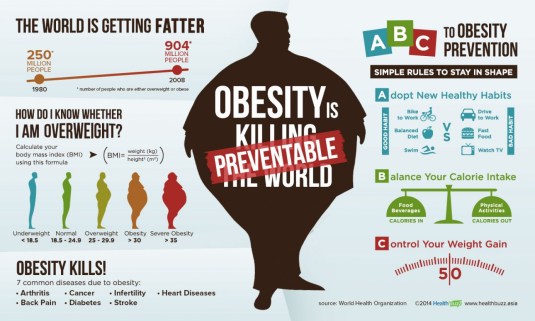
Have you ever head the saying “no pain, no gain?”  This is one of the most idiotic pieces of advice ever given.  Pain is a signal that our body wants us to stop something or that it needs help.  I have little doubt that many people have been severely damaged by this so-called piece of wisdom.  However, taken to the other extreme, we see people who are so afraid of hard work and exercise that they have become couch potatoes.  I believe that many Americans have veered so far off the trail of pain that they have gone to the other extreme.  Look around you and what do you see?  Fat people everywhere you look.  We have an epidemic of obesity in America.  Regard the following facts: (From the Center for Disease Control)

  • The prevalence of obesity was 36.5% (crude estimate) among U.S. adults during 2011–2014.
  • The prevalence of obesity among U.S. youth was 17.0% in 2011–2014.
  • From 1999 through 2014, obesity prevalence increased among adults and youth.

The above data pertain to the frequency of obesity in the USA.  Keep in mind that there are many more people who are overweight than there are who are obese.  Obesity is defined as: “Excess amount of body fat with a BMI of over 30.”  Overweight is defined as: “Having more body weight than is considered normal or healthy for one’s age or build.”  If we were to include the amount of people who were both overweight as well as obese, the figures for “fat” people in the USA would skyrocket.

Several years ago, I attended a World Future Conference.  The former founder and CEO of Medtronic was one of the keynote speakers. His talk was on the topic of rising health care costs.  Many people focus on only one or two causes for the escalation of health care costs.  However, Earl Bakken presented a pie chart which showed several reasons for the rise.  These included:

  • Increased cost of technology
  • People living longer
  • Increased percentage of older people in the population
  • Litigation
  • Inflation
  • Lifestyle choices

obesity-is-preventable_52fc767facaae_w1500

Earl noted that all of these issues have had an impact on health costs.  You will notice that the last issue in his list included “lifestyle choices.”  This category includes such problems as diet, smoking, obesity, drugs, alcoholism, lack of exercise and poor health choices.  Contrary to what many people think, this issue was not the major cause of health care cost increases.  Nevertheless, the category is one of the factors linked to the increase in health care costs.

Looking only at obesity as a contributor to health care costs, we note the following facts: (From the Health Care Costs of Obesity)

  • Obesity is one of the biggest drivers of preventable chronic diseases and healthcare costs in the United States. Currently, estimates for these costs range from $147 billion to nearly $210 billion per year. In addition, obesity is associated with job absenteeism, costing approximately $4.3 billion annually and with lower productivity while at work, costing employers $506 per obese worker per year.  As a person’s, BMI increases, so do the number of sick days, medical claims and healthcare costs.
  •  Obese adults spend 42 percent more on direct healthcare costs than adults who are a healthy weight.
  •  Per capita healthcare costs for severely or morbidly obese adults (BMI >40) are 81 percent higher than for healthy weight adults. In 2000, around $11 billion was spent on medical expenditures for morbidly obese U.S. adults.
  •  Moderately obese (BMI between 30 and 35) individuals are more than twice as likely as healthy weight individuals to be prescribed prescription pharmaceuticals to manage medical conditions.
  •  Costs for patients presenting at emergency rooms with chest pains are 41 percent higher for severely obese patients, 28 percent higher for obese patients and 22 percent higher for overweight patients than for healthy- weight patients.

 People who are obese, compared to those with a normal or healthy weight, are at an increased risk for many serious diseases and health conditions, including the following: (From the Center for Disease Control and Prevention)

  • All-causes of death (mortality)
  • High blood pressure (Hypertension)
  • High LDL cholesterol, low HDL cholesterol, or high levels of triglycerides (Dyslipidemia)
  • Type 2 diabetes
  • Coronary heart disease
  • Stroke
  • Gallbladder disease
  • Osteoarthritis (a breakdown of cartilage and bone within a joint)
  • Sleep apnea and breathing problems
  • Some cancers (endometrial, breast, colon, kidney, gallbladder, and liver)
  • Low quality of life
  • Mental illness such as clinical depression, anxiety, and other mental disorders
  • Body pain and difficulty with physical functioning

Please notice that the CDC list does not explicitly include hip, knee and back problems.  Of course, many people who are not overweight suffer from these problems, but there is considerable evidence that obesity contributes to these problems.  People who are obese often lack muscle tissue and ligament flexibility which help support their knees, backs and hips.  The less exercise they get, the more the problem is exacerbated.  They may go to doctors and chiropractors to get help but the underlying cause of obesity is seldom treated.  Finally, surgery is performed when exercise, diet and physical therapy could be more effective treatments.  So why do so many people get surgery or pills when there are cheaper and more effective treatments with less side effects?

Let’s go back to what I said in the title of this blog.  Laziness and Ignorance.

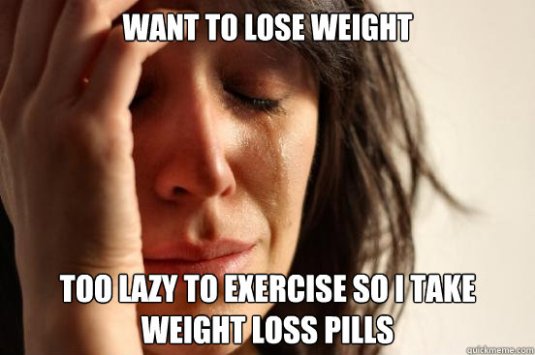
too lazy to exercise

Laziness and Ignorance:

Every year, it is a well-known fact at health clubs across the country that right after New Year’s Day, the membership will increase dramatically and the parking lot will fill up with new members. This phenomenon will last about 15 weeks after which the new members will slowly drop off and the parking lot will go back to normal.  Why do you think this happens?  I will give you two reasons:

First:  The assumption that they will get instant results.  Too many people read the magazines at the grocery store promising “Six Weeks to Abs of Steel” or “Lose 40 lbs. in Eight Weeks.”  I would argue that if you can lose 1 lb. in a month, you are doing a great job.  As for the abs of steel, first you will need to lose a large amount of body fat and second, it may take you a year of hard dedicated disciplined ab exercises.  As someone who does regular ab exercises, they hurt.  They are no fun.

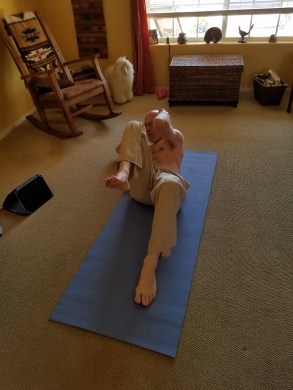
20170406_155206There is a difference between pain and hurt.  When I tried to continue my ab exercises after my prostate surgery and then after my hernia surgery, I experienced pain.  I wanted to get back into shape too quickly both times.  I stopped the exercises and worked on other routines that did not cause pain.  Mind you, the ab exercises still hurt and I have been doing them for six years.  I am making a big distinction here between pain and hurt. Perhaps, I should say they “burn.”  Burn is the athletic euphemism for hurt.  Most people don’t like hurt.  However, if you expect that you can get in shape without some discomfort, you are destined for life as a couch potato or in a surgery ward.

Second:  People are ignorant when it comes to exercise.  How many Americans do you think have ever read a book on exercise?  Unless, you are willing to become a student of exercise or trust in an athletic trainer, the knowledge that most people have regarding exercise is insufficient for them to attain the results they seek.  Sadly, most medical practitioners are just as ignorant when it comes to the role of exercise and diet in a healthy lifestyle.

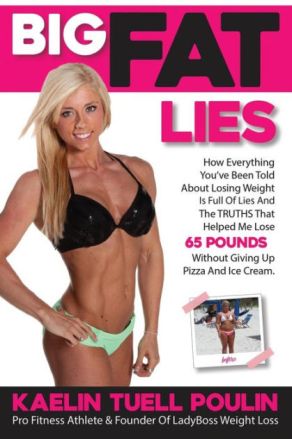
How many exercise books do you think make Amazon’s “best seller” list.  To determine this, I went to Amazon and pulled up their top 100 best sellers.   In the entire list, there was not one book on exercise protocols.  There were two books on dieting at number 41 and number 42 in the top 100 list.  You could find several books on menus and cooking.  It is much easier in the USA to eat, then it is too exercise.

kaelinAmericans are enamored with diets and each new diet best seller promises fantastic results in a short amount of time.  The Amazon number 1 best seller in the health and exercise category was a book titled “Big Fat Lies.”  The author promises you the “truths” that helped her to lose 65 lbs. “without giving up pizza or ice cream.”  The author is Kaelin Tuell Poulin and the book has a very high rating in the customer reviews section.  Ninety-eight percent of the 235 reviewers gave it a 5-star rating.  However, while I often put a great deal of store in ratings, you must be careful about inflated ratings.  The one negative rater had this to say about the book: (typos in the review were not changed)

“Dont be fooled into purchasing a book that was reviewed by 200 hundred women who never read the book (her followees) I have read the book it is subpar at best and not worth the money. My origional review included picture evidence of her asking for reviews but it was removed because it included her identity i suppose. I hope this one stays up so no one else is fooled into buying this. I give this book 1 star only to post. She is a salesperson and she is a great one at that! but if one person reads this and doesnt feed into the hype it was worth the time and effort to type it.”

I would not call the above review a particularly good piece of criticism.  However, the author does alert us to the possibility that the book suffers from a sort of follower worship.  Nevertheless, I would risk the small cost of the book if I were looking for a diet program.  Consider the following review from one of Kaelin’s “ladyBoss” more ardent followers:

“This program has TWO things that every other weight loss program out there is missing.  For ONE Kaelin was heavy once she was 185 pounds herself but with hard work and dedication lost the weight and has kept it off for 5 years.”

This is a great testimonial.  I am not sure if “every other weight program is missing” these two factors, but I am sure that dedication and hard work were necessary for Kaelin to keep the weight off for five years.  One problem with many exercise and diet programs is that the participant is naive and believes that once they lose the weight, their hard work is over.  They may also lack the discipline to continue the work once a certain goal is achieved.  Lack of discipline?  Laziness?  Ignorance? This is a volatile mix.  They seem to go together like salt and pepper.

WWS-Obesity

There is one final factor that we must discuss and that studies have shown have a direct bearing on obesity and poor health.  This is the factor of poverty.  Many studies have shown a direct relationship between income and obesity and between income and exercise.  Poor people get less exercise and generally have poorer nutrition.  There are several explanations for this.  We can posit some possible cause and effect relationships:

  1. Lack of education leads to obesity
  2. Poverty leads to high fat diet and poor nutrition
  3. Lack of education leads to poverty
  4. Poverty leads to low exercise priorities

You might notice that there is a kind of circularity to the above relationships.  Perhaps, if they are circular it does not matter which is cause and which is effect since the result is the same.  The outcomes for poor people are poor nutrition, lack of exercise and obesity.

There are some who dispute the above correlations.  The claim is made that the relationship between poverty and obesity is not linear but varies by age, gender and ethnicity.  It has also been pointed out that rich countries throughout the world have a higher incidence of obesity than poor countries.

“While all segments of the U.S. population are affected by obesity, one of the common myths that exists is that all or virtually all low-income people are far more likely to be obese. In this generalization, two facts commonly are overlooked(1) the relationship between income and weight can vary by gender, race-ethnicity, or age and (2) disparities by income have been weakening with time, particularly for adults.” — Relationship Between Poverty and Obesity, Food Research and Action Center

However, if we look at obesity from an aggregate point of view and disregard the effects of ethnicity, age and gender, we find the following evidence to show a linkage between poverty and obesity:

“Poverty rates and obesity were reviewed across 3,139 counties in the U.S.  In contrast to international trends, people in America who live in the most poverty-dense counties are those most prone to obesity.  Counties with poverty rates of >35% have obesity rates 145% greater than wealthy counties.”Poverty and Obesity by James Levine (2011)

Furthermore, even the Food Research and Action Center admits to the problem that obesity poses for America and state on their site that:

“While all segments of the U.S. population can be affected by poor dietary intake and obesity, low-income and food insecure people are especially vulnerable due to the additional risk factors associated with inadequate resources and under-resourced communities.” 

Note the above statement that “poor people” are especially vulnerable.  Let me tell you the following story that illustrates some of my admittedly selective experience with this issue of poverty and obesity.

One day, Karen and I went to Scottsdale Arizona to visit and do some shopping.  We went to several art galleries and jewelry stores.  When it was time for lunch, we found an authentic looking Mexican restaurant and decided to eat outside.  We were right in the heart of Scottsdale and many people kept walking by our table.  It was fun people watching, but something kept nagging at my mind.  I was not sure why, but there was a difference between the average people I was used to seeing and the people I saw in Scottsdale.

Suddenly, I realized what was bothering me.  In the hour or so that we were eating, we did not see one obese or even moderately overweight person walk by.  All the people that passed by us were healthy and athletic looking.  This was my first realization of the connection between wealth and obesity.  I don’t know about the rest of the world but ever since then, I have observed that most overweight people I see in America are either poor or middle class.  In my opinion, rich people have much lower incidences of obesity in this country.

Aging and Pain:

You will notice that I have not attributed pain to aging.  This is not an oversight.  Neither is it denial.  You can have pain when you are young and you can have pain when you are old.  In either case, there is no way you should just accept the pain.  Unfortunately, what medical practitioners often diagnose and treat with young people, they are willing to accept with old people.  Let me give you another personal example.

20170406_155432Two years ago, I started developing a pain in my right shoulder. I was not sure where it came from but after several months of it getting worse, I went to see an orthopedic doctor.  He asked what if anything I might be doing to aggravate the shoulder.  I mentioned that I swim frequently and am aggressive with my laps.  His simple answer was “Well then, stop swimming.”  I decided to follow his advice and for the next year, I stopped swimming.  However, my shoulder pain did not get any better.

A year later, I went to see another orthopedic doctor and he could not find anything wrong with my shoulder.  He did no MRIs or X-ray’s.  I suggested he give me an injection of cortisone, which he did.  I had moderate pain relief for about six weeks and then the pain resumed and continued to get worse.  At this point, I decided to do some of my own research into shoulder pain.  This research was very productive.

I found some very good descriptions of the exact type of pain I was incurring and a few different suggestions on how I could treat the pain without pills or surgery.  The best and most positive ideas I found came from a Doctor John M. Kirsch in Wisconsin.  Dr. Kirsch put his ideas and supporting evidence for his theory of what causes some types of shoulder pain into a small book titled “Shoulder Pain:  The Solution and Prevention.”  I have since been following his treatment regimen with good results.  My shoulder pain has been decreasing and the range of motion in my right shoulder is improving.

I mentioned earlier that I am 70 years old.  I think that there is too often the attitude among people my age and the doctors they see that “pain with aging is inevitable.”  If it is inevitable, then we should just “suck it up” and live with it.  Sometimes, this might be true.  However, the assumption that aging and pain need to go together is a prescription that does not serve any of the elderly very well.  I have talked to many older people and I often find the same set of attitudes either on their part or their doctors.  It is basically “Well, getting old is a bitch and you just have to live with pain.”

No, you do not have to live with pain!   

I have been running 4 or 5 times a week for over 40 years now.  During this time, I have had shin sprints, knee pain, hip pain, big toe pain, back pain, Morton’s neuroma, plantar fasciitis, sesamoiditis, corns, calluses and blisters.  Each time the pain came, I have gone through the following sequence of activities:

  1. Awareness of discomfort
  2. Try to ignore it
  3. Discomfort moves into the pain stage
  4. Take over-the-counter meds
  5. Go to see a doctor
  6. Pain improved by prescription pills or shots
  7. Pain returned in a short while
  8. Do research on other remedies
  9. Trial and error with other remedies
  10. Voila, eventually find the right remedy (no surgery and no prescription drugs)
  11. Pain goes away and does not return
  12. Sometimes, continuous exercise such as leg stretches and yoga are necessary to keep conditions from returning or getting worse. g., must do calf stretches 3x per week to stop plantar fasciitis from returning.  

20170406_155233Some people are not so lucky.  However, I hesitate to call all of my good health “Luck.”  There is a saying by Thomas Jefferson that “The harder I work the luckier I get.”  I have worked hard to stay in shape.  I exercise regularly.  I watch what I eat.  I try to avoid excesses.  No doubt, I have had some luck that goes beyond hard work and discipline.  Nevertheless, I believe that hard work and discipline has played a large role in my ability to be healthy and still active at my age.

I wish I had a dollar for everyone that has come up to me and said “I wish I could run but I have bad knees.”   Many people do have bad knees.  But many people do not see a connection between their “bad” knees and their obesity.  Their cycle is more like this:

  1. Overeat
  2. Gain weight
  3. Do no exercise
  4. Get pain someplace
  5. Do less exercise
  6. Get more pain
  7. Go to doctor
  8. Get knee or hip or some other surgery
  9. Continue being overweight and doing little or no exercise
  10. Take pills

4 weeks to a healthier

The only way the above activities relate to aging is that it takes some time to destroy your body through lack of exercise and poor diet.  I guarantee you though, it will happen eventually depending on how much you abuse your body.  It may happen when you are young or it may happen when you are old.  The longer you wait to do something about it, the more difficult it will be to repair the damage you have done.  It seems like my body takes more time to repair itself the older I get.

Finally, you do not have to be rich to have good health.  Money will not bring you good health if you abuse your body, overeat, drink too much, smoke too much and avoid exercise.  You can pay all the doctors in the world and you will still have bad health if you follow the 10 steps listed above.

Time for Questions:

Do you exercise regularly?  Why or why not?  Do you have a program to help keep track of your weight?  Why or why not?  Do you have a weight problem?  What do you do about it?  How effective have your efforts been?  What do you think would help them be more effective?

Life is just beginning.

“My mother was a P.E. teacher, and she was kind of a fanatic about fitness and nutrition growing up, so it was ingrained in me at a young age.  As I get older, I’m finding out it’s not about getting all buffed up and looking good.  It’s more about staying healthy and flexible.” — Josh Duhamel


Is Chiropractic an Art or a Science? 

When I grew up on the East Coast, I had little or no contact with chiropractors.  Back then, most people I knew and most medical centers did not regard them as real medical practitioners.  Years later, after I came out to the Mid-West, I found a much wider acceptance of chiropractors.  Over the past 40 years of living in Minnesota and Wisconsin, I have known many people who have gone to chiropractors and who firmly believe that they were being helped.  Most of the people I have known were suffering from back problems.  Here is one comment regarding chiropractors from an obviously very satisfied patient:

“I go to a chiropractor irregularly, usually when my neck is bothering me.  He uses heat, ultrasound, and massage therapy to undo the tension in my back and neck, caused by two vertebrae in my back that have been out of alignment since I was 16.  I go away, and am usually good for another 6 months.

I’ve never had a chiropractor offer to cure anything, from gallstones to depression by cracking my back; I’ve never had one suggest I needed to try any homeopathic remedies; I’ve never had one claim my bipolar disorder was all due to a misaligned spine. When I did have gall bladder trouble, my then chiropractor told me to see my primary care doctor post-haste.”

reno-chiropractor-940x627

If chiropractic medicine has any single claim to fame it is in dealing with back and skeletal muscle problems.  Chiropractors are famous for treating such problems with spinal manipulation and “adjustments.”  Often the diagnosis given to the patient will include the claim that the patient has a “pinched” nerve or some type of “subluxation”.  The patient spends an hour or so with the doctor getting an adjustment to treat the problem.  Many patients will then leave feeling much better then when they arrived.  They will also be out between 65 to 200 dollars per visit.  In most states, Chiropractic medicine is recognized and eligible for insurance reimbursement.

“Medicare does cover medically necessary chiropractic services.  According to the CMS,  Medicare Part B now covers 80% of the cost for ‘manipulation of the spine if medically necessary to correct a subluxation.’  There is no cap on the number of medically necessary visits to a chiropractor.”  — Does Medicare Cover Acupuncture or Chiropractic?, Senior 65

OK, so far, we have happy patients, insurance reimbursement in most states and Medicare coverage for chiropractic service, so what is my problem with chiropractors?  What if it is an art, what’s wrong with that?  Well, an art is something that as opposed to a science does not have objective reproducibility.  There is little or no evidence for cause and effect in an artistic relationship.  From an art, we would expect a much wider variation of results then we would get from something that has demonstrated scientific reproducibility.

“Chiropractic theory and practice are not based on the body of knowledge related to health, disease, and health care that has been widely accepted by the scientific community.

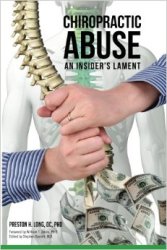
 Most chiropractors believe that spinal problems, which they call “subluxations,” cause ill health and that fixing them by “adjusting” the spine will promote and restore health. The extent of this belief varies from chiropractor to chiropractor. Some believe that subluxations are the primary cause of ill health; others consider them an underlying cause.” —- Twenty Things Most Chiropractors Won’t Tell You  by Dr. Preston H. Long

Another way of looking at the difference between and an art and a science lies in the ability to assign risk factors.  With a science, we should be able to assign a probably of risk in terms of outcomes.  With an art, we cannot reliably assign risk factors since they have no bearing in empirical outcomes.  What difference does this make to a potential chiropractic patient?  It should make a great difference since their chances of getting an accurate diagnosis for many potential problems is much less with chiropractic medicine than with traditional medicine.  Here are two comments from people who have gone to chiropractors.  These comments are from the http://www.spine-health.com forum and website.  The subject was: “Does chiropractic treatment help with pinched nerves:”

“Chiropractic “medicine” deals with the musculoskeletal system. However, many chiropractic offices use TENS therapy, which stimulates the nerves. Most of my back problems come from nerve issues and I have personally never found relief from chiropractic, in fact, it made me worse. But this is only my personal experience. My portable TENS unit helps me; I would ask the doctor who is managing your condition if TENS therapy may be right for you. Good luck!”

“In my case, I made the biggest mistake in my life, I was complaining about little pain in my knee but my chiropractor damaged my upper back T5 and T6 which I’m suffering now with a lot of symptoms nerve pain in between my shoulder, legs , arms , headache ….., I’ll never advise anybody to go to the chiropractor , and this is my own  experience.”

Anecdotes and grievances do not prove a case against chiropractic.  However neither do testimonials from satisfied patients prove the efficacy of chiropractic treatment.  It can be argued that the placebo effect will explain much of chiropractic’s reported success.  I have often argued that massage therapy will produce the same results with lower cost.  Some evidence exists to support my contention.

“A study called Patterns and Perceptions of Care for Treatment of Back and Neck Pain appeared in 2003. The studied questioned over 2,000 people on how they dealt with their aches and pains. Massage took home the gold with people preferring it to chiropractic for any kind of back pain or general body pain, but chiropractic led the race in upper-back pain and neck pain. Even with these results, visits to chiropractors were much more common than visits to massage therapists.”  — Chiropractor Vs. Massage

The above study notes that more people go to chiropractors than massage therapists.  You might wonder why?  Especially since seeing a massage therapist will cost you about 1/2 to 1/3 the cost of seeing a chiropractor.  I propose that the reasons for this propensity of people to prefer chiropractors to massage therapists lies in the more successful lobbying and marketing that chiropractors have done.  A second and related reason is that massage therapy will generally not be covered by most insurance plans or Medicare.  The following applies to Medicare coverage for massage reimbursement:

“Original Medicare does not cover massage therapy. Services that are not covered by Medicare are the sole responsibility of the patient.  In some cases, Medicare Part B will cover chiropractic services if they are medically necessary and are meant to correct a subluxation of the spine. In most cases, Original Medicare pays 80% of the cost for this treatment, but the patient is responsible for the other 20% and all other tests and services performed by the chiropractor.” —  Does Medicare Cover Massage Therapy?

Note that in the above description that chiropractic care is covered but massage therapy is not.  The lobby for chiropractors is much more powerful than the lobby for massage therapists.  This latter fact demonstrates that the type of medical care and medical coverage you are eligible for will be determined not by objective scientific facts but by political persuasion and money spent by lobbyists.  How does that make you feel?  But let’s get back to chiropractic treatments and look more specifically at “adjustments”.  This is the bread and butter treatment for chiropractic patients.  Do you need them?  Will they help you?

Chiropractic Adjustments:

chiro with an adjustmentIf homo sapiens have a weak link in their skeletal structure it is the back.  It has been argued that the problem arose when we switched from hanging in trees to walking upright.  Whatever the cause, back problems are easily the most common and perhaps one of the most painful problems faced by Americans today.  I have heard it said that the “opioid epidemic” is really a “pain epidemic” as more people age and have to deal with back problems, knee problems and hip problems.  No one beset by continuous pain can be blamed for wanting to find an escape from that pain.  However, as I noted in the previous blog, this desire to escape pain often leads to bad choices.  Surgery is too often prescribed when other treatment modalities would be more effective with less side effects.  This brings us to the issue of chiropractic adjustments for back pain.  How effective are they?  Here is another comment from Dr. Preston H. Long regarding the effectiveness of spinal manipulation:

“Research studies that look at spinal manipulation are generally done under strict protocols that protect patients from harm. The results reflect what happens when manipulation is done on patients who are appropriately screened—usually by medical teams that exclude people with conditions that would make manipulation dangerous. The results do not reflect what typically happens when patients select chiropractors on their own. The chiropractic marketplace is a mess because most chiropractors ignore research findings and subject their patients to procedures that are unnecessary and/or senseless.”Chiropractic Abuse: An Insider’s Lament Paperback – 8 Oct 2013, by  PhD. Preston H Long D.C

abuse

I highly recommend you read the book by Dr. Long.  If you are going to go to a chiropractor, you should have a realistic assessment of finding out your chances of getting help and relief.  Too many people leave their medical treatment entirely in the hands of so-called experts.  This is a big mistake.  I will discuss this later in another blog, but you need to be a strong advocate for your health care and not trust any one medical practitioner too much.  How much is too much?

  • It is too much if you are uninformed and have done little or no research into the causes and treatments of your illness.
  • It is too much if you expect that your treatment will take the place of discipline and hard work on your part.
  •  It is too much if you would rather get surgery than lose weight or exercise.
  •  It is too much if you expect that your doctor will advise you to pursue less invasive treatments before surgery or pills.
  •  It is too much if your doctor is overweight, has no exercise program of his/her own or smokes.
  •  It is too much if you have not pursued a second or third opinion.
  •  It is too much if your doctor cannot show you fairly persuasive evidence of a diagnosis and an empirically related treatment modality.

Conclusions:

For the record, I have no vendetta or grudge against chiropractors.  However, it has been my observation that they often treat many problems that they are not competent to treat or that have not had a proper diagnosis.  I have seen too many friends go to a chiropractor and not have a long-term fix to their pain or problem.  Chiropractors may offer a good short term fix to some pain problems but usually no long-term fix.  For the record though, massage, surgery and pills do not usually provide a long-term fix and with surgery, there will usually be consequences that the patient was probably not aware of.

(For more facts on the pro’s and con’s of chiropractic treatment see “Evidence for Chiropractic Treatment“) 

Chiropractors are no better than regular medical doctors when it comes to dealing with the underlying cause of pain.  Sadly, some of the problem for hasty diagnosis must be laid on the patient’s doorstep.  Many pain sufferers want either instant relief or relief that will entail little or no effort on their part.  Doctors too readily give into this desire either because of the financial remuneration that awaits them for treatment or laziness or perhaps simple ignorance.  My skeptical side says that giving a patient an exercise program or diet program is not nearly as lucrative as treating the patient with adjustments or surgery.  Back surgery will generally cost between 50k and 100k.  Spinal adjustments may take place for up to 6 months and final costs may total nearly $5000 dollars (computed as 50 treatments multiplied by an average cost of $65 dollars per treatment.)

On the positive side, there are many chiropractors who offer an alternative to the pills and surgeries so often recommended by mainstream medical doctors.  Perhaps because they have been viewed as less professional by traditional medicine, many chiropractors have considered a variety of non-traditional treatment options.  Many of these treatments are not very scientific or have no proven scientific effectiveness but this does not mean that they may not be effective.  Scientific proof has often taken many years to prove things that traditional folk medicine long knew was true.  However, there is a drawback in delaying some treatments to pursue unscientific remedies.  For instance, when I was diagnosed with prostate cancer, I decided to pursue a “wait and see” or “active surveillance” policy.  I was not ready to accept either the PSA reading or the biopsy or even the MRI results.

During my wait and see time, I opted to try some herbal remedies that were reported to have some success with prostate cancer.  I started taking several of these remedies each day in the hopes that a future biopsy would show a decrease in cancer cells or even the disappearance of my cancer.  No luck.  My next biopsy and a third biopsy all showed increases.  In addition, my Gleason score and PSA scores kept going up.  I now risked the danger that the cancer would spread out of my prostate and migrate to other organs.  It was time for surgery.  Not to pursue surgery at this point would have been foolish and even hopeless.

Thus, there is an ever-present danger that pursuing treatment programs that are a dead end might endanger your life and prevent you from going down more fruitful paths.  There is a reason that many people pursue such options.  It is called “hopefulness.”  I cannot blame anyone for this outlook.  I too was hopeful that I could keep my prostate and continue to pursue a normal life.  Many people go to chiropractors rather than medical doctors in the hope that they will find a cure beyond pills and surgeries.  Some do and some don’t.

Time for Questions:

Have you ever been to a chiropractor?  Why or why not?  Did you find them helpful?  Why?  What evidence did your doctor provide to show why he/she gave you the diagnosis you received?  What kind of exercise program do you follow?  Do you think people without an exercise program are higher risks for medical problems and pain?

Life is just beginning.

“The doctor of the future will give no medicine, but will interest his patients in the care of the human frame, in diet and in the cause and prevention of disease.” – Thomas A. Edison


How Effective are Alternatives to Traditional Medical Practice?

curecancers

This is the second of the ten perspectives I am going to discuss about medical care in the United States in the 21st Century.  My caveat this week is that if you truly think witch doctors, fortune tellers, bizarre untested treatments, herbal cures, doctors in foreign countries, prayers and numerous kinds of quack medical treatments can cure your sainted mother’s cancer or your father’s heart condition, then by all means “go for it.”  Much of what passes for medicine in the USA is not based on science but is based on hopes and wishes and dreams.  Far be it for me to destroy your last hope.

On the other hand, if you want to be rationale and logical about it, then evidence based medicine with a feedback loop based upon open scientific investigation and testing is the best way to truly establish cause and effect in medical practice.  Let me tell you an often heard story.

Mary Jane was 31 years old and was diagnosed with terminal brain cancer.  After ongoing chemotherapy and radiation therapy, she continued to decline physically.  There appeared to be no other options for her.  However, her 39-year-old brother Bill had heard of a treatment being used by some people in a village in the Alps which they claimed could cure cancer.  A doctor Kowalski had written a book extolling the virtues of this treatment and Bill had bought the book.  Bill convinced Mary Jane to give it a try.  She stopped her chemo and radiation treatments and started following the treatment regimen.  Within four weeks Mary Jane was looking a lot better and feeling better as well.  After two months on the regimen, she visited her oncologist.  He took some tests and “would you believe it?”  There was no sign of the cancer any more.  This treatment regimen (unknown to modern science) had totally cured Mary Jane. 

Wow, what a story!  Is that fantastic!  Makes you want to kick all those mainstream traditional doctors right in the butt. 

Epilogue:

Three months later, Mary Jane became quite ill.  Further tests showed her cancer had returned or perhaps never left.  Mary Jane died in another six weeks.

Raise your hands please, if you have heard this story or a similar story before.  I am sure most of you have.  Hope springs eternal in the human breast.  I can’t blame anyone for that.  I can blame those who promote untested and unscientific treatments and get poor suffering people to buy into their schemes.  It is one thing to find a new cure that perhaps may be proven to have medicinal value.  That kind of discovery happens all the time.  It is quite another thing to put down traditional medical science as useless.  Furthermore, there are indeed negative consequences of many alternative medical practices.

Dr. Paul A. Offit, a noted medical researcher and pediatrician (Wiki) has proposed four ways in which alternative medicine “becomes quackery”:

  1. By recommending against conventional therapies that are helpful.
  2. By promoting potentially harmful therapies without adequate warning.
  3. By draining patients’ bank accounts.
  4. By promoting magical thinking.

What is a Quack? 

Quacks are often well meaning but “the road to hell is paved with good intentions.”  We have people who believe vaccines are harmful.  We have people who believe poisonous snakes can be handled safely if you only believe in Jesus.  We have people who believe that disease is caused by negative thinking.  We sometimes confuse these people with the old “snake oil” salesman.  The distinction between the quack and the “snake oil” salesman is quite important.

quackery takes your money

The “snake oil” salesman is probably a fraud, a cheat and a con-artist.  The friend who is trying to convince you that you should not go to a regular doctor is probably well intended.  This makes them even more dangerous than the “snake oil” salesman.  You may instinctively distrust the salesman but you trust your friend.  Such unfounded trust can kill you.  Your friend is pedaling an idea which may be dangerous and have no scientific merit.

“But wait,” you say.  “Why does everything have to be approved by the FDA or the AMA or some other authorized group?  What makes them superior to my witchdoctor or acupuncturist?”  The answer to this question if very difficult to explain.  Studies show that less than 30 percent of Americans are scientifically literate.  Trying to explain why science is more trustworthy than hope and intuition is very difficult to people lacking scientific literacy.  It is even more difficult since the search for empirical evidence is a journey and not a destination.  No one can say that science is 100 percent accurate or 100 percent certain.  Furthermore, we can find many anomalies wherein science was at first wrong or where the scientific evidence was premature.  This leads many who are intimated by science to be even more skeptical of its results and processes.

[For an excellent article on understanding scientific medicine and avoiding quacks, read: Tooth Fairy Science and Other Pitfalls: Applying Rigorous Science to Messy Medicine, — by Dr. Harriet Hall]

Homeopathy, Acupuncture and Pseudo Science

Homeopathy, acupuncture as well as creation theory, alchemy, parapsychology and many occult practices are labeled as pseudosciences.  The definition of pseudoscience is:

“Pseudoscience consists of claims, beliefs, or practices presented as being plausible scientifically, but which are not justifiable by the scientific method.   A topic, practice, or body of knowledge can reasonably be considered pseudoscientific when it is presented as consistent with the norms of scientific research, but it demonstrably fails to meet these norms.” — Pseudoscience, Wikipedia

I had intended to start this section off as a critique of homeopathic remedies but I decided to extend it to include the broader issue of pseudoscientific remedies.  I was going to discuss the fact that homeopathy no doubt relies on the well-known phenomenon of the “placebo effect.”  A placebo is a “fake” pill or medical treatment to which no known curative properties can be attached.  Nevertheless, people given such treatments often report “miraculous” cures.  I have even known people to get drunk while drinking colored water that they thought was wine or liquor.

“In many conditions, placebo effect is a big part of the effect of the drug,” said study researcher, Ted Kaptchuk, a professor of medicine at Harvard Medical School.  In the new study, 50 percent of the drug’s effect could be attributed to the placebo effect, he said. — Live Science, 2014

When it comes down to the efficacy of homeopathic pills, the evidence is just as damming.   Homeopathic treatments simple do not work any better than a placebo.

Homeopathic preparations are not effective for treating any condition; large-scale studies have found homeopathy to be no more effective than a placebo, suggesting that any positive effects that follow treatment are only due to the placebo effect and normal recovery from illness. —  Ernst, E. (2002). “A systematic review of systematic reviews of homeopathy”. British Journal of Clinical Pharmacology. 54 (6): 577–82. —- Wikipedia, Homeopathy

A little earlier in this paper, I briefly gave a testament to the scientific method over methods of pseudo-science that we have been discussing.  But, you may well ask, “What is the difference between science and pseudoscience?”   A second question might be “Well, how much faith can I put into the scientific method?”  Let’s take the first question.

What is the difference between science and pseudoscience?

A simple answer to this question is that science is based on objective repetition of results.  It uses evidence based analysis to determine the strength of the relationship between cause and effect variables.  Science must be transparent and the process used to determine cause and effect must be readily available to other scientists.  Numerous examples can be cited wherein faulty scientific research led to erroneous conclusions.  However, unlike pseudoscience, where there are no checks on the process, scientific faults will eventually be discovered and admitted.  This is often to the chagrin of the scientists who were either foolish or biased in their calculations.

In science, you have theories or hypothesis which are open to testing and ultimately being found either true or false.  There is a great range in the power of a hypothesis which renders some more important than others.  For instance, anyone can predict it will snow in Minnesota but the ability to predict exactly when and how much it will snow on any given day would be evidence of a very strong theory.

In pseudoscience, hypothesis and theories are either untestable or often non-existent.  For example, if I gave you a homeopathic pill of aconite (also known as wolf’s bane) as a remedy for your cold and you got better, does this mean the aconite cured you?  Without some type of controlled study, there is no way to know.  Perhaps, you would have gotten better without it anyway.  Many homeopathic practitioners recommend this substance as a means of alleviating cold symptoms.

(Click here for an excellent analysis of some of the many treatments recommended as cold remedies)

There are literally dozens if not hundreds of such substances that you can find recommended by alternative medicine practitioners.  The problem is not that they do not work, since for some people, some of the time, some of these substances might be very effective.  The problem is that often little is known about their effectiveness, their method of working or potential side effects that might be harmful.  Furthermore, as opposed to the scientific method, pseudoscience will make extravagant claims without more than anecdotal evidence that some treatment regimen was indeed effective.

Forbes (2014) published this list of the top five cold remedies to avoid since there is no evidence to support their effectiveness:

  1. Zicamcontains zinc as its active ingredient. There has been some evidence to suggest that taking zinc right at the onset of a cold might shorten its duration a little bit, from 7 days to 6. But as Dr. Terence Davidson from UC San Diego explained, if you look at the more rigorous studies, the effect vanishes. Zinc turns out to have some worrisome side effects, too.
  1. Airborne. You can find this in the cold remedy section many pharmacies but Airborne doesn’t cure anything. It’s a cleverly marketed vitamin supplement with no scientific support for any health benefits.
  1. Coldcalmis a homeopathic preparation sold by Boiron, one of the world’s largest manufacturers of homeopathic remedies (including Oscillococcinum, an almost laughably ineffective flu remedy). It claims on the package to relieve cold symptoms. What’s in it? A dog’s breakfast of homeopathic ingredients, including belladonna, about which NIH says: Belladonna is UNSAFE when taken by mouth. It contains chemicals that can be toxic.
  2. Umckais another homeopathic preparation that claims to “shorten the duration of common cold” and “reduce severity of cold symptoms.” Sounds pretty good—if only it were true. Umcka’s active ingredient is a plant extract called pelargonium sidoides, an African geranium. Interestingly, there have been a few experiments on this extract, some of which showed a small positive effect.
  1. Antibiotics. Even if you cannot buy them, many people take them to treat a cold.  The problem is that antibiotics do not work for colds.

It would be interesting to see how much Americans spend each year on medicinal preparations that have little or no value.  There is so much superstition out there based on anomalies and anecdotes that people put their faith in.  Which brings us to the next question.

How much faith can I put into the scientific method?

The easy answer is that it depends.  What makes a good theory is the question we need to answer before we can know how much faith we should put into science.  Here is one answer as to what makes a good theory:

  1. A good theory should explain the observations or results of an experiment or phenomena.
  2. A good theory should allow for testing. 
  3. A good theory can be tested against an independent objective criteria.
  4. A good theory should be frugal in its nature so others can test it.
  5. A good theory should be predictive.

Thus, if you are looking for the truth and you get a truth, be it from a scientist or from a witchdoctor, you can ask yourself how well the “truth” meets the four criteria above.  Let’s take some hypothetical examples.

  • My good friend Dick says that Fords are better than Chevies? Do any of the above criteria apply to his belief?  I think not.  If so, I cannot see how.  Thus, I would call this a weak theory or more accurately, an opinion.
  • Another friend of mine says it will be very cold next week. This assertion can be validated. Criteria 2, 3, 4 and 5 might all apply.  If he turns out to be right, he would only have to satisfy criteria number 1 to have a very strong theory.  In other words, he would have to provide some logic or rationale for his theory.  Subsequently, we could continue to test his theory and see if he can continue to accurately predict the weather.  The more his predictions come true and can be validated against some external criteria, the stronger his theory is. (We will assume he is not just reporting from the local weather station.)

So, we are now back to the issue of how much faith can be put into the scientific method.  I hope you will see from the above discussion that this will depend on whether the outcomes of the method are indeed subject to some rigorous external validation and criteria.  Without these factors, I would not trust my local scientist any more than my local witch doctor.

Time for Questions:

Why do you think people go to quacks?   Have you ever been to someone you thought might be a quack?  What results did you get?  What can people do when they are not helped by medical practitioners?  What other recourse do they have?

Life is just beginning.

The claim of alternative practitioners to not treat disease labels but the whole patient…allows alternative practitioners to live in a fool’s paradise of quackery where they believe themselves to be protected from any challenges and demands for evidence.”  — Edzard Ernst


Should We Be Cautious When Seeing Our Family Doctor?

can you trust your doctor

This is the first of the ten perspectives I am going to discuss about medical care in the United States in the 21st Century.  Before I begin, I have already warned you that if you regard physicians as gods or if you love your MD for saving your life and cannot bear to hear anything wrong about the medical profession, you should probably not read what I am going to say.  One of my friends on Facebook sent me this message or caveat:

“I practiced medicine for 30 years. Be careful about generalizing. I got burned out, I cared. I saw the whole person. I’m not unusual. Medicine is hard. You are always looking over your shoulder. Afraid to be sued. We go into this not for money but to help. Really. Believe it.”

I am quite sure that what she says is true.  True for some.  Not true for others.  Is it the majority?  I don’t know.  But there are a lot for whom the medical system is not working and even more importantly for whom it is dangerous and harmful.  Let’s start with some specifics.

After writing and publishing this blog, a good friend of mine reviewed it.  He had a very different perspective on things than I present.  Together, we are like the Yin and Yang. I see the negative side of things and he sees the positive side of things in the medical profession.  It is my belief that we need to see more of the problems with our medical practices and bring them out so that they are more transparent.  Nevertheless, I realize that there are thousands of medical people who work hard and try to do their best to help their patients.  Thus, I am going to print Fred’s letter to me following my comments.  I hope this will “balance” out my negativity somewhat and create a more balanced view of American medical practice in the 21st century.  (Thank You Fred for taking the time to send us your thoughts.)

  1. Number of Needless Surgeries that are Done

There are many people who are enamored with surgery.  There are an equal number of doctors who are enamored with surgery.  When anyone in the first group goes to anyone in the second group, you can bet that surgery will be the answer to all their problems.  AbracadabraAnd like magic, their hip pains, knee pains and back pains will go away.  The patients are joyous, (unless they die on the operating table like my friend did last summer after going in for a hip replacement).  The doctors are joyous since they are thousands of dollars richer and of course the hospitals are also joyous since they too are also thousands of dollars richer.

signs-that-you-should-see-a-doctor-physical-therapyHave you ever heard of a doctor turning anyone down for back surgery, knee surgery or hip surgery by telling them that they are overweight and would be better served by an exercise program or by physical therapy?  If so, I can guarantee they are not typical of most medical practitioners.  How many doctors look at the major cause of back, knee and hip problems and try to deal with that?  Impossible, because doctors do not treat you over a lifetime.  You don’t see a doctor until you have a problem and by then it may be too late.  Surgery is the fastest solution because exercise, dieting and physical therapy take discipline and time.  Doctors do not want to tell you the truth because it is an inconvenient truth but many problems should not be treated by surgery until it is a last resort.  Too often, it is the first resort.

  • Data show that 10% to 20% of some common surgeries are done unnecessarily – USA Today – June 20th, 2013
  • “I think there’s a higher percentage who are not well trained or not competent to determine when surgery is necessary, Santa says. ‘Then you have a big group who are more businessmen than medical professionals — doctors who look at those gray cases and say, ‘Well, I have enough here to justify surgery, so I’m going to do it.” — USA Today

Here per the study reported by USA Today are the six leading surgeries that often performed and just as often not needed:

  • Cardiac Angioplasty, Stents
  • Cardiac Pacemakers

Pacemakers are used to correct heartbeat irregularities, but research shows that more than 22 percent of these implants may be unnecessary.

  • Spinal Fusion Back Surgery

lumbar-spine-surgeryIf you have low back pain and see different specialists you will get different tests: rheumatologists will order blood tests, neurologists will order nerve impulse tests, and surgeons will order MRIs and CT scans. But no matter what tests you get, you’ll probably end up with a spinal fusion because it’s one of the “more lucrative procedures in medicine,” author Shannon Brownlee says – even though the best success rate for spinal fusions is only 25 percent!

  • Hysterectomy
  • Knee and Hip Replacement, and Arthroscopic Knee Surgery

Patients who were informed about joint replacements and alternative treatments had 26 percent fewer hip replacements and 38 percent fewer knee replacements than those who did not. Arthroscopic knee surgery for osteoarthritis is also one of the most unnecessary surgeries performed today, as it works no better than a placebo surgery.

Proof of this is a double-blind placebo-controlled multi-center (including Harvard’s Mass General Hospital) study published in one of the most well-respected medical journals on the planet, the New England Journal of Medicine (NEJM) over 10 years ago.

knee surgeryRecent research has also shown arthroscopic knee surgery works no better than placebo surgery, and when comparing treatments for knee pain, physical therapy was found to be just as effective as surgery, but at significantly reduced cost and risk. And yet another study showed exercise is just as effective as surgery for people with chronic pain in the front part of their knee, known as chronic patellofemoral syndrome (PFPS), which is also frequently treated unnecessarily with arthroscopic surgery.

  • Cesarean Section

According to the World Health Organization, no country is justified in having a cesarean rate greater than 10 percent to 15 percent. The US rate, at nearly 32 percent, is the highest rate ever reported in the US and is higher than in most other developed countries.

The USA Today article went on to talk about many diagnoses that were based on limited medical knowledge and that doctors often lacked the expertise to explore alternative treatment modes.  This is an issue of incompetence and it seems to be a major problem in the medical field with many doctors getting their information from their pharmaceutical representatives.

I have not even touched on the issue of malpractice.  But I will say a few words about this.  No one is perfect.  Everyone makes mistakes.  Medical treatment and diagnosis is a very difficult process.  I will not blame any doctor for an honest error committed with good intentions and not simply out of ignorance or greed.  This is one area where I sympathize with the doctors and hospitals more than I do the lawyers.  Nevertheless, there are some egregious examples of medical practice and a lawsuit might be the only recourse for such cases.

I use the information from the USA Today article, but none of it surprises me.  I have had many friends who have undergone surgery for the situations noted above. I have often tried to counsel them as to other solutions but it is generally a waste of time.  I have had two notable successes though and they have both expressed their gratitude to me for sharing my opinions and thoughts with them and preventing them from getting surgery.
drugs

  1. Pills, Pills and more Pills

If life were fair, many doctors would be in jail right alongside of other drug dealers.  Doctors do not have the violence associated with illegal drugs because they have a license to prescribe drugs.  However, doctors prescribe drugs that are no more needed than heroin or cocaine and at much greater rates than your street drug pusher.

The size of the illicit drug trade (2012 data) in the USA including Marijuana, Heroin, Cocaine and Methamphetamines was estimated to be about 100 billion dollars a year.  —- How Big is the U.S. Market for Illegal Drugs?  We can assume that street dealers and drug pushers are responsible for most of these drugs.  So how much do doctors push?

If we look at the following fact, we can extrapolate from it the total amount of prescription drugs sold each year in the USA.

“In 2013, per capita spending on prescription drugs was $858 compared with an average of $400 for 19 other industrialized nations. In the United States, prescription medications now comprise an estimated 17% of overall personal health care services. —  The High Cost of Prescription Drugs in the United States (2016). 
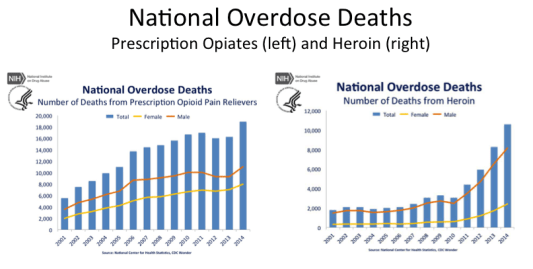
deaths from over druggingSo if we assume roughly 326,000,000 (USA Population in 2016) people and we multiply that by $858 dollars per capita, the total amount should equal the total amount spent on prescription drugs.  This amount equals = $279,708,000,000.  This is almost three times what is being spent on illegal drugs.  I am not even going to talk about caffeine, alcohol, nicotine, and other “legal” drugs.  Given that doctors love to prescribe pills and many patients love to take them, is there any wonder that we have or are currently experiencing an opioid epidemic in the US.

“Americans are in more pain than any other population around the world. At least, that’s the conclusion that can be drawn from one startling number from recent years: Approximately 80 percent of the global opioid supply is consumed in the United States…. The 300 million pain prescriptions equal a $24 billion market.”  — Americans consume vast majority of the world’s opioids (2016).

I say again that if life were fair, many doctors would be called drug pushers or DP’s rather than MD.’s   They would also be in jail.  Who should be responsible for the opiate epidemic if not doctors.  When and where do they stand their ground.  Even if people are stupid or lazy enough to want surgeries to cure problems of obesity and diet or if they want pain killers to mask the problems from their obesity and lack of exercise, who is the expert here?  Do parents give their children everything they ask for?  You go to an expert on medicine to get help and not to have them take advantage of you for their own benefit or pander to you because they are afraid to tell you the inconvenient truth.  What is this inconvenient truth?  I will talk more about this truth later in this series but to be quite direct and blunt it is this:

“British businesswoman and columnist Katie Hopkins has a controversial view on the obesity epidemic: that the solution is simply to eat less and exercise more — and that fat people have no one to blame for their weight issues but themselves.” — I gained 43 pounds to prove obese people are lazy

I had a friend that I used to ride motorcycles with.  He died in a motorcycle crash a few years back.  He was a great guy.  He always had a smile and something nice to say to someone.  His name was Gary.  He was also obese and exercised little.  He had chicken legs and bad knees.  Well, what would you expect if you weighed 100 lbs. more than you should and you let your leg muscles go to hell.  Of course, he went in to see his doctor with knee pains.  The doctor was more than happy to suggest Gary should lose some weight but in the meantime, he would schedule the surgery for knee replacement.  To my mind, this is criminal, irresponsible and ignorant behavior on the part of his doctor.  Gary got the surgery.  Never lost much weight and died not too long after from other causes.

Doctors pushing pills, pushing surgery.  It is like the Yin-Yang of American medical practice.  Throw into the mix a lot of lazy people who do not exercise or take care of themselves and you have a health care system spending tons of money on acute care when preventive care would be a much more sensible solution.

  1. Me Doctor, Me Busy.  Who are You?

Some of you might remember the skit on Saturday Night Live with Martin Short playing a doctor.  When asked what his badge that said MD meant, he would reply somewhat superciliously “Me Doctor, You Patient.”  When I was working as a consultant to some hospitals, it was not uncommon to hear nurses complain that doctors were like gods whose every word should be obeyed.  They seldom came to team meetings because “their time was too valuable.”

I will stay away from the subject of how much money doctors rake in since they often ascribe their high incomes to the length of time it takes to finish medical school and all of the attendant costs.  This sounds like a reasonable explanation but an alternative theory might mention the strangle hold that the AMA had on medical admissions and the role that restricting the supply of doctors has had on the cost of their services.  The law of supply and demand says that if you have fewer doctors, the cost per care will be higher.  For years, the AMA did all they could to help keep the supply of doctors down.

  • But the entities that will be most injurious to the nation’s health are not so much in the evil-mongers’ group but the first group, including the American Medical Association–a doctors’ cartel that has controlled the medical labor market in the U.S. like its personal fiefdom for a century. — The Evil-Mongering Of The American Medical Association (2012)

So, doctors come to regard themselves as the elite who know more than you do and who must be smarter than you since they make a great deal more money than most of their patients.  Doctors used to do house calls many years ago; back then, a doctor might have known something about your family and you personally.   My wife Karen told me the following story about her family doctor.   It generated the following conversation:

Karen —

“When I was married, and raising four children, my ex-husband Ron and I became good friends with a local White Bear doctor.  He became a family friend as well as our family doctor.  We knew him for over thirty years and he knew me and my family personally and really cared about us.” 

John —

“Okay, so now you have been seeing a doctor in Frederic for about seven years.  How much does she know about you personally or really care about you?”

Karen —

“I think she really cares about me.”

John —

“But how much does she know about you personally.  Your goals.  Your dreams.  What you did this past winter?”

Karen —

“Well, at first, she used to take more time to talk to me but the past few years she has seemed much busier and anxious to keep our meetings short.  I suppose the clinic has a quota for how much time she can spend with a patient.” 

Again, there are numerous anecdotes and articles describing the lack of time doctors have to spend today with patients.   Here is an excerpt from one:

“Joan Eisenstodt didn’t have a stopwatch when she went to see an ear, nose and throat specialist recently, but she is certain the physician was not in the exam room with her for more than three or four minutes.

‘He looked up my nose, said it was inflamed, told me to see the nurse for a prescription and was gone,’ said the 66-year-old Washington, D.C., consultant, who was suffering from an acute sinus infection.

When she started protesting the doctor’s choice of medication, “He just cut me off totally,” she said. “I’ve never been in and out from a visit faster.” — You’re on the clock.  Doctors rush patients out the door (2014)

I can guarantee you that if your doctor only takes a few minutes with you, once or twice per year, there is not much they can know about you personally regardless of how caring and concerned they are.  You might ask “well, why is this important.”   Here is the reason stated very well I think in Wikipedia:

“The quality of the patient–physician relationship is important to both parties. The better the relationship in terms of mutual respect, knowledge, trust, shared values and perspectives about disease and life, and time available, the better will be the amount and quality of information about the patient’s disease transferred in both directions, enhancing accuracy of diagnosis and increasing the patient’s knowledge about the disease. Where such a relationship is poor the physician’s ability to make a full assessment is compromised and the patient is more likely to distrust the diagnosis and proposed treatment, causing decreased compliance to actually follow the medical advice.”  — Wikipedia

Conclusions:

I promised some solutions to each truth that I am telling you.  Here are some that might help you to deal with this first truth.

  1. Get a second opinion for any surgery.
  2. Use the Internet to search for alternative treatment modes. Get advice if you are not Internet savvy. Remember, there are many opinions and not all are right.
  3. Exercise and have a health care plan. Follow it.
  4. Don’t take any pills unless you must. Try to unwean or get off them as soon as possible.
  5. Beware side effects from pills. Every pill has a side effect.  Make sure you are aware of any that might affect you and be cognizant of any changes in your life while taking these pills.
  6. Take a friend with you whenever you go in for an appointment or treatment. Talk to your friends to get their insights and opinions.
  7. Don’t assume your doctor is God and knows what is best for you. Be a skeptic but be realistic.  Modern medicine is better than sorcery but not always much better.
  8. Don’t assume that your doctor is your friend or has your best interests at heart. They might not have enough time to care.

Fred’s letter to me:

I read your blog on medical practice and it was indeed thought provoking.

I’ve had good results with doctors over my lifetime. Not always perfect but usually satisfactory and in some cases, it was excellent.

Medical care is a process and requires the same attention as any process. It seems especially complex today because of how rapidly technology and all the stakeholder’s needs and expectations are changing.

Overall, it’s greatly improved in its capabilities. My main concern for medicine is the same as I’ve had for years in business. My business life became more and more controlled by the bean counters and the lawyers. The same is true of medicine. Blaming doctors is blaming people, which is always a red flag to me as one who has a bad habit of judging others without knowing them. Like the driver for quality improvement, expectations always move to higher and higher expectations. And based on what I’ve heard from friends over my life, expectations are often unrealistic.

A friend recently died. He was an old school, oil field production engineer and didn’t trust any of his doctors. He’d get pissed at one and then begin to “doctor hop”; never telling one what the other had done or prescribed. I questioned him many times, always inquiring why he’d not share his history. His reply: “I ain’t telling them anything.  They make good money and are supposed to tell me what’s wrong.”

I see the process much as we viewed our manufacturing and service processes ..with customers, suppliers, inputs and outputs being carefully considered. A critical output is the result when your illness is diagnosed and this is too often a major problem source. My friend tends to expect this to be an exact outcome but in reality it isn’t. It’s only a statistical prediction that too many older doctors failed to point out to naive, uneducated patients.

In recent years, our doctors point out the statistics and involve us in the decisions for corrective action. My wife’s breast cancer surgery was a good example. Years ago, the doctor would have made the decision for which surgery, mastectomy or lumpectomy. Sandra made the decision armed with various study statistics and discussion with the Doctor. The Internet was a source for me to verify the statistics but that isn’t easy because there are often many studies,

The surgeries are complex and the statistics often work out for the worst. Records on lawsuits and doctor reviews are more readily available today. I recall a bad experience with my dad years ago. Our family doctor became a friend from making many house calls as 3 kids were raised. Dad was a merchant seaman and would provide Porte Rico rum for our good doctor. They were the best of buddies and talked about the old days during visits. Dad visited him yearly but when dad’s tobacco tarred lungs became late stage cancerous it was too late. Doctor “Tom” as an individual practitioner didn’t have the computer technology that red flags today’s doctors. Doctor Tom was as heartbroken as my dad. He and his wife nurse apologized that they’d not x rayed dad 6 months earlier. We probably could have sued but dad would never have agreed to such.

The body of knowledge has expanded too much for any one doctor to master it all, so now we have multiple knowledge based “Specialists” having to deal with the directives from medical organization bean counters and their lawyers.

I consider our medical providers to be leading edge. They seem to focus on continuously improving to meet customer expectations. I’m hoping, but doubt the doctors and staff will be given additional support. They track customer satisfaction inputs so I should be more confident.

I can email any of my doctors and I can access historical results. I especially like being able to take a picture of a physical observation and sent it in.  A couple of years ago, I tore a muscle on the back of my leg and a huge blue area surfaced overnight.  It scared the heck out of me. I emailed a picture and he emailed back telling me what it probably was, how to treat it and to see a doctor if it didn’t heal. My expectations are now at an even higher level which puts more load on the doctor. He not only has to live up to corporate standards on office visits but he must respond to patient emails. Just yesterday I received a corporate email announcing that they have decided to do “Face Time” appointments for $25!

Overall, I have concerns for the profession but I think problems are “process” related. To think otherwise would go against what I’ve believed for a long time.

Fred

Time for Questions:

How satisfied are you with your medical care?  Why or why not?  Have you ever had a loved one die?  How were they treated by the medical profession?  What do you think could be done to improve medical care for you and your family?  What would you like to change in the American medical care system?

Life is just beginning.

“We have really good data that show when you take patients and you really inform them about their choices, patients make more frugal choices. They pick more efficient choices than the health care system does.” — Donald Berwick


Startling Facts You Need to Know about Medical Treatment that Might Save your Life!

In the following weeks, I am going to cover some facts about the medical profession and medical treatment that you might not want to hear.  Many of you reading this will object to my opinions and many medical professionals will no doubt take umbrage at my assertions.  Nevertheless, if my truths do not set you free, they might at least keep you healthier.

What are my qualifications for making these claims?  Seventy years or more of dealing with medical professionals.  Personal treatments for broken bones, sprains, cuts, lacerations, infections, pneumonia, measles, whooping cough, bursitis, plantar fasciitis, prostate cancer, hernia, a deviated septum, Morton’s neuroma, knee and hip pains.  I have watched and known many relatives and friends who have died either because of the medical profession or because of the false beliefs that afflict so much of the general population regarding medical treatment.  I have a BS in Health Education and a MS in Psychology.  I also have a wife who has been a nurse for over 50 years and who still works in the medical field.

20170308_084015My disclaimer is that this does not make me an expert.  In fact, I would maintain that expertise in medicine is like the five blind men who were trying to describe an elephant.  Each man had a different perspective on what an elephant looked like.  Individually, no one perspective was a very adequate description of an elephant.  It would take a synthesis of all perspectives and even more to truly describe an elephant.  That is the problem with medicine.  Too often, each professional looks at a problem through the narrow lens of their own discipline. The reality of a medical problem can often only be understood by multiple perspectives because of the interaction of the systems that make up the human body.  This defining perspective of the problem seldom occurs both because of the nature of medical practice and many times because of the egotism of the so-called medical experts we consult.

A few years ago, my wife’s elderly 85-year-old father Ray went into the hospital with a kidney problem.  We knew he had a heart problem, so we were very concerned.  In the hospital, it seems that further complications arose.  He was being treated by several different specialists.  Over the course of the days that he was in, I had the feeling that none of them were talking to each other.

One day both Karen and I went to visit Ray and he seemed very alert and like his old self.  Karen asked him how he felt and he shocked us with the reply that “he was going to die today.”  Since Ray had been somewhat of a hypochondriac, we were wont to dismiss this assertion but we decided to talk to the doctor in charge at the time.  We asked him how Ray was doing.  He replied “Just fine, he will be discharged today.”  Thus, we were both relieved and Karen and I went off to work feeling comfortable that her father was A-OK.

Shortly after noon, I received a call from Karen.  She was crying and wanted me to meet her at the hospital as soon as possible.  She informed me that her father had died sometime after we had left that morning.  I was incredulous.  How could this be?  The lead doctor had said he was going to be discharged this very day.  It was not the first of my many lessons with the medical profession, but it was one of the saddest.  Karen could have been there with her dad, if we had both believed him instead of the MD.  This does not mean that the doctors do not care about you, just that they are too busy to know who you really are or what your problems really are.  They are too busy treating symptoms to give a damn about you as a person.

death-by-medicine-header-bb

In the next few weeks, I am going to cover several perspectives about medicine and medical care.  I will discuss one a week for the next ten weeks.  My perspectives will each be explained in more depth and I will provide some “solutions” for dealing with the problems that arise from these perspectives.  I want to warn you.  If you love your doctor and you truly think that the medical profession are heroes and next to gods, you should not read what I am going to write.  You will not like what I must say.  I am not a “true believer” and this is not a selection to applaud the medical establishment.  There are enough people out there already doing that.

My ten perspectives are:

  1. The AMA and its attendant professionals do not give a damn about you as a person
  2. Homeopathic medicine is a placebo
  3. Chiropractic medicine is an art and not a science
  4. Much pain is caused by laziness and ignorance and not aging
  5. Pharmaceuticals can kill you
  6. Setting exercise goals is a recipe for disaster
  7. Most diet programs ignore basic common sense
  8. Yoga and physical therapy may help but they may make things worse
  9. You need an independent advocate  AND you must be your own advocate
  10. Good health is a journey and not a destination

Time for Questions:

Do you have a favorite doctor?  Why do you like him or her?  How have you been served by the medical profession?  What are the high points?  What are the low points?  What do you think we need to do about the high cost of medical treatment?  Who do you go to first when you need medical help or advice?  Why?

Life is just beginning.

“We look for medicine to be an orderly field of knowledge and procedure. But it is not. It is an imperfect science, an enterprise of constantly changing knowledge, uncertain information, fallible individuals, and at the same time lives on the line. There is science in what we do, yes, but also habit, intuition, and sometimes plain old guessing. The gap between what we know and what we aim for persists. And this gap complicates everything we do.”  ― Atul Gawande, Complications: A Surgeon’s Notes on an Imperfect Science


Previous Older Entries Next Newer Entries