Debate versus Discussion:  Why Debates are a Waste of Time!

(Listen to the Debate Song, while you read my blog this week.)

berniedebateOnce upon a time, I thought debates were the answer to the question of “how do we discover the truth?”  I thought that if you put two intelligent people together and each took opposing positions on an issue, that through the interplay of ideas the truth would emerge.  If you think about this a bit, it is the basis for our judicial system in America.  One side argues for the defendant, the other side argues for the prosecution or against the defendant.   It is also the basis for an academic exercise called Dialectical Research or Dialectical Inquiry.
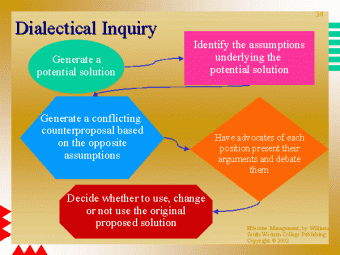
dialectical inquiryA dialectical investigation is a form of qualitative research which utilizes the method of dialectic, aiming to discover truth through examining and interrogating competing ideas, perspectives or arguments.  This latter method is often applied through the use of case studies in which students or investigators discuss real world examples of complex situations.  The purpose of a case study is to provide a more thorough analysis of a situation or “case” which will reveal interesting information to the reader.  As I use them in my classrooms, my goal for my students is to help them understand how to better form strategies for success in business.

159_TJ_Dillashaw_vs_Dominick_Cruz.0.0Unfortunately, in the real world the strategy of debate does not work.  Debates are a waste of time when honest discussion takes second place to winning or looking good.  Dialectical Inquiry is also often useless since the complexity of the subject can be beyond the ability of many students to grasp.  Real world situations are froth with uncertainty, volatility, complexity and ambiguity or as some have called it VUCA.  VUCA is an acronym used by the military to describe or reflect on the volatility, uncertainty, complexity and ambiguity of general conditions and situations.  Many complex situations are seldom able to be accurately modeled leading in most instances to weak images or portrayals of the actual situation.  This is why debaters opt for simple explanations rather than complex explanations.  Another example of this watering down of reality is a Hollywood movie depiction of a supposed “true” story.  Recent movies that come to mind include the following:

  • The Revenant – Story of legendary frontiersman Hugh Glass.
  • American Sniper – Story of U.S. Navy SEAL Chris Kyle
  • Steven Jobs – Story of the founder of Apple Corporation
  • The Theory of Everything – Story of physicist genius Steven Hawking

Hollywood loves to take stories of great enterprise and or daring do and change them into a 1. 5 hour dramatic show full of love, heroism and imaginary situations that often did not exist.  Did I say lies?  Perhaps that would be more accurate.  For often, these Hollywood epics are no more than half true.  The other half are stories added for dramatic impact.  Even worse perhaps are the often skewed biases that intrude into the movie which distort the reality of the character or situation.   For instance, here is what one critic had to say about the Steve Jobs movie:

“With all this in mind, I was disappointed in the Steve Jobs movie.  Partly because as an Apple expert I watched the film in dismay as events were pulled out of context and people appeared in locations and at times where they simply wouldn’t have been around.  I can’t help but think that in his desire to avoid the chronological retelling or Steve Jobs story, a traditional childhood to death epic, in favor of three acts (which would be better suited to a theatrical production) Aaron Sorkin constrained himself too much.  The only way he could tell the story was to pull events from all corners of Jobs’ life and present them as if they had happened in the 30 minutes before a keynote presentation.”  — Karen Haslam, 10 Nov 15

I mentioned earlier that debates cannot work when winning is the primary objective.  Hollywood’s version of winning is making money.  Making money becomes a more important objective than telling the truth.  Similarly, the truth takes second place to winning in political debates.  Winning for the networks means providing entertainment to sell ads, not necessarily a stage full of erudite rationale individuals trying to discover the truth.

The 2016 debates for both the Republican and Democratic candidates have not only been a farce but they have been an insult to the American People.  Here is one comment regarding the Republican debate on TV a few nights ago:

“The GOP debate on FOX last night was an embarrassment.  The talk show hosts said it best.  This debacle stooped to a new low. Penis size?? C’mon people.  Seriously. We need to respect our President.  It is beyond my comprehension how anybody could respect this pathetic excuse for a candidate.”

politifact-photos-Trump_gesturesI have watched several of the debates now and I see no evidence that truth is being discovered.  The debates have become hyperbolic spectacles of insults, half-truths, reality distortions, innuendos and petty personal attacks.  I doubt if anyone has found much truth in these debates never mind elucidations of complex policy positions for any of the candidates.  Trump 2495-so-funny-and-true-rhetoric-wallpaper-427x454will build a giant wall.  Cruz will fix Syria.  Rubio will fix health care.  Sanders will fix inequality in America.  Hillary will fix Obamacare.  Do you know how any of the candidates will accomplish these lofty goals?  Of course not, since they know that the “debates” are no place for such a complex discussion.  Trump perhaps realizes this fact better than anyone and has kept his discussion and clarification of his policy positions to less than fifteen second descriptions.  The general consensus seems to be that if a candidate cannot explain their position on any subject in less than fifteen seconds, they are doomed, i.e., they lose.

In their book, Presidential Debates: The Challenge of Creating an Informed Electorate, (1988) Jamieson and Birdsell make a case for the importance of Presidential debates but only if certain changes are made to the usual format.  Their book was written over twenty five years ago and if you have watched the recent debates, you will note that their recommendations were not heeded.  Furthermore, the present debate formats have probably encouraged worse excesses in rhetoric and sophistry than either Jamieson or Birdsell could have imagined in 1988.  Looking historically at debates, the Lincoln-Douglas debates were the epitome of rationality and decorum.  Today, the networks want drama and entertainment.  Debates such as took place between Lincoln and Douglas would never qualify as either drama or entertainment.

debate parrotsOn a more personal level, I have a problem with debates.  I have a few friends who love to debate.  I have noted as a result of recent discussions with them concerning the Presidential elections that do not want to understand or clarify any issues, they just want to argue or perhaps debate.  I say that they want to argue, because their main agenda seems to be looking good or advancing their points and not understanding my points.  They often enter into these contests (Since that is what a debate means to them.  It seems to be a contest between winning their points and looking good or losing their points and looking bad.) with a pretense of trying to understand why I think or feel a certain way.  Sometimes, they start the “debate” with a flat out rejection of my position or with a declaration such as “you are dead wrong” or “you don’t know what you are talking about.”  I confess that such latter utterances often preclude my disposition to have a rational discussion with them.   I see no point in it.

Have you ever changed anyone’s mind which was made up?  Have you ever tried to have a rational discussion with someone who was being emotional?  Have you ever tried to explain something to someone whose main objective in talking with you was to score points or make you look stupid?  Under the rubric of “debate,” are we to think that our antagonists give one farthing for the truth or where we stand on an issue?  There is a big difference between debating me on an issue and discussing an issue with me.

The result of these “debates” with erstwhile friends have led me to two inescapable conclusions.  First, I don’t need or even want debaters in my life.  I have little time left for scoring points or winning games by making someone else look bad or proving that they are wrong and I am right.  Second, debates do not start from an honest position of fruitful and objective inquiry and thus cannot lead to truth or relevant knowledge.  Rather, most debates start from a position of “I am right and you are wrong.”  The antagonists goal being to show you or the audience how right and smart they are and how wrong and stupid you are.  Is there a point to such an exhibition?  I presume winning is the payoff and reward.  As Vince Lombardy once said:  “Winning isn’t everything, it’s the only thing.”

If your objective is to understand something or if you want to find the truth, I suggest that you think more of discussing and less of debating with others.  A good discussion aims to find an understanding and comprehension of complexities that is often beyond our singular abilities to understand.  The truth can usually (but not always) be found between two extremes.  However, the process of truth seeking is more important than the process of truth finding.  The truth will inevitably change over time.  You will never have found a truth that will be good for all eternity.  There will always be a new truth to be found somewhere.  Thus, the process of truth seeking becomes a way of life that outfits the seeker for a journey through the cosmos that may take the seeker to the end of the universe and back to the beginning.

Well, if you finished my blog and you think I did not give a fair presentation on the evils of debate, then please listen to the song I noted above.  This song makes a case for the value of debate.  It does it in an Indian Rap song with great visual effects, music and choreography.  I am probably undoing my entire argument by including this song but Amen or so be it. 

(Listen to the Debate Song, it makes a great case for the value of debate)

Time for Questions:

Do you seek first to understand or first to be understood?  Do you debate others or discuss with others?  Are you more concerned with understanding or looking right?  How do you grasp complex issues?  How do you insure that you truly understand and are not being duped by charlatans trying to sell you simple answers to complex issues?

Life is just beginning.

“And finally, that Truth is great, and will prevail if left to herself, that she is the proper and sufficient antagonist to error, and has nothing to fear from the conflict, unless by human interposition disarmed of her natural weapons free argument and debate, errors ceasing to be dangerous when it is permitted freely to contradict them:”  — The Virginia Statute for Religious Freedom written by Thomas Jefferson in 1777.

What is the One Thing that is Hardest to Find in Life? 

What is the one thing that we all want in life but that we can’t buy or pay for?  We can live a life without it but we will end up feeling like we only lived a shell of a life.  We can chase all over the world for it but we will sometimes end up finding it in our back yard.  We can live a life with security and comfort and never find it.  We can settle for the mundane but we will regret that we did not have the courage to grab it when it was in our reach.  Sean John says “Life without passion is unforgiveable.”  You can buy his cologne for fifty dollars an ounce but it will not give you passion.  Most of us will never have passion in our lives.  We might think a one night stand or our favorite team winning the Super Bowl or taking a trip to some exotic land is passion but deep down inside of us we know that these activities are only surrogates for passion.

The saddest people I’ve ever met in life are the ones who don’t care deeply about anything at all. Passion and satisfaction go hand in hand, and without them, any happiness is only temporary, because there’s nothing to make it last. ― Nicholas Sparks

You can climb Mount Everest.  You can dive to the bottom of the Mariana Trench.  You can get a Ph.D. degree but you can never get passion simply by accomplishing things.  Passion is not a fad or a commodity.  You can’t buy it in Walmart or find it on top of the Empire State building.  Most of us do not grow up with a desire for passion.  We do not even know that it is missing in our lives.  Passion gets smothered in us when we are very young.  It is extinguished before it can be ignited.  Passion scares people.  Authorities and parents both fear passion.  The passionate person is a juvenile delinquent.  Early on, parents, teachers and others wage a campaign to destroy the roots of passion in children.

Sex is the consolation you have when you can’t have love ― Gabriel Garcí­a Márquez

Someplace deep inside all of us, the embers of passion still burn.  We go through life thinking that there must be more to it then what we are experiencing.  We look for God.  We look for Ghosts.  We look for love.  We look for things but still they do not bring us the passion that we crave.  Some spark must be ignited in us to rekindle our passion.  When they speak of quality, they say that you will know it when you see it.  However, you can’t see passion.  You have to feel passion.   We know it exists because from time to time, we can get a glimpse of it in others.  The passion that we sometimes see in others thrills us to the bone and leaves a certain degree of incredulity in its wake.  We know we are missing something that seems unfathomable to us.  Greatness and passion seem to comingle.  Does greatness produce passion or does passion produce greatness?

I want to know what passion is. I want to feel something strongly.”  ― Aldous HuxleyBrave New World

Hollywood is perhaps the most frequent purveyor of passion.  We get our impressions of passion from our Hollywood idols and movie stars.  Passion is pervasive in Hollywood.  From superheroes saving the world to unrequited love romances to tales of great daring, we glimpse a world where passion is the norm.  A world where passion is as common as grass.

There is no passion to be found playing small – in settling for a life that is less than the one you are capable of living.” — Nelson Mandela

Looking at passion from a theoretical perspective, (something rarely done) we can see that there are three areas in which we can inspire passion.   These conform to our three life components.  We can be passionate about ideas or thinking.  We can be passionate about doing or activities and we can be passionate about feelings.  What about things you may be asking?  I will argue that we cannot really be passionate about things.  Hard core motorcycle riders usually care more about riding their bikes than they do looking at them.  Trophies, money and even fame are ephemeral and rarely suffice to infuse passion in anyone’s life.

Maybe the bike is more dangerous, but the passion for the car for me is second to the bike. — Valentino Rossi

People who are passionate about ideas are intriguing.  We find that they have a love for the mind and all things cerebral.  We may not understand their theories and concepts, but we are fascinated by the premises and hypotheses that they can spin out.  History has shown that a key element of progress lies in the intellect that a civilization can bring to its culture.  The Jews, the Greeks and the Chinese each stand out in our minds with their history of great thinkers from Abraham and Maimonides to Socrates and Plato to Confucius and Lao Tzu.  These cultures had a deep respect for the ideas and philosophies of its great thinkers.

Some of us are passionate about books, education, museums, history, biographies, TED talks, documentaries and other intellectual activities.  We would rather read a good book then go to the Eiffel Tower or the beach.  Our ideal life is of the mind and not of the body.  We no sooner finish one book then we are off to another.  Our dream of heaven is one vast library with no late charges.

You have to be burning with an idea, or a problem, or a wrong that you want to right. If you’re not passionate enough from the start, you’ll never stick it out.”  — Steve Jobs

Some people are passionate about their activities.  Great explorers like Marco Polo, James Cook and Zheng He lived for the adventure and excitement of finding new places and new civilizations.  For such adventurers the risk was hardly a consideration given their dreams and desires for discovery.  One cannot imagine anyone undertaking the hazards and deprivations that met these men without a true love for action and doing.  People like this cannot be content in an arm chair reading a good book or sitting in front of a fire place with a family watching TV.

Some of us are passionate about our work or our sports.  We love what we do so much that we would pay our employers to let us do the work that they are paying us to do.  This is what passion means.  To love something so much that you would pay someone to let you do it.  We live for the activity whether work, traveling, sports or a hobby.  Our dream of heaven is an activity that allows us to become intimately involved with the act of creation or the challenge of overcoming some obstacle or the chance to exceed some goal.

If you don’t love what you do, you won’t do it with much conviction or passion.”  — Mia Hamm

Our final passion involves the realm of feelings.  We usually think of passion as connected to sex.  We have watched the all night love affair of two Hollywood stars as they undress and ravage each other in a fit of what one might call sexual frenzy.  We marvel at their physical dexterity.  Two bodies engaged in positions that would challenge the authors of the Kama Sutra or even tax a painters abilities to portray.  And to think, that after they are done, they start over again until the sun begins to dawn on another day.

“When I touched her body,
I believed she was God.
In the curves of her form
I found the birth of Man,
the creation of the world,
and the origin of all life.”
― Roman Payne

But sex is only a small part of what emotional passion can be.  Passion can involve feelings of all sorts.  People who are deeply passionate about their emotions feel things that the rest of us do not.  They feel the joy and pain and sorrows of other human beings.  They experience the highs and lows of existence.  They live a roller coaster of feelings that range from happiness to sadness.  They do not let the pain of empathy discourage them from identifying with the feelings around them.  Perhaps the greatest fear that people of feelings have is the fear of apathy or indifference.  People who are passionate about their feelings live for harmony and rapport with others.

People who live a life of passionate feelings dream of a heaven that will be populated by all the people that they have known in their lives.  They want to see all their old friends, relatives and loved ones.  They dream of making amends for the wrongs that they have done to some and sharing their love and compassionate hearts with all others for infinity.

Time for Questions:

What are you passionate about?  Do you have enough passion in your life?  How could you have more passion? What would happen if you tried to live a more passionate existence?

Life is just beginning.

My mission in life is not merely to survive, but to thrive; and to do so with some passion, some compassion, some humor, and some style.”  — Maya Angelou

Dear Friends and Family, Our Holiday Message and Greeting to You All.

anniversary partyAs we celebrate the birth of Jesus and the start of another New Year, we also look back at the celebrations of 2014.  Foremost for us was the joint celebration of our 25th wedding anniversary and Karen’s 70th birthday.  It’s so hard to believe both of these numbers.  Our 25 years of marriage (plus 5 dating years) have been so full of adventure, laughter, and love.  But, just in case we don’t make the ages of 93 and 95 for our 50th, we thought we’d recognize the interim event.  Having friends and family travel and stay with us for a few days really was special.

Jeanine (our sister)  came from Rhode Island, Peg (Karen’s “best friend” from grade school) came from Chicago and Xibo and Mary, our friends from Shanghai were able to come from San Francisco where they now live Jeaninemost of the time.  The party brought a nice combination of new Wisconsin friends and “old” ones Peg and Kathyfrom Minnesota.  And Karen got a picture of herself, Peg and Kathy (her “best friend” from high school) who all turned 70 this summer.  They look terrific and that 70 number is starting to be less scary.  We are also celebrating John’s successful recovery from two surgeries this year.  The report after his prostate surgery is that he is cancer free.  Then, about the time he was feeling “almost” as energetic as usual, he needed hernia surgery.  Now he’s back running in the Casa Grande Mountains.

Ice SkatingWe’ve settled into the snow bird routine well.  It’s a bit schizophrenic to leave one set of activities and friends and walk right into a second set, but it definitely keeps life interesting.  Karen misses her dulcimer buddies from WI, weekly coffee get-togethers and her Pilgrim church family.  John misses his “library guys” fellowship which start most of his mornings and the “green and blue” of WI.  But, when it’s time to return, Karen misses her Zumba/Curves group, our First Karen and MeganPresbyterian friends and the mountains plus her new tradition of Lefse and Christmas Cookie baking days with Megan.  New traditions combine with old as John continues to make an annual Jesuit retreat and Karen finds music and choirs wherever she is.  John has been working hard at marketing his consulting business and teaching while in MN.  Karen takes her work with her and does ICD-9 coding for Select Data and home health consulting with Alstar Consulting Group.  Be sure to check out John’s weekly blog at http://www.agingcapriciously.com.  He is very proud of his blog and puts about 4-6 hours per week in researching, writing, editing and publishing the blog with music and pictures to enhance his message.

Orphanage childrenIn-between “commuting” we participated in a mission trip to Puerto Penasco, Mexico in March with a group who support an orphanage in Sonoyta and a thrift store/meals program in Puerto Penasco.  The orphanage houses children who are unadoptable as their parents are still living, but Puerto Penascooften incarcerated.  They are beautiful, happy children, but there is little funding available and they need so much.  Karen did manage to put down the 2 year old boy who wanted to be held and snuggled for the whole time we were there.  As we go to the dentist in Sonoyta, it gives us an opportunity to bring things at other times before our next trip in the spring.  In June, we spent a week in Kentucky for music week.  Karen played her dulcimer most of her waking hours and John toured the area more fully Jim Beam Distillery 2and Karen Dulcimerchecked out a few more Kentucky bourbon brands.  During the fall commute to AZ, we spent 2 days in Colorado viewing the cliff dwellings at Casa Verde National Park.  In November, we spent a weekend in Tucson with our MN/AZ friends Dar and Denny to watch the Day of the Dead parade.

Grandchildren keep getting older which is so much fun to watch.  Juli’s Garrick (22) is a cast member now for the Renaissance Festival and Emily (14) is delightful.  Susan’s Zach (18) is in his first year of college in Rochester MN—and playing year around baseball and Sam (15) is busy with sports and school in Northfield.  Juli is co-leader of the Hastings Paranormal Society; Susan is still at HealthPartners as a pharmaceutical buyer; Kevin is in San Francisco at LinkedIn as a Systems Engineer and Megan has a new training position with Multiple Listings System.

Wishing you and your families a Blessed Holiday Season and the best for the New Year.

John and Karen

What the Hell Do We Need Morality For?

morals and ethics

This blog is about the subject of morality.  Once upon a time, they taught morality in school and in church.   The first system of morality that many older Americans were exposed to was probably the “Ten Commandments.”   This was a code of rules given to the Israelites by Moses on Mount Sinai.  I have always thought it ironic that a set of morals from the “Old Testament” was supposed to be the foundation for a Christian America.  Even today, advocates of this code of morality want to hang it in town halls, schools, courts and government centers.  This is a part of the Bible that promoted an “eye for an eye” and stoning adulterers.

Jesus did say “Think not that I am come to destroy the law, or the prophets: I am not come to destroy, but to fulfill” (Matthew 5:17).  Jesus added at least one commandment to all others that was even more valuable than the ten TenCommandmentsMoses gave.   Jesus said, “A new commandment I give to you, that you love one another; as I have loved you, that you also love one another” (John: 13:34).  I would be much more in favor of seeing this posted in my neighborhood than the Ten Commandments.

Perhaps even more importantly in terms of a system of morality, Jesus gave a sermon where he proposed what has been called:  The Eight Beatitudes:   (Click here to hear the The Beatitudes Song

Blessed are the poor in spirit, for theirs is the kingdom of heaven.

Blessed are they who mourn, for they shall be comforted.

Blessed are the meek, for they shall inherit the earth.

Blessed are they who hunger and thirst for righteousness, for they shall be satisfied.

Blessed are the merciful, for they shall obtain mercy.

Blessed are the pure of heart, for they shall see God.

Blessed are the peacemakers, for they shall be called children of God.

Blessed are they who are persecuted for the sake of righteousness, for theirs is the kingdom of heaven.  —- Gospel of St. Matthew 5:3-10

It is my opinion that the Eight Beatitudes constitute one of the greatest systems of morality to come out of the Bible.  I would rather see these taught (if we are going to teach a system of morality) than the Ten Commandments.  I would also not mind these being posted in schools and other public places whereas I am sick and tired of those who want to post the Ten Commandments.

I noted that once upon a time, we taught morality in schools and churches.   Actually, we not only taught morality but morality was also imbued in our social fabric by many traditional stories and the media.  Children from an early age were exposed to Fairy tales, Uncle Remus stories, Aesop Fables, and Tales of the Arabian Nights.  These stories were full of morals on how to live and behave properly.  Early TV was also full of morality tales.  Shows like Father Knows Best, Leave It to Beaver and Andy Griffith each week clearly conveyed stories of morality and what was right and what was not right in terms of behavior.

sin-guilt-causes-body-pain-sicknessSomeplace along the way, we started losing our sense of morality.  Some have blamed it on becoming a multi-cultural environment.  Some have blamed it on the decline of religion and church going.  Some have blamed education while still others have blamed progress and a business culture that has no room for strict morality.  I am not sure what the actual cause was.  I am more concerned that it did happen.  Studies have shown that our culture has become more amoral than moral and that narcissism now plays an increasing role in our society.  People are less moral and more self-centered than ever before in the history of this country.  A book by Joel Marks (Ethics without Morals: In Defense of Amorality -Routledge Studies in Ethics and Moral Theory, 2012) is one of several that makes an argument for amorality:

“In clear, plainspoken, engaging prose, Joel Marks presents the case for abandoning belief in morality. Anyone who wants to defend the practice of making moral judgments will have to confront the issues Marks raises, and the alternative to morality he proposes.” – Mitchell Silver, University of Massachusetts, Boston, USA 

In the book “The Moral Fool: A Case for Amorality (2009)” the author Hans-George Moeller advances the following case for amorality:

“Justice, equality, and righteousness—these are some of our greatest moral convictions. Yet in times of social conflict, morals can become rigid, making religious war, ethnic cleansing, and political purges possible.  Morality, therefore, can be viewed as a pathology—a rhetorical, psychological, and social tool that is used and abused like a weapon.”

In an article “Why Is Narcissism Increasing Among Young Americans?”  by Peter Gray in Freedom to Learn (2014), Gray notes the following:

“For the past three decades or a little more, researchers have been assessing both narcissism and empathy using questionnaires developed in the late 1970s.  Many research studies have shown that scores on these questionnaires correlate reliably with real-world behavior and with other people’s ratings of the individuals.  For example, those who score high in narcissism have been found to overrate their own abilities, to lash out angrily in response to criticism, and to commit white-collar crimes at higher rates than the general population.[1]  Those who score low in empathy are more likely than the average person to engage in bullying and less likely to volunteer to help people in need.[2.]

Over the years, these questionnaires have been administered to many samples of college students, and analyses that bring all of the data together reveal that the average narcissism score has been steadily increasing and the average empathy score has been steadily decreasing ever since the questionnaires were developed [3.]  The changes are highly significant statistically and sufficiently large that approximately 70 percent of students today score higher on narcissism and lower on empathy than did the average student thirty years ago.

What accounts for this historical rise in narcissism and decline in empathy?  There is no way to know for sure, based on the data, but there are lots of grounds for speculation.”

I think we have thrown the proverbial baby out with the bath water.  I agree we need to keep the State separate from the Church.  I also agree that we don’t need the Ten Commandments as the foundation for moral thought in America.  Nevertheless, I do believe that we all need a code of morality to live by.  Whether it be Christian, Buddhist, Confucian, Agnostic, Atheist, Islamic, Jewish, Hindu, Baha’i, or other, we need a set of morals as a template and foundation for our behavior.  We need a baseline that each of us can start from so that we can assess what is good and what is right.  We need to have some system of ideas about what is correct behavior and how we should live in a socially interconnected world.

When I was a kid, (somewhere along the way) I was taught the Seven Deadly Sins.  Sometimes they were called the Seven Deadly Vices or the Seven Cardinal Sins.  I assume that since I attended a Catholic school, it went along with the teaching.  The Seven Deadly Sins included the following:

  • Lust
  • Gluttony
  • Greed
  • Sloth
  • Wrath
  • Envy
  • Pride

7 deadly sins

Some of you might think that this list is old fashioned or out of date.  How could this set of implicit moral values make a difference in our society?  They are so old; do they really have any relevance anymore?

Take a close look around you at the world.  You have only to look for a few minutes to persuade yourself that these “sins” are at the top of the list of major problems.  Greed, envy, gluttony and lust appear pervasive in our culture.  (See my series on Gandhi’s Seven Social Sins) TV shows, movies, magazines, radio, supermarkets, superstars, sports, credit services, escort services, pornography, Las Vegas all portray an American brand of materialism that is nothing short of sick.  Get it now, get it fast, and get more and moreMore is better!  Bigger is better!  Shop till you drop!  He who has the most toys wins!

“If necessity is the mother of invention, then surely greed must be the father. Children of this odd couple are named: Laziness, Envy, Greed, Jr., Gluttony, Lust, Anger and Pride.”  ― John R Dallas  Jr.

Black Friday ( The day after Thanksgiving in the USA) is only a small manifestation of the greed, lust and sloth that has infected our society.  How many Americans have a regular exercise schedule?  How many obese citizens can you count on the street each day?  How many Americans spend more each week then they earn?  How many Americans will go in debt this Holiday Season to spend money that they don’t have on gifts and toys?  Where is the self-restraint that is necessary to push oneself away from the table or shut the TV off and say “Enough.”  It barely seems to exist.  Is it any wonder that so many countries have a very negative stereotype of the “average” American?  We appear to be a group of people who have lost our moral compass.

ARTICLE 29 —  The Universal Declaration of Human Rights

  • You have a responsibility to the place you live and the people around you-we all do. Only by watching out for each other can we each become our individual best.

At this point, you well may be asking “What right does he have to be so damn moralistic?”  Didn’t Jesus say “Let he who is without sin cast the first stone?”  “Are you so perfect that you have a right to look down on other people?”  “Who does he think he is, Jonathan Edwards?”  “I don’t need anyone telling me my faults.”  “I get enough negativity from work without having to get it from you.”

Please allow me to clarify a few misconceptions.  In some religious circles we are all sinners.  Since I am agnostic, I don’t subscribe to a religious view of sin.  My use of the terminology is borrowed from the religious sphere since I think that the concept of sin has a very useful connotation if we can free it from some of the pejorative and negative associations with which it is fettered.  First of all, I do not believe that you will go to hell for committing these Seven Sins.  Second, you will not be a bad or evil person because of them.  Third and accentuating the positive, you may be happier and healthier if you are more aware of these “sins” and can do a better job of examining the role that they play in your life.  My bringing these “sins” out is to help us all become more aware of the morality that we have allowed to become obscured in our daily lives.

There are only two mistakes one can make along the road to truth; not going all the way, and not starting.  —-Buddha

We have had a decline in morality that started over one hundred years ago and it still seems to be declining.  More people are worried about their taxes increasing then the poverty facing many people in this country.  More people are worried about their security then the number of people going to jail every day for victimless crimes.  More people are worried about the price of gasoline then the pollution we send into the atmosphere every day.  Self-centeredness has become a dominant fixture of the American landscape.  “Greed is Good” says Ivan Boesky and everyone applauds.

If you look for truth, you may find comfort in the end; if you look for comfort you will not get either comfort or truth only soft soap and wishful thinking to begin, and in the end, despair.   — C. S. Lewis

Why do I think we should care about morality? 

goodevilWithout morality, we are not even as good as animals.  Animals eat, drink, sleep, procreate and fight when they have to.  They do not do it simply to hurt other animals or to wage war against groups or individuals that they cannot tolerate.  Animals care for their young and exhibit many characteristics of moral behavior.  In captivity, animals may display much more aggressive behavior.  For instance, Orcas in the wild have never been observed to kill other Orcas.  This is not the case for Orcas in captivity.  There is no such thing as civilization without a commitment to moral and ethical behavior.  Even animal societies are proof of this.

“I am Envy, begotten of a chimney-sweeper and an oyster-wife. I cannot read, and therefore wish all books were burnt; I am lean with seeing others eat – O that there would come a famine through all the world, that all might die, and I live alone; then thou should’st see how fat I would be! But must thou sit and I stand? Come down, with a vengeance!”  ― Christopher MarloweDoctor Faustus

Without morality, we have no compass to define what is good behavior and what is bad behavior.  We are reduced to the level of opportunists willing to take advantage of anyone and anything that suits our ends.  Listen to the current debate on the use of torture and the recent CIA report and you will find numerous “experts” advocating that the “ends justify the means.”  One man on NPR noted that he thought we should ask the victims of the Twin Trade Towers what they thought about the use of torture to capture Osama Bin Laden.   John McCain (May he Rest in Peace) once said it best when he opined in Congress (12-9-14) that “”Our enemies act without conscience. We must not.”  Nevertheless, he was opposed by his own party in his opposition to torture and in fact to even releasing the CIA Tortmoralityure Report. 

Many Republicans argued against releasing the report, especially as the threat of the Islamic State in Iraq and Syria grew and U.S. intelligence officials had warned that its release could cause backlash from nations and groups hostile towards the nation.   American embassies in the Middle East had been put on heightened security alert for its release.

McCain replied that “This report strengthens self-government and, ultimately, I believe, America’s security and stature in the world.”  (CNN 12-9-14)

Finally, without morality, there is no way to transmit values from one generation to another.  A lack of morality has led to the increase in amorality that is now symptomatic of our society.  Amorality is a set of beliefs which deny the value of morality or at best are indifferent to morality.  A rock is amoral.  It is neither good (moral) or bad (immoral) but may be used for either purpose.  Anything or anyone without a conscience is amoral.  It is a fine line and one that is very easy to trespass between amoral and immoral.  Many people today may think their behaviors are amoral when actually they could better be described as immoral.  Harken back to the Seven Deadly Sins and ask yourself, how many of these vices are amoral?  Are greed, gluttony, lust and wrath amoral?   Can anyone with a good conscience say it is okay to partake in these vices?

“Seven deadly sins,
seven ways to win,
seven holy paths to hell,
and your trip begins

Seven downward slopes
seven bloodied hopes
seven are your burning fires,
seven your desires…”
― Iron Maiden

Time for Questions:

What is your moral code? What are the three most important morals in your life?  Do you think everyone should have an explicit moral code?  Why or why not?  Do you know many amoral people?  What do you think about amorality?  When is it justified?  What do you think the world would be like if everyone was amoral?  Would it be a better world or worse? Why?

Life is just beginning.

“Remember tonight… for it is the beginning of always”  ― Dante Alighieri

Kentucky Music Week

Sorry about not doing any blogs last week.  Karen decided that she would like to do Kentucky Music Week and I thought “why not?”  We had the time and we had the money so we planned the trip and decided to camp out for six nights at My Old Kentucky Home State Park.  Karen took the car each day to the Music Week site and I took a bicycle to go touring each day.  The Music Week is really more of a music camp for adults, though there were several younger children there learning to play dulcimers, banjos, fiddles and a few other instruments.  Karen is a dulcimer player and also is learning to play the banjo.  She had five classes a day for five days and was excited about the prospect of “learning” all day and playing all evening.  I was excited about the prospect of touring museums, monasteries, distilleries and Bardstown historic sites.  If you are interested in seeing the pictures I took of the event and my adventures, go to my Facebook page and see my Kentucky Music Week album.  I posted the pictures that I took in an album but somehow each of the individual pictures also was uploaded under “photos.”  If anyone knows how to quickly delete 201 individual pictures from the photo section, please send me an email or comment to describe how. I want to leave the album but get rid of the individual pictures. 

Each night, Karen came back to our campsite and I made supper. Sometimes I cooked over the fire pit but more often over our old but tried and true Coleman two burner stove.  We had stuffed pork chops, catfish, tuna steaks, ribs, shrimp stir fry, and salmon on different nights.  In the evening, were the music jams and we would generally go to a jam together.  One night I went to the musical “Steven Foster” by myself.  It was wonderful music and a great stage production.  The last night of the week, we got together with folks at another campsite and we jammed until 2:30 AM.  I could not believe that I stayed up so late.  We shared a bottle of Evan Williams’s bourbon that I purchased at the Heaven Hill distillery and we ate a bunch of Pecan Turtles that I purchased at the Sisters of Charity Nazareth monastery. 

I found a new use for an IPAD.  I had brought mine along and fully intended to write a few blogs during the week.  In truth, I was having too much fun touring etc. to be disciplined enough to sit down and type.  However, I found that during a jam, musicians sometimes think of songs but cannot remember the tunes well enough to get started.  So I went to my tent, took out the IPAD, typed in the camp WIFI password and lo and behold, the music players ( I listen and do not play) would think of a song to play.  I would look it up on YouTube, play a few notes or bars and we would be off to the Camptown Races.  The latter is one of the songs we jammed that last evening.  It was also played during the Stephen Foster musical.  I had many memories of the South as these old songs were played.

The Camptown ladies sing this song,
Doo-da, Doo-da
The Camptown racetrack’s five miles long
Oh, de doo-da day

Goin’ to run all night
Goin’ to run all day
I bet my money on a bob-tailed nag
Somebody bet on the gray

When I was young, I remember my mother singing or playing many of Stephen Foster’s songs. I was born in Fairfield, Alabama, just outside of Birmingham.  We would go down “South” every few years to visit my mother’s parents on their farm.  I remember walking the country roads which were then still dirt and gravel and going by farms with chickens, pigs, goats and cows.  There were often disputes over whose chicken was eaten for supper each evening as chickens ran loose and were often “fair game” for the frying pan.  The last time I remember seeing my grandfather, his was the last farm in the midst of a new suburban development that wanted his old farm demolished.  However, he held some sort of a land grant or some other legal entity to the property and the city could not condemn or confiscate his land until he died.  He still had many goats when he passed away but I never did learn what happened to them.  He would often “pit barbecue” a goat when we came down to visit. I still remember how great they tasted.  I also remember being chased around the barnyard by some of his “un-barbecued” goats. 

Well, Karen would come back each evening and I would ask her “what did you learn today.”  She was always excited to talk about her day.  I thought that as the week progressed she might become more blasé or perhaps even bored with her routine of five classes each day and a special activities section. This was not the case. She loved each day and when the final day of classes came and went, she was ready for another week of classes.  She loved every minute of the music week. 

We would then turn to my exploits which I “showed” rather than “told’ Karen with the pictures you can see posted.  Something I did “tell” about was the various people I met each day.  From the retired military colonel “Mike” at the Civil War Museum, to the Director of Economic Development at Bardstown City Hall, to Peggy Jones at the SCN monastery, the most interesting part of each day was the people I ran into while on my travels.   Each day brought new places to see and new people that I would meet.  For me, the people that I met while out adventuring were the “icing” on the cake.  Peggy Jones, the volunteer at the monastery is a 75 year old blogger who taught me some things about blogging that I did not know. You can go to her site at http://www.dayofthelily.blogspot.com/ ; Peggy uses the Day Lily as a theme for her site and she says it is because:  “My namesake. Daylily, holds her head up high and gives her all for just one day.”  Such a positive wonderful and beautiful attitude about life and what better way to depict it then with a flower!  Everyone I met was friendly, helpful, interesting and often suggested new places to visit or sites to see. I learned something from everyone I met.

Well, all things had to end and it was finally time to come home.  I am now seated in front of my computer in my Frederic home and getting ready to go out for a run.  Next week, it is time for another biopsy at the Mayo Clinic but that sour note pales in light of the fact that summer seems to finally be here. It was cooler weather all over from Arizona to Wisconsin to Kentucky and some skeptics even wondered if we would have summer this year.  Everyone noted that the weather was much colder than in previous years.  As they say though, there is no place like home.  I am glad we went on the trip but equally glad to be back.  I love the little town up here and the people are so much fun.  If there is a moral or Morel to be drawn from this blog, I am not sure what it is.  I generally write something that I hope can inspire or excite or make a difference to the world.  Perhaps you will find a hidden message here or perhaps not. If you do, send me a comment and tell me what you found. I am sure I will be as excited about it as you are.

Time for Questions:

Do we need adventures in our lives? Can we find adventures closer to home?  Should we be more satisfied with the status quo? What’s the point of going anywhere?  Why leave our front porch?  Who needs to meet new people anyway?  Or do we enrich our lives each day by new adventures and new friends? 

Life is just beginning.


Next Newer Entries