
This blog is about the subject of morality. Once upon a time, they taught morality in school and in church. The first system of morality that many older Americans were exposed to was probably the “Ten Commandments.” This was a code of rules given to the Israelites by Moses on Mount Sinai. I have always thought it ironic that a set of morals from the “Old Testament” was supposed to be the foundation for a Christian America. Even today, advocates of this code of morality want to hang it in town halls, schools, courts and government centers. This is a part of the Bible that promoted an “eye for an eye” and stoning adulterers.
Jesus did say “Think not that I am come to destroy the law, or the prophets: I am not come to destroy, but to fulfill” (Matthew 5:17). Jesus added at least one commandment to all others that was even more valuable than the ten  Moses gave. Jesus said, “A new commandment I give to you, that you love one another; as I have loved you, that you also love one another” (John: 13:34). I would be much more in favor of seeing this posted in my neighborhood than the Ten Commandments.
Perhaps even more importantly in terms of a system of morality, Jesus gave a sermon where he proposed what has been called: The Eight Beatitudes: (Click here to hear the The Beatitudes Song)
Blessed are the poor in spirit, for theirs is the kingdom of heaven.
Blessed are they who mourn, for they shall be comforted.
Blessed are the meek, for they shall inherit the earth.
Blessed are they who hunger and thirst for righteousness, for they shall be satisfied.
Blessed are the merciful, for they shall obtain mercy.
Blessed are the pure of heart, for they shall see God.
Blessed are the peacemakers, for they shall be called children of God.
Blessed are they who are persecuted for the sake of righteousness, for theirs is the kingdom of heaven. —- Gospel of St. Matthew 5:3-10
It is my opinion that the Eight Beatitudes constitute one of the greatest systems of morality to come out of the Bible. I would rather see these taught (if we are going to teach a system of morality) than the Ten Commandments. I would also not mind these being posted in schools and other public places whereas I am sick and tired of those who want to post the Ten Commandments.
I noted that once upon a time, we taught morality in schools and churches. Actually, we not only taught morality but morality was also imbued in our social fabric by many traditional stories and the media. Children from an early age were exposed to Fairy tales, Uncle Remus stories, Aesop Fables, and Tales of the Arabian Nights. These stories were full of morals on how to live and behave properly. Early TV was also full of morality tales. Shows like Father Knows Best, Leave It to Beaver and Andy Griffith each week clearly conveyed stories of morality and what was right and what was not right in terms of behavior.
 Someplace along the way, we started losing our sense of morality. Some have blamed it on becoming a multi-cultural environment. Some have blamed it on the decline of religion and church going. Some have blamed education while still others have blamed progress and a business culture that has no room for strict morality. I am not sure what the actual cause was. I am more concerned that it did happen. Studies have shown that our culture has become more amoral than moral and that narcissism now plays an increasing role in our society. People are less moral and more self-centered than ever before in the history of this country. A book by Joel Marks (Ethics without Morals: In Defense of Amorality -Routledge Studies in Ethics and Moral Theory, 2012) is one of several that makes an argument for amorality:
“In clear, plainspoken, engaging prose, Joel Marks presents the case for abandoning belief in morality. Anyone who wants to defend the practice of making moral judgments will have to confront the issues Marks raises, and the alternative to morality he proposes.” – Mitchell Silver, University of Massachusetts, Boston, USA
In the book “The Moral Fool: A Case for Amorality (2009)” the author Hans-George Moeller advances the following case for amorality:
“Justice, equality, and righteousness—these are some of our greatest moral convictions. Yet in times of social conflict, morals can become rigid, making religious war, ethnic cleansing, and political purges possible. Morality, therefore, can be viewed as a pathology—a rhetorical, psychological, and social tool that is used and abused like a weapon.”
In an article “Why Is Narcissism Increasing Among Young Americans?” by Peter Gray in Freedom to Learn (2014), Gray notes the following:
“For the past three decades or a little more, researchers have been assessing both narcissism and empathy using questionnaires developed in the late 1970s. Many research studies have shown that scores on these questionnaires correlate reliably with real-world behavior and with other people’s ratings of the individuals. For example, those who score high in narcissism have been found to overrate their own abilities, to lash out angrily in response to criticism, and to commit white-collar crimes at higher rates than the general population.[1] Those who score low in empathy are more likely than the average person to engage in bullying and less likely to volunteer to help people in need.[2.]
Over the years, these questionnaires have been administered to many samples of college students, and analyses that bring all of the data together reveal that the average narcissism score has been steadily increasing and the average empathy score has been steadily decreasing ever since the questionnaires were developed [3.] The changes are highly significant statistically and sufficiently large that approximately 70 percent of students today score higher on narcissism and lower on empathy than did the average student thirty years ago.
What accounts for this historical rise in narcissism and decline in empathy? There is no way to know for sure, based on the data, but there are lots of grounds for speculation.”
I think we have thrown the proverbial baby out with the bath water. I agree we need to keep the State separate from the Church. I also agree that we don’t need the Ten Commandments as the foundation for moral thought in America. Nevertheless, I do believe that we all need a code of morality to live by. Whether it be Christian, Buddhist, Confucian, Agnostic, Atheist, Islamic, Jewish, Hindu, Baha’i, or other, we need a set of morals as a template and foundation for our behavior. We need a baseline that each of us can start from so that we can assess what is good and what is right. We need to have some system of ideas about what is correct behavior and how we should live in a socially interconnected world.
When I was a kid, (somewhere along the way) I was taught the Seven Deadly Sins. Sometimes they were called the Seven Deadly Vices or the Seven Cardinal Sins. I assume that since I attended a Catholic school, it went along with the teaching. The Seven Deadly Sins included the following:
- Lust
- Gluttony
- Greed
- Sloth
- Wrath
- Envy
- Pride

Some of you might think that this list is old fashioned or out of date. How could this set of implicit moral values make a difference in our society? They are so old; do they really have any relevance anymore?
Take a close look around you at the world. You have only to look for a few minutes to persuade yourself that these “sins” are at the top of the list of major problems. Greed, envy, gluttony and lust appear pervasive in our culture. (See my series on Gandhi’s Seven Social Sins) TV shows, movies, magazines, radio, supermarkets, superstars, sports, credit services, escort services, pornography, Las Vegas all portray an American brand of materialism that is nothing short of sick. Get it now, get it fast, and get more and more. More is better! Bigger is better! Shop till you drop! He who has the most toys wins!
“If necessity is the mother of invention, then surely greed must be the father. Children of this odd couple are named: Laziness, Envy, Greed, Jr., Gluttony, Lust, Anger and Pride.” ― John R Dallas Jr.
Black Friday ( The day after Thanksgiving in the USA) is only a small manifestation of the greed, lust and sloth that has infected our society. How many Americans have a regular exercise schedule? How many obese citizens can you count on the street each day? How many Americans spend more each week then they earn? How many Americans will go in debt this Holiday Season to spend money that they don’t have on gifts and toys? Where is the self-restraint that is necessary to push oneself away from the table or shut the TV off and say “Enough.” It barely seems to exist. Is it any wonder that so many countries have a very negative stereotype of the “average” American? We appear to be a group of people who have lost our moral compass.
ARTICLE 29 — The Universal Declaration of Human Rights
- You have a responsibility to the place you live and the people around you-we all do. Only by watching out for each other can we each become our individual best.
At this point, you well may be asking “What right does he have to be so damn moralistic?” Didn’t Jesus say “Let he who is without sin cast the first stone?” “Are you so perfect that you have a right to look down on other people?” “Who does he think he is, Jonathan Edwards?” “I don’t need anyone telling me my faults.” “I get enough negativity from work without having to get it from you.”
Please allow me to clarify a few misconceptions. In some religious circles we are all sinners. Since I am agnostic, I don’t subscribe to a religious view of sin. My use of the terminology is borrowed from the religious sphere since I think that the concept of sin has a very useful connotation if we can free it from some of the pejorative and negative associations with which it is fettered. First of all, I do not believe that you will go to hell for committing these Seven Sins. Second, you will not be a bad or evil person because of them. Third and accentuating the positive, you may be happier and healthier if you are more aware of these “sins” and can do a better job of examining the role that they play in your life. My bringing these “sins” out is to help us all become more aware of the morality that we have allowed to become obscured in our daily lives.
There are only two mistakes one can make along the road to truth; not going all the way, and not starting. —-Buddha
We have had a decline in morality that started over one hundred years ago and it still seems to be declining. More people are worried about their taxes increasing then the poverty facing many people in this country. More people are worried about their security then the number of people going to jail every day for victimless crimes. More people are worried about the price of gasoline then the pollution we send into the atmosphere every day. Self-centeredness has become a dominant fixture of the American landscape. “Greed is Good” says Ivan Boesky and everyone applauds.
If you look for truth, you may find comfort in the end; if you look for comfort you will not get either comfort or truth only soft soap and wishful thinking to begin, and in the end, despair. — C. S. Lewis
Why do I think we should care about morality?
 Without morality, we are not even as good as animals. Animals eat, drink, sleep, procreate and fight when they have to. They do not do it simply to hurt other animals or to wage war against groups or individuals that they cannot tolerate. Animals care for their young and exhibit many characteristics of moral behavior. In captivity, animals may display much more aggressive behavior. For instance, Orcas in the wild have never been observed to kill other Orcas. This is not the case for Orcas in captivity. There is no such thing as civilization without a commitment to moral and ethical behavior. Even animal societies are proof of this.
“I am Envy, begotten of a chimney-sweeper and an oyster-wife. I cannot read, and therefore wish all books were burnt; I am lean with seeing others eat – O that there would come a famine through all the world, that all might die, and I live alone; then thou should’st see how fat I would be! But must thou sit and I stand? Come down, with a vengeance!” ― Christopher Marlowe, Doctor Faustus
Without morality, we have no compass to define what is good behavior and what is bad behavior. We are reduced to the level of opportunists willing to take advantage of anyone and anything that suits our ends. Listen to the current debate on the use of torture and the recent CIA report and you will find numerous “experts” advocating that the “ends justify the means.” One man on NPR noted that he thought we should ask the victims of the Twin Trade Towers what they thought about the use of torture to capture Osama Bin Laden. John McCain (May he Rest in Peace) once said it best when he opined in Congress (12-9-14) that “”Our enemies act without conscience. We must not.” Nevertheless, he was opposed by his own party in his opposition to torture and in fact to even releasing the CIA Tort ure Report.
Many Republicans argued against releasing the report, especially as the threat of the Islamic State in Iraq and Syria grew and U.S. intelligence officials had warned that its release could cause backlash from nations and groups hostile towards the nation. American embassies in the Middle East had been put on heightened security alert for its release.
McCain replied that “This report strengthens self-government and, ultimately, I believe, America’s security and stature in the world.” (CNN 12-9-14)
Finally, without morality, there is no way to transmit values from one generation to another. A lack of morality has led to the increase in amorality that is now symptomatic of our society. Amorality is a set of beliefs which deny the value of morality or at best are indifferent to morality. A rock is amoral. It is neither good (moral) or bad (immoral) but may be used for either purpose. Anything or anyone without a conscience is amoral. It is a fine line and one that is very easy to trespass between amoral and immoral. Many people today may think their behaviors are amoral when actually they could better be described as immoral. Harken back to the Seven Deadly Sins and ask yourself, how many of these vices are amoral? Are greed, gluttony, lust and wrath amoral? Can anyone with a good conscience say it is okay to partake in these vices?
“Seven deadly sins,
seven ways to win,
seven holy paths to hell,
and your trip begins
Seven downward slopes
seven bloodied hopes
seven are your burning fires,
seven your desires…”
― Iron Maiden
Time for Questions:
What is your moral code? What are the three most important morals in your life? Do you think everyone should have an explicit moral code? Why or why not? Do you know many amoral people? What do you think about amorality? When is it justified? What do you think the world would be like if everyone was amoral? Would it be a better world or worse? Why?
Life is just beginning.
“Remember tonight… for it is the beginning of always” ― Dante Alighieri
 Karen says that I should start our annual holiday letter off because I write better than she does. Well, since it is the holiday season, I will let her slide. For my part, (Karen will add hers in a short while), I promise not to talk about politics, religion or philosophy. We are all sick of politics and you are probably only marginally interested in the latter two topics. What’s left then? Well, I was thinking that I just turned 70 in September. I never believed that I would see 30 years of age. Now here I am 4 decades later pondering the same mysteries of life that I pondered forty years ago. Feeling a little nostalgic, I got to thinking about the “firsts in my life.” For instance, my first kiss and my first job. So how about participating in a little nostalgia here and fire up your memories as well. I have posted a list of “my firsts” with my responses to each item. List is on the left with my responses to each one on the right. Can you remember your answers to my list? I would love to hear your list of firsts. Please post your FIRSTS in the comments section if you can remember what they are and don’t mind sharing.
 Hi all. I think I’ll stick with my firsts for the past year. My first Dulcimer Jamboree in April, 2016 in Mountain View AR where I met the dulcimer 9 years ago. A fateful meeting it was. My first chromatic travel dulcimer which I took with me to New York in Nov. My first raised bed garden this past summer made from old discarded stock tanks. It produced more food than we could eat and it was so easy to weed and harvest. My first grandson, Garrick, getting married to Kat this coming spring. My first viewing of an opera at the Metropolitan Opera in NYC. My first concert in Carnegie Hall. My first trip up the Statue of Liberty and out to Ellis Island to look for ancestors.
 It’s been a full, fun and sometimes exhausting year. We still work part time to support our “snow birds” lifestyle. I’m working with start-up home care agencies, teaching and consulting, and ICD 10 coding. John has taught both on-line and residence classes. We escaped our part time work with trips down to Kentucky for Kentucky Music Week, trips to the ocean in Puerto Penasco, Mexico, and a fall anniversary trip to Bayfield, WI. And, of course, the trips back and forth from WI to AZ where John tries to find new unspoiled routes each time we go.
 Once upon a time, I thought debates were the answer to the question of “how do we discover the truth?” I thought that if you put two intelligent people together and each took opposing positions on an issue, that through the interplay of ideas the truth would emerge. If you think about this a bit, it is the basis for our judicial system in America. One side argues for the defendant, the other side argues for the prosecution or against the defendant. It is also the basis for an academic exercise called Dialectical Research or Dialectical Inquiry.
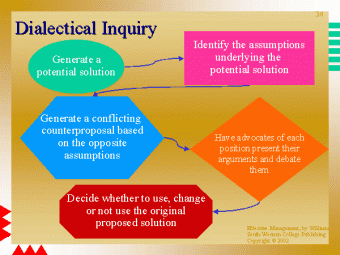 A dialectical investigation is a form of qualitative research which utilizes the method of dialectic, aiming to discover truth through examining and interrogating competing ideas, perspectives or arguments. This latter method is often applied through the use of case studies in which students or investigators discuss real world examples of complex situations. The purpose of a case study is to provide a more thorough analysis of a situation or “case” which will reveal interesting information to the reader. As I use them in my classrooms, my goal for my students is to help them understand how to better form strategies for success in business.
 Unfortunately, in the real world the strategy of debate does not work. Debates are a waste of time when honest discussion takes second place to winning or looking good. Dialectical Inquiry is also often useless since the complexity of the subject can be beyond the ability of many students to grasp. Real world situations are froth with uncertainty, volatility, complexity and ambiguity or as some have called it VUCA. VUCA is an acronym used by the military to describe or reflect on the volatility, uncertainty, complexity and ambiguity of general conditions and situations. Many complex situations are seldom able to be accurately modeled leading in most instances to weak images or portrayals of the actual situation. This is why debaters opt for simple explanations rather than complex explanations. Another example of this watering down of reality is a Hollywood movie depiction of a supposed “true” story. Recent movies that come to mind include the following:
 I have watched several of the debates now and I see no evidence that truth is being discovered. The debates have become hyperbolic spectacles of insults, half-truths, reality distortions, innuendos and petty personal attacks. I doubt if anyone has found much truth in these debates never mind elucidations of complex policy positions for any of the candidates. Trump
  will build a giant wall. Cruz will fix Syria. Rubio will fix health care. Sanders will fix inequality in America. Hillary will fix Obamacare. Do you know how any of the candidates will accomplish these lofty goals? Of course not, since they know that the “debates” are no place for such a complex discussion. Trump perhaps realizes this fact better than anyone and has kept his discussion and clarification of his policy positions to less than fifteen second descriptions. The general consensus seems to be that if a candidate cannot explain their position on any subject in less than fifteen seconds, they are doomed, i.e., they lose.
 On a more personal level, I have a problem with debates. I have a few friends who love to debate. I have noted as a result of recent discussions with them concerning the Presidential elections that do not want to understand or clarify any issues, they just want to argue or perhaps debate. I say that they want to argue, because their main agenda seems to be looking good or advancing their points and not understanding my points. They often enter into these contests (Since that is what a debate means to them. It seems to be a contest between winning their points and looking good or losing their points and looking bad.) with a pretense of trying to understand why I think or feel a certain way. Sometimes, they start the “debate” with a flat out rejection of my position or with a declaration such as “you are dead wrong” or “you don’t know what you are talking about.” I confess that such latter utterances often preclude my disposition to have a rational discussion with them. I see no point in it.




 Aging Capriciously