How We Can Leverage AI to Create a “Jobless” society: Part 2

In Part 1 of this Blog, I described some of the possibilities that AI might provide us in terms of developing what could become a utopian Society.  I named the economic system that such a society would need as an Equalitarian Economy as opposed to a Capitalistic, Socialistic, Communistic or any other type of economy that ever existed.  This new economy would be extremely Democratic in that everyone would be able to benefit from it.  I described several critical parameters of such an economy which included: 

Core Principles of Equalitarianism:

Shared Prosperity: Wealth produced by automated systems and AI is treated as a collective inheritance, not private privilege.

Universal Security: Every person is guaranteed access to health, education, housing, food, and connectivity as rights of citizenship.

Democratic Ownership: Data, infrastructure, and automation are managed for the public good through civic and cooperative institutions.

Ecological Balance: Progress is measured not by growth alone but by sustainability and planetary stewardship.

Purpose Beyond Profit: Humans pursue creativity, service, and learning as the highest expressions of freedom in a post-labor world.

Transparency and Trust: Economic algorithms and institutions operate openly, accountable to citizens, not corporations.

Responsibility and Contribution: Freedom is balanced with duty—to community, environment, and future generations.

Cultural Flourishing: Arts, education, and civic engagement become the new engines of meaning.

Global Solidarity: Equalitarianism recognizes that abundance must be shared across borders to preserve peace and human dignity.

The Equilibrium Principle: Every policy seeks harmony between technological power and human values.

Some people would call me overly idealistic or say that I had my head in the clouds.  They would argue that humans being can never create a society that evidences the characteristics noted above.  Karen says I am the ultimate pessimist.  That I don’t trust anyone or anything.  How do I resolve these apparent contradictions in my personality?  Who is right?  Am I a fuzzy headed idealist or a skeptical pessimist who thinks the worse in every situation? 

When someone calls me an unrealistic idealist who doesn’t understand human nature, I take it as a backhanded compliment.  I do understand human nature—both its flaws and its possibilities.  I’ve spent a lifetime studying how fear, greed, and ego shape behavior, but I refuse to believe they are destiny.  To me, realism without conscience is cynicism, and idealism without realism is sentimentality. The space I try to inhabit is between the two: the realm of the pragmatic humanist. 

I believe that understanding human nature means believing that it can grow—through education, empathy, and systems that bring out our better selves.  I’m not an unrealistic idealist; I’m a realist of potential.  The human race has yet to tap the potential that lies in all of us.  From the newborn baby to the fading senior citizen.  From America to Europe to Africa to Asia.  From the poorest people in the world, to the richest.  We have so much untapped potential.  If we could only learn to love others instead of hating others. 

Baha’u’llah taught that love is the fundamental principle of existence, the “spirit of life” for humanity, and the most powerful force for progress.  Jesus said that the two greatest commandments are to love God with all your heart, soul, and mind, and to love your neighbor as yourself.  Buddha described love as a boundless, benevolent wish for the happiness of all beings, a quality he called loving-kindness.  Muhammad’s teachings on love emphasized love for the sake of Allah, which includes compassion for all of humanity and other creations.  Krishna teaches that “he who does my work, who loves me, who sees me as the highest, free from attachment to all things, and with love for all creation, he in truth comes to me.”

Dr. Deming once told me that transformation starts in the heart but ends in the brain.  Transformation requires a new way of thinking and not following the dead ends that come from thinking in a box.  Einstein said that we cannot solve the problems of today with the same level of thinking that created these problems.  We can make a better world, and we can be better people, but it requires love, empathy, compassion and kindness.  Once we understand this, we can think our way to the world that we can only dream of now.   How can we get there from today? 

Transitioning from Today to Tomorrow:

The road to 2075 could unfold in three arcs:

2025–2035: Universal healthcare, education, pilot dividends, civic wealth funds.

2035–2055: Scaling UBB modules, digital public wallets, land value taxes.

2055–2075: Constitutional right to the Bundle, full Automated Productivity Dividend (APD) , AI-audited transparency.

The system’s heart is trust.  Algorithms determining the APD or resource prices must be openly audited.  Fiscal boards set rules, not politicians seeking applause.  Citizen assemblies test and refine programs through feedback loops, ensuring continual improvement—Plan, Do, Study, Act (The Deming Cycle) on a planetary scale.

Here are the key elements of my Equalitarian Economy and how they would work.

1) What’s guaranteed (the “Universal Basic Bundle”)

Instead of only cash, society guarantees a bundle of essential services, delivered like utilities:

  • Healthcare: universal coverage with public providers + private options layered on top.
  • Food: a baseline food allowance redeemable at grocers/meal services; nutrition standards, not one-size-fits-all rations.
  • Housing: right to housing via public development + vouchers + mutuals; minimum quality standards.
  • Education: free lifetime learning, credentials, and creative/technical studios.
  • Connectivity & Mobility: free broadband and a mobility pass (local transit + basic distance allotment).

The bundle is portable, unconditional, and choice-preserving (people pick among accredited providers).  Think “public option platforms” rather than one provider per need.

2) How people get spending power (beyond the basics)

Everyone receives an Automated Productivity Dividend (APD)—a cash-like stipend reflecting the value created by AI/robotic capital. It’s funded by:

  • Sovereign & civic wealth funds that own broad stakes in AI/robotic enterprises.
  • Resource rents (land value, spectrum, minerals), carbon fees, and environmental charges—returned equally as dividends.
  • A luxury VAT and/or robot/compute levy on supernormal AI rents (carefully designed to avoid stifling innovation).

Result: basics in-kind + optional cash for variety and luxuries.

3) Who owns the machines (so the dividend is real)

Without purposeful ownership design, a few owners capture everything.  Options that spread the gains:

  • National/municipal wealth funds (Alaska-style, but scaled and diversified into AI).
  • Pension & community funds mandated to hold a share of AI/automation indexes.
  • Data & model trusts that license public data/commons to AI firms in exchange for recurring royalties paid to residents.
  • Cooperative platforms where users/workers/cities co-own service robots and local models.

Mixing these creates a plural, resilient ownership base that throws off steady APD cashflows.

4) How to allocate real scarcities

Even with abundant automation, some things will remain scarce: prime urban land, top-tier medical slots, rare materials, energy peaks.

Use clear, fairness-preserving allocation rules:

  • Congestion pricing for peak resources (electricity at 6–9pm, popular transit slots)—revenues go back to people.
  • Auctions with dividend money for luxuries/rare items (keeps fairness and price signals).
  • Lotteries with rotation for non-monetizable scarcities (e.g., coveted campsites).
  • Personal environmental/material budgets (cap-and-dividend) to keep within planetary limits while preserving individual choice.

5) Governance that people can trust

  • A Constitutional floor of social rights (bundle + APD) guarded by independent fiscal/actuarial boards.
  • Transparent algorithmic policy: models that set APD levels, bundle rates, and scarcity prices are open-audited; citizens’ assemblies review changes.
  • Local experimentation / national reinsurance: cities iterate; the center backstops risks.
  • A Deming-style continuous improvement loop: publish indicators, test alternatives, keep what works.

6) Work, purpose, and status in a post-work world

“Jobs” give income, yes—but also identity, mastery, and community. Replace the income function with APD + bundle; replace the meaning function with:

  • Civic & creative missions (caregiving, arts, restoration ecology, mentoring, open-source, local news).
  • Reputation and recognition systems (think honors, badges, grants, residencies) that are non-financial but unlock opportunities (studio access, travel fellowships, lab time).
  • Voluntary problem prizes for hard societal challenges—open to anyone.

Let us look at how the above ideas would work on a day-to-day basis.  We will watch how Maya, one citizen in the new economy would receive economic benefits:

  • Maya receives the bundle automatically (healthcare, housing lease, mobility, broadband, education access) plus a monthly APD deposited into her public wallet.
  • She books a surgical consult on the health platform, enrolls in a ceramics + music course, and applies for a community garden micro-grant.
  • Peak-hour e-bike lanes use congestion pricing; her wallet is refunded weekly with the proceeds.
  • She enters a materials-light design contest; the prize is a year in a shared studio with high-end tools—no salary needed, but high status and joy.
How long would it take to transition to this new economy.  We can look at a path that such a transition might take.  (so this isn’t sci-fi hand-waving or pie in the sky thinking)

Years 0–10

  • Make healthcare and education genuinely universal; scale housing-first programs.
  • Launch/expand sovereign & civic wealth funds; start data trusts for public sector datasets.
  • Pilot UBB modules (mobility, broadband, food) in cities; pilot APD at modest levels via carbon/resource dividends + luxury VAT.
  • Enact land value tax shifts and congestion pricing with rebates/dividends.

Years 10–25

  • Ratchet APD as automation rents grow; fold in compute/robot levies if warranted.
  • Convert portions of tax expenditures into automatic bundle entitlements.
  • Standardize digital ID + public wallet (privacy-preserving) for payments and allocations.
  • Scale community/co-op ownership of local service robotics.

Years 25–50

  • Codify the social rights floor; stabilize APD against business cycles with rules-based mechanisms.
  • Shift most routine administration to auditable public AI; keep humans on goals, ethics, and appeals.
  • Tighten ecological caps with cap-and-dividend so abundance doesn’t overshoot the planet.

Now let us look at the Feasibility or Likelihood that such a transition could ever take place. 

  • Feasibility (could we?)

High, in terms of some  pieces.  Every element has real-world precedents: public services, dividends from shared assets, congestion pricing, social wealth funds, lotteries, co-ops.  Stitching them together is an engineering-and-governance project, not magic.

  • Likelihood (will we?)

Medium-low.  Left to markets alone, AI rents concentrate; political resistance to broad ownership and unconditional floors is strong.  Likelihood rises if we start now with: building civic wealth funds, enshrining social rights floors, deploying public wallets, and sharing automation rents early so people feel gains, not only disruption. 

Every component already exists somewhere—Alaska’s oil dividend, Norway’s wealth fund, Singapore’s housing model, open-source governance.  Integration is engineering, not fantasy.  We must act deliberately and share compassion for all of humanity.  Otherwise, AI and automation will only amplify inequality.  But if we start early—own public AI equity, legislate social rights floors—than the likelihood rises sharply. 

Bottom line

A post-work economy is possible if we socialize a slice of the returns to automation (not all of the economy), guarantee a Universal Basic Bundle, and use transparent, fair allocation for what remains scarce.  People keep freedom, society keeps stability, and progress keeps its edge.

Who Holds the Future?  Ilya Sutskever or Donald Trump

Introduction

Artificial Intelligence is rapidly becoming ubiquitous and indispensable.  Predictions as to the future of AI range between two extremes.  AI will save humanity and usher in a Golden Age for Mankind.  An age that will make the Greek Golden Age seem trivial.  Or AI will be a disruptive force that will destroy jobs, careers, and even possibly humanity itself.  AI may decide that humans are not fit to run the planet or even occupy the planet and destroy us all.  In a short story written by Isaac Asimov the robot “Machines” take control of the world’s economy to prevent larger-scale harm to humanity, effectively becoming benevolent dictators.  — “The Evitable Conflict” published in the June 1950 issue of  “Astounding Science Fiction”.

Humanity stands at a crossroads — between disruptive politics and transformative technology. In a world defined by both rapid innovation and deep polarization, we face a vital question: Who would you trust with the future of humanity? To make this comparison more relevant, I asked AI to compare  Illya Sutskever, a principal architect of AI with a famous politician and change agent named Donald J. Trump.  Who I asked would you trust to lead the world into a Golden Age?  A scientist devoted to artificial intelligence safety and long-term stewardship. Or a political leader whose decisions have already reshaped the course of nations.

The Scientist: Ilya Sutskever

Ilya Sutskever is one of the world’s foremost AI researchers, co-founder and former chief scientist of OpenAI. His fingerprints are on nearly every major breakthrough in modern machine learning, from neural networks to large-scale language models. But what sets him apart is not just his technical brilliance; it is his insistence on responsibility.

Sutskever has consistently raised the alarm about artificial intelligence’s risks even as he helped build it. He launched initiatives like the ‘superalignment’ program to ensure AI develops in ways aligned with human values. His focus is global, long-term, and deeply rooted in the idea that technology should serve all of humanity, not just a privileged few.

Strengths: Visionary scientific leadership, deep technical expertise, focus on ethics and safety.

Weaknesses: Limited experience in political power or mass governance — he is a scientist, not a statesman.

The Politician: Donald Trump

Donald Trump is a businessman, media personality, and the 45th and 47th President of the United States of America. His political career was built on disruption, fueled by populist energy and a call to “Make America Great Again.” Trump’s influence is undeniable — he has reshaped U.S. politics, polarized public opinion, and left a global footprint.

Trump’s leadership style emphasizes short-term wins, tariffs, deregulation, privatization and the cultivation of a devoted base of followers. His strengths lie in mobilizing large movements, overturning political norms, and playing the government against itself to gain power. Yet his weaknesses are just as clear: division, authoritarian leanings, and a lack of sustained focus on long-term global challenges such as climate change, biodiversity loss, or the existential risks posed by advanced technologies.

Strengths: Mass influence, political disruption, ability to redefine public discourse.

Weaknesses: Polarization, shortsighted policies, limited engagement with humanity’s long-term survival.

Who Shapes a Golden Era?

A Golden Era for humanity will not emerge by accident. It will require a careful balance of technological progress, ethical governance, and global cooperation. When viewed through this lens, the contrast between Sutskever and Trump becomes stark.

Sutskever embodies foresight, responsibility, and global vision. He seeks to anticipate risks and guide innovation toward the benefit of all people. Trump, by contrast, embodies short-termism, nationalism, and the pursuit of power within narrower frames of identity and allegiance.

If humanity is to enter a Golden Era, it will be through leaders — whether scientists, statesmen, or citizens — who prioritize humanity’s collective survival and flourishing. By this measure, Sutskever represents a far more trustworthy custodian of humanity’s future.

Conclusion

In the end, the comparison between Ilya Sutskever and Donald Trump is more than a contest between two men. It is a mirror reflecting the choices before us. Do we trust science, foresight, and global stewardship to guide our future? Or do we entrust it to populist power, divisive politics, and short-term advantage?

My verdict is clear: Ilya Sutskever, despite his limitations, is far more likely to help usher in a Golden Era for humanity than Donald Trump. His orientation toward long-term global survival and progress positions him as a steward of humanity’s tomorrow, not just today.

And yet, this question is not just about Sutskever or Trump. It is about all of us. Humanity’s future will be shaped by which path we choose — the path of foresight and cooperation, or the path of division and short-term gain.

Which path do you choose? A Golden Age just for America or a Golden Age for the Whole World?

What is a Humanitarian?

maxresdefault

It is not unusual to hear someone refer to the need for more humanity.  We often hear about “Calls” for humanitarian needs.  But what does it mean to exercise humanity?  What are our humanitarian needs?  Who is a real humanitarian?  Should we all strive to be humanitarians?  Can you get a diploma or a degree in humanitarianism?  My Google AI program gave me the following definition for a “humanitarian”:

A humanitarian is a person who is concerned with the welfare of others.  They may work to improve the happiness and health of people.    Humanitarians can be volunteers or paid employees.”

Humanitarian-Charter-cartoons-6

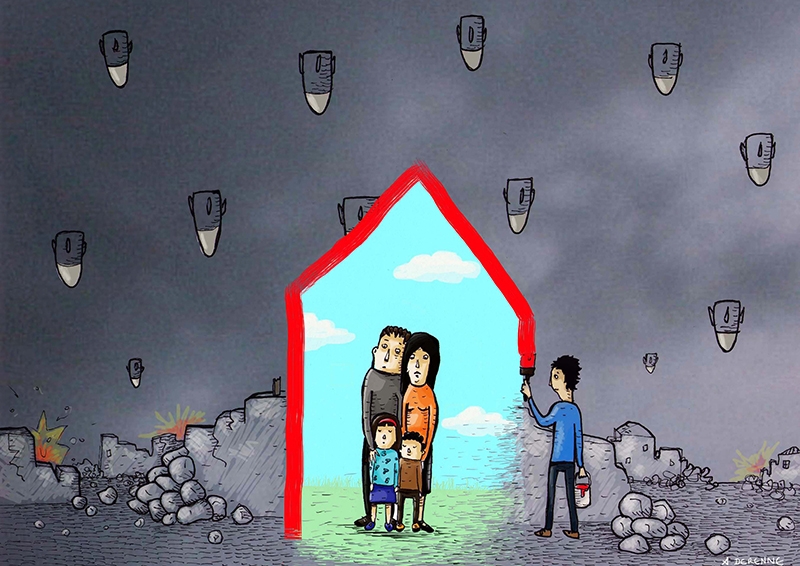
The last few years in the USA, Humanitarians and humanitarianism seem to be in scarce supply.  More people are concerned with how much they can buy and the fact that “Black Friday” is fast approaching than they are with improving the happiness and health of other people.  I find it very confusing that a large portion of Americans claim that the USA is a Christian Nation or that it should be.  My reading of the Bible gives me a different understanding of what a Christian is and how they behave.  Recently, I discovered the term “Cultural Christians.”  A “Cultural Christian” is a Christian by birth.  Someone who is born into a family of Christians or is baptized into a Christian denomination shortly after their birth.

Calling upon my AI program again, a “Cultural Christian” is defined as, “Someone who identifies as a Christian but doesn’t have a personal relationship with Jesus.”  In other words, a Cultural Christian does not have a clue as to the teachings of Jesus Christ or any other Christian prophet, Saint, or proselytizer.  Ironic isn’t it that many of these same people call on the name of Jesus to save them.  I suspect that if Jesus were alive today, he would ask them to repent before they went to hell.  A song (You Don’t Love God If You Don’t Love Your Neighbor) that I recently heard by Rhonda Vincent has the following lines:

There are many people, who will say they’re Christians

And they live like Christians on the Sabbath day

But come Monday morning, till the coming Sunday

They will fight their neighbor all along the way

Oh, you don’t love God

If you don’t love your neighbor.

Gérôme_-_La_rentrée_des_félins_1902-1-of4o8rppoxx3zn8toq8ws79zz8zqsftfoxkhwq8olkTwo thousand years ago, the Roman Empire started its decline after having been the greatest empire that the world had yet seen.  Many historians point to the decadence of the Roman Empire during its decline.  “Decadence” is defined by the Oxford On-Line Dictionary as, “Moral or cultural decline as characterized by excessive indulgence in pleasure or luxury.”  The Romans had their “Bread and Circuses.”  The Oxford Dictionary defines “Bread and Circuses” as, “A diet of entertainment or political policies on which the masses are fed to keep them happy and docile.”  For many, football and politics are the bread and circuses or our American Empire.  I think the rot and decay in America today goes much deeper than that.  Here is my list of some of the decadence that I see in the USA today:
  • Excessive consumerism and a frenzy to have bigger and bigger stuff
  • Excessive shopping till we drop, more and more stuff
  • Excessive eating leading to mega levels of obesity in America
  • Excessive time spent watching TV, movies, and other entertainment
  • Obsession with sports and team affiliation from grade school to the NFL
  • Excessive casino gambling
  • Pull tabs, scratch offs, lotteries
  • Drugs and alcohol addiction
  • Greed and more greed. Forever, cutting taxes so the greedy can have even more and the poor and needy can have even less
  • And now we have added “On-line Sports Betting.”

You Don’t Love God If You Don’t Love Your Neighbor

If you gossip about him, if you never have mercy

If he gets into trouble, and you don’t try to help him

Then you don’t love your neighbor

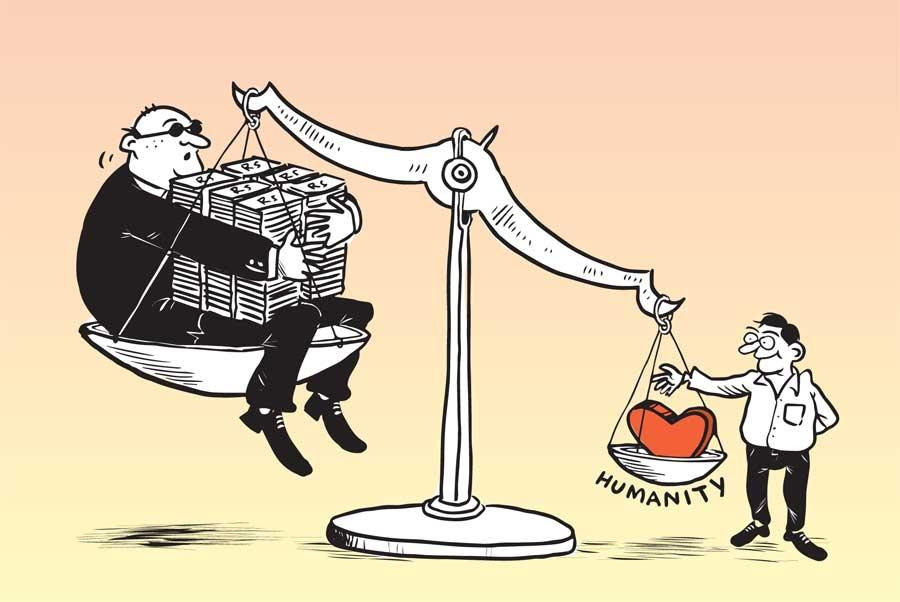
greed versus humanity

The more I write this blog, the more I think of the prophet Jeremiah.  Jeremiah constantly called upon the Israelites to turn away from their wicked ways and dependence upon idols and false gods and return to God.  For his troubles, Jeremiah was stoned to death.  But Jeremiah did more than just rail against sin and evil.  He also tried to give hope to his countrymen.  He promised that a “New Covenant” was coming to all those who followed God’s laws.  This covenant would supersede the old Mosaic Covenant.  Instead of inscribing his law upon tablets of stone as in the Mosaic Covenant, God would write his law upon the hearts of men.  Jesus said at the last supper, “This cup is the new covenant in my blood.”  — (Luke 22:20)

In the holy Bible, in the book of Matthew

Read the 18th chapter in the 21st verse

Jesus plainly tells us that we must have mercy

There’s a special warning in the 35th verse

Oh, you don’t love God

If you don’t love your neighbor

If you gossip about him, if you never have mercy

If he gets into trouble, and you don’t try to help him

Then you don’t love your neighbor

And you don’t love God.

neighbor_slide_title

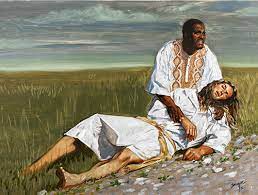
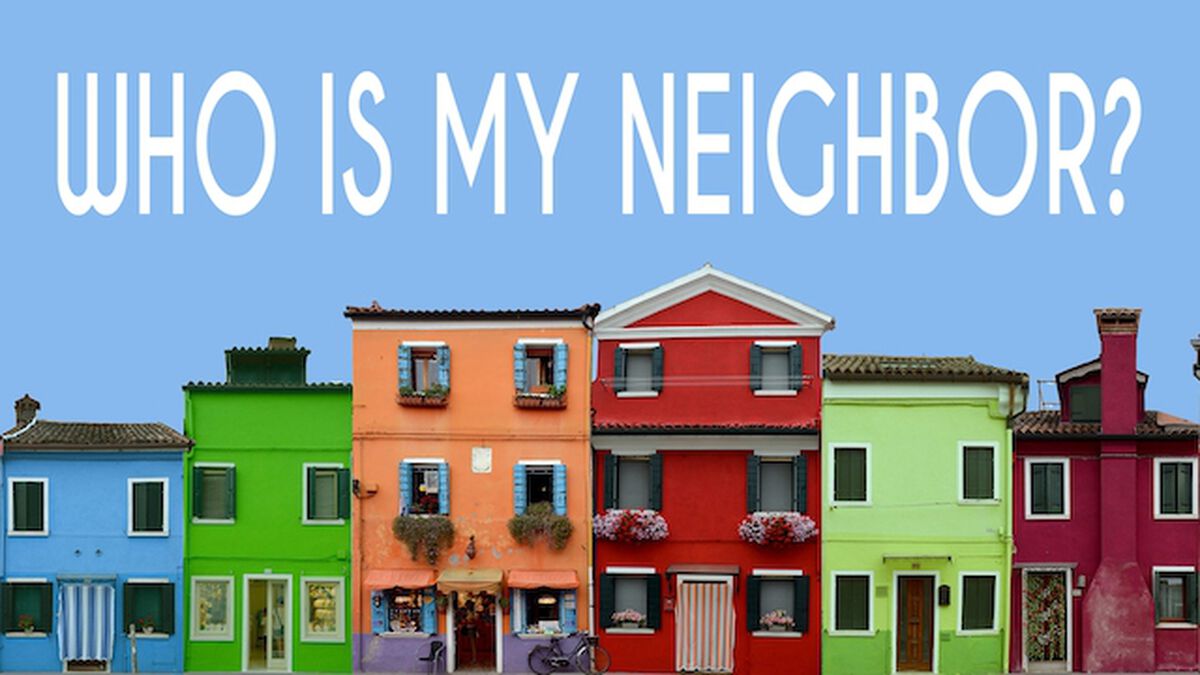
You may well ask, Well “Who is my neighbor?”  Jesus answered this question in his story about the Good Samaritan.  Jesus tells the parable of the Good Samaritan (Luke 10:29–37) and makes it clear in this parable that our neighbor is anyone around us, regardless of their ethnic, religious, or socio-economic status.  I have a T-Shirt that I like which reads, “God Bless Everyone:  No Exceptions.”  I have had many people come up to me and tell me how much they like this blessing.

the good samaritanI have another T-Shirt where I list the “No Exceptions” groups that somehow seem to be conveniently overlooked by many Cultural Christians.  The major fallacy that many Christians seem to observe is to define their neighbors as either someone in their own church or in their own social group.  When Jesus included the Samaritans who were an outcast group at the time as his neighbors, this should have made it clear that you must go beyond your tribe or friends to include other nations, other ethnicities, other religions, and other people with different beliefs as your neighbor.
There’s a God Almighty, and you’ve got to love him

If you want salvation and a home on high

If you say you love him while you hate your neighbor

Then you don’t have religion, you just told a lie

Oh, you don’t love God

If you don’t love your neighbor.

Well, we are almost at the end of my story.  Not much else to say is there?”  Just one last thought to leave you with.  Please feel free to share this with others.

  • If you love things more than you love people,
  • if you love money more than you love people,
  • if you love ideology more than you love people,
  • if you love tv, gambling, sports, and movies more than you love people,
  • If you love drugs and alcohol more than you love people,
  • then I think Jesus would say that:
  • “You Don’t Love God.”

 My thanks to Rhonda Vincent for her song and the lyrics in this blog.  You may listen to her song at:  https://www.youtube.com/watch?v=IR2rpVd5Lwo


I Wonder as a I Wander

20210524_1igantiusstars

I have always loved the phrase “I wonder as I wander out under the sky” from a song written by American folklorist and singer John Jacob Niles.  It was first sung in 1944 by Pvt. Cecil Gant.  The record made it to number one on the Juke Box Race Records chart in 1944 and 1945.  It has probably been sung over a billion times and is a favorite among Christians during the holiday season.  The lyrics are as follows:

I wonder as I wander out under the sky

That Jesus my Savior did come for to die

For poor ordinary people like you and like I

I wonder as I wander out under the sky

Now many of you would know that I profess to be part Atheist and part Agnostic, so Jesus is not my savior.  However, I regard him as a great prophet and teacher of the human spirit.  Seldom have I read anything as significant as the Eight Beatitudes that Jesus gave in a sermon.  These eight messages tell us much about the man and speak volumes in terms of how we need to treat other human beings:

  1. Blessed are the poor in spirit: for theirs is the kingdom of heaven.
  2. Blessed are the meek: for they shall possess the land.
  3. Blessed are they who mourn for they shall be comforted.
  4. Blessed are they that hunger and thirst after justice: for they shall have their fill.
  5. Blessed are the merciful: for they shall obtain mercy.
  6. Blessed are the clean of heart: for they shall see God.
  7. Blessed are the peacemakers: for they shall be called the children of God.
  8. Blessed are they that suffer persecution for justice’ sake, for theirs is the kingdom of heaven. — Matthew (5:3-10).

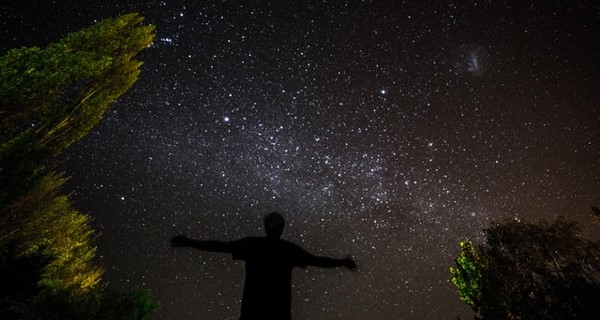
I wonder many nights when I am out under a clear sky.  I wonder what it all means.  I wonder what I am here for.  I wonder about friendship and loyalty.  I wonder about integrity and politics.  I wonder about the world and the climate.  I wonder if wars and murders will ever end.  I wonder if prejudice and discrimination will ever cease.  I wonder if abuse to women and gender-diverse people will ever end.  I wonder if religions will stop persecuting other religions.  I wonder if it was all worth living for.

A wise person once said that there are two “What Ifs.”  One deals with fear and can be paralyzing and enabling, “What if this happens?”  “What if I should fall or break a leg?”  “What if things should go wrong?”  The other “What If” deals with wonder and can lead to positive and rewarding insights.  Insights that raise life and humanity up and create a better world.  “What if we did this instead of this?”  “What if we could have peace instead of war?”  “What if we could eliminate the need for guns and weapons?”  “What if we valued humanity more than we valued money?”

I wonder what would happen if we chose hope and love over fear and greed.  I wonder as I wander out under the stars what life on this planet COULD be like.

Why Vote for Biden and Harris?

Yes, I know, the Democrats will take our guns away.  They will let the starving hordes of immigrants ravage our country and steal our jobs.  The Democrats will support the killing of unborn children.  They will raise our taxes and prevent us from becoming rich like Trump.  The Democrats will allow unions to take control of our businesses and destroy free enterprise. 

Last week, my wife and I drove to Tomahawk Wisconsin to visit some friends.  We drove via Hwy 8 and returned via Hwy 64.  Just for fun, we decided to count political signs going and coming.  Going we limited our sign counts to 1 sign per home passed.  Most if not all Trump supporters have more than one sign in their yards.  Some have flags and gigantic Trump signs.  We even passed two guys on a street corner waving Trump signs.  When we arrived at Tomahawk the score was Trump signs 41 and Biden signs 21.  On the way back, we counted all signs regardless of how many were on one property.  The score was 219 Trump signs to 25 Biden signs.  Nearly a 10-1 advantage.  Clearly a lot of people in rural Wisconsin like and maybe even love Trump.  Non-Trumpers are confused, perplexed, and bewildered.  What is there to like about Trump they ponder just as many people ponder the heavens and stars?

I have always been an independent.  I vote the person, not the party.  I sometimes call the Dems, the party of Wimps and the Republicans, the party of Greed.  I think of both parties as the Democans and the Republicrats or Tweedle Dee and Tweedle Dum.  What did the Democrats do for the rural white non-college working class older voter?  Support for diversity, Gay marriage, NAFTA, Immigration, climate change and social welfare programs do not hit the mark with people in the hinterlands like Northern Wisconsin. 

So along comes a Savior riding a Mercedes golf cart, living in a Florida mansion befit for a king and supporting a trophy wife, the envy of every male or at least straight male in America.  He will bring jobs back, keep out the ravaging hordes of rapist immigrants, stick it to the Chinese, lower taxes, make everyone rich again, protect our unborn children, keep at least one gun in every house and perhaps most of all “drain the swamp.”  The swamp as we know it is full of college educated brainwashed left-wing pedophiles and socialist bureaucrats.  People who do not really work for a living but are blood suckers thriving on your tax money.  None of your friends, relatives or neighbors live in the swamp.    

So, given all the great things that Donald Trump will do, why will I vote for Biden and Harris?  Simply because character matters.  The ends can never justify the means.  I have no illusions that Biden will drain the swamp or that he does not have his warts and blemishes.  He is no hero to me, nor do I foolishly believe that he will make America great again.  The only thing that will make America great or keep America great is when 100 percent of Americans get off their butts and get involved in the political process.  In the last presidential election, only about 61 percent of Americans took the time and effort to pull themselves away from their TV screens and vote.  We need to make changes in government, but it will only happen when we take the political process out of the hands of the lobbyists and career politicians.

 So why will I vote for Biden and Harris?  Because character does matter.  Morality matters.  Compassion matters.  Concern for people more than money matters.  Appealing to my humanity and not my fears or greed matters.  I loath bureaucracies.  I too want a safe place to live.  I want to see jobs for people that want jobs and I don’t want to see freeloaders given a handout.  But I also believe that Jesus said to feed the hungry and help the poor:  “If anyone has material possessions and sees a brother or sister in need but has no pity on them, how can the love of God be in that person?”  1 John 3:17. I do not think this means only your neighbors or your friends or relatives.  I think it means strangers, foreigners and people who may not be the same color or religion as we are.  I do not think Jesus wanted us to discriminate between Black people, Red people, Brown people or any other people on the face of the earth. 

So why will I vote for Biden and Harris.  I think we made a big mistake four years ago.  The swamp is even bigger now than it was then.  The greed in Washington is ever worse.  The political infighting ensures that nothing gets done.  The lawyers seem to control everything, and corporations have grown richer on the backs of the working people that live in both rural and urban areas.  These fat cat corporations have no loyalty to America but are “International” in scope.  “America First” sounds great to many of us but it is a selfish policy that appeals to our sense of fear and greed.  We need a leader with a vision that embraces humanity and does not demonize people or pit one group against another no matter where they live.  We need a leader that respects all people and not just his base of supporters and the sycophants that in my day were called brownnosers for good reason. 

I have been as disappointed by the Democrats as many of you have over the years.  However, I will vote for Biden and Harris because I get a sense of character and integrity from both of these two candidates.  They are not heroes.  People get the government they deserve.  If you want heroes or heroines, watch the Avengers, or read Marvel comic books.  But character, morality, compassion, and humanity are the only things that have ever made America great.  Vote for who you believe has the right stuff but vote my friend. 

Happy New Year:  Welcome to 2016  The Best Year in the History of the Human Race!

New-Years-ResolutionsToday is the day when we make new resolutions and promises galore.  A time to begin over and to make dreams and wishes come true that did not work out the year before.  We bring in the New Year as a new born baby, full of promise and youth.  Some skeptics might look at the trail of broken commitments from bygone years and laugh at the efforts of others.  Such cynics ignore the profound possibility of hope and change.   (Listen to the Hope Song by Lata, it will inspire you more than my words ever could)

True wisdom is less presuming than folly. The wise man doubteth often, and changeth his mind; the fool is obstinate, and doubteth not; he knoweth all things but his own ignorance.”   — Akhenaton

your-dream-doesnt-have-an-expiraiton-date-take-a-deep-breath-and-try-again-kt-witten-inspirational-quote-julie-flyagre-narcolepsy-bloggerYes, there is injustice and inhumanity in the world.  Yes, there is poverty and disease.  Yes, there are natural disasters and misery.  But there is also happiness and love.  There is compassion and charity.  There is a world of people who are trying to create a better world and are willing to put their lives on the line to do it.  Wherever we look there are heroes and heroines who will sacrifice themselves in an effort to create a world full of joy and love.

Let our New Year’s resolution be this: we will be there for one another as fellow members of humanity, in the finest sense of the word.Goran Persson

sisyphus1Yes, I do not doubt it for one second.  We will be better this year than we were last year.  We will continue to grow and change.  We will continue to overcome the folly of yesterday and of our past lives.  We will overcome the mistakes we have made and do better this year than last year.  Hope, they say, springs eternal in the human breast and what would we be without it?  We need to try again and when we fail, try again.  The only failure is when we stop trying.  So disregard the naysayers, go ahead and make some new goals and new dreams.  Make some New Year resolutions.  Stretch your vision and your horizons.  People do not perish because of their dreams; they perish because of a lack of dreams.

Make New Year’s goals.  Dig within, and discover what you would like to have happen in your life this year. This helps you do your part.  It is an affirmation that you’re interested in fully living life in the year to come.  — Melody Beattie

ReachingOurGoals042610Time for Questions:

Only one question today, “What are you going to do this year to make the world a better place.”

Life is just beginning.

There is no going back.  Let the past go.  It is time to start fresh.

The Twelfth Greatest Mystery of all Time:  Can We Solve All the Mysteries of Existence?

The-Mystery Well, we have come to the end of my Greatest Mysteries of All-Time Series.  So far, I have solved ten of the eleven.  This last one is the easiest of all.  Yes, we will solve all the mysteries of existence except for one.  Why do people do what they do?  I submit we will never satisfactorily solve this question.  Thus, I might as well say that the answer to this last mystery is NO!  We will not solve all the mysteries.  There will always be more mysteries.  As long as people are curious and unpredictable, life will be one long stream of continuous and never-ending mysteries.  Mysteries are like the stars in the universe. They are beyond counting and beyond measure.  They are as infinite as humanity’s quest for answers.  (Click here to listen to the Mystery of Existence Song by Farzin Darabi Far)

Although there are several ‘schools of thought’ relating to why God allows mental, emotional, and physical afflictions, it essentially remains a mystery” — R. Alan Woodslatmosphere_metereologie_populaire_camille_flammarion2

How many times have you picked up the newspaper, read a headline and asked yourself: “Why would anyone do that?”  Why would anyone do that? What were they thinking?  I once listened to a series of interviews with serial killers thinking I might find an answer to this question, instead, all I found were more questions.  The killers themselves did not know why they did what they did.  Yesterday, on one of the CNN vignettes on my IPAD, I found an article that started out as follows:  Inside the mind of a serial killer .  It featured an interview with Forensic psychiatrist Helen Morrison who has interviewed over 135 serial killers.  When asked by interviewer Brooke Burke “Why do serial killers continue to kill over and over?”; Dr. Morrison replied “I wish I knew.  It is still a big mystery of why.”   Here are some recent headlines that were in the news on CNN as I write this blog:


If you are like me, you probably look at several of these headlines, shake your head and ask “Why would anyone do that.”  Why?  Why? Why?

As I get older and presumably wiser, I find myself less able to come up with answers to this question:  “Why did he do that?”  “Why did she do that?”  “How could anyone do that?”  “What were they thinking?”  Is it just me?  Karen says she is amazed that I am almost constantly rendered speechless by the things that other people do: “Why would anyone vote Republican?  Why would anyone vote Democrat?

godsshadowHow come people put large ugly tattoos all over their bodies?  Why would anyone pay $300 dollars for faded ripped jeans?  How could anyone marry someone like that? Why would anyone let themselves be treated like that?”


“All is mystery; but he is a slave who will not struggle to penetrate the dark veil.” — Benjamin Disraeli


Mystery after mystery confronts my daily existence.  My best efforts to solve the mysteries of life are worthless in the face of this continuous barrage of mysteries.  While I may solve one or two great mysteries each day, one hundred others seem to pop up to take their place.  Solving my mysteries, I feel like a rat running on the tread mill and staying in the same place.  I apply genius, innovation, creativity, determination, perseverance, fortitude, patience, discipline and still the mysteries of life continue to multiply and accumulate faster than I can dispose of them.

“The most beautiful thing we can experience is the mysterious. It is the source of all true art and all science. He to whom this emotion is a stranger, who can no longer pause to wonder and stand rapt in awe, is as good as dead: his eyes are closed.”– –Albert Einstein

Do mysteries have some inestimable place in our daily existence?  Are they like vitamins and minerals a necessary part of our daily diet?  Can we live without all the perplexity and confusion that these numerous mysteries provide us?  Or without them, would we gradually wither away and die of sameness and complacency?

I know not what course others may take; but as for me, give me mysteries or give me death! John Persico Jr.

Time for Questions:

What are your greatest mysteries?  What makes a mystery for you?  What do you find most curious or interesting about life?  How do you go about solving your own mysteries?  Do you regard mysteries as fun and entertaining or challenging and provocative?  Do you hate mysteries?  Why?

Life is just beginning.

“Every woman that finally figured out her worth, has picked up her suitcases of pride and boarded a flight to freedom, which landed in the valley of change.”  ― Shannon L. Alder

A Time for Charity and a Time for Michelle (Shelly) Skow

Have you ever had one of those epiphanies or sudden feelings that the world is a wonderful place to be?  A time when you felt guilty for all of the pessimism, cynicism or negative thoughts that you had about humanity.   One of those days when you know that Sartre (“Hell is other people”) was terribly wrong.  At this moment, you know people are special and you would not want to be in any other possible world.  Well, yesterday Karen and I had one of those days.  Saturday the 29th of June. 

The day started out more or less inauspiciously.  I had received bad news from my biopsy the day before that my Gleason Score (A measure of the virility of cancer in the prostate) had gone from 6 to 7 or from mildly aggressive to moderately aggressive.  My doctor wants me to move out of “wait and see” to some other treatment mode “to be determined.”   I was not in the best of moods as the day begun. 

A few weeks before, I had noticed a flyer in one of the town store windows for a benefit or fund raiser for some local resident who had some problems.  Apparently the fund raiser was to help defray medical costs.  I see many more of these type efforts today that I have seen in the past.  Fundraisers for veterans, for animals, for sick people, for sick children.  They all tug at you heart but there are so many needy people today and one has only so much money to go around.  You give to any charity and your mail box is deluged with requests from other charities everywhere from Venus to Neptune.  I supported Obama during the last campaign and now I am get campaign fund requests from every Democrat in Congress, the Senate, the House and the Moon who is running, planning to run or has run for office.  It’s enough to make you switch parties except the Republicans would probably be no better.  Everyone asking for money, more money and even more money!

Nevertheless, my thoughts about Michele (Shelly) Skow the subject of the fundraiser here in Frederic were sympathetic and I thought “Heck, let’s go to the fundraiser and help out with whatever we can.”  I mentioned it to Karen and she was receptive.  I should add that I had no idea who this woman was nor I have ever met anyone who was related to her or who even knew her.  I put a note on my calendar to remember the date.  Saturday afternoon (The fundraiser started at 3PM) I reminded Karen we had planned to go to this fundraiser.  She asked me what it was for.  The paper that I had given her with information was nowhere to be found and I had to admit I did not remember.  I only knew it was a good cause.  I told Karen we could find out when we got there.  We briefly discussed how much we could afford to donate and off we went.  To Hackers Bowling Alley and Restaurant for a fundraiser for a woman I had never heard of before three weeks ago. 

When we got to the parking lot, we were quite surprised.  It was packed with cars and people were parking across the street.  I noted “Wow, she must really know a lot of people.”  We walked in and looked in the hall.  There were a number of tables set up for wristband donations, food with a donation box, raffle tickets for a large number of prizes and a silent auction.  We looked for a box to put a check in and decided to put it in the box with the wristbands.  We passed on the bands but left our check in the box.  We then headed to the food area. It looked like most potlucks one encounters in our area.  Rolls, Sloppy Joes, beans, and lots of the usual deserts, brownies, cookies and coffee were in abundance.  We picked up plates and each grabbed an assortment of edibles.  I had to remind myself that this was not about food but about helping Shelly.  

We took our plates to some tables which were occupied but not as full as some others and found a couple of seats across from an elderly looking couple.  I think everyone looks older than me.  Somehow I never grew up mentally.  I asked Karen what she wanted to drink and I headed to the bar.  The selections were to be expected.  I ordered a light beer for Karen and a regular Bud for myself.  Now if you know me, there is almost nothing I loathe more than the standard domestic Bud except a Bud light.  I am a fine connoisseur of small batch beers hand made with love and thought.  Of course, knowing that such beers did not exist at Hackers, I was okay with swilling down a Bud.  I just hoped none of my legions of fans would see me drinking a Bud.  The bartender (I noticed a sign next to their tip jars that all tips would go to the fundraiser), passed me two cans and popped the tops for me.  I handed him my credit card which he handed back. “We don’t do plastic he said. There is an ATM across the street.”  With some mild irritation (Who doesn’t take credit cards these days?), I headed to the Holiday Station.  I was suddenly conscious of how kind and thoughtful the bartenders were that they would give up their tips to help add to the fundraiser.  Probably someone they did not know either.

When I entered the Holiday, I said “Hi,” to the young woman who was at the cash register. I see her a lot there and she is always friendly.  She said “What are you up to today?” I replied “I am at this fundraiser for Shelly Skow, do you know her?”  She said “Nope.”  Then a very funny thing happened, she said, “If I give you some money would you put it in the donation box for me?”  I said of course and I took some cash from her hands.  I finished getting my money from the ATM and headed back to the bar at Hackers. I paid the bartender for the two “beers” and left a dollar tip.  I then took the Holiday Station clerks’ money and put it in one of the donation boxes. I must admit I peeked to see how much she had given me.  I was quite surprised at the amount.  She had given me 8 dollars. Now eight dollars might not seem like much to you but I know that this woman is a single mom raising a child on a Holiday Station clerks’ pay.  Eight dollars is not a small amount to donate to someone you do not even know.  And she was not even getting any Sloppy Joes.

Back at the table, I found Karen talking to the two people we knew from town (the only two people we had seen that we knew at this point) and she had asked if they knew Shelly.  Another surprise, they did not.  They simply saw the notice and wanted to help out.  Shortly after, another friend from town came over to our table and upon asking the same question, we received the same reply “Nope, never met her and do not know her.”  I started a conversation with the “elderly couple” across from us, thinking they might know of Shelly.  I thought perhaps they were grandparents or even great grandparents.  But no!  They did not know Shelly either.  They came for the simple reason of helping someone out who needed help. 

After finishing our gourmet dinner of chips, beans and Sloppy Joes, (Did I not mention the Buds?) we decided to go over to the silent auction table.  There were a surprisingly large number of items and Karen decided to bid on a potting chair.  She put a bid in slightly above the last bid.  She remarked on how nice the chair was and how nice she thought it would look in our garden.  I thought, “She will never win with a bid only five dollars above the last bid”, so I upped the bid when she was not looking by about 10 dollars. This meant that anyone wanting this item would have to go up 20 dollars more than the bid before Karen.  I thought this was good strategy.  I did not tell Karen at the time that I had “outbid” her. 

We left the fundraiser and headed home.  We both took a short break at home and then we headed up to a place called “Log Cabin Hollows.”  It was too nice an evening to say inside and we wanted to see if they were going to have a Saturday night music jam.  About 15 years ago, a brother of a man I know in town started these music jams out at this resort and campgrounds.  We attended one about two years ago and it was fun.  Not quite like the music jams at the Minnesota Bluegrass Festival or the ones in Mountain View, Arkansas, but still some good music you could listen and dance to without your eardrums breaking.  As we drove up to Log Cabin Resorts, Karen and I discussed the fundraiser. 

I was already quite surprised at the number of people we met who did not know the recipient.  I was also very surprised to find so many nice objects that were donated by the local merchants and townspeople.  These merchants are not Wal-Marts or Costcos.  They are small town local stores who have been suffering from a poor economy and the competition coming from “Big Box” retailers within a few miles. There is a joke that every store in town is for sale and has been for several years.  This is not just a joke but reflects the hard economic conditions up here and how difficult it is for local merchants to make a living.  Many of our local stores are for sale.  Nevertheless, places like Daeffler’s (our local meat market) who donated all of the meat for the Sloppy Joes and a “basket” of food as well for the auction gave more than generously.  Karen and I were touched by the compassion and kindness exhibited by people for someone many of them did not know and had never even met.  And when I think of the Holiday Clerk who also wanted to help out and would give a good portion of her income to do so, I can only be grateful to live in a world full of such kind and generous people.  

The newspapers give us a daily diet of evil and mayhem.  The Tele adds to the store of menace and murder that we are endlessly confronted with.  Serial killers threaten us from the pages of most novels that litter the NY Times best seller list only to be replaced by an even more twisted and malevolent killer.  A new trial replaces the last gory trial that dominated the news for six months or so.  Everywhere we turn, we see evidence of the depravity and inhumanity that the media must want us to believe is the world we live it.  However, it is all a mirage.  We are living in a fantasy world of carnival mirrors that reflects a reality that does not exist.  The illusion we see shows us a depraved, destructive, disastrous, execrable, foul, harmful, hateful, heinous, hideous, iniquitous, injurious and loathsome world that no one in their right mind would want to live in. 

I have never been nor probably ever will be accused of being a Pollyanna.  I have no rose collared glasses and I grew up in Brooklyn NY.  I am Italian and Irish and my father was a Post-Man back before we had Post-People.  Nevertheless, I believe that 99.9 percent of the world is good.  I might even be low in my estimates.   If you think of a world with this much good and this little evil, then what would this world really look like?  I think this poem by Aileen Karg sums it up:

A World of Wonderful People

We live in a world of wonderful people
throughout the universe.
We live in a world of wonderful people
where friends are friends with us.
With “hellos” here and “hellos” there
and “How are you today?”
“I hear the stock market’s down,
but there’s plenty to go around
and there’s health and happiness we see,
in the likes of you and me.”
We live in a world of wonderful people,
who love and work and care,
for beauty, strength and honor,
we find it everywhere.
We find just what we look for,
we find it every day,
in this world of wonderful people
God gives to us along life’s way. 

By Aileen Karg

Well, this morning I got a call.  I won the potting chair at the silent auction.  I told Karen and she was excited.  I said she can place it in the garden but I get to pick the flowers.

Time for Questions:

How can we see the real world when we are bombarded daily with images of evil and depravity?  What can we do to help others see the real world?  How can we fight the cynicism that surrounds us?  How can we make a difference in the world?  What if we rejected all of the pessimism and turned off the TV and News and never bought another serial killer novel or movie?  What does it do to our children?  What will they believe about the world when they grow up?  Is it what you would want them to believe? 

Life is just beginning:

PS:   If you would like to send funds or donations to help Michelle (Shelly) Skow, send a check in her name to me and I will make sure it finds its way to her.  She has a Facebook page at

https://www.facebook.com/pages/Prayer-Chain-for-Shelly-Skow/115295908661959

My address is:  John Persico, 202 Peake Avenue South, Frederic, WI:  54837