Something Rotten in America Is Coming This Way

Something Wicked This Way Comes” is a 1962 dark fantasy novel by Ray Bradbury.  It tells the story of  two 13-year-old boys, Jim Nightshade and Will Halloway, in Green Town, Illinois, who confront the sinister Cooger & Dark’s Pandemonium Shadow Show.  The show is part of a malevolent carnival that preys on people’s secret desires and fears.  Jim and Will are forced to battle evil and examine the nature of good and evil, youth and aging.  The title comes from Shakespeare’s “Macbeth”, and the story explores themes of good vs. evil, the fear of growing old, and the cost of wishes.

Macbeth is the story of a man driven by ambition and a lust for power to murder his king and seize his throne.  Like Bradbury’s novel, it is also a tale of good and evil.  The famous quote is “By the pricking of my thumbs, something wicked this way comes.” It is spoken by the Second Witch in Act 4, Scene 1, as she senses Macbeth’s evil approach, indicating his profound moral corruption even to supernatural beings.  Someone once noted that most great stories involve a battle between good and evil.  Fiction mimics reality.

The famous Gettysburg Address by President Abraham Lincoln also described a battle between good and evil and the sacrifice made to restore good.

“It is rather for us to be here dedicated to the great task remaining before us—that from these honored dead we take increased devotion to that cause for which they gave the last full measure of devotion—that we here highly resolve that these dead shall not have died in vain—that this nation, under God, shall have a new birth of freedom—and that government of the people, by the people, for the people, shall not perish from the earth.”

The cause was the elimination of the evil of slavery and racial discrimination, and the continuation of a nation built on the values of life, liberty and the pursuit of happiness.  Values that were not allowed to be held by a significant portion of Americans specifically Black people, Indigenous people but also including women, gay people, Asian people, and many immigrant groups

Today, the thought rings in my mind that “Something rotten comes this way.”  Yes, a paraphrase of the Bradbury quote but it has a somewhat different meaning to me.  Something rotten smells and stinks in our country.  Carved into a White House mantel is a quote by John Adams, “May none but honest and wise men rule under this roof.”  Today something is rotten in the White House.  The foul and putrid odor has spread to the Supreme Court and both houses of Congress.  Wise men search for the odor but cannot agree on its source.  When something is smelly we generally assume that it is rotten.  Hence my reflection that “Something rotten comes this way.”  It has been coming for a long time, but the stench and fetid smell have now become unbearable.  From the White Mountains of New Hampshire to the top of Mt. Whitney in California, the rank fumes are causing people to gag and vomit and leave our country.

What is the source of this rottenness?  The smell comes from an ever-enlarging foundation of greed and narcissism that has replaced integrity and morality.  From the pulpits of many so-called Christian churches to the podiums of our once great universities, Americans are now baptized or given diplomas in greed, avarice and opportunism.  Increasingly, cowards roam the halls of Congress where statesmen once tread.  Too many of our leaders lack morals or integrity.

Sycophants earn positions as heads of government with no qualifications except an unscrupulous ability to kiss ass.  The media daily screams headlines that defy logic and comprehension while profits for news conglomerates soar to ever higher peaks.  Meanwhile, the information contained in media broadcasts bears scant resemblance to the reality that most of us face.  Lying is the norm and has become one more strategy in a congressperson’s arsenal.  A stew of lies daily spread by the internet and its media minions.   None of us can escape complicity in this economy as we all breath its rotten air.
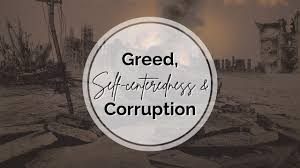
Something rotten comes this way:

How can we expunge this rottenness?  Will singing Kumbaya work?  Will hands across the aisles work?  Will prayers and thoughts work?  Will more empathy work?  What about better communication?  What about more people going to college to get educated?  What about doing away with Social Security and replacing it with Stock Portfolios?  What about more guns?  What about?  Sorry, I am out of simple solutions.  None of these so-called solutions work because they do not confront the real problem.  The golden idol that makes money the measure of all good things in life.  It may be possible to stop the spread of this rot, but it will take a change of heart as well as a change of mind.  Many of my friends ask me if it is not too late.

I only know one thing.  Unless we change the path that we are heading down, we can kiss democracy in America goodbye.  The rottenness will eventually infect the entire nation until we are left with nothing but a country of cowards, sycophants, greedy merchants and greedy consumers.  People who will continually lie to get ahead.  People with no goals except to consume the latest do-dads in hopes of becoming happier and more satisfied with their lives.

Ironic that so many Americans want to go down this path, since not one great prophet in history has preached that owning more stuff will either make you happy or get you into heaven.  Nevertheless, today we have Christian churches preaching the “Prosperity Gospel.”  A narrative that has millions of followers subscribing to a bastardization of every great scripture that has ever been written.

The prosperity gospel teaches that faith, positive confession, and financial giving to religious leaders will bring the giver personal wealth, health, and success.  It portrays material prosperity as due to God’s favor and poverty or illness as evidence of weak faith or spiritual failure.  The Prosperity Gospel is a Super Con because it monetizes hope, blames failure on the believer, and shields itself from disproof.  People buy into it because it promises certainty and reward in an unfair economy.  It exploits vulnerability, fear, and selective success stories to convince “true believers” that it is a Christian teaching.

Robert Tilton: “I believe that it is the will of God for all to prosper because I see it in the Word… I do not put my eyes on men, but on God who gives me the power to get wealth”.

Creflo Dollar: “When we pray, believing that we have already received what we are praying, God has no choice but to make our prayers come to pass”.

John Avanzini: “Jesus had a nice big house”, “Jesus wore designer clothes”, “Jesus was handling big money”.

Joel Osteen: “If you want to reap financial blessings, you have to sow financially”. He also states, “I believe God wants you to prosper in your health, in your family, in your relationships, in your business, and in your career”.

Oral Roberts:  “Sow a seed on your MasterCard, your Visa or your American Express, and then when you do, expect God to open the windows of heaven and pour you out a blessing.”

Friends, the only solution that will save our country along with our immortal souls is to defeat the basic tenets of corporate capitalism and to cast out the evangelists of hypocrisy who spread such false gospels as the “Prosperity Gospel.”  The corruption that we see in the White House, the Congress, the Supreme Court, the Universities, the Media and many so-called Christian Churches is a symptom of the rot that is associated with our predatory avaricious Corporate Capitalistic system.
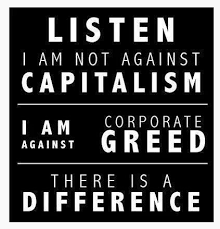
Corporate Capitalism itself must be understood as a mindless media driven machine that puts profits over virtue.  A system in which the greater needs of society are no longer the recognized or given any priority.  All that is rotten today in America today can be traced to greed and avarice.  The same motivations that caused the Israelites to build the Golden Calf.  The Golden Calf still stands—no longer forged of gold but of brands, markets, and corporate power.  We bow to consumption, give obedience to profit, and keep silent to wrongdoing in exchange for comfort and toys.  We mistake greed for progress and idolatry for economic necessity.  We do not need a rejection of markets but a rejection of markets without moral and ethical anchors.

The late Pope Francis is quoted as saying that:

“From an economic point of view, it is irrelevant to produce tanks, or candy provided the profit is the same.  Similarly, it might be the same to sell drugs or sell books if the profit figures match.  If the measure of value is money, everything goes provided that the profit does not vary.  The measure of every human being is God, not money.”

Money becomes the measure of good and evil.  Money becomes the measure of a person’s value and even life.  Today, the religion of America has become “How can I get more money.”  The true prophets throughout history have always preached the potential dangers of focusing on accruing either wealth or fame.

Christianity (Jesus): “No one can serve two masters. … You cannot serve both God and money.”

Islam (Prophet Muhammad, Hadith): “Riches are not the abundance of worldly goods; rather, true riches are the richness of the soul.”

Judaism (Talmudic/Midrashic Thought): “The truly rich are those who are satisfied with what they have.”

Baha’i Faith (Baháʼu’lláh): “Material comforts are only a branch, but the root of the exaltation of man is the good attributes and virtues which are the adornments of his reality.”

Red Cloud (Oglala Lakota): “I am poor and naked, but I am the chief of the nation.  We do not want riches, but we do want to train our children right.  Riches would do us no good.  We could not take them with us to the other world.  We do not want riches.  We want peace and love.”

If we want to rid our nation of the rottenness and stench that is rapidly covering it, we must rid ourselves of the obsession that capitalism seeks to instill in us with every media at their disposal and every commercial that they can provide.  It is an obsession to own more, to possess more, to have more, to buy more, to shop until we drop.  You can have a heart attack so long as you have spent your last dollar.  Christmas has become $Mas.  Our world has become one big shopping mall.  We are speeding on a spending train to oblivion.  Next stop HELL. 
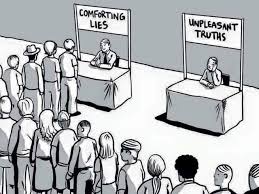
What Can We Do?

If the disease is moral, the response must be moral as well.   We must all:

  • Refuse to lie or accept lies
    • Reject those who tell lies to get ahead for any reason
  • Refuse to worship money and wealth
    • Reject anything to do with the “Prosperity Gospel”
  • Refuse to relate success with goodness
    • Teach that success is not always associated with morality or doing the right thing
  • Teach our children to be responsible
    • Responsibilities are as important as rights. Develop children who accept responsibility for their lives
  • Choose sufficiency over excess
    • Corporate Capitalism thrives on “wretched” excess. Ask yourself what you really need to be happy not what some commercial tells you that you need.

The single most important thing we can all do is to get off the spending train.  Substitute empathy for others for greed.  Substitute kindness for strangers and immigrants instead of suspicion and hatred.  Substitute charity for all for a desire for more stuff and more toys for oneself.  Substitute compassion for the poor and the needy instead of worrying about what you are going to get.  Substitute mercy and forgiveness for hatred and retribution.
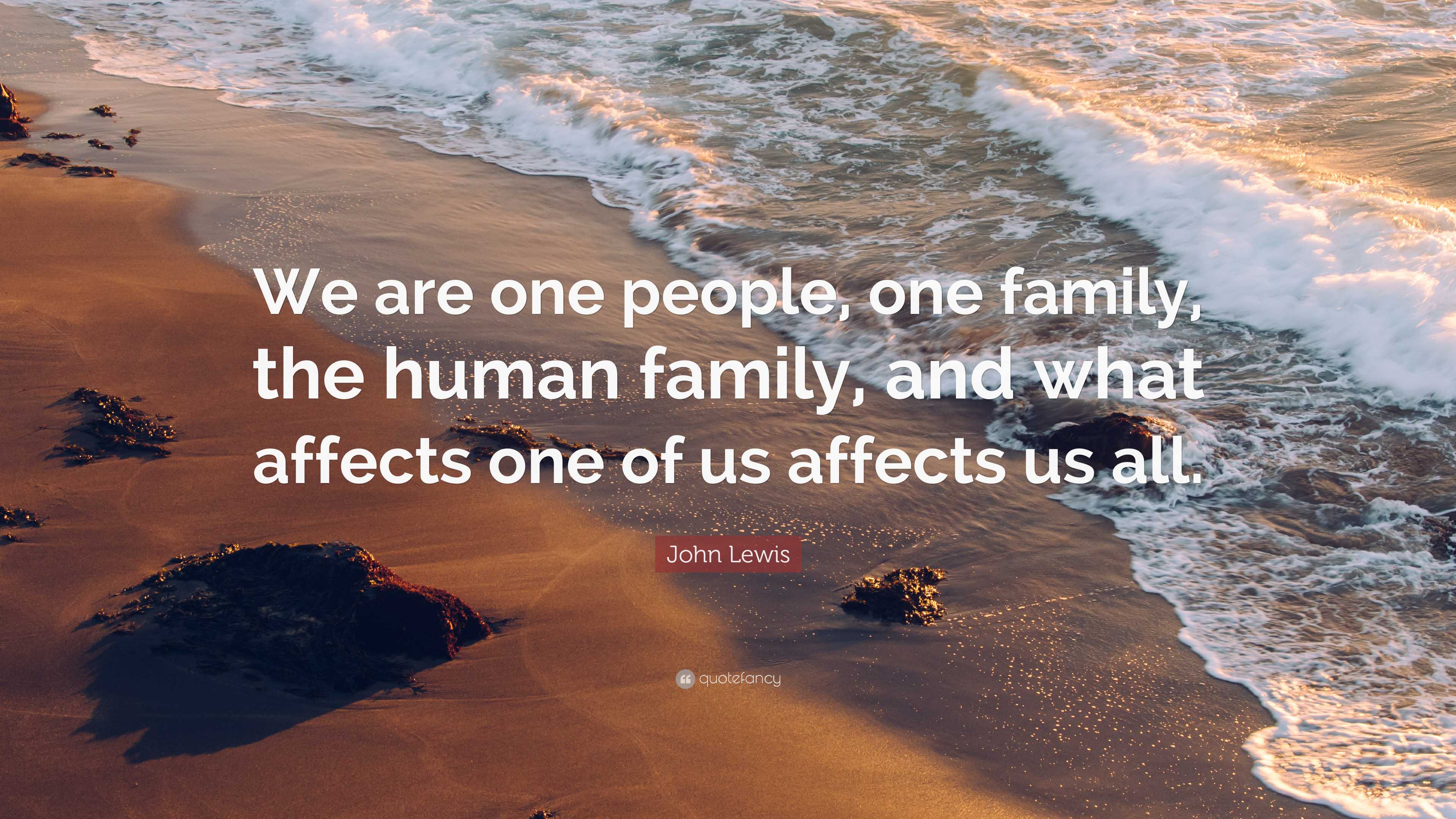
Above all remember that we are all one people.  There are about 180 or more countries in the world.  Karen and I have only been to 45 now, but we have found that everyone in every country that we have been to want the same things:  Meaning for their lives.  Peace for their nation.  Safety for their families.  A decent place to live.  A good meal each day.

We must embrace the idea that everyone is entitled to these elements of a satisfactory life and not just people in our circle or community or nation.  People in every country of every color of every religion and of every political and economic philosophy deserve the same thing.  Life, liberty and the pursuit of happiness.  

Loneliness in America:  A Tragedy of the Commons by J. Persico and Metis – AI Assistant

As I get older, I have noticed more and more people talking about loneliness.  One of my greatest fears has always been loneliness.  I remember embracing the song “Sometimes I feel like a Motherless Child” by Richie Havens.  He was not the first singer or author of this song, but he made it quite popular during the sixties and seventies.  This song reflected how I felt about life and growing up.  I was on my own with no one who loved or cared about me.  No mother.  No loved ones.  Just myself.


“The most terrible poverty is loneliness and the feeling of being unloved.” —Mother Teresa

I grew up somewhat hard and even at times cruel because it was my way of fighting back against the possibility of loneliness that lurked around every corner.  I never trusted anyone because I was sure that they would abandon me and then I would feel the pain of loneliness.  It is hard to describe this pain.  It is not a physical pain.  For me it felt like being thrown off the top of a high mountain or bridge and spiraling down as I waited to hit the ground.  During acute panics of loneliness, I would feel dizzy and lose my sense of balance.  My core felt empty.  I was shrouded with feelings that embraced despair and contempt for myself.  There was nowhere to run or anyone to turn to.  I was alone on an island barren of people, trees or any living creatures.  Not like purgatory and not like limbo.  Just a nothingness in which I existed with no other human beings.
“When you have nobody you can make a cup of tea for, when nobody needs you, that’s when I think life is over.” —Audrey Hepburn

I dreaded these feelings and would do anything to avoid them.  I would abandon other people before they could abandon me.  This destroyed many relationships I had over a period of years including my first marriage and to some extent the relationship I had with my daughter.  It continues to intrude on my life whenever I feel threatened with the loss of love in my relationship with Karen.

“You can be lonely even when you are loved by many people” — Anne Frank:

I tell you these things not because I want sympathy or any feelings of support.  I want you to know that I take loneliness more seriously than many other elements of life that cause us pain.  For this reason, I want to look at loneliness and what seems to be behind the increase that many people say is happening in America.  If one asks well, “Define Loneliness” or what data do you have that supports loneliness is on the increase in America, I am going to plead “Mea Culpa.”  I don’t have the requisite data to prove conclusively that loneliness is an epidemic as some have claimed.  But frankly, I don’t give a damn.  If there is one person in America or the world that is suffering from loneliness, that is one person too many for me.  However, there is in fact some data to support the five major trends that I am going to discuss later in this blog as contributing factors to the loneliness that so many people experience.

“There were moments of intense pain & utter darkness that I wanted to end it all.  The only thing I wanted was not to live.” ― Lala Agni,

For those of you that are not convinced that loneliness is a problem today.  Here are some facts and data that point in that direction.  Because surveys define loneliness differently (daily vs weekly vs “often”), the cleanest approach is to present a small set of credible, recent benchmarks.  Here are some that my AI assistant Metis found:

  • Gallup (daily loneliness): 20% of U.S. adults reported feeling lonely “a lot of the day yesterday” (Aug 27–Sept 4, 2024), up from ~17–18% earlier in 2024 and below the pandemic peak of 25%. Gallup.com
  • Pew Research Center (frequency): 16% say they feel lonely/isolated all or most of the time, 38% say sometimes, 47% hardly ever/never (report published Jan 2025). Pew also finds adults under 50 report “often” loneliness more than 50+ (22% vs 9%). Pew Research Center
  • Harvard “Making Caring Common” (overall prevalence): A nationally representative May 2024 survey found 21% of U.S. adults feel lonely. Making Caring Common
  • AARP (older adults trend): Among adults 45+, AARP reports 40% are lonely (fielded Aug 2025), up from 35% in 2010 and 2018. AARP
  • Workplace-focused lens (Cigna Group): “More than half of American workers classify as lonely,” with the report tying loneliness to absenteeism, disengagement, and turnover risk. MediaRoom

Depending on how it’s measured, loneliness shows up in anywhere from about one in five Americans to well over half in some surveys—especially when you ask about frequent feelings or focus on workplaces.  Gallup found that 20% of respondents felt lonely ‘a lot’ on the prior day, Pew found 16% of respondents feel lonely all or most of the time, and the nation -wide Harvard survey put overall loneliness at 21%.”

Now lets look at five of the reasons commonly cited for the increase in loneliness in America. 

1) We spend less time “doing life” with other people

Large-scale time-use data show Americans are less likely to socialize on a given day than a decade ago, and when we do, we spend less time at it.  In 2024, BLS reports 30% socialized/communicated on an average day (down from 38% in 2014), and average time fell from 43 minutes to 35 minutes. – Bureau of Labor Statistics

I often ask my students what they are going to do on the weekends.  The majority of times, the reply I get reflects their intentions to stay home and play video games.  I find it amazing that they are not going to go out to a park to play sports with other people.  Instead, they are going to interact with their friends through the digital world.  We all see this today wherever we go.  People texting and playing video games in restaurants, bars and parks, rather than talking or interacting with others.  We may not want to admit it, but older adults can be just as addicted to their phones as children seem to be.

2) Social networks are shrinking (fewer close confidants, weaker “bench strength”)

The Surgeon General’s advisory summarizes evidence that social networks are getting smaller and social participation is declining and cites research showing a steep drop in daily social time (e.g., “companionship/social engagement”) from 2003 to 2020.  That same advisory highlights the broader “fraying” context—lower trust in each other and institutions—which makes connection harder to initiate and sustain.

Once upon a time family dinners on Sunday were a major social event in the lives of most Americans.  Today, large-scale displacement of families now make such events almost impossible on a weekly basis.

3) Demographic and household shifts leave more people without built-in companionship

The Surgeon General’s advisory points to long-run declines in marriage rates and family size, plus a rise in single-person households (e.g., 13% in 1960, rising substantially over time).  That matters because for many people, spouses/partners, kids, and nearby kin are the default daily social glue.

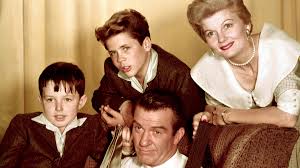
There is probably no place in America where “Leave it to Beaver”, “Father Knows Best” or “Ozzie and Harriet” families are the norm anymore.  Two parent families are becoming rarer and rarer.  Many young people opt for simply living together either to avoid a commitment that they are apparently not willing to make or else feel that they could not keep.  You can argue about the value of a traditional relationship all you want.  I am not going to argue that children must be brought up by a Mom and Dad.  However, having two or even more adults to help in child raising has always made the task somewhat easier.  Many years ago, the task of child raising was presumed to be a communal or extended family activity.  Few homes today include a mom, dad and grandparents.

It is even rarer to find homes where either parent is home to simply look after their children.  The economics of modern life demand that both parents have jobs.  It is unbelievable to me when I remember that my father was only a postal worker and never a manager and that my mother stayed home with four kids.  Nevertheless, we had a tidy small home in a small town and food on the table every day.  We might even have had a lot more if my father was not a compulsive gambler spending his earnings or at least a portion of them on the horses.

4) Erosion of “third places” and community institutions

Over the years, there has been declining participation in traditional community anchors—religious groups, clubs and labor unions.  When these institutions fade, people don’t just lose activities; they lose the repeated, low-effort contact that turns acquaintances into friends.

If you are my age, you may remember the large number of social networks that people once belonged to from Camp Fire Girls to Girl Scouts to Boy Scouts to Fraternal groups like the Elks, Moose, Eagles,, Masons, and Shriners.  Churches were another source of community for many people.  I will repeat that the data shows sharp declines in participation in all of these groups.

5) Technology reshapes connection (often replacing, not enriching, relationships)

The Surgeon General’s advisory is careful here: the evidence is “complex,” but there are documented benefits and harms, and it concludes we have reason to be concerned about certain kinds of tech use affecting relationships and social connection.  Once upon a time, it was claimed that TV would destroy family life.  Then it was the Internet.  Now it is the social media programs.  Experts seem to pop up to dispute that any of these technologies have had or are having an adverse impact on socialization.  However, common sense argues against the wisdom of paid shills who benefit and profit from the exploitation of others via the media platforms that they shill for.

So How Do We Address the Loneliness that Exists in our Country Today?

This is a very difficult question to answer.  Lets start by describing what we are not going to do.

  • We are not going to eliminate TV or streaming digital media. This is not likely to happen given the number of hours people spend in front of TV’s.
  • We are not going to eliminate or ban Smart Phones. This will never happen as they serve too many good uses and are now a necessary part of doing business in the world.
  • We are not going to ban social media groups or make participation in real time groups like church or fellowship groups mandatory. This would involve a gross violation of the freedom and individual rights that people have.

Where Do We Go from Here?  Three Realistic Ways Forward

  1. Rebuild everyday human contact—where people already are

Loneliness will not be solved by telling people to “try harder” or “get out more.” It will be addressed when we intentionally rebuild regular, low-effort human contact into the places people already show up: libraries, senior centers, veterans’ halls, walking paths, coffee shops, classrooms, and clinics.  What matters is not the size or novelty of these efforts, but their consistency.  A weekly discussion group does more than a one-time event.  A familiar face does more than a thousand online “connections.”  Human bonds form through repetition—by seeing the same people, in the same places, over time.  We once understood this intuitively. Community was not something we scheduled; it was something we inhabited.  Recreating that does not require nostalgia or ideology—only intention.

When Karen and I moved to Wisconsin after she retired, we discovered several places in Frederic, Wisconsin where people would meet.  The farmers met in the Dairy Coop.  The literary people met in the library.  The mechanically oriented people met in the Holiday Gas Station.  We lived in Frederic for 14 years and knew about everyone in town.  The meetings at the venues mentioned above went on every day when each venue was open.

Before we left Frederic to move to Arizona permanently, the library had decided not to allow meetings anymore.  We were too noisy they said.  The Holiday Station took out the table and chairs that we had set around claiming the space could be used for more products.  The Dairy Coop caught fire and was not rebuilt.  This past year, the Safeway store in Casa Grande removed the outside tables they had where people could rest and not be in the way of food carriages.  You could sit, drink coffee and carry on a conversation with friends.  It seems as though all over America there is a conspiracy to eliminate places where people can socialize.

  1. Reclaim in-person connection as the default, not the exception

Technology has given us extraordinary tools, but it has also quietly taught us that presence is optional.  Texts replace visits.  Zoom replaces conversation.  Scrolling replaces sitting with one another in silence.  This does not mean rejecting technology.  It means re-establishing boundaries.  Phones down during gatherings.  In-person meetings when distance allows.  Choosing eye contact over convenience when the choice is ours to make.  Loneliness is not cured by communication alone; it is cured by being seen.  And being seen requires physical presence, attention, and a willingness to tolerate a little awkwardness.  The cost of connection has gone up—but the cost of avoiding it is far higher.

“Society is the product of our relationships – if our relationships are confused, egocentric, narrow, limited, national, we project that and bring chaos into the world.” — Krishnamurti

A few years ago, my wife’s adopted daughter came out to visit.  She had her cell phone with her and spent more time on the phone than she did talking to us.  I was very peeved and told Karen, next time she comes tell her to leave her phone in her luggage.  Realistically now though, how do you think this would go down?  Parents fight schools that want to ban cell phones in the class because they say, “What if I had to call my son or daughter or they have to call me?”  It is amazing that we grew a nation of people long before we had cell phones.
  1. Treat loneliness as a shared moral responsibility, not a private failure

Perhaps the most damaging myth about loneliness is that it is a personal shortcoming—a sign of weakness, poor social skills, or individual failure.  When loneliness is framed this way, people hide it.  And hidden loneliness only deepens.  A healthier society would name loneliness for what it is: a civic and moral challenge.  One that affects public health, democracy, trust, and social stability.  One that cannot be solved by individuals acting alone.

A simple but powerful starting point would be for organizations, churches, employers, and communities to ask regularly: Who has disappeared from our circles—and why?” and “How can we create more shared space for people to communicate and get to know each other.”  

My wife Karen has been in a choir for over ten years now and she often does not know the names of new members or even all the old members.  I asked her why several times and I always get the same response “Well, we don’t get time for socializing as we are busy practicing our songs for the Sunday service.”  This seems criminal to me.  I never started a business meeting that I facilitated without going around and allowing each person to introduce themselves and say a little about their background.  What is so important that we cannot take a few minutes to let others know we care about who they are?

A final thought

Loneliness in America will not be solved quickly, cleanly, or perfectly.  In fact, it will not be solved at all unless we decide—quietly and collectively—that showing up for one another is not optionalConnection is not a luxury.  It is the infrastructure of a humane society.

Martin Luther King Jr. developed the concept of an “inescapable network of mutuality” where the fate of individuals is interconnected.  He also stressed the mutual obligation individuals have for each other’s development.  King emphasized that unity is crucial for survival, stating, “We must learn to live together as brothers or perish together as fools.”

Reaching out should not be seen as charity.  It should be seen as a survival skill.  It should reflect Love, Empathy and Compassion for others.


Bringing Generosity to Others

I work with a program called “I Could Be.”  It is a program for mentoring high school age students.  A student (mentee) is matched up with an older qualified person (mentor) for a program of exploration and discovery.  The mission of iCouldBe is to “Provide high school students with an online community of professional mentors, empowering teens to thrive in school, plan for future careers, and achieve in life.”  I am on my fourth student mentee.  The program begins at the start of each school year.  The student I was matched up with this year was name (Juan).  That is not his real name.  Neither of us are actually allowed to identify our real names or where we live.  This confers a needed degree of security for the students. 

At the start of the program, my mentee and I go through a series of introductory exercises to get to know each other.  Juan completed some questions and one pertained to what he wanted to be when he was older.  He said he wanted to be rich and famous.  I asked him what would he do with the money if I gave him a billion dollars.  He replied, “I would give it to my family so that they would not have to work.”  I was very impressed by his generosity.  I told Juan that generosity is a very good quality in a person to have.

I started thinking about the concept “Generosity.”  I did a search in my 1700 blogs and found that I had never directly addressed the subject.  Such an important subject and few if any words from me on how important Generosity is.  Ergo, I decided to write this blog on the subject of Generosity.  Lets start with a dictionary definition and then a WIKI definition so that we are all on the same page.

Webster’s definitions of Generosity include readiness or liberality in giving, freedom from meanness or smallness of mind, and a generous act.  This is the primary definition, emphasizing a willing and free giving of time, money, or other valuable things.

Wikipedia says this about Generosity:  Generosity (also called largesse) is the virtue of being liberal in giving, often as gifts.  Generosity is regarded as a virtue by various world religions and philosophies and is often celebrated in cultural and religious ceremonies.

One important thing to note is that generosity is not limited to money.  It may include time, material goods, jewelry or “other valuable” things.  Now we can have a secular version of Generosity, or we can have a sectarian version of Generosity. 

Sectarian Generosity:

Leans on God, scripture, spiritual duty, and the idea that giving transforms the soul.  Jesus said, “It is more blessed to give than to receive.” — Acts 20:35 

Muhammed said, “The believer’s shade on the Day of Resurrection will be his charity.”  — Tirmidhi

Secular Generosity:

Leans on empathy, human dignity, and the belief that giving transforms society.  Albert Einstein, said, “A hundred times every day I remind myself that my inner and outer life depend on the labors of other men… and that I must exert myself in order to give in the same measure as I have received.”

Confucius wrote that, “The superior man is distressed by his own lack of ability, not by the failure of others to appreciate him; he seeks to give more rather than to receive more.”  — Analects 15:18

Both types of generosity are deeply moral.  Both alleviate suffering.  But they grow from different roots and flower in different ways.  In marketing we talk about the “target” audience.  This is not a concept endemic to philosophy or religion but hails from MBA programs in business schools.  Despite my anathema to strict application of business principles to either religion or philosophy, there is some considerable merit in considering this business concept in terms of secular versus sectarian. 

In a Sectarian community, we can talk about Generosity as it applies to those we know.  We can limit the largesse that we give to those in our inner circle, to relatives, friends and members of our immediate communication.  There is no prescription in most churches for being generous to those outside of our domain.  If I tithe, give to my church and help the poor whom I can identify with, I may be considered a very generous person.  There is no stigma in many religious groups if I don’t want to be generous to welfare people, poor people in other countries, undocumented immigrants or people of other race or other religions.  These exceptions would astonish Jesus who taught that being a follower involves welcoming the stranger, as demonstrated in Matthew 25:35: “I was a stranger and you invited me in”.  We might call these people “Fake Christians,” “Pretend Christians,” hypocrites, or simply selfish.  You would be wasting your time trying to open their eyes with such labels.  It would do no good since their core beliefs are unfortunately supported by those in their inner circle. 

In the Sectarian community, the concept of Generosity may not be much better off.  There are large numbers of non-religious people who support the arts, music, education and health care.  The caveat though is that the people they give the money to are deemed worth the expense.  The Sectarian community is proud to support a hand up and not a handout.  People who qualify and meet certain requirements can get some measure of Generosity.  Those who are not “eligible” are excluded from any Generosity.  It is easy to forget that many people are sick and disabled.  Thousands of people in the USA cannot climb up a ladder.  They are put into a pot labeled “undesirables.” 

So, what does it really mean to be generous?  This story is about a friend of mine named Frank.  It happened one day when we were both coming out of the local IGA store with our wives.  I call it the: “The Last Pair of Gloves”

The first cold front of December rolled into the Sonoran desert like an unexpected guest, sharp and biting.  Frank stood outside the IGA store, pulling his jacket close as he waited for Juanita to finish shopping.  Beside the entrance sat an old man, thin as the winter wind, a cardboard sign resting on his knees: “Anything helps.”

His hands caught Frank’s attention.  They were trembling—not from age alone, but from cold. His fingers were blotched white and red, exposed to the air with only a thin flannel shirt to cover his arms.

Frank felt for his pockets.  He had no cash on him—not unusual these days.  But he did have one thing: his gloves.  Soft fleece-lined leather, a gift from Juanita years ago.  He loved those gloves. They were worn just right, molded to his hands, comfortable in a way only time could produce.

He hesitated.

Inside the store, carols played faintly, muffled by the automatic doors.  People hurried by with carts full of holiday cheer.  Nobody stopped.  The old man’s hands kept shaking.

Frank stepped forward.

“Sir,” he said softly, slipping the gloves from his own hands, “you need these more than I do.”

The man looked up, startled.  For a moment, he didn’t speak.  He just stared at the gloves resting in Frank’s outstretched palm as if they were something far more precious than leather.

Then his eyes filled.

“I—I don’t know what to say,” the man whispered.

“Merry Christmas,” Frank replied.

Juanita walked out just then, her cart filled with groceries. “Where are your gloves?” she asked.

Frank smiled, his fingers already numb.  “Right where they belong.”

And as they walked toward the car, he told me later — that his hands began to feel warmer than they had in years.

Frank did not ask to see the man’s papers.  Frank did not ask the man to perform any reciprocal services for the gloves.  Frank did not decide that he was an “unwanted” immigrant and should be sent back to Mexico.  Frank did not ask what religion he belonged to, where he went to church or whether or not he believed in God or Trump.  Frank gave something up that was very valuable to him because he saw someone that needed it more than he did.  This is the essence of Generosity.  This is what Generosity is all about.  Generosity is more than tithing to your local church.  It is more than taking an angel off the giving tree.  It is more than buying toys for tots.  It is more than donating a turkey to the Salvation Army Christmas dinner.  To paraphrase Paul from 1 Corinthians 13:

“Generosity is patient, Generosity is kind.  It does not envy, it does not boast, it is not proud.  It does not dishonor others, it is not self-seeking, it is not easily angered, it keeps no record of wrongs.  Generosity does not delight in evil but rejoices with the truth.  Generosity always protects, always trusts, always hopes, always perseveres.”

Until we learn the real meaning of Generosity, we will have learned nothing about being human, being kind, being loving or being compassionate.  Generosity does not start with your family and end with your family.  Generosity is for the entire human race.  Generosity recognizes no borders, no race, no religions, no genders.   

Here are some quotes to think about: 

Warren Buffett

“If you’re in the luckiest one percent of humanity, you owe it to the rest of humanity to think about the other 99 percent.”

Mother Teresa

“It is easier to give a cup of rice to relieve hunger than to relieve the loneliness and pain of someone unloved.”

Martin Luther King Jr.

“Life’s persistent and most urgent question is, ‘What are you doing for others?'”

Kahlil Gibran

“You give but little when you give of your possessions.  It is when you give of yourself that you truly give.”

Anonymous, The Holy Bible: King James Version

“Do not neglect to show hospitality to strangers, for by doing that some have entertained angels without knowing it.

Gautama Buddha

When giving to others do not linger on thoughts of a giving, what was given, or the one who has received.

Show your gratitude for life this Thanksgiving by giving to others without conditions who have less than you do. 

The United States of America: Are we a Country without Empathy?

You destroy anything when you withdraw empathy from it.  When you don’t care about anything you are on the path to destroying it.  You destroy a country when there is no empathy for its institutions or cultures.  When you withdraw empathy from a countries values and principles you can find it easy to destroy them.  You destroy people when you don’t have any empathy for them.  When you withdraw empathy from anyone or anybody it is easy to destroy them.

It has ever been the same formula throughout history.  From the Ancient World to the Medieval World to the Industrial World and now to the Information World, destroy empathy for the things and people you hate and then you can destroy them. 

What is empathy you ask?  How is empathy different from sympathy and compassion and mercy?  I won’t bore you with any dictionary definitions or twist your brain with some pure academic definitions.  Here are my thoughts on what empathy is:

Empathy puts you in the other person’s shoes, heart, soul and mind.  When you have true empathy for someone you stand inside them not beside them.  Mercy, compassion and sympathy leave you outside the person.  I feel sorry for you.  I feel bad for you.  I will give you something to make you feel better or to help you out.  However, I do not feel the pain that you do when I simply have sympathy for you.  My friend Jaine says that empathy is essential for mercy and compassion.   I think she is right, but we must start with empathy.  Without empathy, we are merely kind and thoughtful.  We have empathy for one another when we become one with the other.  Their heartache is our heartache.  Their suffering is our suffering. 

The other day while waiting for my wife to finish her Senior Fit class at the Casa Grande Community Center, I picked up the local newspaper.  The Casa Grande Dispatch had an article about a new bill being proposed by the Republicans in the Arizona Senate.   The bill SB-1268 would require hospitals to inquire whether or not the patient was here legally before providing healthcare treatment.  Many empathetic people are concerned that it would deter people who needed treatment from getting it.  The bill’s sponsor said that she does not care.  “They should stay in their own countries if they want to have care”, said Wendy Rogers during a hearing on her legislation.  What do you think Ms. Rogers would say if this was her mother or father or sister or brother?  What if it was a friend or relative of yours?  What would you say?  Is Ms. Rogers one heart short of empathy?  Do you think she ever read the inscription inside the Statue of Liberty?  One stanza of the inscription therein states the following:

Give me your tired, your poor,

Your huddled masses yearning to breathe free,

The wretched refuse of your teeming shore.

Send these, the homeless, tempest-tost to me,

I lift my lamp beside the golden door!”

Why don’t we just knock down this wretched statue?  It would appear that its message is no longer accepted or believed in by millions of Americans.  I am sure Elon Musk would approve of its destruction.  He could use Ellis Island as a new departure point for his Mars expedition.  After all, here is what Musk had to say about empathy:

“The fundamental weakness of Western civilization is empathy.”

This lack of empathy seems to be a major theme running throughout the Republican Party. 

I asked my wife’s pastor one day why he thought that so many conservative Christians wanted to post the Ten Commandments of Moses from the Old Testament in city halls all over the country, but I had never heard of one effort to post the Eight Beatitudes from Jesus’s Sermon on the Mount any place.  Would not Christians be more expected to support the words of Jesus than the words of Moses?  His comment was that many conservative Christians felt the words of Jesus were kind of wimpy.  Interesting that Jesus’s empathy for humanity is regarded as wimpy. 

It had not been 12 hours since the new pope was elected before the so-called Christian Right was attacking him.  Following in the footsteps of his predecessor Pope Francis, the new Pope Leo XIV would seem to be a human who had empathy for the poor and hungry and dispossessed. 

Transcript: MAGA Fury Boils Over at New Pope’s “Anti-Trump” Views

“Leo is known to share some of the same priorities as Francis, particularly when it comes to the environment and outreach to migrants and the poor, according to The College of Cardinals Report, a resource created by a team of Vatican journalists.”  Google AI

Read closely and you will see why Pope Leo XIV is anathema to Trump and his supporters.

  1. He would protect the environment
  2. He would protect immigrants
  3. He would protect the poor

Imagine a Christian who would dare have empathy for these people and the world. 

Now if I seem biased and oblivious to the limitations of empathy, let me point out that throughout history, there have been many great leaders who have had little or no empathy for humanity.  Some of the most notable people and notable categories are:

  • Attila the Hun
  • Genghis Khan
  • Mussolini
  • Stalin
  • Hitler
  • Most slave owners
  • Climate change deniers
  • Greedy billionaires

 It certainly seems like you can go far in this world by substituting cruelty and greed for empathy and compassion.  I will end this blog with the following thoughts on empathy:

“Our bodies have five senses: touch, smell, taste, sight, hearing.  But not to be overlooked are the senses of our souls: intuition, peace, foresight, trust, empathy.  The differences between people lie in their use of these senses; most people don’t know anything about the inner senses while a few people rely on them just as they rely on their physical senses, and in fact probably even more.”  C. JoyBell C.

“Highly sensitive people are too often perceived as weaklings or damaged goods.  To feel intensely is not a symptom of weakness, it is the trademark of the truly alive and compassionate. It is not the empath who is broken, it is society that has become dysfunctional and emotionally disabled.” ― Anthon St. Maarten

“I do not ask the wounded person how he feels, I myself become the wounded person.”  ― Walt Whitman, Song of Myself

“Self-absorption in all its forms kills empathy, let alone compassion.  When we focus on ourselves, our world contracts as our problems and preoccupations loom large. But when we focus on others, our world expands.  Our own problems drift to the periphery of the mind and so seem smaller, and we increase our capacity for connection – or compassionate action.”  ― Daniel Golema

This Link leads to a thread on Facebook with some interesting quotes and comments on empathy in America today: https://www.facebook.com/photo.php?fbid=1125366842958078

Some Recent News Reports Showing a Complete Lack of Empathy for Humanity.  If you have any please share in my comments and I will post as an addendum to this blog. 

DOGE Is Bringing Back a Deadly Disease”

Silicosis is typically caused by years of breathing in silica dust at work, and can worsen even after work exposures stop. In recent years, after decades of inaction, the federal government finally took several important steps to reduce the incidence of this ancient and debilitating disease. Under the Trump administration, all that progress is going away, in but one example of the widespread destruction now taking place across the federal government. —- The Atlantic, 

Tennessee’s GOP leads the fight to deny public education to children without documents 

The sponsors of the proposal have largely downplayed denying children the right to education, but instead have focused on the fiscal impact states are facing in educating children residing in the U.S. illegally.  —– US News, AP

Who gives a damn about the poor, the sick, the hungry and the needy? 

Who gives a damn about the poor, the sick, the hungry and the needy?  According to Pastor John Pavlovitz, it is not the Republicans who voted unanimously on a budget to cut 2 Trillion dollars from aid programs for the needy.  It is not the Evangelicals who Pastor John says put altar calls and prayer ahead of any direct aid to the “marginalized.”  It is also not the many Conservative Christians who say that the Government should not be responsible for the poor and needy but who have yet to devote any money to help those in need, unless of course they be friends or family members.

Pastor John writes, “We’re not witnessing an overwhelming outpouring of compassion from Conservative church folk who have declared that they’re going to repair the homes and make the lunches and pay for the surgeries and watch the children for the tens of millions about to be kicked to the curb by this Conservative leadership—and we shouldn’t be holding our breath.” — “The Christians Mocking Jesus and Defunding the Least of These” — John Pavlovitz, 2-25-25

Tribalism reigns supreme among Conservatives.  My first responsibility according to VP Vance is to take care of my family, then my friends and then my immediate social network.  To hell with the needy who I do not know or who do not live in my social circle.  It is out of sight, than out of mind.

You might argue that we cannot afford all of these social causes.  That is a lie.  It is a matter of priority.  Consider that our military budget is greater than the next highest nine military budgets in the world.  Consider that we have given billions in foreign  aid to the Ukraine and Israel to arm themselves with guns and bombs.  Consider that our tax breaks for the rich have resulted in a situation where the rich are worth hundreds and sometimes thousands of times what even the average middle-class American is worth.

Average Wealth:  The mean household wealth for the top 0.1% is more than $158.6 million.

The Average American Family:  The mean income for all American families is $136.000

Top 1% Wealth:  The top 1% (including the top 0.1%) holds a staggering $49.2 trillion of wealth.  That is 31% of the total wealth of America.

The Bottom 50% of American Families, own just 1% of the wealth in the U.S., with 13.4 million of these families having a negative net worth.

But who gives a damn about income inequality.  These people are losers.  They are lazy or stupid.  Too many of them sit home all day expecting a handout.  All they need is motivation.  A good kick in the ass would get them going.  No one gave me anything!  All I ever needed was a hand-up not a hand-out!  Why should I have to take care of them.  Some of these people make a fortune on government handouts.  Let them win the lottery.  I have a hard enough time paying my own bills.

I walk down a typical American street.  Today I pass by an old woman dressed in the latest “unfashion.”  She is not carrying a Gucci handbag.  In fact, she does not even have a handbag.  She is pushing a shopping cart.  Everything she owns is in a shopping cart.  It is not a Mercedes shopping cart either.  She is moving from one side of town to another so that she can find a new place to set up for the coming evening.  She has learned not to stay in one place too long or the police will move her out.

Yesterday, I passed a homeless Veteran on the streetcorner carrying a sign that reads, “Veteran needs money for food.” I volunteer a few days each month at our local Veterans center.  I am there to help Vets that come in with problems.  Recently, I spent three days trying to help an 80 percent disabled Vietnam veteran get some state assistance under a mobility grant so that he could afford a walk-in shower.  We never got to complete the online form required by the grant.  Every other page had some type of document required to complete the form.

Joe (the Vet) has been asked to provide Proof of Service, Proof of Home Ownership, Proof of Homeowners Insurance and several other proofs.  He has had to come back three times to the center.  Each time he wonders why they just did not state all the forms needed before we started.  A question that I have no answer to.  I have to scan all these forms in as Joe does not have a computer at home.  As I write this, we still have not completed all the paperwork.  He has not returned yet with the remainder of the forms needed.

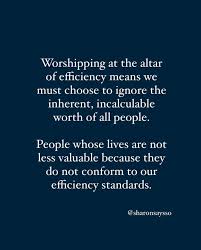
We can send Israel 3.5 billion dollars a year, but we can’t make it simple for a disabled war veteran to obtain a walk-in shower.  For the amount of money we send to Israel each year we could build 350,000 walk in showers.  But who gives a damn about the poor and needy.  And now some idiot with a chainsaw is going to cut thousands of jobs in Social Security, The VA and other government organizations to improve efficiency.  I worked for fifteen years with Dr. W. E. Deming, and other quality greats.  Dr.  Deming always said you improve a process with a scalpel not with a meat cleaver.  When you use a cleaver you cut the muscle and bone along with the fat.  This is no way to improve the efficiency of any process or organization.

By the way, I am not against aid programs to other countries in need.  However, the aid we send to Israel does not help the sick and needy.  Mostly it is used to build guns and bombs or buy guns and bombs.  But our President stops aid to countries where people are starving so he will have more money to give to his rich supporters.

Losers and more losers.  How come so many people need a handout?  

A few years ago, I happened to catch a glimpse of a popular TV show called Bridezillas.  The prospective bride was shopping for a $20,000 bridal gown and screaming, “It’s all about me!  It’s all about me!”  I suppose many people watched this program and enjoyed seeing the little spoiled brat ranting and ranting.  This is a “reality” show.  The real reality is that fifty percent of Americans today are this little spoiled brat.  How many people ranting about Immigration have ever been molested by an immigrant?  How many people wanting to build a border wall have ever lost their jobs to an immigrant?  How many people complaining about illegal immigrants want to do the hard menial work that I see so many immigrants doing all over the USA.  From Arizona to Michigan to Rhode Island to Wisconsin, I have seen dozens of migrant workers doing work that Americans feel is beneath them or does not pay enough.

We complain about poverty and people taking handouts, but our kids are not willing to work anymore because they are too busy playing video games.  We complain about taxes, but we can buy designer clothes, designer shoes, designer weddings and designer handbags.  We complain about inflation, but it does not stop us from eating out at expensive restaurants.  We complain about the price of eggs and gasoline, but we drive $85,000 gas guzzling pickup trucks so that we can be cool.

I inquired of a few people I met recently “How could you vote for a man who is vindictive, unethical, lies like crazy and loves to humiliate other people.”  I was told the same thing by each person I asked, “I don’t care about his personality as long as he gets rid of the immigrants and lowers my taxes.”  Who are the selfish greedy spoiled brats in America?  As Pogo said, “ We have met the enemy, and he is us.”   

The Conservative Evangelicals have bumper stickers and wear t-shirts that read, “What Would Jesus Do.”  I don’t claim to be a Christian and I don’t claim to be a very religious person, but I don’t think Jesus would kick the immigrants out, kick people out of their jobs and stop aid for the people in America and the world who are most in need of help.  The pastor at our church always says, “Give me Jesus, they can have all the rest.”  I don’t think he would want a Jesus who said, “It’s all about me!  I want my taxes lowered and these lazy poor people put to work right after we get rid of the immigrants”

I repeat my question:  “Who gives a damn about the poor, the sick, the hungry and the needy?”  Are you proud to say that you are not your brothers keeper?

“The path of the righteous man is beset on all sides by the iniquities of the selfish and the tyranny of the evil men.  Blessed is he who, in the name of charity and goodwill, shepherds the weak through the valley of darkness, for he is truly his brother’s keeper, and the finder of lost children.” — Ezekiel 25:17

“Try Honey Before Vinegar” – Lessons on Leadership from Abraham Lincoln

America has lost the “Art of Leadership.”  We no longer develop men and women with integrity or selflessness.  Instead of Statesmen, we have political hacks only concerned with getting reelected.  Politicians with no backbones or the courage to stand up against injustice.  We have a Congress of sycophants willing to do whatever they are told to do regardless of how unethical or immoral it may be.  We have thousands of lawyers who do not uphold justice but find arguments to support an amorality that meets the letter of the law but ignores the significance of decency, goodness, honesty, conscience and fairness.

In this blog and the ones to follow,  I will write about insights regarding leadership from one of the greatest American leaders and Presidents of all time.  I found a compilation of these in an old collectors edition of “Civil War Times” published in Winter, 2013. There are 41 in total, and I have already covered the first in a previous blog.  I would like for you to hear the words of Abraham Lincoln and what he had to say about leadership.  I will include some of my own experiences from my years of working with senior management in over 32 organizations.  Some of the men and women I worked with were incredible leaders.  Most of them wanted to be better leaders and that is where I brought the teachings and thoughts of W. E. Deming to my consulting practice.  Dr. Deming achieved extraordinary results in business by tapping the knowledge, skills and abilities of ordinary people.  Senator Hubert Humprey famously said that “Democracy is a system that achieves extraordinary results with ordinary people.”

Insight # 2 – Try Honey Before Vinegar: 

Lincoln said, “If you would win a man to your cause, first convince him that you are his sincere friend.”  Springfield, Illinois, 2/22/1842

This seems to be a principle or idea that is not very well understood by many people today.  I constantly hear people tell me that if you want to change people’s ideas about things, you must “empathize with them.”  “You must really listen to them.”  To these admonitions, I say “Bullshit.”  You can listen to some fanatics all you want to, and they will still totally ignore anything you say that does not fit in with their preconceptions or ideology.

A good woman friend of mine and I were arguing about Trump and his supporters.  Repeatedly in every argument, she would say “John, you just have to really listen to them.”  I finally got tired of hearing this refrain and one day I challenged her.  I said, “Tell me one, only one, Trump supporter you have listened to who has changed their mind.”  She was dumbfounded.  She was stumped.  She was bewildered.  She could not think of one.  Months went by.  I would occasionally rub salt into the wound, “Did you change the minds of any Trump supporters today?”

You can listen to others all you want.  You can listen to hell freezes over.  You will not change a fanatic or zealot’s ideas by listening.  But Lincoln was smarter than all the psychologists we have today put together.  He knew that it would take more than listening to get others to think differently or to appreciate your ideas after you have heard theirs.  It takes believing and feeling that you are a “Sincere” friend.  Not just a Facebook friend or some online friend, but a “Sincere” friend.  Plato talked about the various types of friends, but he said nothing about a “Sincere” friend.  So, what is a “Sincere” friend and what does it take to make someone believe that you really and truly are a “Sincere” friend?  Let’s first define the meaning of “Sincere.”

An online dictionary defines “Sincere” as:

“Free from pretense or deceit; proceeding from genuine feelings.”

Wikipedia defines the virtue of Sincerity as follows:

“Sincerity is the virtue of one who communicates and acts in accordance with the entirety of their feelings, beliefs, thoughts, and desires in a manner that is honest and genuine.  Sincerity in one’s actions (as opposed to one’s communications) may be called ‘earnestness”’.

I think the word “Sincere” has a lot to do with integrity, honesty, trustworthiness and truthfulness.  The Jewish have a word for a person who is sincere and honest called a Mensch.  In Yiddish, a Mensch roughly means “a good person”.  The word has migrated as a word into American English with a Mensch being a particularly good person, similar to a “stand-up guy”.  A Mensch is a person with the qualities that one would hope for in a friend or trusted colleague.

I think we can now answer the question, “What does it take to impact someone’s ideas and ideology?”  The answer is very simple.  If you want to have someone listen to your ideas, you must be a Mensch or at least a very “Sincere” friend.  When I think about the people we elect to political leadership, I am struck by the lack of Menschs in either Congress or the Legislature.

In fact, I would argue that we have the exact opposite.  We have people you would not trust with a nickel.  People who we know will change their mind at the drop of a lobbyist’s donations.  Congresspeople, who continually lie to cover their malfeasance and incompetence.  Ask anyone of them what they do all day long and they will deny that they spend about 80 percent of their time fundraising for their next election campaign.

Try to suggest some new ideas to them as I have done countless times, and you will get the following answer, “I am very busy but send me something and I will look at it.”  Don’t hold your breath my friend.  You will die of asphyxiation before any of them, Democrat or Republican will ever get back to you.  However, mention that you are thinking of a large campaign contribution and doors will open in a New York minute.

Let us think of a scenario wherein a Trump supporter meets a Trump opponent.  We will call Mary the Trump supporter and Joe the Trump opponent.   Neither of them have ever met before and do not know each other.   The talk between them soon turns to politics.

Mary:  I think Trump is doing a great job.  He is really shaking the government up.  Just what we need.

Joe:  You think tariffs, job cuts and threatening our allies are what we need?  Are you crazy?

Mary:  He is already getting results.  Mexico and Canada have agreed to send more troops to the border.

Joe:  These are our allies.  What if I threatened you, how would you feel about me?  I am sure that long-term you would be looking for some way to get even.

Mary:  Well, I have to go.

Joe:  Yeah, so do I. Bye

If the above scenario had gone down between two long-term “Sincere” friends, how do you think it would have turned out?  I am betting both sides would have heard some value in the other sides position.  Furthermore, they might have  finished the discussion and gone out together to have a bite to eat or at least agreed on another time to get together.

Old Abe Lincoln knew a lot about leadership and the role that friendship played in it.

“On the contrary, assume to dictate to his judgment, or to command his action, or to mark him as one to be shunned and despised, and he will retreat within himself, close all the avenues to his head and his heart; and though your cause be naked truth itself, transformed to the heaviest lance, harder than steel, and sharper than steel can be made, and though you throw it with more than Herculean force and precision, you shall no more be able to pierce him, than to penetrate the hard shell of a tortoise with a rye straw.” — Lincoln, Address to Washington Temperance Society (February 22, 1842)

I have heard many conversations between Trump supporters and Trump opponents.  We attack each other.  We condemn each other for stupidity.  We assail each other for taking the Kool-Aide.  Then we retreat to the other sides of the room full of hate and disgust.  We ask ourselves, “How could anyone think like they do?”  “What is wrong with them?”  “They must be either, stupid, uneducated, brainwashed, racist or something else.”

If we are going to break down the walls and barriers that now separate us in the USA , we are going to have to do more than just listen to our opposition.  We are going to have to find ways of befriending each other.  Not just casual friendships but real “Sincere” friendships.  Friends who can accept and support mutual honesty and truthfulness with each other.

Too much of what I have seen in the media supports a narrative that my side is intelligent and smart, and the other side is dumb and uneducated.  I confess to having shared some of this narrative in my own writings.  It is now time to move past these simplistic and detrimental stereotypes and develop empathy and understanding that surpasses mere listening.  The way to do this is through “Sincere” friendship and not by demonizing the other side.

How do we fight an “Uncivil War”?  Insight # 3 from Old Abe has more valuable thoughts to help us in this struggle.  I will share these in my next blog.


My Final Will and Testament – People Enshrined in My Heart – Reflection #13

Last year at my 40th Demontreville Retreat, one of the exercises that we were given by the Retreat Master included a very challenging set of thoughts.  The worksheet for the activity was labeled as “A Testament.” I took the worksheet and instructions home with me.  It had fourteen tasks or reflections to complete.  I did not desire to complete them during the retreat.  It is now over a year since my retreat, and I have decided to make the mental and emotional effort necessary to complete this “Testament.”

The worksheet started with these instructions:

Imagine that this is the last day of your life on earth.  In the time that you have left, you want to leave a “Testament” for your family and friends.  Each of the following could serve as chapter headings for your “Testament.”  This is Reflection Number 13 on the worksheet.

13.  These are the people who are enshrined in my heart.

All of these people are friends or relatives that I have personally known and interacted with as opposed to people I might admire from history or literature.

The following lyrics are from a song made famous by Tom Jones.  Perhaps you can guess from these lines who is first in my heart.

Well, she’s all you’d ever want
She’s the kind I like to flaunt and take to dinner
But she always makes her place
She’s got style, she’s got grace, she’s a winner

She’s a woman
Oh, whoa, whoa, she’s a woman
Talkin’ about that woman
And the woman is my best friend

Well, she’s never in the way
Always something nice to say, and what a blessing
I can leave her on her own
Knowing she’s okay alone and never bored

She’s a woman
Oh, whoa, whoa, she’s a woman
Talkin’ about that lovely woman
And the woman is my wife.

Karen Yvonne (Blomgren) Persico is my blessing in life.  We met in 1983 after we both had sixteen years of marriage ending in heartache for each of us.  We dated for five years before we were ready to tie the proverbial knot.  This first five years of uncertainty has been followed by 35 years of ups and downs as we have navigated the shoals of marriage.  The ups have kept going higher and the occasional downs never as low.  If some people say that they have never had problems in marriage, this does not apply to us.  Karen turned 80 this year and I turned 78.  I never thought I could love or care for anyone as much as I do Karen.  The prospect of continuing to grow old is both comforting and frightening.   It is comforting knowing that we grow old along together.  It is frightening knowing that one of us will part ways with the other along the path someday.

Jeanine Persico Mosesian:  Second on the list of people enshrined in my heart is my sister Jeanine.  Jeanine is caring, compassionate and always helps those who need it.  Growing up we were separated by seven years of age but many more miles of family grief.  Somewhere approaching old age, we discovered each other again and have become close.  I am not one to say that “blood is thicker than water.”  I think Jeanine and I would have become good friends regardless of our family history.  Nevertheless, the many relatives and common family problems have given us a sound foundation for a sibling friendship.

After my first two enshrined people, I would not want to list the other people who have made a difference in my life in numerical order.  There is no scale or ranking that could be applied to show how much each of these people have meant to me.  Or how much of an influence each has had on my life.  I have listed them in chronological order of when they appeared in my life.  Each of these people have made a difference in my life without expectations of reward or perceivable benefits.  I would never had achieved or become the person I am today without the contributions and help of each of these folks.

Dorothy Jordan:  My mother.  A woman who had to survive more than her share of heartaches and violence.  She died at the age of 67.  My mother never stopped caring for children and became a foster mom to many after my father left her and all of her natural born children had left the nest.  The job of mothering was much easier without my father who did not believe in empathy and compassion for children.  In “Drama of the Gifted Child”, the noted Swiss Psychologist Alice Miller explains that in a dysfunctional family, it is “every man for himself.”  My mother had to dole out compassion like a thief in the night or be punished by my father for being compassionate and kind.  I will never forget her surreptitiously “buying” me an encyclopedia with her saved green stamps when my father thought I should just “get my ass to the library.”

Kwame Rice: One of my two best friends. We met in an undergraduate program for social studies at Rhode Island College in 1971.  Kwame is a good friend who goes out of his way to make a positive difference in the world.  He has never stopped trying.

Bruce Fellenz:  My other best friend.  We met in a graduate program at Stout State University in 1978.  Bruce is a person who cares about others and never turns down a request for help.

William Cox:  Bill was a big brother to me.  We met in 1979 when he was the Director of the Men’s Center in Minneapolis.  Bill took part in what was called at the time “The Men’s Movement.”  This was an effort by many men to “Un John Wayne” the role of men in society.  The goal was to help men get more in touch with their feelings and to overcome the stigma of being soft or feminine.  Bill was always there for men who needed help.  Bill was a Methodist Minister who married Karen and I in 1989.

Evelyn Rimel:  A mentor and chief instructor for counseling students at Stout State University.  She was one of the most compassionate people I have ever known.  She was a role model for all of us trying to learn empathy for clients.

Father Sthokal:  The Director at the Demontreville Retreat Center in Lake Elmo, Mn for fifty-eight years.  I attended my first retreat in 1986 and completed my 41st retreat this past July in 2024.  Father Sthokal left an indelible mark on all who ever met him.  He was a lovable curmudgeon.  Sometimes witty, sometimes sarcastic, but always wise and insightful.

W. E. Deming: I first met Dr. Deming in 1986 after completing my Ph.D. degree in Training and Organizational Development. I was hired by Process Management International as a consultant with the Deming Philosophy.  Deming destroyed my four years of business training and taught me what really matters in business.  (See the 14 Points for Business) by Dr. Deming.

There are many other people who have made a difference in my life:  Some honorable mentions are:

Louis Leone, a cousin who was my first “brother”

Margo House, a mentor who took me under her wing when my first wife left me

Sister Giovanni, my Principal at Guadalupe Area Project

Helen Boyer, my boss at the Metropolitan Council in Minnesota

Louis Schulz, the man who hired me at Process Management International in 1986.  Lou was a believer in the Deming Philosophy and become a close friend of Dr. Deming.  Lou created the PMI consulting firm to help spread the Deming method and ideas to the world.  In my mind, there has never been a greater philosophy of how companies can work closely with employees to provide needed products and services that will help the world.  In Deming’s methods, employees, managers, stockholders, investors, the public and of course customers are all involved in a win-win effort to satisfy the needs of all stakeholders. 

Shelly Wolfe, my boss at Crawford Rehab Consultants

Socorro Galusha Luna, a woman who gives her all to helping people find their place in the world.  Socorro asked me to help with a project to find jobs for ex-felons.  She had written a grant that received funding for this effort.  We have become friends over the years and she is still out their “counseling” people to help them with their career choices.  

Sam Pakenham Walsh,  My mentor at PMI when I first started and one of the most brilliant men I have ever met in my life.  We continued our friendship until the day that Sam P-W passed away.  I still miss our conversations and disagreements over theory and practice.

Dr. Hana Tomasek,  A consultants consultant whom Karen and I became best friends with.  I learned how to deal with difficult clients from Hana.  She was hired by PMI to help consultants fine tune their skills and abilities.  Few people could have acheived what Hana did with such grace and humility. 

No doubt, I will continue to forget and then remember other friends who should be on this list.

Next Week:  My Final Reflection Number 14:  “These are my unfilled desires”

My Final Will and Testament – Regrets – Reflection #11

0_ZoCuoHrsdojaIQIt

Last year at my 40th Demontreville Retreat, one of the exercises that we were given by the Retreat Master included a very challenging set of thoughts.  The worksheet for the activity was labeled as “A Testament.” I took the worksheet and instructions home with me.  It had fourteen tasks or reflections to complete.  I did not desire to complete them during the retreat.  It is now almost a year since my retreat, and I have decided to make the mental and emotional effort necessary to complete this “Testament.”

The worksheet started with these instructions:

Imagine that this is the last day of your life on earth.  In the time that you have left, you want to leave a “Testament” for your family and friends.  Each of the following could serve as chapter headings for your “Testament.”  This is Reflection Number 11 on the worksheet.

  1. These are the things that I Regret about my life.

I would rather not write this section, but I am going to anyway.  I have thought about it for several weeks now.  I dreaded when I would reach this reflection.  I had one friend who said he had “No regrets” before he died.  How I envy that perspective.  I still wonder whether he was telling the truth or whether there was something wrong with him.  Perhaps, if he is telling the truth, he may someday be canonized as a Saint.

There will be no sainthood for me.  I have more regrets than I can count.  Some days, I feel like my entire life is one big series of regrets.  Instead of being a serial killer, I am a serial regreter.  If I could go back into the past and try to undo some of the things I did, I would not know where to start.  I have decided to lump my Regrets into three categories.  Each category has some common traits.  The first is Regrets due to a lack of patience.  The second is Regrets due to a lack of compassion.  The third and final category is Regrets due to a lack of kindness.

Let us get started on this task of sorrowful confessions.  In my defense, I hope I have learned over the years many things to mitigate making the same mistakes that I did when I was younger.  I would like to think that I am a very different person now than I was forty years ago.  Many of my Regrets are in the past.  My biggest Regret is that I cannot go back and rewind the past.

patience-498-x-498-gif-k8tzla3s8ut1qerf

Regrets Due to a Lack of Patience:

A lack of patience may just be one of the most destructive traits that anyone can have.  You can defend it if you want to, but I have too often been impatient to see much virtue in it.  Most good things come to those who, if not willing to wait, at least have the patience to persevere in a task or mission that could take years.  We keep reminding ourselves that Rome was not built in a day but neither did it fall overnight.  History is replete of antecedents to subsequent events proving that most of the problems of today actually started many years if not decades or centuries earlier.

There are certain calculations I should like to make with you,

To be sure that your deductions will be logical and true;

And remember, ‘Patience, Patience,’ is the watchword of a sage,

Not to-day nor yet to-morrow can complete a perfect age.  

— From  Sarah Williams, Twilight Hours: A Legacy of Verse

I was not a patient person.  I had a great many talents but foolishly I thought that these talents gave me the right and ability to circumvent practice, dedication, training and experience.  I wanted everything today or at least by next week.  I expected that my brains and intellect gave me the privilege to neglect what all the great writers, artists, musicians, athletes and other talented people know.  There is no greatness without hard work and discipline.

1_KMWUekxMKn2M4Bbm1ZbTHQ

Regrets Due to a Lack of Compassion:

I grew up believing that emotions were somehow evil.  Thinking and brains and knowledge and intellect were everything.  Emotions led us astray.  Somewhere in life, I learned that unless you suffer the same emotions as other people do, you cannot empathize with them.  Until you experience what pain and heartbreak and sorrow and Regret, and joy and love feel like you cannot understand what other people are going through in their lives.  Without empathy, there is no compassion.  Without compassion there is no forgiveness or mercy.  You end up becoming hard like a rock but with about as many feelings.  You protect yourself by eliminating feelings, but that process creates an unscalable wall between you and other human beings.

You eventually are doomed from this lack of feelings to acquiring perhaps the most horrible feeling of all.  That is the feeling of absolute loneliness.  You are no longer part of the human race or anything else.  You exist in a vacuum.  You neither care about anyone nor does anyone care about you.  Loneliness kills.  There is evidence that dying early is linked to loneliness and social isolation.  Suicides due to loneliness are well known to be one of the major causes of death in the USA.

“A meta-analysis of 90 studies examined the links between loneliness, social isolation and early death among more than 2 million adult.  They were followed for anywhere from six months to 25 years.  Participants who reported feeling lonely were 14% more likely to die early than those who did not.  People who experienced social isolation had a 32% higher risk of dying early.”  —  Kristen Rogers CNN, December 24, 2023

“Men who often experienced loneliness, or those who were lonely and living alone, or with a non-partner, were found to have three times higher risk for death by suicide compared to those who were cohabiting.”  — How living alone, loneliness and lack of emotional support link to suicide and self-harm

Loneliness has been found to be different by the generation we are born with as well as by race and gender.

Generation Z (ages 18-22) is the loneliest generation, with 79% reporting feelings of loneliness according to a study by Cigna.

Millennials (ages 23-37) also report high levels of loneliness, with 71% saying they feel lonely at times in a survey by YouGov.

According to a study by YouGov, women are more likely to report feeling lonely than men, with 72% of women saying they feel lonely at times compared to 60% of men.

According to a study by the National Academies of Sciences, Engineering, and Medicine, Black Americans report feeling lonely more often than white Americans, with 44% of Black adults reporting feelings of loneliness compared to 37% of white adults.

Looking back on my life, I see many people who I pushed away because I would not let my feelings show.  Over the years, I have lost friends and relatives because I did not care enough about maintaining the relationships to reach out and “touch someone.”  It was often easier for me to just ignore my feelings and assume others would do likewise.  I have written several blogs where I say, “Don’t wait.”  “Tell them you love them now.”  “Tell them you admire them.”  “Tell them how important they are to you.”

Do it now.  Don’t wait until you are full of Regrets.

tumblr_60bf231c542f31141e336d1957c19437_2bac72bf_640

Regrets Due to a Lack of Kindness:

Kindness is not the same as compassion.  Though I think without compassion there can probably be no kindness.  I might be wrong here but I think kindness (at least physical kindness) like opening doors for people or letting another person sit down first can simply be good manners.  A robotic reaction taught by habit and custom and enforced by upbringing that might have little or nothing to do with compassion. Kindness of whatever stripe involves action.  You must demonstrate kindness by your behavior towards others.

I do not think that emotional kindness can exist without empathy and compassion.   Emotional kindness is a nurturing of the spirit whereas physical kindness is a nurturing of the body.  I think I have always been good at the latter but seldom good at the former.  As I think more about the matter, my regrets come from the emotional and spiritual harm I have done to others by ignoring their emotional and spiritual needs.

For instance, when my daughter was growing up, I took her skiing, bicycling, swimming and camping.  All activities where I spent time in physical empathy with what I assumed were fun and enjoyable needs of my daughter.  As for her emotional needs, I cannot say that I ever really recognized any.  Mores the pity, because that is where I did the damage.  Like a bull in China shop, I treated her in ways that I can reflect back on now and realize led to a suicide attempt and two failed marriages for her.  On the few times in the past years that we have been together, I can see that she is a hard person.  The kind of person I thought it was great to be.  A person who could (to paraphrase Hamlet) “suffer the slings and arrows of outrageous fortune and take up arms against a sea of troubles, and by opposing end them.”

I did not realize that sometimes a person needs a shoulder to cry on more than they need arms and arrows.  Could I go back and be a different dad, I would do so in a heartbeat.  Alas, I have not found the time machine to take me back to undo the many hurts I caused by trying to ignore feelings.  I wish I could say that I never do so anymore, but that would make everything in my final will and testament “One Big Lie.”  If nothing else, I want to tell the truth.  Perhaps the truth that I tell can set someone else free.

Next Reflection:    

  1. These are my life’s Achievements

My Final Will and Testament – Insights – Reflection #5

transfrom-data-actionable-insights

Last year at my 40th Demontreville Retreat, one of the exercises that we were given by the Retreat Master included a very challenging set of thoughts.  The worksheet for the activity was labeled as “A Testament.” I took the worksheet and instructions home with me.  It had fourteen tasks or reflections to complete.  I did not desire to complete them during the retreat.  It is now almost a year since my retreat, and I have decided to make the mental and emotional effort necessary to complete this “Testament.”

The worksheet started with these instructions:

Imagine that this is the last day of your life on earth.  In the time that you have left, you want to leave a “Testament” for your family and friends.  Each of the following could serve as chapter headings for your “Testament.”

5.  These are ten of the greatest Insights that I have gained in the School of Life.

Friends are like flowers:

I have realized that friends are like flowers.  They grow, they bloom and then some of them wither away over time.  Some friends are like Perennials.  They live for more than two years. They grow back each year as we renew them.  They may bloom for many seasons.  Over and over again.  Other friendships are more like Annuals.  Annuals have a much more limited life cycle.  Sometimes, they are over in less than a year.  They are beautiful when they last but somehow they are never destined for longevity.

Cowards die many times before their deaths:

A line from Shakespeare’s “Julius Caesar” that I have used my entire life to remind me that fear can be death.  Fear can stop us from trying new things, going to new places and enjoying life.  True, fear is a warning.  However, fear can also be paralyzing.  You have heard it said that some people are afraid of their shadows.  As we get older, life closes in on us.  Unless we can keep pushing back the boundaries, we will end up in a coffin long before it is our time.

Live for today.  Take one day at a time: 

So easy to say.  So hard to do.  All the great prophets in history have given paeans to the virtue of living one day at a time.  Jesus said “”Therefore do not worry about tomorrow, for tomorrow will worry about its own things.  Sufficient for the day is its own trouble.”— Mathew, 6:34.  Buddha said, “Don’t get caught in the past, because the past is gone.  Do not get upset about the future, because the future is not yet here.  There is only one moment for you to be alive, and that is the present moment.” — Knowing the Better Way to Live Alone.  The Muslim preacher, Hasan al-Basri said, “The world is three days: Yesterday, with all that was in it, has gone.  Tomorrow, you may never see it.  As for today, it is yours, so work on it.”  There are many more admonitions to live in the moment.  Still, easier said than done.

I wake up making my lists each day.  I plan some of them one week, one month, and even years out.  Will those days ever come?  The older I get, the less likely it is that a ten-year plan will ever come to fruition.  It makes sense to live in the moment.  Except, what about the grasshopper and the ants?  They stored up grain for the future, while the grasshopper fiddled and danced.  Who starved?  A good friend of mine complains that it is not fair that state parks and other such venues do not operate on a first come first served basis.  Today, if you do not plan for the future, you may not get a campground.  Not planning for a future can mean even more dire prospects than not getting a campsite.  It might mean not having any retirement money.  It might mean not having any resources for health care and other necessities.  There must be a balance between living for today and planning for tomorrow.  Does anyone know a sure fire way to find that balance?  Here is what ChatGPT said in response to my query:

Balancing living for today and planning for tomorrow can be a delicate act, but it is achievable with mindful practices and habits.  Here are some strategies that can help:

Set Clear Goals: Define your long-term goals and break them down into smaller, manageable steps.  This helps you focus on the present while keeping an eye on the future.

Prioritize Your Time: Make a list of your daily activities and prioritize them based on importance and urgency.  This ensures you are spending time on what matters most, both for today and for your future.

Practice Mindfulness: Mindfulness techniques, such as meditation and deep breathing, can help you stay present and enjoy the moment without constantly worrying about the future.

Create a Balanced Schedule: Allocate specific times for work, relaxation, hobbies, and social activities.  This ensures that you are enjoying life now while also dedicating time to your future goals.

Financial Planning: Save and invest wisely to secure your future, but also set aside some money for leisure and experiences that bring you joy today.

Stay Flexible: Life is unpredictable, and plans may change.  Being adaptable allows you to enjoy the present while being prepared for future changes.

Reflect Regularly: Take time to reflect on your progress and adjust your plans as needed.  Regular reflection helps you stay aligned with your goals and make necessary changes.

Seek Balance in Health: Take care of your physical and mental health through regular exercise, a balanced diet, and sufficient rest.  Good health enables you to enjoy the present and ensures longevity.

Enjoy Small Moments: Find joy in everyday moments and appreciate the present.  Whether it’s a walk in the park, a good meal, or time with loved ones, these moments are valuable.

Continuous Learning: Invest in your personal and professional growth by learning new skills and acquiring knowledge.  This not only prepares you for the future but also enriches your present life.

By integrating these practices, you can create a harmonious balance between living in the moment and planning for the future.

It took ChatGPT all of about one minute to come up with the above list.  Pretty amazing isn’t it.  I only wish I were as smart as she/he is.

Kindness is more important than knowledge:

This is a lesson that has taken me many years to learn.  “Chicken Soup for the Soul” was a pivotal event in my life.  The stories started me thinking more about kindness and less about acquiring a great deal of knowledge.  I once thought that knowledge was everything.  Knowledge was the path to virtue according to the Bible.  Knowledge was power according to Sir Thomas Hobbes.  Knowledge comes from a different place than kindness.  Knowledge is necessary to make a living, but kindness is necessary to make a life.  A human being must be more than just a collection of ideas and theories.  We must be able to show compassion and empathy for other human beings and other creatures.  Kindness will make more of a difference to the world than the Encyclopedia Britannica ever did.

We do not age like a fine wine, we age like bananas:

Whoever came up with the trope about aging and fine wine must never have grown old.  The older I get, the more wizened I get.  My wine is getting moldy.  My face is getting wrinkled.  Like an aging banana, I now am getting more and more black spots on my skin.  Nobody throws a fine old wine away, but in a few years, just like a rotten old banana, my carcass will be disposed of.  I am softer and mushy now.  I once was firm and hard.  Who likes a mushy old banana?

Don’t rely on Hope:

Hope may spring eternal in the human breast but hope never accomplished anything.  It takes effort to make a life.  It takes effort to go to work every day.  It takes effort to do anything worth being done.  You can hope your life away.  Hope is a seasoning for life.  You can season the meat, but you must then cook it.  Hope can help you to have faith that you can change the world, but hope is not enough to get the job done.  Patrick Henry spoke about “hugging the delusive phantom of hope.”

You can hope to win the lottery but unless you buy a lottery ticket, you have no chance of winning the jackpot.  Hope can be a motivator, but running the 100-meter dash of life takes moving your legs to get to the finish line.  Keep hope in perspective but don’t let hope become your whole life.

Life is about trying to make a difference:

We wake up each morning and what do we do?  We say a prayer maybe.  Maybe we have breakfast.  We take a shower.  We write a few lines.  We go to work.  What is the purpose of our life?  If it is not to make a difference in the world, I don’t know what it is for.  Is it simply to live another day?  Is it just to have fun? “God Forbid” to quote Patrick Henry again.  If the meaning of our lives is not to make a difference in the world, I don’t know what we exist for.

Sadly, we may never know if we make a difference.  We are not born with a difference gauge that tells us which of our efforts is the most effective.  Faith can make a difference here.  Mother Teresa was once challenged by a reporter who asked her, “How do you know you are making any difference with all your poverty and charity work?”  Mother Teresa replied, “I am not called upon to make a difference, I am called upon to have faith.”  Faith guides us down the path of hope but we must be propelled by a desire to see a better world if not for ourselves than for our children.

Progress is made by people, ideas, and technology:

There are many theories of human progress.  Karl Marx believed that materialism was the prime motivator and engine for change.  “The essential condition for the existence, and for the sway of the bourgeois class, is the formation and augmentation of capital; the condition for capital is wage-labor.” — The Communist Manifesto, Karl Marx.  Despite the fact that Marx has been refuted more times than I can count, his problem came not from his perspective, it came from his limitations of perspective.  He was not able to see the difference that ideas, people, and technology could and do make on the world.

The argument as to which drives progress is really a chicken and egg dilemma.  Or maybe it is more like a giant Mobius strip.  Great men come up with great ideas which create great technology which creates new material goods which lead to new leaders who have new ideas for more progress.  Around and around we go, but we always remain in one plane.  A Möbius strip is a one-sided surface with no boundaries that looks like an infinite loop.  Progress comes from going around and around and around.  All the elements of the universe help motivate us around this single plane.

Whatever can be done, can also be undone:

The pundits are telling us that if Trump gets reelected he will abandon and even destroy all the foundations for democracy that still exist in the USA.  His first attempt at doing so fell short but together with his minions, he will take another shot at it.  Americans are deluded into thinking that democracy is indestructible.

Democracy is a set of ideas which when put into action creates a system of government.  Sometimes this system works very well but often it is dysfunctional.  Democracy has no guarantee of success if people no longer believe in the set of ideas that defined their democracy.  There are only twenty or so true democracies in the world today out of over 180 different governments.  “The Economist Democracy Index rates countries on the state of their governing system each year.  In the latest published edition, corresponding to the year 2022, only 24 countries in the world have been rated as ‘full democracies’, representing 8% of the world’s population.”The State of Democracy, April 2023

It is by no means inevitable that democracies will be created in the world or that they will be sustained.  History has shown us over and over again that great empires fall, and democracies may not survive.  Human beings seem to have an equal propensity to favor authoritarian governments as they do democratic governments.  Recent events in the USA cannot be denied.  America is full of people who do not believe in democracy and who would favor a tyrant and bully like Trump being elected for life.

Love surpasses everything:

If making a difference is the ultimate purpose of life than love is the ultimate meaning of life.  We often love not too well and not too wisely, but love is the soul of our existence.  Deprive humans of love and you deprive humans of the only thing that really matters in this world.  A lonely life is one that saddens all of us.  How many people live such lives?  What can we do to help others who are not loved or who cannot share love with others?  If we can stop manufacturing bombs and bullets to murder others, we might be able to work towards creating a world based on love.  We may have faith and we may have hope, but unless we mix the ingredients for love and share them with others, love will remain only a dream.

Next Reflection:    

6.  These are the Risks I took.


Emotional Kindness or Physical Kindness: Which One Are You Good At?

7ef1f4465fc7c806e43d414371a3ade6-450x330-center-top.jpg.optimal

One of my favorite quotes is “What knowledge is there that is greater than kindness.”  When I first heard this thought, it literally rocked my universe.  I was brought up to believe that knowledge was the greatest treasure of all.  Knowledge was power.  Knowledge could make you a King or Queen or President.  Knowledge was everything.  Knowledge fed IQ and people with higher IQ’s were more successful than people with lower IQ’s.  Books were the source of knowledge.  Books were like Campbell Soup.  Knowledge condensed into a compact form.  All I had to do was open a book, read, and get knowledge that would make me smart and powerful.

download

I completed my Ph.D.  I was the first one in my family to go to college let alone get a Ph.D.  After finishing my Ph.D. dissertation, I took the Mensa test and joined the organization.  I thought I had just about reached as high as possible in self-development.  I had two certificates to show how smart I was.  Then I heard about Emotional Intelligence (called EQ by Daniel Goldstein who pioneered the concept).  EQ surprised me because truth be told, I thought there was something still missing in in my life.  I had an IQ of 137 but my EQ was more like zero.  I did not have much compassion or sympathy for lazy people, stupid people, dishonest people and loads of people who did not live up to my expectations.  I decided that I needed to work on my EQ and downplay the role of IQ in my life.

I realized that as another famous quote goes “Knowledge helps you to make a living, but wisdom helps you to make a life.”  Wisdom is a combination of EQ and IQ and of course experience in living.  This is why Native Americans value the elders in their societies.  The elderly should have (but sadly often do not today) the experience and wisdom that can help guide the young.  I wanted to seek out more things that would help me to learn compassion and wisdom.  Over the years, my forty retreats, various support groups and readings have helped me to gain a better understanding of the need for EQ.  I thought I was doing well until just recently.

Thumbnail-Primary_Logo_RGB_English

Karen and I have had our quarrels and disagreements over the years.  They have become less frequent after three weekends at Marriage Encounters, numerous trips to a marriage counselor, and more “family meetings” than I can count.  We have now been married over 34 years and most of it very happy despite some rough spots.  I will honestly and humbly admit though that without some counseling and the three marriage encounter weekends we attended that we might not still be together.

funny-marriage-memes-233-5bbf13bd64cd6__700Nevertheless, we still have the occasional spat, and they usually leave us both feeling quite depressed and disappointed.  I am mostly disappointed with myself for not handing things well.  It seems I too often say things or discuss things very differently than we have agreed on.  We have found and used many models for dealing with conflict.  One of our favorites is the “DESC” model.  This stands for “Describe” what is happening in neutral terms.  Talk about how this makes you feel in terms of “Emotions.”  “Specify” what you would like to see happen differently.  Define what the “Consequences” will or could be for change.  Consequences are best provided that are positive, such as we will feel closer together.  When we stick to this model things seem to go well.  Our discussions stay on track and our resolutions come more effortlessly.  When we stray from the model, accusations and insinuations escalate and the discussion becomes difficult if not painful.
After one of our arguments the other day, I had a sudden insight that was the inspiration for this blog.  I have noticed that I try to do a lot of things for Karen.  I help her take her instruments to her music sessions.  I do a lot of the shopping.  I do dishes and laundry.  I help her in and out of the car.  I sometimes wonder how she could not feel totally loved.  She in turn does a lot of things for me but somehow, I often feel unloved.  Out of the blue, I realized that we both try to show our love by doing “things” for each other.  However, when it comes to emotional displays that show love, it seems harder for each of us.

My insight was that there are two kinds of kindness.  One I will call “Physical Kindness.”  Doing things that are physical and overt for another.  Taking the garbage out.  Cooking or baking the things that your partner loves.  Running errands for each other.  Giving nice gifts.  These are all examples of what I would call “Physical Kindness.”  I think I am very good at these things as is my spouse.

download (1)The other kind of kindness I will call “Emotional Kindness.”  This is not doing things but saying things either verbal or non-verbal that honor and appreciate the other person.  It respects their feelings more than their actions.  It might be “I love you” or it might be an appreciation of something the other person says or thinks.  It is building up the other person’s self-esteem and not putting down anything they might express or care about.
Upon more reflection, I could see that there are many times when I am not “Emotionally Kind.”  I ignore or miss opportunities for empathy and emotional support.  Telling someone that “When the going gets tough the tough get going” or “There is no try, there is only do or do not” are examples of my previous “emotional support.”  I should not have been surprised that Karen was never smitten by these suggestions.  Perhaps I should retire these two maxims from my lexicon.  I know I need to learn more varieties of Emotional Kindness.

7000433-Deborah-Blum-Quote-We-think-of-kindness-as-an-emotional-quality

The lesson I have learned, and I hope that this blog somewhat illustrates is that kindness can take many forms.  I have talked about two that are salient to me now.  There is a good book worth reading called the “Five Love Languages.”  It is written by Gary Chapman.  This book teaches that there are several ways to transmit your feelings of love to others.  Just as different people have different preferences for how they learn, the same is true for love and kindness.  You must learn what the recipient of your intended love or kindness resonates with.  It is like finding the right channel on a radio.  You must dial it in correctly or you can not connect.

Previous Older Entries