Let me make this very clear. I voted for Clinton, Obama, Hillary, and Biden. This is not to say that I have always been fond of the Democratic Party. However as compared to the Republican Party, I view the Democratic Party as more willing to spend money on education, health care and needed social programs for the poor and needy in America and the World.
However, where I draw the line on the Democratic Party and where I see little or no difference with the Republicans comes down to their attitudes on supporting the military and the armament industry as the answer to all the world’s problems.
We are now engaged in what some might call a “Two Proxy Front War.” We are supporting the Ukraine in its battle with Russia and Israel in its battle with Hamas. We should not be involved in either battle. We have become the provider of military weapons to the world and when deemed expedient we become the world’s policemen.
Are the deaths in Israel tragic, of course. Is terrorism ever justified? Terrorism is horrible. It is the most brutal form of warfare. But terrorism is defined by the powerful not the weak. It is used by the weak against the powerful. American patriots during the Revolutionary War were regarded as terrorists by England.
King George III insisted he had “acted with the same temper; anxious to prevent, if it had been possible, the effusion of the blood of my subjects; and the calamities which are inseparable from a state of war; still hoping that my people in America would have discerned the traitorous views of their leaders, and have been convinced, that to be a subject of Great Britain, with all its consequences, is to be the freest member of any civil society in the known world.” — King George III speaks to Parliament of American rebellion
“The Sons of Liberty as an active movement disbanded in late 1783. In the end, no universal conclusions, judgments, or definitive statements can be made about the Sons of Liberty. Were they a terrorist organization? The British certainly believed they were. After all, the Sons were advocating overthrow of the status quo government and independence for the thirteen colonies. Were they a patriotic organization? Many American colonists certainly believed they were.” — Sons of Liberty: Patriots or Terrorists?
The recent terrorist attack by Hamas against Israel may have set new boundaries for what can be called terrorism. If the stories of children being beheaded, women raped and civilians taken as hostages can all be believed (only hearsay evidence seems to support the beheading of children), then Hamas has set the bar even lower in what can be tolerated during war.
Many are talking about the one-sided narrative being played out in the press. War victims and atrocities by Hamas are being tallied daily while brutality by Israel seems to be ignored and is not counted. Much of America and Europe takes the side of Israel while much of the rest of the world sides with the Palestinians.
Some say the animosity between the Arabs and Israel only goes back to the early 1900’s. Others look at the ancient history of the Levant and talk about thousands of years of warfare between the Israelites, Philistines, Canaanites, and other tribes. Does history make a difference or should it be ignored in trying to find a solution?
Of course, there is another reason not being discussed that also explains why Britain and now the USA want to support Israel. There is no doubt that politics and ideology are at play here. There are many who see the persecution of Jews over the centuries by every nation in the world and sincerely believe that the Jewish people have a right to their own nation and self-determination. No one can read the history of antisemitism without feeling sorrow and horror at the means that have been used to persecute and murder Jews.
However, economics also plays a major role in this part of the world. Oil became the main fuel in the world after the development of new engines replaced coal driven engines. This happened shortly before the beginning of World War I. Britain, France, and Germany all fought over the vast oil reserves in the Sinai peninsula with each seeking to control the oil and wealth that would flow out of the ground. Arabs were regarded as an impediment to the regular and uninterrupted oil flow that was needed by the developed world. What better strategy than to allow a Western style nation to sit right in the middle of the Arab world. A country that was a democracy and that would help to protect Western interests. Does anyone wonder why Israel was allowed to develop nuclear weapons with no argument while we have spent years studying and arguing about Iran developing even the potential for nuclear weapons? One could well note that since the birth of Mohammed in 570 CE, Arabs have been viewed as an enemy of Western culture. The history of the Crusades is some evidence of this animosity.
So now we are faced with a major decision. To support Israel or to support Palestine? No other choices were put on the table as our President rushed to Tel Aviv to declare that “He stands with Israel. We have their back.” The first time an American president has visited Israel during a time of war. Biden hastened to Israel to offer support and armaments, while opining that the attack against Hamas should not murder innocent civilians, women, and children. This last claim is rather disingenuous since how does anyone aerial bomb a city while not killing women and children. As of this writing the present tally for the Gaza War between what Biden referred to as the “teams” stands at:
Israel Dead 1400
Israel Wounded 3400
Palestine Dead 4385
Palestine Wounded 9700

Then Biden comes home to the USA to give one of the worst speeches in history on October 20, 2023, to assure America that we are doing the right thing in Israel. The logic in this speech and the assertions he makes are time worn tropes and generalizations that only serve to obscure the realities of the path that Biden wants America to go down. I am going to take several excerpts from his speech and give you my thoughts on his words. The selections do not follow the correct order that Biden gave them in his address.
“History has taught us when terrorists don’t pay a price for their terror, when dictators don’t pay a price for their aggression, they cause more chaos and death and more destruction. They keep going. And the cost and the threat to America and the world keep rising.” — President Biden
Apparently, this is only true for the dictators that we do not like or do not support. It does not seem to be historically true for those dictators that we have supported. Here is a list of our friendly dictators.
The United States and its Friendly Dictators
“Many of the world’s most repressive dictators have been friends of America. Tyrants, torturers, killers, and sundry dictators and corrupt puppet-presidents have been aided, supported, and rewarded handsomely for their loyalty to US interests. Traditional dictators seize control through force, while constitutional dictators hold office through voting fraud or severely restricted elections and are frequently puppets and apologists for the military juntas which control the ballot boxes. In any case, none have been democratically elected by the majority of their people in fair and open elections.
They are democratic America’s undemocratic allies. They may rise to power through bloody ClA-backed coups and rule by terror and torture. Their troops may receive training or advice from the CIA and other US agencies. US military aid and weapons sales often strengthen their armies and guarantee their hold on power. Unwavering “anti-communism” and a willingness to provide unhampered access for American business interests to exploit their countries’ natural resources and cheap labor are the excuses for their repression, and the primary reason the US government supports them. They may be linked internationally to extreme right-wing groups such as the World Anti-Communist League, and some have had strong Nazi affiliations and have offered sanctuary to WW ll Nazi war criminals.
They usually grow rich, while their countries’ economies deteriorate, and the majority of their people live in poverty. US tax dollars and US-backed loans have made billionaires of some, while others are international drug dealers who also collect CIA paychecks. Rarely are they called to account for their crimes. And rarely still, is the US government held responsible for supporting and protecting some of the worst human rights violators in the world.” From The Friendly Dictators.
Friendly dictators
Abacha, General Sani —————————-Nigeria
Amin, Idi———————————————Uganda
Banzer, Colonel Hugo —————————-Bolivia
Batista, Fulgencio———————————Cuba
Bolkiah, Sir Hassanal —————————-Brunei
Botha, P.W. —————————————South Africa
Branco, General Humberto ———————Brazil
Cedras, Raoul ————————————-Haiti
Cerezo, Vinicio ———————————–Guatemala
Chiang Kai-Shek ———————————Taiwan
Cordova, Roberto Suazo ————————Honduras
Cristiani, Alfredo ——————————-El Salvador
Diem, Ngo Dihn ———————————Vietnam
Doe, General Samuel —————————-Liberia
Duvalier, Francois ——————————–Haiti
Duvalier, Jean Claude—————————–Haiti
Fahd bin’Abdul-‘Aziz, King ———————Saudi Arabia
Franco, General Francisco ———————–Spain
Hussan II——————————————-Morocco
Marcos, Ferdinand ——————————-Philippines
Martinez, General Maximiliano Hernandez —El Salvador
Mobutu Sese Seko ——————————-Zaire
Ozal, Turgut ————————————–Turkey
Pahlevi, Shah Mohammed Reza —————Iran
Papadopoulos, George ————————–Greece
Park Chung Hee ———————————South Korea
Pinochet, General Augusto ———————Chile
Pol Pot———————————————Cambodia
Rabuka, General Sitiveni ————————Fiji
Montt, General Efrain Rios ———————Guatemala
Selassie, Halie ————————————Ethiopia
Salazar, Antonio de Oliveira ——————–Portugal
Somoza, Anastasio Jr. ————————–Nicaragua
Smith, Ian —————————————-Rhodesia
Stroessner, Alfredo —————————–Paraguay
Suharto, General ———————————Indonesia
Trujillo, Rafael Leonidas ———————–Dominican Republic
Videla, General Jorge Rafael ——————Argentina
Zia Ul-Haq, Mohammed ———————-Pakistan
“Like so many other, I am heartbroken by the tragic loss of Palestinian life, including the explosion at a hospital in Gaza — which was not done by the Israelis.” — Biden
Both sides claimed the bombing of the hospital was the result of the other sides missile efforts. As far as I know and as of this writing there has been no independent collaboration of these claims. Why has not a UN team been assigned to go to the hospital to determine conclusively who was at fault in this terrible atrocious bombing? Instead, our President with no apparent evidence blames Hamas. It may well have been a Hamas missile but let’s see the evidence.
“Hamas and Putin represent different threats, but they share this in common: They both want to completely annihilate a neighboring democracy — completely annihilate it.” — President Biden
The Wilson Center, a non-partisan think tank states the following:
“The war that began as an intention to stop NATO expansion and seize control of Ukraine is now being fought over a few regions that have no strategic value for Russia except as a land corridor to Crimea.” — The Wilson Center
The war began to stop NATO expansion, something we had promised we would not pursue. Instead, we did. The resulting threat to Russia pushed Putin into a corner. When any rat is in a corner, it will attack. That is what Putin has done. Now we are supporting a war between two countries, neither of whom is a member of NATO. The real reason for this war is the perceived threat to our economy that a rising Russia posed. We have already cited China as our next major world enemy.
“Hamas does not represent the Palestinian people. Hamas uses Palestinian civilians as human shields, and innocent Palestinian families are suffering greatly because of them.” — President Biden
This assertion that Hamas does not represent the Palestinian people is untrue. As much as we would like to believe that Hamas is only a small group of terrorists who do not reflect the values of the Palestinian people, it is not true. Hamas was elected by the Palestinian people in 2006 to govern Gaza:
“Legislative elections were held in the Palestinian territories on 25 January 2006 in order to elect the second Palestinian Legislative Council (PLC), the legislature of the Palestinian National Authority (PNA). The result was a victory for Hamas, contesting under the list name of Change and Reform, which received 44.45% of the vote and won 74 of the 132 seats, whilst the ruling Fatah received 41.43% of the vote and won 45 seats.” — Wikipedia
“It’s a smart investment that’s going to pay dividends for American security for generations, help us keep American troops out of harm’s way, help us build a world that is safer, more peaceful, and more prosperous for our children and grandchildren.” — President Biden
This claim is so full of baloney that I don’t know where to start. The idea that creating ever more armaments for the world and growing our military even larger will better protect us is incredible. It is like saying that more guns in America are going to make us all safer or that the more weapons we can sell to the world will make us safer. To describe weapons as an investment ignores any economic facts. Education is an investment. Childcare is an investment. The environment is an investment. Infrastructure is an investment. An investment is something that returns more than it gets. Bombs and bullets do not return more. They destroy more.
When are we going to learn that you cannot have both guns and butter. You never could and we still can’t. Either we build a strong economy based on factors that save lives and make lives better for everyone, or we build an economy that will destroy more and more lives. Destroying lives, even if in other countries, will eventually destroy our nation.
“The security package I’m sending to Congress and asking Congress to do is an unprecedented commitment to Israel’s security that will sharpen Israel’s qualitative military edge, which we’ve committed to — the qualitative military edge.” — President Biden
The United States has given Israel over $260 billion in foreign aid since World War II. This includes:
$260 billion in combined military and economic aid
$10 billion in contributions for missile defense systems like the Iron Dome
$10.6 billion in assistance through the Defense Department, including air and missile defense support, and industrial base investments
More than $14 billion for Israel’s air defense system and other weapons purchases
Israel is the largest cumulative recipient of U.S. foreign aid. US legislators have long seen Israel as an ally to help protect US strategic interests in the Middle East.
Israel has the most powerful army in the Mideast. How much more powerful can we help to make them? When will we stop? If there are lessons of war, we should have learned by now that a powerful army and many high-tech weapons systems will not necessarily defeat a determined adversary. The wars in Vietnam and Afghanistan should have taught us this fact but apparently, they did not.
“And let me be clear about something: We send Ukraine equipment sitting in our stockpiles. And when we use the money allocated by Congress, we use it to replenish our own stores — our own stockpiles with new equipment — equipment that defends America and is made in America: Patriot missiles for air defense batteries made in Arizona; artillery shells manufactured in 12 states across the country — in Pennsylvania, Ohio, Texas; and so much more.” — President Biden
Great, we can clean out our stockpiles and make room for new weapons.
“We are, as my friend Madeleine Albright said, ‘the indispensable nation.’ In moments like these, we have to remind — we have to remember who we are. We are the United States of America — the United States of America. And there is nothing — nothing beyond our capacity if we do it together. — President Biden
We cannot even elect a speaker of the house these days without violent acrimony. Our own democracy now teeters on the brink of destruction. Liars and thieves have become common place in political circles. A value on ethics and morality has been discarded in favor of opportunism, getting reelected and protecting ones party. Greed is the lubricant for all our political institutions. Our country is divided into camps and ideologies that have no common ground nor do they seek any common ground. We cannot agree that we need to make major changes to protect and restore our climate. We cannot even get rid of an antiquated measurement system that requires two sets of tools to work on anything. Yet we have a President who says that there is “nothing beyond our capacity.”
Let’s cut the bull and baloney. I do not believe that we should stick our heads in the ground and ignore the rest of the world. I do not believe in isolationism. But I also do not believe that we need to take sides in all the worlds conflicts. If we can be guided by the same spirit that guided Nelson Mandela and Martin Luther King and Mahatma Gandhi, we can save ourselves and help the world. But if we are guided by a spirit which values money, oil, and self-interest above all else, then we will surely become another failed empire.
Biden claims that he is making the world safer for Americans. This is another piece of baloney. He is not making the world safer for Americans, Jews, Muslims, Arabs or anyone else. All he is doing is throwing gas on a raging fire. If we keep going down this path, we will find that there is no place safe in the world for anyone.
“One of the mistakes which some political analysts make is to think their enemies should be our enemies,” — Nelson Mandela


 Compassion is the most important of the seven virtues. Compassion is just one stroke short of love. Compassion leads to love but it takes some doing to get there. The journey involves a number of steps each predicated on a trait or behavior that is uniquely human. In this blog, I want to describe the journey to compassion and beyond to love. Each step of the journey is a commitment to humanity. If you do not care about others, you will not be interested in the journey. Compassion is the opposite of narcissism. A narcissist loves them-self. A person with compassion loves others. With a narcissist, it is “all about me.” With a compassionate person, it is “all about them.”
 The journey starts with sympathy. We think of sympathy as “feeling sorry for someone.” It is the ability to have feelings for another person. We see another person who looks hungry or unhappy or ill and we feel some sense of remorse or regret for the other person. We might be distressed for them or we might simply be glad that we are not in their shoes. A part of us hurts or aches for the other person, but we do not identify with them on a deeper level. Our sorrow goes no further than to perhaps wonder what had befallen them to bring such misery.
 Our next step in our journey to compassion takes understanding. We need to try to understand others and to put ourselves in their shoes. We must avoid separation and thinking that we are so different from others. We must avoid judging others. When you couple understanding with sympathy, you have taken the next step. You have now arrived at empathy. To have empathy for others, is to combine sympathy and understanding. You are sorry for those who are less well-off then you are, but you do not separate yourself from them and instead you seek to find the common ground that links you to the other person. Sympathy involves the heart. Empathy involves both the heart and the mind.
 The next step in our journey is action. All of the empathy in the world will not make a difference if we do not take action. Empathy + Action = Compassion. Compassion is the way we make a difference to others. Jesus said “Feed my sheep.” He did not say to just take pity on them or to simply have empathy for them. Empathy by itself does not clothe the poor, feed the hungry or help the weak. We must make action and doing a part of our empathy for others. This is true compassion.
 Bob’s actions made a great impact on me, since I had seldom gone further in my life than either waiting to be asked for help or sometimes asking others if they needed help. It would never have occurred to me to just show up and help. Perhaps, you might think that simply showing up and helping someone is going too far. However, think about yourself. Would you really ask others for help? I know I probably would not. Pitching in to help when not asked may not always be warranted but I now see it as something worth endeavoring to do more often than not.
 Compassion is a much more useful and practical virtue for my life. I can deal with compassion and I can be more compassionate if I really aspire to. I am not sure I can be more loving. I have a hard time “loving” others whom I dislike or who do unkind things to people I do like. I more often “love” others who think and act like I do. I may be taking the easy way out, but if I can be more compassionate to others and if someday I am thought of as a compassionate person, that will be enough for me. If you are further along in your journey through life, then you should consider including love as one of your “most” important virtues. No one will be a worse person for it. For me today, compassion for others is enough of an effort.
 Once upon a time, I thought debates were the answer to the question of “how do we discover the truth?” I thought that if you put two intelligent people together and each took opposing positions on an issue, that through the interplay of ideas the truth would emerge. If you think about this a bit, it is the basis for our judicial system in America. One side argues for the defendant, the other side argues for the prosecution or against the defendant. It is also the basis for an academic exercise called Dialectical Research or Dialectical Inquiry.
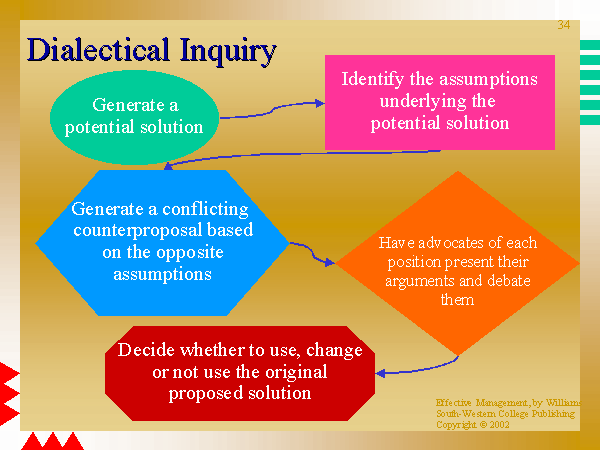 A dialectical investigation is a form of qualitative research which utilizes the method of dialectic, aiming to discover truth through examining and interrogating competing ideas, perspectives or arguments. This latter method is often applied through the use of case studies in which students or investigators discuss…
 We are surrounded by people who only do things because they get paid for it or because they will be rewarded by power, fame, or fortune. If the highest calling we can have in the world is to love others, then the next highest calling must be to perform some task or effort simply for the “Love of It.” Not because we are going to receive any payment for it. Not because we expect to get a promotion for it. Not even because we expect to get a pat on the back for it. Simply because we do it for the “Love of It.”