Why do we need all those damn minorities anyway !?!?!?!?

immigrantsThis blog is best read while listening to the following song:  South Park – Minorities at My Water Park song  (Eric Cartman)

Ever since this country (USA) began, we have had to deal with the problem of immigration and immigrants. You know those lazy shiftless dirty ignorant people from other countries who want to come here to steal the “better” life we have.  Of course, some (those Black folks) came over unwillingly, but that’s not our fault right?  The vast majority of immigrants have been let into the American Dream by laws designed to allow a certain amount of legal immigration each year.  This legal amount has been supplemented by a large amount of illegal immigration or undocumented immigration that takes place because of our porous borders (Read no large brick walls) or perhaps force fields.

Each year seems to bring a new “minority” group to this country.  I can remember in St. Paul when the Hmong come over, then the Somalians, then the Russians.  Many of the Latinos had come over before I moved to St. Paul.  If my history is correct, much of the Mexican migration to the Twin Cities took place in the 40’s and 50’s.  Of course, before that it had been those dirty Italians, lazy Swedes, and mean spirited Germans among others too numerous to mention.  It is a wonder that St. Paul is still basically a White country.  My adopted Korean daughter used to refer to White Bear Lake as “White Boy Lake.”  There were not too many Asians in her high school.  Oh, did I forget the Chinese, Koreans and Japanese who live in the Twin Cites?  No matter, what’s few more or less minorities?  And you know those Asians, they all look alike.

I suppose before I go any further, I should mention those dam Indians.  I know, they were here first!  And they let us know everyCavalry_and_Indians chance they get.  But let’s face it.  They don’t really count.  After all, they were primitive people who had no law, no writing, no books, no libraries, no Mc Donald’s or anything else you need for a real civilization.  You can’t really take their claims to this country seriously.  Why, they sold Manhattan for only 40 bucks.  Their lack of business acumen is testimony to their inability to manage a large endeavor like the USA.  They should be happy we “Treatied” this land from them.  “Treatied” is a word that I made up to denote the process we followed with these indigenous people.  It works as follows:

  • Befriend Indians
  • Encroach on their land
  • Skirmish with angry Indians
  • Make treaty with Indians for peace
  • Break treaty with Indians to take more land
  • Make new treaty with Indians
  • Break treaty to steal more land
  • Kill Indians that complain
  • Take more land
  • Make new treaty

As you can see, this process worked pretty well. We (The White people) now own most of the good land and the remaining Indians (those we did not kill) got put on the Bad Lands (now called reservations.)  That is because we “reserved” those Bad Lands for them.   Well, actually, we only loaned those lands to them, since whenever, gold, copper, water, oil or anything else of value was found on them, we sort of took the lands back and moved those Indians who complained to a new reservation.   I told you earlier Indians were never really very good businesspeople.

Ann coulter on illegalsSo, now that I have briefly reviewed the history of immigration to this (the “Greatest Country on God’s Green Earth”), I would like to look individually at the various minority groups that we (read White folks) have more recently had problems with.  I want to see if perhaps there are solutions to dealing with “those” (non-White) people.  I will look at one minority group in each of my next blogs to review in terms of history, culture and potential contributions to our country.  Based on my findings, we will have a better means of answering the question: “Should we let any more of those people in or should we toughen up our immigration policies to make sure they cannot find a way in?”   I would like to discuss the following groups:

  • Black people
  • Latino people
  • Asian people
  • Disabled people

I am going to skip Indians since they were already here and they pose little threat in terms of immigration.  I know a few Eskimos and Natives from Alaska have tried to come down to the “lower” 48, but their numbers are too low to really matter and besides, Alaska is already a state so legally they are not immigrants.

The first of the minority groups that I will look at have been called Africans, African Americans, Blacks, Negros and other more pejorative terms.  This group is composed of people who were tribal in origin but now may lay claim to being descendants from such new nations as Somalia, Uganda, Nigeria and Rhodesia.  The large majority of early slaves who found their way to North America came from West Africa, mainly the region that now has the countries of Benin, Ghana, Guinea, Nigeria, Senegal and Cote I’voire. Traders often referred to this part of Africa as the “Slave Coast”.  Many bought or captured slaves would have come from the Yoruba, Oyo and Ashanti people. The main slave trading countries of Europe were England, Portugal, Spain and the Netherlands.  Slaves were brought to this country and traded at slave markets for money, rum or other goods.  It goes without saying that slaves did not come over to America willingly.  I suppose most of them were undocumented but so were most Europeans back in the seventeenth and eighteenth century.

You might question my qualifications to write about Black people in America.  If so, I can only defend myself by saying that some of my best friends have been Black.  How many of your have had some best friends who were Black?  Perhaps, I would be more qualified if my sister or niece had married a Black man but that did not happen.  I have known quite a few Black people in my life and I have been to several sessions (sponsored by my company) on “diversity.”   So there, my qualifications are unchallengeable.  Diversity training, Black friends, and I have even read a few books about Black people.  If you still do not find my qualifications acceptable, then I suggest you read the book:  “Black like me” by John Griffin and skip my blog.     japs keep moving

Time for Questions:

Are you a minority?  What makes a person a minority?  Is it color, ethnicity or ideology or all of them?  Have you ever felt like an outsider?  What do you do to help people feel included?  Do you think America is for Americans?  What is a real American?  What should we do about immigration?  Do you think building more walls will help? What about building “walls of hate?”

Life is just beginning.

Lyrics:  Minorities at My Water Park Song:  Eric Cartman

What has happened to this place?
I don’t recognize it anymore.
It used to be so fun and special.
What is life worth living for?
The dream is dead, our land is gone;
There’s a hole in my heart and I can’t go on.

There are too many minorities (minorities)
At my water park (my water park).
This was our land, our dream (our dream)
and they’ve taken it all away.
They just keep coming and coming (minorities).
I tried to go and tell the police,
But even the authorities
Are minorities
At my water park.

There’s no place for me to sit anymore,
And the lines just keep getting crazier.
There are Mexicans all around me.
The lazy river has never been lazier.
It’s a 40 minute wait to go down one slide,
And the instructions are in Spanish on the Zip Line ride!
(Guarden los brazos y piernas dentro del paseo)
Just do it in English!

There are too many minorities (too many)
At my water park (somebody do something).
Where did they all come from?
Why can’t they leave this land alone?
And it’s such a tragedy (feel a bit like dying).
We looked the other way too long.
We’ve got to change our priorities
And get all these minorities
Out of my water park

(Minorities) Mexicans and Asians,
(Black people), I think I even saw Native Americans (gross).
God I’m asking please, get all of these minorities
Out of my water park (my water park).


The Land of the Free and the Home of the Brave?

Repeat the words in the title anywhere in the world and they are immediately recognizable as referring to the United States of America.  As Michael Medved loudly proclaims on each of his shows:  “And another great day in this, the greatest country on God’s green earth.”  It is my guess that you have never thought about where the phrase “land of the free and home of the brave” comes from.  Of course, it comes from our national anthem but where did the words originally come from?  Were they from some patriot during the Revolutionary War or from the War of 1812?  Actually they came from a lawyer and amateur poet, Francis Scott Key.  He penned them as part of a poem he wrote in 1814 which was originally titled:  “Defense of Fort McHenry.” 

The poem was set to the tune of a popular British song written by John Stafford Smith for the Anacreontic Society, a men’s social club in London. “The Anacreontic Song” (or “To Anacreon in Heaven“), with various lyrics, was already popular in the United States. Set to Key’s poem and renamed “The Star-Spangled Banner”, it would soon become a well-known American patriotic song.”  — http://en.wikipedia.org/wiki/The_Star-Spangled_Banner

Today, we naturally assume that the words refer to our penchant for American independence and heroism.  Our unique ability to save the world from itself and to right injustices wherever they are found.  Our vaunted American exceptionalism that gives us the moral right and categorical imperative to influence and insert ourselves in events and places the world over.  No one dares to question (or at least few in this country) the right of America to influence politics throughout the world.  No one questions the assumption that we are only in it for the greater good of humanity.  How could anyone from the “land of the free and the home of the brave” do otherwise?  Where our boots tread, soon follows democracy and prosperity, right?

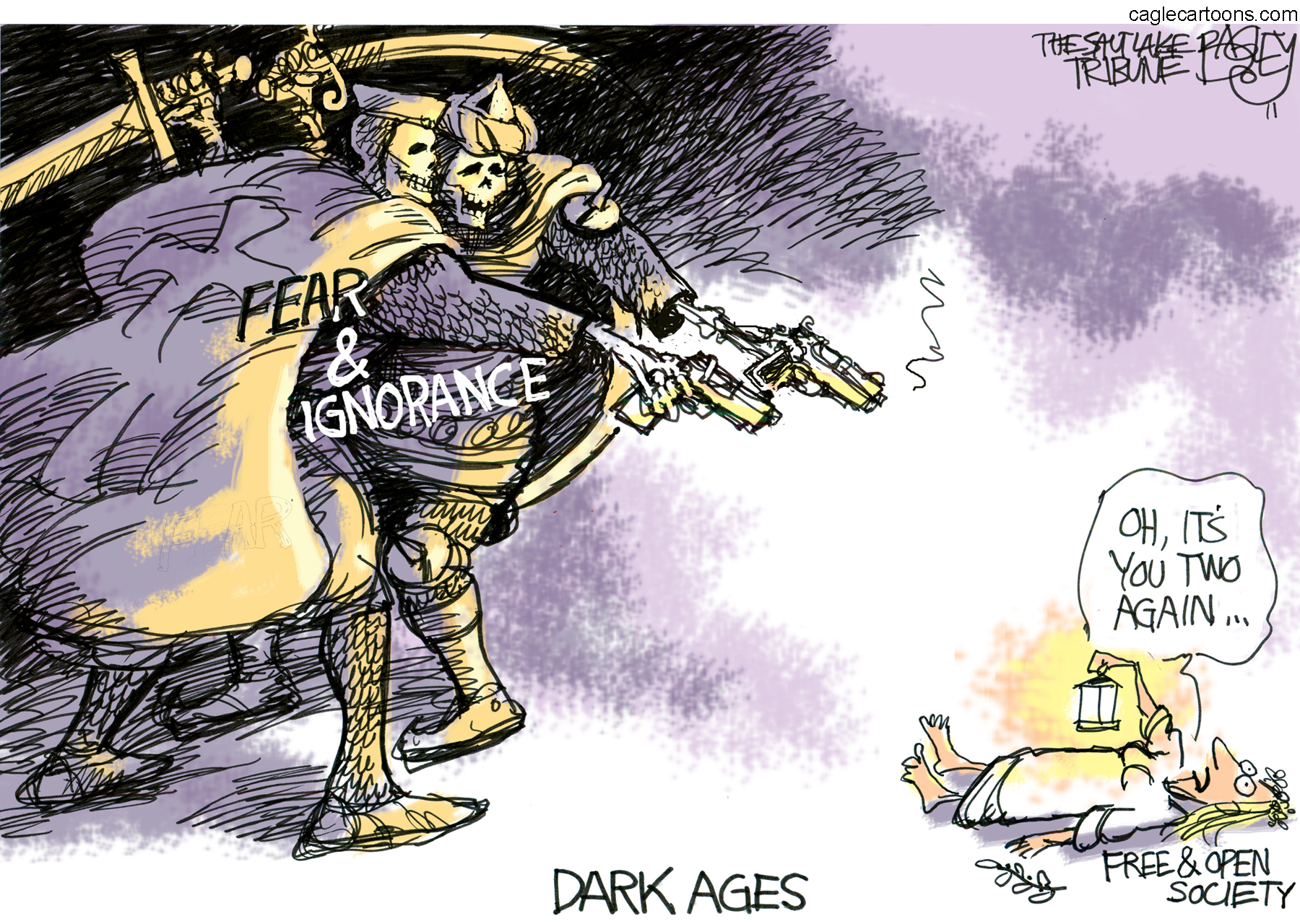
But what if the “land of the free and the home of the brave” was not the reality anymore?  What if it was more accurate to say that today America has become the “land of the guarded and the home of the fearful.”  Since 911, Americans have seemed to retreat behind a cloak of ongoing surveillance and security measures that could become the greatest detriment to freedom, this country has ever faced.  As Benjamin Franklin so wisely noted; “Those who would give up essential liberty, to purchase a little temporary safety, deserve neither liberty nor safety”. 

So I have decided to do some first-hand research and go visit a few “average” Americans.  I took a little road trip across Wisconsin to find some true patriots and to see what they think about our country.  Are we really scared and fearful?  Are we willing to give up our freedom for security?  Have we become more xenophobic?  To answer these questions, I stopped at diners, coffee shops, rest areas, truck stops, libraries and Denny’s Restaurants to visit with real Americans.  Not the 1 percent who make their money from stocks and bonds, but the hardworking “Joes and Janes” who make their money the old fashioned way, by the sweat of their brows.  I will briefly post a few excerpts here from some of my interviews.

Roxanne:  The Full-Time-Part-Time Worker:

I met 36 year old Roxanne in a booth in Mc Donald’s where we talked over a Big Mac, fries and a shake.  Roxanne is a divorced mother of two school aged children whom she is raising with the help of some grandparents.   She works both a part-time day job at Benny’s Cleaners and a part-time night job at Wal-Marts.

John:  Let’s cut to the chase Roxanne. What do you think about America today?

Roxanne:  Well, John, its dam hard to make a living, I can tell you that. Without my grandparents helping me, I don’t know how I would get by.

John:  Do you think we have too much security and not enough freedom?

Roxanne:  I don’t know, seems like there is never a cop around when you need one.  I had a fight with my boyfriend the other day and called the cops, but it took them over 30 minutes to get to my place.

John:  What do you think about the Russians, Iraqis, Mexican Cartels and Obama?

Roxanne:  I think they should all go back to the countries they came from and leave us alone.

John:  Did you vote in the last elections?

Roxanne:  Who was running?

John:  Thanks Roxanne – got to go now.

Patriot: the person who can holler the loudest without knowing what he is hollering about.”  — Mark Twain

 Pete:  The Carpenter

I met Pete while stopping to fill up my gas at a Pilot Station.  I noticed the painted sign on his pick-up truck which read “Carpenters keep it up longer: Call Pete for a good job.”  I offered to buy him a coffee if he would answer a few questions.  Pete was 54 years old, married with four kids. One daughter was still living home with him.  She had been married and was now divorced.  Pete’s wife worked part-time as a church secretary.

John:  So Pete, what do your kids do?

Pete:  Well, one boy works with me when I need extra help. One daughter is married and lives out of state.  One daughter lives with us and the other son works nearby at a local manufacturing plant as a night supervisor.

John:  Do you think this country has provided enough opportunity for them?

Pete:  Yeah, I guess so

John:  What do you think about the economy Pete?

Pete:   Sucks.

John:  I guess a lot of people would agree with you there.  What are your biggest worries for the future?

Pete:  Paying my mortgage and taxes.

John:  Are you worried about freedom and security.

Pete:  Nope, got a concealed carry permit and a good stockpile of ammunition.

John: What do you think we should do about immigration?

Pete:  Send them all home.

John:  Well, thanks for your time Pete.

True patriotism hates injustice in its own land more than anywhere else.” — Clarence Darrow

 Bob:  The Tea Party Member

Bob is a 47 year old accountant. He is married with wife and no kids.  I met Bob at a local café that I had stopped at on my journeys.  He was wearing a t-shirt that read: TEA: Taxed Enough Already.   I sat down at the counter next to Bob and struck up a conversation.

John:  So you belong to the Tea Party?

Bob:  Yeah, joined about five years ago.  I am fed up with big government, taxes and the present no ethics politicians running this country.

John:  So how is the Tea Party going to change things?

Bob:  Well, for a start we are going to only elect politicians that support our views and are not going to compromise away what we stand for.

John:  So what do you stand for?  I know you hate taxes but is that all?

Bob:  Well, here look at this card.  It says it all.

John:  The card Bob gave me read as follows:

Our Core Principles

Tea Party Patriots stands for every American, and is home to millions who have come together to pursue the American Dream and to keep that Dream alive for their children and grandchildren.

What unites the Tea Party movement is the same set of core principles that brought America together at its founding, that kindled the American Dream in the hearts of those who struggled to build our nation, and made the United States of America the greatest, most successful country in world history.

At its root the American Dream is about freedom. Freedom to work hard and the freedom to keep the fruits of your labor to use as you see fit without harming others and without hindering their freedom. Very simply, three guiding principles give rise to the freedom necessary to pursue and live the American Dream:

John:  That sounds very good Bob, but I don’t see a lot of progressive thinking coming from the Tea Party.  Seems like you guys are more against things then for things?

Bob:  That’s because we want to go back to the way this country used to be run before the bureaucrats, illegal aliens, liberals and socialists took over this country.

John:  What about health care and education and social services for the needy?

Bob:  This country is full of free loaders who sponge off the hard working Americans who work for a living.

John:  So you don’t believe that there are truly needy people out there in this country?  What about new immigrants?

Bob:  No one gave me anything or my grandparents.  They came over to this country with just the shirts on their backs.  People used to believe in hard work and honesty.

John:  What about education?  It is barely affordable anymore.

Bob:  That’s because we give all of these free scholarships to students from other countries and the high salaries that those lazy professors make.  Do you realize most of them work less than ten hours a week?

John:  Well, thanks for the opinions Bob.  Time to go!  You have a great day.

 “Let us take a patriot, where we can meet him; and, that we may not flatter ourselves by false appearances, distinguish those marks which are certain, from those which may deceive; for a man may have the external appearance of a patriot, without the constituent qualities; as false coins have often lustre, though they want weight.”  — Samuel Johnson

Cassie Jean:  The NRA Member

Cassie Jean is a 33 year old single woman who works as an Assistant Manager in a small bakery.  I talked to Cassie Jean while she was on a break over coffee and a cigarette.  I had stopped for donuts and a rest break.  Cassie Jean rides a 2002 Honda Shadow 600 motorcycle.  She is an avid hunter and a card carrying member of the National Rifle Association.

John:  So Cassie, what was the last thing you killed?

Cassie Jean:  Well, got me a good sized buck this past fall and a nice turkey this spring.

John:  How long have you been shooting?

Cassie Jean:  Ever since I was a little girl.

John:  Why do you belong to the NRA?

Cassie Jean:  They protect our rights.  You know the Second Amendment.

John:  Isn’t that about militias?

Cassie Jean:  People have the right to arm themselves.   If we let them take our guns away, we will have no protection.

John:  Protection from what.

Cassie Jean:  The wackos and socialists.

John:  What about our army, National Guard and the police department.  Isn’t their job to protect us?

Cassie Jean:  They work for the liberal socialists that are destroying this country.  The only thing that stands between them and us is our guns.

John:  But what about all the gun violence in this country?

Cassie Jean:  If more people were armed, there would be less violence.

John:  How do you figure?

Cassie Jean:  Well, would you screw with someone who had a gun?

John:  But what if no one had a gun?

Cassie Jean:  Over my dead body.

John:  Well, you sure make good donuts.  Take care and happy hunting.

Our government has kept us in a perpetual state of fear – kept us in a continuous stampede of patriotic fervor – with the cry of grave national emergency.”  — General Douglas MacArthur

 Dick:  The Mechanic

Dick is a retired Ford mechanic who worked for a small Ford garage in upstate Wisconsin for over 30 years.  A bad back and a desire to enjoy more of life convinced Dick to retire early.  Dick is a strange sort of man as he does not like hunting or sports but enjoys literature and particularly good poetry.  He is a connoisseur of fine wines and good music and never misses an opportunity to travel with his wife Paula to see new places.  Dick belongs to a group of retired men who hang out at a local library where they can get free coffee and an occasional donut.  Despite his lack of a formal education, Dick is knowledgeable and well versed on many subjects.  His views would surprise many.

John:  What’s new Dick?

Dick:  I am going to Russia!

John:  For real?

Dick:  Yep, I like the way Putin is running things.  No BS in that country.

John:  What about freedom of speech and freedom of religion?

Dick:  Religion is a farce, just a bunch of know nothing do-gooders trying to live off the backs of hardworking people.

John:  What about freedom of speech?

Dick:  No one listens to you here anyway unless you are a billionaire.

John:  I don’t think Putin would tolerate unions and I thought you were a union man?

Dick:  Unions used to help people now most of them are just parasites as well.

John:  You sound like a libertarian.

Dick:  I don’t belong to any party.  They are all useless.

John:  When are you leaving for Russia?

Dick:  Soon

John:  How soon?

Dick:  Not soon enough.

John:  Well, I imagine many of your friends would hate to see you leave.

Dick:  Yeah, well I can send them a postcard.

John:  Do you think the libraries in Russia would have a men’s group and free coffee?

Dick:  I don’t know.  I will talk to Putin about it when I get there.

John:  Well, if I don’t see you before you leave Dick, have a good flight.

Conclusions:

I arrived back to my starting point in Frederic Wisconsin after several days on the road.  Truly, I cannot say I had any great insights into the subject of freedom and liberty.  My “random” sample of “average” Americans would not satisfy even a lazy graduate student much less a hard core researcher.  Nevertheless, my total observations have literally been based on hundreds of such conversations over the past ten years.  My interviewees are a composite of dozens of people whom I have met and talked to from the shores of Coon Lake in Wisconsin to the rocky Casa Grande Mountains in Arizona.

Numerous books attest to major changes taking place in our country.  Are we going backwards, forwards or perhaps sideways?  Are things getting better or worse?  Are we still the place that everyone wants to immigrate to?  If not, what has changed?  We are surrounded by apocalyptic visions.  The USA will be overrun by illegal immigrants.  Socialists will take over the country.  Fascism will become the norm.  The end days are near and the Messiah will return to judge the good and the evil.  The poor will rise up and destroy America.   The country will become one vast prison with drug addicts and drug dealers on every corner.  No one will be able to afford health care or education.  Terrorists will infiltrate and bomb our most prized establishments.  The country will give in to Sharia Law.

With such gloomy visions of the future, is it any wonder that many people are fearful and ready to sacrifice their freedom for security.  More and more Americans live behind walls either in a prison or in a gated community.   Neither prison walls nor community walls seem to protect us from our worst enemies which may be ourselves.

Beck – It’s All In Your Mind, music video         (Love this Song, click on here to listen)

Time for Questions:

Have you felt things are getting better or worse in this country?  Do you think we need more or less patriots?  Do you think most people professing patriotism are really patriots?  What do you think makes a good patriot?  What do you think makes a “bad” patriot?  Where do you stand on patriotism?

Life is just beginning.


John’s New Blog Site.

I left “time parables” and started a new blog at http://www.agingcapriciously.com    I wanted to explore longer themes and a greater variety of subjects. I should have left this message two years ago, but I guess “better late than never.”  If you have enjoyed my blogs here, I think you will enjoy my new site. My posts are now longer, generally 2000 to 3000 words and my subject matter more diverse.  I would like to think my writing has also improved and has more variety to it.  If you go to my new site, you might want to start at the beginning which was Feb 2013.  Hope you enjoy.

Mans Inhumanity to Man

I am out of town this next week so I am reposting one of my favorite blogs. If you have read this one already, you might want to visit my other blog site at http://www.timeparables.blogspot.com. I have nearly 500 blogs I wrote on this site. I will have a new blog next week but this week was so busy, I decided to do a reblog. If you have not listened to the music with this blog you are really missing the essence. The music is haunting.

Dr. John Persico Jr.'s avatarAging Capriciously

I have advice from a respected friend who says it is better to be positive than negative.  Generally, I think there is much truth to his comment.  Pessimists, cynics, skeptics, and critics seem to live hard unhappy lives.  Studies show that though optimists may not live as long as pessimists, they live happier lives.  We can look around us and see misery, inhumanity and poverty or we can look around and find kindness, generosity and love.  So why would I write about “man’s inhumanity to man?”  Perhaps I cannot give you a good reason.  Sometimes it just seems so egregious to me and terrible that I feel the need to condemn it.  I can not always have a “Happy Face” in light of the inhumanity that I see displayed by other human beings.

I am not talking about a specific act of cruelty or any one specific act that has…

View original post 1,476 more words

The Goals of Life or Should We Live a Life without Goals? Part 2

In part one of this blog we examined the question of whether it was possible to achieve goals that gave other people health, wealth, wisdom or happiness.  Our major conclusion was that this would be a futile effort.  Thus, we turn to the question of whether or not we can set goals to achieve any of these cardinal objectives for ourselves.  Prima Facie, you are probably wondering why anyone would even ask this question.  I think this a critical point to address before we proceed further. I want you to understand that I am not being frivolous here.  I am indeed serious in asking whether we can set goals for happiness, health, wealth or wisdom.   Image

Most of us accept as well established dogma, if not fact, that goal setting is essential to accomplishing our dreams and leading a successful life.  I assure you I am not setting up a straw dog.  I bring in Dr. W. E. Deming as my expert witness and mentor.  Dr. W. E. Deming believed that goal setting could be a waste of time and effort.  He was so adamant that one of his famous 14 Principles even addressed the subject, Principle Number 11:

“Eliminate numerical goals, numerical quotas and management by objectives. Substitute leadership.”

To understand Dr. Deming’s antipathy towards goal setting a few basic points must first be established.

  1. A system can only produce what it is producing unless changes in the system are undertaken.
  2. Arbitrary changes without consideration of the system as a whole will produce random results.
  3. “Pushing” a system to produce more than it is capable of will produce undesirable and unknown side effects.   For example:  asking workers to speed up production or to work longer hours.
  4. Improving a system will improve output and increase desirable outcomes.
  5. Continuous improvement comes from understanding of the process and the various factors that contribute to the process outcomes.

Dr. Deming believed that one of the worst evils in the business world was management arbitrarily setting goals for workers and employees.  We have already looked at the futility of such efforts.  We now turn to the issue of whether or not we can set similar goals for ourselves.  Keeping in mind the five points made above, will help us to more realistically look at the feasibility of setting goals in these areas.

Happiness for Ourselves:

My goal is to make myself happy. This sounds very simple but it may be the most difficult goal of all. How many people do you know who are depressed, alcoholic, suicidal, angry, bigoted, intolerant and worse even homicidal?  Rarely do we see anyone in the news who is happy.  If so, it is a very transient state of being.  Many people are happy today and sad tomorrow.  Happiness seems like a state of mind that can only be attained for a very short space of time.  “The happiest day of my life” can be remembered by most of us, but if we could be happy all of the time, why would any one day stand out?  That they do attests to the fact that truly happy days are very few and far between for most of us.  Happy days always seem to be in the past.  Perhaps that is because we really forget the miseries that often accompanied even the so called happiest days of our lives.

ImageBuddha said about happiness that we can have a false happiness which is a search for things to make us happy.  We can try to find happiness by obtaining more money, more friends or more possessions.  This kind of happiness is transient and our “happiness glow” soon fades.  Things can never make us happy.  True happiness is a state of mind.  It is a state of mind that accepts all things and that simply observes rather than reacts.  True happiness cannot come from changing others or even trying to change ourselves.   Buddha said, “Happiness is in the mind which is released from worldly bondage. The happiness of sensual lust and the happiness of heavenly bliss are not equal to a sixteenth part of the happiness of craving’s end.”

Conclusion:  We can achieve happiness but it is not the happiness of having things or getting medals or being successful.  True happiness is a state of mind.  Happiness starts when striving for results or accomplishments ends.  Thus, setting a goal to become happy might only lead to more unhappiness. The way to accomplish this objective is a paradox since to be happy we must let go of the goal of being happy.  Jesus said to live one day at a time. 

Health for Ourselves:

My goal is to make myself healthy.  We all want good health and we can certainly make ourselves unhealthy.  Can we do the opposite and make ourselves healthy?  I think we can strive to be as healthy as possible but we have to accept the fact that some “health” is beyond our control or at least beyond our current scientific knowledge to impact.   In terms of the five points given above, we do not fully understand the biological processes that create health in human beings.

A few weeks ago, a young woman in our town died of terminal cancer at the age of 32 leaving two young children.  She died only a few months after being diagnosed.  What did she do to make herself unhealthy?  Was it something she ate?  Did she not exercise enough?  I think you could spend your lifetime looking for an answer to these questions and you would never find an answer.  Do your best to stay healthy.  Exercise, eat right, don’t smoke, avoid stress and you might lead a long and healthy life.  On the other hand, you might die in six months from some disease that you never realized you had.

Conclusion:   We can have a major impact on our health by living properly but no one person or no single effort can guarantee us health.  It is a worthwhile goal if seen as a journey and not a fixed end state.  Some days you will be healthy and some days you will be sick. 

Wealth for Ourselves:

My goal is to make myself wealthy.  I have often pondered the value of this goal.  Since I have never achieved it, though I have often stated it as a goal, I am left with two questions.  First: Did I really value wealth enough to make it a priority in my life?  Second: Would my life have been better had I become wealthy?  My answer to the first question is a tentative no.  I have valued many things more than wealth.  I have always valued time more than wealth and I have always valued my own independence more than wealth.  I would rather be out running or swimming than reading the Wall Street Journal.  I have always had a difficult time taking orders and valuing loyalty to a company whose major motive is making profit is foreign to my nature.  Perhaps (which is why I said tentative) these are the reasons I have never achieved wealth or status.  On the other hand maybe I was just too lazy, stupid or undisciplined to become another Warren Buffett.  I thought I had the brains, but somehow the billions have never come.

ImageThe second question is perhaps more interesting.  “What if I had become rich?”  Would my life have been better?  Would I have been happier?   I have thought about this question more as I have aged and I honestly think that if I had become wealthy at a young age, my life would have self-destructed.  Like many young people who become wealthy and ruin their lives with drugs or fast living, I think it entirely likely I would have been unable to handle the influence or power that money would have brought.  I certainly do not think that becoming wealthy would have led to my happiness.  As I have become older, the goal of wealth has become less important.  I would not change my present lifestyle for all the money in the world.  I am content with my life, my friends and my spouse.  I am also content with growing older and coming to the end of my time.

Conclusion:  Beware of what you ask for, because you may get it.  Few of us are wise enough or strong enough to handle the “drug” of wealth. 

Wisdom for Ourselves:

My goal is to make myself wise.  We have already seen the difficulty of giving wisdom to others. Can we make ourselves wise?  Are there activities or knowledge that we can pursue which will ultimately confer upon us the mantle of “wise one?”  I think you could go to school for 100 years every day and you still would not be wise.  There is an old saying that “knowledge helps you to make a living but wisdom helps you to make a life.”  We go to school and receive knowledge, but the world is full of educated idiots.  We all know people who know how to make a living but haven’t the slightest clue as to how to make a life.

I am nearly 70 years of age now.  I am almost at that time of age when years ago, I would have been considered one of the tribal elders.  By dint of having lived seven decades, I would have been considered wise. Perhaps years ago, that is all it took.  The older you were, the wiser you were.  Today, I see little correlation between aging and sageing.  In fact, if you look at many of the great prophets, they achieved their status as leaders at what today would be a very young age.  Jesus was in his mid-thirties when he was killed.   Gandhi was fifty three when he became the leader of the non-violent movement in India and Martin Luther King was only thirty nine when he was assassinated.  History is full of examples of people who were deemed wise without the benefit of age or education.  Thus, we are back to the question, “how does one become wise?”  If I do not know the answer, I can hardly make myself wise.  Looking at the five points noted earlier, we must address the issue of “what kind of a system can or does produce wisdom?” Until we can answer that question, the goal of wisdom will remain elusive.

“Confucius once said that there were three ways to learn wisdom: “First, by reflection, which is noblest; second, by imitation, which is easiest; and third by experience, which is the bitterest.” Gaining wisdom, the most prized of virtues across almost all cultures, is an exercise in life learning, careful analysis, and thoughtful action.”   http://www.wikihow.com/Be-Wise

If someone as wise as Socrates was purported to be could deny the mantle of wisdom, perhaps this is one of those goals which is ineffable.  No one I know would claim to be wise and certainly no one I know would anoint me with the title of “Wise Olde Man.”  This is probably a good thing.  If I were known as the wisest man in Frederic, I can only imagine what this would do to my free time.  I can also imagine the effects this would have on my spouse and friends.  I am not generally regarded as being humble now and walking around bearing a cloak of wisdom would be deleterious for my ego in the long run

Conclusion:  I don’t really know the answer to becoming wise nor do I have a formula for how to become wise.  I must conclude that at the present time, I have achieved a great deal of knowledge but the magic of wisdom has still escaped me.  I have found that trying to become wise is an exercise in futility, like looking for the Holy Grail.  Perhaps we would all be better off working to become more humble than more wise. 

Time for Questions:

What goals have you set for your life? How successful have you been in accomplishing them?  What obstacles have you faced?  How have you overcome them?  If you could re-live your life, what changes would you make in the goals you set?  Why?

Life is just beginning.


The Goals of Life or Should We Live a Life without Goals? Part 1

ImageOne of the common assumptions of modern life is that we all need to set goals.  It is said that our goals should be purposeful and measurable.  Furthermore, we are told that without such goals, we are doomed to live a life of meaninglessness.  Minus thoughtful goals, we will be like Alice in Wonderland where since Alice had no purpose or direction in Wonderland, it did not matter which direction she went.  Heaven forbid it!

But could modern wisdom be wrong?  Could common assumptions about the importance of goals be another of life’s many canards?  In my blog this week, I would like to explore the role of goals in our lives and look at whether or not they really are useful or are they simply another tyranny of a materialistic society that wants us to be running like rats on a treadmill.  Forever and forever scurrying through all eternity trying to achieve more and more and enjoying life less and less!  (By the way, I love exclamation points because they get rid of those annoying green lines that Word places in phrases that it does not like.)

Let us start our discussion by breaking goals down into two fundamental categories.  The first category concerns “goals for others.”  These are goals that we set either by malevolence or benevolence but they are destined to impact the lives of others.  Missionaries (depending on who you ask) may be thought of as having benevolent goals.  Dictators and tyrants (depending on who you ask) may be thought of as having malevolent goals.

The second category concerns “goals for ourselves.”  These are goals that we set to help us achieve either current or future objectives.  Thus, if I want to become set goalssuccessful, I may set a goal of going to college and obtaining a degree in law or politics or business.  This will be a future goal.  A more current goal would be to find some means to raise enough money to pay for my college education.  The element of time is somewhat flexible in determining whether it is a future goal or current goal and the distinction has created many an argument between people.  The indisputable element here is that we pursue these goals to benefit our own well-being. There is no altruism or charity in this category of goals.  Having said this, all distinctions are really like water. They are very fluid.  I am using these two basic categories to facilitate discussion and not with any hope of creating a uniform or indisputable and universally accepted definition.

Proceeding on with our discussion, we can identify under these two categories of goals, four specific goals that many would say are the four most important goals in the world.  I am not going to challenge this assumption.  For our discussion of goals, I will accept that these four goals are extraordinarily worthwhile objectives.  Furthermore, they are four in both of our major categories.  The four specific goals are:

  • Happiness
  • Health
  • Wealth
  • Wisdom

I am going to accept each of these goals at face value and forego any discussion of whether they are cause or effect.  I am also willing to accept that whether outcome or process they all are objectives that few of us would forego.  Thus, if a genie appeared to almost anyone on the face of the earth and said:  “Would you like to have eternal health, wealth, wisdom or happiness, there would be very few who would turn any one of these goals down.  We can put these goals into a table as follows.

Goals for Others Goals for Ourselves
Happiness Happiness
Health Health
Wealth Wealth
Wisdom Wisdom

Returning to the original question, “should we live a life with or without goals?” it is obvious that we must first answer a second question:  “Can any of these goals (In either category) ever be accomplished?”  If the most important goals we can set for life are impossible to achieve then it would seem wise to assume that “goal setting” is a waste of time.  Let us consider one by one each of these eight possible goals and see how many (or even if any of them) are really attainable.  What can we honestly expect to achieve for ourselves and others?

 Image

Happiness for Others:

My goal is to help make other people in the world, in my life or in my family happy.  What would you say to that goal?  If you are honest, you would probably say that it was a ridiculous goal and that no one can make anyone else happy.  No matter how hard we try, we cannot insure that the things we do will bring happiness to other people.  Happiness, you may wisely note is more of an inside job.  It depends more on our expectations and views of the world then what other people do for us.  Conclusion:  Don’t waste your time. 

Health for Others:

My goal is to help make other people in the world, in my life or in my family healthy.  This sounds like a goal that someone in a medical profession might pursue.  But how healthy can even a doctor make someone else?  Again, honesty would lead to the conclusion that nature and personal factors have more to do with health than even the best MD or medical practitioner.  Science has made major strides in helping populations become healthier but few are the medical people who could claim that they have made people healthy.  To make someone healthy would be almost an impossible task.  The best we can accomplish is to help prevent certain diseases and to help alleviate the effects of other diseases.  Conclusion:  We can help make people healthier but health is a state influenced by too many variables to be under the control of anyone but God.

Wealth for Others:

My goal is to help make other people in the world, in my life or in my family wealthy.  If I could make enough money, I could donate or leave it to my heirs or to some type of philanthropic foundation.  The skeptic in me would reject the idea that all of the donations in history have had much impact on world poverty.   I could be a teacher and teach other people how to make money or run a successful business. I could also be a consultant or business investment advisor and teach others how to wisely run their businesses or investments.  There is little doubt that we can help people have more money or even use their resources more wisely, but how many people have been made wealthy by the advice of others?  As a business instructor and management consultant for over 30 years, I can tell you that the answer is very few. When I look at the Forbes List of Richest People in the World, I see self-made billionaires, most of who were initially laughed at for their efforts.  I doubt Bill Gates, Sergei Brin, Jeff Bezos, Larry Ellison, Richard Branson or Warren Buffett depended very much on consultants or business teachers for advice.   Conclusion:  We can help people manage their money better but individuals make themselves wealthy. 

ImageWisdom for Others:

My goal is to help make other people in the world, in my life or in my family wise.  In order to see if this is possible, let us first look at Socrates.  Socrates was a teacher.  According to the Oracle at Delphi, Socrates was the wisest man in the world. Thus, we may ask the question:  Did Socrates teach other Athenians to be wise?  This is not a simple or easy question to answer.  Socrates did not accept that he was wise and went looking for a wise man but could not find one.  He never claimed to be teaching his students to be wise, but merely how to question assumptions and conventions.  Is a person who questions wise? How many wise people do you know?  Is wisdom a matter of age or does college teach you to be wise?  I would argue that school and teachers can give you knowledge but only life and your experiences drawn from life can give you wisdom.  Conclusion:  No one can make any other person wise.

If you accept the majority of my arguments so far, I think it would lead to the obvious conclusion that we cannot really make anyone else healthy, wealthy, wise or happy.  These are tasks that are far beyond our ability to have more than a minor impact on.  However, I am not yet ready to dismiss the power of goal setting.  Before I can do this we must turn to the second category of goals: goals for ourselves.  Do we have the ability to accomplish goals for ourselves?  If we can achieve even one of these objectives, then it would be ridiculous to say that goal setting is a waste of time.  In fact, given the seriousness of each of these goals, it would necessitate establishing goal setting as a serious repertoire in our lives.

In Part 2, which I will publish next week, we will look at each of these second category goals and see how much impact we can have on them.  If we really cannot make much of a difference for others, perhaps we can at least set goals that will make a difference in our lives.

Time for Questions:

Have you ever set goals for other people?  What goals have you set for others?  Have you been able to accomplish them?  What helped you or hindered you in this effort?  Do you think it was a valuable use of your time? Why or why not? What would you do different if you could do it over?

Life is just beginning.

Grow Old Along with Me

We think of growing old and we think of aged people, old people, retired people, elderly people, nursing home people and dying people.  When we think of growing old, we don’t think of babies, teenagers, young people and college students.  Ironic in a way, since everyone from birth to death is growing old or is at least growing older.  Perhaps that is the difference.  Growing old seems to Imagemean aged.  Growing older is a process while growing old denotes a physical condition.    Old means droopy skin, failing health, difficulty walking and a general decline in one’s ability to be mobile.  To some, old is a state of being or as others would say a state of mind.  Call old what you will, but none can deny the physical deterioration that comes with growing older.

In the Velveteen Rabbit, as the stuffed toy rabbit grows older, he becomes more and more worn and raggedy.  Despite his aging, the rabbit becomes more and more loved by the boy who has become his constant companion through the years.  The love of the boy eventually makes the ImageVelveteen Rabbit “real.”  Regardless of the rabbit’s becoming threadbare, torn and disfigured, the Velveteen Rabbit gains a persona that can only be understood by someone who values longevity, companionship and friendship.

Of course, we all value companionship and longevity; many people in our lives are like the Velveteen Rabbit.  Our sisters and brothers, our grandfathers and grandmothers, our mothers and fathers and our good friends and spouses; will all become older and older and older.  Eventually, they all become aged, misshapen, wrinkled and decrepit.  But if they have been good companions through the years, we are blind to their aging process.  We only see the love and caring that they have shown us.  We are blind to their difficulty with hearing and their inability to keep up with us.  We only see the person who was kind and thoughtful to us.  We are blind to their infirmaries and disabilities.  We only see the person who took care of us and helped us in our time of need.

I sometimes look at my spouse Karen who has put on pounds and wrinkles and walks slower than she used to.  Over the years, she has become more and more beautiful.  Looking back, I am not sure Karen was real to me when we were first dating and even married.  It has taken nearly 30 years of togetherness for Imageme to more fully appreciate the person that she is and it is still a process that is evolving.  The commitments that she makes to others often go beyond my understanding.   The kindness and compassion that she shows to those who are in need is more than touching.  The many ways she sacrifices what she wants so that she can help me get what I want have all made Karen real to me.

One of the saddest things, you hear at funerals, is the comment “I wish I had spent more time with them.”   It is probably inevitable that we feel this way.  Having pondered this comment over many wakes and funerals, I wonder if more time would really have made a difference.  I rather think it would be the “quality” of time we spent with others.  You may think that I am simply citing a cliché “quality of time?”  What is this elusive quality of time?  Some examples from my own life with Karen illustrate this concept for me.  Perhaps for you it will be different:

  • Sharing meals together
  • Going to hospital visits together
  • Sharing back rubs and massages
  • Reading together
  • Traveling together
  • Shopping together
  • Spending quiet time together
  • Being concerned with each other’s work
  • Helping each other whenever we can
  • Checking in each day to see how the other is doing
  • Always hugging and greeting each other when going or coming
  • Taking care of each other when sick

My list might seem trivial to you.  Your list might be very different.  Nevertheless, what if we spent the time with our loved ones that enabled all of us to say when they are no longer with us that:  “I am glad I spent the time with them that I did.”   Is the time we spend watching TV or football or golfing, or fishing so precious that we could not have spent a little more time growing older with our loved ones?

Image

We are inundated with emails, text messages, advertisements, news, news and more news.  Our minds and brains are saturated with people beseeching us to buy, sell, rent, borrow, donate, loan or vote.  The rest of our time, we are numbed by media depictions of trivia, deprivations and horror.   We are fascinated by Hollywood, Bollywood and royalty.  For many of us, Princess Kate is more real than our own brother or sister.

When Princess Diana was killed, I remember seeing a co-worker who had a shrine in her cubicle for the Princess.   Princess Diana was one of the most popular people in the world.  She was real for many because they lived her life with her.  Recent polls show ImagePrincess Kate is now as popular as Diana once was.  The media is making Kate real for us just as it once did for Diana.  The sad part of this is not that we identify with and make these people real, it is that we fail to make the truly important people in our lives real.  How much do you know about the lives, wishes, hopes, dreams and fears of the really important people in your life?  Do you get as much news about and with them as you get about Princess Kate?

GROW old along with me!   (From Rabbi Ben Ezra by Robert Browning)

The best is yet to be,

The last of life, for which the first was made:        

Our times are in His hand    

Who saith ‘A whole I planned,                 

Youth shows but half; trust God: see all, nor be afraid!’

I think we fail to teach our children the value of time.  We teach the value of money, but we neglect to teach the value of time.  It might be argued that money and time are valued according to their scarcity.  To the young, time is plentiful and money is scarce.  To the old, time is scarce and money is (if not plentiful) at least often more abundant.  If this argument is correct, then it would be a waste of time trying to teach the value of either time or money.  Their value is fixed according to age.  I disagree with this argument.

ImageI think if you look closely, many older people have never valued time as much as they still value money.  And many young people fully understand the value of time and would readily put it over the lure of more and more money.  If this is so, then it suggests that the value of each is not fixed by age but by some mental process perhaps not fully understood.  If a mental concept or construct is at work here, it can be modified or changed by reason and logic.   I may be justified in thinking that young children need to be told that time is valuable and that in many cases it is not fungible.  You can never replace or substitute money or goods for the time that you did not spend with your family, friends or loved ones.

Time has every right to be as respected a discipline as the study of money.  In capitalism, money becomes King, money is good. We pervert nature by upending the true value of things. Tangibles become more important than intangibles.  Goods become more important than services.  Greed becomes more important than charity.  Youth becomes more important than experience.

Aristotle was right in his use of the Golden Mean concept to show how to create a balance that was harmonious with the world.  ImageAnything taken to extremes becomes evil or distorted.  Time and money are the pivots upon which the world rotates.  They must be kept in harmony.  We have lost our balance though and let money become the sacred source of happiness and success.  Perhaps the really wealthy people are the ones with more time.  Why wait until retirement to become truly wealthy?

Time for Questions:

Do you have a balance in your life between time and money?  Do you keep the really important things in your life in proper perspective?  Do you value time as much as you value money?  Do you think we need to do more to help have a balance in our country?  Are you willing to share your time with others?  How about your money?

Life is just beginning. 


It’s Coming Quick. It’s Coming Quick, the End is Coming Quick. 

ImageWinnie-the-Pooh was walking home one day when he passed a young man standing on a park bench.  The young man was shouting “Quick, it’s coming quick, it’s coming quick, the end is coming quick.”  This greatly distressed the Pooh bear who ran home as fast as his bear legs could carry him. After arriving home, he made a big honey and jelly sandwich on toast.  He had been saving this honey for a special occasion but since the end was coming quick, he decided he had better eat it as soon as he was able to.  After this, Pooh straightened up his abode and waited.  Pooh thought he might as well wait for the end to happen while he was home and warm and comfortable and feeling very nourished after his honey and jelly on toast sandwich.

ImageBut you know Pooh bears, they are not very patient.  Soon, Winnie-the-Pooh became restless and started wondering when the end was coming.  He began pacing back and forth and forth and back but the end still did not come.  Finally, losing patience, Pooh decided to visit his good friend Eeyore to see if he had any news on the end.  After a short trek over to where Eeyore lived in his house made of sticks. The two good friends met and embraced each other.  Quickly, Eeyore started worrying and wondering what was going to happen. If Pooh bear came to see him, something must be wrong.  Eeyore finally blurted out “Pooh, what is up, what is happening, why are you here?”  Pooh knew that Eeyore was easily unsettled but he felt that this situation warranted unsettling poor Eeyore.  Pooh said “Eeyore, the end is coming quick.”  “Oh my, oh my” said Eeyore, “That is a problem.  What do you think we should do?”  Pooh replied well “Do you have any honey or jelly?  We could make some honey and jelly sandwiches and wait for the end.”  Eeyore was not as fond of honey and jelly sandwiches but he had some good hay and aged straw that he had been saving and he invited Pooh to share it with him.  This was not exactly what Pooh had in mind but he watched and paced back and forth and forth and back, while Eeyore ate his aged straw.

tiggerFinally, after a very long time had passed (it was actually a very short time but it seemed long to Pooh and Eeyore), they both became restless again.  When was the end going to come?  Pooh suggested that they both go to visit Tigger since he is always very optimistic and might have a different view on things.  Hurrying over to Tigger’s house, they find Tigger out in the front yard playing with a balloon while bouncing up and down on a trampoline.  “Hi” says Tigger, “do you guys want to bounce on my trampoline with me.”  “No, no” says Eeyore, “this is very serious. The end of coming quick, we must be ready.”  “Fine with me” says Tigger, “but can’t we just bounce and play until the end comes?”  “Well,” says Pooh, “that would be fine but I am getting hungry. Do you happen to have any honey or jelly that I could make a sandwich with?”  “Sorry Pooh, but my cupaboard is bare, I have been too busy bouncing to worry about eating.”  So the three friends decided to just wait together for the end.  Tigger kept bouncing, Pooh kept feeling hungry and Eeyore kept fretting since he was becoming less and less certain that anything was really going to happen.

Eventually after a long bout of bouncing, Tigger became tired.  “I am going to take a nap” says Tigger, “if the end is coming, I would just as soon be rested when it does.”  Eeyore, more and more doubting that the end was really coming or at least that it would be quick also decided to go home.  “Bye Pooh, see you later” said Eeyore, “that is if there really is a later.”  Pooh was left all alone. Tired, hungry and confused, he was not sure what to do.  Then, in a flash, it came to him. I will go to see Owl.  He is the wisest animal in the forest.  He will know what to do.  So Pooh went off to see Owl.

owlWhen Pooh arrived, Owl was perched up in his nest.  “Hi” said Owl, when Pooh was still a long way off, he could see him coming. “What brings you to the forest today? Are you here to discuss the ethics of Aristotle or maybe you have come to hear about my life when I was a young owl about your age.  Did I ever tell you about the time that I met” —–“Ahem, ahem”, says Pooh, this is an emergency.  The end is coming quick. We must be ready. I tried to warn Eeyore and Tigger, but Tigger decided to take a nap and Eeyore went home. What are we to do?”  “My, my” said Owl, “You say the end is coming quick. Pray tell me what end is coming: the end of the ball game, the end of the warm weather, the end of the hunting season?”  All of these questions just confused Pooh.  He had no idea what end was coming.  He just assumed it meant the end of the world.  Why did Owl always have to make things so complicated?  “Well” said Pooh, “I am not really sure. I saw this young boy (who looked a lot like Christopher Robin) standing on a park bench shouting that the end was coming quick.  I am not really sure what end he meant, now that you have confused me so.  I just came to ask you for advice on what to do.  I am all out of honey and jelly and the end is coming quick.”

Owl thought about the situation and came up with the following poem that he had heard many years before: “A Song on the End of the World” by Czeslaw Milosz, 1944

On the day the world ends

A bee circles a clover,

A fisherman mends a glimmering net.

Happy porpoises jump in the sea,

By the rainspout young sparrows are playing

And the snake is gold-skinned as it should always be.


On the day the world ends

Women walk through the fields under their umbrellas,

A drunkard grows sleepy at the edge of a lawn,

Vegetable peddlers shout in the street

And a yellow-sailed boat comes nearer the island,

The voice of a violin lasts in the air

And leads into a starry night.


And those who expected lightning and thunder

Are disappointed.

And those who expected signs and archangels’ trumps

Do not believe it is happening now.

As long as the sun and the moon are above,

As long as the bumblebee visits a rose,

As long as rosy infants are born

No one believes it is happening now.


Only a white-haired old man, who would be a prophet

Yet is not a prophet, for he’s much too busy,

Repeats while he binds his tomatoes:

There will be no other end of the world,

There will be no other end of the world.

Pooh honestly did not know what this poem meant or why Owl was telling it to him.  “Owl” says Pooh, “you are hurting my brain.  I am even more confused now then I was before. Couldn’t we keep this simple?”  “Well,” said Owl, “animals and people always want things simple.  But maybe, this is not so simple as you would think.  Perhaps we should discuss this further.”  “That is okay” replied Pooh; “I am too hungry now to worry about the end.  All I know is my stomach is growling and I need to find some honey quick to end the rumbly in my tummy.  In fact, maybe that is what the boy was trying to say.  I must find honey very quick or my end will be near.”  Thinking that this was wise advice, Pooh thanked Owl for his time and ran off to find some honey.  By the time, Pooh returned home, he had found a big stash of honey and had totally forgotten that the end was near.  Pooh made a great big honey sandwich and settled in with a large mug of hot chocolate and decided that the end was no longer near.  As long as he had good friends, honey and a comfortable home, that darn end (whatever it was) could come whenever it wanted to.

Time for Questions:

What do we all have in common with Pooh bear?  What end is coming quick?  When do you think the end will come? Are you ready for the end?  Should you care?  What do you have to do to be ready?  What if your end was tomorrow, what would you do?

Life is just beginning. 

My interpretation of this Winnie-the-Pooh story is based on a recent incident.  Last week while coming back from Minneapolis, I passed a young man standing on a park bench, who was shouting “It is coming quick, it is coming quick. The end is coming quick.”  I passed by him in my car and did not have the time (or most likely the desire) to find out what end was coming or how quick was quick.  I decided it would make a good blog.

A Word of Thanks to A. A. Milne who wrote the original Winnie-the-Pooh stories.  Adults and children will for all of time be inspired and grateful for his wonderful characters and stories.  Please buy the book if you have not read it:

Winnie-the-PoohWinnie-the-Pooh by A.A. Milne

“We’ll be Friends Forever, won’t we, Pooh?’ asked Piglet.
Even longer,’ Pooh answered.” 


The Worlds First Un-Blog: How we can solve all of the worlds problems!

Image

I woke up this morning and told Karen that while she was at church, I was going to write an un-blog.  She looked puzzled and wanted to know if that meant I was not going to write a blog.  I said “Of course, I am going to write a blog but it will be an un-blog.”  “Well,” she said, “What is an un-blog?” I replied that it was like an un-birthday party. I actually did not have the slightest clue what it was or could be but I knew that today I was going to invent an un-blog.  With no templates, I would have to invent it as I went along.  I did not bother to Google “un-blog”, so you will forgive me if I reinvent the wheel.  (Actually after I finished this “un-blog”,  I did Google the term to see if I was a “Johnny come lately” or had really invented something new.)

There are several reasons that I come to the point in my blogging where I now know that I need to write an un-blog.  First of all, many of you are probably tired of my advice, admonitions, critiques, complaints, exhortations, etc. about the state of the world and its many problems.  This week alone, I found over five million problems that needed solving in the pages of CNN, MSN, FOX and BBC news.  My best guess is that the number of problems we face in the world has steadily escalated since I was born.  Thus, despite my efforts and other bloggers like me, the number of problems just seems to keep growing exponentially.

Well, being the strategic planner that I like to think I am, I took out my handy “world problem solving software.” I programmed it to prioritize the “greatest” problems this week that I could solve with my exorbitant ego and unlimited resources of advice and solutions.  I must have had low batteries because my screen suddenly went blank and it started flashing “I quit, I quit, I quit.”  Perhaps it was a virus or some type of Trojan?  I immediately turned it off.  This has now created a dilemma.  How can I pick the single most important world problem to solve, if my software is malfunctioning? Would my many followers (considerably less than George Takei) accept me simply choosing a great big humongous problem and solving if for them and the rest of the world?

No! This would not be fair to you my faithful readers and followers.  You will only accept me going after the biggest baddest problems out there selected scientifically and with great forethought.  You expect me to solve these incredible problems with shrewd insight and analytic ability.  You want me to provide solutions that would make Solomon humble.  You expect me to solve only the most critical problems facing the world.  Simple selection would never do for my followers.  Knowing these facts, I felt lost and confused.  With millions of problems out there and my software on the blink, I was like Garry Kasparov trying to win against Big Blue Computer.  I am only human; the stress is unbearable at times.  Thousands of followers, (well maybe a few hundred) depending on my blog each week for advice and succor!

In truth again (Never trust anyone who says “in truth” or “trust me”) I could not select a single problem this week to tackle.  I am weary of solving all of the problems in the world. The burden has become too great.  Simply perusing my blogs, you will note the number of critical world and USA problems that I have already solved this past year.  To make matters worse, to date, I have not received one penny for my efforts or even an invitation to the White House.  I have not been knighted or given the Profiles in Courage award either. Perhaps, I missed the phone calls from Obama and the Queen.  I must remember to check my voice mail more often or at least my text messages.

It is very frustrating.  No matter how altruistic I am, I crave some simple recognition.  It is a lot like being a superhero but no one knows it.  What is the point of having super-powers if no one is there to applaud idealize and worship you?  I can accept that a few of my miraculous ideas and solutions might have been slightly off mark, but I cannot accept that all of them were.  Furthermore, please go to my first blog site where I have posted over 600 blogs dealing with various and assorted issues affecting the world.  See if some of these blogs don’t bring tears to your eyes or joy to your heart.  (You can find them at www.timeparables.blogspot.com)  All of these issues has led me this week to create the world’s first “un-blog.”

It is my considered but humble opinion that in an un-blog, I (the Blogger) should not solve any problems.  A typical blogger writes their blog either to solve problems or to give opinions and advice. It is not fair, that you the reader (The Bloggee) get all this free advice and give nothing in return.  It is only right that in an “un-blog”, you the reader and faithful follower, should be the ones to solve the problems and give me advice.  It is time to pony up.  How many of my blogs have you commented on?  How many have you disagreed with?  What have you taken a stand on?  What has stopped you from being an “un-blogger?”  It is your turn to pay me back for all the solutions and advice I have so freely and graciously given to you.  Think of your world without my blog.  As the walrus said in “Alice in Wonderland”:

Image

“The time has come,” the Walrus said,
“To talk of many things:
Of shoes–and ships–and sealing-wax–
Of cabbages–and kings–
And why the sea is boiling hot–
And whether pigs have wings.”

I would love to hear your take on “What are the biggest problems the world faces.”  I would really like to hear what you think.  (See my questions below.)  Send me an email persico.john@gmail.com or post your replies in the comments section.  Speak out.  Today is your chance to be an un-blogger.  It is your golden opportunity to help solve the many problems facing the world or to at least offer some advice on what you think those problems are.  Perhaps, your brilliance and erudition might be discovered on my blog and you will be invited to the White House.  (Please do not hold your breath.)  If you do get invited, please, please take me along. 

Time for Questions: 

What are the biggest problems you face in your life?  What are your solutions?  What do you think we should do to save the world?  How can we deal with apathy and those that do not care?  Where do we start?  Should we have major political changes in our constitution?  How could we get these?  What would you like to see changed in the world or even just in your home town?  What does Persico mean “Life is just beginning?”

Life is just beginning.

I finally broke down and looked up “Un-blog” on Google.  Here is what I found.

  1. un- blog – definition and meaning – Wordnik

https://www.wordnik.com/words/un-%20blog

Sorry, no example sentences found. Related Words. Log in or sign up to add your own related words. Wordmap. (beta). Word visualization. Comments. Log in or …

I think this means that there are no definitions.  I can thus claim the distinction of being the first “un-blogger” on the internet.  Or perhaps my readers and faithful followers who have answered my questions should be the first to receive this distinction.

Here is my definition of an “un-blog.”

“A blog site where the readers post opinions and solve problems and the blogger simply listens and does not weigh in with advice or solutions.  A place of introspection rather than extrospection.” 

Killing for Machismo

I hope to have more people read this blog. It is one of the most important I think I have written.

Dr. John Persico Jr.'s avatarAging Capriciously

It was a crime of passion

She took me by the heart when she took me by the hand

Crime of passion

A beautiful woman and a desperate man  —- Ricky Van Shelton

I find it ironic that there are Seven Deadly Sins or vices but they do not include the “Sin of Machismo.”  I would venture to argue that there are more people killed in the world every day because of Machismo than any other cause or problem that you could name.  To not include Machismo in any list of major crimes or sins or vices, is one of the most egregious oversights in history.  Is it because Machismo is a uniquely masculine concept that it has never acquired the degree of condemnation that it merits?  Or is it an example of the “Fish being the last one to see the water.”   Some would argue that…

View original post 1,445 more words

Previous Older Entries Next Newer Entries