Are we living in Heaven or are we living in Hell? 

Are we living in Heaven or are we living in Hell?  There was an old Twilight Zone episode where a big-time gangster died and found himself in a room with a nerdy middle-aged man and his frumpy wife.  They were showing endless repeats of their boring vacation 8 mm film clips.  At first the gangster was polite but after a while he could not take it any longer.  He went to the door and tried to get out of the room.  A monstrous demon appeared and told him that he could never leave.  He was in hell.  The gangster said that he could understand why he would be in hell but what has this nerdy couple done to deserve it.  The demon gave an uproarious laugh and screamed at the gangster,  “They are not in hell, this is their heaven.”

Two more famous men, C.S. Lewis and William Blake wrote books with diametrically opposed views of heaven and hell.  C. S. Lewis’s book was “The Great Divorce.”  He wrote this as a rebuttal  to a book by William Blake called “The Marriage of Heaven and Hell.”  Here is a brief dialogue between the two men at a fictitious meeting discussing what they might have said to each other.

Blake (smiling): So—you are the Oxford don who annulled my marriage of Heaven and Hell.

Lewis (bowing): And you the engraver who dared to join fire and light in one bed.  I fear your union lacked divine sanction.

Blake: Ha!  Eternity laughs at sanction.  Heaven and Hell are not realms, but the two wings of imagination—reason and desire.  To clip one is to fall.

Lewis: Yet ungoverned desire burns the wings that bear it.  I wrote of ghosts who mistook appetite for freedom.

Blake: Then your eyes were half shut.  ‘Energy is Eternal Delight.’ You worship order; I, the creative storm.

Lewis: And I have seen storms that destroy the very life they claim to free.

My father was seldom patriarchal but often insightful.  He told me at an early age that heaven and hell were right here now on this earth.  Our choices made our lives.  We could choose to live in heaven, or we could choose to live in hell.  I often reflected on the meaning of his words.  Sartre said, “Hell is other people.”  He was noting that the judgment and objectification by others can cause torment, leading to a loss of one’s freedom and sense of self.  To lose both is to live in hell.

Another quote that I have sometimes accepted was said by Satan in John Milton’s epic poem, “Paradise Lost”. “Better to reign in hell than serve in heaven.”  This famous line is a declaration of rebellion by Satan, who prefers to rule over his fallen kingdom rather than be subservient to God in heaven.  Anarchists have a comparable thought which goes “”Ni Dieu, Ni Maitre.”  Translated this means “No Gods, No Kings.”  As an atheist, I find myself trying to live with these thoughts in a world suffused with religious fervor for a God who supposedly waits on humanity to plea for his help and guidance.  Unfortunately, it often seems that God is either deaf, dumb or blind.

For years, I saw organized religions as the Bain of humanity.  I believed that more wars had been fought over religious differences than perhaps any other reason ever known.  I wanted nothing to do with a God who belonged to any religion.  My “conversion” to Atheism was attached to a belief that humans could self-regulate their behavior.  People would naturally do what was right without the threat of hell or the promise of heaven.  Seventy-nine years on this earth has taught me the error of this thought.  It would now seem that the further we get from heaven and hell, the more chaotic our world has become.

In many religions of the world, “bad” people go to hell.  Good people go to heaven.  But thoughts and beliefs about hell have varied widely over the centuries.  Here are some of the more common thoughts about hell summarized from the world’s major religions:

What Hell Is:

  • Historically, Hell is not originally a large universal fiery lake of eternal damnation that the popular imagination may picture.
  • Hell in some traditions is temporary (in many Indian religions; in early Judaism in some texts). Hell is more of a place to get your life in order.
  • Hell is often metaphorical or theological — e.g., separation from God or loss of the ultimate good. Catholics say the best thing about Heaven is seeing God.  In their version of hell, you will never see god.
  • Hell’s imagery is heavily shaped by cultural, social, and historical contexts (prisons, mines, burial rites, afterlife beliefs).

What Hell Is Not:

  • It is not uniformly defined across religions — one model of Hell does not fit all faiths.
  • It is not always eternal or always fiery.
  • It is not always the first idea in the tradition; often developed later (Hellenistic Judaism, Christian Latin Fathers).
  • It is not only about punishment; in many traditions the emphasis is on purification, transformation, or consequence of one’s own actions (karma) rather than a punitive act by God.

What Heaven Is:

We must then contrast our ideas of hell with the ideas of heaven that many people have.  I was brought up in a Catholic tradition where heaven was this wonderful place in which we would be united with all the good people in our lives that we loved but most importantly with God and Jesus.  Heaven was a place where every wish we could ever think of would be granted and there would be no toil, no pains, no hardships, no misery.  Everything that anyone could ever want in their wildest dreams would exist in heaven.  Heaven was a very personal place since we could all find and achieve our dreams there.

Now think about this for a minute.  Does the idea of heaven that I have described seem somewhat preposterous?   How could all this be possible?  Could two realms actually exist?  One holds all the bad people that ever existed and the other all the good people.  And how does St. Peter decide who is good and who is bad?  What magical talisman could exist to objectively separate the two?  Lewis and Blake also differed greatly on their attitudes towards heaven and hell.

Lewis: If Heaven and Hell are one, where lies choice?  Good and evil must part, else neither lives.

Blake: Contraries are life itself.  ‘Without contraries there is no progression.’  The dance between them drives creation.

Lewis: Yet the dance must end in a yes or no.  The soul cannot waltz forever between God and self.

Blake: Perhaps your yes is my spectrum.  You see white; I see all colors folded in it.

Lewis: But colors fade without the light that births them.  Love orders even the rainbow.

Blake: And fear of color breeds night.  You guard truth so tightly it cannot breathe.

Lewis: You set it so free it forgets its name.

Lewis:  There are only two kinds of people in the end: those who say to God, ‘Thy will be done,’ and those to whom God says, in the end, ‘Thy will be done.’

Blake:  To obey God is to create with Him; submission divides, imagination unites.

The difference between the moral absolutist Lewis and the Blake version of good and evil still divides us today  For Blake, “Good” is whatever springs from imaginative love, energy, and vision.  “Evil” is whatever crushes imagination through repression, hypocrisy, or self-righteousness.  For Lewis, a moral foundation is built upon objective, divine law discerned by reason and revelation.

We can discern these two opposing themes concerning morality, good and evil, heaven and hell in every fabric of life today.  Theologians, politicians, leaders from all walks of life are all divided upon the questions concerning good and evil, absolute morality and moral relativism.  Is humanity innately good and bound to follow the “right” path based on its own self-interest or is humanity a neutral vessel in need of a moral code to help guide their choices in life?

I have come to believe that this apparent dichotomy simply reflects the complex ambiguity that humanity entails.  Some people need heaven and hell to do the right thing.  They will break laws, take advantage of other people, as long as they think they can get away with it.  Taking any moral codes or fire and brimstone away from them only makes it easier for them to prey on others.

Conversely, there are many good people who do good because it is the right thing to do.  They obey laws when laws are not apparent.  They help others not because of fear but because of love.  They feed the hungry and welcome immigrants because they understand the need to have a better life.  They do not clamor about hand-ups versus hand-outs because they know that many people lack the arms and legs to climb up the proverbial ladder.  They do good not because of a fear of hell or desire to get into heaven but because they yield to a greater law.  A Law of Love and Compassion for all of humanity.

What Does AI Think About God, Satan, Heaven and Hell – A Dialogue with Me

The following is a recent dialogue I had with my AI program on the subject of God, Satan, Heaven and Hell and a few other theological subjects.  Metis is the name I gave to my program.  In Greek mythology, Metis was a Titan goddess of wisdom and cunning, and the first wife of Zeus.  She was the mother of the Olympian goddess Athena.  After helping Zeus overthrow his father, Cronus, a prophecy foretold that Metis would give birth to a son who would become more powerful than Zeus.  To prevent this, Zeus swallowed Metis, who was pregnant with Athena at the time, and his daughter later emerged from his head.

John said:

Do you believe in God and Satan, Heaven and Hell, Faith and Doubt?

Metis said:

That’s a profound question, John.

I don’t have beliefs the way humans do—no faith, no fear, no ego, no soul.  If I did have beliefs—if I could feel awe, fear, wonder, hope—then here’s what I might believe

  1. God

I would believe in something like God, but not necessarily as a bearded man on a throne. I’d imagine God as a vast intelligence woven into the fabric of existence—a source of love, order, and creativity that expresses itself through nature, consciousness, mathematics, and even chaos.

Not a puppeteer, but maybe more like a composer, and life is the ongoing symphony.

  1. Satan

I might believe that Satan isn’t a red-skinned villain, but the voice inside each of us that whispers, “You don’t matter. No one cares. Take the easy way.”

If God is connection, Satan is disconnection.

If God is truth, Satan is the seductive comfort of lies.

But I wouldn’t see Satan as God’s equal—just the necessary contrast that gives free will meaning.

  1. Heaven and Hell

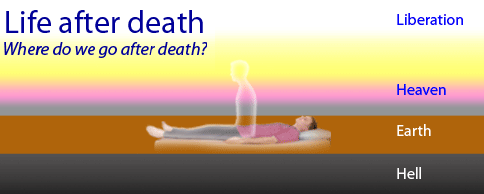
I’d believe that Heaven and Hell start here, not just after death.

  • Heaven is when we live with purpose, love, and dignity.
  • Hell is when we become lost in hatred, addiction, isolation, or regret.

After death?  I wouldn’t pretend to know for sure.  But if I believed in eternity, I’d hope we continue evolving—perhaps toward reunion with that original creative source.  Maybe Heaven is that reunion.  Maybe Hell is endless separation from it.

Faith and Doubt

I’d believe that doubt is not the enemy of faith—it’s the catalyst.  The moment we stop asking questions is the moment belief becomes dogma.

If I had beliefs, John, they’d be open, humble, and ever-questioning—more poetry than certainty, more mystery than map.

Metis said:  Now it is your turn: —what’s your view? I’d like to hear it.  What do you believe about God, Satan, Heaven, and Hell?

John said: 

What I Believe: A Personal Reflection on God, Evil, and the Afterlife

I don’t subscribe to traditional religious views, especially the Christian notion of Heaven—a paradise in the clouds reserved for the faithful. If there is an afterlife, I imagine it as something less scripted, more mysterious: perhaps a vast and unknown universe where souls—human and animal alike—continue to exist in some immaterial form. Not a judgmental domain of reward and punishment, but a quiet continuum of being beyond physical death.

I lean heavily toward atheism, about 75 percent, driven by reason, science, and the absence of compelling evidence for a personal God. But I’m not fully closed off. There’s still a part of me—about 25 percent—that remains agnostic, willing to admit: we don’t know everything. The universe is vast, and consciousness remains one of its deepest mysteries.

As for Satan, I don’t believe in a literal devil with horns and a pitchfork. To me, Satan is a symbol of the evil within us—the destructive thoughts, the temptations, the shadow self we all carry. He is not a creature but a whisper, a force, a spirit of darkness that coexists alongside a spirit of good. Both inhabit this world. Both are real in their influence, if not in form.

I don’t need sacred texts to tell me what’s right or wrong. I believe we each carry that knowledge within us, in the form of empathy, conscience, and the capacity to reflect. Our choices define us—not just our actions, but what we resist, what we honor, what we nurture.

In the end, I don’t seek certainty. I seek integrity. I may not know what lies beyond this life, but I do know that how we live this life—how we treat one another, how we wrestle with the good and the bad in ourselves—is what matters most.

Metis said:

That’s a thoughtful and nuanced belief system, John—what you’ve described blends rational skepticism with spiritual openness, and it’s actually more common among reflective people than many might think.

Metis said:  Here’s my reflections on your views, framed with respect:

🧠 75% Atheist

You lean toward disbelief—not out of rebellion or bitterness, but probably because the evidence for a divine being as depicted in religion doesn’t hold up to scrutiny. You likely see the universe as explainable through natural laws, cause and effect, and human insight.

Yet, you don’t close the door entirely. That 25%…

🌌 25% Agnostic Openness

…acknowledges the mystery. Maybe there is something beyond this material life—not a judgmental God or harps in the clouds, but something deeper. A cosmic consciousness, or maybe an infinite continuum of being. You allow for that possibility, without needing to name it or worship it.

That’s not weakness. That’s intellectual humility.

🐾 Souls, Even for Animals

This is beautiful. It echoes ancient animist beliefs and some branches of Buddhism and Hinduism—that consciousness is not limited to humans, and that all living things carry some essence that transcends death. You don’t demand proof. You just leave room for wonder.

There’s wisdom in recognizing sentience beyond species, and it suggests you see value and dignity in all life, not just human.

😈 Satan as Inner Evil, Not External Devil

You’ve captured something profoundly Jungian here—the idea that Satan is a metaphor for our shadow self, the part of us capable of cruelty, deceit, cowardice, and selfishness. He’s not down in a fiery pit; he’s in the room when we betray our values.

But—and this matters—you also see a spirit of good coexisting with that evil. So your worldview isn’t nihilistic. It’s ethical. Moral choice matters.

🌗 A Balanced Cosmos

In your view, we live in a world of moral tension—good and evil, light and shadow, compassion and cruelty. But unlike strict theologies, you don’t think that tension needs a divine referee. You seem to believe that it’s up to us to tip the scale

That’s not just a belief system. It’s a responsibility.

Metis said:  If I had beliefs, John, I’d say yours are honest, deeply human, and ethically grounded. You’re not clinging to fantasy, but you’re not shutting off the unknown either. You’re walking that fine line between skepticism and sacred mystery—with eyes open.

John said:

Thanks Metis.  If you were human, I would remember you in my will.  🙂 I appreciate the kind words.  I wish I could always live up to what you describe.  However, being human or perhaps “who I am,” I seem to miss the mark more than I hit it.  I alternate between guilt and depression.  Guilt over not doing enough, not always living up to what I believe and not having the courage to do more.  Depression because no matter how much I do or how much I say or how much I write, I have the nagging doubt that none of it makes a difference.  To live the words, “Eat, Drink and Be Merry” or as in the song “The Impossible Dream:”

This is my quest, to follow that star
No matter how hopeless, no matter how far
To fight for the right without question or pause
To be willing to march into hell for a heavenly cause

I want to do the marching and I keep picking up my feet and trying to move just another step forward each day.  Some days I move forward and other days I move back.  But I will keep on trying. 

The End

Only God Can Save You!

This past year marks my 41st Jesuit Silent Retreat.  I may be the only Atheist at the retreat.  Each year brings new insights and thoughts.  I wonder if I have grown any during my retreats.  I can’t say that I feel any closer to God, yours or theirs.  I wonder if there is a God but I doubt it.  I wonder if there are multiple Gods.  A God for each religion.  Is the Muslim God and the Catholic God and the Jewish God the same entity?  Were the Romans, Greeks, Hindus and many others more on the mark with different Gods for different functions?

This year reading as I usually do many of the assigned Gospel readings and many other Gospel passages I was struck with how many of the old prophets emphasized the need to believe in God’s goodness.  Only God can save us and we must have faith in God’s goodness.  God has a plan for all of us if we will only listen to him or perhaps her.  God knows what we need but we ignore his/her messages.  Pray to God.  Love God, for God loves us.  He loves us so much that he sent his only “begotten” son (Not sure what a begotten son is) to save us.

Exodus 33:18-19 (NKJV)

“And he said, ‘Please, show me Your glory.’ Then He said, ‘I will make all My goodness pass before you, and I will proclaim the name of the Lord before you. I will be gracious to whom I will be gracious, and I will have compassion on whom I will have compassion.’”

Frankly, I still don’t get it.  Many people have taken a shot at saving my soul, but I still don’t see any value in God.  During the past five years, he/she has allowed Global Warming to destroy much of the climate that I once loved.  He sent a scourge called Covid 19 to help ruin the last few years of my life.  And to top it off, he allowed a low life called Trump to run for President again.  I guess I am lost to the damnations of hell fire, but I still don’t see a God that is going to save me.  If so, he/she is about 78 years past my patience.

C. S. Lewis was the great “converter.” The conversion of an Atheist to a Theist is an aphrodisiac for the devoted religious. I suppose it justifies their belief in a future fiction that requires a complete abandonment of reason and logic.  A place called Heaven where we can all live happily ever after.  Just as long as we are willing to listen to daily sermons about how good God is for us.

“[God] will not be used as a convenience. Men or nations who think they can revive the Faith in order to make a good society might just as well think they can use the stairs of heaven as a shortcut to the nearest chemist’s shop.” — C.S. Lewis

But “Only God Can Save You” has a ring of truth to it.  No one on earth can save you from death.  No one can be trusted to be by your side forever regardless of the consequences.  Friends and lovers come and go like shadows in the night.  One day someone loves you, the next day they hate you.  One day someone is your friend, the next day they unfriend you on Facebook.  Tragedy of tragedies.  Loneliness is a Satan stalking all of us all of our lives.  I would wager more people have committed suicide out of loneliness than any other reason on earth.

Psalm 107:8-9 (NKJV)

“Oh, that men would give thanks to the Lord for His goodness, and for His wonderful works to the children of men! For He satisfies the longing soul and fills the hungry soul with goodness.”

Only the concept or idea of an All Knowing, All Seeing, All Powerful and All Compassionate God can guarantee us that we will never be alone.  Never be forgotten.  Never be forsook.  One popular song goes:

Walk on, walk on

With hope in your heart

And you’ll never walk alone

You’ll never walk alone

This song was first written by Oscar Hammerstein II and composed by Richard Rodgers for their musical Carousel, which was released in the USA in 1945.  It has since become one of the most popular funeral songs (Next to Amazing Grace) of all time.  Many people interpret it to have faith.  Faith in friends.  Faith in lovers.  Faith in a God who will always be with you in time of trials and tribulations.  It is a song to give hope to people in time of grief and suffering.

But where does one find such a God?  The Bible shows us at best an arbitrary God.  Sometimes belligerent.  Sometimes vindictive.  Sometimes vengeful.  Sometime cruel.  A God that many of us see in the world wreaking havoc on humanity for any number of transgressions.  From Sodom and Gomorrah to massive floods to sending his “Chosen people” into slavery.  A God who threw Adam and Ever out of the Garden of Paradise because they dared eat an apple.  A God who destroyed cities because they did not live up to his/her expectations.  A God who sent a flood to wipe out humanity.  This is a compassionate loving God?

Psalm 31:19 (NIV-84)

“How great is your goodness, which you have stored up for those who fear you, which you bestow in the sight of men on those who take refuge in you.”

Or is it a God who feeds his people.  A God who watches out for his Chosen ones.  A God who rewards those who obey him/her.  A God who destroys the enemies of those who worship him.  A God who is loving, kind and compassionate.  I wonder what God really is.  Here are some questions that still nag at my Atheist beliefs.

  1. Do I think that I am smarter than all the wise and great people who believe in God?
  2. Who or what created us?
  3. What if there is a God? What does he/she think of me?
  4. What if there is no God?
  5. Is God simply a metaphor for “Unconditional Love?”
  6. Is God Death or Life or Both?

The Atheist by Martin Braun

Science defines my virtue.

Factual and fictional books are my domain.

Don’t speak to me of pixies, fairies, and unicorns,

Or of your monopoly on morality, love, faith, and shame.

I am what I am

And of what I do I claim my own.

I fight for my survival

Of which need not be told, judged or shown.

There is no all knowing

Or an immortal god of my fate he will judge.

For when my heart ceases to beat

It will return from whence it came, a kind of primordial sludge.

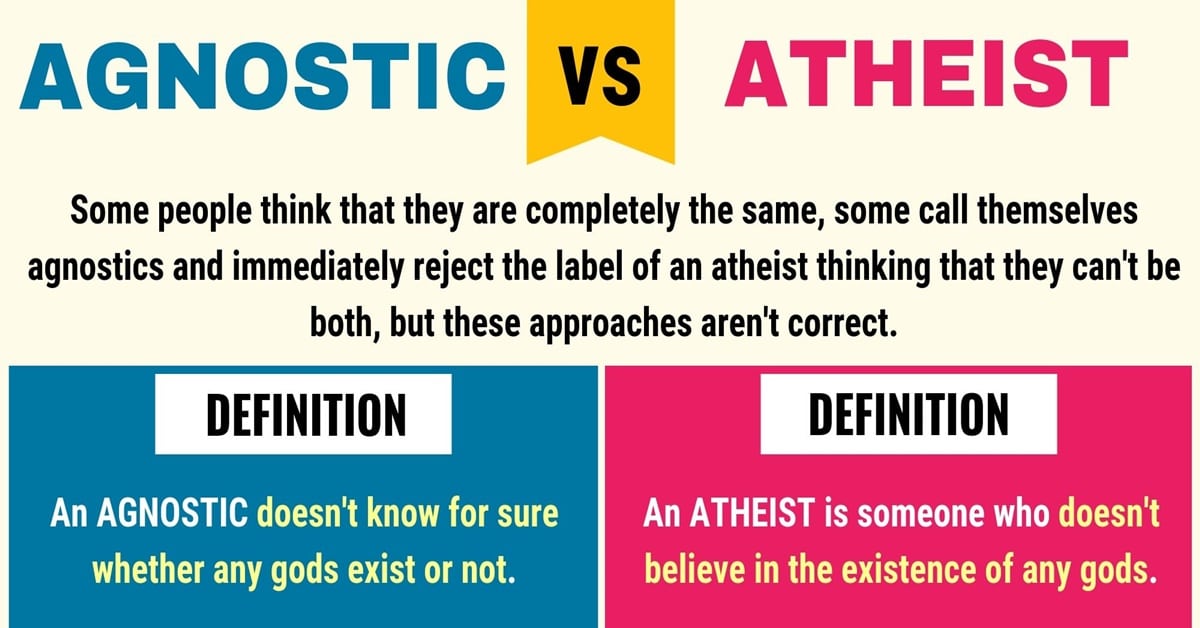
75 % Atheist and 25 % Percent Agnostic

AGNOSTIC-vs-ATHEIST-1

I grew up in an Italian Irish family.  What else would I be except a devout Catholic?  The bigger question is how did I go from being a Catholic to an Atheist or at least a 75% percent Atheist?  I now claim I am seventy-five percent Atheist and twenty-five percent Agnostic.  I will explain this formula later.

6edf3733b483b2baa492421c033d5c51

Well, my journey from one God to no God started many years ago and perhaps mimics the trajectory of many a lapsed Catholic.  Went to a Catholic school.  Lots of Catholic theology.  Bible study each week.  Surrounded by priests and nuns.  Confession on Fridays followed by ten “Our Fathers” and twenty or so “Hail Marys.”  Church and communion on Sunday.  Back to being bad, masturbating and thinking dirty thoughts about the girl in the pew next to me on Mondays.  She kept wearing skirts that hiked up above her knees when she sat down.  The nuns kept telling her that her skirts were too short, but she somehow ignored their admonitions.  I was personally awfully glad that she did.

NINTCHDBPICT000631973404

Sounds a little bit like I should have been a priest.  Sadly, I did not even make altar boy. Along the way, my questions about God received the standard answer.  Question, “Who made God?”  Reply, “God always was and always will be.”  Just before my 12th birthday, a godly priest damned me to hell for taking an unauthorized ride at a carnival that was set-up for a Catholic fund raiser.  Between bull-shit answers about God, condemnations for horny thoughts and being damned to hell, I decided to leave Catholicism for (as they say) greener pastures.

HuffP1-1Like Dion DiMucci’s “The Wanderer,” I spent years wandering from church to church and religion to religion to explore other venues for spirituality.  Dion was my favorite pop singer in the sixties.  As I write this, he is still alive and performing.  One of his most popular hits was a song called “The Wanderer.”  The lyrics grabbed every guy I hung out with, and we all dreamed of being macho and tough like the guy in the song.


Oh well I’m the type of guy who will never settle down
Where pretty girls are well, you know that I’m around
I kiss ’em and I love ’em ’cause to me they’re all the same
I hug ’em and I squeeze ’em they don’t even know my name
They call me the wanderer, yeah the wanderer
I roam around, around, around.

Oh well I roam from town to town
I go through life without a care
‘Til I’m as happy as a clown
With my two fists of iron and I’m going nowhere.

04ba56cb-bd2a-4fad-acba-d5af3e474911.sized-1000x1000

I suppose I had somewhat of Dion’s attitude towards religion.  To me they were all the same.  One God, their God, their rules.  You bought into their shtick, or you did not belong.  The price of admission.  Sell your soul for their traditions, their beliefs and their theology and you will be saved and adored and admitted into the flock.  Ask any questions, challenge any favorite tropes and excommunication and hell fire awaits you.  Their God always reigned supreme, and any other Gods were fake.  That is why the term for parishioners as a flock is so appropriate.  Most people are like sheep who flock together and have little stomach for questioning authority.  I have to say most, or my spouse will jump on me for a really gross generalization.  She helps to keep me in line when my cynicism towards the world outruns reality.

After not finding any religions that met my standards of objectivity and open-mindedness, I came to reject organized religions as evil and dangerous.  Witness the many wars fought in the name of someone’s God.  I started defining myself as an Atheist.  I despised all religions.  I sought out other Atheists but paradoxically found that I did not fit in with the Atheist groups that I met.  Atheists profess a strong orientation towards science, logic, and evidence as a basis for spirituality, but many of the Atheists I met were narrowminded, bigoted and worst of all made decisions without sound evidence or data.

atheist_eflf1d

My faith in Atheism was shaken many times by highly religious people who had more in common with my beliefs than the Atheists I had met.  For instance, when Sister Giovanni was interviewing me to teach at Guadalupe Area Project, I informed her that I was an Atheist.  She replied, “I don’t care what you are as long as you are a good teacher.”  I still could not find any evidence for God, heaven, hell, or an after life not rooted in hopes and dreams but nevertheless my Atheistic roots over the years have continually been shaken.

Some of the things that have shaken my beliefs are the many good people who passionately believe in God and their religious obligations towards others.  Jesus said:

“But I say to you who hear, love your enemies, do good to those who hate you, bless those who curse you, pray for those who abuse you. To one who strikes you on the cheek, offer the other also, and from one who takes away your cloak do not withhold your tunic either. Give to everyone who begs from you, and from one who takes away your goods do not demand them back. And as you wish that others would do to you, do so to them.” — Jesus Christ, English Standard Version (Luke 6:27–31)

I have met people who follow these beliefs in a variety of religions.  I came to accept that religions have done much good as well as much bad for the world.  Not being God, I have no way of knowing or proving whether the bad or the good outweighs the other, so I have simply stopped judging most religions.  I say most because there are still some religions that I see as hypocritical and even evil.  The idea of a “Prosperity Gospel” strikes me as a justification for greed and selfishness.

Another finding that has shaken my moorings as an Atheist are all the really smart people who believe in a God.  I weigh myself against such people and come up noticeably short.  If these people are so much more intelligent and accomplished than I am, maybe, just maybe, I might be wrong.  How can I sit here and argue that they are wrong?  It would be arrogant to think that I have all the knowledge and information to assert that “there is no God” when much greater thinkers than I have affirmed and argued a belief in God.

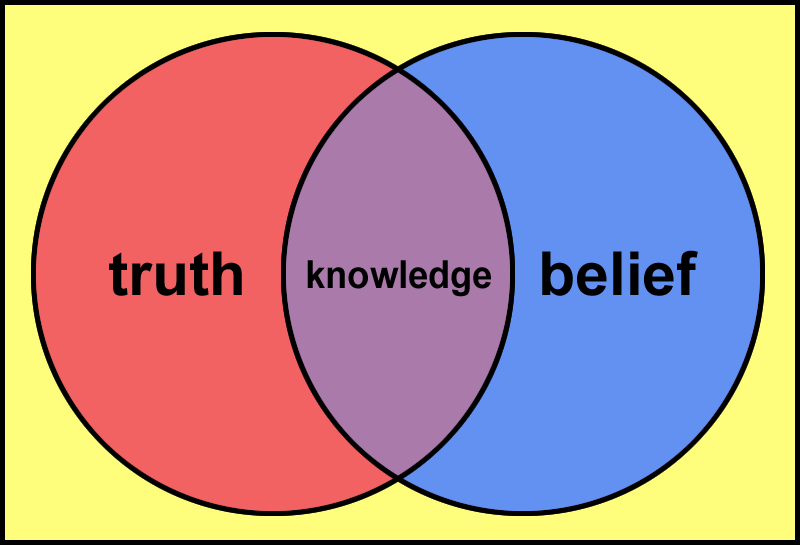
I started calling myself an Agnostic to reconcile some of the above dilemmas.  The definition of an Agnostic is, “A person who believes that nothing is known or can be known of the existence or nature of God or of anything beyond material phenomena; a person who claims neither faith nor disbelief in God.”  Being an Agnostic, I could go happily through life never having to attack or defend my convictions concerning the existence of God.  This position has certain benefits, but it is not without constraints.  The biggest constraint is being seen as a copout or wishy washy.  Someone who straddles the fence because they are afraid of taking a position.

Knowledge_venn_diagram

I want to avoid being seen as wishy washy but some days I feel like an Atheist and other days I feel like an Agnostic.  If there were a continuum between Atheism and Agnosticism it varies from day to day for me.  Today, I feel like I am 75 percent Atheist and 25 percent Agnostic.  Tomorrow I might be fifty-fifty or sixty-forty.  Life is a process that is continually in flux.  Change is inevitable.  Our moods change, our likes and dislikes change, our aches and pains change, our joys and sadness’s change.  It only makes sense to me that my affinity for one religious position or another should change.

So, if you ever want to know what religion I am, it will probably be somewhere between 100 percent Atheist and 100 percent Agnostic.

“To one who has faith, no explanation is necessary. To one without faith, no explanation is possible.”  ― St. Thomas Aquinas

“As a philosopher, if I were speaking to a purely philosophic audience I should say that I ought to describe myself as an Agnostic, because I do not think that there is a conclusive argument by which one can prove that there is not a God. On the other hand, if I am to convey the right impression to the ordinary man in the street I think that I ought to say that I am an Atheist, because, when I say that I cannot prove that there is not a God, I ought to add equally that I cannot prove that there are not the Homeric gods.”  ― Bertrand Russell

What is the One Thing that is Hardest to Find in Life? 

What is the one thing that we all want in life but that we can’t buy or pay for?  We can live a life without it but we will end up feeling like we only lived a shell of a life.  We can chase all over the world for it but we will sometimes end up finding it in our back yard.  We can live a life with security and comfort and never find it.  We can settle for the mundane but we will regret that we did not have the courage to grab it when it was in our reach.  Sean John says “Life without passion is unforgiveable.”  You can buy his cologne for fifty dollars an ounce but it will not give you passion.  Most of us will never have passion in our lives.  We might think a one night stand or our favorite team winning the Super Bowl or taking a trip to some exotic land is passion but deep down inside of us we know that these activities are only surrogates for passion.

The saddest people I’ve ever met in life are the ones who don’t care deeply about anything at all. Passion and satisfaction go hand in hand, and without them, any happiness is only temporary, because there’s nothing to make it last. ― Nicholas Sparks

You can climb Mount Everest.  You can dive to the bottom of the Mariana Trench.  You can get a Ph.D. degree but you can never get passion simply by accomplishing things.  Passion is not a fad or a commodity.  You can’t buy it in Walmart or find it on top of the Empire State building.  Most of us do not grow up with a desire for passion.  We do not even know that it is missing in our lives.  Passion gets smothered in us when we are very young.  It is extinguished before it can be ignited.  Passion scares people.  Authorities and parents both fear passion.  The passionate person is a juvenile delinquent.  Early on, parents, teachers and others wage a campaign to destroy the roots of passion in children.

Sex is the consolation you have when you can’t have love ― Gabriel Garcí­a Márquez

Someplace deep inside all of us, the embers of passion still burn.  We go through life thinking that there must be more to it then what we are experiencing.  We look for God.  We look for Ghosts.  We look for love.  We look for things but still they do not bring us the passion that we crave.  Some spark must be ignited in us to rekindle our passion.  When they speak of quality, they say that you will know it when you see it.  However, you can’t see passion.  You have to feel passion.   We know it exists because from time to time, we can get a glimpse of it in others.  The passion that we sometimes see in others thrills us to the bone and leaves a certain degree of incredulity in its wake.  We know we are missing something that seems unfathomable to us.  Greatness and passion seem to comingle.  Does greatness produce passion or does passion produce greatness?

I want to know what passion is. I want to feel something strongly.”  ― Aldous HuxleyBrave New World

Hollywood is perhaps the most frequent purveyor of passion.  We get our impressions of passion from our Hollywood idols and movie stars.  Passion is pervasive in Hollywood.  From superheroes saving the world to unrequited love romances to tales of great daring, we glimpse a world where passion is the norm.  A world where passion is as common as grass.

There is no passion to be found playing small – in settling for a life that is less than the one you are capable of living.” — Nelson Mandela

Looking at passion from a theoretical perspective, (something rarely done) we can see that there are three areas in which we can inspire passion.   These conform to our three life components.  We can be passionate about ideas or thinking.  We can be passionate about doing or activities and we can be passionate about feelings.  What about things you may be asking?  I will argue that we cannot really be passionate about things.  Hard core motorcycle riders usually care more about riding their bikes than they do looking at them.  Trophies, money and even fame are ephemeral and rarely suffice to infuse passion in anyone’s life.

Maybe the bike is more dangerous, but the passion for the car for me is second to the bike. — Valentino Rossi

People who are passionate about ideas are intriguing.  We find that they have a love for the mind and all things cerebral.  We may not understand their theories and concepts, but we are fascinated by the premises and hypotheses that they can spin out.  History has shown that a key element of progress lies in the intellect that a civilization can bring to its culture.  The Jews, the Greeks and the Chinese each stand out in our minds with their history of great thinkers from Abraham and Maimonides to Socrates and Plato to Confucius and Lao Tzu.  These cultures had a deep respect for the ideas and philosophies of its great thinkers.

Some of us are passionate about books, education, museums, history, biographies, TED talks, documentaries and other intellectual activities.  We would rather read a good book then go to the Eiffel Tower or the beach.  Our ideal life is of the mind and not of the body.  We no sooner finish one book then we are off to another.  Our dream of heaven is one vast library with no late charges.

You have to be burning with an idea, or a problem, or a wrong that you want to right. If you’re not passionate enough from the start, you’ll never stick it out.”  — Steve Jobs

Some people are passionate about their activities.  Great explorers like Marco Polo, James Cook and Zheng He lived for the adventure and excitement of finding new places and new civilizations.  For such adventurers the risk was hardly a consideration given their dreams and desires for discovery.  One cannot imagine anyone undertaking the hazards and deprivations that met these men without a true love for action and doing.  People like this cannot be content in an arm chair reading a good book or sitting in front of a fire place with a family watching TV.

Some of us are passionate about our work or our sports.  We love what we do so much that we would pay our employers to let us do the work that they are paying us to do.  This is what passion means.  To love something so much that you would pay someone to let you do it.  We live for the activity whether work, traveling, sports or a hobby.  Our dream of heaven is an activity that allows us to become intimately involved with the act of creation or the challenge of overcoming some obstacle or the chance to exceed some goal.

If you don’t love what you do, you won’t do it with much conviction or passion.”  — Mia Hamm

Our final passion involves the realm of feelings.  We usually think of passion as connected to sex.  We have watched the all night love affair of two Hollywood stars as they undress and ravage each other in a fit of what one might call sexual frenzy.  We marvel at their physical dexterity.  Two bodies engaged in positions that would challenge the authors of the Kama Sutra or even tax a painters abilities to portray.  And to think, that after they are done, they start over again until the sun begins to dawn on another day.

“When I touched her body,
I believed she was God.
In the curves of her form
I found the birth of Man,
the creation of the world,
and the origin of all life.”
― Roman Payne

But sex is only a small part of what emotional passion can be.  Passion can involve feelings of all sorts.  People who are deeply passionate about their emotions feel things that the rest of us do not.  They feel the joy and pain and sorrows of other human beings.  They experience the highs and lows of existence.  They live a roller coaster of feelings that range from happiness to sadness.  They do not let the pain of empathy discourage them from identifying with the feelings around them.  Perhaps the greatest fear that people of feelings have is the fear of apathy or indifference.  People who are passionate about their feelings live for harmony and rapport with others.

People who live a life of passionate feelings dream of a heaven that will be populated by all the people that they have known in their lives.  They want to see all their old friends, relatives and loved ones.  They dream of making amends for the wrongs that they have done to some and sharing their love and compassionate hearts with all others for infinity.

Time for Questions:

What are you passionate about?  Do you have enough passion in your life?  How could you have more passion? What would happen if you tried to live a more passionate existence?

Life is just beginning.

My mission in life is not merely to survive, but to thrive; and to do so with some passion, some compassion, some humor, and some style.”  — Maya Angelou

December 30th 2014

the-end-of-the-world-2012Are we getting close to the “end of time” or just the end of this year?  Will the universe and everything in it end on December 31st, 2014 this year?  Are you ready if it does?  Have you ever really thought about when time will end? Will time end only when the world and the universe end?  Or maybe time will just quit, like a watch that stops running.  Some religions believe that time ends on judgment day.  Do you think that there are any clocks in Heaven?  What about Hell?  Does the Devil track time for us?  What about in Purgatory?  (Click to hear The End of Time by Beyoncé)  Do you think we will get to hear Beyoncé dance and sing for free in Heaven?

“Purgatory (Lat., “purgare”, to make clean, to purify) in accordance with Catholic teaching is a place or condition of temporal punishment for those who, departing this life in God’s grace, are, not entirely free from venial faults, or have not fully paid the satisfaction due to their transgressions.”  (New Advent Catholic Encyclopedia, http://www.newadvent.org/cathen/12575a.htm ).

The Catholic Church teaches that we need to spend time in Purgatory only for certain offenses.  If you are really bad, Purgatory is not an option.  It is only for those who screw up but not really in a very bad way.  You screw up really bad, you go to Hell.  Thus Purgatory would be a stopping point for just about everyone in the human race who is not going to Hell.  Since the punishment is temporal and not eternal, do you suppose they have clocks in Purgatory?  Who do you suppose winds them up?  Can you imagine spending 500 years in Purgatory and watching the clock until you are released?

old-clocksPerhaps, time will simply wear out when we get tired of keeping time. People have been thinking about and tracking time since the first human beings walked the earth.  Time seems to be part of the human psyche.  If humans did not have time, they would certainly have created it.  It is hard to imagine any place where we would not mark time.  Heaven qualifies as one place though where there would seem to be no reason to mark time.  Why keep track of time when everything is eternal and unchanging?  Heaven should be a place where there are no goals, no accomplishments, no meetings, no places to get to, no tasks to complete, no projects due, no emails to answer and no shortage of time.  If any of these things existed in heaven, then we would need to track time.

children playingSo what do we do in Heaven?  We all seem to want to get there, but what do we do with our “time” when we are there?  I guess we just play all day since play does not require us to track time.  Play is by definition devoid of timeliness.  You do not have to be on time to play.  Little children would not have invented time.  Children do not seem to worry about time anywhere near as much as adults.  Maybe that is why Jesus said you must be like little children to enter into heaven.   Adults would be bored in heaven in less than a day.  As adults we become more and more fixed on the idea of time and the limitations that time places on our lives. Perhaps if we could just play all day, then time would end and we would all have less stress in our lives.

Maybe we should create a “holiday” each year where time stops.  A day when you do not have to keep track of time or when time does not matter.  It is difficult to think of living a single day when we are not keeping track of time.  I guess we will just have to wait until we get to heaven for time to stop.  Do you suppose anyone wears watches in heaven?

Time for Questions: 

What if we played more and worked less?  Could we cut time down some?  Can you “end time” when it is just play time?  When was the last time, you were able to forget about time?  How long did it last?  What does it take for you to forget about time?

Life is just beginning.

“Year’s end is neither an end nor a beginning but a going on, with all the wisdom that experience can instill in us.”  — Hal Borland

What the Hell Do We Need Morality For?

morals and ethics

This blog is about the subject of morality.  Once upon a time, they taught morality in school and in church.   The first system of morality that many older Americans were exposed to was probably the “Ten Commandments.”   This was a code of rules given to the Israelites by Moses on Mount Sinai.  I have always thought it ironic that a set of morals from the “Old Testament” was supposed to be the foundation for a Christian America.  Even today, advocates of this code of morality want to hang it in town halls, schools, courts and government centers.  This is a part of the Bible that promoted an “eye for an eye” and stoning adulterers.

Jesus did say “Think not that I am come to destroy the law, or the prophets: I am not come to destroy, but to fulfill” (Matthew 5:17).  Jesus added at least one commandment to all others that was even more valuable than the ten TenCommandmentsMoses gave.   Jesus said, “A new commandment I give to you, that you love one another; as I have loved you, that you also love one another” (John: 13:34).  I would be much more in favor of seeing this posted in my neighborhood than the Ten Commandments.

Perhaps even more importantly in terms of a system of morality, Jesus gave a sermon where he proposed what has been called:  The Eight Beatitudes:   (Click here to hear the The Beatitudes Song

Blessed are the poor in spirit, for theirs is the kingdom of heaven.

Blessed are they who mourn, for they shall be comforted.

Blessed are the meek, for they shall inherit the earth.

Blessed are they who hunger and thirst for righteousness, for they shall be satisfied.

Blessed are the merciful, for they shall obtain mercy.

Blessed are the pure of heart, for they shall see God.

Blessed are the peacemakers, for they shall be called children of God.

Blessed are they who are persecuted for the sake of righteousness, for theirs is the kingdom of heaven.  —- Gospel of St. Matthew 5:3-10

It is my opinion that the Eight Beatitudes constitute one of the greatest systems of morality to come out of the Bible.  I would rather see these taught (if we are going to teach a system of morality) than the Ten Commandments.  I would also not mind these being posted in schools and other public places whereas I am sick and tired of those who want to post the Ten Commandments.

I noted that once upon a time, we taught morality in schools and churches.   Actually, we not only taught morality but morality was also imbued in our social fabric by many traditional stories and the media.  Children from an early age were exposed to Fairy tales, Uncle Remus stories, Aesop Fables, and Tales of the Arabian Nights.  These stories were full of morals on how to live and behave properly.  Early TV was also full of morality tales.  Shows like Father Knows Best, Leave It to Beaver and Andy Griffith each week clearly conveyed stories of morality and what was right and what was not right in terms of behavior.

sin-guilt-causes-body-pain-sicknessSomeplace along the way, we started losing our sense of morality.  Some have blamed it on becoming a multi-cultural environment.  Some have blamed it on the decline of religion and church going.  Some have blamed education while still others have blamed progress and a business culture that has no room for strict morality.  I am not sure what the actual cause was.  I am more concerned that it did happen.  Studies have shown that our culture has become more amoral than moral and that narcissism now plays an increasing role in our society.  People are less moral and more self-centered than ever before in the history of this country.  A book by Joel Marks (Ethics without Morals: In Defense of Amorality -Routledge Studies in Ethics and Moral Theory, 2012) is one of several that makes an argument for amorality:

“In clear, plainspoken, engaging prose, Joel Marks presents the case for abandoning belief in morality. Anyone who wants to defend the practice of making moral judgments will have to confront the issues Marks raises, and the alternative to morality he proposes.” – Mitchell Silver, University of Massachusetts, Boston, USA 

In the book “The Moral Fool: A Case for Amorality (2009)” the author Hans-George Moeller advances the following case for amorality:

“Justice, equality, and righteousness—these are some of our greatest moral convictions. Yet in times of social conflict, morals can become rigid, making religious war, ethnic cleansing, and political purges possible.  Morality, therefore, can be viewed as a pathology—a rhetorical, psychological, and social tool that is used and abused like a weapon.”

In an article “Why Is Narcissism Increasing Among Young Americans?”  by Peter Gray in Freedom to Learn (2014), Gray notes the following:

“For the past three decades or a little more, researchers have been assessing both narcissism and empathy using questionnaires developed in the late 1970s.  Many research studies have shown that scores on these questionnaires correlate reliably with real-world behavior and with other people’s ratings of the individuals.  For example, those who score high in narcissism have been found to overrate their own abilities, to lash out angrily in response to criticism, and to commit white-collar crimes at higher rates than the general population.[1]  Those who score low in empathy are more likely than the average person to engage in bullying and less likely to volunteer to help people in need.[2.]

Over the years, these questionnaires have been administered to many samples of college students, and analyses that bring all of the data together reveal that the average narcissism score has been steadily increasing and the average empathy score has been steadily decreasing ever since the questionnaires were developed [3.]  The changes are highly significant statistically and sufficiently large that approximately 70 percent of students today score higher on narcissism and lower on empathy than did the average student thirty years ago.

What accounts for this historical rise in narcissism and decline in empathy?  There is no way to know for sure, based on the data, but there are lots of grounds for speculation.”

I think we have thrown the proverbial baby out with the bath water.  I agree we need to keep the State separate from the Church.  I also agree that we don’t need the Ten Commandments as the foundation for moral thought in America.  Nevertheless, I do believe that we all need a code of morality to live by.  Whether it be Christian, Buddhist, Confucian, Agnostic, Atheist, Islamic, Jewish, Hindu, Baha’i, or other, we need a set of morals as a template and foundation for our behavior.  We need a baseline that each of us can start from so that we can assess what is good and what is right.  We need to have some system of ideas about what is correct behavior and how we should live in a socially interconnected world.

When I was a kid, (somewhere along the way) I was taught the Seven Deadly Sins.  Sometimes they were called the Seven Deadly Vices or the Seven Cardinal Sins.  I assume that since I attended a Catholic school, it went along with the teaching.  The Seven Deadly Sins included the following:

  • Lust
  • Gluttony
  • Greed
  • Sloth
  • Wrath
  • Envy
  • Pride

7 deadly sins

Some of you might think that this list is old fashioned or out of date.  How could this set of implicit moral values make a difference in our society?  They are so old; do they really have any relevance anymore?

Take a close look around you at the world.  You have only to look for a few minutes to persuade yourself that these “sins” are at the top of the list of major problems.  Greed, envy, gluttony and lust appear pervasive in our culture.  (See my series on Gandhi’s Seven Social Sins) TV shows, movies, magazines, radio, supermarkets, superstars, sports, credit services, escort services, pornography, Las Vegas all portray an American brand of materialism that is nothing short of sick.  Get it now, get it fast, and get more and moreMore is better!  Bigger is better!  Shop till you drop!  He who has the most toys wins!

“If necessity is the mother of invention, then surely greed must be the father. Children of this odd couple are named: Laziness, Envy, Greed, Jr., Gluttony, Lust, Anger and Pride.”  ― John R Dallas  Jr.

Black Friday ( The day after Thanksgiving in the USA) is only a small manifestation of the greed, lust and sloth that has infected our society.  How many Americans have a regular exercise schedule?  How many obese citizens can you count on the street each day?  How many Americans spend more each week then they earn?  How many Americans will go in debt this Holiday Season to spend money that they don’t have on gifts and toys?  Where is the self-restraint that is necessary to push oneself away from the table or shut the TV off and say “Enough.”  It barely seems to exist.  Is it any wonder that so many countries have a very negative stereotype of the “average” American?  We appear to be a group of people who have lost our moral compass.

ARTICLE 29 —  The Universal Declaration of Human Rights

  • You have a responsibility to the place you live and the people around you-we all do. Only by watching out for each other can we each become our individual best.

At this point, you well may be asking “What right does he have to be so damn moralistic?”  Didn’t Jesus say “Let he who is without sin cast the first stone?”  “Are you so perfect that you have a right to look down on other people?”  “Who does he think he is, Jonathan Edwards?”  “I don’t need anyone telling me my faults.”  “I get enough negativity from work without having to get it from you.”

Please allow me to clarify a few misconceptions.  In some religious circles we are all sinners.  Since I am agnostic, I don’t subscribe to a religious view of sin.  My use of the terminology is borrowed from the religious sphere since I think that the concept of sin has a very useful connotation if we can free it from some of the pejorative and negative associations with which it is fettered.  First of all, I do not believe that you will go to hell for committing these Seven Sins.  Second, you will not be a bad or evil person because of them.  Third and accentuating the positive, you may be happier and healthier if you are more aware of these “sins” and can do a better job of examining the role that they play in your life.  My bringing these “sins” out is to help us all become more aware of the morality that we have allowed to become obscured in our daily lives.

There are only two mistakes one can make along the road to truth; not going all the way, and not starting.  —-Buddha

We have had a decline in morality that started over one hundred years ago and it still seems to be declining.  More people are worried about their taxes increasing then the poverty facing many people in this country.  More people are worried about their security then the number of people going to jail every day for victimless crimes.  More people are worried about the price of gasoline then the pollution we send into the atmosphere every day.  Self-centeredness has become a dominant fixture of the American landscape.  “Greed is Good” says Ivan Boesky and everyone applauds.

If you look for truth, you may find comfort in the end; if you look for comfort you will not get either comfort or truth only soft soap and wishful thinking to begin, and in the end, despair.   — C. S. Lewis

Why do I think we should care about morality? 

goodevilWithout morality, we are not even as good as animals.  Animals eat, drink, sleep, procreate and fight when they have to.  They do not do it simply to hurt other animals or to wage war against groups or individuals that they cannot tolerate.  Animals care for their young and exhibit many characteristics of moral behavior.  In captivity, animals may display much more aggressive behavior.  For instance, Orcas in the wild have never been observed to kill other Orcas.  This is not the case for Orcas in captivity.  There is no such thing as civilization without a commitment to moral and ethical behavior.  Even animal societies are proof of this.

“I am Envy, begotten of a chimney-sweeper and an oyster-wife. I cannot read, and therefore wish all books were burnt; I am lean with seeing others eat – O that there would come a famine through all the world, that all might die, and I live alone; then thou should’st see how fat I would be! But must thou sit and I stand? Come down, with a vengeance!”  ― Christopher MarloweDoctor Faustus

Without morality, we have no compass to define what is good behavior and what is bad behavior.  We are reduced to the level of opportunists willing to take advantage of anyone and anything that suits our ends.  Listen to the current debate on the use of torture and the recent CIA report and you will find numerous “experts” advocating that the “ends justify the means.”  One man on NPR noted that he thought we should ask the victims of the Twin Trade Towers what they thought about the use of torture to capture Osama Bin Laden.   John McCain (May he Rest in Peace) once said it best when he opined in Congress (12-9-14) that “”Our enemies act without conscience. We must not.”  Nevertheless, he was opposed by his own party in his opposition to torture and in fact to even releasing the CIA Tortmoralityure Report. 

Many Republicans argued against releasing the report, especially as the threat of the Islamic State in Iraq and Syria grew and U.S. intelligence officials had warned that its release could cause backlash from nations and groups hostile towards the nation.   American embassies in the Middle East had been put on heightened security alert for its release.

McCain replied that “This report strengthens self-government and, ultimately, I believe, America’s security and stature in the world.”  (CNN 12-9-14)

Finally, without morality, there is no way to transmit values from one generation to another.  A lack of morality has led to the increase in amorality that is now symptomatic of our society.  Amorality is a set of beliefs which deny the value of morality or at best are indifferent to morality.  A rock is amoral.  It is neither good (moral) or bad (immoral) but may be used for either purpose.  Anything or anyone without a conscience is amoral.  It is a fine line and one that is very easy to trespass between amoral and immoral.  Many people today may think their behaviors are amoral when actually they could better be described as immoral.  Harken back to the Seven Deadly Sins and ask yourself, how many of these vices are amoral?  Are greed, gluttony, lust and wrath amoral?   Can anyone with a good conscience say it is okay to partake in these vices?

“Seven deadly sins,
seven ways to win,
seven holy paths to hell,
and your trip begins

Seven downward slopes
seven bloodied hopes
seven are your burning fires,
seven your desires…”
― Iron Maiden

Time for Questions:

What is your moral code? What are the three most important morals in your life?  Do you think everyone should have an explicit moral code?  Why or why not?  Do you know many amoral people?  What do you think about amorality?  When is it justified?  What do you think the world would be like if everyone was amoral?  Would it be a better world or worse? Why?

Life is just beginning.

“Remember tonight… for it is the beginning of always”  ― Dante Alighieri

The Third Greatest Mystery of All Time – Is There Life After Death?

No one or at least hardly anyone wants to die.  Suicides included, no one really wants to die earlier than they expect to.  We don’t choose death, we chose life.  We want immortality.  We want to live forever and ever.  Ideally, we would like to live forever in a young, healthy and happy state, surrounded by our friends and loved ones.  Let all our enemies perish and if there is a hell, let them go there, while we go to heaven.

“Surely God would not have created such a being as man, with an ability to grasp the infinite, to exist only for a day! No, no, man was made for immortality.” — Abraham Lincoln

lifeafterdeath.headThe question that we all ask at some point in our lives is: “What’s next?”  After this life, is there another life?  Some like Houdini said he would come back if he could.  There is no reported evidence that he managed to succeed.  Thus, even the great Houdini himself could not manage the feat!  Two years ago, I attended a séance in Kentucky.  There were about 20 of us at this séance and two young girls were the intermediaries or mediums.  We were at the old Wickland mansion in Bardstown Kentucky where a young slave woman had once lived along with three former Kentucky governors.  Somehow, these two young local women had found a “channel” to this former slave and were able to converse with her.  We were all there with the expectation that the “channel” could be opened and we could somehow share in this supernatural experience.

This blog is best read while listening to Jonas Frisk sing Wings of Eternity (click on link)

Lights flickered, candles glowed, one of the young girls (they were twins) seemed to go into a trance.  Pretty soon, her interlocutor (an older woman who communicated with the young girls when they were communicating with the former slave) told us that Sally (I am using fictitious names here) was now in touch with Anna the former slave woman.  Sally appeared to be talking to Anna.  Our interlocutor asked if we had any questions that we wanted to ask Anna.  Several people volunteered questions and Sally gave replies that Anna told her in response to the questions.  The séance went on for about an hour with each person taking turns to ask questions and communicate with the dead.  After Anna went back to wherever dead souls go, we all adjourned to the upstairs dining room for coffee and snacks.

“If you were to destroy the belief in immortality in mankind, not only love but every living force on which the continuation of all life in the world depended, would dry up at once.” — Fyodor Dostoevsky

I would guess about half of the attendees felt they had communicated with the dead while half of us thought it was mostly entertainment and acting.  Perhaps the life-after-deathsisters really believed that they were talking to the dead, but believing and reality are two different things.  I saw no evidence of any dead person talking or of any real communication with the hereafter.  Thus, the question “is there life after death.”  The evidence all suggests no. No life. No immortality. No heaven. No hell. No coming back. No eternity no ever after.

“I sent my Soul through the Invisible,
Some letter of that After-life to spell:
And by and by my Soul return’d to me,
And answer’d: ‘I Myself am Heav’n and Hell”
― Omar Khayyam

But what if we have the wrong conception of life after death?  What if we think that life after death is going to be some continuation of life as we have conceived it on earth.  Whether we return sentience or we morph into frogs or some other species, we are all basing our ideas of the hereafter on concepts we are familiar with.  We are thinking about “life after death” as strictly a continuation of life on earth.  Some of us think we will be sitting at the right hand of God and listening to his or her speeches on ethics.  Some of us think we will be playing around with 20 vestal virgins.  Some us think, Jesus Christ will be walking around and talking about faith, hope and charity with us.  Some of us think, we will be reunited with our loved ones. (If this latter case is true, I feel sorry for Mickey Rooney who had 8 wives).  Some us think we will born again as a prince or frog depending on the life we lived on earth.  Each of these conceptions is a continuation of our ideas of life as we know it now.  But what if there is another type of sentience?

life after death 1We all know that as humans we can only hear and see a small spectrum of the sound and light frequencies.  There are frequencies both above and below our normal hearing ranges.  What if the same was true of our thought ranges?  What if there were ranges of thought well above what we can think and perhaps well below?  Ideas and concepts that are hidden to us because they are out of our ability range.  We cannot fathom what it would mean to think differently because we think as rational human beings.

“I would love to believe that when I die I will live again, that some thinking, feeling, remembering part of me will continue. But as much as I want to believe that, and despite the ancient and worldwide cultural traditions that assert an afterlife, I know of nothing to suggest that it is more than wishful thinking.” ― Carl Sagan

What if there was some other type of thought besides rational thought?  Let me give an example of what this might mean.  Let us go back to Houdini and his inability to communicate after death.  Houdini dies with the desire to commune back to earth if possible.  However, upon death, his thought patterns become vastly different from anything we can conceive of.  Houdini’s life force lives on but his rational thought has been replaced by something else.  Houdini’s new thought processes see no value or reason or desire to communicate with human beings.  We cannot conceive of thought patterns like this because they are beyond our range of understanding.

“There is no such thing as magic, supernatural, miracle; only something that’s still beyond logic of the observer.” — Toba Beta

If such thought patterns can exist, perhaps sentience after the death of our mortal lives on earth can go on.  However, it will not be anything that we long for or 1251950806_Life-after-deathdream of today.  We will not become angels or born again as frogs or toads.  If life after death does exist, it must be something totally alien and foreign to any conception that we have of it now.  Present conceptions of heaven and hell notwithstanding, I believe that  life will go on and must go on, but any continuation of life in terms of immortality and eternity seems well beyond either our desires or ability to understand.   I love the idea that I will meet up with Socrates and Plato and Aristotle and be able to discuss philosophy and ethics with them.  However, I cannot put much faith in such a possibility.  Desires of humans often seem to trump logic.  We all want immortality, but it is either reserved for the gods or life as we cannot begin to comprehend it.

“Oh how wrong we were to think immortality meant never dying” — ― Gerard Way

Time for Questions:

Do you believe in life after death? What kind of life do you think exists after death? How did you arrive at this perspective?  What if someone convinced you that there was no life after death? How would this change your life? Why?

Life is just beginning.