Five Westerns and Five Moral Universes: What Old TV Shows Still Teach Us About America

By John Persico (with a lot of help from Metis)

In the late 1950s and early 1960s, American television was overrun with cowboys.  Westerns galloped across nearly every network, each one promising a different angle on courage, justice, and the messy human struggle to build a society out of dust and gun smoke.  We tend to remember the big ones—Gunsmoke, Bonanza, The Rifleman—but tucked in that crowded landscape were several thoughtful, sometimes surprisingly philosophical shows that tried to answer deeper questions about right and wrong.

I have always loved cowboy shows.   My favorite cowboys when I was growing up were Hopalong Cassidy, the Lone Ranger and Roy Rogers.  Most of these men got their start in the 30’s but their shows migrated to the TV medium when it was first started.  Many episodes of Hopalong were taken from his early movies.  Later, TV started to develop its own cowboy series with weekly episodes of tall, dark and handsome heroes.  By this time in the late 50’s and early 60’s I was not watching TV anymore.  I was in my early teens and had better things to do than watch TV.  Thus, I never watched the five shows that I am going to talk about in this blog when I was young.

I only started to watch these old TV shows a few years ago.  I was rather amazed at the quality of the stories that they told.  They were nothing like many of the TV series that came around later characterized by many more shootouts and gun fights.  These early TV shows tried to convey a strong sense of morality and featured a more discreet and thoughtful use of gunplay.   Many of the heroes in these shows eschewed violence and attempted to use reason to end a fight rather than gunning down a villain.   

Five of these Westerns—The Tall Man, Wyatt Earp, The Restless Gun, Tombstone Territory, and The Texan—offer a fascinating window into how Americans of that era imagined moral life on the frontier.   Each operated in a different moral universe.  Together, they reveal a whole spectrum of values still relevant in 2025: authority vs.  independence, violence vs.  restraint, institutions vs.  personal codes, loyalty vs.  law.

Here’s what these shows have to teach us when we dust them off and look again.

The Tall Man: Tragedy, Friendship, and the Gray Zone of Morality

Among these Westerns, The Tall Man stands out for its dramatic complexity.  Rather than presenting the frontier as a struggle between clear-cut good and evil, the series explored the psychological and moral tensions between Pat Garrett and Billy the Kid—historical figures already steeped in myth.  The show emphasized the tragic inevitability of their relationship: Garrett, the reluctant lawman; Billy, the charming outlaw whose charisma repeatedly outpaced his judgment. These were not cardboard heroes and villains; they were complicated men bound together by loyalty and destiny.

The morality here is not a simple endorsement of law or rebellion.  Instead, it suggests that human loyalties are fragile, destiny is unforgiving, and justice often emerges from personal conflict rather than abstract principles.  It is a Western operating in shades of gray, reflecting an America grappling with Cold War dilemmas where allies and enemies were not always easy to distinguish.  Viewers recognized themselves in the struggle between duty and friendship, a theme uncommon among early Westerns.

The underlying message was that life often puts us in situations where justice isn’t neat.  Friendship can clash with duty.  Good intentions can slide into the wrong choices.  And sometimes the person you care about most becomes the person you eventually have to confront.

In that sense, The Tall Man feels strikingly modern.  It understands that real life doesn’t divide neatly into good guys and bad guys—something America in the Cold War era was just beginning to wrestle with.

Wyatt Earp: The Comfort of the Uncomplicated Hero

If The Tall Man reveled in moral ambiguity, Wyatt Earp offered the opposite: a mythologized portrait of the West’s greatest lawman, played with crisp, upright dignity by Hugh O’Brian.  This series promoted a worldview in which society advances only when firm, principled authority imposes order on chaos.  Earp serves as the archetype of the responsible American leader—a man who does not relish violence but accepts it as a necessary instrument of civilization.

Earp represented the belief that civilization requires firmness.  Order doesn’t grow on its own—it has to be imposed by strong, decent people who are willing to shoulder responsibility.  For postwar America, still anxious about the atomic age and the looming tensions with the Soviet Union, this moral clarity was reassuring.

The show’s moral message resonated with 1950s ideals of stability: strong institutions, disciplined citizenship, and faith in the ability of virtuous leaders to “keep the peace.” It aligned neatly with postwar values, especially the belief that social progress requires firmness rather than moral compromise. Earp rarely doubted himself, and the series rarely doubted him either.  Its clarity, even rigidity, provided reassurance during an era troubled by atomic anxieties and Cold War uncertainty.

Earp didn’t struggle with his conscience—he was the conscience.

The Restless Gun: Pacifism in a Violent Landscape

In sharp contrast to both Garrett and Earp stands Vint Bonner of The Restless Gun, one of the few early Western heroes who actively sought alternatives to violence.  Bonner modeled the idea that courage is not measured by willingness to kill but by the ability to resolve conflict through empathy, reason, and patience.  Yes, this was a Western.  Yes, he still ended up in gunfights.  But the moral direction of the show pointed firmly away from killing and toward understanding.

This places The Restless Gun closer to a moral philosophy of restorative justice than frontier retribution.  In many episodes, Bonner functioned as a mediator, teacher, or counselor.  The villains were not always evil; they were often misguided, desperate, misinformed, or trapped in circumstances they could not manage.  The show’s worldview subtly challenged the Western convention that justice flows from the barrel of a gun.  Instead, it argued that America’s future might depend more on understanding than dominance.

This made the series unusually modern, anticipating later Westerns such as Have Gun, Will Travel, which incorporated moral complexity into the traveling-gunman archetype. Though the show ended early, its worldview remains distinctive in the genre.

In a genre built on bullets, The Restless Gun dared to say: there is another way.

Tombstone Territory: Justice as a Public Responsibility

Tombstone Territory offered a more institutional perspective on frontier justice. Structured around the fictional Tombstone Epitaph newspaper, the show dramatized the challenges faced by Sheriff Clay Hollister in maintaining order within a volatile, fast-growing community.  Unlike Wyatt Earp, where the marshal’s authority was never questioned, Hollister constantly wrestled with public scrutiny, political pressure, and misinformation—issues that eerily foreshadow the modern news cycle.

The moral heart of the series lies in its quasi-documentary tone. Hollister must uphold the law not simply by enforcing it, but by navigating competing interests, calming mobs, and maintaining legitimacy.  Truth, evidence, and due process—rare elements in early Westerns—become central themes. The show’s structure echoes the belief that justice is not merely an individual virtue but a collective responsibility.  It encourages viewers to appreciate the difficulty of governing rather than merely celebrating the lone hero.

In many ways, Tombstone Territory anticipated the later rise of procedural dramas where law enforcement is portrayed as an institution rather than a personal crusade.

The show’s moral center was institutional: justice requires process, evidence, and the difficult work of maintaining legitimacy.  It wasn’t glamorous.  But it was honest.  In many ways, Tombstone Territory speaks more directly to our modern world than some of the bigger Westerns of its time.

The Texan: The Noble Drifter and the American Myth of Honor

Rory Calhoun’s The Texan returned to the classic Western figure of the noble wanderer—a man whose moral code is internal rather than institutional.  Bill Longley, a Confederate veteran, embodies the Western ethos of individual honor: help the vulnerable, confront injustice, and ride away when the dust settles.  The show foregrounds personal integrity over law, suggesting that character—not institutions—ultimately preserves the frontier’s fragile social fabric.

This worldview reflects an enduring American belief in self-reliance and moral autonomy. Longley’s wanderings represent not rootlessness but a spiritual quest to repair the world one town at a time.  His code is chivalric, almost knightly, and he stands as a corrective to the bureaucratic tensions seen in Tombstone Territory.  While he respects the law, he serves a higher standard—his own conscience.

Longley wasn’t defined by the law, nor by institutions.  His moral compass was internal.  He showed that a single person—armed only with decency and grit—could make things a little better wherever he went.

It is the Western as America likes to imagine itself: independent, honorable, and self-reliant.  Even if it rarely works that way in real life, the aspiration is part of our national DNA.

Five Shows, Five Moral Visions

When you line up these Westerns side by side, the moral variety is remarkable:

  • The Tall Man explores the tragedy of conflicting loyalties.
  • Wyatt Earp celebrates firm authority and disciplined leadership.
  • The Restless Gun champions compassion and restraint.
  • Tombstone Territory elevates due process and public trust.
  • The Texan extols personal conscience as the highest law.

Together, they show how deeply Americans were thinking—even through half-hour cowboy shows—about law, justice, violence, and the kind of people we wanted to be.

And perhaps that is the most interesting lesson of all: Westerns weren’t just entertainment.  They were moral storytelling, played out on horseback.

In dusting off these forgotten classics, we rediscover a whole range of ethical possibilities—some stern, some gentle, some tragic, some idealistic.  The frontier wasn’t just a place; it was a metaphor for the ongoing journey America has always been on: trying to figure out how to live decently in a world that is not always decent.

What Happened to These Shows and the Morality that They Tried to Convey?

  1. The Tall Man (1960–1962)

Why it was cancelled:

  • Ratings sagged as audiences drifted toward lighter, family-friendly Westerns and bigger stars.
  • NBC also faced increasing difficulty with script standards: portraying Billy the Kid sympathetically clashed with emerging TV violence guidelines.
  • Production costs were rising, and no strong sponsor stepped in to keep it going.
  1. The Life and Legend of Wyatt Earp (1955–1961)

Why it was cancelled:

  • After six seasons, the formula grew repetitive, and the mythologized Earp no longer impressed audiences seeking the grittier realism of later Westerns.
  • Hugh O’Brian wanted to move on, and ABC saw declining ratings.
  • The Western market was oversaturated by 1961.
  1. The Restless Gun (1957–1959)

Why it was cancelled:

  • Despite solid ratings, Payne’s contract and salary demands increased, and NBC hesitated to renew at higher costs.
  • The show’s gentler tone was overshadowed by edgier Westerns.
  • Payne himself said he felt the stories were becoming repetitive.
  1. Tombstone Territory (1957–1960)

 Why it was cancelled:

  • Transition from ABC to syndication hurt the budget.
  • Stiff competition from higher-budget Westerns.
  • The semi-documentary framing was admired but not loved; viewers were shifting toward character-driven stories.
  1. The Texan (1958–1960)

Why it was cancelled:

  • It had strong early ratings but lost its time slot advantage to more modern “adult” Westerns.
  • Calhoun’s outside film commitments strained scheduling.
  • CBS was phasing out lower-budget half-hour Westerns in favor of hour-long dramas.

Each show ended for slightly different reasons, but the common story is:  the genre evolved faster than these earlier, simpler morality tales could adapt.  Americans wanted more “grit” more “violence” and yes even less morality.  The change from John Wayne to Clint Eastwood capped the change that we would see in Westerns from morality tales to tales of vengeance and retribution.  America was becoming more jaded.  We did not want heroes any more who were goody two-shoes.  We wanted anti-heroes and the studios offered them up in droves. 

Looking at American politics today, I often wonder where, when and how the decline in values, integrity and morality started.  Some would say it started with the decline in religion.  I don’t think religion has in the last 200 years in the USA been that big of an influence in terms of morality and integrity.  Karl Marx always believed that economics was the major driver of most social trends.  Many people who disagree with him nevertheless admit that the primary influence on voting behavior is the state of the economy.  In my opinion, this influence goes much deeper than voting behavior.  Capitalism thrives on avarice and stupidity.  It needs a large mass of people who want more and more stuff and too brainwashed to realize that the stuff they are buying is not going to bring them happiness. 

Madison Avenue became a major influencer with the advent of TV.  Go back and look at some of these early Westerns.  Smoking was de rigor.  Many of the heroes of these early Westerns died of lung cancer.  Legendary figures like John Wayne, Gary Cooper, and Chuck Connors, with numerous other actors, musicians, and public figures from that era also falling to the disease, highlighting smoking’s heavy toll in Hollywood.  But while these heroes were dying, Madison Avenue was perfecting the use of TV to sell all kinds of products. 

I always laugh at the fact that so many men have been conned into buying what I call “piss beer” from Budweiser, Miller and Coors.  Large macho football players posing in a bar with these watered down beers spent years on TV regaling their followers with the virtues of light beer.  Would be macho males stormed the liquor stores to buy their six pack of piss beer that they could swill down while watching their favorite football teams playing.  The average person is brainwashed by Madison Avenue on a daily basis.  Watch some of the old TV shows and see how much more sophisticated the ads are today.

I once asked all my MBA students if they thought that TV ads had much influence on their buying patterns.  The typical answer I received was “No, I make up my own mind when I go shopping.”  Most people do not even know that they are brainwashed.  The cigarette industry spent years lying to people about the medical effects of cigarettes.  Today, it is the liquor companies that are lying to consumers.  But all of Capitalism and advertising has one major motive when it comes to making a sales pitch.  That motive is too make you feel inferior.  To make you feel needy.  To make you feel inadequate.  Once you feel like you are somehow lacking something, they can pitch you their product.  Their pitch will always be that you will be better, smarter, faster or happier with their product or at least you will be better, smarter, faster and happier than your next-door neighbor who did not buy their product.

I believe the decline in morality and integrity in the USA can be directly linked to Madison Avenue and the brainwashing they conduct on consumers.  If you are on the producers side of the economic equation, you cannot have any qualms about what you are selling or the side effects or the unintended consequences of the use of your products or services.  If you are on the consumer side of the economic equation, your whole reason for being is to buy more and more stuff regardless of its impact on your health and sanity or the environment.  This callousness on both sides has resulted in a society that is unparalleled in terms of greed and avarice. 

The old Westerns were like some of the early fairy tales.  They had a motive beyond entertainment.  They existed to convey a morality that eventually seemed too simplistic and certainly too limiting.  Morality is a unique virtue in the sense that it not only asks you what you are doing for yourself, but it also asks what are you doing for others. Morality cannot coexist with Capitalism any more than Capitalism can coexist with Communism.  We need a new economic system based on principles of love, trust and compassion for ALL the people in world and not just our friends or relatives or the people in our own country. 

Nothing Left to Mourn

What happens when everything you believe in is shattered?  To mourn something means to regret its loss or disappearance.  What happens if your ability to mourn is overwhelmed by the sheer magnitude of the destruction impacting those people or things or ideas that you love?  Does our ability to face life with a positive attitude disappear in the wind?  Are we less able to effect a happy demeanor as we face each new day?  How do we cope when the world around us seems to no longer support anything that we trust in?

I am probably selfish when I ask these questions.  I am still healthy, can pay my bills and have a wonderful spouse.  But after reading the news this morning about still another Supreme Court victory for trump, I felt an overwhelming sense of depression and futility extend over my life.  Karen noticed my attitude and asked if anything was wrong.  I said yes and told her what I had read.  What can I do about it?  How do I help stop a juggernaut that now seems to be tearing our world apart?  I thought it could not get any worse than Covid and Climate Change and now I am trying to cope with a country that I do not recognize.  We have elected a government that seems to support evil, vengeance and extreme injustice.

I know that there are many people who feel the same way that I do.  I try to coach and counsel them with bromides about resistance and the power of one person to make a difference.  But then I look at the futility of my own efforts.  I march.  I write.  I speak out.  Things keep getting worse.  When will the arc of justice bend back towards love and mercy and compassion?  I am old enough now to think that I will see my life ebb away before this country returns to anything that I once believed it stood for.  Every institution in the country seems corrupted by greed or power or some type of anti-human ideology.  We are the greatest.  We are exceptional.  We can do whatever we want to do because we have bigger and more bombs than anyone else.

Perhaps I am just venting here and will rise like the Phoenix tomorrow.  Born again with hope and optimism.  But what if I cannot?  What if there is nothing left to mourn?  What if all my ideals and hopes for a better world are now simply a chimera?  A phantom that only exists in fairy tales and stories told by naïve writers.  Does the world really march towards progress and less iniquity or have we all been sold a childish narrative.  A story of good and evil where the good always wins over the evil.

Lately I find myself watching many of the reruns of old cowboy stories from the fifties and sixties on YouTube.  I watch them because I can’t read or find any good news in books or the media.  In these old cowboy stories, the good guys always win.  My biggest bit of joy these days is watching a person on the side of justice overcome the evil doers who would thwart the rationale rules of law and order.  In the old cowboy stories, the rule of law is always supported by the end of the story.

I have never shunned history or ever idealized the past.  I am too familiar with the barbarism of all the older and ancient empires in history.  The cliche that “Power Corrupts and Absolute Power Corrupts Absolutely” is as true as any of the laws of Physics.  History is a chronology of the powerful taking the rights away from the less powerful.  There has never been and perhaps never will be a humanistic empire.  Every empire that has ever existed has been an entity that has attacked, destroyed, stolen and devoured what belonged to others less powerful.  OSHO thought that humans would always be destructive since war provided a release from the boredom of everyday life.

If you think that wars have become any less violent or barbaric you need to only review your history books.  Modern wars since 1900 have killed more people than most of the ancient wars by the Assyrians, Babylonians, Egyptians, Romans, Huns, or Mongols.  The Spanish, French, British, German and Russian empires were just as brutal as any of the ancient empires.  That leaves the American empire.  The land of the free and the home of the brave.  A country that was fought and died for by patriots.  Patriots that killed millions of indigenous people and tens of millions of Africans shipped over to work in the fields and help build this country on their whipped backs.

The Great Dying:  Some sources suggest that colonization led to the death of around 56 million people, or about 90% of the indigenous population in the Americas between 1492 and 1600, leading to a period termed the “Great Dying”.  Thousands more were killed during the expansion of the US empire and what have been called the “Indian Wars.”  — Wikipedia

The Slave Trade:  During the Transatlantic Slave Trade, approximately 1.8 million Africans are estimated to have died during the Middle Passage, the horrific journey across the Atlantic Ocean.  This represents about 10-15% of the estimated 12.5 million Africans forcibly transported across the Atlantic between 1500 and 1866.

However, it’s important to understand this is just the mortality on the ships. The total number of deaths associated with the slave trade is much higher, including those who died during:

  • The initial capture and forced march to the coast.
  • Confinement in coastal barracoons awaiting shipment.
  • The “seasoning” process upon arrival in the Americas, where they adjusted to a new climate, brutal work routines, and harsh living conditions.
  • Resistance, mutiny, suicide attempts, and forced starvation during the voyage.

For every 100 enslaved people who survived the Middle Passage, another 40 died in Africa or during the voyage itself.  The Equal Justice Initiative reports that nearly two million Africans died during the Middle Passage, nearly one million more than all Americans who have died in every war fought since 1775 combined.  —- Digital History

It is not easy assimilating the truths about the American empire.  An empire that was and is about as bloody as any empire in history.  That is why the “truthtellers” want to eliminate concepts like Critical Race Theory and Diversity, Equity and Inclusion Training.  It is shameful and embarrassing to have to face the truth about a nation billed as the Shining City on the Hill.  Most of us who grew up in this country with any knowledge of history knew many of the facts concerning the American myth of Truth, Justice and Equality.  However, we held onto the idealism that underpinned the founding of this country.

We believed that someday the checks that Martin Luther King said were marked “Insufficient Funds” would be redeemed for their declared value.  We believed that we would move to a society where equality of income and opportunity would become a reality for all citizens.  We believed in the words inscribed inside the Statue of Liberty that we would provide a haven for all people looking for a better life regardless of where they were from.  We believed that democracy would be exported to other countries rather than a rapacious greedy system of corporate capitalism.  We believed that people would want to imitate our country because they would see firsthand a country that practiced the ideals that all people in their hearts cherish.

We never thought that we would see a country where greed had replaced morality and personal virtue as guiding principles. 

Mr. Wardell E. Stephens:  A Profile in Courage, Character and Integrity

Mr.  Wardell Stephens is a 95-year-old Navy veteran.  He was born in 1930 in St. Louis.  Wardell joined the Navy in 1947 at the age of seventeen.  He retired twenty years later in 1967 at the age of 37.  He had a long and distinguished career as a Navy diver conducting deep sea rescue operations.  He is a rare man, and it is my pleasure to provide a brief overview of his life.  I call it a Profile in Courage, Character and Integrity.  Reading this testimonial, I think you will agree that these terms aptly apply to Mr. Stephens.

I first met Mr. Stephens several years ago at one of the Eloy Veterans Day celebrations.  Mr.  Stephens was the guest of honor and a keynote speaker.  He was mild mannered and humble.  He briefly thanked the people for his being there and said a few words about how much the Navy mattered to him.  He was a Navy diver who had conducted several deep-sea rescue operations back when the equipment was much more primitive than it was today.  No bragging about his bravery or how dangerous the job was.  I was impressed with his humility.

Several years went by and one day shortly after they opened the new Eloy Veterans Center, (January 2025) Mr.  Stephens dropped by to visit.  Wardell was now 95 but had not seemed to age a day.  He still walked like a young man with none of the shuffling you often see with the aged.  He was ramrod straight and looked in better health than many people half his age.

We had a talk about some of his career exploits and again I was very impressed with his courage and humility.  I asked if I could interview him and he agreed.  That was more than two months ago.  Mr.  Wardell was sick for a while (as was I) with the damn bug that went around this spring.   We finally set a date for me to interview him.  Earlier he had left a packet of information about his Navy ships and projects for me to look at.  Some of the material that follows are taken from his Navy record and some will include my interview with Wardell on May 7th, 2025.  The interview lasted about 2 hours.  Many veterans are inclined to some exaggeration as the years have passed.  Wardell was just the opposite.  I had a hard time getting him to be anything more than modest about his adventures.

Here is what one of his commanders said about him in a Navy Review:

“Stephens is an extremely conscientious Petty Officer in that he invariably will take charge of an operation.  He goes out of his way to correct other divisional personnel who are performing work in an unseamanlike manner.  His timely suggestions and technical ability have contributed greatly to the ability of the diving division to perform submarine repair work in an expeditious manner.  He is always in a clean complete uniform and wears it in a shipshape fashion at all times.  Definite credit to his rate and to the Naval service.  Highly recommended for advancement in rate.  Stephens when in charge of an evolution uses excellent judgement and disposes his men for maximum effectiveness in accordance with their abilities thereby assuring a smooth operation.”  — J. H. Lindsay, CDR, USN

I had a chance to look at Mr. Stephen’s training record.  It was full of very difficult diving techniques including the following:

  • Deep sea diving school
  • Salvage diving school
  • Diving school instructor
  • Submarine rescue

A number of years ago I went to scuba training and received my PADI certification.  I then went on a trip to Belize to do several dives in the area of Ambergris Caye and Caye Caulker.  I was sixty years old at the time.  Some of my dives were fun but some were scary.  Swimming among large sharks.  Swimming through some narrow channels in dark conditions.  Having to think about time for compensation stops to avoid getting the bends.  Watching my air and depth gauges.  Trying to avoid scraping coral.  Trying to manage my buoyancy to stay with the other divers.  It was very challenging, and I was only recreational diving.  I never went below 150 feet and was never down for more than thirty minutes.

Wardell was diving in pitch black conditions.  Sometimes using helium instead of oxygen and going down to do rescue and salvage operations at depths of 350 feet.  Here is a Letter of Commendation describing one operation that Wardell completed:

On May 13, 1964, NEREUS completed the water-borne replacement of the propeller on the USS Scamp.  The old and new propellors weigh approximately 12 tons.  As far as is known the replacement had never been accomplished in the water.  As a member of the diving crew, you did the work assigned and thus contributed to the overall success enjoyed.  In each instance, the reliance placed on you by the Master Diver and diving officer was justified and your contribution was significant.”  — M. des Granges, Commanding Officer, USS NEREUS

The following video talks about what it is like to be a Navy Rescue and Salvage diver.

https://www.youtube.com/watch?v=AnihhBnzowg

I would like to describe one more operation that Wardell did from the Commendation letter that he received.  After this I will go to the interview that I did with Wardell.  I am glad that he sent me some of his service records because it was hard to get Wardell to “brag” about any of his Navy exploits.  I am trying to give you a sense of the danger and difficulty of what Mr. Stephens did for twenty years.  I don’t often think of all military people as heroes, but it is certainly an appropriate designation for Wardell.

“In the early evening of December 3, 1958, a Marine Corps helicopter flying under conditions of darkness and poor visibility crashed in the Potomac River near Jones Point, Alexandria, Virginia.  While  enroute to commence the salvage operation on the assigned helicopter, you were advised of a second aircraft crash.  This second crash was a Navy Beechcraft with a crew of two which crashed in the Potomac river off Haines Point.  Throughout the daylight hours of 4 December under adverse weather conditions, the officers and men of your entire organization worked expeditiously in the salvage of the downed Beechcraft.  On December 5th, you were also able to complete the salvage of the downed helicopter.” — Commandant, Potomac River Naval Command 

On my last Scuba Diving trip to Belize in April of 2024, the weather conditions were pretty bad.  A storm had come through the area and the water visibility was very poor.  The waves and current were quite rough.  I had a hard time reading my depth gauge and my air gauge and ended up getting separated from the other divers on our ship.  I came up to the surface and could not see the dive boat.  I had left my safety flag back with my pack.  I also had not bothered to take my snorkel.  My tank was almost out of air, and I had no way to alert anyone as to where I was.  When the oxygen ran out of my tank, I had to keep propelling myself above the waves to get a breath of air.  With the waves running high, I could do little except bob up and down and hope someone would find me.  About 90 minutes later, the boat finally found me.  I was picked up and spent the next two hours trying to barf up the seawater that I had swallowed.

I tell you the above story because Mr. Stephens had made many operations where he had to arrange a tow in weather ten times worse than I experienced.  To link a tow ship with a disabled vessel is not as easy as simply throwing a rope to someone on the other ship.  This short video might give you some idea of what courage it would take to engage in such an operation.

Rescue Salvage Towing operations on rough sea

https://www.youtube.com/watch?v=-JhLJoCYi-g

Here are my interview questions and Wardell’s replies.  On the day of the interview, we had not scheduled a definite time.  I had said that I would be at the Veterans Center between 10 AM and 2 PM and that he could stop by anytime he wished.  Shortly after 10 AM, my cell phone rang, and it was Wardell.  I expected that he was calling to say that he was not feeling well.  Not an unexpected event for a man 95 years old.  Instead, he had called to tell me that he might be a little late since he had a phone problem at his house and the repair person was coming out that morning.  I thanked him for his call and told him that any time he arrived it would be okay.  I can’t tell you how surprised I was at his call.  I cannot get repair people to give me a date and time that they will arrive much less call me if they are going to be late.  Wardell receives not one penny from this interview and yet he is courteous and diligent beyond what any norm is today.

John and Wardell Interview:

John:  Can you tell me a little about yourself when you were growing up.  Friends, school, culture, family, dreams?

Wardell:  I was raised by my mom and aunt.  I had no siblings.  I grew up in East Saint Louis in the Rush City Area.  We called it the bottoms.  I started working as a pin setter in a bowling alley when I was 14.  I drove a coal truck when I was 16.  My dream was to own my own truck and go into the coal business.  I never got a drivers license.  I joined the Navy when I turned 17

Wiki describes the Rush City area as follows: 

“Rush City is a historically African-American community within East St. Louis, Illinois, that is unique in the American Bottom region.  It’s characterized by a rural Southern influence, dispersed housing, and vernacular architecture, making it a distinct “country life” pocket within a struggling urban environment.  The community has faced challenges related to economic disinvestment, environmental pollution, and industrial encroachment.”

John:  Why did you pick the Navy?

Wardell:  Well, one day during the second World War, the Navy brought an LST to St. Louis.  I went down to see it and was very impressed.  Later when I decided to leave St. Louis, I enlisted in the Navy.

John:  What are you most proud of in terms of your military service?

Wardell:  The work I did as a rescue and salvage diver and my Sailmaker rate

John:  Can you tell me more about your work in the military?  Challenges etc.?

Wardell:  There was a lot of things to learn.  Setting up a tow.  Different type of rigging on different ships.  Working cables in rough weather.  Using hoists in rough weather.  It was easy to get hurt if you were not careful.

John:  What were your biggest difficulties in the military?

Wardell:  Only had a few minor negative experiences.  Most of my career was positive.

John:  What were the negative experiences?

Wardell:  Well Truman changed some of the policies for the better.  Before Truman there were some bases where they separated Blacks and Whites in the dining halls.

John:  How did the transition to civilian life go for you?

Wardell:  At first it was very chaotic.  In the military things are very orderly and predictable.

John:  Can you tell me a little about your family life?  Spouse, kids?

Wardell:  Well, I was married twice.  I have four children and ten grandchildren.

John:  Wardell, for a 95-year-old guy, you are in great shape.  How do you do it?

Wardell:  I lift weights three times a week.  I don’t smoke or drink.  I eat lots of protein.  Three times per week, I go for a walk.   I walk as much as I can.  I always park as far away from a store in the parking lot so I get more walking in.  I have a treadmill at home I walk on when the weather is too hot or bad.

John:  What advice would you give young people today?

Wardell:  I would tell them that you have to learn and study to get something good in life.  You have to study hard and pay attention in school.  I would tell them that they should learn another language.

John:  What were the highs and lows of your life Wardell?

Wardell:  The high was completing Navy diving school in 1954.  I also finally completed my GED since I never graduated high school.

John:  What would you do over if you could?

Wardell:  I would go for more school.  Continue education all your life.

John:  Am I leaving anything out you would like to share?

Wardell:  That’s about it.  Except I also had a stint in the Merchant Marine after I retired from the military.

John:  Thank you for taking the time to share some of your life and thoughts with us Wardell.  It has been a pleasure talking to you.

That’s it folks.  I hope you have enjoyed learning about a very remarkable human being.  In addition to a depth of character and integrity that is more than noteworthy, Mr. Stevens is  a kind man who said not one bad word about anyone during the entire interview or the time that I have known him.  His integrity and character stems from his taking the responsibility to live life according to what his mother and aunt taught him and what his religious beliefs have inspired in him.

PS:  I still see Wardell every few weeks when he comes down to the Veteran Center in Eloy.  Yesterday, he asked me to add a little something to the bio I did for him.  I was quite surprised to learn that Wardell is a Life Association Member of the Buffalo Soldiers.  He officially belongs to the “9th and 10th (Horse) Cavalry Association – Official Army Unit Association.”  For those of you who have never heard of the Buffalo Soldiers, I give you the following brief excerpt from Wikipedia.  For more information, click on the Wikipedia link or simply go to any Arizona Library.  There are many books written about the Buffalo Soldiers.

Buffalo Soldiers were United States Army regiments composed exclusively of Black American soldiers, formed during the 19th century to serve on the American frontier.

Legacy and Contributions
  • Courage and Discipline:
    The Buffalo Soldiers had the lowest desertion and court-martial rates in the army, demonstrating exceptional discipline and courage. 

    Westward Expansion:
    They played a crucial role in the expansion of the United States, though this placed them in the complex position of enforcing policies that displaced Indigenous populations. 

    Paving the Way for Civil Rights:
    Their exemplary service and perseverance in the face of discrimination helped to advance the cause of civil rights and military integration, which was fully realized in 1948. 


The Lost Art of Leadership: Lessons on Leadership from Abraham Lincoln

America has lost the “Art of Leadership.”  We no longer develop men and women with integrity and courage.  Instead of Statesmen, we have political hacks only concerned with getting reelected.  Instead of people with a backbone and the guts to stand up against injustice, we have a Congress of sycophants willing to do whatever they are told to do regardless of how unethical or immoral it may be.  We have thousands of lawyers who do not uphold justice but find arguments to support an amorality that meets the letter of the law but ignores the significance of decency, goodness, honesty, conscience and fairness.

In my next blogs, I want to write about 41 insights regarding leadership from one of the greatest American leaders and Presidents of all time.  I found a compilation of these insights in an old collectors edition of “Civil War Times” published in Winter, 2013.  I would like for you to hear the words of Abraham Lincoln and what he had to say about leadership.  I will include some of my own experiences from my years of working with senior management in over 32 organizations.  Some of the men and women I worked with were incredible leaders.  Most of them wanted to be better leaders and that is where I brought the teachings and thoughts of W. E. Deming to my consulting practice.  Dr. Deming achieved extraordinary results in business by tapping the knowledge, skills and abilities of ordinary people.  Senator Hubert Humphrey famously said that “Democracy is a system that achieves extraordinary results with ordinary people.”

I should issue one caveat before I begin this series.  There are some who disparage “Honest Abe” as not really caring about slavery.  They argue, Lincoln only fought the war to save the Union and not to free the slaves.  My readings and knowledge of Lincoln shows that nothing, I repeat NOTHING could be further from the truth.  Lincoln was appalled at slavery from the time he was a young child until he issued the Emancipation Proclamation.  The idea that Abe did not care about slavery is a lie fostered by a bitter Confederacy that wanted to hide their heinous practice behind the cloak of states rights.

Lincoln said,  “I have here stated my purpose according to my view of official duty; and I intend no modification of my oft-expressed personal wish that all men everywhere could be free.”  –August 22, 1862, Letter to Horace Greeley

Lincoln also said, “My paramount object in this struggle is to save the Union and is not either to save or destroy slavery.  If I could save the Union without freeing any slave I would do it.” —August 22, 1862, Letter to Horace Greeley

Two very different goals.  Two very different thoughts.  What are we to make of Lincoln’s motivations?  The Confederacy pushed the latter because it justified their defense of States rights to choose slavery as a viable economic system.  Several of the constitutions of the new Confederate states proclaimed their rights to practice slavery.

In its statement for seceding from the Union, the state of Georgia wrote the following:

“The party of Lincoln, called the Republican party, under its present name and organization, is of recent origin.  It is admitted to be an anti-slavery party.  While it attracts to itself by its creed the scattered advocates of exploded political heresies, of condemned theories in political economy, the advocates of commercial restrictions, of protection, of special privileges, of waste and corruption in the administration of Government, anti-slavery is its mission and its purpose.”

Alexander H. Stephens, the Confederate vice president said the following:

“Our new government is founded upon . . . its foundations are laid, its corner-stone rests, upon the great truth that the negro is not equal to the white man; that slavery – subordination to the superior race – is his natural and normal condition.”

Lincoln was always against slavery.  Long before he became president he argued about the evil and immorality of slavery.  He modified this position to include saving the Union at the beginning of the war as a political expedient to gain support for the war.  As it became clear that the North would win and thereby have the power to free the slaves and abolish slavery, that became his main objective.  There can be no doubt that he did both.  There can be no doubt that in doing so, he signed his death certificate.  Like Martin Luther King, Malcolm X and many other civil rights martyrs, the cause of equal rights for all has always been a precarious position to assume.

Lincoln said that “Four score and seven years ago our fathers brought forth on this continent, a new nation, conceived in Liberty, and dedicated to the proposition that all men are created equal.”  Martin Luther King in his famous “I have a Dream” speech said that this promise was an uncashed check.  It is now “Eight Score” years from the date of the Emancipation Proclamation and we are once again engaged in a battle between racism and equality, between prejudice and tolerance and between fascism and democracy.  We have begun a new “Uncivil War” which has divided the hearts, minds and loyalties of Americans from the East Coast to the West Coast every bit as deeply as did our first Civil War.

Today we face a battle between those who believe that America should be a White Supremacist Christian nation ruled by rich oligarchs and those who believe in the concepts of Equity, Diversity and Inclusion.  One half of America wants to create a country that believes in the concepts of White exceptionalism, America First and Evangelical Christianity above all over religions.  This half praises individual rights above individual responsibilities.  The rights of the individual are more important than the rights of society.

The other half of America wants to create a country where racism, sexism, exclusivity and prejudice does not exist.  This half believes that responsibilities are just as important as rights.  That the rights of others in society must be protected from those who would trample on them.  This group believes in democracy over oligarchy.  These Americans believe that we all have the right to “Life, Liberty and the Pursuit of Happiness” as long as we take responsibility to insure that everyone in our nation shares these rights.

The war between these two sides of America has now entered a new phase.  The first phase started many years ago.  The second phase has started on January 21, 2025.  I want to help us to remember the ideas and insights of Abraham Lincoln as we move into this second phase.

Insight # 1

Fight the Good Fight:  The probability that we may fall in the struggle ought not to deter us from the support of a cause we believe to be just.  — Springfield, Illinois, 12/20/1839

Lincoln was thirty years old when he said these words.  They reflect the words of Frederic Douglas who said, “ If there is no struggle, there is no progress.  Those who profess to favor freedom, and yet depreciate agitation, are men who want crops without plowing up the ground.” 

The words of Patrick Henry also come to my mind,

“If we wish to be free– if we mean to preserve inviolate those inestimable privileges for which we have been so long contending–if we mean not basely to abandon the noble struggle in which we have been so long engaged, and which we have pledged ourselves never to abandon until the glorious object of our contest shall be obtained–we must fight!  I repeat it, sir, we must fight!

I keep these words and thoughts in my mind as our “Uncivil War” commences the next four years to preserve and protect what we call our democracy.  I have no doubt that many people have struggled throughout American history to save things that they believed in.  There has been times when African Americans, Latinos, Women, Indigenous People, Asian Americans and LGBTQ people have all been persecuted and where life must have seemed totally unjust and not worth living.  Many of us woke up on November 6th with similar feelings.  I cringed when I saw people walking around town waving Trump flags and others proclaiming that they voted for Trump.  I consoled myself with “hoping they would get what they deserved.”  Then I realized that “hope” was not enough.  We must fight for what we believe in.

How do we fight an “Uncivil War”?  Insight # 2 from Old Abe has some valuable thoughts to help us in this struggle.  I will share these in my next blog.


The Four Most Important Searches in Our Lives — The Search for Authenticity

authenticity2

Authenticity is being true to yourself.  It is being who you really are versus who others want you to be.  It is being true to a set of values, morals or principles that define a good life.  It is defining oneself and not letting others define you.  “In existentialism, authenticity is the degree to which a person’s actions are congruent with their values and desires, despite external pressures to social conformity.”Wikipedia

What do you want your life to be like?  What will you stand up for?  What is worth living for and dying for?  These questions frame a Search for Authenticity which will continue our entire lives.  It is not that we never find authenticity, it is that as our roles change in life, the meaning of authenticity will change.  We must continually redefine ourselves in terms of being authentic.

It will not matter whether you are rich or poor, whether you are educated or uneducated.  It will not matter who you know or what you know.   Authenticity comes from the heart and soul and not from the brain.  You cannot buy authenticity.  You cannot acquire authenticity by fame or fortune.  Knowing celebrities and being a celebrity are no guarantees of authenticity.  You cannot go to school and get a degree in authenticity.  Think for a minute.  Who is the most authentic person you know?  What makes them authentic?

authenticity-2

Two things have escaped me in my life.  When I was young, I wanted to be rich and famous.  Often, I still dream of it.  Not an unusual desire given American values.  Over the years, I have read many books about famous people.  I have read most of the great philosophers.  I studied a Harvard Business course on the histories of the richest entrepreneurs like Getty, Rockefeller, Carnegie, and Mellon.  These were the predecessors of Gate, Musk, and Buffett.  The results would show that I am nowhere near successful in my twin goals.  Neither fortune nor fame has cast its shadow over my life.  Perhaps I am blessed because of this.  Knowing how immature and ungrateful that I have often been, either the money or fame would have been squandered or it would have destroyed me.

Today, I am happier than I have ever been.  I have more than some people and less than others.  I have good friends and a loving wife and sister.  My ex-relationship with my daughter is not wonderful but it is no longer on rocky grounds.  What does my life have to do with authenticity?  Why my story here?  Well, over the years I have pondered the reasons that my goals of fame and fortune were never attained.  My answer lies in what it means to be authentic.

I have never chosen money over knowledge.  Money has never been as important to me as learning and education.  I would sooner spend an afternoon in a library as in an office.  I have never chosen money over ethics.  My clients always knew that I would tell them the truth, even if it was not always tactfully done.  I never dreamed of getting ahead in business by developing a network of influential friends or meeting clients on the golf course.  In fact, I purposely never learned to play golf.  I wanted to be respected for what I knew and not who I knew.  This is a major mistake in the world of commerce.  When my boss at the consulting firm asked me where my list of contacts was for networking, I was befuddled.  I had to go back into his office and ask him to explain networking to me.

Being a rich successful businessperson was not in my genes.  I came to accept that fact over time.  The answer for how you get to Carnegie Hall is “Practice, practice, practice.”  I was never willing to take the time to be a businessperson.  I would rather do other things like travel and meet new people, see new places and explore new ideas.  I would not practice the skills needed to succeed in business.  I valued time more than money.

I also was not willing to take the risks needed to be an entrepreneur.  I remember reading a biography of the great African American entrepreneur John Johnson who founded Ebony Magazine.  When he needed money to meet a deadline for publishing an issue of Ebony, he pawned his mom’s furniture.  He had already invested his last cent in the business.  It would be interesting to know what his mom said when she came home and found her furniture gone.  I was never a risk taker when it came to money.  I still have never bought a lottery ticket.  I cannot imagine hocking my furniture much less my mom’s furniture.

download

Being authentic means being true to who you are in spirit.  Integrity and authenticity go hand in hand.  Integrity is upholding those unique values and virtues that make you authentic.  Oxford Online dictionary defines integrity as: “the quality of being honest and having strong moral principles; moral uprightness.”  If you say that you value honesty, then you must practice honesty.  If you say that you value truth, then you must practice truthfulness.  If you say that you value democracy, then you must support democratic values and principles.  First though, you must ask yourself what it is that makes you alive?  What makes you human?  What is truly meaningful to you?  The answers to these questions will determine your integrity.  People with little or no integrity can be authentic.  There are authentically “bad” people.  However, I believe that authenticity must always be allied with good character development and that means authenticity must meld with integrity.  Unfortunately, it seems that sometimes the two do not find each other.

Today we are faced with a tsunami of public figures who seem to have no integrity.  Lawyers lie and spin devious schemes to protect their clients and themselves.  Politicians take oaths and contributions from PACs which ensure that they will ignore the will of the majority.  Sports figures use their influence to take advantage of others.  Celebrities have no qualms about ethics and will do anything to continue their celebrity status.  So called journalists are more interested in advertising revenue than in the veracity or merits of any news.

Being authentic only has merit if you also have integrity.  Father Stokhal of Demontreville used to say that if you do bad actions, you can tell yourself all day long that you are a good person, but you will never be good until you stop the bad actions.  If you have grievous character defects such as lying and cheating others, being true to yourself has no merits or value to the world.  Jesus said that if the salt loses its flavor, what good is it.  Socrates believed that the ultimate goal of human existence was not just to live but to live a good, meaningful, and virtuous life.  A good life was guided by virtue and moral principles.  Being authentic means to find the virtues and morals that will help you to lead a good life.  Integrity is sticking to those virtues and morals that you believe in through thick and thin.  You do what is right regardless of what others may think or how much you may or may not profit by your actions.  Here is an example of the lack of authenticity and integrity that plagues politics today.  This concerns the upcoming Republican debate.

KNDebates

Yesterday, I was reading the following story on several different news outlets.  One headline on the N.Y. Times read “Defend Trump and ‘Hammer’ Ramaswamy: DeSantis Allies Reveal Debate Strategy.”  The principal points that the coaches suggested to DeSantis were as follows:

  • Take a sledgehammer to Vivek Ramaswamy, the political newcomer who is rising in the polls.
  • Defend Donald Trump when Chris Christie inevitably attacks the former president.
  • Attack Joe Biden and the media no less than three to five times.

If the guidance above does not smell to you as garbage, then I apologize.  But please don’t tell us that “Well, this is politics.”  I hope we all expect more of our politicians than people who ignore authenticity and integrity to score cheap points in a debate.  Nevertheless, this is what politics in America has become.  Now there always was and always will be devious and unethical methods used to get elected.  Study the history of Thomas Jefferson and you can see the media at work two hundred and fifty years ago to smear his name because of his alleged affair with a slave named Sally Hemings.  But if we don’t start expecting more, when will things change?

We may be at a crossroads in America.  A large percentage of people no longer respect politicians and lawyers (they seem to go together).  Many people are clamoring for less government.  Governmental agencies have lost a great deal of their former influences due to the actions of our leaders.

A study on respect for government found the following:

A Pew Research Center survey finds that just 20% of Americans say they trust the federal government just about always or most of the time. — Dec 5, 2021

Two studies on feelings towards lawyers in the USA found:

In a Gallup poll from 2015, only 4% of respondents rated the “honesty and ethical standards” of lawyers as “very high.” In that same poll, more than one-third (34%) rated attorneys’ honesty and ethical standards as low (25%) or very low (9%).

A landmark study for the American Bar Association found even harsher truths underlying the popular perception of attorneys:

74% of those surveyed agreed that “lawyers are more interested in winning than in seeing that justice is served.”

69% believed “lawyers are more interested in making money than in serving their clients.”

These studies were done eight years ago.  I would bet you a 100 to 1 that feelings towards lawyers today are even worse than they were eight years ago.  Former Vice President Pence recently referred to “Trump’s gaggle of crack pot lawyers.”  Trump and eighteen other cohorts have now been indicted in respect to his scheme to overthrow the 2020 presidential election.  Seven of those indicted were lawyers.  If you ever believed that lawyers follow a “Code of Ethics” you may well wonder where Trump’s lawyers went to school.

download (1)

You might wonder if authenticity and integrity are just for the average person.  It certainly seems that “above” average people including the rich and famous do not subscribe to the same playbook that is recommended for the rest of us.  Why then worry about a “Search for Authenticity?”  Will it keep you happy?  Will it make a difference in your life?  Here is what some other people and religions have to say about it.

“Authenticity is a collection of choices that we have to make every day. It’s about the choice to show up and be real. The choice to be honest. The choice to let our true selves be seen.”  ― Brene Brown, The Gifts of Imperfection

“If you don’t know who you truly are, you’ll never know what you really want.”  ― Roy T. Bennett

“Only the truth of who you are, if realized, will set you free.”  ― Eckhart Tolle

“But above all, my brothers, do not swear, either by heaven or by earth or by any other oath, but let your “yes” be yes and your “no” be no, so that you may not fall under condemnation.” — James 5:12 ESV

“The objective of Islamic ethics is to illuminate the virtues that enable a person to perfect his or her humanity.” — Omar Qureshi, Finding the Authentic Self

“In Buddhism, living authentically means living with honesty and being willing to look at your own illusions and self-deceptions. It also means questioning your self-images and self-limiting identities, and examining the stories you weave about yourself.” — Tricycle, The Buddhist Review

Conclusions:

  • Do not believe what I am telling you. Search for your own authenticity.
  • Find out what it means to “Be Yourself.” What is yourself?
  • Find a mentor, partner or someone who will be honest with you. Do an authenticity check with them every so often.  Ask them if you are an authentic person.
  • Who do you most admire? Are they authentic?  Do they have integrity?  If not, why do you admire them?
  • Are you voting for and supporting people who are authentic and have integrity? Why not?
  • What barriers exist in your life to being authentic?

Next week we will look at Man/Woman’s Search for Love.

I doubt that a person ever existed who did not want or search for love.  Love is older than the Greek gods, older than the Bible, older than the universe.  Everyone knows what love is and no one knows what love is.  Everyone wants love but few really know how to give love.  Love may be the most frequently used word in any language.   It is probably the most frequently misused word in any language as well.  We search for love and many of us will never find it.  Some of us will find it at a very old age and some will find it while very young.  No amount of arguing will ever stop anyone from looking for love.

  1. Arabic: حب (habb)
  2. Chinese: 爱 (ài)
  3. Filipino: Pag-ibig
  4. Swahili: upendo
  5. Hindi — मोहब्बत (mohabbat)
  6. Indonesian: cinta
  7. Japanese: 愛 (ai)
  8. Persian: عشق (ishq)
  9. Punjabi: ਪਿਆਰ (pyaar)
  10. Russian: любовь (lyubov’)
  11. Spanish: Amor

PS:

At the first Republican debate Wednesday night, Seven of the eight Republican presidential candidates on the debate stage raised their hands to confirm that they would support former President Trump as the 2024 GOP nominee, even if Trump is convicted in a court of law. Former Arkansas Gov. Asa Hutchinson was the only candidate to keep his hand down.  Some readers have commented that one or the other of these candidates have set themselves apart from Trump and are no longer sycophants.  I think these raised hands are enough evidence to prove that there is little or no integrity in the Republican Leadership today. 


This Bond of Men – By J. Persico and R. Casey

Johnston HS Baseball Team 19631963 Johnston High School State Baseball Champions
Some stories shout to the world to be told.  Other stories whisper.  This story is of the latter kind.  It took place back in 1963 in a small obscure part of the world called Johnston, R.I.  Far overshadowed by events like the Kennedy assassination and the Vietnam war, I hardly noticed it occurred.  I would not even be telling you this story now were it not for some recent events involving the men whom it happened to.

Partly it is a David versus Goliath story.  We all like these stories and they grab our attention because we love to see the little guy kick the big guy’s butt.  Perhaps the two most famous stories I can recall in this vein are the defeat of the Russian Hockey team by the US team in the Olympics.  On Feb. 22, 1980, the United States beat the Soviet Union 4-3 in an ice hockey game at the Lake Placid Olympics.  It was one of the biggest upsets in sports history.  They called this the” Miracle on Ice.”  The USA team went on to win the gold medal.  Herb Brooks, the coach. was from Minnesota and was well known in our town of St Paul.  He died in a car accident in 2003 and was posthumously inducted into the Hockey Hall of Fame in 2006.

The second story which most of us know is the story of Muhammed Ali versus Sonny Liston.  Sonny Liston or the “Bear” as he was known was a terrifying hulk of a man whom it was said had killed men in the ring with one punch.  Muhammed Ali (Cassius Clay at the time) was a young promising upstart of a boxer with quick hands and an even quicker mouth.  He disturbed boxings notion of what a fighter should be and do and most boxing fans wanted to see him get his head handed to him and fully expected that he would.

The fight for the Heavyweight Championship of the world was held on February 25, 1964, in Miami Beach, Florida.  Muhammed Ali (an 8–1 underdog) won in a major upset.  This fight turned the boxing world upside down.  It became one of the most controversial fights in the sport’s history.  “Sports Illustrated labeled it as the fourth greatest sports event of the twentieth century.” — Wikipedia.

The first fight between Ali and Liston barely registered on my antenna at the time.  I was finishing high school and wondering what I was going to be when I grew up.  I had little or no chance of going to college and was considered one of the biggest disappointments at my high school.  I was attending Johnston High School where the event that I am about to describe took place.  It happened nearly sixty years ago in 1963.  I am telling you this story now not because it is simply another David beats Goliath tale but because the story happening after this event is even more significant than the event itself.

Johnston High School opened in 1960.  My family had just moved from Woonsocket, R.I. to Johnston R.I. for reasons that I will never know.  In the years that followed, I went from being an A student to a student barely passing my classes.  Teachers and other students regarded me as intelligent but lacking discipline.  In my four years of high school, I achieved only one noticeable success.  I did not join any clubs.  I played no sports.  I participated in no school activities.  I went to no school sporting events.  I took no doe eyed damsels to a single prom.  I was twice arrested.  Once for breaking and entering and once for drag racing on a public highway.  My single success in high school was derided by the head of the English department as “A dark day for Johnston High School.”  I won first place in a school-wide writing contest that I had loudly insulted and laughed at.

Johnston was actually “West Providence” by another name.  It lay between the borders of Massachusetts and Connecticut.  It would take you less than an hour to drive across the middle of R.I.  We had North Providence, South Providence, and East Providence but no “West” Providence.  Instead, we had Johnston.  I often assumed Johnston was simply an afterthought or a poor stepchild for R.I.  Comprised mostly of working-class blue-collar Italians, it was just a suburb of Providence.  In 1952 when this story really begins, Johnston was a rural area with dirt roads, streams, and many farms.  Today the population is over 30,000.

My friend Bob thought the town was a great place for kids to grow up.  It had a volunteer fire department, a “keystone” cops police department, and an average school system although no high school until 1960.  The town had approximately 5000 residents.  Today the town has almost 30,000 residents.  The most important (For this story anyway) part of the town was its recreation department.  It offered barebones opportunities in respect to sports but it had managed to establish a little league baseball association and a teener league baseball association.   You probably do not remember now but back in the fifties “Baseball” and not football was the “All American Sport.”

1958 Little League

1958 Little League in Johnston R.I.

Every kid wanted to be like Joe DiMaggio (1936-1951) or Mickey Mantle (1951-1968) or Whitey Ford (1961-1965).  Trading cards of baseball players were like finding gold and young boys spent hours collecting and trading their cards to get their favorites.  The American historian Jacques Barzun said, “Whoever wants to know the heart and mind of America had better learn baseball.” 

Before Johnston High School opened, most of the kids in Johnston went to other high schools around the state.  In 1963, Johnston H.S. was barely three years old.  It had maybe 400 students enrolled.  It had no history of “Esprit de Corp” or reputation for anything.  Nevertheless in 1963, Johnston H.S. won the R.I. State High School Baseball championship.  At the time, there was no divisions by size for the finals in baseball, so Johnston won against much bigger and well-established high school teams.  It was pitted against a Goliath (La Salle Academy) in the semi-finals for the State Championship.

La Salle Academy is a private Roman Catholic college preparatory school run by the Institute of the Brothers of the Christian Schools in Providence, Rhode Island.  It was founded by the Christian Brothers in 1871.  Today it has an enrollment of 1,478 students in the sixth through twelfth grades, and hosts sixty-four teams in 18 sports.  In May 2005, Sports Illustrated magazine cited La Salle for having the best athletic program in Rhode Island.  The schools list of alumnae would stagger you and take up the rest of this story.  The same is true for its list of State Championships in football, baseball, soccer, and other sports.  Back in 1963, any notion or idea that Johnston High School could beat La Salle in anything would have drawn hysterical laughter.  The odds would have been fifty to one against it.

Johnston High School beat La Salle Academy 2-1, in a best-of-three state final series.  The Johnston Panthers then proved that the win over La Salle was no fluke and beat Barrington High School 5-0 for the Final Championship.   A miracle perhaps but the real miracle took place in the years following this event.

Athletics and the sports world in general love to regale the public with stories of how sports have made a difference in the lives of others.  I am sure that you have heard how sports builds character and helps to mold the lives of young people.  As often as we may have heard these claims, we have seen repeated stories of spoiled young athletes.  Athletes who think the world owes them something and who squander any character building that their coaches might proclaim.  I am critical of the ability of sports to instill character, but I also stand ready to acknowledge that there are instances where it does happen.  That is the moral of this story.  A time when character was developed.

In 1963, fourteen ragtag baseball players, two team managers and two young coaches banded (nay bonded) together to put together a championship team.  That this event has been little heralded and perhaps less remembered by most of the world is not important.  For the players on this team, it was a galvanizing influence on their lives.

Several years ago, a popular novel was the “Band of Brothers.”  This story told of the bonds that were forged in the military during combat among the men of a platoon.  There have been many tales of battlefield bonds that were forged between men of great diversity in ethnicity and ideology.  The battlefield is a catalyst for such bonds.  To some extent, a team represents the possibility for such bonds.  A popular trope is that “There is no I in team.”  Unfortunately, there are too many I’s in too many teams.

I knew many of the men that played on the Johnston baseball team of 1963.  It may seem callous of me to say this, but I doubt that any of them were MLB material.  One outstanding player on the team was kicked off by Coach Edward Di Simone for swearing.  Di Simone said that the athlete, Robert Casey, was the most gifted man he had ever coached.  Unfortunately for Bob, there was too much “I” in his demeanor at the time and he left the team for good.  Later in life, Bob proved the words of Di Simone many times over by repeatedly winning the R.I. Handball Championship.  Handball is not a team sport.

Bob and coach Di Simone later became good friends and maintain a friendship to this day.  Bob Casey also remained friends with several of the men on the baseball team whom he had once played with.  Why did this team of average players go on to win against teams with players who did go to the major leagues?  I think it attests to the fact that Di Simone created a true team with men who bonded together with a common passion to play and minus the common passion to stand out and be a “superstar.”  They were men who looked up and listened to coach Di Simone.  The lack of ego among the players contributed to a desire to work together.  As D’Artagnan said in the “Three Musketeers”, “All for one and one for all.”  Senator Hubert Humphrey said that “Democracy is a system that achieves extraordinary results with ordinary people.”  Great teams like the ones that Di Simone and Brooks coached were remarkable because they created bonds that laid a foundation for extraordinary results with ordinary men.

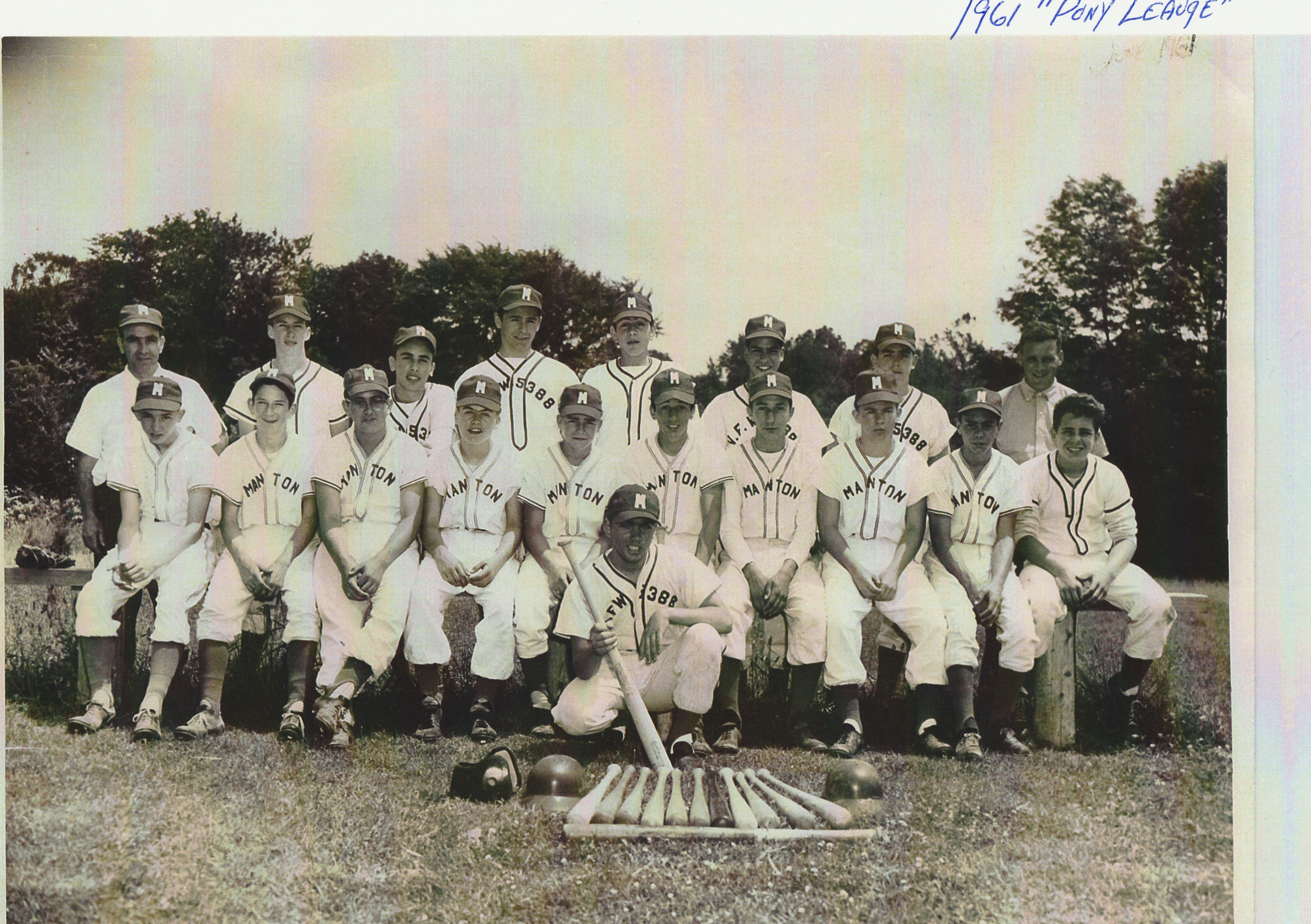
1961 Pony League

1961 Teener or Pony League 

The bonds that developed between the men on the Johnston High School Baseball team were forged over many years of playing together.  Years before any of them would step foot in Johnston High School, these boys had played together in the Johnston Little League and then the Johnston Teener League.  They had learned to work together.  They had learned what strengths and what weaknesses each player had.  There were no super stars in the group.  Just a bunch of kids who loved to play the game of baseball and wanted to excel at everything they did.

Coach Eddie Di Simone was recently out of college and only about ten years older than most of his players in 1963.  He inherited a group of boys who had been playing baseball together for nearly five years.  Bonds had already started to develop but these were honed and polished by Coach Di Simone.  He believed that it was not enough to be a good ball player.  He strove to instill in his team his belief in four main values.  These were Simplicity, Honesty, Integrity, and Fair Play.

Coach Di Simone believed in these values, and he wanted his players to believe in them.  He demonstrated them on the playing field both with his own behavior and with his expectations for the team.  He was someone who practiced the values that he taught his players.  Imagine any Coach today kicking one of his best players off the team for swearing?  Coach Di Simone knew that after life with baseball, each of these men would go out to face a very different playing field.  On the “field of life” his values of simplicity, honesty, integrity, and fair play would be much more valuable than skills at hitting, throwing, catching, and running bases.

Sixty years later many of the surviving members of the Johnston High School Panthers baseball team are still meeting regularly with their former Coach Di Simone to remember the day that they won the championship.  However, they celebrate the specific day and its memories of winning less than they do the events that followed.  They have not been “stuck” in the past of 1963 when they put on their cleats, took their bats and gloves, and walked out on the ball field.  They have not spent the past sixty years trying to relive their “glory” days as it seems so many former high school athletes do.  What they celebrate when they meet with their former coach and now friend is the bond that was forged between the team and its Coach Di Simone.  It is a bond of men forged over a fire of values.  The values learned on the playing field helped to make the members of the 1963 Johnston High School championship team into the successful men that they have become in life.  That is the real story here.

Coach Di Simone is now 89 years old.  Amazingly, 12 of the original 14 team members remain alive and in their late seventies.   A few weeks ago, at one of their meetings they bestowed a plaque on Coach Di Simone commemorating the 1963 championship and what Coach Di Simone has meant to them.  As I write this, there are plans for a December meeting at Coach Di Simone’s house and dinner afterwards.  The affection for their former coach is very evident in his former players.  (NOTE:  This meeting took place in December of 2022)

The end to this story will be written in the future.  To paraphrase Abe Lincoln, “The world will little note, nor long remember what I say here, but it should never forget the real reasons why these men became who they are today.”  In a world awash with narcissism and egotism, it is comforting to find that upstanding values can still be the basis for an unshakeable bond between people as well as a basis for successful lives.

By the way, if you want to have some fun, see how many of the players you can recognize on the above pictures who are in each picture.  It is interesting to see the changes from “Kids” to “Young Men.”

Appendix: Date:  April 10, 2023

I have listed the names of the 14 men that were on the original 1963 Championship team along with their two coachs.

  • Kenneth J. Ainley, first base
  • Thomas J. Donnelly, third base
  • Richard A. Esposito, utility
  • William G. Geremia, utility
  • Alex M. Giarrusso, catcher
  • Frank E. Jasparro, left field
  • Scott Moore, pitcher
  • James J. Petteruti, center field
  • Daniel Pisaturo, third and second base
  • Ronald P. Ricci, utility
  • Edward A. Skovron, second base and shortstop
  • Melvin D. Steppo, third base
  • David P. Taraborelli, right field
  • Michael R. Ursini, utility
  • Coach Ed Di Simone
  • Coach Bob Smith

Why am I reading this? 

sandovalTom Sandoval addressed the jaw-dropping drama that he and longtime girlfriend Ariana Madix called it quits over infidelity.

The “Vanderpump Rules” star made a conscious effort to remain silent after news broke he and co-star Raquel Leviss were having a “full-on affair” — but decided to finally speak out Friday night.  —- ‘Hated’ Tom Sandoval addresses Ariana Madix split amid cheating claims by Nika Shakhnazarova, March 4, 2023 | 4:58am

Before I saw this headline on my Google consolidated news channel, I must confess that I had never heard of Tom Sandoval, Raquel Leviss or Ariana Madix.  Over the years, I have “jealously” noted that major movie stars (For example, Hugh Grant and Elizabeth Hurley) with drop dead gorgeous girlfriends or wives always seem to cheat on them with equally beautiful drop dead gorgeous girlfriends who are no doubt dating other famous movie stars.

dish-092117-ariana-madix-embed-02

Now for “common” guys like me, having a girlfriend like Ariana Madix would be like “let’s say” owning a Ferrari.  Not a chance in a lifetime that I ever will but it is still something to dream about.  By the way, to my female readers, I am sorry that I cannot write a blog that might sum up some of your fantasies, but it is beyond my writing skills to put myself in your shoes.  The only thing that I might say is that perhaps many women would like to write a blog about a guy that does not cheat on them.  If so, I would suggest that you do not look for inspiration in Hollywood.  The saying that a man’s penis and his brain cannot both operate at the same time seems largely true for much of “mankind.

Raquel-Leviss-Snatched-Waist-Round-Bum

So, I saw this headline this morning and immediately wondered if Tom was leaving a decrepit homely looking girlfriend for better waters or if my imagined “Law of Cheating” held true.  Was his new illicit girlfriend just as beautiful but no more beautiful than his old girlfriend?  I had to test my hypothesis, so I Googled pictures of both.  You can make your own mind up by scanning the pictures I have posted of each woman.  I think my “Hollywood Law of Cheating” is still valid.  But this is not really the issue.

The real issue is why a seemingly intelligent man like me (I hope somewhat intelligent anyway) would even care about Sandoval and his exploits.  I know we call some of these headlines click-bait and I keep telling myself to ignore them.  After all, I really don’t care about British Royalty, the Kardashians, Zombie TV shows or the trysts of Hollywood actors and actresses.  I have a hard enough time trying to avoid the latest news dealing with crooked politicians, greedy real estate developers and lying lawyers to last me the rest of my life.  Short though that might now be.

I have an idea that might help us to avoid these clickbait useless stories.  We need a schema for categories of news stories.  Such a schema would help us to prioritize what we could or should read and when.  Might I suggest the following as a start:

Category One:  Local news that might directly impact your safety or wellbeing or the safety or wellbeing of your loved ones.

Category Two:  Local news that might impact you or your family either socially or economically.

Category Three:  National news that impacts you or your family in any meaningful tangible way.

Category Four:  International news that you might be able to do something positive about in terms of aid or humanitarian assistance.

Category Five:  News about subjects you are interested in like science or history.

Category Six:  Social, Economic or Political news that you cannot change or do anything about.

Category Seven:  News about sports or entertainment

Category Eight:  News that includes gossip about other people whom you have never met and or likely to never meet.  This includes British Royalty, the Kardashians, and most movie stars.

The way you use these categories is as follows.  Just like you have a meal with a balanced diet of carbs, fats, proteins, and nutrients, you would select your daily diet of news based on a balanced news diet.  For example:

Monday:  Two helpings from Category 1.  One helping from Category 2.  One helping from Category 3.  One helping from Category Seven.

Tuesday:  Two helpings from Category 2.  Two helpings from Category 3.  Two helpings from Category 5.  One helping from Category Eight.

You get the idea?  A balanced diet of news with some allowance for “junk food.”  Junk food being anything in Categories Six, Seven or Eight.  Such a diet would help many Americans focus on what is important.  You can start by cutting out my list of categories and keeping this list close by your TV or favorite news source.

Now that I have helped you to think about the important things in your life, I am going to go back to reading about Tom Sandoval, whoever he is.

By the way, I would not trade my spouse Karen for all the glamorous movie stars in the world.  Happiness lies not in what we can buy or what is skin deep but in character and personality.  I can not imagine growing old with anyone else by my side than Karen.

Who Speaks for Integrity?

download

When I wrote my series of blogs on the Seven Most Important Virtues, I neglected to add Integrity.  Limiting myself to seven, I felt that the seven I identified were more important than any other virtues.  This was simply a judgement call.  I have been challenged on it several times and indeed I challenge myself on the list.  There is hardly a day goes by that I wonder if I should not have numbered Integrity among the Seven.  Well, as they say, that is water under the dam.  What I would like to do in this blog is discuss Integrity.  What is Integrity?  Why is Integrity so important?  How do we get Integrity?  Finally, how do we sustain Integrity?

What is Integrity?

download (1)Integrity is everything to lose and nothing to gain, except your self-respect.  Integrity is standing up for what you believe is right even when everyone is against you.  Integrity is the ability to put compassion and kindness ahead of self-interest.  Integrity cannot co-exist with greed.  It cannot co-exist with lust.  It cannot co-exist with a thirst for power.  It cannot co-exist with a drive for money, fame, or fortune.  All of these elements are like Kryptonite to Integrity.  Kryptonite was the one thing that could rob Superman of his powers.  Lust, greed, money, fame, and power all have the ability to rob one of his/her integrity.

One example of a man without integrity was Goethe’s Faust.  Faust was considered the smartest man alive.  He was a genius and a consummate intellectual.  There was little that he did not know about or could not speak intelligently about.  Yet, Faust was unhappy.  Old age had creeped up on him.  His desire for youth and sex overcame his ability to think with the maturity befitting his status.  He sold his soul to Satan and in the bargain sold his integrity.  His lack of integrity lead to the death of another human being and to his own banishment to hell.

82d6d633-d7ce-4e27-959e-37dab25c0c24__1_

There are many examples of men and women with integrity.  I think of the whistleblowers who sacrifice their careers and sometime their lives to report issues that might be dangerous to others.  I think of the journalists in countries like Mexico who risk their lives every day to report injustices.  I think of the prosecutors and law enforcement officers in countries where criminals have the ability to enact retribution and death when they are charged with a crime.  In all these examples, there is nothing for these courageous people to gain and everything to lose by their standing up for what they believe is right.  This is integrity.

Why is Integrity Important?

I believe that it is fair to say that never before in the history of America has there been so little integrity shown by our political leaders.  Right, Left, Democrat, Republican, Independent, it does not matter.  There are too many political leaders who are driven by greed and a desire for power.  You may argue with this analysis but when I see even a third of our elected officials calling for term limits, I will recant my assertion.  When I see a third of our elected officials with a plan to eliminate paid lobbyists, I will recant my assertion.

Political_Integrity_-_iStock.com-Bobboz_resizedPolitics is a sham in America today.  We have men and women who are elected for life and spend more time campaigning then they do in serving their constituents.  Public servants who start collecting money to run their next campaigns within days of winning their present office.  We have a system of government where money is the most important factor in who gets elected and who gets reelected.  Our politicians are more worried about losing votes than they are in the constitution or in protecting our democracy.  What Integrity is there in supporting a riot to overthrow a fair election that every court and every state in America found was fairly conducted?  The media seized on the outrageousness of the Big Lie to sell news.  The losing party seized on the credibility of millions of gullible supporters to buy the Big Lie and try to maintain their power.

imagesThe media in America has become another hallowed institution gutted by greed and a desire for more and more money.  Reporters, writers, and journalists in America today are more interested in selling advertising than they are in balanced objective reporting.  You can divide the news up by whether they lean Right or Left, Liberal or Conservative, Democrat or Republican.  Each side has a mirror image on the other side of the political spectrum.  CNN is opposed by Fox News.  The New York Times is opposed by The New York Post and the Washington Post is opposed by the Washington Times.  One side supports the Right and the other side supports the left.  This is not balanced reporting, and no truth comes out of the dynamic between the two sides.  What both sides have in common are reporters who will report the most useless, tasteless, uninformative stories if they perceive that these stories will sell advertising or if they can figure out a clickbait title that will attract readers and thereby expose them to paid commercials.

I see few solutions to the problems I have noted above except to start holding our leaders and media to standards of Integrity that do not seem to exist.  This brings us to the issue of where Integrity comes from.

How Do We Get Integrity?

I do not believe humans are born with Integrity.  I do not think that there is a gene or DNA for Integrity.  Humans learn Integrity like they learn to speak.  The morals, ethics and traditions of any society become part of the fabric of learning that a child goes through.  Integrity is a virtue.  It may be valued more in some families and cultures more than others.  There is an Index of Public Integrity that measures five factors that the developers link to Integrity and is used to assess a countries capacity to control corruption and ensure that public resources are spent honestly.   The six scales used in this index include:

  1. Judicial Independence
  2. Administrative Burden
  3. Trade Openness
  4. Budget-Transparencies
  5. E-Citizenship
  6. Freedom of the Press

Idownload (3)f you want more of a description of each scale you can follow the hyperlink above.  The USA ties for 10th place with Great Britain on this index.  I can see some correlation with Integrity, but I can see many differences.  I think honesty is one component of Integrity, but Integrity is more complex than being simply honest.  An honest person can still lack integrity if they are unwilling to stand up for what they believe.  Cowardice and Integrity are incompatible.

Professor Stephen L. Carter of Yale Law School points out in his book “Integrity,” one cannot have integrity without being honest, but one can be honest and yet lack integrity. … Integrity in its bare-bones essence means adherence to principles.

You cannot buy Integrity.  You cannot inherit Integrity.  Fortunately, Integrity does not have a price tag.  It is open to everyone.  Young people, old people, women, men, and people from different ethnic backgrounds all can find Integrity.  I use the work “Find” because you must seek Integrity.  It is a treasure, and you must look for it.  You can acquire Integrity, but you can also lose Integrity.  However, you cannot give it away and no one can steal it from you.  It is one of the most unique treasures in the world.  So, where do we find this treasure?  There are three rules for finding Integrity.

  1. It must be something you value personally
  2. You must value it more than your life, your career or anything else that you might ever possess.
  3. You must not expect applause or accolades. It is more likely you will be criticized and condemned. 

If you can accept these three rules, then finding Integrity is easy.  Simply establish a set of morals, virtues, and ethics that you believe in and start standing up for them.  When they are challenged, you must speak out.  Your actions and behaviors must reflect our values.  Do not preach one thing and do another.  Do what you say you will do.  When you feel like taking the easy way out, you must take the road that leads to consistency with your actions and values.  The simple formula to remember is that:

Integrity = Morals + Behavior + Consistency

How do We Sustain Integrity?

Integrity can be lost as well as found.  There are many examples of people who once were exemplars of shining Integrity but who succumbed to temptations for greed and power.  It takes a great deal of fortitude and courage to maintain a life of Integrity.  I think of people like Jesus Christ who was not tempted by the devil and went to his death for what he preached.  Pilate gave him opportunities to recant but Jesus refused.  Socrates went to his death also after refusing to recant his beliefs.  I would like to share the example of one more recent person of great Integrity.

85557

“María Santos Gorrostieta Salazar (1976 – 2012) was a Mexican physician and politician of the Party of the Democratic Revolution (PRD).  From 2008 to 2011, she served as mayor of Tiquicheo, a small town in the Mexican state of Michoacán.  In spite of three failed assassination attempts during her tenure as mayor, Gorrostieta Salazar continued to be outspoken in the fight against organized crime.  In a fourth attack, Gorrostieta Salazar was kidnapped and assassinated by suspected drug traffickers on 15 November 2012.” – Wikipedia

To this date, there has been no one charged and tried in connection with her murder.  How many people do you know who would stand up to a drug cartel after even one attempt on their lives?  Maria was a physician.  She could have lived a life of relative ease and prosperity simply by ignoring the crimes going on around her.  Instead she stood up for the law and standing up cost Maria her life.  Who is saying her name today?

integrity in the workplace - integrity-traits-integrity-in-the-workplace

Like any skill or talent, you must practice it.  Practice is one means of sustaining Integrity.  Part of practice is an honest self-reflection.  Each day or week you need to ask yourself if you have been a person of Integrity.  What did you do that showed Integrity?  What did you do or say that allowed you to stand up for your values and ethics?  What did you do that was not consistent with your values?  How could you be more consistent with your values and behaviors?

There is a popular meme that says, “How do you get to Carnegie Hall?  Practice!  Practice! Practice!”  There can be no Integrity without practice, action, and reflection.  Stand up for your values and morals and you will be a Person of Integrity.  Every person who can say that they are a Person of Integrity is one more person that will help to change the world for the better.

“The supreme quality for leadership is unquestionably integrity. Without it, no real success is possible, no matter whether it is on a section gang, a football field, in an army, or in an office.”- Dwight D. Eisenhower

“The greatness of a man is not in how much wealth he acquires, but in his integrity and his ability to affect those around him positively.”- Bob Marley


The Seven Greatest and Most Important Virtues for Humanity

christian_virtueI thought I would start the year of 2021 off with a positive slant.  Namely, some things we can all do or practice to be better people.  However, before anyone should pay any attention to what I am about to say, there are several questions they must ask themselves.  I would advise you that the veracity and hence credibility of an author is critical to your acceptance of what the author is trying to sell you or convince you of.  Do not buy an argument from someone who cannot be trusted.  Think about the comment that “If you see the Buddha on the road, kill him.”  An uncritical acceptance of any idea is dangerous to your own integrity and responsibility.  Hence, the questions I would want answered (If I were you) would be as follows:  Who is this writer to say what the “greatest” virtues for a human are?  How did he come up with these Seven Virtues?  What is the difference between a virtue and a value?  Is this an important difference or is he about to sell me another new religion?

Taking each question as noted, who am I?  What credibility do I bring to the subject? 

The-Virtue-ContinuumI would like to answer that I am a seeker of truth and knowledge.  I am very opinionated, often highly judgmental and have frequently been accused of being a “know it all.”  Many people would write my opinions off as being too liberal while others would say that I am too rational.  I place great value on being logical and trying to stay open to many possibilities.  I have been studying philosophy and religion since I was eighteen.  I have no degrees in either.  But the number of books and articles and stories that I have read number in the hundreds.  I have attended many different worship houses and types of religious services.  I was brought up as a Catholic until I rejected its teachings at about the age of 10.  When no one would give me a good answer for “Who made God?” I more or less decided that most religions were based on superstitions.

I continue to read and study and write in the hope and belief that continuous learning is critical to living a good life.  As Socrates noted “An unexamined life is not worth living.”  I want to examine all aspects of existence.  From good to evil, from logical to emotional, from predictable to unpredictable.  I want to understand and comprehend all of the mysteries of the universe.  Nevertheless, I am not trying to be omnipotent nor do I think that anyone can or will ever understand all that the universe holds.  The quest is the most important thing, but the results of the journey are also very important.  My goal is to dream the impossible dream.  I am dedicated to the idea that truth and knowledge will bring me closer to being able to live this “impossible” dream.  As the song notes:

To dream the impossible dream
To fight the unbeatable foe
To bear with unbearable sorrow
To run where the brave dare not go

To right the unrightable wrong
To love pure and chaste from afar
To try when your arms are too weary
To reach the unreachable star (From Man of La Mancha (1972) music by Mitch Leigh and lyrics by Joe Darion)

How did I derive these Seven Virtues?

In all honesty, seven is a good number for any set of factors since most humans can only remember between five to nine random numbers.  Seven is the mean for a large proportion of the human race in terms of memory capacity.  We note that many cultures have used seven as a sort of “perfect” number for deriving sets of values, ideas, virtues, and even mundane things like phone numbers and license plate numbers.

virtues_listGiven that one could easily comprise a list of ten or perhaps one hundred important virtues, why do I believe that my seven are the seven greatest and most important?  How do I have the audacity to make such an assertion?  I might have been sitting under an apple tree one day, or perhaps simply thinking about life at one of my yearly silent retreats at the Demontreville Retreat Center, when I compiled a list of seven virtues.  While I truly “value” these ideas, I understand them more as virtues than values.  I will address this difference later.  I decided that I want to live by these virtues.  Each day for the last fifteen or more years, I have selected one of these seven virtues to help guide me through the day.  Whether it is patience, kindness or courage, each day I start by reflecting on this virtue and trying to make it a part of my life.

How does my list compare to other lists?  One of the most famous lists of seven virtues is the Catholic Hierarchy of Virtues.  The top three in the Catholic Hierarchy are Faith, Hope and Love.  Of these, my list includes Faith and Love, though I use the term compassion rather than love. The next four in the Catholic Hierarchy are justice, wisdom, moderation and courage.  My list includes courage but not wisdom, justice or moderation.  This is not to say that I do not think these are important, but my list is based on feelings more than knowledge.  This is somewhat ironic since I believe that knowledge and wisdom are two of the keys to understanding life.  However, l cannot argue with the question: “What wisdom is there that is greater than kindness?”  Comparing my list to the Catholic list, I realize that I am emphasizing feelings over thinking.  I am emphasizing the heart over the brain and love over logic.  My final list of seven virtues includes the following:

  • Gratefulness
  • Forgiveness
  • Patience
  • Kindness
  • Faith
  • Compassion
  • Courage

Over the next several blogs, I will present each of these as virtues and explain why they are important and how we can go about integrating them in our lives.  I know and believe that we will all live better lives if we are living a life based on virtue.

What is the difference between a Virtue and a Value?  Is it important?

I would like to include the following excerpt from an article by Iain T. Benson called “Values and Virtues:  A Modern Confusion.”

“Now George Grant, the Canadian philosopher, whom I mentioned a while ago, made this point in an important comment on a CBC radio program a few years ago.  Here is what he said, “values language is an obscuring language for morality, used when the idea of purpose has been destroyed. And that is why it is so widespread in North America.” In North America, we no longer have any confidence that there are any shared purposes for human life. We don’t. It is that dramatic. Consequently, we cannot order any human action towards an end, because all means are related to ends.” 

Looking at the Oxford Dictionaries definitions of these two terms will also shed some light on the differences.

  • Virtue is defined as follows:
  1. Behavior showing high moral standards: paragons of virtue
  2. Quality considered morally good or desirable in a person: patience is a virtue
  3. A good or useful quality of a thing: Mike was extolling the virtues of the car
  • Value is defined as follows:
  1. The regard that something is held to deserve; the importance, worth, or usefulness of something: your support is of great value
  2. The material or monetary worth of something: prints seldom rise in value equipment is included up to a total value of $500
  3. The worth of something compared to the price paid or asked for it: at $12.50 the book is a good value

I think it is easy to see from these definitions that a value is generally something we attach to a product or service.  A virtue is more often attached to a behavior or character trait.  We value things, while we practice virtues.  A man or woman may be virtuous but we would not say they are “valuous”, in fact the word does not even exist.  We might say they were valuable, but then we would probably not be talking about their character but addressing their instrumental worth to us.  Therefore, I have labeled these critical seven behaviors as virtues.

-The-12-Lakota-Virtues-native-pride-33907515-700-630The danger in this discussion lies in your taking a sectarian or religious approach to my writings.  I assure you that I am not a religious person.  I may be a spiritual person but I do not think of myself in either of these categories.  I am an agnostic who wants to live a better life and help build a world that is a better place to live for future generations.  Living by these seven virtues is one way I believe I can contribute to this goal.

My Vision for my life is “To live a healthy useful and wise life.”

My Mission is “To live one day at a time.  To be the best person I can be each day and to do the best I can each day to do good for the world.”   I hope I sometimes achieve at least some of these goals.

virtue is doing itIf I have satisfactorily answered the questions that I posed above respecting my integrity and credibility, I will now set off to address each of my Seven Virtues and explain why they are so important and the difference that I think they can make in our lives.  Look for my virtues over the next several weeks in my blogs.

Time for Questions:

What do you think of my list of seven?  What would you change?  Do you have your own list that you live by?  Why or why not?

Life is just beginning.

Just as treasures are uncovered from the earth, so virtue appears from good deeds, and wisdom appears from a pure and peaceful mind. To walk safely through the maze of human life, one needs the light of wisdom and the guidance of virtue.  — Buddha

Reconstructing the Great Speeches – Martin Luther: “Here I Stand”

download

I have attended over 35 Jesuit retreats at Demontreville Retreat Center.  Every year at the end of each retreat, I have received a Plenary Indulgence bestowed by the Pope on people who complete a retreat.  Unlike in the day of Martin Luther, I do not have to pay for these indulgences.  My understanding is these indulgences will knock some of the time off that I have to spend in purgatory as reparations for my less than mortal sins.  You still cannot get time off for mortal sins without going to confession.

I am not sure how much time will be knocked off and since I am an atheist or sometimes an agnostic, I am not sure whether or not they will be valid.  I once wondered if I could put them up on eBay and maybe get some money from them.  This would be more in line with the uses that were associated with these plenary indulgences in the time of Martin Luther (1483 to 1546).

Reformation.crop_528x396_2,0.preview (1)There are many who would consider Martin Luther the father of the Protestant Reformation.  Growing up Catholic, we regarded Protestants as heretics.  We all knew that the one true religion was Catholic, and Protestants did not know what they really wanted.  What does the name Protestant even mean?  Taking it at face value, it would seem to mean to protest against.  The dictionary defines a Protestant as someone who has broken from the Roman Catholic church.  If you are a Protestant you practice a form of Christianity in protest to the Catholic form.  There are over 200 major Protestant denominations in the USA and over 35,000 independent or non-denominational Christian churches which are ostensibly Protestant.  During the past few decade, we have seen numerous splits in Protestant churches over such issues as gay marriages, gay clergy, women ministers.  Even though I am a non-Catholic myself, I can’t help but be amazed at the dissension and disunity among Protestants.  I wonder what Martin Luther would have thought if he were alive today.

cc-1509034747-1xk2ppowve-snap-image

In any case, Luther protested against the selling of Indulgences by the Catholic Church and the Pope.  He published his famous 95 Theses (which were polemics primarily against the monetary abuses of the Church) by nailing the theses on the door of All Saints’ Church and other churches in Wittenberg, Germany.  An extremely dramatic way to advance his opposition.  The theses were quickly reprinted and spread like wildfire throughout Europe.  And thus, began what is known as the Protestant Reformation (1517 – 1648).  It actually started even earlier but Luther’s theses were the proverbial straw that broke the camel’s back.

00bayfield

Martin Luther’s position and actions were quite bold, even audacious.  Luther’s ecclesiastical superiors had him tried for heresy, which culminated in his excommunication in 1521.  This retaliation on the part of the Catholic Church was quite serious.  Luther risked life and limb with his attack on the Church.  The following is a list of people executed for challenging Catholicism during the period from 1500-1600 CE.

  • Ipswich Martyrs († 1515–1558)
  • Jean Vallière († 1523)
  • Jan de Bakker († 1525), 1st martyr in the Northern Netherland
  • Wendelmoet Claesdochter († 1527), 1st Dutch woman charged and burned for the accusation of heresy
  • Michael Sattler († 1527), Rottenburg am Neckar, Germany
  • Patrick Hamilton († 1528), St Andrews, Scotland
  • Balthasar Hubmaier (1485–1528), Vienna, Austria
  • George Blaurock (1491–1529), Klausen, Tyrol
  • Thomas Hitton († 1530), Maidstone, England
  • Richard Bayfield († 1531), Smithfield, England
  • Thomas Benet († 1531), Exeter, England
  • Thomas Bilney († 1531), Norwich, England
  • Joan Bocher († 1531), Smithfield, England
  • Solomon Molcho († 1532), Mantua
  • Thomas Harding († 1532), Chesham, England
  • James Bainham († 1532), Smithfield, England
  • John Frith (1503–1533), Smithfield, England
  • William Tyndale (1490–1536), Belgium
  • Jakob Hutter († 1536), Innsbruck, Tyrol
  • Aefgen Listincx († 1538), Münster, Germany
  • John Forest († 1538), Smithfield, England
  • Katarzyna Weiglowa († 1538), Poland
  • Francisco de San Roman († 1540), Spain
  • Étienne Dolet (1509–1546), Paris, France
  • Henry Filmer († 1543), Windsor, England
  • Robert Testwood († 1543), Windsor, England
  • Anthony Pearson († 1543), Windsor, England
  • Maria van Beckum († 1544)
  • Ursula van Beckum († 1544)
  • Colchester Martyrs († 1545 to 1558), 26 people, Colchester, England
  • George Wishart (1513–1546), St Andrews, Scotland
  • John Hooper († 1555), Gloucester, England
  • John Rogers († 1555), London, England
  • Canterbury Martyrs († 1555–1558), c.40 people, Canterbury, England
  • Laurence Saunders, (1519–1555), Coventry, England
  • Rowland Taylor († 1555), Hadleigh, Suffolk, England
  • Cornelius Bongey, († 1555), Coventry, England
  • Dirick Carver, († 1555), Lewes, England
  • Robert Ferrar († 1555), Carmarthen, Wales
  • William Flower († 1555), Westminster, England
  • Patrick Pakingham († 1555), Uxbridge, England
  • Hugh Latimer (1485–1555), Oxford, England
  • Robert Samuel († 1555), Ipswich, England
  • Burning of Latimer and Ridley, Oxford, 1555
  • Nicholas Ridley (1500–1555), Oxford, England
  • John Bradford († 1555), London, England
  • John Cardmaker († 1555), Smithfield, London, England
  • Robert Glover († 1555), Hertford, England
  • Thomas Hawkes († 1555), Coggeshall, England
  • Thomas Tomkins († 1555), Smithfield, London, England
  • Thomas Cranmer (1489–1556), Oxford, England
  • Stratford Martyrs († 1556), 11 men and 2 women, Stratford, London, England
  • Guernsey Martyrs († 1556), 3 women, Guernsey, Channel Islands
  • Joan Waste († 1556), Derby, England
  • Bartlet Green († 1556), Smithfield, London, England
  • John Hullier († 1556), Cambridge, England
  • John Forman († 1556), East Grinstead, England
  • Pomponio Algerio († 1556) Boiled in oil, Rome
  • Alexander Gooch and Alice Driver († 1558), Ipswich, England
  • Augustino de Cazalla († 1559), Valladolid, Spain
  • Carlos de Seso († 1559), Valladolid, Spain
  • María de Bohórquez († 1559)
  • Pietro Carnesecchi († 1567) Florence, Italy
  • Leonor de Cisneros († 1568), Valladolid, Spain
  • Dirk Willems († 1569), Netherlands
  • Giordano Bruno (1548–1600), Rome, Italy

6542cb86e28310d760047cf9591b8929

The famous scientist Galileo was forced to recant his idea that the earth revolved around the sun.  This was widely known among many scientists, but it was opposed by the Catholic Church which held to the view that the sun revolved around the earth.  Thus, in 1521 Galileo was charged with heresy.  After a rather lengthy trial, Galileo retracted his theory preferring to live rather than to be right.  Nevertheless, he spent the rest of his life under house arrest.  Publication of any of his works was forbidden, including any future works.

martin luther

Martin Luther’s Speech at the Imperial Diet in Worms (18 April 1521)

On 18 April 1521 Luther stood before the presiding officer, Johann von Eck at the ongoing Diet in Worms.  Luther was called before the political authorities rather than before the Pope or a council of the Roman Catholic Church.  Eck acting on behalf of the Catholic Church informed Luther that he was acting like a heretic.  Pope Leo X had demanded that Luther retract 41 sentences included in his original 95 Theses.  Luther had been questioned the day before, but he had requested time to think about his response to the charges.  Thus, began Luther’s short but famous speech.   His life depended on his response.

“I this day appear before you in all humility, according to your command, and I implore your majesty and your august highnesses, by the mercies of God, to listen with favor to the defense of a cause which I am well assured is just and right.  I ask pardon, if by reason of my ignorance, I am wanting in the manners that befit a court; for I have not been brought up in king’s palaces, but in the seclusion of a cloister; and I claim no other merit than that of having spoken and written with the simplicity of mind which regards nothing but the glory of God and the pure instruction of the people of Christ.”

Luther begins his speech with humility and with apologies for any lack of etiquette or procedure, but no apologies for his actions.  He is certain that he is right.

“I have composed, secondly, certain works against the papacy, wherein I have attacked such as by false doctrines, irregular lives, and scandalous examples, afflict the Christian world, and ruin the bodies and souls of men. And is not this confirmed by the grief of all who fear God?  Is it not manifest that the laws and human doctrines of the popes entangle, vex, and distress the consciences of the faithful, while the crying and endless extortions of Rome engulf the property and wealth of Christendom, and more particularly of this illustrious nation? Yet it is a perpetual statute that the laws and doctrines of the pope be held erroneous and reprobate when they are contrary to the Gospel and the opinions of the church fathers.”

Luther’s words could not be stronger here.  He accuses the Pope of offense that are scandalous, immoral, and perhaps even criminal.  He softens his words here not one bit.  He is not on the defense but on the offense.  Here is a man not dissembling or hedging his words.  If he is afraid for his life, his words show no fear or caution.  He is doing no political two step or making effort to appease the Pope.  Perhaps Luther knew that he was in little danger of being executed but the fact that he spent the next nine months of his life in hiding would suggest differently.

“In the third and last place, I have written some books against private individuals, who had undertaken to defend the tyranny of Rome by destroying the faith.  I freely confess that I may have attacked such persons with more violence than was consistent with my profession as an ecclesiastic: I do not think of myself as a saint; but neither can I retract these books.  Because I should, by so doing, sanction the impieties of my opponents, and they would thence take occasion to crush God’s people with still more cruelty.”

Luther does not back down one bit.  He confesses to more passion than might have been required but he will not retract anything he has written.  I am no saint he says but I will not be a hypocrite.  Just think of the people surrounding President Trump and contrast their lies, obfuscations, and baffling oratory with the quite clear words of Martin Luther: “What, then, should I be doing if I were now to retract these writings?”  “What if I said my president was lying?  What if I said my president was engaging in double speak?  What if I admitted that my president actually said the words which he claimed that he did not say?  Would I be subject to trial by fire or would I be burned at the stake?”

What makes someone lie on behalf of someone else?

The ending of Luther’s defense was epic.  Perhaps no more forceful words have ever been spoken in history.

“I neither can nor will retract anything; for it cannot be either safe or honest for a Christian to speak against his conscience.  Here I stand; I cannot do otherwise; God help me!  Amen.”

Emperor Charles V passed the Edict of Worms, which banned Luther’s writings and declared him a heretic and an enemy of the state.  Luther fled and although the Edict mandated that Luther should be captured and turned over to the emperor, it was never enforced.  Bear in mind the list of heretics who came after Luther and was executed.

Luther was a German professor of theology a composer and a priest.  He was no warrior or fighter.  In many ways, he was average, except in one especially important way that mattered and would make him a hero for all time.  He was not afraid to stand up to tyranny and to stand up for his beliefs and to speak out on behalf of what he believed.

Martin-Luther-on-Trial-1300x740-81e5a3c51e

Imagine if more citizens were courageous enough to stand up for what they believed and to speak out forcefully and not meekly on behalf of these same beliefs.  It has been said that “Evil triumphs when good people do nothing.”  Doing nothing or saying nothing are one of the same cloth.  If you want to allow a dictator, bully, or tyrant to take power, simply stay quiet and bemoan the fact that you can do nothing.  Or you can write, speak, march, protest and organize against injustice wherever it can be found.  Any less makes us guilty of a conspiracy of silence.

“A conspiracy of silence, or culture of silence, describes the behavior of a group of people of some size, as large as an entire national group or profession or as small as a group of colleagues, that by unspoken consensus does not mention, discuss, or acknowledge a given subject.  The practice may be motivated by positive interest in group solidarity or by such negative impulses as fear of political repercussion or social ostracism.”  —  Wikipedia

Previous Older Entries