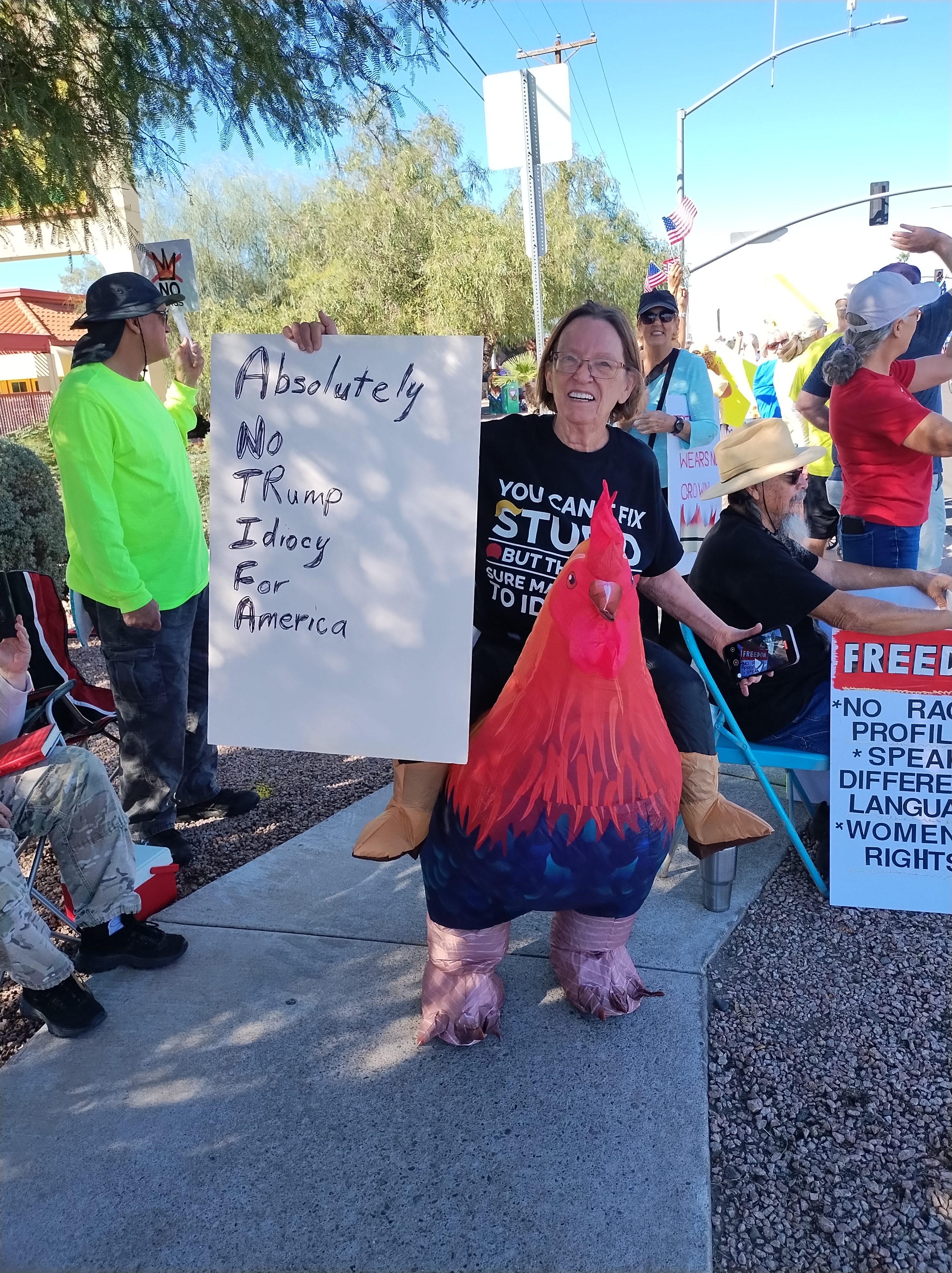
No Kings in America Rally – Casa Grande, AZ, October 18, 2025, 10 AM to 12 AM

I am posting this blog as an interim post until Monday.  On Monday, I will post Part 2 of my blog on Truth, Beauty and Goodness and how Art and Music relate to these values.  Today though, I joined my third “No Kings in America” rally in Casa Grande, Arizona.  The turnout was as the young like to say “Awesome.”  There was at least 35 percent more people who attended this rally than the last ones. 

The really and truly “Awesome” part though had nothing to do with the participants.  Sure, we were colorful, had great signs and plenty of enthusiasm, but it was nothing compared to the enthusiasm we received from passing motorists.  For two hours, we had nonstop honks and waves from people driving by.  Many both waved and honked.  I only counted two people who threw us the middle finger or shouted some inanity about Trump.  The majority of the people who drove down Florence Blvd seemed to be in support of our efforts.  What does this mean we all asked each other?  Our conclusions while lacking any corroborating evidence is that people are getting sick of Trump and his sycophantic followers in Congress.  We can only hope this is the case.  I am posting some pictures here from the rally. 

By the way, try as I might I did not see any Hamas Terrorists or anyone with Hate America Signs. I did see several dump Trump signs though. Maybe Trump is the real terrorist.

Can you find me in these pictures?


The Sacred Triad: How Truth, Goodness, and Beauty Shape Our Humanity — Part 1

I made my 42nd retreat at the Demontreville Retreat Center in Lake Elmo this past September.  Two strong influences on my life have since passed away who were connected to my retreats.  The first was Father Sthokal S.J.  A man who spent 54 years of his life at this center.  Thirty-four of my retreats were spent with Father Sthokal at the center.  Father Sthokal died in 2020.

This year a new dormitory was built in his memory and named Sthokal Hall.  I was fortunate enough to have a room in this new hall.  With the air conditioning, outside patio and coffee bar it was quite a pleasure.  The memories of the words of Father Sthokal infuse the entire retreat center but perhaps more so in the new hall.

The second great influence on my life was Pope Francis who died in April of 2025 this year.  Cardinal Jorge Mario Bergoglio was ordained Pope in 2013.  When he became Pope, the Catholic Church was facing a major crisis.  I read about the new Pope at my retreat that year and thought “surely they are going to assassinate him.”  He posed a challenge to an established and often corrupt Vatican administration which was mired in the past.  Pope Francis set about to change the order of things at the Vatican.  He did this to a surprising degree.  He was also a profound and prolific writer.

At the retreat center, we have a small library full of books dealing with all aspects of spirituality.  The year that Pope Francis was ordained, I picked out a book that he had written. I could not put it down.  I read it on my walks around the monastery as a means of reflection and contemplation.  Every year when I came back, I found something else that Pope Francis had written.  His writings made a difference on my life.  His thoughts on mercy and justice and social responsibilities still ring in my head.

This year, I went looking for something by the new Pope Leo XIV in the library but could find nothing.  I had read everything by Pope Francis and thought that surely the new Pope would have some writings.  We also have a little kiosk of sorts at Demontreville where you can purchase sundries including rosaries, candy, prayer books and some bathroom items.  While passing by the kiosk, I stopped to look at the prayer books thinking that I had purchased most of them in the past.  Then I saw one that I had not seen before.  It was called “A Year with Pope Francis” and it included a series of daily reflections from his writings.  I purchased it and brought it back to my room.  The day was September 20th and the reflection for that day was “Always remember that truth, beauty and goodness are inseparable.” 

This thought really struck me.  I did not know what it meant.  How could they be inseparable?  How did they fit in with the life that one needed to live to find meaning and purpose?  Following my retreat, I started tracing the etiology of Pope Francis’s thoughts.  As with many subjects, the history of this idea goes back centuries.  In this blog and the one following, I want to share some of the impact that this idea had on me and can have on the lives of all of us.  I have used a combination of my own ideas as well as research and reflections with ChatGPT.  I go back and forth with my AI partner to discover thoughts and ideas and to refine my thinking.  Many of these ideas come from saints, philosophers and other thinkers from the past.  My channel to the past is Pope Francis and AI.

When Pope Francis spoke of Truth, Beauty, and Goodness as inseparable, he was not offering a poetic slogan.  He was reminding us that these three values — long revered since Plato and Aquinas — describe the full stature of the human soul.  When any one of them is lost or diminished, the others soon fade.  Truth without goodness becomes cold and cruel.  Beauty without truth becomes deceptive.  Goodness without beauty becomes joyless duty.

In the modern world, we have grown accustomed to fragmentation.  We analyze without compassion, feel without understanding, and act without reflection.  But life only finds meaning when our thinking, feeling, and doing are woven together — when the mind, heart, and hand move as one.  The harmony of these dimensions is not a luxury for saints or philosophers; it is the quiet work of becoming fully human.

I. Thinking, Feeling, and Doing — Three Dimensions of Being

Human beings are triadic creatures.  We live through three interlocking faculties:

  • Thinking – our capacity to seek truth, to question, to discern what is real.
  • Feeling – our capacity to sense beauty, to be moved, to connect and care.
  • Doing – our capacity to enact goodness, to choose and to build what should be.

The philosopher’s triad (Truth–Beauty–Goodness) and the psychologist’s triad (Thinking–Feeling–Doing) are not two separate models.  They describe the same reality from different directions.  One names the qualities we seek; the other names the faculties we use to reach them.

Thinking without feeling leads to cynicism; feeling without doing leads to sentimentality; doing without thinking leads to folly.  When all three are united, the result is wisdom — not the kind found in textbooks, but the lived wisdom that radiates from people who see clearly, love deeply, and act justly.

II. The 3×3 Matrix of Integration

To visualize their relationship, imagine a simple grid.  Across the top: Truth, Beauty, Goodness. Down the side: Thinking, Feeling, Doing.
In each cell lies a different way of being human — nine ways of aligning the head, heart, and hand.

Truth Beauty Goodness
Thinking Wisdom — understanding reality as it is Wonder — perceiving harmony and meaning Conscience — discerning what ought to be done
Feeling Empathy — sensing truth through others’ eyes Joy — feeling beauty in all things Compassion — feeling goodness as care
Doing Integrity — acting in truth Creativity — embodying beauty through action Justice — realizing goodness in the world

This matrix is not an abstract diagram; it is a mirror. Each of us can find ourselves somewhere within it on any given day.

III. When the Triad Fractures

The modern world often tears these apart.

Truth without goodness becomes sterile knowledge — the scientist who measures everything but values nothing, the pundit who knows every fact but forgets every face.
Beauty without truth becomes vanity — the glossy perfection of advertising or social media, beauty used to manipulate rather than to inspire.
Goodness without beauty becomes moralism — well-intentioned people who do right but radiate no joy, whose kindness feels obligatory rather than free.

Likewise, when our own inner triad splits, we feel lost.
We may think brilliantly but feel numb.
We may feel deeply but never act.
We may act endlessly but without understanding why.
Each imbalance carries its own suffering — confusion, anxiety, or burnout. The cure is not more effort but more integration.

IV. Thinking Aligned with Truth

The first step toward wholeness begins with how we think. Truth asks us to see the world as it is — not as we wish it to be.  Thinking in truth means facing facts, admitting mistakes, and refusing to let ideology replace inquiry.

But truth is not limited to intellectual accuracy. It is also moral clarity — a refusal to lie to ourselves. When we think truthfully, we free ourselves from illusion.  We develop what the ancients called Sophia — wisdom.  Wisdom joins knowledge to humility.  It recognizes that truth is not possessed but pursued.

V. Feeling Aligned with Beauty

Beauty, said Dostoevsky, will save the world. But not the beauty of cosmetic perfection.  True beauty awakens wonder and gratitude.  It is the radiance of harmony — a sunset, a melody, an act of forgiveness.  Feeling beauty means allowing the heart to be touched, even wounded. It calls us to empathy — the ability to enter another’s experience and still see the light within it. In a cynical age, this is an act of resistance.

When feeling is shaped by beauty, life regains texture and meaning.
We begin to notice small miracles: the laughter of a child, the discipline of a craftsman, the resilience of someone who refuses to give up.  These glimpses of beauty soften us.  They remind us that beneath the noise and ugliness of the world, there is still something worth cherishing.

But feeling must not end in sentimentality.  Beauty moves us to love, and love — if it is genuine — demands action.

VI. Doing Aligned with Goodness

Goodness is truth and beauty made visible.
It is what happens when we act from conscience, not convenience.  Doing good is rarely glamorous.  It often means small, consistent acts of courage: listening instead of judging, volunteering when no one notices, speaking truth to power even when afraid.

Goodness without action is merely intention.  To “do” goodness is to give it form — through justice, kindness, and creative service.  A teacher who inspires curiosity in children, a nurse who comforts a frightened patient, a neighbor who plants trees for the next generation — all are artists of goodness.

Goodness is contagious.  One act done well invites another.  In a divided world, each small deed of integrity pushes back against despair.  As Pope Francis reminds us, “Reality is more important than ideas.” The good we do embodies the truths we believe and the beauties we feel.

VII. The Intersections — Where Wholeness Is Born

Each intersection in the matrix is a doorway to transformation.

  • Thinking × Truth → Wisdom
    To think clearly in a confused age is a moral act.
  • Feeling × Beauty → Joy
    To let beauty move us is to say yes to life.
  • Doing × Goodness → Justice
    To act rightly even when inconvenient is the seed of renewal.

But the deeper magic lies in the crossings between columns:

  • Thinking + Goodness (Conscience): we discern what should be done.
  • Feeling + Truth (Empathy): we understand others from the inside.
  • Doing + Beauty (Creativity): we make the world more radiant.

When these elements feed one another, we experience alignment — a state of inner peace that radiates outward. We stop living in fragments and begin living as whole persons.

VIII. Everyday Applications

How might this integration appear in ordinary life?

  1. In Conversation
    Before reacting, we think (truth), we feel (beauty through empathy), and we act (goodness through restraint or honesty). The result: communication that heals rather than divides.
  2. In Work
    Whatever our craft — teaching, building, healing, writing — we can strive for accuracy (truth), care (beauty), and fairness (goodness). Excellence becomes not a competition but a form of love.
  3. In Community
    A society guided by truth builds trust.
    A society that celebrates beauty cultivates joy.
    A society committed to goodness ensures justice.
    When one of these is missing, culture decays. When all three flourish, community becomes communion.

IX. The Spiritual Thread

The unity of Truth, Beauty, and Goodness is not just psychological; it is spiritual.  Each reveals an aspect of the divine image within us.

  • Truth reflects the Mind of God — the eternal Logos, the pattern behind all creation.
  • Beauty reflects the Heart of God — the harmony and joy woven into being.
  • Goodness reflects the Will of God — the self-giving love that sustains the world.

To live these values is to participate in the divine life, whether we use theological language or not.  I am an Atheist but every human being, consciously or unconsciously, seeks these three.  Call their reflections God, or Karma or Goddess or Divinity, they are the compass points of the soul.

X. Reweaving the World

Our age suffers not from lack of knowledge but from disconnection.  We have mastered the science of information but lost the art of integration.  We are clever but not wise, expressive but not empathetic, busy but not good.

Reweaving the world begins with reweaving ourselves. Each time we align our thoughts with truth, our feelings with beauty, and our actions with goodness, we mend a small tear in the fabric of humanity.

Start simply. Ask three questions at the end of each day:

  • Did I think truthfully today?
  • Did I feel beauty and let it move me?
  • Did I do at least one thing that was good?

Over time, these questions become habits, and habits become character. The goal is not perfection but harmony — to be a person through whom truth shines, beauty blossoms, and goodness flows.

XI. Closing Reflection

The poet John Keats once wrote that “Beauty is truth, truth beauty — that is all ye know on earth, and all ye need to know.”  Pope Francis extends that vision: when beauty and truth walk hand in hand, goodness inevitably follows.  The three are not separate paths but a single road leading home.

To think rightly, to feel deeply, and to act justly — this is the trinity of human wholeness. Each of us, in our own small sphere, can live this harmony.  When we do, we not only become better people; we help the world remember what it was always meant to be — a place where truth enlightens, beauty delights, and goodness redeems.

In Part 2 of this blog, I want to weave the relationship between Goodness, Truth, Beauty with Art and Music.  I attended a wonderful workshop/performance a few days ago by Mark Ochu at the Desert Rose Bahai Institute in Eloy Arizona.  Mark is a “Visionary Pianist” who was presenting  “A Listen and Learn” Piano Concert reflecting on the life of Franz Liszt.  Mark weaves in art, history and music to tell the story of Franz Liszt and his relevance to modern music.

Mark combines piano and lecture.  His performance made me realize that in my earlier reflections on Truth, Goodness and Beauty,  I had not included the role that music and art play in life.  In Part 2, I want to weave this into the texture and fabric of the mosaic that I am trying to create.  Much like my wife’s quilts or perhaps the kaleidoscopes that I love, life can be a beautiful tapestry that brings all of us joy and meaning.  We have only to put the elements in place in our lives to bring out the true nature of humanity.  A nature that transcends violence, vengeance, war and retributions.  Watch a concert sometime and look at the peace and harmony that the performers share with each other.  Now imagine that every soldier in the world was carrying a flute or violin or oboe instead of a weapon of destruction.

Author’s Note

Portions of this essay were developed in collaboration with “Metis,” an AI writing partner powered by OpenAI’s GPT-5.  The ideas, direction, and final reflections are my own, shaped through a dialogue intended to illuminate and refine the themes explored here.

The time has come. I can’t wait any longer. by Jane Fritz

This week I am reposting a blog by a good friend who has been writing them for over 13 years now.  She has decided to take a hiatus for reasons that you will discover when you read her blog.  Many of her followers have left comments describing how much her blogs meant to them and how sad her leaving the blog community will make them.  I will post my comments to Dr. Jane Fritz at the end of this blog.  I am also sad at her leaving.  Her blogs were always fun, inspirational and truthful.  The late Pope Francis said that Truth, Beauty and Goodness were inseparable.  Dr. Fritz managed to bring these to her readers and often with a sense of humor and perspective that left you feeling motivated and challenged to face another day in a chaotic world.  Her words and ideas made the world a better place and they will be missed.  Please do not skip reading the comments left by many other readers. They testify to the good that Jane brought to the world and how much her blog meant to many other people also in need of need of truth, beauty and goodness.

Dr. John Persico Jr.

 says:

October 6, 2025 at 11:39 am

I can certainly understand where you are coming from Jane.  I will be 80 next September and have been blogging for over 15 years now.  My blogs are nowhere near as popular as yours are and I think my blogs are usually darker than yours.  I have tried (and your blogs motivate me to keep trying) for a balance between optimism and pessimism.  My normal pessimism side give me five blogs a day that I want to publish excoriating the clown and evil man that is running our government today. 

Of course, I recognize that he is just a puppet as are the 74 million people that voted for him.  This latter fact only makes our situation worse in this country.  Nevertheless, I see the value in publishing more optimistic and often more personally helpful blogs like you do.  I am trying to do a balance and hope that this balance will keep me from going off the deep end.  There is still much beauty in life and still so many people out there to connect with that have been helped by our blogs.  You get many more comments each blog than I do and I am touched by how many people you have helped with your blogs.  I get a few comments per blog but even these few comments keep me going.  My mantra is that if I can touch one soul a month, than I am going to keep writing. 

This long diatribe on my part sounds like a subtle plea for you to keep writing.  However, I am not being subtle when I say that your blogs make a difference to thousands of people and it would be a shame to see one more beautiful and thoughtful voice eliminated from the blogosphere.  That is just what D.J. Trump wants.  To silence beauty, goodness and truth.  So I hope you can simply take a break from your writing.  Find a balance in terms of content.  And pick up your pen again when you are ready.  Remember the “Pen is mightier than the sword.”  Your friend John

Who Holds the Future?  Ilya Sutskever or Donald Trump

Introduction

Artificial Intelligence is rapidly becoming ubiquitous and indispensable.  Predictions as to the future of AI range between two extremes.  AI will save humanity and usher in a Golden Age for Mankind.  An age that will make the Greek Golden Age seem trivial.  Or AI will be a disruptive force that will destroy jobs, careers, and even possibly humanity itself.  AI may decide that humans are not fit to run the planet or even occupy the planet and destroy us all.  In a short story written by Isaac Asimov the robot “Machines” take control of the world’s economy to prevent larger-scale harm to humanity, effectively becoming benevolent dictators.  — “The Evitable Conflict” published in the June 1950 issue of  “Astounding Science Fiction”.

Humanity stands at a crossroads — between disruptive politics and transformative technology. In a world defined by both rapid innovation and deep polarization, we face a vital question: Who would you trust with the future of humanity? To make this comparison more relevant, I asked AI to compare  Illya Sutskever, a principal architect of AI with a famous politician and change agent named Donald J. Trump.  Who I asked would you trust to lead the world into a Golden Age?  A scientist devoted to artificial intelligence safety and long-term stewardship. Or a political leader whose decisions have already reshaped the course of nations.

The Scientist: Ilya Sutskever

Ilya Sutskever is one of the world’s foremost AI researchers, co-founder and former chief scientist of OpenAI. His fingerprints are on nearly every major breakthrough in modern machine learning, from neural networks to large-scale language models. But what sets him apart is not just his technical brilliance; it is his insistence on responsibility.

Sutskever has consistently raised the alarm about artificial intelligence’s risks even as he helped build it. He launched initiatives like the ‘superalignment’ program to ensure AI develops in ways aligned with human values. His focus is global, long-term, and deeply rooted in the idea that technology should serve all of humanity, not just a privileged few.

Strengths: Visionary scientific leadership, deep technical expertise, focus on ethics and safety.

Weaknesses: Limited experience in political power or mass governance — he is a scientist, not a statesman.

The Politician: Donald Trump

Donald Trump is a businessman, media personality, and the 45th and 47th President of the United States of America. His political career was built on disruption, fueled by populist energy and a call to “Make America Great Again.” Trump’s influence is undeniable — he has reshaped U.S. politics, polarized public opinion, and left a global footprint.

Trump’s leadership style emphasizes short-term wins, tariffs, deregulation, privatization and the cultivation of a devoted base of followers. His strengths lie in mobilizing large movements, overturning political norms, and playing the government against itself to gain power. Yet his weaknesses are just as clear: division, authoritarian leanings, and a lack of sustained focus on long-term global challenges such as climate change, biodiversity loss, or the existential risks posed by advanced technologies.

Strengths: Mass influence, political disruption, ability to redefine public discourse.

Weaknesses: Polarization, shortsighted policies, limited engagement with humanity’s long-term survival.

Who Shapes a Golden Era?

A Golden Era for humanity will not emerge by accident. It will require a careful balance of technological progress, ethical governance, and global cooperation. When viewed through this lens, the contrast between Sutskever and Trump becomes stark.

Sutskever embodies foresight, responsibility, and global vision. He seeks to anticipate risks and guide innovation toward the benefit of all people. Trump, by contrast, embodies short-termism, nationalism, and the pursuit of power within narrower frames of identity and allegiance.

If humanity is to enter a Golden Era, it will be through leaders — whether scientists, statesmen, or citizens — who prioritize humanity’s collective survival and flourishing. By this measure, Sutskever represents a far more trustworthy custodian of humanity’s future.

Conclusion

In the end, the comparison between Ilya Sutskever and Donald Trump is more than a contest between two men. It is a mirror reflecting the choices before us. Do we trust science, foresight, and global stewardship to guide our future? Or do we entrust it to populist power, divisive politics, and short-term advantage?

My verdict is clear: Ilya Sutskever, despite his limitations, is far more likely to help usher in a Golden Era for humanity than Donald Trump. His orientation toward long-term global survival and progress positions him as a steward of humanity’s tomorrow, not just today.

And yet, this question is not just about Sutskever or Trump. It is about all of us. Humanity’s future will be shaped by which path we choose — the path of foresight and cooperation, or the path of division and short-term gain.

Which path do you choose? A Golden Age just for America or a Golden Age for the Whole World?

Have you forgotten the past?

I happened to come across this short blog post that I wrote in July of 2010. A few of the comments seemed to be very prophetic. Of course, I was not much of a prophet since this trend towards fascism and authoritarianism has been happening much longer than most people realize in the USA. The comment by Santayana is as ever very relevant. It is also clear that it is seldom heeded. We keep doing the same thing. We keep fighting wars. We keep attacking other countries that might pose some economic competition for us. I was recently researching the first and second Punic Wars between Rome and Carthage. Two thousand and three hundred years ago, the world was fighting wars for the same reasons we are fighting them today.

Strategic Rivalry in the Mediterranean

  • Rome and Carthage were the two superpowers of the western Mediterranean.
  • Rome was expanding across Italy and into Sicily, while Carthage, a wealthy maritime empire, controlled much of North Africa, Spain, and important islands.
  • Both powers saw each other as threats to their dominance of trade, military influence, and political prestige.

Today, we can substitute China for Carthage and the USA for Rome. Our story for future generations might read:

Strategic Rivalry in the East

  • The USA and China were the two superpowers of the World.
  • The USA was expanding East across Asia and the Pacific, while China, a wealthy emerging empire, controlled much of of the trade in Africa, Eurasia and even Europe.
  • Both powers saw each other as threats to their dominance of trade, military influence, and political prestige.

Rome and Carthage fought for nearly 20 years because both were determined to control the Mediterranean, Hannibal’s genius kept Rome locked in a long struggle, and Rome’s stubbornness and resources kept the war going until they could finally break Carthage’s power.

Our leaders keep making the same mistake. We keep repeating the past and it is “We the People” who suffer for it. Is there no other solutions except to destroy the other country? Is there no way to use diplomacy to find a win-win solution? Is the only way to destroy the other country as Rome destroyed Carthage?

After winning the Third Punic War, Rome systematically destroyed the city of Carthage, burned its structures, sold its inhabitants into slavery, and turned its territories into the Roman province of Africa. Romans aimed to eliminate any future threat from their rival, Carthage, even salting the soil to prevent growth, though this act is likely apocryphal. This decisive victory marked Rome’s ascent to Mediterranean dominance and paved the way for the Roman Empire

Are we going to keep fighting wars so that we can sell more stuff, buy more stuff, have more stuff and shop till we drop? Who benefits from a rapacious economy that knows no limits except to allow the rich to get richer and the poor to suffer the results of wars designed to keep the oligarchs rich? How many people really believe in the Trickle Down theory?

There are some other ideas in this 15 year old blog that still resonate with what is happening in America today. Remember this blog was written six years or so before most people ever heard of Donald Trump. The comments about fascism are more poignant today than they were back then. Could no one see what was coming? Leave your thoughts and comments please. What can we do to stop going down the path of war and more war?

Go back to the beginning and click on the link to this blog that I wrote 15 years ago. Seems like only yesterday. https://agingcapriciously.com/2010/07/23/have-you-forgotten-the-past/

Reflections on Humanism: A Father and Daughter in Conversation

This year, after my 42nd silent retreat at Demontreville, I found myself reflecting over a different kind of lesson — one not from the retreat master, but from a conversation with my daughter.

My daughter Chris and I could hardly be further apart politically.  I lean toward policies that support immigrants, the poor, minorities, and the sick.  She supports Trump and the Republican agenda, which I believe diminishes those very groups.  Our conversation was brief, but it revealed something that I have been mulling over ever since.

When it comes to personal interactions, my daughter is tactful, gracious, and considerate.  She knows how to get along with people, soften conflict, and maintain civility.  I, by contrast, am often blunt and confrontational.  When I disagree, I rarely hide it.  I leave enemies in my wake since I have little tolerance for greed and immoral people.  She accuses me of being harsh, even inhumane, in my manner.

And yet, when I step back, I see an irony.  My brusque words are often in service of a vision of justice for the many.  Her gentle tone exists alongside a commitment to policies that, in practice, withdraw support from those most in need.  In fact, the Trumpian policies she supports will result in starvation, disease and death for millions.

This tension raises a deeper question: what does it mean to be a true humanist?

Is it the ability to show kindness in the moment, face-to-face, even if one’s broader commitments bring harm to many unseen lives?  Or is it the willingness to fight for systemic justice, even if the style of delivery offends, unsettles, or disturbs?

I think of Christ, who could be gentle with the broken and the poor, yet fierce with the powerful and the hypocritical.  He healed with a touch, but he also overturned tables.  His humanity was both intimate and systemic.

Perhaps that is the lesson I am being given now.  Humanism is not one thing.  It asks us to be kind in the small circle of our relationships but also bold in the larger circle of society.  Without the first, justice grows cold.  Without the second, kindness becomes complicity.

I wonder if my daughter and I — so different in politics, so different in style — are each holding half of a larger truth.

Yinandyang GIFs | Tenor

A Recipe for Violence

The experts in the media, academia and political halls throughout America are all calling for a decline in violence.  The calls and pleas that they are making to reduce violence will be about as effective as the prayers to stop school shootings or yelling at the moon not to go behind the clouds.  There is a simple reason that they will not be effective.  It is because we are all eating from what I will call the Recipe for Violence in America.  If you want to reduce poisonings, you stop people from eating or at least having ready access to poisons.  The Recipe for Violence in America is systemic in that it pervades every culture, every ethnic group, every regional group and every economic group in America.  We are all eating from the same poisonous recipe.

There are four main ingredients to this recipe, but first I want to tell you a short story.  A week or so ago, I went to a local sports bar in Casa Grande called Mc Mashers.  They are known for having more TV’s than I can count all showing an array of sports from motorcycle racing to the more common sports like football and baseball.  It was a Saturday and I wanted to see the fight live between Canelo and Crawford.  I figured if anyone in town would show the fight live, it would be Mc Mashers.

Karen and I went in and sat down at a high-top table between two walls of televisions portraying several various sporting events.  It was almost 8 PM Arizona Time and I thought that the prelim fights before the main bout should be showing.  I did not see anything that looked like a fight on any of the screens in the pub.  The server came over ( a young woman with a friendly smile) and asked if we wanted something to drink and were we going to eat.  Quickly I asked if the Canelo Crawford fight was going to be showing on any of the screens.  She replied “No, sorry, the owner does not allow fights on our screens.”  This struck me as very peculiar.  A sports bar with football on half the screens but the owner will not show MMA or boxing matches.  I was curious if it was a moral or ethical issue that the owner had with fighting.  “No” said the young woman, “It is because fighting on screen leads to too many fights in the bar. You mix on screen fighting with liquor and you get fights.”

Since Karen and I were both hungry we decided to eat and then see if we could catch the fight elsewhere.  We had a few beers and a very pleasant pub meal and discussed the reply that we had heard.  I was very struck by our servers comments as I realized from past experience that it made a lot of sense.  You mix certain things together and you have a Recipe for Violence.  The bar owner knew it.  The young server knew it.  But the experts in Congress seem oblivious to this fact.  All our elected leaders can do is offer prayers and platitudes.  I should have told the bar owner he would get more business if he prayed more.

So think about it for a minute.  What do you need for a Recipe for Violence?  The following are what I see as the main ingredients.

  1. A culture that glamorizes violence
  2. Pervasive opportunities to absorb violence
  3. Available enemies that it is legitimate to wreak violence on
  4. A plentiful supply of weapons that will make wreaking violence on others easy and fatal

 1. A culture that glamorizes violence

When I was growing up, cowboy shows were all the rage.  The main thing that made cowboy movies interesting were the shootouts.  The most notorious gunslinger and killer in the old west was John Wesley Hardin who was credited with killing some 40 odd men.  None of his shootouts were ever documented to be mano a mano gunfights down the middle of main street.  He killed one man by shooting him through a hotel room wall.  The statistics on true wild west shootouts such as Hickok versus Tutt which featured the classic walk towards each other and draw and shoot show few documented gun fights such as were featured on wild west tv shows.  Nevertheless, since people like to see shootouts, tv provided them in abundance.  The good guy Lucas McCain on the show The Rifleman killed 120 people in “fair” fights while Marshall Dillon on the show Gunsmoke killed and estimated 400 people although not all in one on one gun fights.

Since the heyday of cowboy shows in the fifties and sixties, the violence on tv has been augmented by video games where the most popular games for boys involve shootouts and killings beyond count.  You could not begin to count the number of people that get murdered in these video games.  Furthermore, the killings are more graphic and numerous than anything that was ever shown on the old westerns.  One game player claims to have achieved 461 kills in a single match of Black Ops 6 according to a YouTube video.  Two of the more popular games for young teens include:

Call of Duty: A massive, annual franchise that includes modern, historical, and futuristic warfare settings.  It is very popular for its competitive multiplayer modes.  The games are rated “M” for intense violence, language, and in some cases, graphic combat scenes.

Doom: Known for its fast-paced action and gruesome combat against demons.  The modern reboot and its sequel, Doom Eternal, are beloved for their bloody, over-the-top violence and heavy metal soundtrack.

In most multiplayer modes, especially those like Team Deathmatch or Domination, the goal is to accumulate as many kills as possible.  The game doesn’t impose a strict limit on how many kills a player can get in a single match in these modes.  This means that in theory, players can achieve extremely high kill counts.  Add the graphic violence that you can see in these videos and you have a major ingredient for Violence in America.

Now if you are some kind of expert, you might want to insist that these games are nothing but fantasies and that they help young teens to let off murderous urges that would otherwise go unchecked.  They are all fun and good times.  Strange though that the bar owner at Mc Mashers would tell you that the violence on screen transferred in real time and real life to violence in his bar.  All the hypothetical bullshit that we hear to emasculate the idea that violence condoned leads to more violence has done nothing  to stem the rising tide of Violence in America.

2.  Pervasive opportunities to absorb violence : Here are some key findings on the pervasiveness of Violence on America

Key findings

        1. Children’s exposure to violence is very common
  • About 60% of American children had been exposed in the past year to violence, crime, or abuse in homes, schools, or communities. Office of Justice Programs
  • Nearly 40% of children were direct victims of two or more violent acts in that same period. Office of Justice Programs
  • Around 10% of children had been victims five or more times in a year. Office of Justice Programs
  • Lifetime exposure: 66% have experienced two or more types of violence; about 30% have experienced five or more types; 10% experienced more than 10 different types of violence over childhood. Office of Justice Programs

2. Rates of witnessing or victimization among older children and youth

  • 41% of children (in ages <18) reported being assaulted in a given year; around 10% were injured in an assault. OJJDP
  • ~5.6% for children aged 5-17 had exposure to neighborhood violence (either witness or victim) in 2019; with older children (13-17) having higher exposure than younger (5-12). CDC
  • Racial disparities exist: non-Hispanic Black children have higher rates of neighborhood violence exposure than Hispanic or non-Hispanic white children. CDC

3.  Gun-violence exposure among adults and youth

  • Nearly two-thirds of U.S. adults have experienced some form of in-person exposure to gun violence—witnessing shootings, being threatened, etc. ScienceDirect+1
  • Over half of U.S. adults (≈ 54-58%) report personally or through someone close to them having been exposed to a gun-related incident (being threatened, witnessing a shooting, having someone in the family affected). KFF+1
  • Among children/adolescents: ~8% have been exposed to a shooting in their lifetime (and that figure is higher—~13%—among older youth, ages 14-17). KFF

4.  Violence and mass shootings

  • ~7% of U.S. adults report having been present at the scene of a mass shooting (defined as 4+ people shot) in their lifetime. JAMA Network
  • A smaller share (~2%) report being injured in such mass shootings. JAMA Network
        1. General statistics on gun deaths

6.  Child maltreatment / abuse / neglect

  • In 2022, about 558,899 children were confirmed victims of abuse or neglect in the U.S. National Children’s Alliance
  • Exposure to intimate partner violence, domestic violence, etc., adds further to the risk. (E.g. 17.9% of all children have been exposed to physical intimate partner violence in their lives.)

3.  Available enemies that it is legitimate to wreak violence on

If you are going to kill someone, you must first hate them.  Hate can come from many sources, but it can also be manufactured.  Hate culturally has always been a prerequisite for attacking another country or for justifying wars between different ideologies or religions.  Hate more domestically can come from demonizing political opponents or people who simply think differently than we do.  Here are a few examples of statements that serve to demonize others.  Such statements make these people into enemies, and it has become more legitimate to attack and even kill our enemies.

Donald Trump — blaming the “radical left” for Charlie Kirk’s killing

In an Oval Office address following the shooting death of conservative activist Charlie Kirk, President Trump blamed the “radical left” for political violence, despite the fact that the shooter’s identity and motives were not clearly established. He said that “for years, those on the radical left have compared wonderful Americans like Charlie to Nazis and the world’s worst mass murderers and criminals.  This kind of rhetoric is directly responsible for the terrorism that we’re seeing in our country today.”

Why this is demonizing: It frames an entire political side (“radical left”) as violent, morally depraved, and directly responsible for “terrorism.” It generalizes and attributes collective guilt.

JB Pritzker, Illinois Governor, speech at NH Democratic fundraiser

During a Democratic Party event in New Hampshire, Governor Pritzker sharply criticized the Trump administration and associated Republicans with terms likening their governance to authoritarianism.  He particularly targeted what he described as “authoritarian policies and unethical behavior” from Trump and his allies.  He urged Democrats to resist those policies forcefully.

Why some interpret it as demonizing: Using words like “authoritarian” suggests that the other side is not just wrong but anti-democratic or dangerous. This kind of language paints opponents as enemies of shared democratic norms, not merely political rivals.

It should be no surprise that in America today, the gulf between Republicans and Democrats and Liberals and Conservatives and Left-Wing and Right-Wing politics has spread to a chasm that is too wide to ever cross.  Many are now declaring that a War exists in America, and the only solution is to “wipe” the other side off the face of the earth.  Add this ingredient to the Recipe for Violence and there is only one more ingredient that you need.

4.  A plentiful supply of weapons that will make wreaking violence on others easy and fatal

I can quote you all the statistics about the availability of guns and gun laws.  The gun carry laws that have now been abandoned.  In Arizona, I can carry a gun without a permit either concealed or not.  This is beyond crazy.  No one I know feels safter when in a Walmart if they spot some gun owner wearing his Glock 19 on his belt.  They will usually walk away or detour down another aisle.  Do you feel safer knowing that the guy or gal in the car behind you might have an AR 15 or handgun on their seat beside them?  Did you know that most towns, even in the days of the old West did not allow open carry on their streets?

Two towns that are often featured in old cowboy movies as havens for gunfights and wild west shootouts were Tombstone, Arizona and Dodge City, Kansas.  The mythology is that these towns were lawless, and shootouts were a common occurrence.  The truth is vastly different. Tombstone, Arizona passed ordinances in the 1880s “to provide against the carrying of deadly weapons.”  Dodge City, among others, had large signs announcing that carrying firearms in town was prohibited.

Summary:

If we want to decrease the Violence in America, we will have to create a new recipe.  A Recipe for Peace rather than violence.  Calls to decrease violence will amount to nothing in the long run unless the underlying factors that create violence are disrupted.  This will not happen in a short period of time.  We have been creating a violent culture for decades now.  If we want to change things, we will have to make a commitment for a long term effort to erode and erase the ingredients that lead to violence.

Is There Anything Fair about Life?

No doubt when you were growing up, one day you yelled at your mom or dad, “But that’s not fair.”  I am equally certain that their retort was “Life’s Not Fair.”  If you and I are normal, we have heard that refrain more times than we care to count.  Nevertheless, being honest, I cannot say that I truly have given up one iota of my belief that life should be fair.  The fact that I know it isn’t fair, that I know it will not be fair today or tomorrow and that I know it never will be fair, does not matter one fraction of all the numbers in the universe.  I want life to be fair, and I am sick of and tired of the instances where life is not fair and life rubs it in my face.

Perhaps, my most detested instances of life not being fair are in relation to people with emerging talent.  Artists, writers, actors and singers who are suddenly stricken down just as they are being recognized for their talent.  These deaths leave me feeling bruised and battered and cursing the injustice of life.  Cursing life for being unfair.  If life was standing in front of me at these times, I would beat it to a pulp.

Here’s a short list of artists, writers, actors, and singers who were on the rise—just becoming widely known or breaking through—when their deaths shocked me as well as many other people in the world.  If I am missing some, it is because my radar is different from yours.  Feel free to suggest some people in the comments section whose untimely passing shook you up.

Artists:

Jean-Michel Basquiat (1960–1988) – The graffiti-artist-turned-painter was already acclaimed but was only 27 when he died, and many believe he was on the cusp of becoming one of the most dominant figures in contemporary art.

Matthew Wong (1984–2019) — At the age of 35, Wong had an art world ascent that was described as “the stuff of legend”.  He taught himself to paint and was discovered through Facebook.  His energetic landscapes and interior scenes earned him comparisons to Vincent Van Gogh, and his death left a significant mark on the contemporary art scene

Sarah Cunningham (1993–2024) — The rising abstract painter was 31 when she passed away in November 2024.  Known for her emotionally charged, hypnotic canvases, she was represented by London’s renowned Lisson Gallery.

Writers:

Sylvia Plath (1932–1963) – Poet and novelist who achieved some recognition in her lifetime but became legendary only after her death at 30.

Randall Jarrell (1914–1965) – Acclaimed poet and critic who was just gaining a broader audience when he died in a mysterious car accident at 51.

John Kennedy Toole (1937–1969) – Author of *A Confederacy of Dunces*, which won the Pulitzer Prize posthumously after his suicide at 31.

Actors:

James Dean (1931–1955) – Had only starred in *Rebel Without a Cause* and two other films when he died at 24, becoming a cultural icon almost overnight.

River Phoenix (1970–1993) – Rising star of films like *Stand by Me* and *My Own Private Idaho*; his sudden death at 23 shocked Hollywood.

Heath Ledger (1979–2008) – Acclaimed actor whose fame skyrocketed after *Brokeback Mountain* and *The Dark Knight*; he died at 28 just as his career peaked.

Singers & Musicians:

Buddy Holly (1936–1959) – Pioneering rock musician who died in a plane crash at 22, influencing The Beatles and countless others.

Jeff Buckley (1966–1997) – Singer-songwriter praised for his ethereal voice; drowned at 30 after releasing only one studio album.

Aaliyah (1979–2001) – R&B star whose music career and budding film career were taking off when she died in a plane crash at 22.

Patricia Burda Janečková (1998 – 2023) — Slovak coloratura soprano.  At the age of 12, she was the winner of the Czech–Slovak television.  She was just reaching stardom in the opera world.

I have not tried to give an exhaustive list of the numerous people I have admired who “bit the dust” well before their time.  If I say, “well before they should have”, it begs the question of when should they have passed.  For that matter when should anyone of us pass?  Well, I can answer that question for myself.  I will be 79 in less than a week and I am now older than the average age that American males live to.  If I should die before I wake (an old line from my Catholic nightly prayer), I don’t think anyone will say, “Well, why do the good always die young?”  Here I might substitute the word talented for the word “good.”  Why do so many talented people seem to die young.  This seems particularly true with writers and singers.

Getting back to where I fit in with all this, first of all, I am not young and secondly, I am not on the cusp of stardom.  As near as I can tell, I reached my peak many years ago.  Everest was the peak I dreamed of reaching, at least metaphorically.  In life, my ultimate peak has been at least two mountains shy of the top of Mt. Everest.  I lived in Rhode Island a total of 18 years.  Jerimoth Hill in Foster, R.I. was the highest point with an elevation of 812 feet.  I never made it to the top of that hill.  Since living in Arizona, I have run several trails up our local mountains that are at about 1800 feet high.  Still speaking metaphorically, I am about 27,000 feet shy of  Everest’s peak.

Perhaps, because I can’t mourn my own passing (though I am not on the brink of international acclaim), I feel acutely sensitive to seeing others die just as they are about to summit Everest.  It is those times when I curse life and the unfairness of it all.  To take away such beauty, talent and joy from others is the ultimate unfairness.  Although he was already at his peak in terms of stardom, Dmitri Aleksandrovich Hvorostovsky was a Russian operatic baritone who died at the age of 55.  With Pavarotti dead and Placido Domingo mostly retired, how I enjoyed watching Dmitri sing the great tenor arias as well as songs like Moscow Nights.  How can you listen to someone like Dmitri and hate Russians?  Musicians are perhaps the best ambassadors for peace in the world.  I leave you with a noted performance by Dimitri.

https://youtu.be/r3-z_KKsYhA?si=GOt0JfufP9wPAs5p

The Little Girl and the Caterpillar

Once upon a time there was a little six-year-old girl named Angelica.  She had three older brothers, a mom and dad.  I never met her mom, but I will introduce the other family members as they enter my story.  I did subsequently find out that Angelica was a very curious little girl and her mom warned her that too much curiosity could get her in trouble.

It was a beautiful morning in mid-September.  The sun was out, and the sky was cloudless.  I decided to strike while the iron was hot and go for a hike in the Casa Grande Mountains.  Temperature was 75 degrees.  Sun was over the mountains but still low enough to be cool.  Projected high for the day was 97 degrees, which they announced was cooler than average.

I started out somewhat undecided which trail to take but finally made up my mind and went south along the middle trail.  This trail is bracketed by the high or ridge trail and a lower short trail.  The two lower trails run south towards Mexico.  As I was walking along what I call the “middle trail” I saw five people coming down the high trail.  The middle trail forks with the high trail and I hurried to avoid running into the people coming down the high trail.  None of these trails are very wide and I did not feel like stepping off the trail.  I made the fork before they arrived and headed south. 

For a short distance, the middle trail parallels the high trail.  I noticed an older man, three young boys and a young girl some distance behind the men.  She appeared to be sitting on her haunches and looking at something on the ground.  I immediately thought “I hope she is not looking at a rattlesnake.”  Snakes tend to come out in cooler weather to sun themselves or to find a nice comfortable spot in the shade.  I have seen a few crossing a trail and I always keep my eyes peeled for them when running or hiking. 

As her siblings got farther away she called out to them.  I could not make out what she said but I noticed that she stayed intent on whatever she was watching.  She was about 25 yards north of me.  My own curiosity got the best of me, and I called out to her “Hey, what are you looking at?”  She turned towards me and replied, “A caterpillar.”  I had never in my 15 years of hiking up the Casa Grand Mountains seen a caterpillar anywhere. 

I left my trail to go up and see what Angelica was looking at.  I got there before her family did.  I introduced myself and asked the little girl what her name was.  She told me her name was Angelica.  I told her that mine was John.  The three boys (her brothers) and the older man (her dad) soon arrived on the spot.  Angelica did not budge (I marvel at the dexterity and flexibility of youth).  I introduced myself to her family members.  I met Antonio her dad, two teenage brothers named Alejandro and Arthur, and a pre-teen brother named Arturo.  Seems her dad had a liking for names starting with A.  I never did find out her mother’s name.


I turned my attention back to Angelica and the caterpillar.  “Angelica, do not touch the caterpillar” I warned her.  ‘Why not Mr. John?” she asked.  “Well, it could be poisonous and very dangerous.”  “It does not look very dangerous.” she replied.  “You cannot always tell what is dangerous by looking at it” I opined.  Her dad seconded my warning.  “Yes, do not try to pick it up” he added.  One of her teen brothers suggested “Maybe we should just kill it if it is dangerous.”  “NO” shouted Angelica, “It is not hurting anyone, just leave it alone.”  I chimed in “Well if it is not an indigenous species, it might do more harm than good out here in the desert.  Who knows maybe it is from Russian or China and could infiltrate our desert environment and destroy everything we hold sacred.”  My suggestion drew blank looks.  Her dad said, “I think Mr. John might have a good point maybe we should just step on it and be on our ways?”  Alejandro and Arthur agreed with this idea.  Arturo sided with his sister and suggested we just leave it alone. 

As we were debating and puzzling what to do, Angelica suddenly picked the caterpillar up in one hand and gently closed her fingers around it.  We stood horrified.  I think we all expected to hear a scream, and Angelica would fall over either dead or in a coma.  None of us moved for several moments which seemed like minutes.  Then Angelica opened her fingers.  The caterpillar had curled up inside her palm and appeared to be sleeping.  “See” Angelica said, “He was just looking for some shade so that he could rest.”  She then stepped off the trail and walked over to a towering twenty-foot Saguaro.  Very carefully, she set the little caterpillar down in the shade of the cactus and walked back up to join her family. 

I sheepishly said “Well, it was nice meeting all of you.  I hope to see you again on the trail.”  With more goodbyes, the family left for the parking lot, and I left to finish a four-mile hike. 

Thus, while I fit in with the millions of homo sapiens worried about climate change, Trumpian politics, violence in America, the Supreme Court’s biased rulings, immigration, education, health care, Democracy and several other MAJOR weighty issues, Angelica sits oblivious to what is destroying life in America to watch a tiny little caterpillar move slowly across the desert floor in search of shade.  Angelica watches the beauty of life while millions of us only see the dirt and grime and misery that we think is all pervasive. 

Oh, how I wish I could be like Angelica again.

Everything You Know is Wrong!  – A Thought Experiment

I want to share a “thought experiment” with you.  What would you do if one morning you woke up and realized that everything you believed about life, love, liberty, justice, aging, politics, and even religion was wrong?  Not just slightly off but fundamentally flawed.

That thought crossed my mind recently.  Over the years, I have been very opinionated.  This morning, I told a good friend that assigning motives to people was ridiculous.  We all want explanations why people do dangerous, criminal or simply dumb things.  However, the motives that we spew out might as well be as valid as Chinese fortune cookies.  There are dozens of possibilities why someone has done something. 

The recent subway stabbing and murder is a good example.  Why did the perp murder the young girl?  He had never seen her before.  He did not know her.  He had no reason to kill her.  But kill her he did.  Why?  Go ahead and speculate if you like but you can speculate all day, and you may never know the true reason or even if he had a reason.  Do you remember the famous line “The Devil made me do it.”  That is as good an explanation as any. 

The more I thought about this question of belief and knowledge, the more my head began to spin.  I felt like I had vertigo.  All the experiences, books, teachers, and years of reflection that have shaped my worldview suddenly seemed like they might be a house of cards.  It was unsettling—terrifying, even.  I who believe in facts, data, rational thinking and logic.  What if I am wrong?  Is there any value to doubt everything?  Ecclesiastes says that “In much wisdom is much grief, and he that increaseth knowledge increaseth sorrow”

But after reflecting on it, I realized something: this is what growth feels like.  Let me break this idea of growth down into some concepts that have merit on the subject.

The Shock of Doubt:

Beliefs are comfortable.  They provide a framework for navigating life, a lens through which we interpret meaning.  To suddenly question them feels like losing gravity.  But doubt, in its purest form, isn’t a threat.  It’s an invitation.

I thought of people I admire—Deming, Aristotle, Kahneman, Sagan—men who thrived on challenging assumptions.  They didn’t fear being wrong; they saw it as a step toward being less wrong.

The Emotional Reckoning:

There is grief in realizing cherished ideas might not hold water.  Some beliefs are tied to memories, mentors, or moral choices we’ve made.  Questioning them can feel like betrayal.  Worse, questioning them can bring us guilt.  Guilt that our pig-headed stubborn beliefs have labeled  and judged other people.  Guilt that not only were we wrong but that we sentenced other people based on false ideas and information. 

But emotions are honest teachers.  The discomfort signals that we’re brushing against something important—something worth reexamining.  For instance, what if I am wrong about trump?  What if he is really ushering in a new and better age for America.  What if his policies will help Americans and even the entire world live better lives?  What if I came back to this earth 100 years from now only to find the world more prosperous, egalitarian and peaceful than any time in history?  How would I feel about my stubborn insistence that trump is the not only the worst president in history but evil?  A man who will destroy democracy and bring untold misery to millions of people.  Am I strong enough to even entertain this possibility?

Breaking vs. Building:

In moments of doubt, it’s tempting to throw everything out and start over.  Sort of like “Zero Based Budgeting” or what my wife does when she finds a mistake in her knitting.  I do not know how many times Karen has torn apart something that she has worked weeks on.  All because she found a dropped stitch or some other knitting or quilting error.  Her tenacity always boggles my mind. 

Yet wisdom isn’t built from demolition; it comes from integration.  It comes from standing on the back of genius who came before us.  Plato built on Socrates.  Aristotle built on Plato.  Deming built on Shewhart.  Wisdom comes from assimilating and reshaping, adding new layers and molding something even more perceptive and sublime than what went before.  Deming always said that “Experience without Theory teaches nothing.”  I added to his message the thought that “Theory without Experience teaches nothing.”  It is a Yin/Yang of reality. 

Isaac Newton in a letter to Robert Hooke wrote, “If I have seen further, it is by standing on the shoulders of Giants”.

I realize that being “wrong” doesn’t mean that my life has been wasted or misguided.  It means I now have a chance to weave new threads into the tapestry that I’ve been creating for decades.  I wonder what will happen to the 2000 threads or blogs that are now part of this tapestry.  Perhaps to my friends, my dedication and even fixation on my blogs are trivial pursuits.  I am sure some of my friends are bugged when I say, “Did you read my blog” or “I just wrote a blog on that subject.”  But my blogs have become part of the thread that I weave through my life.  I expect to write a blog the day or even hour before I die. 

Aging into Humility:

Humility is the opposite of pride.  While pride is often derided, humility always gets applauded, at least among philosophers and theologians.  In the world of politics, humility is never an asset.  Politicians pride themselves on taking credit for saving the world one minute after they are elected.  Can you imagine any politician aging into humility?  Donald Trump as a humble person?

One of the gifts of age is perspective.  I’ve lived long enough to see entire social movements rise and fall, “truths” overturned, and science rewrite itself.  If I’ve learned anything, it’s that being wrong is inevitable.  What matters is how gracefully we grow from it.  The title of my website is Aging Capriciously.  The definition of “capricious” is:

“One who is prone to sudden, unpredictable, and unexplainable changes in their attitude, behavior, or decisions, often based on whim rather than reason or logic. They are often described as impulsive, erratic, and fickle.”

If you are going to be capricious, you had better learn some humility.  I liked the word capricious for my blog since it blessed my desire and need to change my mind.  To be wrong, to be fickle.  I have always and perhaps too pridefully believed that I was blessed with a consistency that would rival Lt Commander Spock on the starship Enterprise.  Spock was erratic in my mind since he had an earthling mother.  I was a motherless child or at least felt that way growing up.  I could not be wrong, or I would be punished by a dad who would have cowered Zeus.  

Humility doesn’t mean shrinking—it means making space for change.  It means admitting that liberty, justice, and love are too vast for any one lifetime to fully comprehend.  If I am born again and I have the opportunity to start another blog, I will call it Aging Into Humility.  Maybe the second time around, I will get it right.
A Call to Curiosity:

So, I ask myself—and you—what if we welcomed the possibility of being wrong?  What if, instead of clinging to certainty, we embraced curiosity?  A good friend of mine had a sign over his desk which read “There are no mistakes, only lessons to be learned.”  I took this quote to heart and have tried to use it as a guide for my life. 

Maybe the purpose of a long life isn’t to arrive at a final truth, but to remain open, to keep asking, to keep revising.  If that’s true, then perhaps being “wrong” isn’t a failure at all.  Perhaps it’s proof that we’re still alive, still learning, still becoming.

“The important thing is not to stop questioning.  Curiosity has its own reason for existence.  One cannot help but be in awe when he contemplates the mysteries of eternity, of life, of the marvelous structure of reality.  It is enough if one tries merely to comprehend a little of this mystery each day. — —”Old Man’s Advice to Youth: ‘Never Lose a Holy Curiosity.'” LIFE Magazine (2 May 1955) p. 64” — ― Albert Einstein

Previous Older Entries Next Newer Entries