Something Rotten in America Is Coming This Way

Something Wicked This Way Comes” is a 1962 dark fantasy novel by Ray Bradbury.  It tells the story of  two 13-year-old boys, Jim Nightshade and Will Halloway, in Green Town, Illinois, who confront the sinister Cooger & Dark’s Pandemonium Shadow Show.  The show is part of a malevolent carnival that preys on people’s secret desires and fears.  Jim and Will are forced to battle evil and examine the nature of good and evil, youth and aging.  The title comes from Shakespeare’s “Macbeth”, and the story explores themes of good vs. evil, the fear of growing old, and the cost of wishes.

Macbeth is the story of a man driven by ambition and a lust for power to murder his king and seize his throne.  Like Bradbury’s novel, it is also a tale of good and evil.  The famous quote is “By the pricking of my thumbs, something wicked this way comes.” It is spoken by the Second Witch in Act 4, Scene 1, as she senses Macbeth’s evil approach, indicating his profound moral corruption even to supernatural beings.  Someone once noted that most great stories involve a battle between good and evil.  Fiction mimics reality.

The famous Gettysburg Address by President Abraham Lincoln also described a battle between good and evil and the sacrifice made to restore good.

“It is rather for us to be here dedicated to the great task remaining before us—that from these honored dead we take increased devotion to that cause for which they gave the last full measure of devotion—that we here highly resolve that these dead shall not have died in vain—that this nation, under God, shall have a new birth of freedom—and that government of the people, by the people, for the people, shall not perish from the earth.”

The cause was the elimination of the evil of slavery and racial discrimination, and the continuation of a nation built on the values of life, liberty and the pursuit of happiness.  Values that were not allowed to be held by a significant portion of Americans specifically Black people, Indigenous people but also including women, gay people, Asian people, and many immigrant groups

Today, the thought rings in my mind that “Something rotten comes this way.”  Yes, a paraphrase of the Bradbury quote but it has a somewhat different meaning to me.  Something rotten smells and stinks in our country.  Carved into a White House mantel is a quote by John Adams, “May none but honest and wise men rule under this roof.”  Today something is rotten in the White House.  The foul and putrid odor has spread to the Supreme Court and both houses of Congress.  Wise men search for the odor but cannot agree on its source.  When something is smelly we generally assume that it is rotten.  Hence my reflection that “Something rotten comes this way.”  It has been coming for a long time, but the stench and fetid smell have now become unbearable.  From the White Mountains of New Hampshire to the top of Mt. Whitney in California, the rank fumes are causing people to gag and vomit and leave our country.

What is the source of this rottenness?  The smell comes from an ever-enlarging foundation of greed and narcissism that has replaced integrity and morality.  From the pulpits of many so-called Christian churches to the podiums of our once great universities, Americans are now baptized or given diplomas in greed, avarice and opportunism.  Increasingly, cowards roam the halls of Congress where statesmen once tread.  Too many of our leaders lack morals or integrity.

Sycophants earn positions as heads of government with no qualifications except an unscrupulous ability to kiss ass.  The media daily screams headlines that defy logic and comprehension while profits for news conglomerates soar to ever higher peaks.  Meanwhile, the information contained in media broadcasts bears scant resemblance to the reality that most of us face.  Lying is the norm and has become one more strategy in a congressperson’s arsenal.  A stew of lies daily spread by the internet and its media minions.   None of us can escape complicity in this economy as we all breath its rotten air.
Something rotten comes this way:

How can we expunge this rottenness?  Will singing Kumbaya work?  Will hands across the aisles work?  Will prayers and thoughts work?  Will more empathy work?  What about better communication?  What about more people going to college to get educated?  What about doing away with Social Security and replacing it with Stock Portfolios?  What about more guns?  What about?  Sorry, I am out of simple solutions.  None of these so-called solutions work because they do not confront the real problem.  The golden idol that makes money the measure of all good things in life.  It may be possible to stop the spread of this rot, but it will take a change of heart as well as a change of mind.  Many of my friends ask me if it is not too late.

I only know one thing.  Unless we change the path that we are heading down, we can kiss democracy in America goodbye.  The rottenness will eventually infect the entire nation until we are left with nothing but a country of cowards, sycophants, greedy merchants and greedy consumers.  People who will continually lie to get ahead.  People with no goals except to consume the latest do-dads in hopes of becoming happier and more satisfied with their lives.

Ironic that so many Americans want to go down this path, since not one great prophet in history has preached that owning more stuff will either make you happy or get you into heaven.  Nevertheless, today we have Christian churches preaching the “Prosperity Gospel.”  A narrative that has millions of followers subscribing to a bastardization of every great scripture that has ever been written.

The prosperity gospel teaches that faith, positive confession, and financial giving to religious leaders will bring the giver personal wealth, health, and success.  It portrays material prosperity as due to God’s favor and poverty or illness as evidence of weak faith or spiritual failure.  The Prosperity Gospel is a Super Con because it monetizes hope, blames failure on the believer, and shields itself from disproof.  People buy into it because it promises certainty and reward in an unfair economy.  It exploits vulnerability, fear, and selective success stories to convince “true believers” that it is a Christian teaching.

Robert Tilton: “I believe that it is the will of God for all to prosper because I see it in the Word… I do not put my eyes on men, but on God who gives me the power to get wealth”.

Creflo Dollar: “When we pray, believing that we have already received what we are praying, God has no choice but to make our prayers come to pass”.

John Avanzini: “Jesus had a nice big house”, “Jesus wore designer clothes”, “Jesus was handling big money”.

Joel Osteen: “If you want to reap financial blessings, you have to sow financially”. He also states, “I believe God wants you to prosper in your health, in your family, in your relationships, in your business, and in your career”.

Oral Roberts:  “Sow a seed on your MasterCard, your Visa or your American Express, and then when you do, expect God to open the windows of heaven and pour you out a blessing.”

Friends, the only solution that will save our country along with our immortal souls is to defeat the basic tenets of corporate capitalism and to cast out the evangelists of hypocrisy who spread such false gospels as the “Prosperity Gospel.”  The corruption that we see in the White House, the Congress, the Supreme Court, the Universities, the Media and many so-called Christian Churches is a symptom of the rot that is associated with our predatory avaricious Corporate Capitalistic system.
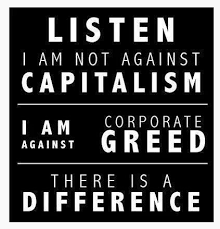
Corporate Capitalism itself must be understood as a mindless media driven machine that puts profits over virtue.  A system in which the greater needs of society are no longer the recognized or given any priority.  All that is rotten today in America today can be traced to greed and avarice.  The same motivations that caused the Israelites to build the Golden Calf.  The Golden Calf still stands—no longer forged of gold but of brands, markets, and corporate power.  We bow to consumption, give obedience to profit, and keep silent to wrongdoing in exchange for comfort and toys.  We mistake greed for progress and idolatry for economic necessity.  We do not need a rejection of markets but a rejection of markets without moral and ethical anchors.

The late Pope Francis is quoted as saying that:

“From an economic point of view, it is irrelevant to produce tanks, or candy provided the profit is the same.  Similarly, it might be the same to sell drugs or sell books if the profit figures match.  If the measure of value is money, everything goes provided that the profit does not vary.  The measure of every human being is God, not money.”

Money becomes the measure of good and evil.  Money becomes the measure of a person’s value and even life.  Today, the religion of America has become “How can I get more money.”  The true prophets throughout history have always preached the potential dangers of focusing on accruing either wealth or fame.

Christianity (Jesus): “No one can serve two masters. … You cannot serve both God and money.”

Islam (Prophet Muhammad, Hadith): “Riches are not the abundance of worldly goods; rather, true riches are the richness of the soul.”

Judaism (Talmudic/Midrashic Thought): “The truly rich are those who are satisfied with what they have.”

Baha’i Faith (Baháʼu’lláh): “Material comforts are only a branch, but the root of the exaltation of man is the good attributes and virtues which are the adornments of his reality.”

Red Cloud (Oglala Lakota): “I am poor and naked, but I am the chief of the nation.  We do not want riches, but we do want to train our children right.  Riches would do us no good.  We could not take them with us to the other world.  We do not want riches.  We want peace and love.”

If we want to rid our nation of the rottenness and stench that is rapidly covering it, we must rid ourselves of the obsession that capitalism seeks to instill in us with every media at their disposal and every commercial that they can provide.  It is an obsession to own more, to possess more, to have more, to buy more, to shop until we drop.  You can have a heart attack so long as you have spent your last dollar.  Christmas has become $Mas.  Our world has become one big shopping mall.  We are speeding on a spending train to oblivion.  Next stop HELL. 

What Can We Do?

If the disease is moral, the response must be moral as well.   We must all:

  • Refuse to lie or accept lies
    • Reject those who tell lies to get ahead for any reason
  • Refuse to worship money and wealth
    • Reject anything to do with the “Prosperity Gospel”
  • Refuse to relate success with goodness
    • Teach that success is not always associated with morality or doing the right thing
  • Teach our children to be responsible
    • Responsibilities are as important as rights. Develop children who accept responsibility for their lives
  • Choose sufficiency over excess
    • Corporate Capitalism thrives on “wretched” excess. Ask yourself what you really need to be happy not what some commercial tells you that you need.

The single most important thing we can all do is to get off the spending train.  Substitute empathy for others for greed.  Substitute kindness for strangers and immigrants instead of suspicion and hatred.  Substitute charity for all for a desire for more stuff and more toys for oneself.  Substitute compassion for the poor and the needy instead of worrying about what you are going to get.  Substitute mercy and forgiveness for hatred and retribution.
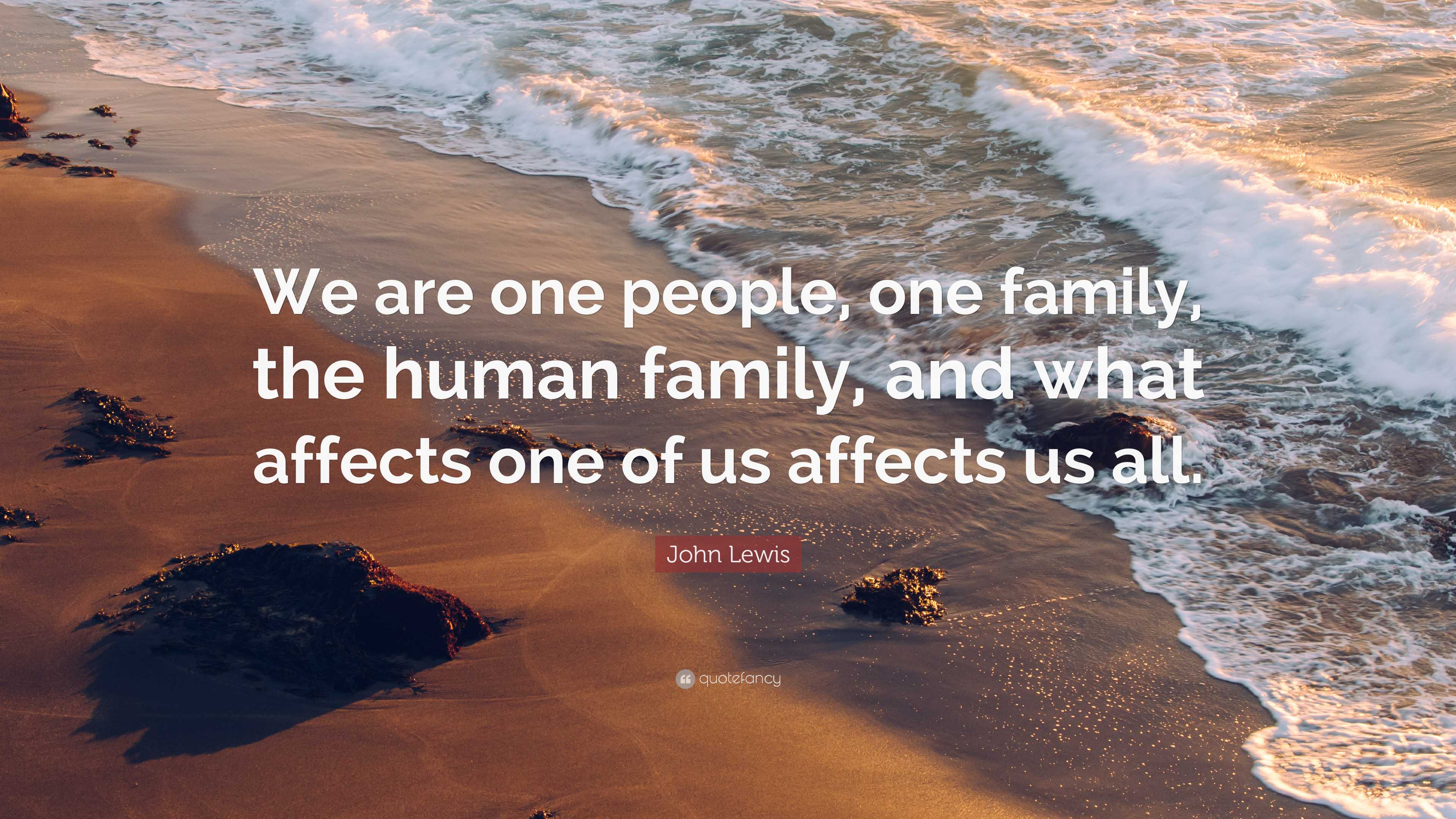
Above all remember that we are all one people.  There are about 180 or more countries in the world.  Karen and I have only been to 45 now, but we have found that everyone in every country that we have been to want the same things:  Meaning for their lives.  Peace for their nation.  Safety for their families.  A decent place to live.  A good meal each day.

We must embrace the idea that everyone is entitled to these elements of a satisfactory life and not just people in our circle or community or nation.  People in every country of every color of every religion and of every political and economic philosophy deserve the same thing.  Life, liberty and the pursuit of happiness.  

Loneliness in America:  A Tragedy of the Commons by J. Persico and Metis – AI Assistant

As I get older, I have noticed more and more people talking about loneliness.  One of my greatest fears has always been loneliness.  I remember embracing the song “Sometimes I feel like a Motherless Child” by Richie Havens.  He was not the first singer or author of this song, but he made it quite popular during the sixties and seventies.  This song reflected how I felt about life and growing up.  I was on my own with no one who loved or cared about me.  No mother.  No loved ones.  Just myself.

“The most terrible poverty is loneliness and the feeling of being unloved.” —Mother Teresa

I grew up somewhat hard and even at times cruel because it was my way of fighting back against the possibility of loneliness that lurked around every corner.  I never trusted anyone because I was sure that they would abandon me and then I would feel the pain of loneliness.  It is hard to describe this pain.  It is not a physical pain.  For me it felt like being thrown off the top of a high mountain or bridge and spiraling down as I waited to hit the ground.  During acute panics of loneliness, I would feel dizzy and lose my sense of balance.  My core felt empty.  I was shrouded with feelings that embraced despair and contempt for myself.  There was nowhere to run or anyone to turn to.  I was alone on an island barren of people, trees or any living creatures.  Not like purgatory and not like limbo.  Just a nothingness in which I existed with no other human beings.

“When you have nobody you can make a cup of tea for, when nobody needs you, that’s when I think life is over.” —Audrey Hepburn

I dreaded these feelings and would do anything to avoid them.  I would abandon other people before they could abandon me.  This destroyed many relationships I had over a period of years including my first marriage and to some extent the relationship I had with my daughter.  It continues to intrude on my life whenever I feel threatened with the loss of love in my relationship with Karen.

“You can be lonely even when you are loved by many people” — Anne Frank:

I tell you these things not because I want sympathy or any feelings of support.  I want you to know that I take loneliness more seriously than many other elements of life that cause us pain.  For this reason, I want to look at loneliness and what seems to be behind the increase that many people say is happening in America.  If one asks well, “Define Loneliness” or what data do you have that supports loneliness is on the increase in America, I am going to plead “Mea Culpa.”  I don’t have the requisite data to prove conclusively that loneliness is an epidemic as some have claimed.  But frankly, I don’t give a damn.  If there is one person in America or the world that is suffering from loneliness, that is one person too many for me.  However, there is in fact some data to support the five major trends that I am going to discuss later in this blog as contributing factors to the loneliness that so many people experience.

“There were moments of intense pain & utter darkness that I wanted to end it all.  The only thing I wanted was not to live.” ― Lala Agni,

For those of you that are not convinced that loneliness is a problem today.  Here are some facts and data that point in that direction.  Because surveys define loneliness differently (daily vs weekly vs “often”), the cleanest approach is to present a small set of credible, recent benchmarks.  Here are some that my AI assistant Metis found:

  • Gallup (daily loneliness): 20% of U.S. adults reported feeling lonely “a lot of the day yesterday” (Aug 27–Sept 4, 2024), up from ~17–18% earlier in 2024 and below the pandemic peak of 25%. Gallup.com
  • Pew Research Center (frequency): 16% say they feel lonely/isolated all or most of the time, 38% say sometimes, 47% hardly ever/never (report published Jan 2025). Pew also finds adults under 50 report “often” loneliness more than 50+ (22% vs 9%). Pew Research Center
  • Harvard “Making Caring Common” (overall prevalence): A nationally representative May 2024 survey found 21% of U.S. adults feel lonely. Making Caring Common
  • AARP (older adults trend): Among adults 45+, AARP reports 40% are lonely (fielded Aug 2025), up from 35% in 2010 and 2018. AARP
  • Workplace-focused lens (Cigna Group): “More than half of American workers classify as lonely,” with the report tying loneliness to absenteeism, disengagement, and turnover risk. MediaRoom

Depending on how it’s measured, loneliness shows up in anywhere from about one in five Americans to well over half in some surveys—especially when you ask about frequent feelings or focus on workplaces.  Gallup found that 20% of respondents felt lonely ‘a lot’ on the prior day, Pew found 16% of respondents feel lonely all or most of the time, and the nation -wide Harvard survey put overall loneliness at 21%.”

Now lets look at five of the reasons commonly cited for the increase in loneliness in America. 

1) We spend less time “doing life” with other people

Large-scale time-use data show Americans are less likely to socialize on a given day than a decade ago, and when we do, we spend less time at it.  In 2024, BLS reports 30% socialized/communicated on an average day (down from 38% in 2014), and average time fell from 43 minutes to 35 minutes. – Bureau of Labor Statistics

I often ask my students what they are going to do on the weekends.  The majority of times, the reply I get reflects their intentions to stay home and play video games.  I find it amazing that they are not going to go out to a park to play sports with other people.  Instead, they are going to interact with their friends through the digital world.  We all see this today wherever we go.  People texting and playing video games in restaurants, bars and parks, rather than talking or interacting with others.  We may not want to admit it, but older adults can be just as addicted to their phones as children seem to be.

2) Social networks are shrinking (fewer close confidants, weaker “bench strength”)

The Surgeon General’s advisory summarizes evidence that social networks are getting smaller and social participation is declining and cites research showing a steep drop in daily social time (e.g., “companionship/social engagement”) from 2003 to 2020.  That same advisory highlights the broader “fraying” context—lower trust in each other and institutions—which makes connection harder to initiate and sustain.

Once upon a time family dinners on Sunday were a major social event in the lives of most Americans.  Today, large-scale displacement of families now make such events almost impossible on a weekly basis.

3) Demographic and household shifts leave more people without built-in companionship

The Surgeon General’s advisory points to long-run declines in marriage rates and family size, plus a rise in single-person households (e.g., 13% in 1960, rising substantially over time).  That matters because for many people, spouses/partners, kids, and nearby kin are the default daily social glue.

There is probably no place in America where “Leave it to Beaver”, “Father Knows Best” or “Ozzie and Harriet” families are the norm anymore.  Two parent families are becoming rarer and rarer.  Many young people opt for simply living together either to avoid a commitment that they are apparently not willing to make or else feel that they could not keep.  You can argue about the value of a traditional relationship all you want.  I am not going to argue that children must be brought up by a Mom and Dad.  However, having two or even more adults to help in child raising has always made the task somewhat easier.  Many years ago, the task of child raising was presumed to be a communal or extended family activity.  Few homes today include a mom, dad and grandparents.

It is even rarer to find homes where either parent is home to simply look after their children.  The economics of modern life demand that both parents have jobs.  It is unbelievable to me when I remember that my father was only a postal worker and never a manager and that my mother stayed home with four kids.  Nevertheless, we had a tidy small home in a small town and food on the table every day.  We might even have had a lot more if my father was not a compulsive gambler spending his earnings or at least a portion of them on the horses.

4) Erosion of “third places” and community institutions

Over the years, there has been declining participation in traditional community anchors—religious groups, clubs and labor unions.  When these institutions fade, people don’t just lose activities; they lose the repeated, low-effort contact that turns acquaintances into friends.

If you are my age, you may remember the large number of social networks that people once belonged to from Camp Fire Girls to Girl Scouts to Boy Scouts to Fraternal groups like the Elks, Moose, Eagles,, Masons, and Shriners.  Churches were another source of community for many people.  I will repeat that the data shows sharp declines in participation in all of these groups.

5) Technology reshapes connection (often replacing, not enriching, relationships)

The Surgeon General’s advisory is careful here: the evidence is “complex,” but there are documented benefits and harms, and it concludes we have reason to be concerned about certain kinds of tech use affecting relationships and social connection.  Once upon a time, it was claimed that TV would destroy family life.  Then it was the Internet.  Now it is the social media programs.  Experts seem to pop up to dispute that any of these technologies have had or are having an adverse impact on socialization.  However, common sense argues against the wisdom of paid shills who benefit and profit from the exploitation of others via the media platforms that they shill for.

So How Do We Address the Loneliness that Exists in our Country Today?

This is a very difficult question to answer.  Lets start by describing what we are not going to do.

  • We are not going to eliminate TV or streaming digital media. This is not likely to happen given the number of hours people spend in front of TV’s.
  • We are not going to eliminate or ban Smart Phones. This will never happen as they serve too many good uses and are now a necessary part of doing business in the world.
  • We are not going to ban social media groups or make participation in real time groups like church or fellowship groups mandatory. This would involve a gross violation of the freedom and individual rights that people have.

Where Do We Go from Here?  Three Realistic Ways Forward

  1. Rebuild everyday human contact—where people already are

Loneliness will not be solved by telling people to “try harder” or “get out more.” It will be addressed when we intentionally rebuild regular, low-effort human contact into the places people already show up: libraries, senior centers, veterans’ halls, walking paths, coffee shops, classrooms, and clinics.  What matters is not the size or novelty of these efforts, but their consistency.  A weekly discussion group does more than a one-time event.  A familiar face does more than a thousand online “connections.”  Human bonds form through repetition—by seeing the same people, in the same places, over time.  We once understood this intuitively. Community was not something we scheduled; it was something we inhabited.  Recreating that does not require nostalgia or ideology—only intention.

When Karen and I moved to Wisconsin after she retired, we discovered several places in Frederic, Wisconsin where people would meet.  The farmers met in the Dairy Coop.  The literary people met in the library.  The mechanically oriented people met in the Holiday Gas Station.  We lived in Frederic for 14 years and knew about everyone in town.  The meetings at the venues mentioned above went on every day when each venue was open.

Before we left Frederic to move to Arizona permanently, the library had decided not to allow meetings anymore.  We were too noisy they said.  The Holiday Station took out the table and chairs that we had set around claiming the space could be used for more products.  The Dairy Coop caught fire and was not rebuilt.  This past year, the Safeway store in Casa Grande removed the outside tables they had where people could rest and not be in the way of food carriages.  You could sit, drink coffee and carry on a conversation with friends.  It seems as though all over America there is a conspiracy to eliminate places where people can socialize.

  1. Reclaim in-person connection as the default, not the exception

Technology has given us extraordinary tools, but it has also quietly taught us that presence is optional.  Texts replace visits.  Zoom replaces conversation.  Scrolling replaces sitting with one another in silence.  This does not mean rejecting technology.  It means re-establishing boundaries.  Phones down during gatherings.  In-person meetings when distance allows.  Choosing eye contact over convenience when the choice is ours to make.  Loneliness is not cured by communication alone; it is cured by being seen.  And being seen requires physical presence, attention, and a willingness to tolerate a little awkwardness.  The cost of connection has gone up—but the cost of avoiding it is far higher.

“Society is the product of our relationships – if our relationships are confused, egocentric, narrow, limited, national, we project that and bring chaos into the world.” — Krishnamurti

A few years ago, my wife’s adopted daughter came out to visit.  She had her cell phone with her and spent more time on the phone than she did talking to us.  I was very peeved and told Karen, next time she comes tell her to leave her phone in her luggage.  Realistically now though, how do you think this would go down?  Parents fight schools that want to ban cell phones in the class because they say, “What if I had to call my son or daughter or they have to call me?”  It is amazing that we grew a nation of people long before we had cell phones.

  1. Treat loneliness as a shared moral responsibility, not a private failure

Perhaps the most damaging myth about loneliness is that it is a personal shortcoming—a sign of weakness, poor social skills, or individual failure.  When loneliness is framed this way, people hide it.  And hidden loneliness only deepens.  A healthier society would name loneliness for what it is: a civic and moral challenge.  One that affects public health, democracy, trust, and social stability.  One that cannot be solved by individuals acting alone.

A simple but powerful starting point would be for organizations, churches, employers, and communities to ask regularly: Who has disappeared from our circles—and why?” and “How can we create more shared space for people to communicate and get to know each other.”  

My wife Karen has been in a choir for over ten years now and she often does not know the names of new members or even all the old members.  I asked her why several times and I always get the same response “Well, we don’t get time for socializing as we are busy practicing our songs for the Sunday service.”  This seems criminal to me.  I never started a business meeting that I facilitated without going around and allowing each person to introduce themselves and say a little about their background.  What is so important that we cannot take a few minutes to let others know we care about who they are?

A final thought

Loneliness in America will not be solved quickly, cleanly, or perfectly.  In fact, it will not be solved at all unless we decide—quietly and collectively—that showing up for one another is not optionalConnection is not a luxury.  It is the infrastructure of a humane society.

Martin Luther King Jr. developed the concept of an “inescapable network of mutuality” where the fate of individuals is interconnected.  He also stressed the mutual obligation individuals have for each other’s development.  King emphasized that unity is crucial for survival, stating, “We must learn to live together as brothers or perish together as fools.”

Reaching out should not be seen as charity.  It should be seen as a survival skill.  It should reflect Love, Empathy and Compassion for others.


Bringing Generosity to Others

I work with a program called “I Could Be.”  It is a program for mentoring high school age students.  A student (mentee) is matched up with an older qualified person (mentor) for a program of exploration and discovery.  The mission of iCouldBe is to “Provide high school students with an online community of professional mentors, empowering teens to thrive in school, plan for future careers, and achieve in life.”  I am on my fourth student mentee.  The program begins at the start of each school year.  The student I was matched up with this year was name (Juan).  That is not his real name.  Neither of us are actually allowed to identify our real names or where we live.  This confers a needed degree of security for the students. 

At the start of the program, my mentee and I go through a series of introductory exercises to get to know each other.  Juan completed some questions and one pertained to what he wanted to be when he was older.  He said he wanted to be rich and famous.  I asked him what would he do with the money if I gave him a billion dollars.  He replied, “I would give it to my family so that they would not have to work.”  I was very impressed by his generosity.  I told Juan that generosity is a very good quality in a person to have.

I started thinking about the concept “Generosity.”  I did a search in my 1700 blogs and found that I had never directly addressed the subject.  Such an important subject and few if any words from me on how important Generosity is.  Ergo, I decided to write this blog on the subject of Generosity.  Lets start with a dictionary definition and then a WIKI definition so that we are all on the same page.

Webster’s definitions of Generosity include readiness or liberality in giving, freedom from meanness or smallness of mind, and a generous act.  This is the primary definition, emphasizing a willing and free giving of time, money, or other valuable things.

Wikipedia says this about Generosity:  Generosity (also called largesse) is the virtue of being liberal in giving, often as gifts.  Generosity is regarded as a virtue by various world religions and philosophies and is often celebrated in cultural and religious ceremonies.

One important thing to note is that generosity is not limited to money.  It may include time, material goods, jewelry or “other valuable” things.  Now we can have a secular version of Generosity, or we can have a sectarian version of Generosity. 

Sectarian Generosity:

Leans on God, scripture, spiritual duty, and the idea that giving transforms the soul.  Jesus said, “It is more blessed to give than to receive.” — Acts 20:35 

Muhammed said, “The believer’s shade on the Day of Resurrection will be his charity.”  — Tirmidhi

Secular Generosity:

Leans on empathy, human dignity, and the belief that giving transforms society.  Albert Einstein, said, “A hundred times every day I remind myself that my inner and outer life depend on the labors of other men… and that I must exert myself in order to give in the same measure as I have received.”

Confucius wrote that, “The superior man is distressed by his own lack of ability, not by the failure of others to appreciate him; he seeks to give more rather than to receive more.”  — Analects 15:18

Both types of generosity are deeply moral.  Both alleviate suffering.  But they grow from different roots and flower in different ways.  In marketing we talk about the “target” audience.  This is not a concept endemic to philosophy or religion but hails from MBA programs in business schools.  Despite my anathema to strict application of business principles to either religion or philosophy, there is some considerable merit in considering this business concept in terms of secular versus sectarian. 

In a Sectarian community, we can talk about Generosity as it applies to those we know.  We can limit the largesse that we give to those in our inner circle, to relatives, friends and members of our immediate communication.  There is no prescription in most churches for being generous to those outside of our domain.  If I tithe, give to my church and help the poor whom I can identify with, I may be considered a very generous person.  There is no stigma in many religious groups if I don’t want to be generous to welfare people, poor people in other countries, undocumented immigrants or people of other race or other religions.  These exceptions would astonish Jesus who taught that being a follower involves welcoming the stranger, as demonstrated in Matthew 25:35: “I was a stranger and you invited me in”.  We might call these people “Fake Christians,” “Pretend Christians,” hypocrites, or simply selfish.  You would be wasting your time trying to open their eyes with such labels.  It would do no good since their core beliefs are unfortunately supported by those in their inner circle. 

In the Sectarian community, the concept of Generosity may not be much better off.  There are large numbers of non-religious people who support the arts, music, education and health care.  The caveat though is that the people they give the money to are deemed worth the expense.  The Sectarian community is proud to support a hand up and not a handout.  People who qualify and meet certain requirements can get some measure of Generosity.  Those who are not “eligible” are excluded from any Generosity.  It is easy to forget that many people are sick and disabled.  Thousands of people in the USA cannot climb up a ladder.  They are put into a pot labeled “undesirables.” 

So, what does it really mean to be generous?  This story is about a friend of mine named Frank.  It happened one day when we were both coming out of the local IGA store with our wives.  I call it the: “The Last Pair of Gloves”

The first cold front of December rolled into the Sonoran desert like an unexpected guest, sharp and biting.  Frank stood outside the IGA store, pulling his jacket close as he waited for Juanita to finish shopping.  Beside the entrance sat an old man, thin as the winter wind, a cardboard sign resting on his knees: “Anything helps.”

His hands caught Frank’s attention.  They were trembling—not from age alone, but from cold. His fingers were blotched white and red, exposed to the air with only a thin flannel shirt to cover his arms.

Frank felt for his pockets.  He had no cash on him—not unusual these days.  But he did have one thing: his gloves.  Soft fleece-lined leather, a gift from Juanita years ago.  He loved those gloves. They were worn just right, molded to his hands, comfortable in a way only time could produce.

He hesitated.

Inside the store, carols played faintly, muffled by the automatic doors.  People hurried by with carts full of holiday cheer.  Nobody stopped.  The old man’s hands kept shaking.

Frank stepped forward.

“Sir,” he said softly, slipping the gloves from his own hands, “you need these more than I do.”

The man looked up, startled.  For a moment, he didn’t speak.  He just stared at the gloves resting in Frank’s outstretched palm as if they were something far more precious than leather.

Then his eyes filled.

“I—I don’t know what to say,” the man whispered.

“Merry Christmas,” Frank replied.

Juanita walked out just then, her cart filled with groceries. “Where are your gloves?” she asked.

Frank smiled, his fingers already numb.  “Right where they belong.”

And as they walked toward the car, he told me later — that his hands began to feel warmer than they had in years.

Frank did not ask to see the man’s papers.  Frank did not ask the man to perform any reciprocal services for the gloves.  Frank did not decide that he was an “unwanted” immigrant and should be sent back to Mexico.  Frank did not ask what religion he belonged to, where he went to church or whether or not he believed in God or Trump.  Frank gave something up that was very valuable to him because he saw someone that needed it more than he did.  This is the essence of Generosity.  This is what Generosity is all about.  Generosity is more than tithing to your local church.  It is more than taking an angel off the giving tree.  It is more than buying toys for tots.  It is more than donating a turkey to the Salvation Army Christmas dinner.  To paraphrase Paul from 1 Corinthians 13:

“Generosity is patient, Generosity is kind.  It does not envy, it does not boast, it is not proud.  It does not dishonor others, it is not self-seeking, it is not easily angered, it keeps no record of wrongs.  Generosity does not delight in evil but rejoices with the truth.  Generosity always protects, always trusts, always hopes, always perseveres.”

Until we learn the real meaning of Generosity, we will have learned nothing about being human, being kind, being loving or being compassionate.  Generosity does not start with your family and end with your family.  Generosity is for the entire human race.  Generosity recognizes no borders, no race, no religions, no genders.   

Here are some quotes to think about: 

Warren Buffett

“If you’re in the luckiest one percent of humanity, you owe it to the rest of humanity to think about the other 99 percent.”

Mother Teresa

“It is easier to give a cup of rice to relieve hunger than to relieve the loneliness and pain of someone unloved.”

Martin Luther King Jr.

“Life’s persistent and most urgent question is, ‘What are you doing for others?'”

Kahlil Gibran

“You give but little when you give of your possessions.  It is when you give of yourself that you truly give.”

Anonymous, The Holy Bible: King James Version

“Do not neglect to show hospitality to strangers, for by doing that some have entertained angels without knowing it.

Gautama Buddha

When giving to others do not linger on thoughts of a giving, what was given, or the one who has received.

Show your gratitude for life this Thanksgiving by giving to others without conditions who have less than you do. 

Our Thanksgiving Message to the World, 11-28-2024

5333-thanksgiving

Fear, Anger and Greed have become epidemic in society today.  The opposite of these traits are Peace, Love, and Charity.  I do not think the hope for civilization lies in politics or our political leaders.  But if we all will commit to spreading Peace, Love and Charity, I believe we can change the world.  Gandhi said, “Be the change you want to see.”

When you say your blessing today at mealtime or whenever, bless the world for what you have.  Be grateful to those who helped you achieve your life and its attainments.  We all reach higher levels by standing on the shoulders of others who have helped or guided us along our chosen paths.  When you are done recognizing the people who have helped you, I would like to ask you to make a commitment.

The commitment is to promise to do all that you can to help spread Peace, Love and Charity to your friends, your relatives, your country, and the rest of the world.  Let each of us do what we can to erase the diseases of Fear, Anger and Greed.

May you all enjoy Peace, Love and Charity today and the rest of your lives. 

John and Karen Persico 

My Final Will and Testament – Scriptures – Reflection #10

images

Last year at my 40th Demontreville Retreat, one of the exercises that we were given by the Retreat Master included a very challenging set of thoughts.  The worksheet for the activity was labeled as “A Testament.” I took the worksheet and instructions home with me.  It had fourteen tasks or reflections to complete.  I did not desire to complete them during the retreat.  It is now almost a year since my retreat, and I have decided to make the mental and emotional effort necessary to complete this “Testament.”

The worksheet started with these instructions:

Imagine that this is the last day of your life on earth.  In the time that you have left, you want to leave a “Testament” for your family and friends.  Each of the following could serve as chapter headings for your “Testament.”  This is Reflection Number 10 on the worksheet.

  1. These are the Scripture Texts that have touched and helped me.

My being an Atheist some people might think that I would have a hard time with finding Scriptures that have touched me.  In truth, it is one of the easiest reflections for me to think about.  I have so many wonderful parables from the New Testament and many proverbs and wisdom from the Old Testament that I use to guide my life and decisions.  I see the Bible as another source of great wisdom that has been compiled over the ages.  It is a combination of history, storytelling and profound thoughts compiled into one large book.  I do not view the Bible as infallible or “The Word of God” unless I use that interpretation very loosely.  If there is a God, perhaps he does reside in all of us and all of us are “Children of God.”

In 1775, Thomas Paine wrote a short essay criticizing slavery and reflecting on “Pretended” Christians who could support such a practice.  His words were:

“to catch inoffensive people, like wild beasts, for slaves, is a height of outrage against humanity and justice, that seems left by heathen nations to be practiced by ‘pretended’ Christians.” — African Slavery in America, 1775

Today we have a system that seems somewhat analogous to the system of “Pretended Christians” that Thomas Paine described 250 years ago.  “Pretended Christians” who can support a man and party that attacks, insults, abuses, and maligns minorities, immigrants, women, disabled people, and veterans.  A man who swears vengeance against the people who disagree with his policies.  A man who pays no attention to Scripture which says:

“Dearly beloved, avenge not yourselves, but rather give place unto wrath: for it is written, Vengeance is mine; I will repay, saith the Lord.  Therefore, if thine enemy hunger, feed him; if he thirst, give him drink: for in so doing, thou shalt heap coals of fire on his head.  Be not overcome of evil but overcome evil with good.”Romans 12:19-21 King James Version

Many of the people insulted by this man continue to feel that he is some sort of Christian Savior.  A man who will restore Christianity as the Mother Religion of America.  A position for religion that not one of the 56 signers of the Declaration of Independence, our Founding Fathers either desired or supported.  We have a country full of people who want to call America a Christian nation but who neither practice nor believe in one iota of what Jesus of Nazareth taught and died for.  We have a nation full of “Pretended Christians.”  I do not pretend to be a Christian or a Saint or a Holy Man.  God (If he/she exists) save me from these “Pretended Hypocritical Christians.”

The following are four of the scripture quotes that have had the most influence on my life.  I will briefly describe the impact that each has had on my thoughts and behaviors.

How-to-Understand-and-Interpret-the-Parables-of-Jesus

  1. What doth it profit a man if he gain the whole world but suffer the loss of his own soul? — Matthew 16:26

The first Jesuit retreat that I did at Demontreville in 1984, upon entering the grounds I saw the larger-than-life sized statue of Saint Ignatius Loyola, the founder of the Jesuit Order.  He stands on a large concrete pedestal.  I was forty years old at the time and just finishing my Ph.D. degree.  I was hungry for fame and fortune and success.  During the retreat, I walked up to the statue and discovered the words “What doth it profit a man if he gain the whole world but suffer the loss of his own soul?’ written on the base of the pedestal.  These words are perhaps the most profound words I have ever heard in my life.  I went back several times during the retreat to read and reflect on these words.  Over the past forty years or so, despite these words being etched in my brain, I always go to see the statue of St. Ignatius and silently repeat these words to myself several times.

My first visit to these words did not stop me from chasing what some call the elusive gods of fame and fortune.  Over the years, my chasing has become less vigorous, but the goal posts still exist in my mind.  Part of me longs to carry the football over the goal line and to hear the roar of the crowd and bask in shouts of “hurrah” and “you’re the greatest.”  The fortune part has never really mattered as much to me as the adulation and recognition that I still thirst for.  Thus, every year that I go back to Demontreville, (this will be my 41st retreat), I will make my pilgrimage to the statue to restore my commitment to the fact that fame and fortune are no substitute for the real nutrients that nurture the soul.  No amount of fame and fortune can substitute for integrity, compassion, kindness and charity towards others.

Version 1.0.0

  1. Therefore, do not worry about tomorrow, for tomorrow will worry about its own things. Sufficient for the day is its own trouble. — Matthew 6:34

Another phrase from the teachings of Jesus as marked down by Matthew.  Throughout history, this same thought has been voiced by most of the great prophets, thinkers and philosophers.  “Live each day one moment at a time.”  “Live in the now.”  “Be mindful of today.”  Doing so is akin to walking a tightrope.  It requires a sense of balance.  We must plan for the future, but we must also live one day at a time.  How to find that balance is a Herculean task.  A second Herculean task is maintaining our balance.   These two tasks are by far more difficult in the modern world than slaying the Nemean lion or capturing the Cretan bull.  Hercules managed to complete 12 very difficult tasks.  I have yet to manage completing even one of my two challenges.  I suppose I will be working on “Living in the Now” for the rest of my days.

GettyImages-185181132-5bdf5e1dc9e77c00512d517b

  1. Vanity of vanities, says the Preacher, vanity of vanities!  All is vanity.  — Ecclesiastes 1

The Book of Ecclesiastes is reported to have been written by King Solomon.  Solomon as you know was one of the wisest men in history.  He was granted wisdom by God because Solomon did not ask for fame or fortune.

“And God said to Solomon: Because this was in your heart, and you have not asked for riches or wealth or honor or the life of your enemies, nor have you asked for long life; but you have asked for wisdom and knowledge for yourself, that you may judge My people over whom I have made you king.”  — (2 Chronicles 1:11-12 NKJV)

Buddhism, Advaita, Zen and other religions talk about the major problem that leads to all of humanities other problems being what psychologists call our Ego.  Solomon called it vanity.  Some might call it self-conceit, narcissism, self-centeredness, self-absorption, me-ism or egotism.  Its all the same.  People become the center of the universe.  I saw a sign the other day that read “When I am not the center of the universe, people become human.”  This is another difficult battle to overcome.  We can focus only on our own needs or desires, or we can expand our awareness to notice the needs and desires of other people.

The Eight Beatitudes given by Jesus in his famous Sermon on the Mount are the greatest exposition of our responsibility to other people that has ever been written.  Jesus elucidated what are called the Eight Beatitudes.  I will not list them all as they are easy to find on Google.  These eight thoughts clearly define how we should treat other people.  I often wonder why so many “Pretended Christians” want to put up the 10 Commandments from the Old Testament, when their Jesus gave them the 8 Beatitudes to obey.   I have actually read that many “Evangelicals” believe that the 8 Beatitudes are wimpy.  The lack of respect for the man that founded Christianity is beyond belief.

I try ever day to remember that I am not the center of the universe.  The world does not revolve around me.  For every one of my rights, there is a responsibility.  I need to look out for others and to help those in need, be they gay, women, immigrants, minorities or even right-wing bigots.  They are all part of the human race.  To paraphrase Ben Franklin, “Either we all work together for a better world, or we shall surely all perish together in ways that none of us desire.”

eye-of-the-needle

  1. It is easier for a camel to go through the eye of a needle than for a rich man to go to heaven. — Mark 10:25

My friend Kwame says that we should be grateful that we are not rich.  Money is a corrupting influence.  It is somewhat like a drug.  It is addictive.  The more you get the more you want.  The more you have the more you need.  Another friend of mine whom I met in China told me before we left Shanghai in 1989 that we were rich.  I explained that we were not rich, but very middle class.  In fact, we were definitely not even upper middle class.  Xibo said, “you are rich to us in China.  You have nice house, and you can afford to travel to distant countries.”  Xibo’s comments were very accurate, and they had the effect of making me realize just how selfish I often am.  I am bemoaning my mundane middle-class status when to most of the rest of the world, I am regarded as rich.  Never mind regarded.  I am rich to possibly 90 percent of the world.

I am told by biblical interpreters that Jesus never said “rich people were bad” or that rich people could not go to heaven.  What Jesus did say and used many parables to illustrate the fact was that it would be hard for rich people to get to heaven.  Money is a heavy load to carry, and it corrupts.  Lord Acton said that “Power corrupts, and absolute power corrupts absolutely.”  The same can be said of money, “Money corrupts, and excessive money corrupts excessively.”

Regard the quest for money in the USA today.  Everyone wants more than they have.  We worry about Inflation, about immigrants stealing our jobs, about the Chinese sending too many products to us.  On the other hand, billions of dollars are now spent on people trying to get rich quick through pull-tabs, lotteries, online gambling and now sports betting.  The mania for money is fueled by the incessant celebrities, media influencers and TV shows touting the “Lifestyles of the Rich and Famous.”  The airwaves, newspapers, Internet and all of our media are full of non-stop advertising.  “Shop till you drop” should be the title of a song or at least put on the US dollar bill right under George Washington’s picture.

To be mindful of what I have I keep repeating this thought in my head.  ‘It is easier for the camel than the rich man to get to heaven.”  By the way, I do not believe in heaven or hell but I take it metaphorically that it is better for the human race if I try to be the camel and not rich and greedy.

Next Reflection:    

  1. These are things that I Regret about my life.

Good Days and Bad Days

5032664-Usain-Bolt-Quote-You-have-good-days-and-bad-days

It is a well-known fact, perhaps the only “fact” that is not disputed anywhere by anyone in the world.  This fact is that we all have “good days and bad days.”  Now some people might argue that there is a normal bell-shaped curve for humans that applies even to this fact.  You probably learned in science that almost all human traits and characteristics follow the “Normal” bell shaped curve.  If this is true, then some of us have more bad days than others and some of us have more good days than others.  That would not seem to be very fair though.  This raises the primordial question “Is life fair?”  We all know the answer to this question because we have heard it from our parents many times and at a very early age.

curveI suppose in one sense, “life is not fair” means that life is indeed following a bell-shaped curve and some of us are on the undesirable end.  In other words, some of us are too short, too fat, too unappealing, or any number of other less-desirable traits that we find on the extremes of the bell-shaped curve.  Last night I was watching a 3-year-old do stunts on a sized down motorcycle.  I could not do these stunts if my life depended on it.  This young boy was a natural on the motorcycle.  He took to it like a fish to water.  We have all seen and perhaps envied some of the more fortunate on our bell-shaped curve who can do things we only dream about doing.  For those of us on the wrong end of the bell-shaped curve, life will never seem fair.

Well, does this “unfairness” also apply to “good days and bad days?”  Are some of us destined to have more bad days than others?  I woke up this morning thinking about this question.  Lately, I seem to be having more than my share of bad days.  Is it my attitude?  Is it just the run of the draw?  Is it something I am doing or not doing?  Can I change my bad days to good days by working harder or smarter?  Should I see a doctor or a shrink?  Is there a pill I can take to overcome the bad days or to change myself in some ways so that I have more good days than bad days?  A pill like this might be very popular.  Of course, some would argue that we have enough artificial chemicals to help alleviate “bad” days, but these chemicals or drugs only lead to worse days in the long run.

a-complete-guide-to-meditation-722x406

I have spent a lifetime, seventy-five years seeking wisdom.  I have looked for nirvana in high and low places.  I have read the books of the great philosophers.  The writings of the greatest thinkers of all time.  I have looked for satori in meditation, life everlasting in prayer, enlightenment in contemplation but still I seem to remain stuck on this loathsome bell-shaped curve.  Some days are good and some bad.

Aging seems to bring more bad days than good.  Each day the phone rings, I pick it up wondering who or which of my friends have died now.  I admit I have a hard time with death.  I wonder if it is my death I fear or the death of so many people that I have loved or admired.  I read and read about how to conquer death.  How to accept death.  How death is inevitable.  How everyone I see walking around will die eventually.  How death is the “next great adventure.”  Will death find me starting a new life?  Will it find me greeting old friends?  Or will death simply be a deep sleep that nothing can disturb me from?

unnamedI understand why so many people want to believe in heaven and hell.  It would be much easier to go on living peacefully if I could really believe that there was someplace better to go to than this earth I now reside on.  Too many bad days now seem to intrude on my equanimity.  You and I and everyone else that resides on this 3rd rock from the sun are abused and tormented every day with disease, starvation, accidents, environmental devastations, and pandemics.  I could handle all of these things but for one thing.  It is called “mans’ inhumanity to man.”  The stupid cruel things we do to each other over and over again.  The wars, murders, and injustices that we inflict on other human beings.  And it is not just the average person that inflicts these cruelties, it is the “best” people in the land.  In fact, it would seem that the inhumanities done by those with the most money, most intelligence and those we call our leaders are the worst of all the brutalities and savagery that we see in the news each day.


A friend of mine once told me that if you want people to listen to you, you must give them a positive message.  Give them hope.  Give them faith.  Give them love.  The greatest prophets (as opposed to greatest thinkers) all spread a message of love and charity.  The great message of Jesus, Buddha and Muhammad was the need to care for others and to do the best you can to make a difference in the world.

When I give up on our ability to make a difference, I fall into gloom, doom, and despair.  But how can we not give up, when we all seem so helpless to really make a difference.  None of our leaders were able to stop the Ukrainian war from starting.  Could I have done any better?  Now we read each day about nonstop atrocities being committed against a people than only wanted to live a good life in peace with their neighbors.  How can I not feel like it is a bad day when the news, radio, texts, chats and television all besiege me with unrelenting gloom and doom?  Is there an antidote to despair?  Is anyone who is optimistic simply a naïve foolish Pollyanna?

polly

There is one solution that I have found.  No matter how little, no matter now small, no matter how much, there are things in my life to be grateful for.  These people and things bring me joy and happiness.  When I focus on these things, my mood lifts.  The hardship and travails of life do not seem so bad.  These things and people will not be with me forever.  As I mentioned earlier, each day seems to bring news of a once former friend who has now embarked on a last great journey.  So we must realize that everything is temporary but that does not matter “Right NOW.”  Since right now, my joys and happiness are right in front of me, waiting to be appreciated and waiting to be loved and cared for.  These joys are the friends and people I know and the people I have yet to meet.

oyster

The aphorism that “the world is my oyster” is a beacon that I can always tack to.  A sailor must have a North Star to guide his or her travels.  Each of us must have a direction to lead us on our journey through life.  Without a direction, we sail in circles and life seems meaningless and cruel.  Find your North Star and you will find your happiness.  Just remember there will always be days when you will lose your way.  We must reset our rudder and readjust our sails and start out again and again and again.  Life will always be a journey and not a destination.

“Light is sweet,

and it pleases the eyes to see the sun.

However many years anyone may live,

let them enjoy them all.

But let them remember the days of darkness,

for there will be many.

Everything to come is meaningless.”

― King Solomon Son of David

Faith:  The Fifth Most Important Virtue for a Good Life

Faith-of-a-childFaith is number five of my seven essential virtues for leading a happy and successful life.  Every Friday I start my day with the following prayer:
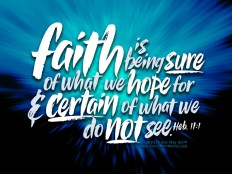
  • “Help me to be as well as to do and to have Faith in the future by living today the best that I can.”

 Please listen to Pete Seeger’s rendition of:  “You Gotta Walk That Lonesome Valley” for a musical version of what Faith is really about.  Read the comments about Pete Seeger.  He was a prime example of a man that had Faith. 

Faith is the first of the three major theological virtues.  As I thought about preparing this blog, I asked myself the question, “What is the difference between Faith and Trust?”  Or perhaps there is no difference?  I wondered if one has to be religious or have a religious affiliation to have Faith.  Most people think of Faith in terms of a belief in God or some other deity.

faithI decided that I must first understand what Faith really means.  To do this, it is helpful to deconstruct how we think about Faith and how we use the word.   I thought about how we use both Trust and Faith in common language.  For instance we use trust in English as follows:

  • Trust me!
  • Do you trust yourself?
  • Have a little trust in me.

Now if you try substituting the word Faith for Trust, it is obvious that in the first two instances, it just does not fit:

  • Faith me!
  • Do you Faith yourself?
  • Have a little Faith in me.

You will notice that in the third instance, you can substitute the word Faith for the word trust.  A grammarian would quickly note that the word Trust can be used either as a noun or a verb whereas the word Faith is primarily a noun and cannot usually be used as a verb.

It might be interesting to compare dictionary definitions of Faith and trust.

Faith: http://www.merriam-webster.com

  • Strong belief or trust in someone or something
  • Belief in the existence of God : strong religious feelings or beliefs
  • A system of religious beliefs

Trust:  http://www.merriam-webster.com

  • Assured reliance on the character, ability, strength, or truth of someone or something
  • Dependence on something future or contingent :  hope
  • Reliance on future payment for property (as merchandise) delivered : credit <bought furniture on trust

mountain climbingI think you can readily see that there is a certain degree of overlap between the two concepts. However, Faith generally seems to convey a more sectarian or theological concept of belief whereas Trust is generally used in more secular terms.  Thus, we don’t “trust” God but we have Faith in her.  Faith seems to be a term that is not contingent upon any kind of physical or logical proof.  We might not trust a person with our money without proof that they are “bonded” or trustworthy, but we would not expect such displays of material evidence when it comes to having Faith in God.  So what is the relevance to this in our lives?  What good is Faith if we can substitute trust for faith and have more security in the long run?
He replied, “Because you have so little Faith. Truly I tell you, if you have Faith as small as a mustard seed, you can say to this mountain, ‘Move from here to there,’ and it will move. Nothing will be impossible for you.” — Matthew 17:20

childThe answer seems to be (IMHO) that sometimes we can trust without evidence but generally we are better off trusting with some element of surety that can mitigate the risk of our trust being unfounded or mistaken.  Whereas, there is little or no evidence that can prove your need or desire to have Faith.  You must have Faith like a parent has love for a child.  It is unconditional.  You have Faith simply because you want to believe.  You have Faith because you accept something without conditions.  You need no proof or evidence to support your Faith.  Is this a good thing or a bad thing?   Should you have Faith without proof?  What would a life without Faith be like?  Would we be safer or happier with less Faith?


“On a long journey of human life, Faith is the best of companions; it is the best refreshment on the journey; and it is the greatest property.”  — Buddha

Buddha thought that Faith is a companion that we cannot ignore on our journey through life.   There is a story about Mother Teresa that when she was visiting Iowa many years ago and was being interviewed by a somewhat cynical journalist; she was asked if she really thought she was making a difference to the poor in India.  Her reported reply was “I am not called upon to make a difference.  I am called upon to have Faith.”  If that sounds somewhat evasive, consider the following professionals who toil diligently and with great dedication:

  • Teachersblack couple
  • Doctors
  • Psychologists
  • Writers
  • Philanthropists
  • Artists

There are no doubt dozens of other professionals who toil in areas that are not readily amenable to evidence that they are “making a difference.”  As an educator and consultant, I can readily attest to the fact that seldom if ever is there “evidence” or concrete proof that my actions and thoughts have made a difference on my students or clients.  Most of us work on day after day, motivated by one force and one force only.  That force is the power of Faith.

You must not lose Faith in humanity. Humanity is an ocean; if a few drops of the ocean are dirty, the ocean does not become dirty.” — Mahatma Gandhi

Each time I write a blog, I write with the hope that something I say will help someone have a better day or lead a better life.  I have now written over 800 blogs and I have received about two dozen or so letters or emails telling me how much they appreciate my writing or how much it has helped them.  The percentage of letters received is about 3.4 percent of the blogs I have written and whose readers have been moved to write to me or drop me a comment.  And that is fine.  People are busy and many times the thought of writing to a writer is something that readers never think of.

big-challengesFortunately, the 3.4 percent of respondents have been more than enough to help me keep my Faith.  (Should I really need such sustenance if I have Faith?) Yes, I have Faith that my writing is making a difference to the world but alas, I have no proof for the empiricists, the materialists or the skeptics.  I have to ask you as well as myself to believe that I am.  It is Faith that keeps me motivated.  Without Faith, life would appear to be a futile waste of time.  Faith helps us to carry on when everything and everyone is saying to quit.  The woman in the life raft, the athlete with a severe injury, the parents with a disabled child, the poor fighting hunger, the righteous fighting injustice are all sustained by the power of Faith.
19176-Have-FaithFaith can believe everything
That we say.
Belief can increase the strength
Of Faith.
Belief is pure,
Faith is sure.
Belief looks around
To see the truth.
Faith looks within
Not only to feel the truth
But also to become the truth
.  —- Sri Chinmoy

Time for Questions:

What do you have Faith in?  What helps you to maintain your Faith?  Where would you like to have more Faith?  Do you think we have too much or too little Faith in the world?

Life is just beginning.

“Faith is to believe what you do not see; the reward of this faith is to see what you believe.” —- Saint Augustine


3528 – Tuesday, September 3, 2019 — Love versus Hate:  Does Hate Trump Love?

love versus hate

God calls us to love others, just as he loves us.  We show love to others by forgiving, accepting and honoring them.  —  From a quote in a Lutheran Church Brochure

Pick up a newspaper any day of the week.  How much love do you see?  Very little I would bet.  How much hate?  Pages and pages of hate.

  • Man kills seven and injures 31 with assault rifle.
  • Woman with five DUI’s kills mother and daughter in auto crash.
  • Israeli bomb attack kills fifteen jihadists.
  • Terrorist bomb kills 35 soldiers in Iraq.
  • Trump encourages beating up protesters.

I propose that you will find at least ten times more hate in the news than you do love.  But that is not news to you or anyone else, is it?  Newspapers exist to sell advertising, and nothing sells like hate, violence, gore, mayhem and disasters.  The crème de la crème is reserved for serial killings, mass killings and family murders.  Local news is full of crime stories from places that are thousands of miles away and that no one has ever heard of.  Bad news and hate crowd out the good and love that society has.  In a way it is ironic, since so many people in the world regard themselves as Christians.  Christianity professes to follow the teachings of a man named Jesus Christ.

Jesus Christ (for those of you who might be unfamiliar with him) was a big advocate of love and peace.  Jesus told his followers “A new command I give you: Love one another.  As I have loved you, so you must love one another.”  — John 13:34.  Jesus is also reputed to have said “Love your enemies and pray for those who persecute you.”  — Mathew 5:44.  Another irony, considering that numerous Christian churches have supported racism and hatred towards Blacks and other minorities.

One would think that particularly in those parts of the United States dominated by Christian churches, love would blossom like a million flowers.  You would expect that in the so called “Bible Belt” you would see evidence of love and not hate everywhere you look.  If any place was against prejudice, discrimination, bigotry and ill will towards their fellow human beings, it should be in the Bible Belt.  Another irony, since according to the Southern Poverty Law Center, the South has more hate groups than any other area of the United States.  Even more confusing, are the Christian ministers who preach hate and use Christs name to justify it.  This is a recent map of hate groups in the USA.

ir166-hate-map-launch

A few Sundays ago, Pastor Joe Major of Louisiana’s Faith Baptist Church gave a guest sermon at the Philippines church of Pastor Logan Robertson.  You’ll never guess what Major talked about.  In a sermon titled “Make the World Straight Again,” Major told the raucous crowd about how all homosexuals were inherently pedophiles and that’s why they deserved to be executed.  Several years past, the Rev. Steven Anderson quoted passages from the Old Testament to the congregation of his Faithful Word Baptist Church about the kinds of people God hates in Tempe Arizona.  Anderson told worshipers he interprets these passages to include Mr. Obama and that he prays for the president’s death.  Is it ironic that Anderson believes he is a Christian and promotes hate in the name of Jesus?

But enough looking at hate, what about love?  Can we find examples of love in the world?  Do we even know what love really is?  We all know the quote about “love is kind, love is patient, etc.”  But what is the difference between love and compassion or between love and mercy or between love and charity?  What about the role of forgiveness?  Can we have love without forgiveness?  Should we forgive everyone?

“If you do away with the yoke of oppression,

with the pointing finger and malicious talk,

and if you spend yourselves in behalf of the hungry

and satisfy the needs of the oppressed,

then your light will rise in the darkness,

and your night will become like the noonday.  —

Isaiah, 58:9-10

Love can not exist in the dark.  Hate brings the dark.  Love is extinguished by hate. In order to have love, you must eliminate hate.  The two cannot go together.  Love opens the door.  Hate closes the door.  Love leads to mercy.  Hate leads to revenge.  Love leads to compassion.  Hate leads to scorn.  Love leads to forgiveness.  Hate leads to vendettas.  Love leads to charity.  Hate leads to greed.   If you want to bring love into the world, you must work to eliminate hate.  Love cannot blossom in a soil that is contaminated with the poison of hate.

I think we are love deprived today.  I mean real love.  Not love of things.  I love my car.  I love my new watch.  I love my blender.  This is not love.  This is idolatry.  It is a Madison avenue con that has been foisted on us to buy stuff and more stuff.  No where in the world do people own more stuff than in America.  Rich or poor in this country, we all have the disease of stuff.  We buy and sell and buy more stuff.  A t-shirt exhorts us to “shop till we drop.”  The midnight madness sales during the Holiday seasons are an ironic example of what it means to be really crazy.  Ironic, because when things matter more than people, we have a world that is truly mad and insane.  We have a world without love.

“Darkness cannot drive out darkness; only light can do that.  Hate cannot drive out hate; only love can do that.” — Martin Luther King


Unbecoming a Victim: Or how to stop complaining and make a difference

Life’s not fair!  I never get any breaks! Other people have all the luck!  The world is crap and there is nothing anyone can do about it!  It’s not my fault. Why did he/she get the job and not me? (Listen to the Power of Responsibility as you read my blog today)  Do-You-Have-a-Victim-Mentality-at-Work

If you have ever made any of the above comments, rest assured, you are probably normal. It is called feeling like a victim or wallowing in self-pity. From time to time, we all engage in victim-hood. However, if your entire life is dominated by feelings of regret, remorse and envy, you are not just engaging in a bout of self-pity, you are embracing full-on victim-hood. We all feel like victims from time to time. That is normal. But if you are thoroughly convinced that you are a victim, you need help. The world has too many too many real victims, it does not need pseudo victim. This blog is about how to avoid embracing a victim mentality and the key factors necessary to overcome such a mentality.

First, let’s look at two key questions:

  1. What is a victim?

As I am describing it here, I am not talking about victims of torture, oppression, starvation, crime, disease, pestilence or any phenomenon that is beyond the ability of an individual to evade. I am talking about a mindset that occurs when we fail to take responsibility for our actions and the consequences of our actions and behaviors on others. You probably know some people who you would describe as having this mentality. My wife Karen says she defines a victim as “someone whose problems are always someone else’s fault. They also seem to need problems and will create them if they don’t have them.”  hero versus victim

“Your complaints, your drama, your victim mentality, your whining, your blaming, and all of your excuses have NEVER gotten you even a single step closer to your goals or dreams. Let go of your nonsense. Let go of the delusion that you DESERVE better and go EARN it! Today is a new day!”  ― Steve Maraboli

We see many people who cannot find any good in the world since they are so busy feeling sorry for themselves that they cannot see the blessings that they have. I find many right-wing Christians to be prime exemplars of this victim mentality. They are so convinced that the world is evil and will end any day. The “anti-Christ” is coming and then the world will be destroyed and all the evil in it. Such people seem to revel in the idea of an apocalypse which will wipe the entire world out and only spare the “good” people. Of course, these right-wing fundamentalist Christians are the “good” people who will be spared.

  1. Why do people choose a victim mentality?

I believe the answer to this question is that it absolves the “victim” of responsibility. They can blame God, the world, other people, nature, the weather or DNA for their failures. Never having to take responsibility is a panacea for those with a victim mentality. It is easier to do nothing when any effort is predestined to fail.

“Life is not compassionate towards victims. The trick is not to see yourself as one. It’s never too late! I know I’ve felt like the victim in various situations in my life, but, it’s never too late for me to realize that it’s my responsibility to stand on victorious ground and know that whatever it is I’m experiencing or going through, those are just the clouds rolling by while I stand here on the top of this mountain! This mountain called Victory!” ― C. JoyBell C.

Overcoming the Victim Mentality:

The antidote to a victim mentality consists of four vaccines. They are as follows:

  • Moral Courage
  • Moral Reasoning
  • Moral Universalism
  • Moral Responsibility

Anyone of these four vaccines can keep you from becoming a whining victim. Taking all four together, will help you to become independent and strong. You will be a winner instead of a victim. We need to give our children these vaccines at an early age, but it is seldom done. It seems as though we must find them on our own later in life or else we flounder through life succumbing to the victim mentality until we find one or more of them.

Moral Courage:

moral courageTo dream the impossible dream, to fight the unbeatable foe, to go where no one has gone before is courage. To stand up for what you believe, to right the unrightable wrong, to boldly speak out against injustice. This is courage. There is physical courage as is manifested in a war or sports or extreme athletic challenges. Moral courage is of the heart and soul. Bothe moral courage and physical courage result in action. One of my favorite quotes is as follows:

“The test of courage comes when we are in the minority. The test of tolerance comes when we are in the majority.”Ralph W. Sockman

Moral courage does not exist by just talking about it or complaining about things. Moral courage is an attempt to make a difference by taking some decisive action. You speak out against prejudice, bigotry, hatred, racism, injustice and stupidity. You do more than read the newspaper and bemoan the sad state of the world. The life of the prophet Mohammed provides many examples of moral courage:

“Before claiming Prophethood, the Prophet Muhammad, upon him be peace and blessings, was well off and had a respected place among his community. However, he had to confront all kinds of hardships and persecutions after Prophethood and spent for his cause whatever he had. His enemies slandered him, mocked him, beat him, expelled him from his homeland and waged war on him. He bore all such cruel treatments and hostilities without complaint and asked God Almighty for the forgiveness of even his enemies.”The Way to Truth 

Moral Reasoning:

devil_angelMoral reasoning occurs when you question right and wrong. Moral reasoning is a cognitive action that takes place when you question standards, conventions, group reasoning, and crowd think. Moral reasoning is the questioning of social and cultural standards. Jesus of Nazereth gave many examples of moral reasoning during his life.

“Woe to you, teachers of the law and Pharisees, you hypocrites! You give a tenth of your spices—mint, dill and cumin. But you have neglected the more important matters of the law—justice, mercy and faithfulness. You should have practiced the latter, without neglecting the former. You blind guides! You strain out a gnat but swallow a camel (Matthew 23:23-24).” 

Jesus is making an important distinction here between convention and morality. We often confuse justice with legality. The inability to understand the difference and its moral relevance is a failure of moral reasoning. Throughout his ministry Jesus gave many examples of moral reasoning.

Moral Universalism:

Hans Kung was a Roman Catholic priest who was stripped of his license to teach theology by the Catholic Church for criticizing the concept of papal infallibility.

“In the early 1990s, Küng initiated a project called Weltethos (Global Ethic), which is an attempt at describing what the world’s religions have in common (rather than what separates them) and at drawing up a minimal code of rules of behavior everyone can accept. His vision of a global ethic was embodied in the document for which he wrote the initial draft:, Towards a Global Ethic: An Initial Declaration.”Wikipedia

responsibilityKung’s life demonstrates a strong moral believe in the universal principles that underlie all religions. My religion is not better than your religion and all of the worlds’ great religions have a core of morality and ethics which are admirable and worth following. When we find one religion fighting with another religion or one advocate maintaining the superiority of their religion over another, we have a counter example of moral universality.

Moral universalism is an important element in overcoming victimhood. One cannot believe that their religion is superior to another religion without eventually succumbing to the rampant persecution complex that seems typical of so many religious people. I was taught when I grew up that I would go to hell if I ever stepped in a Synagogue or Temple.   Karen was taught that as a good Lutheran she should never date a Catholic. Baptists denigrate other Protestants while Muslims and Christians act as though they were worshipping different Gods. Jesus and Mohammed had a deep respect for all religions because they were wise enough to perceive the universality of religion.

Moral Responsibility:

moral responsibilityThe famous poet John Donne is perhaps best known for one of his lines that goes: “Never send to know for whom the bell tolls, it tolls for thee.”   Donne well understood the idea that we are all interconnected and we all have an incomprehensible interdependency such that anyone’s death affects us all. The same is true with morality. A key tenet of Buddhism is the moral responsibility that everyone on the earth faces for social and political actions.

 “Today we have become so interdependent and so closely connected with each other that without a sense of universal responsibility, irrespective of different ideologies and faiths, our very existence or survival would be difficult” – (Dalai Lama, 1976)

Of the four vaccines that are critical for overcoming a victim mentality, it is my opinion that a sense of moral responsibility is the most important. If I could only receive one vaccine, I would choose to be vaccinated with moral responsibility. A sense of moral responsibility allows us to help others who are in need. Charity, love, compassion and kindness are all nurtured by a sense of moral responsibility. As they say: “what goes around comes around.” When we do “good” for others, we do good for ourselves. By identifying with the pain and injustices that others suffer, we forget our own problems and we understand that we can make a difference in the world. No one who believes in their ability to make a difference in the world can suffer from a victim mentality.

Time for Questions:

Are you a victim or a hero? How often do you feel hopeless? What do you do about your feelings of hopelessness? How do you overcome feeling like a victim? Do you think people have a choice of how they feel? Why or why not?

Life is just beginning.

“Most things, even the greatest moments on earth, have their beginnings in something small. An earthquake that shatters a city might begin with a tremor, a tremble, a breath. Music begins with a vibration.”  -― Lauren Oliver


Joy to the World

joy-to-the-world

Tis the season to be jolly, but for many people there might seem little to be jolly about.  In one of the most famous holiday stories of all time, the central character Ebenezer Scrooge gave what has become an iconic line about the holiday season.  Scrooge said:

“What’s Christmas but a time for finding yourself a year older and not a day richer?  There’s nothing merry in that.  If I could work my will, nephew, every idiot who goes about with “Merry Christmas” on his lips should be boiled with his own pudding and buried with a stake of holly through his heart.”A Christmas Carol by Charles Dickens

Not exactly a fan of Christmas, Scrooge may have echoed sentiments that lie dormant in many of us.  Over the years, it seems the holiday season starts earlier and earlier.  There is more pressure than ever to buy the right gifts and to spend increased amounts of hard earned money on presents for friends and loved ones.  The airwaves and pulpits bemoan the crass commercialism that accompanies so much of the holiday season while at the same time making sure that all commercial breaks are properly inserted between the “holiday messages.”

Our churches are full of giving trees, toy drives and Christmas shoes boxes.  Perhaps giving more at Christmas to some mysteriously perceived needy children in dire need of more toys will make us feel better about ourselves for ignoring the poor and needy for the rest of the year.  Even at church, the message that Jesus meant for us gets diluted with the drive to fill the toy box.  Do we even know any more what message Jesus wanted us to hear?

the-gospelJesus talked about the three classes of good people.  The first class hears his message but has little time to do anything about it.  The second class hears the message and when convenient they try to help others and spread the message of Jesus.  The third class commits their body and soul to sharing Jesus’s message.  The third class of men/women make a commitment to doing this year round and 24/7.  For the third class, it is not a onetime thing or something to be done when they have time or are not busy.  It is a lifetime commitment to share his message with the world.

“The title, Three Classes of Men, stands for three kinds of persons in any walk of life. They might be three classes of religious or priests, husbands or wives, workers or professional men.  However, classified, they represent three levels of volitional disposition to sacrifice whatever is less than God and stands in the way of His more perfect service and love.  Viewed from another aspect, they are three states of spiritual detachment which in ascending degree dispose a man for the reception of divine grace.  Implicit in the meditation is the belief that no matter how entangled in secular pursuits and impeded in the way of perfection, a person can rise above this condition if he takes the trouble to recognize these impediments and is humble enough to pray for help to overcome them.” — Three Classes of Men by Fr. John A. Hardon, S.J.

Most of us will watch at least a few moving holiday stories before December 25th.  From Miracle on 34 Street to the story of the Christmas Truce during the fighting of WWI, we will hear many heartwarming tales of kindness and love.  Most of these stories are similar in theme to the Christmas Carol.  An individual who has utter contempt or callousness for the Christmas message somehow finds redemption through the love and compassion of others.

quote-the-life-of-jesus-christ-is-a-message-of-hope-a-message-of-mercy-a-message-of-life-in-max-lucado-90-79-19The Joy of Christmas is a state of fulfillment, contentment and gratitude.  Through the love of others who give selflessly of themselves, we can all be free to experience a Joy that cannot be bought or traded.  It is one of the reasons that giving and not receiving is said to be the true path to happiness.  During the holidays, we are excited about the chance to give to others.  And nowhere is that feeling of giving more delightful than in watching the face of a young child receive something that we know they really wanted.  However, Joy to the World should mean more than just giving toys to tots.  There are physical gifts which we can give but there are also emotional and spiritual gifts as well.

thank-you-fatherI am frequently critical of all the toy drives that I see going on at Christmastime.  Not just because I think most kids in America have more toys than they know what to do with, but because of the message that this sends.  Why not I ask, have a “books for tots” drive?  Why not give books for a present?  Why is it always about toys?  We become so narrowly focused that we lose sight of the larger picture.

Christmas is about Joy.  But Joy does not just come from toys.  Joy comes from learning.  Joy comes from sharing.  Joy comes from helping others.  Joy comes from being present when needed by others.  Joy is not just a physical phenomenon; it is a spiritual and emotional phenomenon.  The Message of Joy that Jesus wanted to bring into the world was a message about peace and love.

I see a lot of talk these days about putting the Ten Commandments up on scrolls and even billboards.  Here in Arizona City, they have erected a billboard with the Ten Commandments printed on it.  To the best of my knowledge, Jesus said

“Do not think that I have come to abolish the Law or the Prophets; I have not come to abolish them but to fulfill them.  For truly, I say to you, until heaven and earth pass away, not an iota, not a dot, will pass from the Law until all is accomplished.  Therefore whoever relaxes one of the least of these commandments and teaches others to do the same will be called least in the kingdom of heaven, but whoever does them and teaches them will be called great in the kingdom of heaven.  For I tell you, unless your righteousness exceeds that of the scribes and Pharisees, you will never enter the kingdom of heaven.” — Matthew 5:17-20

acts-kindness-inspiremoreThus, Jesus did not come to replace the commandments but he did come to go beyond the commandments.  God brought the commandments to Moses but the message that Jesus brought to us is in addition to the commandments.  Jesus extended the Ten Commandments with a list that has come to be known as the Eight Beatitudes.   A beatitude is something that gives one both happiness and blessedness.  Jesus gave these Eight during his famous Sermon on the Mount:

THE EIGHT BEATITUDES OF JESUS

“Blessed are the poor in spirit,
for theirs is the kingdom of heaven.

Blessed are they who mourn,
for they shall be comforted.

Blessed are the meek,
for they shall inherit the earth.

Blessed are they who hunger and thirst for righteousness,
for they shall be satisfied.

Blessed are the merciful,
for they shall obtain mercy.

Blessed are the pure of heart,
for they shall see God.

Blessed are the peacemakers,
for they shall be called children of God.

Blessed are they who are persecuted for the sake of righteousness,
for theirs is the kingdom of heaven.”

Gospel of St. Matthew 5:3-10

message-to-the-worldI am continually surprised by so-called Christians who seem to revel in the Ten Commandments but treat the Eight Beatitudes as though they were bastard children of Satan.  When was the last time you heard anyone wanting to put up a statue or sculpture or sign with the Eight Beatitudes on it?  The Message of Christmas is the Eight Beatitudes.  The Joy that Jesus wanted to bring to the world can only come by following the Eight Beatitudes.  If you call yourself a Christian but you do not practice these in you daily life, then you are not spreading the Gospel of Jesus.

In this present climate of fear, bigotry and uncertainty engendered by the recent US Presidential race and outcome, the message of Jesus needs to be repeated and spread as never before.  If there was no Joy in Muddville when Casey struck out, there certainly will not be any Joy in the World until all of us, Christian, Buddhist, Jew, Muslim, Hindu, Mormon, Baha’i  and others start believing in and following the Eight Beatitudes.  I am not saying this to try to convince anyone to be a Christian.  The kindness-quotes1words of the Beatitudes go beyond any one religion.  They speak to a way of being in the world and a way of treating other human beings.  Just as I have found valuable teachings in other religions, I think more Christians should be willing to share the Message of Jesus in the Eight Beatitudes.  Keep in mind though, that sharing this message will never work unless you also live by the message.  You must be the change you want to see in others.  Do you know what the famous Indian Chief Sitting Bull said when asked what he thought of Christianity?  Chief Sitting Bull replied: “I have read your Bible and the religion seems good but I do not see many White people practicing it.”

Time for Questions: 

  • When we denigrate people on welfare and refuse to support the poor and needy what Beatitude are we ignoring?
  • When we want to wage war on other countries to support our lifestyle, what Beatitude are we breaking?
  • When we have no time for immigrants and refuse to shelter those needing respite from tyranny and injustice, what Beatitude speaks to this?
  • When we practice racism and discrimination towards those who are different from us in thoughts, words or deeds, what Beatitude are we not following?
  • When we fail to speak out against bigotry and hatred, what Beatitude would challenge our behavior?
  • When we fail to treat others with honesty and integrity, what Beatitude are we disdaining?
  • When we fail to give compassion and comfort to those in need, what Beatitude should we be thinking more of?
  • When we practice narcissism and think we are better than others, what Beatitude would Jesus tell us to look at more closely?
  • Which “Class” of people do you belong to?

Life is just beginning.

“The spirit of Christmas is the spirit of love and of generosity and of goodness.  It illuminates the picture window of the soul, and we look out upon the world’s busy life and become more interested in people than in things.” — Thomas S. Monson
happyholidaysbanner1


Previous Older Entries