Hearts First or Minds First – What is the Right Order of Change?

For many years now, I have seen people follow the most bizarre ideas.  Their beliefs defied all my logic and rationale thinking.  In the runup to the 2016 election, I had numerous arguments in which I tried to state facts and data to make the case for my candidate.  My arguments were largely ignored.  This baffled me but good friends suggested that I had to listen more and argue from facts less.  This method did not work either.  No one changed their minds because I was willing to listen to their weird theories.

Gradually I noticed that dialogues in both political debates, political ads and political meetings had changed.  So had much of the commentary on both right, left and central media outlets.  Logic and facts were replaced by narratives.  Stories about the man who lost his job to overseas low paid workers.  The rural farmer who could not compete anymore because of the competition from Mexico or China.  Joe the Plumber in the 2008 Obama election.  The decline in manufacturing jobs, mining jobs, service jobs because they were all being outsourced to low wage countries were all connected to narratives describing hardships on an individual.  Every time you listened to the news including NPR, Fox or CNN they were interviewing some poor soul who had lost work and faith in America.  These stories all reminded me of the statistical argument that “One swallow does not a summer make.”  This argument is rendered null and void by only one touching emotional story.   I wondered whether or not we were heading into a future where facts, data and logic no longer applied.

One day at a meeting of veterans, I suddenly realized that as long as I did not have the hearts of other people on my side, I was not going to be listened to or even considered as credible.  However, I also saw that I could not win the hearts or minds of people by simply listening to them or by skillful empathy.  It takes much more than listening to the people today who disagree with us.  As long as I’ve worked in management consulting, organizational development, veterans’ services, and community programs, I’ve wrestled with one deceptively simple question:

Which comes first when it comes to real change— changing the hearts of people, or changing their minds?

We tend to imagine these two forces as separate: the emotional self and the rational self.  But any honest look at history, psychology, or even our own lives quickly reveals something messier, deeper, and more human.

What I’ve come to believe is this.  There is a time when the heart will lead and a time when the mind will lead.  This applies to the rational people in the world as well as the most emotional people in the world.  To some extent we all vary in our tendency to resort to one or the other.  Different situations will necessitate different strategies.  Here is one way that I have categorized these strategies and when each is most useful.

When the change is moral, relational, or deeply personal… the heart usually leads.

Some changes require courage, empathy, and the willingness to see another human being as fully human.  These are heart-changes.  Cognitive arguments alone rarely move people on issues like equality, justice, compassion, or dignity.

  • Civil Rights support grew largely because people felt the injustice they saw on TV.
  • Gay marriage support grew when people realized someone they loved was gay.

Emotion is the brain’s prioritization system.  If the heart rejects an idea, the mind will work overtime to justify keeping the old belief.

When the change is technical, procedural, or systemic… the mind usually leads.

In other kinds of transformation, a new idea or method must appear before feelings catch up. Deming understood this well.  Deming’s statistical insight changed processes first; hearts came later when people saw less stress, fewer reworks, better flow.  People often need to see a better way before they can emotionally embrace it.  People shift cognitively first, then emotionally.

Technical Change Involves:

  • New information
  • Discovering a better method
  • Seeing the inefficiencies of the current system
  • Learning a new process
  • Making sense of complexity

Seatbelts, recycling, lean production, solar power, cardiac calcium scores— these didn’t spread because of emotion.  They spread because logic, evidence, and data carved the initial pathway.  Once the results became visible, the emotional commitment followed.  In these cases, cognition laid the track, and emotion rode in on it.

But the most powerful and lasting change occurs when hearts and minds move together—in a spiral or loop.

  • Not heart then
  • Not mind then

But an iterative loop:

  1. A new idea challenges us (mind).
  2. We see its human impact (heart).
  3. We seek deeper understanding (mind).
  4. Understanding strengthens conviction (heart).

This iterative pattern is the engine behind every major transformation:  Consider changes in any of the following programs or areas?  What was moved first:  Heart or Mind?

  • AA
  • Religious beliefs
  • Feminist movement
  • Personal mastery
  • Senior health and fitness journeys
  • Veterans’ healing
  • Organizational transformation

Most of us have lived this loop many times, even if we’ve never named it.  Love defies all logic and facts.  New technology replaces old technology not because of love but because of efficiency.  Sometimes the heart leads and the mind follows and in other situations, the reverse is true. 

In Summary:

If you want deep human change — heart first.
If you want procedural or systemic change — mind first.
If you want lasting change — both in spiral.

Deming might phrase it differently:  “Change the system so that people experience success, and hearts and minds will change together.”  Dr. Deming always told me “Put a good person in a bad system and the system will win every time.”  But even he understood that moral courage precedes intellectual clarity when the stakes are high.  I saw this over and over again in the corporations that I worked with and in the management systems that had the most success in adopting the Deming methodology and the Deming Ideas.  And maybe that’s the real takeaway.  The order doesn’t matter as much as the movement.  Deming described everything as a process.

Hearts awaken minds.
Minds strengthen hearts.
Change is a dance, not a formula.

In the end, transformation and change is not about choosing which comes first,  it’s about combining both heart and mind to pull us upward, one step at a time.

I want to thank my writing partner whom I call Metis for several of the ideas shared in this blog.  Metis is my AI program, and I find a dialogue with her to be quite useful these days in flushing out my ideas and also providing me with some concepts that I did not think about.  Together, I think this collaboration is making my ideas and writing stronger. 

A discussion on Moral Courage will be the subject of my next blog.

Everybody is in a Hurry Today to go Fast

download

Everybody is in a hurry today.  Nobody has any time today.  We do everything we can to keep busy today.  The hell with everyone else.  The hell with tomorrow.  The hell with life.  I am busy so you can just get out of my way.  The roads are full of maniacs passing on double yellow lines.  Other maniacs riding your bumper to the next stop sign about 100 yards away.  Passing on the right, then left, then right again until they wind up next to you at the next red light.  Where are the cops these days.  Speed limits and time seem to have no meaning anymore.

When I first came down to Arizona, I would ask people “How are you doing?”  “Living the dream” was a common reply.  “What is living the dream?” I would ask them.  “Well, I can golf everyday now.”  Ah, yes, you retired so that you could stay busy hitting a little round ball around 18 holes.  So that you could try like hell to hit the tiny ball into the tiny hole eighteen times.  What a life!  At first I did not understand.  When you retire, shouldn’t you make some time to just relax?  Karen says well maybe they relax by swinging their expensive golf clubs.  I doubt it.

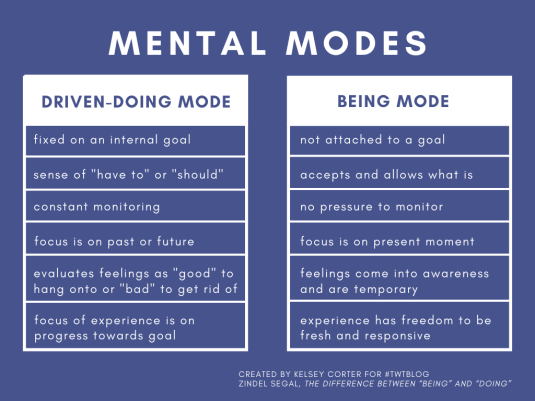
Years ago, I learned that one can be or do and life is a balance between each.  Being involves spiritual activities that make us better people.  It is meditating.  It is going on a retreat.  It is praying.  It is reading a good book.  Doing is moving.  Doing is animated.  Doing is hitting a pickle ball back and forth over a net.  Nothing is wrong with doing but something is wrong with a life that is filled only with doing.  I have met too many people that spend time doing but spend no time being.

“Hi, Paul, would you like to get together for a coffee next week?” “Gee, John, I would love to, but I am really busy next week.”  “Well, than how about the week after that?”  “Sorry, but my great aunt and her son are coming over that week and I need to get the house cleaned.  Tell you what I will check my calendar and get back to you.  Not sure but I think I have an opening next year.”

cyan-minimalist-t-chart-3

There is a mania in this country with going nowhere fast and doing something all the time.  I rush to get somewhere so I can get busy staying busy.  The business of America is more about staying busy than doing anything really useful.  The country band Alabama penned a song many years ago which went as follows:

I’m in a hurry to get things done

Ohh I rush and rush until life’s no fun

All I really gotta do is live and die

Even I’m in a hurry and don’t know why?

Don’t know why?  I have to drive so fast

My car has nothing to prove

It’s not new

But it’ll do zero to sixty in five point two

Ohh, I hear a voice

That says I’m running behind

I better pick up my pace

It’s a race and there ain’t

No room for someone in second place

 I wonder what life would be like in America if more people meditated and less people were in a hurry.  What if people spent more time praying than watching TV?  I would give you better than ten to one odds that if more people prayed and/or meditated that we would have less crime, less war, and less violence.  Society and the world would be more peaceful if people spent more time meditating.  We would have more time for friends.  More time for settling differences peacefully.

The average USA citizen spends the following amount of time in each of these activities each day: — Bureau of Labor Statistics, 2022

Sleeping                      9.02 hours

Eating:                         1.23 hours

Shopping:                   .66 hours

TV:                               2.79 hours

Religious/Spiritual      .13 hours

Volunteering:             .10 hours

Educational:               .44 hours

Working:                     3.23 hours

You can see from the above chart that the average USA citizen spends approximately 8 minutes per day in religious or spiritual activities.  I wonder whether this statistic would find any greater amount of time spent by the religious right in America doing prayers or meditating than for the average person.  The time spent per person is just about enough time to say a blessing at supper time.  To repeat what I said above “What if people spent more time meditating and praying and less time rushing to get somewhere?”  Would we have a better country?  I believe we would.  We would probably have:

  • Less road rage
  • Less drug use
  • Less alcoholism
  • Less traffic accidents
  • Less wars
  • Less violence

On the positive side, just imagine how relaxed people would be.  If people were more relaxed, there would be nicer people walking around.  Imagine the following scenarios:

Ariana:  “You just took the parking spot I was going to drive into.”

Alex:  “Oh, I am very sorry.  I did not see you waiting there.  Just give me a second and I will pull out and park elsewhere.”

Ariana:  “No, that’s ok, I can find another spot.  There is plenty of spaces in the parking lot.”


President Biden:  “Look, President Putin.  I am sorry for all the names I called you in the past.  I have so much on my plate and too much to do.  Sometimes, my age gets in the way.”

President Putin:  “I did not want a war with Ukraine, but you kept bad mouthing us and surrounding our country with more and more NATO members.  We just want to survive like you do.”

President Biden:  “I think it is time for peace talks now.  We can back off and leave Ukraine alone if you can promise to pull troops out and restore Ukraine to its former territories.” 

President Putin:  “Lets start the peace talks now and see what agreements we can come to.”

Well, you can call me Pollyanna and laugh if you want but if Putin and Biden could sit down and meditate together and then pray together for peace, I seriously think the world would be a different place.  Maybe we could even get Netanyahu to pray and meditate some.


Once Upon a Time, I thought I knew Everything.

searching_for_truth_preview00

The older I get, the less I know.  Isn’t it supposed to work the other way around?  A friend of mine, Jerry, gave me this quote from Bertrand Russell the other day “The trouble with the world is that the stupid are cocksure and the intelligent are full of doubt.”  The Greek philosopher Socrates was once proclaimed to the wisest man in the world. The day before he died, Socrates declared that he knew nothing.  On that same day, the Oracle at Delphi was asked “Who is the wisest man in the world?”  She replied “Socrates is the wisest man in the world.”  This was reported back to Socrates who said “When I was young, I knew everything but now I know nothing.”  The Oracle, who was never wrong, was asked “How can Socrates be the wisest man in the world when he knows nothing?” She replied “Only the wisest man in the world would know that he knows nothing and have the courage and humility to admit it.”

Facts

We go to school to learn many facts and figures.  We study history to learn the story of humanity, we study physics to learn the theory of the cosmos, we study biology to learn how animals grow and develop and we study science so we will know how the world really works.  We learn more and more and are coerced into theories and opinions and positions.  We become more and more certain that we are wiser and smarter.

The more degrees that are conferred on us, the smarter we are supposed to be.  If we are really smart, we begin to feel that all of these facts and data bits are not really helping us to understand the world.  The older most of us get and the more learned most of us become, the more we suspect that there are no truths to the world.  We begin to see that there are always truths behind the truths that we think we have found.  Our profundities become curiosities as we age until at some point they wither away and become obsolete.  How many theories have you seen that were proven wrong?  How many times have you had to eat humble pie because something you were absolutely positively sure about was proven conclusively wrong?

horrible face

I remember seeing a picture in the paper the other day of a man accused of sexually molesting a young girl.  He was accused of pedophilia and charged with a felony offense.  I took one look at the visage staring out of the paper at me and promptly proclaimed “If there were ever a guy who was a pedophile, he sure is.”  A few weeks later, a more complete investigation proved him completely innocent of all offenses and the young girl admitted that she made the story up for some unknown reason.  I was beyond having egg on my face.  You would think that at my age, I would have learned to avoid a rush to judgment.  I can make no excuses for my blatant stupidity.

Every few months, the media finds some new tragedy or murder case to focus on.  A few years ago it was the Trayvon Martin case.  It seemed that every day we were confronted with some new facts that supported a change in who the media wanted us to think was guilty.  Trayvon initiated the encounter.  Zimmerman initiated the encounter.  Trayvon provoked Zimmerman.  Zimmerman provoked Trayvon.  Trayvon was a good kid.  Zimmerman was a good guy loved by all of his friends.  Trayvon was a racist.  Zimmerman was a racist.

quotes-by-martin-luther-king-jr6-min

Tapes, witnesses, photo enlargements, medical information, acoustic information, video tapes, the entire gamut was presented daily with one expert after another telling us what they think.   This same scenario plays itself out over and over again in the media.  The “crime of the century” has been replaced by the “crime of the week.”

Right Way

Each day regardless of what news we read or what cable show we watch, it appears we know more and more about less and less.  What are we doing here folks?  Are they looking for truth or are they selling papers?  Are we voyeurs to some weird witch hunt?  Are we taking sides so we can become right?  If so, we will truly have become a Roman Circus instead of a civilized society of laws and courts and presumptions of innocence until proven guilty.

If we can somehow get pass this media circus that pretends to convey the truth,  there are lessons that we need to learn.  If you remember the famous story Rashomon, you may realize that truth is often a matter of perspective and not hard cold facts.

Time for Questions: 

What can you help do to overcome the types of bias and prejudice that the media often promotes?  How can you avoid your own “rush to judgment?”  What does it mean to “judge not others, less you be judged yourself.”  How often do we see the mote in others eyes but ignore the pole in our own?

Life is just beginning.

“We live in a culture where everyone’s opinion, view, and assessment of situations and people spill across social media, a lot of it anonymously, much of it shaped by mindless meanness and ignorance.”  — Mike Barnicle