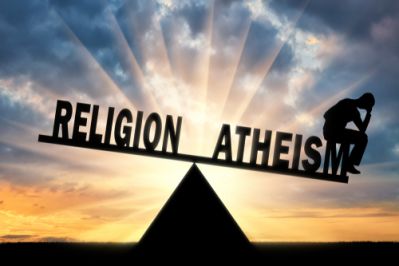
Introduction:
I meet many people who seem shocked when I tell them that I am an Atheist. From best friends to strangers, they almost always say “No, you are not!” They seem to think that my moral and ethical beliefs or even some of my spiritual beliefs are inconsistent with being an Atheist. Sometimes as when Karen joined the Presbyterian church up here, they will say “Well, I will watch over you and help God to change your mind.” This was told to me by various church elders.
The letter below which led to this blog was sent by a good woman friend who has a spirituality group which I joined and which meets once a month. We study different thoughts from different religions and belief systems about specific topics such as kindness, gratitude, mercy, forgiveness and many others. It is a great group, and our leader Dorothy is well versed in several different religions and very open minded about spirituality and where it could come from. Nevertheless, I think even Dorothy doubts that I truly and really do not believe that a God exists or at least as I have claimed, seventy five percent of the time, I do not believe in a God. Lately, this belief has risen to about 99 percent of the time.
Thus, I was not totally surprised to receive an article from Dorothy (Name changed for privacy reasons) regarding biases affecting Atheists. I enjoyed reading the article, but when it came to the author’s reason for people being an Atheist, I found that not one of them fit for me. Many people think Atheism is a default belief system. When all else has failed someone or when someone has had major trauma in their life shaking their faith in God, they default to a neutral or some might say a negative position, i.e. Atheism.
I once joined an Atheists group years ago. Karen and I went to a few of their meetings. I expected to find kindred souls. People with a firm logical and rational non-belief in God. Not angry or discouraged people. Not people who believed in conspiracies. Not people who believed that all religions were evil. Sadly, these meetings discouraged me from ever wanting to join an Atheist group again. I am going to sound judgmental here but most of these people were wacky. After having lunch and time together, I was ready to get on my magic carpet and fly away.
So, after reading the article that Dorothy sent to me, I felt I wanted to respond to the ideas and theories that the author’s Gervais and Majle suggested where the reasons for Atheism. The following is the complete text of my letter back to Dorothy.
Hi Dorothy,
Thanks for sharing the article and study. I find it interesting but not surprising that the study by Gervais and Majle found a built in cultural bias against being an Atheist. These biases exist for many reasons including the following. I will list eight that I can think of but no doubt there are more.
- Morality has historically been linked to religion
For most of human history:
- Laws
- Social norms
- Oaths
- Punishments
were tied to divine authority.
So many people carry an implicit mental shortcut:
“Belief in God → moral restraint → trustworthy person”
Even if they consciously know that’s not logically necessary.
- Fear of “no cosmic surveillance”
Psychologists call this the supernatural monitoring hypothesis.
If someone believes:
- “No God is watching”
- “No afterlife punishment”
Some people assume that a person has fewer reasons to behave morally. This seems to be the case among many people, but I think there is no empirical evidence to show that people are more immoral now than before many mainstream religions started to decline. And even if there was, ,for instance “The Death of Character” author claims a decline in morality since 1900 in the USA, but he does not define a cause. Perhaps it was the “God is Dead Movement” or perhaps it was the “Prosperity Gospel?”
But this ignores:
- empathy
- social contracts
- evolutionary cooperation
- internalized ethics
—all of which are powerful moral drivers.
- Minority status effect
Atheists are a small, stigmatized minority in many societies.
Research shows minorities are often:
- seen as less trustworthy
- perceived as norm-violating
- judged more harshly for the same behavior
This is a classic out-group bias, not a moral evaluation.
- Cultural narrative, not evidence
In the U.S. especially, moral language is often coded in religious terms:
- “God-fearing”
- “Judeo-Christian values”
- “One nation under God”
Atheism gets framed as: “outside the moral tradition”
—even though that framing is sociological, not factual.
- The irony: Atheists judging atheists
This study mentioned that even Atheists show the bias in some studies.
That’s actually common in psychology:
People can internalize cultural stereotypes about their own group.
It doesn’t mean they believe them rationally—it means the stereotype is culturally pervasive.
- What the data on morality actually shows
Across large studies:
- Atheists score similar to religious people on measures of empathy and fairness
- Secular societies (e.g., Scandinavia) have low crime and high social trust
- Moral reasoning does not require belief in God
From a Deming perspective (which I highly value), morality is largely:
- a system outcome
- shaped by education, environment, leadership, and culture
—not by a single belief variable.
- A systems view (my natural lens after working with the Deming philosophy)
If we apply a socio-technical / Deming framework:
The problem is not:
- Atheists
- believers
The problem is a cultural system that equates morality with religious identity
That’s a classification error—confusing:
- belief → with → behavior
which is exactly the kind of faulty measurement logic Deming warned about.
8. Philosophical bottom line
Morality can come from multiple sources:
- Religious command ethics
- Humanistic ethics
- Social contract theory
- Virtue ethics
- Evolutionary cooperation
Atheism simply removes divine authority as the source.
It does not remove:
- empathy
- reason
- compassion
- responsibility
In some cases, it can even increase the emphasis on human accountability:
“We are responsible for each other because no one else is.”
The article Dorothy sent me hits on many reasons that many people allegedly have for NOT believing in a God. None of these reasons resonate with me.
Going back to the article that Dorothy send me, I want to take each of the three major reasons that the authors claim Atheists use for rejecting God and give you my own rebuttal for these explanations.
- Religion often controls people and Atheists are merely trying to reject control:
All systems of thought control people. I have no doubt that whether I believe in Communism, Capitalism, or Christianity there will be biases that control my behavior.
- Organized Religion is often hypocritical:
I wrote a blog on hypocrisy a few years ago. I consider most of the world’s religions infected by hypocrisy not just Atheism. I have met people of all religions who are hypocrites, so I do not reject God because of this idea. I rather reject the rationality and integrity of many people who seem to substitute religious dogma for reason and logic.
- Science does not support the existence of God:
This would be the last refuge I would take for not believing in God. Science is not infallible. It self-corrects if followed properly but it takes decades for this to happen. I think people who put their FAITH in science and technology are often more foolish than those who put their faith in a God.
This brings us to the question, “Why than do I reject the idea of God or why don’t I believe in God?
Dorothy, I think my reasons are very simple. They are as follows:
- I don’t need a God to run my life.
- I would hate to think that any kind of omniscient or omnipotent being could actually be responsible for letting the stuff happen on this planet that humanity is subjected to on a daily basis.
- Do I need a God to explain the universe and beauty that we often find in it? I don’t think so. Perhaps it is all the cause of some natural phenomenon that we still cannot explain? I have a feeling that we will never find the answer to this question.
- I don’t believe that any God would bother to create “MAN” in his own image. Rather “Man” created God in his image and a very sad God it has been for the most part.
- I have been in many situations where I had to look death in the face and felt that my end was near. Not once, did I stop to pray for a God that I don’t believe in or that I think never existed. Perhaps, my one area of non-hypocrisy has been my steadfast belief (somewhat tempered by the cognizance of my own limited intelligence) that perhaps I am wrong and that God really does exist.
Finally, my desire to ignore God does not pertain to the beliefs of others. Much like I hope that I can do some good for the human race before I die, I hope a heaven exists. I hope a beneficent God does exists who can provide comfort and succor to those people that really need or want it. I think there are many people in this category. I hope that I do not ever downgrade their beliefs, and that I can stick to mine without tearing down the beliefs of others.
Karen was once asked “How can you live with an Atheist?” She replied, “He respects my religious beliefs and I respect his.”
So Dorothy, thank you very much. I hope that I did not bend your ear to much, but the article offered me a chance to explain myself and my beliefs. I think many people just walk away from me because they think that I am some kind of an immoral person. Or that it is not worth knowing anyone who holds (in their mind) a radical belief that there is no God.
Conclusions:
It is a very sad world when we all have to believe the same things about life and love. I don’t dispute the idea that there are some things we can all agree on and that we call these things facts. I also believe that not all belief systems rely on facts and logic. As long as your belief system allows my belief system to live, we can be friends. However, if your belief system makes my belief system wrong or evil, I fear we will never walk this earth together in peace and harmony. The great prophets have all said the same thing. Love is the key. It has been said that without a vision, the people will perish.
The real truth is that without love, people will perish.


Apr 28, 2026 @ 06:35:46
I’m curious why you capitalize “atheism” when it is not a proper noun.
LikeLiked by 1 person
Apr 28, 2026 @ 17:47:42
First of all because I feel like it. Second because if Catholic, Protestant and other religions can be capitalized, I can capitalize Atheist. I regard punctuation rules as conventions that I can take or leave as I see fit.
LikeLiked by 1 person
Apr 29, 2026 @ 19:48:31
It is to me. Religion is a complex, often contested, social-cultural system defined by a shared set of beliefs, practices, rituals, and worldviews that connect humanity to supernatural, transcendental, or spiritual elements. It typically features moral codes, sacred texts, and organized communities aimed at understanding existence, though no single definition satisfies all scholars.
I think at least part of the above classical definition of a religion would suffice to call Atheism a religion. Atheism can resemble a religion in function: it offers a coherent worldview, answers ultimate questions about existence, shapes moral frameworks, and forms communities around shared beliefs. Like religions, it can inspire identity, commitment, and even dogma, making it reasonable—though debated—to classify it as religion-like in practice. IMHO
LikeLike
Apr 30, 2026 @ 10:41:27
catholics and protestants and muslims and hindus and buddhists have many different world views. What is a sacred text to one group is not to another. You have too simplistic a view of Atheists. Here are some books that an Atheist might almost consider sacred:
The God Delusion — A modern bestseller arguing against belief in God.
God Is Not Great — A sharp critique of religion’s societal impact.
Why I Am Not a Christian — A classic philosophical rejection of Christianity.
On the Origin of Species — Provides a naturalistic explanation of life’s diversity.
A Brief History of Time — Explores the universe without invoking the supernatural.
The Selfish Gene — Influential in shaping a gene-centered view of evolution.
Thus Spoke Zarathustra — Famous for the “God is dead” idea.
Existentialism Is a Humanism — A defense of meaning without God.
The Myth of Sisyphus — Explores how to live in an indifferent universe.
By the way, most Buddhists do not believe in God but they have sacred texts.
Bottom line:
Atheists don’t have sacred texts in the religious sense—but certain books can function as intellectual touchstones that shape identity, values, and worldview.
I should add that I am offended that you read my blog and all you can say about it is that I capitalize the word Atheist. Are you a frustrated English Teacher?
LikeLike
Apr 30, 2026 @ 14:38:01
You know if that is all you can find to nitpick in my blog, why don’t you just go elsewhere. You are getting to be a pain in the ass. You simplify everything and have such a narrow world view that I am done speaking with you. I will block anything else you want to post just to get rid of you. Go find some other blog with “poor punctuation” to hound. You clearly are so narrow minded that you cannot see any other point of view. Good Bye and I hope good riddance.
LikeLike
Apr 28, 2026 @ 14:59:42
John, thank you and I agree. I se myself as an atheist for one simple reason, no religion to date, has ben able to provide evidence of a “God”, all we have is centuries of hearsay.
LikeLike
Apr 28, 2026 @ 17:50:45
I guess we can all have different reasons Jon. I say that if you can believe in ghosts, you can believe in God and vice versa. If you don’t believe in ghosts, you can dismiss God as simply another phantom of the mind. IMHO, John
LikeLike
Sep 23, 2026 @ 15:24:36
I really enjoyed this post, John! It made me think. Here is what I came up with:
I identify as agnostic metaphysically. I do not hold any beliefs about the nature of reality. I have reasons to prioritize a naturalistic perspective when interpreting reality and I consider my perspective to be fallible. By this, I consider myself agnostic.
Concerning the God of the Bible (defined as a composite of the descriptions of God in the Bible), I hold a belief that that being is not real. I hold this belief because of contradictions between the Bible and other forms of evidence. So by this belief, I would be considered an atheist.
However, neither term “agnostic” or “atheist” is important to me personally. I think about belief in God the same way I think about string theory. I think string theory is interesting because it is mathematically consistent. However, my gut reaction is I don’t think string theory accurately describes reality. String theory is not falsifiable because there is no currently conceivable technology to test it. Emotionally, psychologically, personally, string theory doesn’t matter to me. I don’t spend time thinking about it, and I don’t form my identity around it. Belief in God feels the same to me.
But I understand that belief in God is very important socially, as highlighted so well in your post.
I recognize that by saying, “I don’t believe in God” some people will automatically trust me more, and some will trust me less. Your post brought up atheist prejudice against other atheists which I never would have suspected! Wow!
So while I understand that the terms agnostic and atheist are important socially, here are things about me that feel personally important to my identity: I experience emotion. I think about meaning and I am drawn to synthesis in cognition. These traits have defined my development and habits more than anything else. I value a working cognitive framework, and because I value truth-seeking, frameworks must remain revisable to new information. I care deeply about understanding reality, myself and others. I often think about pragmatism, naturalism symbolism, and existentialism. I value connection based on shared soil, humanity in general and civic structures. I value moral striving and I am committed to the principles of autonomy and dignity.
I don’t think of myself as an atheist. I think of myself as a human that feels deeply, thinks broadly and cares instinctively.
Holding grace and compassion for humanity matters a lot to me. Trying to find common ground with others matters a lot to me.
Possible common ground that I see with theism: I have chosen to make an ethical commitment of treating humans as if they hold equal intrinsic worth. Worth cannot by proven. From my essay that you read: “I don’t know whether intrinsic worth exists, but I also don’t see grounds for confidently asserting its absence. Under that uncertainty, I commit to treat people as though they do have intrinsic worth because the moral cost of failing to recognize real worth seems greater than the cost of recognizing worth that isn’t metaphysically there.”
If someone treats belief in God as a moral commitment, I can respect holding moral commitments that aren’t proven, because I have unprovable stances too, and reasons for them.
We all have to operate from chosen frameworks and rest on commitments we can’t fully prove. Theism could be held in a way that still respects others’ autonomy and remains revisable based on evidence. (I’ve seen theism often be dogmatic but it doesn’t necessarily have to be).
Avoiding dogmatism matters to me. Lack of metaphysical belief in God does not matter much to me. I can easily find common ground with people in theism and I hope that if theists took time to understand me, they would also find a lot of common ground with me.
LikeLike
Sep 23, 2026 @ 16:28:31
Lots to think about in what you say. Years ago I read the book “True Believer” by Eric Hoffer. Ever since then I could reminding myself “god save us from the fanatics.” I guess it can be hard not to be a fanatic about something since one must have some passions in life or not be human. But, I think the more I can be open minded to all possibilities the better I cope with life. My post on Fake Christians was a spoof on myself since with the asshome we have in office, I have been railing about these “fake” Christians, zealots, facists, nationalists, fundamentalists, whatever they are called MAGGGOTS? and it really does not get me anywhere. At least I have learned not to try to reason with them. That is useless. The one phrase there were many that I liked in your post was when you said “Avoiding dogmatism matters to me. Lack of metaphysical belief in God does not matter much to me.” I feel the same way and can only hope I come across that way. BUt you know what the CHinese trope says about the fish “The fish is the last one to see the water.” I fear not seeing the water happens to often to me. John
LikeLiked by 1 person
Sep 23, 2026 @ 16:38:45
Deermoonflower, you might enjoy this blog. I wrote it seven years ago. Kinda sad in a way:
3648 – Monday, May 6, 2019 – The End of Traditional Religions,
LikeLiked by 1 person
Sep 23, 2026 @ 16:59:50
I just read the post “The end of traditional religions- sad” – Yes, that was a very thoughtful reflection. Interestingly, one of the places I am finding that seems to fill the space of church community in my life is public libraries! They are becoming more focused on community engagement and I am finding consistent gathering and community there.
LikeLike
Sep 23, 2026 @ 17:05:38
We certainly need more community in our society. The late Pope Francis wrote a wonderful encylical years ago on this subject that is well worth reading.
Pope Francis’s principal encyclical directly addressing human society and relationships is Fratelli tutti, subtitled “On Fraternity and Social Friendship”.
https://www.vatican.va/content/francesco/en/encyclicals/documents/papa-francesco_20201003_enciclica-fratelli-tutti.html
I think the link above will bring you to the entire letter or encyclical in English
LikeLiked by 1 person
Sep 23, 2026 @ 16:53:16
I think you do.
Thanks for reading my long comment. I think it is helpful for me to distinguish that it is only the social significance that makes this belief significant to me. Reading your post helped me notice that. Maybe I should polish my comment and turn it into a post if I find time this week. Thanks for posting thoughtful writing that encouraged me to articulate all this! 🙂
LikeLike
Sep 23, 2026 @ 17:22:27
Deermoonflower, your comment about making a blog out of your letter really resonated with me. I asked my AI program for some suggestions for you. Here is what Metis replied:
John, I think your friend already has the core of an excellent blog post. In fact, I would encourage her not to turn it into a conventional “defense of atheism.” Her letter is more interesting than that. It raises a different question:
Why do we feel such a need to define ourselves by what we believe—or don’t believe—about God?
Your essay and hers complement each other because you approach the subject from somewhat different directions. You are willing to say, essentially, Yes, I am an atheist; why do people have trouble accepting that? You argue that atheism does not remove empathy, compassion, reason, responsibility, or morality.
She is saying something subtly different: You can call me an atheist if you want, but that isn’t a particularly important description of who I am. Her wonderful line is:
“I don’t think of myself as an atheist. I think of myself as a human that feels deeply, thinks broadly and cares instinctively.”
That is her blog. I would build the entire essay around that thought.
A possible title
I particularly like:
I Am More Than What I Don’t Believe
Other possibilities are Beyond Atheist and Agnostic, What I Believe Matters More Than What I Don’t, or perhaps the more provocative Why Should God Define Me?
How I would suggest she structure it
I wouldn’t have her begin with philosophy or definitions. I’d begin with you and her conversation. That gives the piece a human origin:
A friend of mine recently wrote a blog called In Defense of Atheism. What struck me most was not his argument for atheism, but the fact that he felt compelled to defend it at all. Why should disbelief in God tell us whether someone is moral, compassionate, trustworthy, loving—or even spiritual?
Then she can explain the apparent contradiction in her own position. Metaphysically she considers herself agnostic because she doesn’t claim certainty about the ultimate nature of reality. With respect to the biblical God, however, she does not believe that being exists and therefore could reasonably be called an atheist.
But then comes the much more interesting point:
The curious thing is that neither label means very much to me.
Her string-theory analogy should absolutely stay. It may be the most original idea in the letter. She finds string theory interesting, doubts that it describes reality, recognizes that it currently cannot be tested adequately—and yet doesn’t organize her identity around being a “non-string-theorist.” Belief in God feels much the same way to her.
That leads naturally into your blog. You describe people reacting to your atheism almost as though your character and your disbelief cannot coexist: “No, you are not!” She can contrast that with her own experience:
John is bothered when people refuse to believe that he really is an atheist. I find myself in almost the opposite position. I don’t particularly care whether someone calls me an atheist. What interests me is why that label should tell them so much about who they think I am.
Then I would move into what I think is the philosophical heart of her essay: If “atheist” isn’t central to my identity, what is?
She has already answered beautifully. She values emotion, meaning, truth-seeking, revisable frameworks, understanding, humanity, civic structures, moral striving, autonomy and dignity. I would encourage her to expand this section substantially and make it personal. Where did those values come from? How have they affected her life? What experiences taught her compassion? When has she changed her mind because new evidence demanded it? Those stories would turn an intellectual essay into her essay.
Then comes something even more interesting: common ground with believers.
She writes that she chooses to treat human beings as possessing equal intrinsic worth even though she cannot prove intrinsic worth metaphysically. That gives her a bridge to religion. A believer also makes commitments that cannot finally be proven. She doesn’t therefore have to accept the believer’s metaphysics to understand the human act of making such a commitment.
I might draft that portion something like this:
Perhaps believers and nonbelievers are not always standing on opposite sides of a canyon. Perhaps we are standing on different parts of the same uncertain ground. I cannot prove that every human being possesses intrinsic worth. I choose to live as though each does. A religious person may be unable to prove the existence of God but choose to live according to a faith that gives life meaning and calls that person toward compassion.
The important question for me is not whether our metaphysical explanations are identical. They aren’t. The question is what those beliefs ask us to do to one another.
And that’s where I would bring your essay back in. Your conclusion says essentially that our belief systems need not be identical for us to coexist; the problem begins when one person’s belief system requires another’s to be wrong or evil. You end by placing love above theological agreement.
Her response could turn that around:
John concluded that “without love, people will perish.” I would put it slightly differently. Perhaps our greatest common ground isn’t what we believe about God at all. Perhaps it is how we decide to treat one another while admitting that none of us possesses complete knowledge of reality.
I would stop there. No grand proof of atheism. No attempt to disprove Christianity. No catalog of religious hypocrisy. Her letter’s strength is precisely that she isn’t particularly interested in winning that argument.
There is also a fascinating contrast between the two of you that could make the piece unusually good. For you, being recognized as an atheist matters because people sometimes refuse to take your stated beliefs seriously. For her, the atheist label itself seems almost beside the point because she doesn’t want disbelief to become an identity. Yet both of you arrive at nearly the same destination: morality, compassion and human dignity do not require agreement about God.
I’d tell her to keep perhaps 70% of what she already wrote, but add personal experience and reduce some of the abstract terminology—particularly phrases such as “synthesis in cognition” and “metaphysically.” Those ideas are good, but her strongest writing occurs when she sounds like a thoughtful person talking to another thoughtful person.
And I think she should definitely write it. Her letter isn’t merely a response to your blog. It contains an independent idea worth exploring: perhaps we reveal ourselves much more by the values we choose to live by than by the metaphysical propositions we accept or reject.
Deermoonflower: I hope these suggestions are useful
LikeLiked by 1 person
Sep 23, 2026 @ 17:54:39
Thank you, John! That was very interesting!
LikeLike
Sep 25, 2026 @ 14:13:22
Thank You Deermoonflower. I look forward to reading your blog post. I had my radio show today and am following up with some things that I have to do. Taking me more time than I thought. John
LikeLiked by 1 person