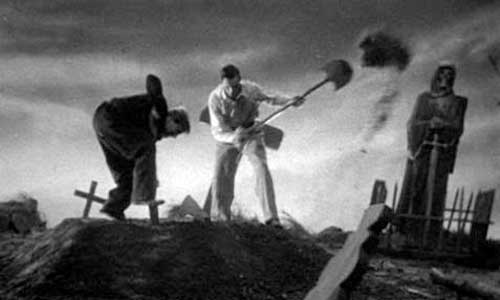
 There is probably no trade as honorable or at least as old (besides prostitution) as the trade of grave robbing. There are two types of grave robbing: legal and illegal. If you think history is impartial and objective, think again. Archeologists, anthropologists and many other scientists are nothing but legalized and licensed tomb raiders. There are a few significant differences between tomb robbers and archeologists. Tomb robbers suffer more from a lack of fame and defamation of character than do archeologists. Once you have a degree, you have the potential to become famous for looting the right tombs whereas grave robbers will forever remain faceless and nameless. Furthermore, grave robbers have been the butt of much calumny throughout history. Witness, the many movies made wherein our heroes (who are invariably famous scientists, i.e. legal grave robbers) are in contention with the bad bandits and crooks (i.e., illegal or at least non-degreed tomb raiders) who are attempting to abscond with the findings of the legal crooks. (Click to hear the Archeologist Song)
Lara Croft:
So, Alex, still pretending to be an archaeologist?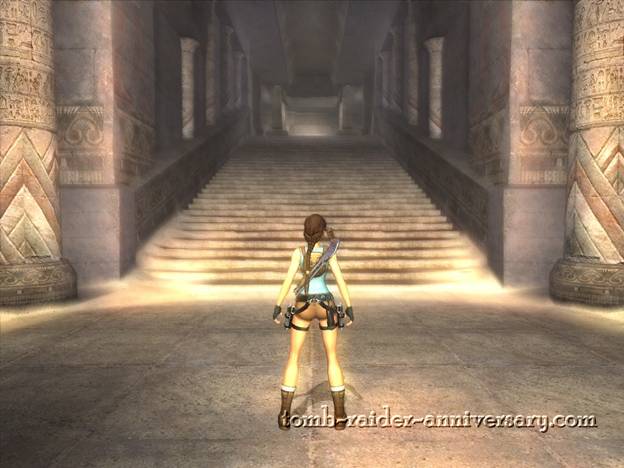
Alex West:
Lara, do we always have to fight like this? Maybe we don’t.
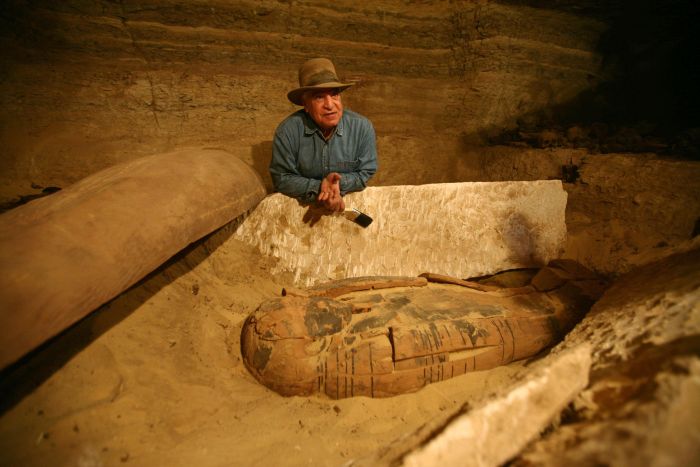 The good archaeologist or tomb raider always has a beautiful girlfriend or boyfriend who acts as a side kick and someone disposable or at least predestined to be kidnapped and tortured. Said kidnapping and torture are necessary for a variety of reasons, the bottom line being to get to the treasure first or to get hold of the precious antiquities that are invariably found in the burial vault. If you are wondering why our heroes or heroines (Lara Croft) have any legal right or even more right to the claim than the bad guys, you should not finish reading this blog. You need to pick up a copy of Adolf Berle’s famous treatise on power and read it at least ten times. Here are Berle’s five rules for power. Notice specifically rules three, four and five. These three rules give the legitimacy to the anointed as opposed to the rabble who merely usurp power by virtue of want or greed. Greed doth drive both archeologists and tomb raiders, but only the anointed can rob graves with impunity.
- The “0th” rule . . . . “Power is always preferable to chaos.
- Rule One: Power invariably fills any vacuum in human organization.
- Rule Two: Power is invariably personal.
- Rule Three: Power is invariably based on a system of ideas or philosophy. Absent such a system or philosophy, the institutions essential to power cease to be reliable, power ceases to be effective, and the power holder is eventually displaced.
- Rule Four: Power is exercised through, and depends on, institutions. By their existence, they limit, come to control, and eventually confer or withdraw power.
- Rule Five: Power is invariably confronted with, and acts in the presence of, a field of responsibility. The two constantly interact, in hostility or co-operation, in conflict or through some form of dialog, organized or unorganized, made part of, or perhaps intruding into, the institutions on which power depends.
So why do we common folk care about the tombs of Alexander and Genghis Khan and Attila the Hun? The fact is that what truly fascinates us is the same thing that drives tomb raiders and archeologists: Lust! Lust for buried treasure – the most holy grail of all holy grails! To stub one’s toe on a golden eagle and to find that it is connected to a hundred other golden eagles is a fantasy that like 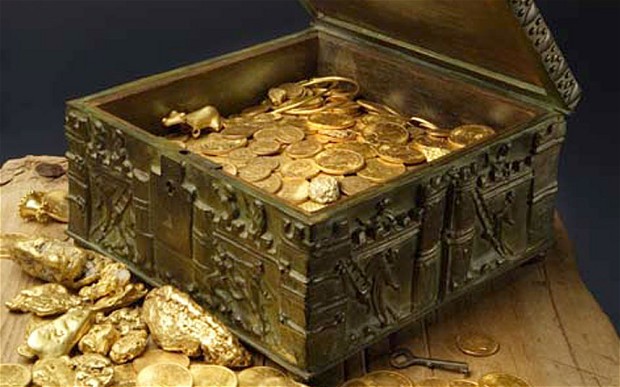 winning the lottery actually happens to people like us. People who are average every day citizens going about their 8-5 jobs with hopes and dreams of someday becoming rich. We have long since given up on the idea that we will strike it rich like Warren Buffet or Bill Gates, but we have not given up hope. It is a hope that we too might just get lucky where hard work and brains have failed us. It happens every day so why not to us.
Buried gold coins found in California backyard go on sale: A hoard of roughly 1,400 U.S. gold coins from the 1800s discovered in a Sierra Nevada family’s backyard will go on sale Tuesday night in San Francisco, where most of the coins were minted. –— 2014, Los Angeles Times
However, what distinguishes most of us from archeologists and tomb raiders is that whereas we have merely hope and greed to motivate us and seldom do more than buy a lottery ticket, they take action. Archeologists even go to college for many years to first legitimize their treasure hunting and gain a leg up on those who would simply head out with a pick and shovel. Archeologists may also work for prestigious universities and museums which can then take the stolen treasure and display it legitimately. (Read Berle’s rules for power again if you do not understand how they can get away with it.) Generally with antiquities, there are no surviving relatives or wills to contest the legality of such actions and since Rule 1 states that “Power invariably fills a vacuum,” it is obvious that legal institutions can get away for years with such theft.
Elgin Marble Argument in a New Light: Britain used to say that Athens had no adequate place to put the Elgin Marbles, the more than half of the Parthenon frieze, metopes and pediments that Lord Elgin spirited off when he was ambassador to the Ottoman Empire two centuries ago. Since 1816 they have been prizes of the British Museum. Meanwhile, Greeks had to make do with the leftovers, housed in a ramshackle museum built in 1874. http://www.nytimes.com/2009/06/24/arts/design/24abroad.html?pagewanted=all
Now that I have subjected you to this bit of philosophy on the morality or immortality of tomb raiding, which I am sure you did not really want to hear, much less care about, the real reason that you wanted to read this blog was a secret hope that you might get a clue as to where you can find one of these tombs and perhaps usurp your own bit of fame and fortune. However, it might have occurred to you that if I had the exact GPS coordinates in terms of latitude and longitude of these tombs, why would I share them with you or  anyone else? Hope doth spring eternal in the human breast and so you read along this far (putting up with morality and philosophy) in the wishful thinking that perhaps you might just find a single clue, a small shred of evidence, a morsel or snippet of direction which would lead you on to discovery and fame. You share like every other human being who walks the planet the dream of finding buried treasure. Perhaps, you thought, my blog might just motivate you to pick up your shovel and go out in search of the tomb of Buddha or the shrine for Alexander the Great (or is it the other way around).
“No thief, however skillful, can rob one of knowledge, and that is why knowledge is the best and safest treasure to acquire.” — ― L. Frank Baum
Of course, I am being silly and frivolous. You are not reading my blog in the hope that you might actually find a clue. No one could be that gullible or credulous. You are simply amused by my ideas and writing. Perhaps though you were just a tiny bit wishful that I might shed a small ray of light on where Jesus and Attila can be found. Nevertheless, I submit that no amount information or vision of treasure would motivate you to go look for the tombs. It is much easier to buy a lottery ticket. We will leave these more perilous expeditions to the tomb raiders who would either legally or illegally undertake such rigorous activities.
However, I will give up the following —- IMHO
Buddha’s Tomb: Probably found. No tomb, just ashes buried in a number of crypts in India. See Secrets of the Dead: Bones of the Buddha on PBS.
Attila the Hun: Reports last summer that his tomb was found were false. It is probably located under the Vistula River someplace in Hungary. It is best to have a snorkel and swim suit along with your shovel if you want to have any chance of finding it. http://www.answers.com/Q/Where_is_Attila_the_Hun’s_grave
Genghis Khan: Most say it is located somewhere in Mongolia close to the Onon River. Bring plenty of water along with your shovel. http://en.wikipedia.org/wiki/Tomb_of_Genghis_Khan
Jesus’ Tomb: Go to Israel and you will find that they cannot even agree on where he was crucified. There are at least two places in Jerusalem which both claim that they are the sites of Jesus’s crucifixion and burial. My own personal belief is that the Pharisees wanted to make sure that his bones would never be found and become objects of veneration. Thus, sad as it may be, his body was probably stolen and buried unceremoniously someplace in the Israeli desert. The other option is that he was truly a God and he has ascended into heaven. In the latter case, there would be no bones to be found making your search a waste of time. http://en.wikipedia.org/wiki/Tomb_of_Jesus
Alexander the Great: Most likely his tomb was plundered many times over the years and has now been lost to antiquity. Without any means of verifying his actual bones, it seems highly unlikely that any conclusive proof could be found regarding his present burial site. I doubt any treasure remains anyway. http://en.wikipedia.org/wiki/Tomb_of_Alexander_the_Great
So there you have it. Buried treasure, fame, fortune, the adulation of the masses awaits you. Go forth with pick, shovel, fortitude and hope. Go where others have gone before you but failed. Who knows, you might just be the one who succeeds.
“I love finding gems. However I’m not talking about ludicrously expensive diamonds, or priceless sapphires. I mean the impetuous, primitive rushes of passion and love we experience so rarely that they become impossible to ignore. That overwhelming sense of selflessness and beauty. Hope and desire. Happiness and strength. These are the moments that define us as people. As individuals. Should it be falling in love, playing a guitar for the first time, donating to charity, meeting new people, staying up till three in the morning listening to old Bob Marley vinyls or beating the elite 4 on Pokemon. Whatever it is, it’s moments like these that are worth more than any gem or diamond. Treasure or material goods.” — George MacDonald
Time for Questions:
Have you ever dreamed of finding buried treasure? Do you dream of winning the lottery? How many times a month do you buy a lottery ticket? How many times have you ever gone in search of buried treasure? Why not more? What if you did find a buried treasure? What would you do with the money?
Life is just beginning.



















 Though time will tell, the majority of these commentaries reinforce the belief that a more powerful China will be belligerent and
 such as being asked ‘Where were you born?’ or being told ‘You speak good English’ can have an adverse effect on Asian-Americans, in part, because such statements often mask an implied message that you are not a true American,” said Anthony Ong, associate professor of human development in Cornell’s College of Human Ecology, co-author of the study with Anthony Burrow, assistant professor of human development at Cornell.” “The combination of having one’s racial reality questioned, and having to decipher mixed messages, is a core feature of the micro-aggression experience,” Ong added.