What is Wrong with the Democratic Party Is Even Worse Now Than It Was Seven Years Ago!

night mare

I wrote this blog seven years ago on Jan 21, 2018.  Not much has really changed with the Democrats except that Trump was re-elected.  I was an independent then and I remain an independent now.  My biggest attitude change is that I see MOST Democrats as clueless and an impediment to the changes many of us want in America.  I am not talking about the devasting and disastrous policies of our present so-called leader.  I am talking about a set of policies that will build on the true American Dream for a Democratic nation founded on a separation of church and state and equally concerned for the minorities in the country as well as the majorities.  A country where no one will tolerate constant wars with other countries much less a war between the haves and the have nots in our own nation.

Recently such people as Robert Reich, James Hightower, Bernie Sanders and many others even in the Democratic Party have echoed the sentiments which I noted seven years ago.  I called it a party of cowards with no vision for the future and totally beholden to corporate money.  I am not talking about the Republican party.  My only defense for voting for Hillary, Biden and Harris is that I saw them as the “lesser” of two evils.  It is a sorry state of affairs when millions of Americans either see no reason to vote or must choose between the lesser of two evils.

I have made very few changes in my original blog.  Where noted my changes will be in {  } and in bold lettering.  Lets start off then seven years ago:

January 21, 2018

It’s been a year now since the bad dream or worst nightmare in the history of this country burst upon us.  For many of us, we still cannot believe it happened.  Never in America has a man with so little character and absolutely no qualifications to be president been elected to this office.  In my lifetime, I have seen several presidents whom I did not think were good presidents.  Nixon and Ford come to mind.  I thought Clinton should have been impeached over the Lewinsky thing.  I thought Reagan’s Star Wars Initiative was the height of stupidity.  Neither of the wars started by either Bush did one thing to make America or the world safer.  But the new president takes stupidity, arrogance and downright evil to new heights.  Every day, Americans wake up to a Trump tweet declaring our hatred and belligerence to the rest of the world.  If there was ever a great depression, it is the feelings that many Americans now share about the fate of their country.  {This last statement may be the truest thing I have ever said}

I wanted to start a blog this week without going into another political diatribe or rant as some would call them.  I know we all get tired of the unremitting bad news from the papers, radios, TV, Internet and incessant analysts that surround us like flies on poop.  Bad news sells and in our 24/7 daily schedule of unceasing commercial bombardment, we now must hear bad news from any part of the world and not just our own local geography.   If a mother murders her babies in Angola, we will see it on the front page of our local news.  If a young woman is raped in France, we will be treated to a torrent of trending stories until they get tired of the story or catch the perpetrator.  News is now not only 24/7, it is global as well.

Shortly after Trump was elected, the analysts started to figure out why Hillary lost.  {Now they are trying to figure out why Harris lost}  I think I counted over 20 different rationales for Hillary losing.  Everyone had their theory.  The idea of multiple causality seems to have eluded many as each pundit hawked their own explanation.  I won’t bore you by subjecting you to the list.  In a complex answer, each of these theories would be weighted and we would find that some carried more weight then others.  Among the weightier was the issue of racism.  Nevertheless, no single cause contributed entirely to Hillary’s defeat.

One issue is still important today.  There is no longer any reason to worry about Hillary’s email server or about her seeming lack of warmth.  These problems are water under the bridge.  The problem though that is still substantial and that must be addressed concerns the problems within the Democratic Party itself.  {Even more true today than seven years ago.}  If the Democrats want to regain their former influence with Americans, they must do more than fight Trumpism.  They must also stand for something.  The Democrats may be looking better today {This is a real big maybe.}  but that is only because the Republicans and Trump look so bad.  The Democrats were once seen as the party of the working class and the champions of the underprivileged.  They clearly lost this mantle in the years leading up to the Trump debacle.  The Democrat Party has three big challenges:

  1. Moral cowardice
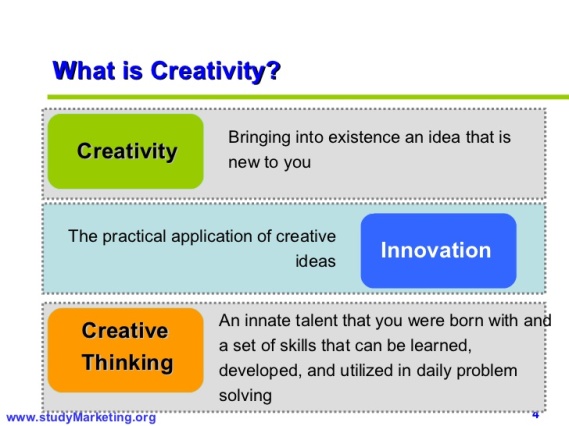
  2. New ideas and creativity
  3. Championing all classes as well as the working class
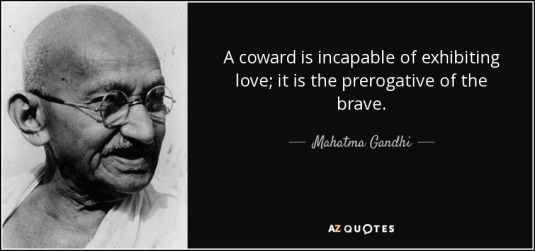
quote-a-coward-is-incapable-of-exhibiting-love-it-is-the-prerogative-of-the-brave-mahatma-gandhi-10-58-44

Moral Cowardice:

John F. Kennedy wrote a book called Profiles in Courage.   It was about senators who defied the opinions of their party and constituents to do what they felt was right and suffered severe criticism and losses in popularity.  One of the famous stories in Profiles in Courage concerned Senator Sam Houston.  He was pulled from a train by an angry mob of constituents and threatened to be hanged because of his vote.  He steadfastly faced the mob and explained why he voted the way he did and why he would do so again.  Stories like this are rare and while that makes them inspirational, it also makes them sad.

We have a US Senate with 100 members and a US House with over 400 members.  On any given day, most of these men and women are more concerned with their poll numbers than what is good for the America people.  Partisanship has become the norm in Congress with both sides mutely aping their leadership’s call to “back their party.”

I remember well the drum beat to the first Iraq War called Desert Storm in 1990.  A year before the invasion, I could hear the calls going out for an Iraqi Invasion.  I looked for some logic for this war but could not find it.  I waited for my political leaders to counter Bush’s need for an invasion.  Almost everyone in Congress sat mutely by while Bush and his cohorts planned the invasion.  Gradually, they found more and more reasons to invade Iraq.  Gradually, the religious leaders jumped on board to support the administration.  Billy Graham declared it a justified war and held hands with George H. W. Bush while he pretended to agonize over his already foregone decision.  And still I waited and wondered why so few Democratic leaders challenged this war.  Where were the Democrats?

The Second Gulf War was not a repeat of the First Gulf War.  It was an even worse unmitigated disaster.  Trillions of dollars spent, and nothing accomplished except to make some private war contractors rich.  Where were the Democrats?  They seemed to be out looking with the Republicans for the so-called Weapons of Mass Destruction that Saddam had supposedly stockpiled.

I had a button many years ago that said on one side “Democrats: The Party of Wimps” and on the other side “Republicans: The Party of Greed.”  I do not know who printed this button but thirty years ago, the writing on the wall was clear.  The Democratic Doves feared the Republican Hawks.  Better to be labeled a Hawk than a Dove.  The term liberal was once a term of pride but under the Democrats it became associated with wasteful spending and half-baked solutions to social problems.  Bleeding heart liberal has now become a term despised by all.
creative-and-innovative-thinking-skills-4-728

New Ideas and Creativity:

I live in two counties.  Both are predominantly Red Republican strongholds today.  However, my county in Wisconsin was once a Democratic stronghold.  Wisconsin was once a great bastion of Democratic ideas.  It was a state that was proud to have produced such champions of the underdog as Fighting Bob La Follette, William Proxmire and Senator Gaylord Nelson.  If anyone had ever told me that Wisconsin would have gone Red, I would have said they were crazy.

Now many of my “old” friends and many of my acquaintances in Wisconsin (A state I have lived in on and off for nearly twenty years now) are old line Democrats.  I confess I would rather have Democrats for friends than Republicans these days.  We share many of the same values even though I have never and will never be a card-carrying member of the Democratic Party or any other party.  I take pride in voting as an independent and not someone mindlessly following some party.

I have been each year for the past seven years to the local county Democratic Fundraisers.  Each year, I have listened to Democratic speakers who are jostling for political positions with hopes of defeating the Republican incumbents.  In some cases, more recently they have succeeded.   I can only hope this trend will continue but I am dubious.  My skepticism comes from looking at the people I see running.  Generally, they are well intentioned.  Some might even have the moral courage I want to see in leadership.  However, too many of the candidates that I have seen are either stuck in ideas from the past or lack new ideas that would bring some creativity and innovation to the Democratic Party.

Our political system not only needs new people, we need new ideas.  The same old ideas that worked in the past will not work in the future.  We need forward looking people that can challenge the existing system by promoting innovative ideas that do more than just support the status quo.  Our education system, our health care system, our prison system, our military system, our legal system, our infrastructure system and even our electoral system are all in need of more than reform.  They all need a complete restructuring.  These were systems designed for the 19th and 20th Century.  We need systems for the 21st and 22nd Century.  It is folly to think that simple reforms or piece meal patches to these systems will fix the blight and decay endemic in them.

I see too few of the emerging Democratic leaders as having a vision beyond fighting Trumpism.  That is clearly a start, but we need more than just reaction to Trump we need pro-action in our politics.  We need positive ideas.  We need new ideas.  Good intentions are not enough.

{On Tuesday of this week (August 11,2025) I had a meeting with one of the local officials of the Pinal County Democratic Party.  I wanted to show her how AI could be used in the upcoming mid-term elections to help sharpen focus and elect more progressive candidates.  I was still hoping that since she was a newbie to the leadership, she might be open to some new ideas.  Less than five minute into my synopsis of how AI (See the end of this blog for AI political information) could be used; she stopped me and said “Sorry, but I think AI is unethical.”  I jumped back in and admitted that it did use huge amounts of energy but I retorted “True, it absorbs a great deal of electricity but if we do not elect some forward thinking candidates we won’t have any energy to worry about.”}  

{“The Republicans with their denial of climate change and Trump with his dismantling of the EPA and clean energy will have destroyed the world as we know it.”  She was unfazed and replied that “She had her ethics and that was all there was to it.”  End of story.  I parted company with her and realized that it was futile talking to her.  I give you this brief story which is 100 percent true as just one illustration of what is wrong with the Democratic Party.  A party that seems stuck in the past and wondering why they are losing races and no one wants to be associated with them.}

20140201_USD001_1

Championing All Classes as well as the Working Class:

Once upon a time, the Democratic Party was known as the champions of the working class.  They stood up for unions, higher wages, income parity and equal opportunity.  The working class was once the class of high school graduates.  Today, more than one-third of the adult population in the United States has a bachelor’s degree or higher.  The average earnings in 2016 for those ages 25 and older whose highest educational attainment was high school were $35,615.  The average earnings for those with a bachelor’s degree were $65,482 compared with $92,525 for those with an advanced degree (Census.Gov).  The composition of the American workforce has undergone a long evolution from the agricultural era though the industrial revolution to the new information era.  Definition of working class has continued to change as social structure has changed in the age of computers and the Internet.

As educational levels continued to increase, aspirations by Americans continued to increase.  Whereas once perhaps most Americans saw belonging to a union and retiring with a pension after 30 plus years to be the epitome of working life, that vision became obsolete.  The typical worker today sees themselves as a college educated salaried worker whose interests are more aligned with their company then with any union.

My father worked for the Post Office for over 30 years before retiring.  He never thought it was a fun job or an interesting job.  For my father, it was a job that paid the bills, had good benefits and would enable him to retire with a good pension.  My father’s aspirations and attitudes towards work were like most of his generation.  The idea of being passionate about your work would have been a joke to my father and his peers.  Times have changed dramatically.  Workers today want to believe in their work and their companies.  Workers want their jobs to be challenging, rewarding and fun.  The old days of waiting to enjoy life until you retire are dead.

The workers in America are different than they were twenty or thirty years ago.  The Democrats forfeited their allegiance to the American worker and allowed the Republicans to become the champions of the American worker.  From coal miners to computer programmers, from trailer parks to gated communities across America, once proud Democrats have become Republicans.  The sad part of the story is that the Democrats did not seem to raise a finger to stop the migration.  They did little or nothing to prevent it from happening.  They allowed the Republicans to become the standard bearer of wealth and prosperity.

Unfortunately, few workers realized that their Republican champions were more about privileges for the elite than sharing the wealth.  Or that gains for the upper class would come at the expense of other classes in this country.  The concept of Trickle Down is alive and well in the Republican Party.

Conclusions: 

Democrats need to build a new party.  Trumpism is a short-term aberration.  {I don’t believe that this is true anymore.  Trump might be short-term, but Trumpism should be a synonym for the Republican Party.}  Euphoria might be high right now for Democrats who see Trump as the best thing to ever happen for Democratic candidates.  With one of the lowest popularity ratings of any president in history, Trump will help insure a wave of Democratic Party victories.  However, it can be nothing but short-sighted folly to mistake the present disgust for Trump with a disgust for Republican principles in general.  The Republican Party became strong because they offered the American people a vision of society which promised a better life for millions of them.  Unless Democrats can come up with a compelling vision of society that addresses a wide spectrum of workers, the Republicans will regain power once their debacle with Trump is over.  {Actually they regained power despite ther 2020 debacle with Biden.  One could easily lay the blame for this on Biden and the Democratic Power Structure.}

“However [political parties] may now and then answer popular ends, they are likely in the course of time and things, to become potent engines, by which cunning, ambitious, and unprincipled men will be enabled to subvert the power of the people and to usurp for themselves the reins of government, destroying afterwards the very engines which have lifted them to unjust dominion.”  — GEORGE WASHINGTON, Farewell Address, September 19, 1796

“If a political party does not have its foundation in the determination to advance a cause that is right and that is moral, then it is not a political party; it is merely a conspiracy to seize power.” — DWIGHT D. EISENHOWER, speech, March 6, 1956

AI for Democracy: Smart Tools to Strengthen Progressive Wins in Pinal County

Goal

Leverage Artificial Intelligence to:

  • Counter authoritarian messaging
  • Engage and mobilize voters
  • Support fact-based, progressive policies
  1. Data-Driven Voter Outreach
  • Predictive Targeting – Use AI models to identify persuadable voters and low-turnout supporters for focused engagement.
  • Issue Mapping – Match voters with the issues they care about most (e.g., healthcare, climate, reproductive rights).
  • Turnout Propensity Scores – Prioritize outreach to those most likely to vote if contacted.
  1. Rapid Response to Misinformation
  • Real-Time Monitoring – AI scans local social media and forums for emerging false narratives.
  • Fast Rebuttal Drafting – Automated content library to push out fact-checks in plain language.
  • Local Storytelling – Quickly create sharable, people-first content showing the impact of progressive policies.
  1. Volunteer Empowerment
  • AI Chatbots – Handle volunteer signups, FAQs, and event reminders.
  • Route Optimization – Maximize canvassing efficiency with AI-generated walking/driving maps.
  • Virtual Training – Simulated voter interactions for canvassers to practice persuasive conversations.
  1. Personalized Communications
  • Smart Messaging – AI crafts personalized emails/texts based on voter interests.
  • Multilingual Outreach – Translate campaign materials into Spanish and other key languages (with human review).
  • Micro-Videos – Short, tailored clips for TikTok, Instagram, and Facebook audiences.
  1. Building Trust in Democracy
  • AI Listening Tools – Analyze community discussions to guide messaging and policy focus.
  • Civic Media Creation – Produce short podcasts, radio spots, and graphics with clear, local facts.
  • Moderated Virtual Town Halls – Keep online conversations civil, focused, and inclusive.

Ethics & Safeguards

  • Transparency about AI use
  • Protect voter data privacy
  • Avoid deepfakes or manipulative falsehoods
  • Focus on truth, empathy, and community building

Bottom Line:
AI is not about replacing human judgment — it’s about amplifying our ability to connect with voters, protect truth, and build a stronger, more inclusive democracy in Pinal County.

To Be Bold or Not to Be Bold? – Part 1

With the passage of trump’s “Big Beautiful Bill” it would appear that the Democrats have been handed a major defeat.  A defeat that will go down in history as something that they have earned by their timidity and wimpy responses to the growing menace of fascism in America.  Had they been bolder over the years, they could have cut this menace off at the proverbial knees.  But while the Republican Party became the Party of Greed, the Democratic Party became the Party of Wimps.  What value would Boldness have had for the Democrats?  In Part 1 of my blog, I want to relate what ChatGPT says about the value of Boldness.  In Part 2, I am going to lay out some of my own strategies for what Boldness might entail as we must still confront the goals of trump to destroy democracy in America.  Make no mistake, trump and his supporters have no more affinity for Democracy than Brutus had for Caesar.

I started ChatGPT off with the question:  Is it true that “Fortune Favors the Bold” or that “Success is the Child of Audacity?”  These are two aphorisms that have been around for ages.

ChatGPT:

Great question — both “Fortune favors the bold” (from Latin Fortes fortuna adiuvat) and “Success is the child of audacity” reflect a deep truth about human psychology, society, and even evolution.

Here’s why these ideas seem to hold up in life:

  1. Bold Actions Break Stagnation

Most people are cautious by nature. Those who take bold steps — start businesses, lead movements, speak up, try something unconventional — stand out. And standing out is often a prerequisite for success in a crowded world.

Boldness disrupts inertia. It pushes things into motion that otherwise never would have moved.

  1. Risk Is Tied to Reward

Success usually carries risk: social, financial, emotional, or reputational. Those who are bold enough to accept those risks have access to greater potential rewards. Many never try, so those who do are ahead simply by taking the shot.

  1. Confidence Is Attractive and Contagious

Bold people inspire confidence — in investors, partners, followers, or even random bystanders. Audacity, when not reckless, signals that someone believes deeply in their cause, and others often want to follow or support that.

  1. Failure Is a Learning Loop

The bold fail more — but also learn more. They get feedback the timid never receive. Over time, this trial-and-error process builds resilience, insight, and eventually success.

“The timid die a thousand deaths, the bold only once.”

  1. History Favors the Story of the Bold

Think of who history remembers: explorers, revolutionaries, inventors, artists — often people who defied norms and dared big things. Their boldness makes a compelling narrative. Even when the odds were against them, their courage became legend.

  1. Boldness Taps Into Serendipity

Bold moves often place people in the path of opportunity. Taking initiative creates collisions with luck — new people, ideas, or events that can’t be predicted or planned.

In Short:

Boldness is the gateway to uncommon results.
Not because it’s always right — but because it’s often the only way to reach what’s rare and meaningful.

ChatGPT

Would you like examples from history, psychology, or even nature to see how this principle plays out?

YES

Great — let’s walk through examples from history, psychology, and nature that show how boldness and audacity lead to success, or at least open the door to it in ways caution rarely does:

🏛️ History: The Bold Are Remembered

  1. Alexander the Great
  • At age 20, he became king. Instead of consolidating power cautiously, he launched a bold campaign and conquered most of the known world.
  • His military strategies were risky — but successful — and his name still echoes 2,000 years later.
  1. Rosa Parks
  • Her refusal to give up a bus seat wasn’t the first act of civil disobedience — but it was bold, direct, and visible.
  • That audacity became the spark that lit the Montgomery Bus Boycott and the larger civil rights movement.
  1. Elon Musk
  • Whether one admires or criticizes him, Musk’s career is a case study in boldness: betting his PayPal fortune on rockets, electric cars, and AI.
  • Many experts predicted his failure. But his audacity forced entire industries to evolve.

🧠 Psychology: Why Boldness Works

  1. The “Approach Motivation” Advantage
  • Bold individuals are wired to approach opportunity rather than avoid risk. Psychologists call this “behavioral activation.”
  • This mindset triggers more action, more experimentation, and more eventual wins.
  1. The Halo Effect
  • People attribute competence and strength to those who act confidently and decisively — even if they’re not always right.
  • That perception can open doors that might otherwise remain closed.
  1. The Spotlight Effect
  • We often overestimate how much others notice our failures.
  • Bold people tend to care less about being judged, and this emotional freedom lets them act while others hesitate.

🌱 Nature: Evolution Favors the Daring

  1. Peacocks and Risky Traits
  • A peacock’s tail is wildly impractical. But it’s bold — and signals genetic strength to peahens.
  • Nature sometimes rewards the flashy and the fearless, even if it comes with risks.
  1. Predator-Prey Dynamics
  • In a pack of prey, the ones that break from the herd occasionally find a faster escape route.
  • While riskier, this behavior sometimes allows survival where conformity means death.
  1. Mutation and Evolution
  • Every major evolutionary breakthrough came from a “mistake” — a mutation that took a leap from the ordinary.
  • Boldness, in this sense, is biological experimentation — and essential to progress.

🧭 Summary

Realm Example Boldness Led To…
History Rosa Parks, Alexander, Musk Movements, empires, industries
Psychology Confidence bias, approach motivation Influence, momentum, resilience
Nature Peacocks, predators, mutations Survival, reproduction, evolution

As you can see from the above analysis, there is more than a little truth to the trope that “Fortune Favors the Bold.”  There is not much I can add to these thoughts except to wonder what it will take to instill the boldness in the actions that we will need as we move forward with trumps presumed tenure in office.  I say presumed because I believe he will do everything he can in the next three and ½ years to further gut the powers of Congress and the courts.  His ultimate goal will be to install himself as “President for Life.”  An American version of Stalin, Hitler and Mussolini.

Nothing Left to Mourn

What happens when everything you believe in is shattered?  To mourn something means to regret its loss or disappearance.  What happens if your ability to mourn is overwhelmed by the sheer magnitude of the destruction impacting those people or things or ideas that you love?  Does our ability to face life with a positive attitude disappear in the wind?  Are we less able to effect a happy demeanor as we face each new day?  How do we cope when the world around us seems to no longer support anything that we trust in?

I am probably selfish when I ask these questions.  I am still healthy, can pay my bills and have a wonderful spouse.  But after reading the news this morning about still another Supreme Court victory for trump, I felt an overwhelming sense of depression and futility extend over my life.  Karen noticed my attitude and asked if anything was wrong.  I said yes and told her what I had read.  What can I do about it?  How do I help stop a juggernaut that now seems to be tearing our world apart?  I thought it could not get any worse than Covid and Climate Change and now I am trying to cope with a country that I do not recognize.  We have elected a government that seems to support evil, vengeance and extreme injustice.

I know that there are many people who feel the same way that I do.  I try to coach and counsel them with bromides about resistance and the power of one person to make a difference.  But then I look at the futility of my own efforts.  I march.  I write.  I speak out.  Things keep getting worse.  When will the arc of justice bend back towards love and mercy and compassion?  I am old enough now to think that I will see my life ebb away before this country returns to anything that I once believed it stood for.  Every institution in the country seems corrupted by greed or power or some type of anti-human ideology.  We are the greatest.  We are exceptional.  We can do whatever we want to do because we have bigger and more bombs than anyone else.

Perhaps I am just venting here and will rise like the Phoenix tomorrow.  Born again with hope and optimism.  But what if I cannot?  What if there is nothing left to mourn?  What if all my ideals and hopes for a better world are now simply a chimera?  A phantom that only exists in fairy tales and stories told by naïve writers.  Does the world really march towards progress and less iniquity or have we all been sold a childish narrative.  A story of good and evil where the good always wins over the evil.

Lately I find myself watching many of the reruns of old cowboy stories from the fifties and sixties on YouTube.  I watch them because I can’t read or find any good news in books or the media.  In these old cowboy stories, the good guys always win.  My biggest bit of joy these days is watching a person on the side of justice overcome the evil doers who would thwart the rationale rules of law and order.  In the old cowboy stories, the rule of law is always supported by the end of the story.

I have never shunned history or ever idealized the past.  I am too familiar with the barbarism of all the older and ancient empires in history.  The cliche that “Power Corrupts and Absolute Power Corrupts Absolutely” is as true as any of the laws of Physics.  History is a chronology of the powerful taking the rights away from the less powerful.  There has never been and perhaps never will be a humanistic empire.  Every empire that has ever existed has been an entity that has attacked, destroyed, stolen and devoured what belonged to others less powerful.  OSHO thought that humans would always be destructive since war provided a release from the boredom of everyday life.

If you think that wars have become any less violent or barbaric you need to only review your history books.  Modern wars since 1900 have killed more people than most of the ancient wars by the Assyrians, Babylonians, Egyptians, Romans, Huns, or Mongols.  The Spanish, French, British, German and Russian empires were just as brutal as any of the ancient empires.  That leaves the American empire.  The land of the free and the home of the brave.  A country that was fought and died for by patriots.  Patriots that killed millions of indigenous people and tens of millions of Africans shipped over to work in the fields and help build this country on their whipped backs.

The Great Dying:  Some sources suggest that colonization led to the death of around 56 million people, or about 90% of the indigenous population in the Americas between 1492 and 1600, leading to a period termed the “Great Dying”.  Thousands more were killed during the expansion of the US empire and what have been called the “Indian Wars.”  — Wikipedia

The Slave Trade:  During the Transatlantic Slave Trade, approximately 1.8 million Africans are estimated to have died during the Middle Passage, the horrific journey across the Atlantic Ocean.  This represents about 10-15% of the estimated 12.5 million Africans forcibly transported across the Atlantic between 1500 and 1866.

However, it’s important to understand this is just the mortality on the ships. The total number of deaths associated with the slave trade is much higher, including those who died during:

  • The initial capture and forced march to the coast.
  • Confinement in coastal barracoons awaiting shipment.
  • The “seasoning” process upon arrival in the Americas, where they adjusted to a new climate, brutal work routines, and harsh living conditions.
  • Resistance, mutiny, suicide attempts, and forced starvation during the voyage.

For every 100 enslaved people who survived the Middle Passage, another 40 died in Africa or during the voyage itself.  The Equal Justice Initiative reports that nearly two million Africans died during the Middle Passage, nearly one million more than all Americans who have died in every war fought since 1775 combined.  —- Digital History

It is not easy assimilating the truths about the American empire.  An empire that was and is about as bloody as any empire in history.  That is why the “truthtellers” want to eliminate concepts like Critical Race Theory and Diversity, Equity and Inclusion Training.  It is shameful and embarrassing to have to face the truth about a nation billed as the Shining City on the Hill.  Most of us who grew up in this country with any knowledge of history knew many of the facts concerning the American myth of Truth, Justice and Equality.  However, we held onto the idealism that underpinned the founding of this country.

We believed that someday the checks that Martin Luther King said were marked “Insufficient Funds” would be redeemed for their declared value.  We believed that we would move to a society where equality of income and opportunity would become a reality for all citizens.  We believed in the words inscribed inside the Statue of Liberty that we would provide a haven for all people looking for a better life regardless of where they were from.  We believed that democracy would be exported to other countries rather than a rapacious greedy system of corporate capitalism.  We believed that people would want to imitate our country because they would see firsthand a country that practiced the ideals that all people in their hearts cherish.

We never thought that we would see a country where greed had replaced morality and personal virtue as guiding principles. 

“The Silence Weighs More”

“The Silence Weighs More”  by ChatGPT and J. Persico, mostly by Chat. 

You wake each day with a world on fire,
Yet choose the path of least desire—
To see, but not to raise a voice,
To name the wrong, then mute your choice.

But silence is not soft or kind,
It’s the heavy chain that grips the mind.
Each quiet hour, each averted gaze,
Is fuel to keep injustice ablaze.

The fear is real, that much is true,
But fear has never made hearts new.
Change is born in trembling hands,
In whispered truths and stammered stands.

Don’t wait to be the perfect light—
A flicker can ignite the night.
Your voice, though small, could be the spark
To guide a soul lost in the dark.

You say, “I’m just one,”—yes, and still,
One seed can split the hardest hill.
The world does not need flawless men,
It needs the brave to rise again.

So speak, even if your voice must shake.
Step forward, though the ground may quake.
The price of comfort is far too steep
When justice cries and you still sleep.

No, you don’t have to save the day—
But don’t just look the other way.
For every moment you pretend,
Another soul meets bitter end.

Rise not to be a hero crowned,
But simply one who stood their ground.
Let history say, when it recalls,
You saw the truth—and did not stall.

Mr. Wardell E. Stephens:  A Profile in Courage, Character and Integrity

Mr.  Wardell Stephens is a 95-year-old Navy veteran.  He was born in 1930 in St. Louis.  Wardell joined the Navy in 1947 at the age of seventeen.  He retired twenty years later in 1967 at the age of 37.  He had a long and distinguished career as a Navy diver conducting deep sea rescue operations.  He is a rare man, and it is my pleasure to provide a brief overview of his life.  I call it a Profile in Courage, Character and Integrity.  Reading this testimonial, I think you will agree that these terms aptly apply to Mr. Stephens.

I first met Mr. Stephens several years ago at one of the Eloy Veterans Day celebrations.  Mr.  Stephens was the guest of honor and a keynote speaker.  He was mild mannered and humble.  He briefly thanked the people for his being there and said a few words about how much the Navy mattered to him.  He was a Navy diver who had conducted several deep-sea rescue operations back when the equipment was much more primitive than it was today.  No bragging about his bravery or how dangerous the job was.  I was impressed with his humility.

Several years went by and one day shortly after they opened the new Eloy Veterans Center, (January 2025) Mr.  Stephens dropped by to visit.  Wardell was now 95 but had not seemed to age a day.  He still walked like a young man with none of the shuffling you often see with the aged.  He was ramrod straight and looked in better health than many people half his age.

We had a talk about some of his career exploits and again I was very impressed with his courage and humility.  I asked if I could interview him and he agreed.  That was more than two months ago.  Mr.  Wardell was sick for a while (as was I) with the damn bug that went around this spring.   We finally set a date for me to interview him.  Earlier he had left a packet of information about his Navy ships and projects for me to look at.  Some of the material that follows are taken from his Navy record and some will include my interview with Wardell on May 7th, 2025.  The interview lasted about 2 hours.  Many veterans are inclined to some exaggeration as the years have passed.  Wardell was just the opposite.  I had a hard time getting him to be anything more than modest about his adventures.

Here is what one of his commanders said about him in a Navy Review:

“Stephens is an extremely conscientious Petty Officer in that he invariably will take charge of an operation.  He goes out of his way to correct other divisional personnel who are performing work in an unseamanlike manner.  His timely suggestions and technical ability have contributed greatly to the ability of the diving division to perform submarine repair work in an expeditious manner.  He is always in a clean complete uniform and wears it in a shipshape fashion at all times.  Definite credit to his rate and to the Naval service.  Highly recommended for advancement in rate.  Stephens when in charge of an evolution uses excellent judgement and disposes his men for maximum effectiveness in accordance with their abilities thereby assuring a smooth operation.”  — J. H. Lindsay, CDR, USN

I had a chance to look at Mr. Stephen’s training record.  It was full of very difficult diving techniques including the following:

  • Deep sea diving school
  • Salvage diving school
  • Diving school instructor
  • Submarine rescue

A number of years ago I went to scuba training and received my PADI certification.  I then went on a trip to Belize to do several dives in the area of Ambergris Caye and Caye Caulker.  I was sixty years old at the time.  Some of my dives were fun but some were scary.  Swimming among large sharks.  Swimming through some narrow channels in dark conditions.  Having to think about time for compensation stops to avoid getting the bends.  Watching my air and depth gauges.  Trying to avoid scraping coral.  Trying to manage my buoyancy to stay with the other divers.  It was very challenging, and I was only recreational diving.  I never went below 150 feet and was never down for more than thirty minutes.

Wardell was diving in pitch black conditions.  Sometimes using helium instead of oxygen and going down to do rescue and salvage operations at depths of 350 feet.  Here is a Letter of Commendation describing one operation that Wardell completed:

On May 13, 1964, NEREUS completed the water-borne replacement of the propeller on the USS Scamp.  The old and new propellors weigh approximately 12 tons.  As far as is known the replacement had never been accomplished in the water.  As a member of the diving crew, you did the work assigned and thus contributed to the overall success enjoyed.  In each instance, the reliance placed on you by the Master Diver and diving officer was justified and your contribution was significant.”  — M. des Granges, Commanding Officer, USS NEREUS

The following video talks about what it is like to be a Navy Rescue and Salvage diver.

https://www.youtube.com/watch?v=AnihhBnzowg

I would like to describe one more operation that Wardell did from the Commendation letter that he received.  After this I will go to the interview that I did with Wardell.  I am glad that he sent me some of his service records because it was hard to get Wardell to “brag” about any of his Navy exploits.  I am trying to give you a sense of the danger and difficulty of what Mr. Stephens did for twenty years.  I don’t often think of all military people as heroes, but it is certainly an appropriate designation for Wardell.

“In the early evening of December 3, 1958, a Marine Corps helicopter flying under conditions of darkness and poor visibility crashed in the Potomac River near Jones Point, Alexandria, Virginia.  While  enroute to commence the salvage operation on the assigned helicopter, you were advised of a second aircraft crash.  This second crash was a Navy Beechcraft with a crew of two which crashed in the Potomac river off Haines Point.  Throughout the daylight hours of 4 December under adverse weather conditions, the officers and men of your entire organization worked expeditiously in the salvage of the downed Beechcraft.  On December 5th, you were also able to complete the salvage of the downed helicopter.” — Commandant, Potomac River Naval Command 

On my last Scuba Diving trip to Belize in April of 2024, the weather conditions were pretty bad.  A storm had come through the area and the water visibility was very poor.  The waves and current were quite rough.  I had a hard time reading my depth gauge and my air gauge and ended up getting separated from the other divers on our ship.  I came up to the surface and could not see the dive boat.  I had left my safety flag back with my pack.  I also had not bothered to take my snorkel.  My tank was almost out of air, and I had no way to alert anyone as to where I was.  When the oxygen ran out of my tank, I had to keep propelling myself above the waves to get a breath of air.  With the waves running high, I could do little except bob up and down and hope someone would find me.  About 90 minutes later, the boat finally found me.  I was picked up and spent the next two hours trying to barf up the seawater that I had swallowed.

I tell you the above story because Mr. Stephens had made many operations where he had to arrange a tow in weather ten times worse than I experienced.  To link a tow ship with a disabled vessel is not as easy as simply throwing a rope to someone on the other ship.  This short video might give you some idea of what courage it would take to engage in such an operation.

Rescue Salvage Towing operations on rough sea

https://www.youtube.com/watch?v=-JhLJoCYi-g

Here are my interview questions and Wardell’s replies.  On the day of the interview, we had not scheduled a definite time.  I had said that I would be at the Veterans Center between 10 AM and 2 PM and that he could stop by anytime he wished.  Shortly after 10 AM, my cell phone rang, and it was Wardell.  I expected that he was calling to say that he was not feeling well.  Not an unexpected event for a man 95 years old.  Instead, he had called to tell me that he might be a little late since he had a phone problem at his house and the repair person was coming out that morning.  I thanked him for his call and told him that any time he arrived it would be okay.  I can’t tell you how surprised I was at his call.  I cannot get repair people to give me a date and time that they will arrive much less call me if they are going to be late.  Wardell receives not one penny from this interview and yet he is courteous and diligent beyond what any norm is today.

John and Wardell Interview:

John:  Can you tell me a little about yourself when you were growing up.  Friends, school, culture, family, dreams?

Wardell:  I was raised by my mom and aunt.  I had no siblings.  I grew up in East Saint Louis in the Rush City Area.  We called it the bottoms.  I started working as a pin setter in a bowling alley when I was 14.  I drove a coal truck when I was 16.  My dream was to own my own truck and go into the coal business.  I never got a drivers license.  I joined the Navy when I turned 17

Wiki describes the Rush City area as follows: 

“Rush City is a historically African-American community within East St. Louis, Illinois, that is unique in the American Bottom region.  It’s characterized by a rural Southern influence, dispersed housing, and vernacular architecture, making it a distinct “country life” pocket within a struggling urban environment.  The community has faced challenges related to economic disinvestment, environmental pollution, and industrial encroachment.”

John:  Why did you pick the Navy?

Wardell:  Well, one day during the second World War, the Navy brought an LST to St. Louis.  I went down to see it and was very impressed.  Later when I decided to leave St. Louis, I enlisted in the Navy.

John:  What are you most proud of in terms of your military service?

Wardell:  The work I did as a rescue and salvage diver and my Sailmaker rate

John:  Can you tell me more about your work in the military?  Challenges etc.?

Wardell:  There was a lot of things to learn.  Setting up a tow.  Different type of rigging on different ships.  Working cables in rough weather.  Using hoists in rough weather.  It was easy to get hurt if you were not careful.

John:  What were your biggest difficulties in the military?

Wardell:  Only had a few minor negative experiences.  Most of my career was positive.

John:  What were the negative experiences?

Wardell:  Well Truman changed some of the policies for the better.  Before Truman there were some bases where they separated Blacks and Whites in the dining halls.

John:  How did the transition to civilian life go for you?

Wardell:  At first it was very chaotic.  In the military things are very orderly and predictable.

John:  Can you tell me a little about your family life?  Spouse, kids?

Wardell:  Well, I was married twice.  I have four children and ten grandchildren.

John:  Wardell, for a 95-year-old guy, you are in great shape.  How do you do it?

Wardell:  I lift weights three times a week.  I don’t smoke or drink.  I eat lots of protein.  Three times per week, I go for a walk.   I walk as much as I can.  I always park as far away from a store in the parking lot so I get more walking in.  I have a treadmill at home I walk on when the weather is too hot or bad.

John:  What advice would you give young people today?

Wardell:  I would tell them that you have to learn and study to get something good in life.  You have to study hard and pay attention in school.  I would tell them that they should learn another language.

John:  What were the highs and lows of your life Wardell?

Wardell:  The high was completing Navy diving school in 1954.  I also finally completed my GED since I never graduated high school.

John:  What would you do over if you could?

Wardell:  I would go for more school.  Continue education all your life.

John:  Am I leaving anything out you would like to share?

Wardell:  That’s about it.  Except I also had a stint in the Merchant Marine after I retired from the military.

John:  Thank you for taking the time to share some of your life and thoughts with us Wardell.  It has been a pleasure talking to you.

That’s it folks.  I hope you have enjoyed learning about a very remarkable human being.  In addition to a depth of character and integrity that is more than noteworthy, Mr. Stevens is  a kind man who said not one bad word about anyone during the entire interview or the time that I have known him.  His integrity and character stems from his taking the responsibility to live life according to what his mother and aunt taught him and what his religious beliefs have inspired in him.

PS:  I still see Wardell every few weeks when he comes down to the Veteran Center in Eloy.  Yesterday, he asked me to add a little something to the bio I did for him.  I was quite surprised to learn that Wardell is a Life Association Member of the Buffalo Soldiers.  He officially belongs to the “9th and 10th (Horse) Cavalry Association – Official Army Unit Association.”  For those of you who have never heard of the Buffalo Soldiers, I give you the following brief excerpt from Wikipedia.  For more information, click on the Wikipedia link or simply go to any Arizona Library.  There are many books written about the Buffalo Soldiers.

Buffalo Soldiers were United States Army regiments composed exclusively of Black American soldiers, formed during the 19th century to serve on the American frontier.

Legacy and Contributions
  • Courage and Discipline:
    The Buffalo Soldiers had the lowest desertion and court-martial rates in the army, demonstrating exceptional discipline and courage. 

    Westward Expansion:
    They played a crucial role in the expansion of the United States, though this placed them in the complex position of enforcing policies that displaced Indigenous populations. 

    Paving the Way for Civil Rights:
    Their exemplary service and perseverance in the face of discrimination helped to advance the cause of civil rights and military integration, which was fully realized in 1948. 


How One Determined Woman Made Lemonade When Life Handed Her a Bunch of Lemons

While surfing the Internet a few days ago, I came across the following story by Ms. Jackie Fishman.  I was very moved by her story.  It was certainly a story that deserved retelling.  Her story has so many uplifting themes it is hard to describe them all.  Themes of determination, themes of courage, themes of personal responsibility, themes of renewal, themes of hope and themes of resilience.  Her story also reflects some negative themes that I saw during my three years as an employment counselor.  Themes of age discrimination, themes of one-way loyalty and an overall callous labor market that uses and discards people as nothing more than commodities.

I wrote to Ms. Fishman and asked for permission to reprint her story.  The following is in Jackie’s words and has not been edited.  Again, I think it is a story of courage and bravery in the face of what for many would have been a devasting experience.  It is a great example of the old saying that “When life gives you lemons, make lemonade.”  I think this story fits in well with the title of my blog site which is “Aging Capriciously.”  Aging is a challenge that we may all face.  We may never win but we do not need to go gently into the night either.

________________________________________________________________________________

I was put on a performance-improvement plan, so I chose to retire at 58.  Sometimes I wish I wasn’t a young retiree.  —- Essay by Jackie Fishman, Apr 19, 2024

After working for nine years as a communications specialist for a healthcare association, I was put on a performance-improvement plan during my 10th annual job review.

“Has my performance changed so much from my last exemplary review?” I asked, knowing that my previous review had been conducted by a former boss who was no longer at the company.

As a result of the PIP, I was sent to human resources to fill out paperwork outlining how my boss would closely supervise my work.  I had three months to improve.

As a 58-year-old, I worried about what this would mean for my career, but it became an opportunity for me to retire early.

I walked away from the job I had held for nearly a decade

I signed all the paperwork with HR and went back to my boss. I wanted to ensure she understood what was happening and get additional guidance on avoiding termination.  I started to get nervous.

After an uncomfortable meeting with human resources the following day, I left the company voluntarily.  I didn’t want to stick around to see how this situation worked out because I already had enough information to know my days there were numbered.

Leaving my job with no plan was unsettling.  My normal approach would not be so rash; I prefer to have a plan and know my next steps.  I was especially worried about my financial situation.

I had several interviews, but I felt forced to retire

Shortly after I left my old job, I worked part-time for a vendor I had previously done business with.  I eventually started applying for full-time positions and going to interviews.  Many of these interviews went well but somehow never resulted in an offer.  I wondered if it was because I was close to retirement age.

I could’ve continued working for the vendor, but the money was not worth the effort or the long commute.  Meanwhile, my personal life was getting complicated.  My daughter wanted help planning her upcoming wedding, my mother needed more oversight as she approached 90, and I craved more freedom to travel.

So, I decided to retire — in my 50s.

Being a young retiree has its pros and cons

I’m younger than most retirees by almost a decade — which is a blessing and a curse.

I decided to keep freelance writing.  I also started writing a longer project about my father’s teenage experiences as a Holocaust survivor, so having more time was welcome.  In addition, I began volunteering as a docent at the Newseum, which brought me a lot of satisfaction.

Plus, being young enough to go on some adventurous journeys is a nice perk: I enjoyed going on safari and on bike trips to California’s wine country.  It was also nice to have extra time to help plan my daughter’s and son’s weddings and be involved in all the pre-wedding activities.  Having time to do what you want is a definite benefit of retiring young.

Sometimes, though, I wish I wasn’t.

I can’t help but feel I still have a few more years left of full-time work in me, so I sometimes regret retiring so young.  I was cut off early from building up Social Security for a few more years, so from a financial perspective, I feel like retiring early has been detrimental.

I’m also worried I will quickly lose my grip on technological advancements.  I kept up with those advances through work, but as a retiree, I’m worried I’ll fall behind.

Either way, I wonder if my age played a role in all of this

In the end, it all worked out, but I do wonder if my age is what caused all of this.

I won’t ever know for sure if I was put on a PIP because of my age, nor will I know if I struggled to find a new job for the same reason.  But I now stand by my decision to retire and start a new phase.  After all, I was given the opportunity to reinvent myself and try new things.

Retirement is a time of rediscovery and transformation, and exploiting that opportunity is the best way to win the game of life.

download

Ms. Fishman is a writer, story teller, & Emee, Jewish & child of Holocaust survivors: She can be reached on Twitter at @jackiefishman or for more of her great stories at https://jackiefishman.substack.com

Here is a link to Ms. Fishman’s Web Page Portfolio. Some very interesting things to see and learn about there.

https://mediabistro.com/freelance-connect/profiles/jackiefishman/

Can you forgive yourself and start another day?

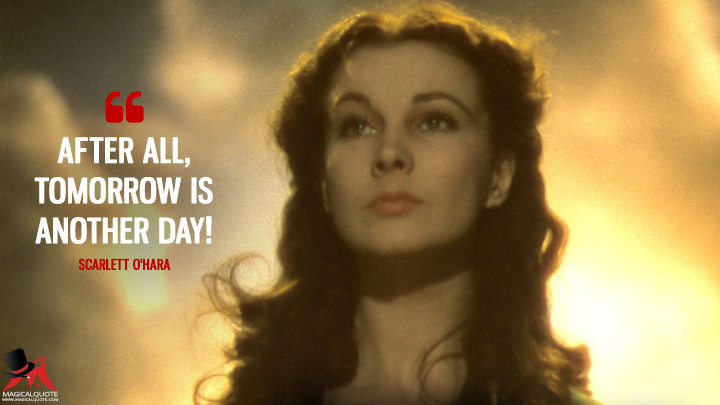
After-all-tomorrow-is-another-day

“Tomorrow’s another day” is the famous comment from Scarlet O’Hara in “Gone with the Wind.”  This was perhaps one of the most powerful and dramatic endings to any story ever told.  Most of us were touched by these words and few who have heard them will ever forget them.  Have you ever wondered why these words were so powerful?  Why do they touch us all somewhere deep in our soul?  I believe it is because they blend an element of self-forgiveness with recognition that each new day is the possibility of a new beginning.  Self-forgiveness is evident, because Scarlett is not going to spend a great deal of time in self-recriminations.  She is simply going to start over again.

Blog-pictures-2

The new day “tomorrow” represents for Scarlet is a new start to life.  It is her resurrection and her birth. Each day we can choose our life, our goals and our behavior.  The simple but powerful phase “tomorrow’s another day” allows us to be reborn.  It allows us to become free of the past and to start a new beginning. Each day of our lives offers us this possibility, if like Scarlet we are willing to grasp it.  We can have a new life or we can have an old life.  We can continue on the old path that we have chosen or we can find a new path.  Each new day can be a risk but life is a risk.  Without risk there is no change and no chance to live more fully.  We wake up each morning to a new set of choices.  Each choice offers opportunities and each opportunity has its own set of risks.

slide_1

How many of us do not realize the inherent possibility that tomorrow brings for us?  Do you see each tomorrow as a new beginning or as more of the same?  What will it take to help you realize the hidden possibilities in each new tomorrow?  Do you start each day with a sense of joy at the opportunities it presents?  Why not?

Who Speaks for Integrity?

download

When I wrote my series of blogs on the Seven Most Important Virtues, I neglected to add Integrity.  Limiting myself to seven, I felt that the seven I identified were more important than any other virtues.  This was simply a judgement call.  I have been challenged on it several times and indeed I challenge myself on the list.  There is hardly a day goes by that I wonder if I should not have numbered Integrity among the Seven.  Well, as they say, that is water under the dam.  What I would like to do in this blog is discuss Integrity.  What is Integrity?  Why is Integrity so important?  How do we get Integrity?  Finally, how do we sustain Integrity?

What is Integrity?

download (1)Integrity is everything to lose and nothing to gain, except your self-respect.  Integrity is standing up for what you believe is right even when everyone is against you.  Integrity is the ability to put compassion and kindness ahead of self-interest.  Integrity cannot co-exist with greed.  It cannot co-exist with lust.  It cannot co-exist with a thirst for power.  It cannot co-exist with a drive for money, fame, or fortune.  All of these elements are like Kryptonite to Integrity.  Kryptonite was the one thing that could rob Superman of his powers.  Lust, greed, money, fame, and power all have the ability to rob one of his/her integrity.

One example of a man without integrity was Goethe’s Faust.  Faust was considered the smartest man alive.  He was a genius and a consummate intellectual.  There was little that he did not know about or could not speak intelligently about.  Yet, Faust was unhappy.  Old age had creeped up on him.  His desire for youth and sex overcame his ability to think with the maturity befitting his status.  He sold his soul to Satan and in the bargain sold his integrity.  His lack of integrity lead to the death of another human being and to his own banishment to hell.

82d6d633-d7ce-4e27-959e-37dab25c0c24__1_

There are many examples of men and women with integrity.  I think of the whistleblowers who sacrifice their careers and sometime their lives to report issues that might be dangerous to others.  I think of the journalists in countries like Mexico who risk their lives every day to report injustices.  I think of the prosecutors and law enforcement officers in countries where criminals have the ability to enact retribution and death when they are charged with a crime.  In all these examples, there is nothing for these courageous people to gain and everything to lose by their standing up for what they believe is right.  This is integrity.

Why is Integrity Important?

I believe that it is fair to say that never before in the history of America has there been so little integrity shown by our political leaders.  Right, Left, Democrat, Republican, Independent, it does not matter.  There are too many political leaders who are driven by greed and a desire for power.  You may argue with this analysis but when I see even a third of our elected officials calling for term limits, I will recant my assertion.  When I see a third of our elected officials with a plan to eliminate paid lobbyists, I will recant my assertion.

Political_Integrity_-_iStock.com-Bobboz_resizedPolitics is a sham in America today.  We have men and women who are elected for life and spend more time campaigning then they do in serving their constituents.  Public servants who start collecting money to run their next campaigns within days of winning their present office.  We have a system of government where money is the most important factor in who gets elected and who gets reelected.  Our politicians are more worried about losing votes than they are in the constitution or in protecting our democracy.  What Integrity is there in supporting a riot to overthrow a fair election that every court and every state in America found was fairly conducted?  The media seized on the outrageousness of the Big Lie to sell news.  The losing party seized on the credibility of millions of gullible supporters to buy the Big Lie and try to maintain their power.

imagesThe media in America has become another hallowed institution gutted by greed and a desire for more and more money.  Reporters, writers, and journalists in America today are more interested in selling advertising than they are in balanced objective reporting.  You can divide the news up by whether they lean Right or Left, Liberal or Conservative, Democrat or Republican.  Each side has a mirror image on the other side of the political spectrum.  CNN is opposed by Fox News.  The New York Times is opposed by The New York Post and the Washington Post is opposed by the Washington Times.  One side supports the Right and the other side supports the left.  This is not balanced reporting, and no truth comes out of the dynamic between the two sides.  What both sides have in common are reporters who will report the most useless, tasteless, uninformative stories if they perceive that these stories will sell advertising or if they can figure out a clickbait title that will attract readers and thereby expose them to paid commercials.

I see few solutions to the problems I have noted above except to start holding our leaders and media to standards of Integrity that do not seem to exist.  This brings us to the issue of where Integrity comes from.

How Do We Get Integrity?

I do not believe humans are born with Integrity.  I do not think that there is a gene or DNA for Integrity.  Humans learn Integrity like they learn to speak.  The morals, ethics and traditions of any society become part of the fabric of learning that a child goes through.  Integrity is a virtue.  It may be valued more in some families and cultures more than others.  There is an Index of Public Integrity that measures five factors that the developers link to Integrity and is used to assess a countries capacity to control corruption and ensure that public resources are spent honestly.   The six scales used in this index include:

  1. Judicial Independence
  2. Administrative Burden
  3. Trade Openness
  4. Budget-Transparencies
  5. E-Citizenship
  6. Freedom of the Press

Idownload (3)f you want more of a description of each scale you can follow the hyperlink above.  The USA ties for 10th place with Great Britain on this index.  I can see some correlation with Integrity, but I can see many differences.  I think honesty is one component of Integrity, but Integrity is more complex than being simply honest.  An honest person can still lack integrity if they are unwilling to stand up for what they believe.  Cowardice and Integrity are incompatible.

Professor Stephen L. Carter of Yale Law School points out in his book “Integrity,” one cannot have integrity without being honest, but one can be honest and yet lack integrity. … Integrity in its bare-bones essence means adherence to principles.

You cannot buy Integrity.  You cannot inherit Integrity.  Fortunately, Integrity does not have a price tag.  It is open to everyone.  Young people, old people, women, men, and people from different ethnic backgrounds all can find Integrity.  I use the work “Find” because you must seek Integrity.  It is a treasure, and you must look for it.  You can acquire Integrity, but you can also lose Integrity.  However, you cannot give it away and no one can steal it from you.  It is one of the most unique treasures in the world.  So, where do we find this treasure?  There are three rules for finding Integrity.

  1. It must be something you value personally
  2. You must value it more than your life, your career or anything else that you might ever possess.
  3. You must not expect applause or accolades. It is more likely you will be criticized and condemned. 

If you can accept these three rules, then finding Integrity is easy.  Simply establish a set of morals, virtues, and ethics that you believe in and start standing up for them.  When they are challenged, you must speak out.  Your actions and behaviors must reflect our values.  Do not preach one thing and do another.  Do what you say you will do.  When you feel like taking the easy way out, you must take the road that leads to consistency with your actions and values.  The simple formula to remember is that:

Integrity = Morals + Behavior + Consistency

How do We Sustain Integrity?

Integrity can be lost as well as found.  There are many examples of people who once were exemplars of shining Integrity but who succumbed to temptations for greed and power.  It takes a great deal of fortitude and courage to maintain a life of Integrity.  I think of people like Jesus Christ who was not tempted by the devil and went to his death for what he preached.  Pilate gave him opportunities to recant but Jesus refused.  Socrates went to his death also after refusing to recant his beliefs.  I would like to share the example of one more recent person of great Integrity.

85557

“María Santos Gorrostieta Salazar (1976 – 2012) was a Mexican physician and politician of the Party of the Democratic Revolution (PRD).  From 2008 to 2011, she served as mayor of Tiquicheo, a small town in the Mexican state of Michoacán.  In spite of three failed assassination attempts during her tenure as mayor, Gorrostieta Salazar continued to be outspoken in the fight against organized crime.  In a fourth attack, Gorrostieta Salazar was kidnapped and assassinated by suspected drug traffickers on 15 November 2012.” – Wikipedia

To this date, there has been no one charged and tried in connection with her murder.  How many people do you know who would stand up to a drug cartel after even one attempt on their lives?  Maria was a physician.  She could have lived a life of relative ease and prosperity simply by ignoring the crimes going on around her.  Instead she stood up for the law and standing up cost Maria her life.  Who is saying her name today?

integrity in the workplace - integrity-traits-integrity-in-the-workplace

Like any skill or talent, you must practice it.  Practice is one means of sustaining Integrity.  Part of practice is an honest self-reflection.  Each day or week you need to ask yourself if you have been a person of Integrity.  What did you do that showed Integrity?  What did you do or say that allowed you to stand up for your values and ethics?  What did you do that was not consistent with your values?  How could you be more consistent with your values and behaviors?

There is a popular meme that says, “How do you get to Carnegie Hall?  Practice!  Practice! Practice!”  There can be no Integrity without practice, action, and reflection.  Stand up for your values and morals and you will be a Person of Integrity.  Every person who can say that they are a Person of Integrity is one more person that will help to change the world for the better.

“The supreme quality for leadership is unquestionably integrity. Without it, no real success is possible, no matter whether it is on a section gang, a football field, in an army, or in an office.”- Dwight D. Eisenhower

“The greatness of a man is not in how much wealth he acquires, but in his integrity and his ability to affect those around him positively.”- Bob Marley


You Are Never So Alone as When You Stand Out

download

Give me the Fortitude to challenge injustice,

The Courage to stand up for those who are weaker than I am,

The Boldness to do what is right when no one else seems to care,

The Determination in the face of criticism and mockery,

The Firmness to stand my ground when I am abandoned and alone,

The Tenacity to ignore insults and attacks on my character,

The Grit to fight the battle until I can fight no more.

The Ability to believe in myself when no one else does.

372JH2GG3EI6TBKNIBWI6S7HAY

The human race is a history of high spots and low spots.  A history of happiness, joy, love, and compassion.  It is also a history of injustice, murder, racism, and cruelty.  When we look back at the past, we see villains and heroes.  The villains are those who exploited and oppressed others.  The heroes are those men and women who stood up for the downtrodden.  The courageous few who stood up when the majority stood down.  Those who had the gumption to endure ostracism and worse because they would not abandon morality and righteousness.

Many years ago, Martin Niemöller (1892–1984) wrote the following prophetic words:

First they came for the socialists, and I did not speak out—because I was not a socialist.

Then they came for the trade unionists, and I did not speak out— because I was not a trade unionist.

Then they came for the Jews, and I did not speak out—because I was not a Jew.

Then they came for me—and there was no one left to speak for me.

Being faced with injustice poses a difficult choice for many of us.  If it were simply a choice behind a high road and a low road, it would be easy.  But life is seldom black and white.  The choice is often much more difficult.  It can be a choice between being alone or standing with the anonymity of the crowd.  No one wants to stand out.  There is a saying in Japan that the “nail that sticks up, gets hammered down.”  It is the same with every other culture.  The world is moved by the adage to “not make waves.”

Chinese Activist Blocks Column of Tanks

A few years ago, I fought a battle with the town to fire the library director or else to put him back to work.  He had been accused of pedophilia and suspended from his job with pay.  Wisconsin is an employment-at-will state and I could see no reason that a poor small-town library needed to pay a salary to someone who was now suspended from his job.  I went to the library board and eventually to the town council to challenge this decision.  Either fire him I said or put him back to work until he has been tried by a court of his peers.  Both boards told me the same thing.  A lawyer that the city hired advised against such a move due to the potential of a lawsuit.  Lawyers all over this country use the possibility of a lawsuit as a scare tactic to do nothing.

At first, I had support from others in my battle with these boards.  Eventually, one by one they all dropped out.  “We have to live in this town, and we don’t want to make waves.”  I continued what had become a lonely battle.  Doubts and recriminations daily filled my mind and heart.  I was disappointed by the lack of support I was receiving.  I felt deserted by friends who I thought shared my ideas of right and wrong.  I was told by the city council that I should not attend any more of their meetings.  I was persona non-gratis.

I toyed with the idea of giving up.  I wanted at least one other person who could help me justify my crusade.  “Why should I care about the library if no one else does?”  Instead of giving up, I amplified my efforts.  I threatened to send a flyer out to every citizen in Frederic during Frederic Family Days.   My flyer was carefully worded to show the cowardice of the City Council and the costs to the Frederic taxpayer due to this cowardice.  Within three days of the council receiving a copy of my flyer, they fired the former library director.  Because of their spinelessness, they had kept him on the payroll for nearly nine months while he fled to Mississippi.  A few months later he was convicted of pedophilia and sentenced to jail.

I did not like the role I played in this battle.  I would have preferred that someone else had taken up the gauntlet.  However, no one wanted it.  I am no hero.  I question myself every day.  I am always wondering if this decision or that decision is the right one.  I lack the self-confidence to assert that I am right and that you are wrong.  How can I be certain that I am right?  What if I am not?

a76ce78ebb5a097bfdd284a75347259bI look around me today and I do not understand the world.  I do not understand the decisions that our leaders make.  It seems we have a moral disease.  The symptoms of this disease are short-term thinking and greed.  Arizona is suffering from an unprecedented drought and heat wave.  The water levels in both the Central Arizona Project and aquifers are dangerously low.  Yet when asked to cut back water usage by 3.8 percent, the golf course owners in Phoenix created an association to oppose such a “drastic” cut.  Their counter proposal was for a 1.6 percent cut in water usage.  The Governor of Arizona was the keynote speaker for the associations kick off meeting.  Am I crazy?  Do you believe this?  Are golf courses more important than drinking water and water for farm crops?

If you dare to stand against the greed that has taken root in our society, you are an anti-capitalistic liberal communist left-wing radical.  What passes for dialogue in politics today are theatrical stunts, public attacks, name calling and vows to never compromise.  Our legislative bodies have been corrupted by men and women who are only motivated by avarice and power.  We are beyond truth and reason.  Words like reconciliation, harmony and accord no longer have any meaning.  Nothing gets done as each side digs its heels in and votes strictly according to party-line.  Instead of asking what is good for the USA, politicians only ask, “What is good for my party?”

Ali-Stripped

The man or woman who stands out is a person of courage.  It takes guts to stand up and speak out.  It is much easier to do nothing.  Sgt. Shultz used to say, “I hear nothing, I see nothing.”  It may be comforting to go through life hearing and seeing nothing but at what cost to the world?

Do you think the world needs to be changed?  It all starts with us.  Gandhi said, “Be the change you want to see.”

Stand up, speak out, put yourself on the line.  If not you, then who? 

quote-don-t-back-down-just-to-keep-the-peace-standing-up-for-your-beliefs-builds-self-confidence-oprah-winfrey-52-16-50

Courage: The Seventh Most Important Virtue for a Good Life

Courage is number seven of my seven essential virtues for leading a happy and successful life.  Every Sunday I start my day with the following prayer:

  • Give me the ability and courage to make a difference today, no matter how small.

 I have been thinking about courage now for quite some time.  One of my favorite quotes is as follows:

“The test of courage comes when we are in the minority. The test of tolerance comes when we are in the majority.” — Ralph W. Sockman

Courage has been one of the most salient virtues in my life.  I think about it often.  I am afraid to be a coward but wonder if I am brave.  Is it courage to do things because you are afraid of how you will think about yourself if you do not?  I have tried to test myself often to prevent feeling like a coward.  Caesar said “Cowards die many times before their deaths, but heroes only die once.”  Perhaps, it was Shakespeare who really said this, but the point remains the same.  My father hated cowards and more than once chastised me for being afraid of something.  I can think of too many times in my life when my father would have been sorely disappointed in me.

When I was young, I always took the side of the underdog.  I would defend anyone against a bully.  I hated bullies with a passion.  I still prefer the underdog.  This might explain to some degree why I care about the poor, the sick and the homeless.  Psychologists would say I was overcompensating to try to win my father’s approval.  It really does not matter to me what they say.  There is something poignant and sad about people who have less or are needier than I am.  There is something despicable about people that only care about themselves and are too ready to say “I did it myself.”  One of my favorite poems is:

No man is an island,
Entire of itself,
Every man is a piece of the continent,
A part of the main.
If a clod be washed away by the sea,
Europe is the less.
As well as if a promontory were.
As well as if a manor of thy friend’s
Or of thine own were:
Any man’s death diminishes me,
Because I am involved in mankind,
And therefore never send to know for whom the bell tolls;
It tolls for thee.
  — John Donne

In thinking about courage, I have found that the subject is more complex than it would appear.  I believe that there are five kinds of courage.  Some of us may be stronger in one while others are stronger in another kind of courage.  I would like to list each kind of courage, give you my definition and then say a little about each one.  The five types of courage I have found are:

  • Physical courage
  • Intellectual courage
  • Emotional courage
  • Moral courage
  • Spiritual courage

Physical Courage:

physical courageThis type of courage is the most obvious and perhaps least subtle.  The mountain climber, the motorcycle racer, the football player, the sky diver all display what to some of us would seem to be a reckless disregard for life.  Each of these individuals risk life and limb for either fame, fortune, fun or to achieve some goal.  Often money is the least of their motivations for risking their lives.  These people do things that leave most of us awestruck but also inspired.  We watch their events on TV, in the movies and at live shows.  We never fail to be impressed by the exploits and daring do that such individuals undertake.  Risk is the hallmark of their efforts and we note that many of them pay for their risky behaviors.  Death is an ever present companion for these people.  Somehow though, they rise above the fears that chain the rest of us to the TV and they are out there doing what many of us only do in our dreams.

There is another group though that exhibit raw physical courage and they do it for a different set of reasons.  Soldiers, police officers, emergency medical people and fire fighters all risk their lives on a daily basis.  Most of these individuals do it for altruistic motives.  There is not enough money in the world to convince the rest of us to risk our lives like these people do.  No one can say they only do it for the money, since sadly these occupations are not very well paid.  We pay accountants, Wall Street brokers and MBA’s many times more than we pay the people who risk their lives every day to protect the rest of us.

Intellectual Courage:

Death of Socrates JacquesLouisDavidWhat do you do when someone tells you that your ideas are stupid and that you will never amount to anything?   If you are like most of us, you give up and go on to something else.  The person with intellectual courage though is different from the rest of us.  They don’t give up on their ideas.  They plod forward in the face of distain, insults and criticism.  Many times they are dead and buried before the value of their ideas are recognized.  Darwin, Mendel, Pasteur and Copernicus were all ridiculed and ostracized for many years before their ideas were accepted.  Socrates was executed for his ideas.  Indeed, here is what Socrates said at his trial:

“But some of you will ask, ‘Don’t you regret what you did since now it might mean your death?’ To these I answer, ‘You are mistaken.  A good man should not calculate his chances of living or dying.  He should only ask himself whether he is doing right or wrong—whether his inner self is that of a good man or of an evil one.’  From Plato’s Apology.

Now I ask you, was Socrates a brave and courageous man?  Would you have the conviction to die for your ideas?

Emotional Courage:

moral courageI have a good friend of mine who will not go to funerals.  They make him feel very sad and he tries to avoid such feelings.  No one of us likes to feel sad.  It takes a kind of courage to go to a funeral.  What do you say at a funeral to the friends and relatives of the departed one?  How do you act?  What if you did not know the person very well?  There are many ways to feel embarrassed or like a fish out of water at a funeral.  Easier to stay home then go.  But it takes a certain kind of courage to deal with emotional risk.  Any courage is difficult because of the risk.  Emotional risk entails looking stupid, feeling stupid or having to deal with difficult feelings.  A person with emotional courage confronts these situations with a degree of bravery and élan that escapes many of us.

“I learned that courage was not the absence of fear, but the triumph over it.  The brave man is not he who does not feel afraid, but he who conquers that fear.”  — Nelson Mandela

emotional courageOne of the greatest fears that many people have is called “stage fright” or fear of public speaking.  Many professional speakers and actors/actresses feel significant stage fright.  Actress Carol Burnett was so nervous that she threw up before many of her performances.  Most of us would never think of getting up on a stage.  I know that people call it stage fright, but it is not really about the stage, it is really about us.  Who wants to look stupid and particularly in front of hundreds or people?  It takes emotional courage to deal with life.  All of us have it, but we often choose not to exercise it.  We simply spend our lives trying to avoid situations that might make us look dumb or embarrass ourselves.  The people with emotional courage deal with these situations and take the risk that the rest of us hide from.

Moral Courage:

malalaThe world is full of examples of moral courage.  However, to my way of thinking, the amount of moral cowardice far outweighs the shining examples of moral courage.  The number of Martin Luther Kings, Gandhis, Mandelas, Parks, Kellers and Kyis are dwarfed by the number of moral cowards who turn the quote I noted above around.  These are the people who when in the majority would tyrannize the minorities.  They are the moral cowards who use their positions to foster hatred and bigotry and intolerance towards the disadvantaged and weak.  They prey on the sick and quote-moral-courage-is-a-more-rare-commodity-than-bravery-in-battle-or-great-intelligence-robert-kennedy-345839hungry and would deny benefits or help to anyone who is not a member of their tribe or affiliation.  They go through life pretending to be good people and deluding themselves that they are.
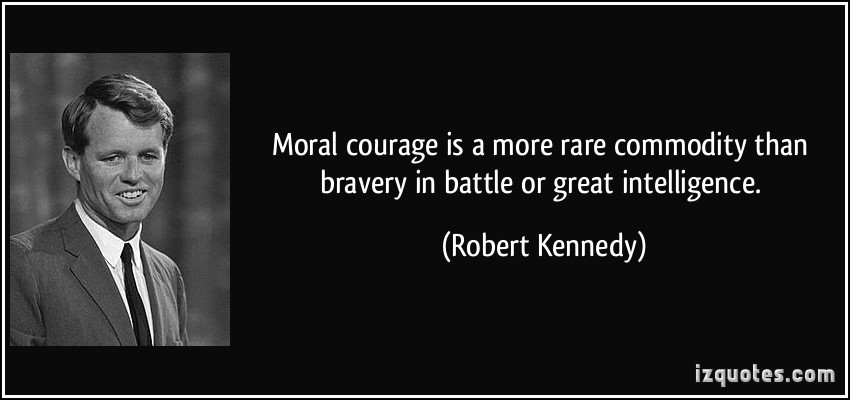
Conversely, we have those cowards who when in the minority are afraid to risk.  They are afraid to speak out when they are surrounded by racists and bigots.  They are afraid of what their friends and neighbors might think if they stand up for their beliefs.  So they say and do nothing.  They find it easy to ignore the admonition that:

“The only thing necessary for the triumph of evil is for good people to do nothing.”  — Edmund Burke

This group of moral cowards also includes the pious so-called Christians who feel that all they need to do to guarantee their ascent into heaven is to spout religious slogans from the bible.  They conveniently forget what Jesus himself did and what the apostle James noted:

“So you see, faith by itself isn’t enough. Unless it produces good deeds, it is dead and useless.” — James 2:17

Jesus said:

“So then, you will know them by their fruits. Not everyone who says to Me, ‘Lord, Lord,’ will enter the kingdom of heaven, but he who does the will of My Father who is in heaven will enter.” — Matthew 7:21

I understand both of these passages to mean that a good person must do good deeds.  It is not enough to have good thoughts or to say “I believe, I believe.”  You must also be able to say “I do good.”  “I do good.”  And what good do you do?  Do you stand up for those who are being persecuted or do you join in their persecution?  Moral courage is standing up for your beliefs.  It is standing up for other people.  It is not just thinking about “What would Jesus do?”  It is doing what Jesus would do.  Jesus would not be silent in the face of persecution of others.

Spiritual Courage:

Spiritual is the ability to face the uncertainly of life and to greet each day with a sense of awe and hope that in the world I can be a better person and that I can help make the world a better place.  If we look at the word spirit, we find the following definition:

“The inner character of a person, thought of as different from the material person we can see and touch.”  — Cambridge Dictionary

The world greets us each day with new possibilities.  Many of these possibilities entail risk.  Risk of dying in a car accident.  Risk of dying in a shooting.  Risk of being raped.  Risk of losing a loved one.  Risk of disease.  Risk of unhappiness.  The list of risks we face each day is endless.  We are sensitized to these risks by the onslaught of news and media that bombards us minute by minute and second by second with ghastly deeds that journalists love to print.

Fear is ever present in our society today and is it any wonder?  The media exalt in horror stories that should have most of us seeking sanctuary in a deep dark cave.  We long to be  hidden from the persecution that seems to engulf our daily lives.  Catholics fighting Protestants.  Jews fighting Muslims.  Shia fighting Sunnis.  Tea Party people hating liberals.  People of different cultures and ethnic groups inflicting insults and defamations on each other.  Women and children subjected to abuse every second of the day.  Wars raging in one country or another.  The wealthy despising the poor and the poor envying the wealthy.  Life is portrayed as nothing but an unmitigated disaster waiting for a tragedy to befall us or so the media would seem to have us believe.  The news becomes a drug whose side effects are to convince each of us to drop out of life and to give up on the world.

“During my 2009 service as an Air Force chaplain in Iraq, I saw countless examples of heroism.  However, the most spiritually heroic act I witnessed was the prayer of a soldier who asked God to forgive the insurgents who had killed his battle buddy.”

Hero’s Highway: A Chaplain’s Journey Toward Forgiveness Inside a Combat Hospital

I wonder that anyone has the courage to get out of bed each day.  It is astonishing to me that any of us has the desire to do good for the world or to make a difference.  It hardly seems possible to roll back the evil and injustices that pour forth each day from every corner of the globe.  So why bother?  One atrocity surpasses and begets the next atrocity.

courageroarNevertheless, in the face of all this iniquity, the majority of humankind has a spiritual courage that defies logic.  The majority of people want to do good for the world. The majority of people are good and most people try to leave the world a better place then they found it.  This is truly an amazing observation.  More people are spiritual heroes than not.  Every day those who have the courage and strength to get out of bed and to start a new day show a sense of spiritual courage.  It would be easier to hide and to do nothing then to face the daily rigors of life on our planet.  Yet, that is what the majority of people do each day.  They get out of bed.  They go to work.  They volunteer.  They innovate and create.  They campaign for their ideals.  They build.  They love.  They pay taxes.  They die.  And the cycle starts all over again for the next generation.

“I long to accomplish a great and noble task, but it is my chief duty to accomplish humble tasks as though they were great and noble. The world is moved along, not only by the mighty shoves of its heroes, but also by the aggregate of the tiny pushes of each honest worker.” — Helen Keller

Time for Questions:

What kinds of courage do you have?  What kind of courage do you wish you had more of?  Why?  What could you do to find more courage in your life?  Do you think it would make a difference?  Why?

Life is just beginning.

“One isn’t necessarily born with courage, but one is born with potential.  Without courage, we cannot practice any other virtue with consistency.  We can’t be kind, true, merciful, generous, or honest.” — Maya Angelou

Previous Older Entries