
Last year at my 40th Demontreville Retreat, one of the exercises that we were given by the Retreat Master included a very challenging set of thoughts. The worksheet for the activity was labeled as “A Testament.” I took the worksheet and instructions home with me. It had fourteen tasks or reflections to complete. I did not desire to complete them during the retreat. It is now almost a year since my retreat, and I have decided to make the mental and emotional effort necessary to complete this “Testament.”
The worksheet started with these instructions:
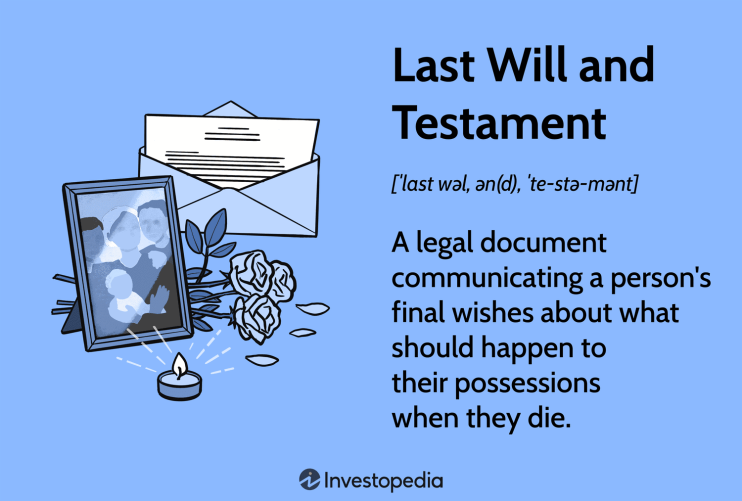
Imagine that this is the last day of your life on earth. In the time that you have left, you want to leave a “Testament” for your family and friends. Each of the following could serve as chapter headings for your “Testament.” This is Reflection Number 11 on the worksheet.
- These are the things that I Regret about my life.
I would rather not write this section, but I am going to anyway. I have thought about it for several weeks now. I dreaded when I would reach this reflection. I had one friend who said he had “No regrets” before he died. How I envy that perspective. I still wonder whether he was telling the truth or whether there was something wrong with him. Perhaps, if he is telling the truth, he may someday be canonized as a Saint.
There will be no sainthood for me. I have more regrets than I can count. Some days, I feel like my entire life is one big series of regrets. Instead of being a serial killer, I am a serial regreter. If I could go back into the past and try to undo some of the things I did, I would not know where to start. I have decided to lump my Regrets into three categories. Each category has some common traits. The first is Regrets due to a lack of patience. The second is Regrets due to a lack of compassion. The third and final category is Regrets due to a lack of kindness.
Let us get started on this task of sorrowful confessions. In my defense, I hope I have learned over the years many things to mitigate making the same mistakes that I did when I was younger. I would like to think that I am a very different person now than I was forty years ago. Many of my Regrets are in the past. My biggest Regret is that I cannot go back and rewind the past.
Regrets Due to a Lack of Patience:
A lack of patience may just be one of the most destructive traits that anyone can have. You can defend it if you want to, but I have too often been impatient to see much virtue in it. Most good things come to those who, if not willing to wait, at least have the patience to persevere in a task or mission that could take years. We keep reminding ourselves that Rome was not built in a day but neither did it fall overnight. History is replete of antecedents to subsequent events proving that most of the problems of today actually started many years if not decades or centuries earlier.
There are certain calculations I should like to make with you,
To be sure that your deductions will be logical and true;
And remember, ‘Patience, Patience,’ is the watchword of a sage,
Not to-day nor yet to-morrow can complete a perfect age.
— From Sarah Williams, Twilight Hours: A Legacy of Verse
I was not a patient person. I had a great many talents but foolishly I thought that these talents gave me the right and ability to circumvent practice, dedication, training and experience. I wanted everything today or at least by next week. I expected that my brains and intellect gave me the privilege to neglect what all the great writers, artists, musicians, athletes and other talented people know. There is no greatness without hard work and discipline.

Regrets Due to a Lack of Compassion:
I grew up believing that emotions were somehow evil. Thinking and brains and knowledge and intellect were everything. Emotions led us astray. Somewhere in life, I learned that unless you suffer the same emotions as other people do, you cannot empathize with them. Until you experience what pain and heartbreak and sorrow and Regret, and joy and love feel like you cannot understand what other people are going through in their lives. Without empathy, there is no compassion. Without compassion there is no forgiveness or mercy. You end up becoming hard like a rock but with about as many feelings. You protect yourself by eliminating feelings, but that process creates an unscalable wall between you and other human beings.
You eventually are doomed from this lack of feelings to acquiring perhaps the most horrible feeling of all. That is the feeling of absolute loneliness. You are no longer part of the human race or anything else. You exist in a vacuum. You neither care about anyone nor does anyone care about you. Loneliness kills. There is evidence that dying early is linked to loneliness and social isolation. Suicides due to loneliness are well known to be one of the major causes of death in the USA.
“A meta-analysis of 90 studies examined the links between loneliness, social isolation and early death among more than 2 million adult. They were followed for anywhere from six months to 25 years. Participants who reported feeling lonely were 14% more likely to die early than those who did not. People who experienced social isolation had a 32% higher risk of dying early.” — Kristen Rogers CNN, December 24, 2023
“Men who often experienced loneliness, or those who were lonely and living alone, or with a non-partner, were found to have three times higher risk for death by suicide compared to those who were cohabiting.” — How living alone, loneliness and lack of emotional support link to suicide and self-harm
Loneliness has been found to be different by the generation we are born with as well as by race and gender.
Generation Z (ages 18-22) is the loneliest generation, with 79% reporting feelings of loneliness according to a study by Cigna.
Millennials (ages 23-37) also report high levels of loneliness, with 71% saying they feel lonely at times in a survey by YouGov.
According to a study by YouGov, women are more likely to report feeling lonely than men, with 72% of women saying they feel lonely at times compared to 60% of men.
According to a study by the National Academies of Sciences, Engineering, and Medicine, Black Americans report feeling lonely more often than white Americans, with 44% of Black adults reporting feelings of loneliness compared to 37% of white adults.
Looking back on my life, I see many people who I pushed away because I would not let my feelings show. Over the years, I have lost friends and relatives because I did not care enough about maintaining the relationships to reach out and “touch someone.” It was often easier for me to just ignore my feelings and assume others would do likewise. I have written several blogs where I say, “Don’t wait.” “Tell them you love them now.” “Tell them you admire them.” “Tell them how important they are to you.”
Do it now. Don’t wait until you are full of Regrets.
Regrets Due to a Lack of Kindness:
Kindness is not the same as compassion. Though I think without compassion there can probably be no kindness. I might be wrong here but I think kindness (at least physical kindness) like opening doors for people or letting another person sit down first can simply be good manners. A robotic reaction taught by habit and custom and enforced by upbringing that might have little or nothing to do with compassion. Kindness of whatever stripe involves action. You must demonstrate kindness by your behavior towards others.
I do not think that emotional kindness can exist without empathy and compassion. Emotional kindness is a nurturing of the spirit whereas physical kindness is a nurturing of the body. I think I have always been good at the latter but seldom good at the former. As I think more about the matter, my regrets come from the emotional and spiritual harm I have done to others by ignoring their emotional and spiritual needs.
For instance, when my daughter was growing up, I took her skiing, bicycling, swimming and camping. All activities where I spent time in physical empathy with what I assumed were fun and enjoyable needs of my daughter. As for her emotional needs, I cannot say that I ever really recognized any. Mores the pity, because that is where I did the damage. Like a bull in China shop, I treated her in ways that I can reflect back on now and realize led to a suicide attempt and two failed marriages for her. On the few times in the past years that we have been together, I can see that she is a hard person. The kind of person I thought it was great to be. A person who could (to paraphrase Hamlet) “suffer the slings and arrows of outrageous fortune and take up arms against a sea of troubles, and by opposing end them.”
I did not realize that sometimes a person needs a shoulder to cry on more than they need arms and arrows. Could I go back and be a different dad, I would do so in a heartbeat. Alas, I have not found the time machine to take me back to undo the many hurts I caused by trying to ignore feelings. I wish I could say that I never do so anymore, but that would make everything in my final will and testament “One Big Lie.” If nothing else, I want to tell the truth. Perhaps the truth that I tell can set someone else free.
Next Reflection:
- These are my life’s Achievements

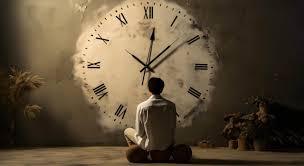















 The concept of tracking time brings forth images of tracking some wild beast in the woods. Deer, moose, bear, cougars, tigers all leave very distinctive tracks. Time also leaves distinctive tracts. Time leaves physical as well as emotional tracks on all of us. Not to mention the tracks that time leaves on the environment. Emotional tracks are evident in the greater cautiousness and fears that we have as we age. From experience, once burned, we no longer want to get so close to the flame. Indeed, many of us will not even go near the fire again. Divorce, rejection, death, pain all leave emotional scars. For some of us they may never quite heal. Physical tracks show up as lines, creases, joint aches, hair thinning, broken bones and disease. I often joke that physically I am aging more like cheese then a fine wine. I am getting squishier and somewhat moldy around the edges.
 Perhaps you see the idea of “tracking time” through a different lens. Maybe you have a need to track your minutes and seconds each day, a twist on tracking your dollars and cents. Perhaps, if you watch your time carefully, you may have more of it. Mark down your time spent each day in an Excel spreadsheet and carefully log your corresponding activities. This last task seems somewhat obsessive to me even though I am often accused of being a Type A personality. I once worked at a job where I was required to check my work in fifteen minute intervals each day and log what I was doing during each interval. After I left this company, I decided I would never again work for anyone where I had to justify myself at this level of detail. It was simply an exercise in obsessive control and domination.


 Meaning and purpose are Yin and Yang to each other. Purpose is outside you and is what you do in the world. For me purpose involves doing. Meaning is inside you and what you do for yourself. Meaning involves being rather than doing. Let’s use a running race as an example.
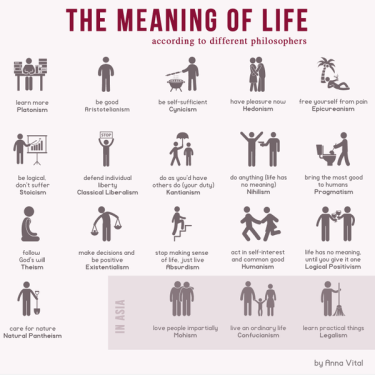 Meaning in my dictionary is about living up to my potential, my values and my beliefs by doing the best I can each day to be consistent with them. No one may ever know if I am being kind, compassionate or patient today. You cannot see the inner virtues that I want to live by. I am the only person at the end of each day who can judge whether or not my life had any meaning today. If I can be the best person that I want to be each day, I will die feeling that my life had meaning. To the rest of the world, I may just be another old teacher, old veteran or old guy who lived an average life and died at an average age. Meaning to me is about being and not doing.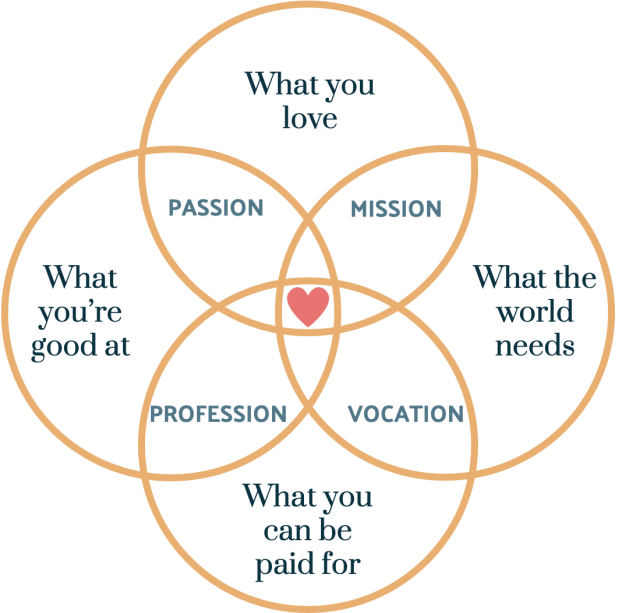
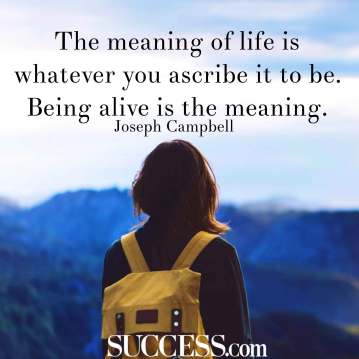 If I answer, I want to be rich, my meaning in life will be defined by how I go about becoming rich and what I do with my money. If I want to be a writer, my meaning will be defined by what I write and how I go about the writing process. If I want to be happy, my meaning in life will be defined by how I go about achieving happiness. No one except me can judge how I define myself. People may say that I am not very rich or that I am not a very good writer, but it is what I believe about myself which will define my meaning in life. Vincent Van Gogh is now widely regarded as one of the greatest painters of all time. His paintings sell for millions of dollars. However, in his lifetime, he sold only one painting. It was to his sister-in-law who felt sorry for him.
 “What am I in the eyes of most people — a nonentity, an eccentric, or an unpleasant person — somebody who has no position in society and will never have; in short, the lowest of the low. All right, then — even if that were absolutely true, then I should one day like to show by my work what such an eccentric, such a nobody, has in his heart. That is my ambition, based less on resentment than on love in spite of everything, based more on a feeling of serenity than on passion. Though I am often in the depths of misery, there is still calmness, pure harmony and music inside me. I see paintings or drawings in the poorest cottages, in the dirtiest corners. And my mind is driven towards these things with an irresistible momentum.” —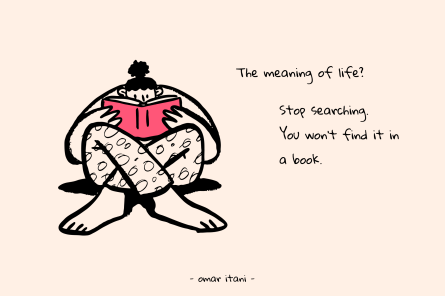
 I conclude with the consideration that Meaning and Purpose may not be everyone’s cup of tea. I confess that it was much later in my life and many hurdles had been taken and many obstacles overcome before I started caring about the meaning and purpose of life. Now I look back and shake my head with some sorrow that I did not grasp their import on life when I was in my teens. A have learned that a life without meaning and purpose is not a life, it is just living.
 Aging Capriciously