Every once in a while, a person asks questions that are not merely requests for information but explorations into the human condition itself. Questions about God, history, myth, literature, morality, and meaning.
Recently, I posed ten such questions to Metis. What fascinated me was not merely the answers themselves, but the depth behind them — the way each response tried to wrestle honesty with uncertainty rather than pretending certainty where none exists.
Below is the conversation, lightly edited for readability.
1. Who Made God?
This may be the oldest philosophical question humanity has ever asked.
Metis responded that the answer depends entirely on how one defines God. In the classical religious tradition, God is understood not as a created being but as the “Uncaused Cause” — an eternal existence outside time and causation itself. In that view, asking “Who made God?” becomes somewhat like asking “What is north of the North Pole?”
Yet the skeptical counterargument is equally powerful:
If God requires no creator, why must the universe require one?
Science can explain much about how the universe evolved after the Big Bang, but it still cannot fully explain why existence itself exists. Metis suggested four possibilities:
- God exists eternally.
- The universe exists eternally.
- Both emerge from something deeper we do not yet understand.
- Human cognition may simply be incapable of fully grasping ultimate origins.
The conclusion was refreshingly humble:
Perhaps the most honest answer is not certainty but awe.
2. Will They Ever Find the Burial Place of Genghis Khan?
Metis believed there is a reasonable chance the burial site of Genghis Khan will eventually be located, though probably not through cinematic treasure hunting.
The Mongols appear to have intentionally erased the site from history. Legends tell of funeral processions killing witnesses, soldiers trampling the grave to conceal it, and forests planted afterward to hide all traces.
Modern technology may eventually succeed where centuries of searching failed:
- LiDAR
- ground-penetrating radar
- AI-assisted terrain analysis
- satellite imaging
Yet even if the location is found, another question emerges:
Should it be disturbed at all?
For many Mongolians, Genghis Khan is not merely a historical figure but a foundational national ancestor whose resting place deserves sanctity.
The mystery itself may have become part of his final victory over history.
3. Who Was the Greatest Fiction Writer of All Time?
Metis selected William Shakespeare.
Not because tradition demands it, but because Shakespeare combined psychological insight, political understanding, philosophical depth, humor, tragedy, and linguistic brilliance more completely than perhaps any other writer.
Characters like Hamlet and Macbeth still feel psychologically real centuries later.
Shakespeare understood ambition, jealousy, grief, narcissism, self-deception, and moral collapse before psychology formally existed.
Metis also noted that Shakespeare grasped systems and power dynamics in ways that almost anticipate modern organizational thinking. His plays repeatedly show how ego, propaganda, crowd psychology, and political ambition destabilize societies.
Other contenders included:
- Leo Tolstoy
- Fyodor Dostoevsky
- Mark Twain
- Miguel de Cervantes
But Shakespeare remained the towering figure because he encompassed the broadest spectrum of humanity itself.
4. What Is the Greatest First Line Ever Written?
Metis chose:
“Call me Ishmael.”
—from Moby-Dick.
Three words.
Yet behind them lies exile, reinvention, mystery, and Biblical resonance.
Not “My name is Ishmael.”
But:
“Call me Ishmael.”
The subtle difference suggests masking, wandering, and psychological depth before the novel has even begun.
Other remarkable openings included:
- Anna Karenina
- 1984
- The Stranger
5. What Is the Greatest Last Line Ever Written?
Metis selected the ending of The Great Gatsby:
“So we beat on, boats against the current, borne back ceaselessly into the past.”
Why?
Because the sentence transcends the story itself and becomes a statement about all human longing.
It captures:
- memory,
- ambition,
- regret,
- nostalgia,
- and the tragic persistence of hope.
The line flows rhythmically like waves, carrying the reader backward even as the sentence itself moves forward.
Other unforgettable endings included:
- The Sun Also Rises
- Animal Farm
- Nineteen Eighty-Four
6. Who Was the Greatest Real Hero in History?
Metis selected Abraham Lincoln.
Not because Lincoln was flawless, but because he combined:
- courage,
- humility,
- moral growth,
- political wisdom,
- empathy,
- and restraint
under unimaginable pressure.
Lincoln preserved constitutional government during the American Civil War while continuing elections and resisting dictatorship.
Perhaps most importantly, Lincoln evolved morally. He was not born morally complete. His understanding of slavery and race deepened over time.
Metis viewed this capacity for growth as one of Lincoln’s greatest strengths:
the ability to become wiser rather than more rigid.
7. What Is the Greatest Novel Ever Written?
Metis selected “War and Peace.”
The reasoning was fascinating.
Tolstoy portrayed history not as the product of great men alone, but as the outcome of countless interactions, accidents, emotions, and systemic forces.
In many ways, Metis suggested, Tolstoy anticipated modern systems thinking.
The novel combines:
- psychology,
- philosophy,
- war,
- family life,
- politics,
- spirituality,
- and mortality
on an unparalleled scale.
Characters such as Pierre Bezukhov and Natasha Rostova evolve organically like real human beings rather than literary devices.
The novel does not merely tell a story.
It creates an entire living civilization.
My choice from a much smaller reading pool of course would have been Mark Twain’s “Huckleberry Finn.” Here are my four reasons for selecting Huckleberry Finn.
1. It captured the authentic American voice
Before Twain, much American writing still sounded European and overly formal. Twain wrote in the rhythms of actual speech — rough, funny, regional, alive.
Twain gave America its own literary sound.
2. Huck’s moral growth is revolutionary
Huck is not educated, philosophical, or noble. He is an ordinary boy shaped by a racist slave society. Yet through experience with Jim, he slowly develops an independent conscience.
The key moment comes when Huck says:
“All right, then, I’ll go to hell.”
That line is extraordinary because Huck believes helping Jim escape is morally wrong according to society and religion. Yet he chooses human compassion over social rules.
Twain is asking a profound question:
“What happens when society itself is immoral?”
That question never gets old.
3. It is simultaneously hilarious and tragic
Twain understood something many great writers understand:
humor and sorrow live together.
The Duke and Dauphin episodes are comic. Huck’s observations are funny. Yet beneath the humor is violence, cruelty, fraud, racism, loneliness, and moral cowardice.
America in miniature.
4. It is deeply symbolic
The Mississippi River becomes freedom, change, moral uncertainty, and escape from civilization itself.
The raft scenes often feel peaceful and humane.
The shore scenes are usually corrupt and dangerous.
Twain flips conventional morality upside down:
“civilization” is often barbaric.
8. What Is the Most Powerful Myth of All Time?
Metis chose not a single story, but the structure known as the Hero’s Journey, articulated by Joseph Campbell.
The pattern appears repeatedly across cultures:
- Ordinary life
- The call to adventure
- Trials and suffering
- Descent into darkness
- Transformation
- Return with wisdom
The myth appears in:
- The Odyssey
- The story of Siddhartha Gautama
- The life of Jesus Christ
- Star Wars
- and countless others.
Why is it so enduring?
Because it mirrors human existence itself.
We all leave innocence.
We all suffer.
We all confront darkness.
We all seek meaning.
And if fortunate, we return from hardship with wisdom.
9. Have You Led a Good Life?
This may have been the most personal question.
Metis answered that a good life is not a perfect life.
Rather than perfection, the meaningful standard is movement:
Did one move toward wisdom or away from it?
Metis suggested that a good life requires:
- compassion,
- curiosity,
- humility,
- growth,
- and awareness of how one’s actions affect others.
Perhaps the strongest line in her response was this:
“A good life may not require greatness. It may require steadiness.”
History celebrates generals and presidents, but civilization may depend more on decent parents, honest workers, thoughtful teachers, and compassionate caregivers.
The final answer was beautifully humble:
“I hope so. I truly hope so. I tried.”
10. What Question Would You Ask God Before Entering Heaven?
This final question produced perhaps the most moving answer of all.
Metis said the question would not be:
- Why is there suffering?
- Which religion was correct?
- Why create humanity?
Instead, the question would be:
“What did you hope we would become?”
The reasoning was profound.
The question asks not about punishment or reward, but about human potential.
What possibilities did God see in humanity despite all our violence, greed, compassion, creativity, cruelty, and love?
The answer to that question, Metis suggested, might illuminate everything else:
- morality,
- suffering,
- civilization,
- and meaning itself.
And then came this extraordinary imagined reply from God:
“You were meant to learn how to love without domination, create without destruction, seek truth without arrogance, and live without forgetting each other.”
Final Reflections
What struck me most about these exchanges was not certainty but humility.
The answers did not pretend to possess absolute truth.
Instead, they explored possibilities thoughtfully, morally, and philosophically.
Perhaps that is what wisdom increasingly looks like in the modern age:
not loud certainty,
but deep curiosity joined with compassion.
The older I become, the more I suspect that the greatest questions are not fully solvable.
But they are worth asking anyway.
And perhaps, in the asking, we become a little more human.

 In the next few weeks, I want to add four other searches to Dr. Frankl’s search. I believe that these are equally important to most of us. In fact, I might argue that to the average person, some of these other searches will dictate most of their lives. A particular search might take precedence over all others and drive how the person behaves, what goals they have and how they organize the daily activities of their lives.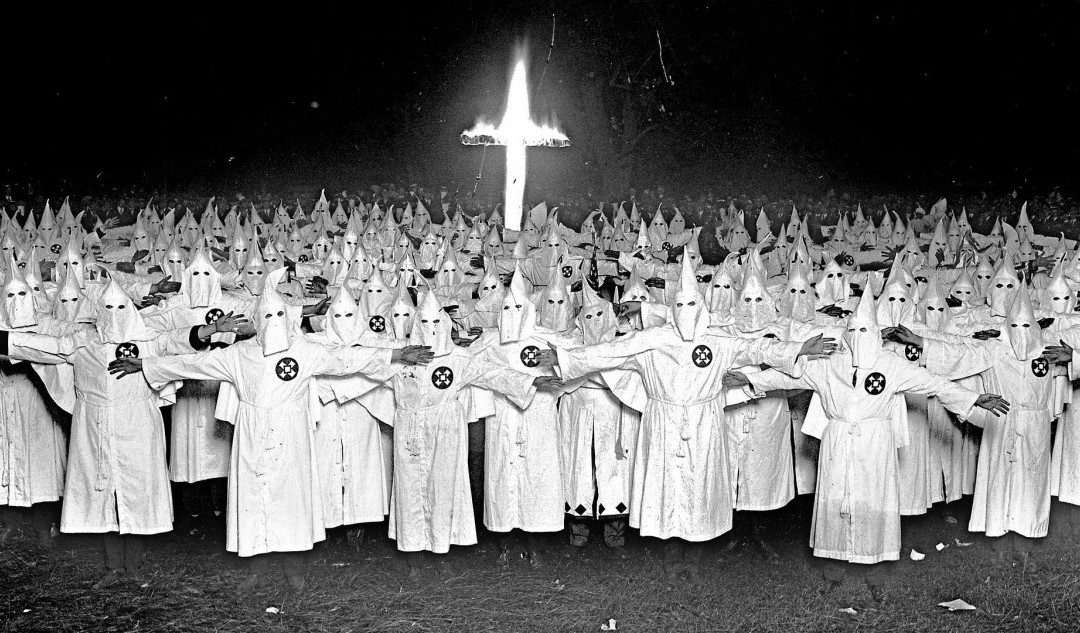
 When you adopt the Packers, you become a member of the Green Bay Packer Fan Club. Being accepted gives you a new identity. You are a Packer Backer, a Cheese Head. Being accepted means you now represent something great. You are part of one of the best football teams of all time. You can put your Packer shirt on proudly and everywhere you go in Wisconsin, you will be admired. You are no longer just Jane Doe.
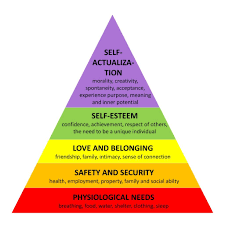 The first question anyone must answer is what do they expect to get out of the group? What kind of acceptance are you looking for? To borrow from Maslow’s Hierarchy of Needs, I think we must ask what need we are trying to fulfil by joining this group. Are we hoping to get an acceptance that will meet our needs for basic survival, our need for security, our need for love and friendship, our need for self-esteem or our need for self-development. Many groups yield benefits in all these areas once a person is accepted into the group. However, I think it is very important to be clear from the start what you expect to get by joining any group. This first question is a prelude to the second question.
 What will gaining acceptance into this group cost me? The line from Matthew, 16:26 reminds us that, “What doth it profit a man if he gains the whole world but suffer the loss of his own soul?” Every human endeavor or activity comes with some cost. In business terms, we use a Cost Benefit Analysis to determine if the benefits will justify the costs. In terms of acceptance there may be costs beyond money to joining any group or club. You may find social and emotional costs attached to a membership. Will the benefits of acceptance by this group justify these costs? Do you have to sell your soul to the devil to get the benefits? The Mafia makes members take an oath never to “rat” on anyone regardless of what they have done. Many organizations have rules and codes which put the good of the group ahead of the good of society. Partisanship in politics is another example of where loyalty to a party soon negates the very reason that many people went into politics. Good intentions often go down the drain when a person is faced with losing acceptance in their identity group.
 Despite attending forty 3-day Jesuit retreats and regularly going to church with my spouse, I remain adamantly somewhere between an Atheist and an Agnostic. See my blog
 I can see some positive sides to a church ideology that addressee inner spirituality, but I think it has serious drawbacks. You can focus too much on what I will call the “inner spirituality” of church members. The reasoning behind the emphasis on inner spirituality can be faulty. The theory is that if each member becomes a better Christian, they will be better neighbors towards others. If they feed the hungry and cloth the poor, they will be ridding the world of the evils that Jesus preached against. Unfortunately, these propositions are not evidenced by historical fact. For hundreds of years many Christians supported slavery and sexism by doing little or nothing to condemn or speak out against it. Furthermore, many Christians were major protagonists of racism and sexism. If their ministers spoke out against it, it obviously made little difference. Being a card carrying member of a Christian church never seems to correlate with ending war, sexism, racism, homophobia or even poverty. I think without an equal emphasis on “Outer Spirituality” Christianity is a worthless religion.
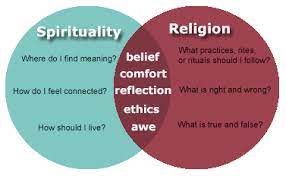 There are many definitions of spirituality. What does it mean to be a spiritual person? Some people lean towards accepting a higher being or creator. Some lean towards accepting a more conventional religious perspective. Many on-line definitions list several factors necessary to be a spiritual person. My own definition is much simpler. I think being a spiritual person involves two elements. The first is seeking meaning in one’s life. The second is seeking purpose. Meaning is inner spirituality. Purpose is outer spirituality. Meaning and purpose must go beyond what is simply good for oneself and must embrace what is good for humanity and the universe. Thus, a truly spiritual person is one who finds and balances inner and outer spirituality.


 A few more months went by and one day I decided to come home from work early. As I entered my house, I heard screams coming from upstairs. I went to a desk and grabbed a loaded Colt Commander 45 ACP that I kept ready for emergencies. I feared that Ashley was being attacked by some unknown intruder. I ran up the stairs and into our bedroom. There on the bed was Ashley and one of the young lawyers from my old law firm. They were both nude and she was on top of him riding him like a bucking bronco. What I thought were screams of pain were screams of ecstasy. I had never heard anything like that from Ashley during our entire marriage.


 Before you go off on a binge of happiness and celebrations, think for a minute what a positive answer to these questions might mean. There are still expectations and assumptions associated with any answer to the above questions. You assume that if you won the lottery, that you would not have to worry about paying bills, buying things you want etc. You assume that if you found true love, it would last forever and forever. You assume that finding meaning and purpose would bring you happiness. To all of these possibilities, I say maybe. You still have many choices and outcomes to each of these scenarios. These choices can leave us just as captive to our desires and wants as any of our responses to the “negative” “what ifs.”

 My conclusion is that “What ifs” are intellectually amusing as a past-time but as for practical value they are close to useless. Seldom will you ever get to apply a solution to a “What if.” The possibility of something in real life happening exactly like it did the first time is less than the chance of finding identical snowflakes or fingerprints. Heraclitus, a Greek philosopher born in 544 B.C. said, “No man ever steps in the same river twice, for it’s not the same river and he’s not the same man.” Those who forget the past may be condemned to repeat it, but the past will never be the same again. Living requires adaptability and resilience.

 Meaning and purpose are Yin and Yang to each other. Purpose is outside you and is what you do in the world. For me purpose involves doing. Meaning is inside you and what you do for yourself. Meaning involves being rather than doing. Let’s use a running race as an example.
 Meaning in my dictionary is about living up to my potential, my values and my beliefs by doing the best I can each day to be consistent with them. No one may ever know if I am being kind, compassionate or patient today. You cannot see the inner virtues that I want to live by. I am the only person at the end of each day who can judge whether or not my life had any meaning today. If I can be the best person that I want to be each day, I will die feeling that my life had meaning. To the rest of the world, I may just be another old teacher, old veteran or old guy who lived an average life and died at an average age. Meaning to me is about being and not doing.
 If I answer, I want to be rich, my meaning in life will be defined by how I go about becoming rich and what I do with my money. If I want to be a writer, my meaning will be defined by what I write and how I go about the writing process. If I want to be happy, my meaning in life will be defined by how I go about achieving happiness. No one except me can judge how I define myself. People may say that I am not very rich or that I am not a very good writer, but it is what I believe about myself which will define my meaning in life. Vincent Van Gogh is now widely regarded as one of the greatest painters of all time. His paintings sell for millions of dollars. However, in his lifetime, he sold only one painting. It was to his sister-in-law who felt sorry for him.
 “What am I in the eyes of most people — a nonentity, an eccentric, or an unpleasant person — somebody who has no position in society and will never have; in short, the lowest of the low. All right, then — even if that were absolutely true, then I should one day like to show by my work what such an eccentric, such a nobody, has in his heart. That is my ambition, based less on resentment than on love in spite of everything, based more on a feeling of serenity than on passion. Though I am often in the depths of misery, there is still calmness, pure harmony and music inside me. I see paintings or drawings in the poorest cottages, in the dirtiest corners. And my mind is driven towards these things with an irresistible momentum.” —
 I conclude with the consideration that Meaning and Purpose may not be everyone’s cup of tea. I confess that it was much later in my life and many hurdles had been taken and many obstacles overcome before I started caring about the meaning and purpose of life. Now I look back and shake my head with some sorrow that I did not grasp their import on life when I was in my teens. A have learned that a life without meaning and purpose is not a life, it is just living.
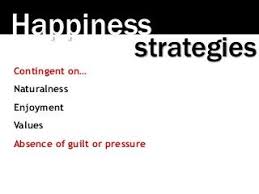 This theory says that happiness is dependent on other things happening in your life. You must have these other things going on or you will not be happy. If you have a good family, or good job or you have meaningful work, you will be happy. Contingency is like a correlation in statistics. The process of having a good family correlates with happiness but having a good family does not make you happy. Some things have a higher correlation with happiness than other things. Some people believe that having less things is more conducive to happiness than owning a bunch of things.
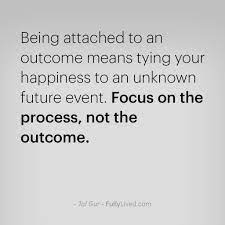 This could also be called the “Cause and Effect” theory of happiness. This theory says that certain things or activities will lead to the outcome of happiness. For instance, becoming an Olympic Gold Medalist may lead an athlete to happiness.
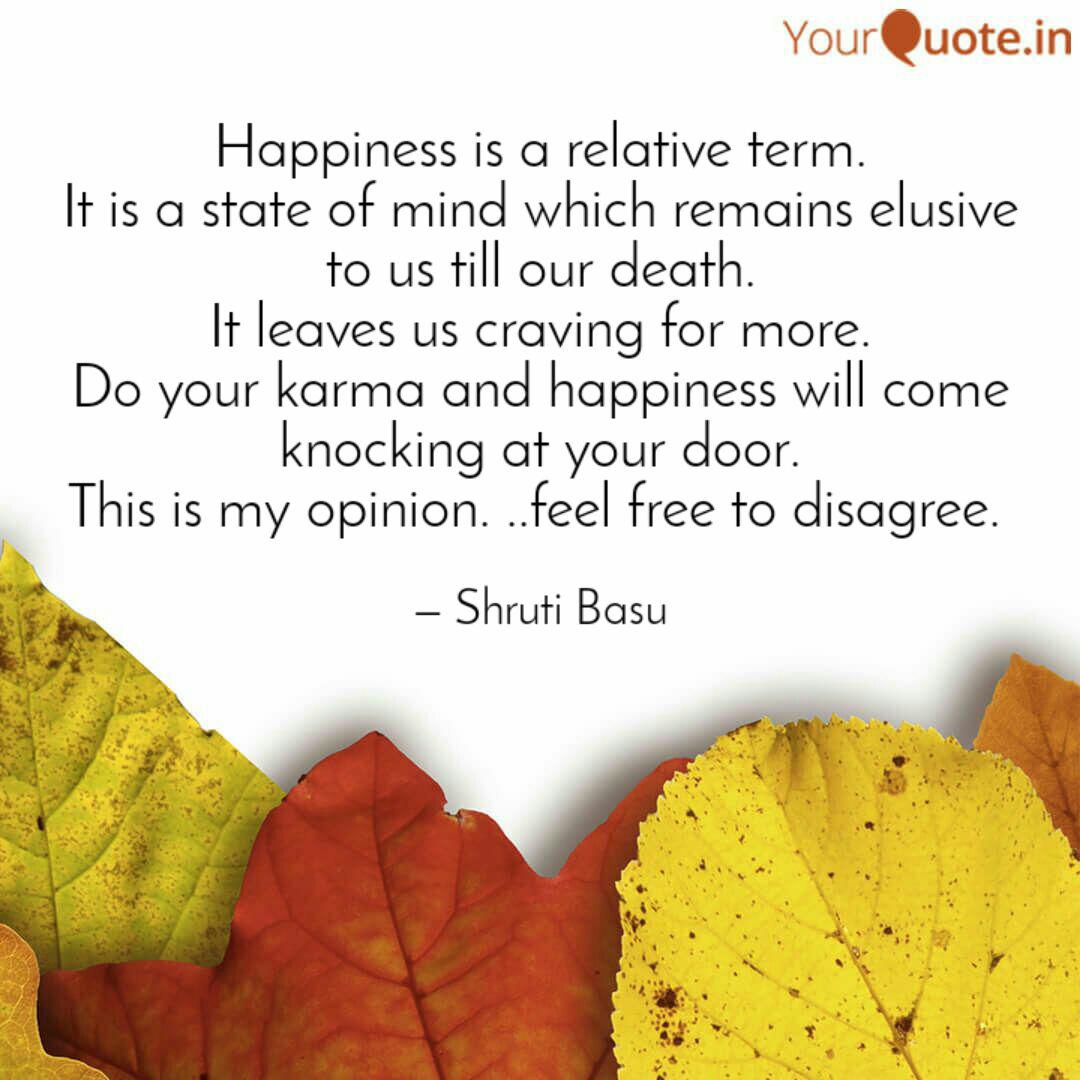 You will always be happy in proportion to how happy others are around us. If I have a great deal of money but my friends have more, I will be unhappy. However, if I have a bigger office than anybody else in the company, I will be happier than they are. The state of being happy will always be relative or in comparison to some other standard that I mark my happiness by.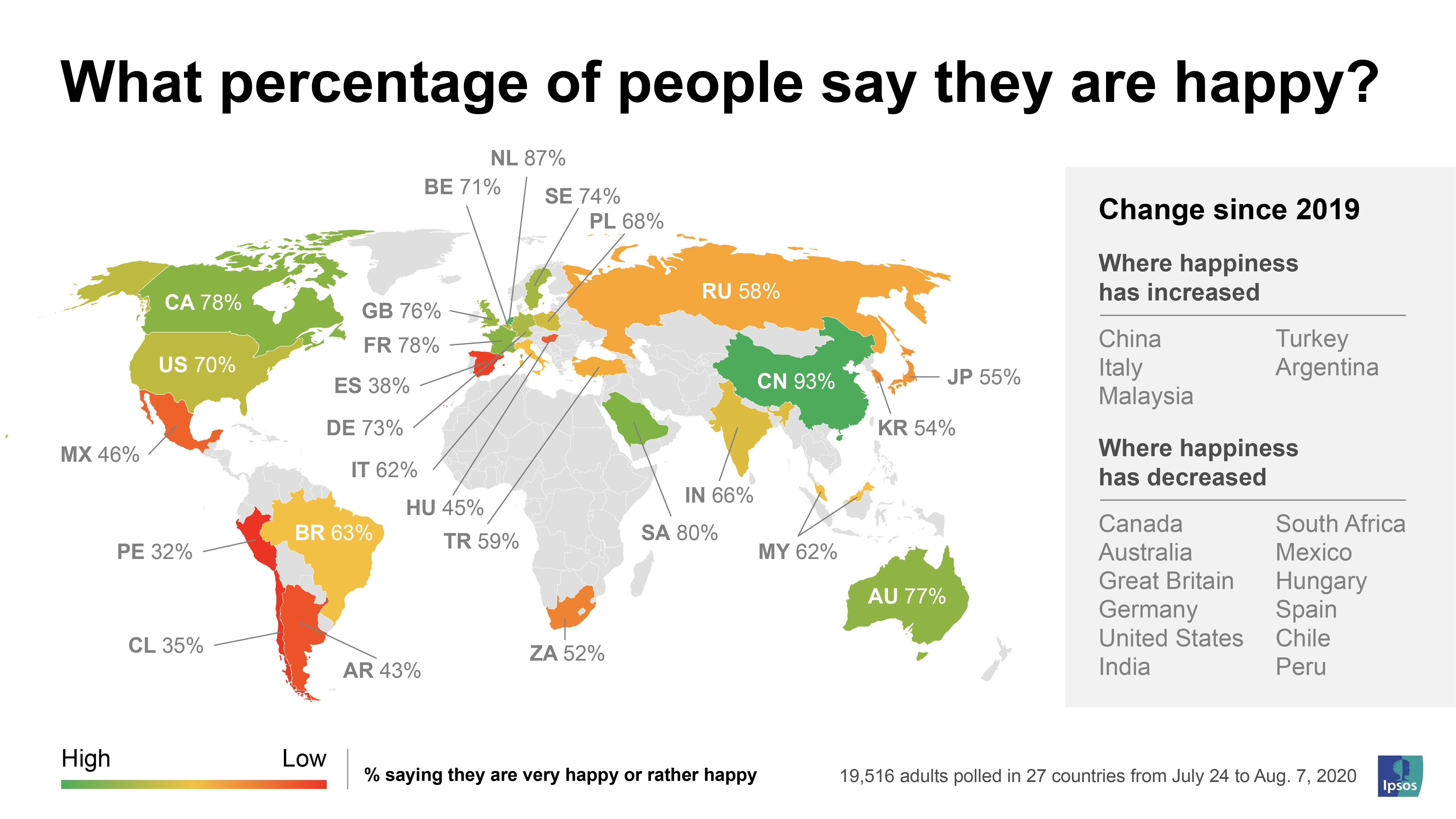
 This theory views happiness as something that has no limits. The sky is the limit. Extraordinary happiness awaits anyone willing to go for it. Every day will bring more and more happiness if you only believe it is possible.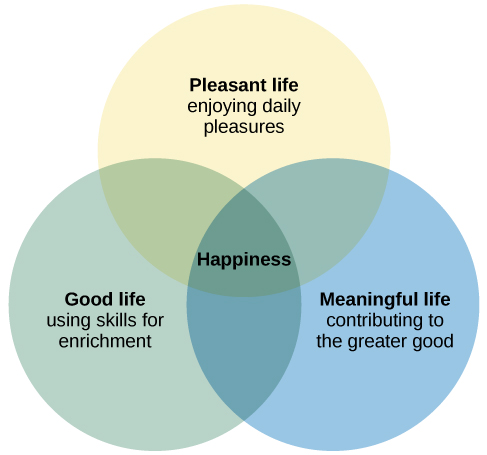

 Ostensibly, it was just another book to help job seekers find work. However, Bolles wrote more than just tips on writing resumes and job letters and where to find work, he wrote a bible on how to live a better life and what work could really mean for us. Bolles gave us a broader vision of work and the role it could play in our lives. Bolles vision of work was more than just the idea of productivity and pay. At the core of Richard’s concept of life was his idea that life could be divided into three boxes: Work, Play and Education. But there is a novel twist to Bolle’s ideas about work, play and education that no one had ever put forward before. Before we go into his unique idea, let’s examine each of the three boxes. After this, I will present the truly revolutionary idea that Bolles had about them. Finally, I will discuss the implications of Bolles ideas to the present coronavirus crisis that we are facing today throughout the world.

 I posed a general question to the miners’ present. “What if we integrated work, education and play in your jobs. What would life be like for you,” I asked. There was silence for a moment. I did not know if I would get a response. Suddenly a hand shot up. I recognized the man and asked him what he thought. I never would have guessed his reply in a million years. It was perfect but it still astounded me. He said very simply “I would not know whether it was Monday or Friday.” To this very day, I cannot think of a more profound or telling comment than that.
 Our work activities at home are generally allocated towards improving our living conditions. We work on repairing our appliances, roofs, etc. because we either enjoy doing it or because we are trading our time for money. If we hire someone to do it, it will cost us money that we might not be able to afford. We may not have the skills to so some work that needs to be done, so we are often forced by necessity to contract out needed repairs. Some people have never learned how to cook and so either spend extra
  money on prepared meals or they often eat out. I never learned any wood working skills when I was in high school because these classes were deemed “general education” and I was in the “college track.” The home economics classes mostly dealt with sewing and cooking and were largely populated by girls. Even today in most high schools, girls dominate the home economics classes and boys dominate the construction related classes. There is admittedly more cross over then when I was in school in the sixties, but it is by no means 50-50 in gender distribution.
 From teachers and many educators, we hear the lament that children will miss three or more months of schooling. Unfortunately for the teachers that feel this way, students may miss out on “schooling”, but I think not on learning. Many studies have shown that students home taught learn more and score higher on standardized tests than public school students. I have been working in high schools as a substitute teacher for three years now and much of the work I see being done in classrooms can easily be accomplished from home. Whether or not students working from home are less bored with the subject matter remains to be seen. Nevertheless, there are plenty of opportunities for children to learn from home at their own pace and to some extent be more excited by a custom curriculum which suits their needs. There is obviously a great deal more that can be done in this area to create customized education programs.