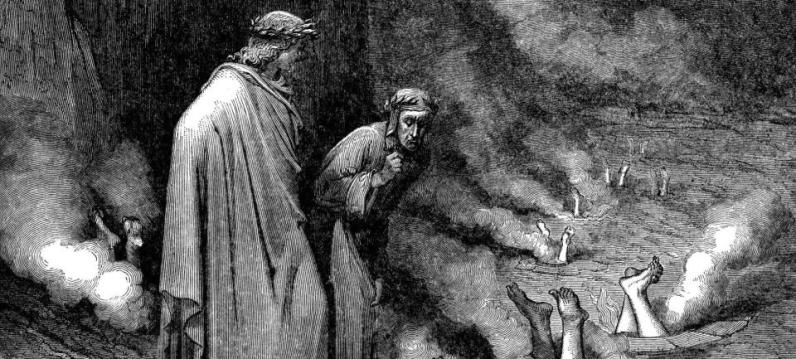
The eighth circle of Hell in Dante’s Inferno is for the sin of fraud. Generally, this includes counterfeiting, hypocrisy, lying, stealing, and more.
What is the punishment in circle 8?
Circle 8 of Hell in Dante’s Inferno has ten different areas for fraudsters. Dante describes these as separate ditches or trenches within the circle. In the first ditch, demons whip pimps and seducers. In the second, flatterers are buried in sewage and feces. In the third, “simonists” – those who abuse church power – are buried upside down and their feet are burned. In the fourth, sorcerers or fortune tellers are forced to walk around with their heads on backwards. In the fifth, the politically corrupt are buried in boiling tar. In the sixth, religious hypocrites are forced to wear torturously heavy church robes. In the seventh, snakes bind thieves’ hands behind their backs and torture them in various other ways. In the eighth, those who lied for personal gain are turned into living flames. In the ninth, people who sowed division walk in a circle. When they pass a certain demon, it chops their head or limbs off – their wounds slowly heal as they walk around again, and the demon chops them again when they come back around. In the tenth and final ditch, counterfeiters are punished with various afflictions like scabies, itching, or thirst. —- From Study.Com by Angie Armendariz, Arielle Windham, and Jenna Clayton.
Christians believe that everyone is a sinner. That is why every week at a Christian church you will hear an aisle full of practitioners asking forgiveness for their sins. The times I accompany my spouse to church, I am reluctant to confess any sins or to ask for any forgiveness. I can’t help but wonder what I should ask forgiveness for. Many the day I regret something I have said or done but seldom do I think this makes me a sinner. When they say that Christ died for my sins, I wonder how he could have known the stupid and sometimes malicious things I actually have done? Perhaps this is an example of a Big Lie.
Writers all lie. Some more than others. There are lies of omission. There are lies of commission. There is hyperbole. There is obfuscation. Writers of course are not the only ones who lie. The government lies. The army lies. The CIA lies. Even your parents probably lied to you more than you think. Sometimes we lie to get our point across. Sometimes we lie to protect another. Sometimes we lie to protect ourselves. Sometimes we lie because of erroneous beliefs, common but false tropes, misinformation, and disinformation.
The media today is one big melting pot of lies. CNN, MSNBC, FOX News, Breitbart and all the other major networks are cesspools of daily lies. Left wing, right wing, Democrats, Independents, Republicans, John Birchers all lie. Studies show that average people also lie fairly regularly. “Do as I say and not as I do” is one form of lying. The biggest lies we engage in are lies to ourselves. Self-talk is full of lies. “I would never do that.” “I get better every day.” “I get enough exercise.” “I am a follower of Jesus Christ.” Some studies such as noted below show that the assumption that most people are liars is not exactly true. Many people are opportunistic liars.
“People also have good and bad lie days, when they tell more or fewer lies than is typical for them, Levine says. People do not lie for the most part, he says, a few pathological liars aside. Also, for the most part, people do not lie unless they have a reason to. Our daily communication demands are a big driver for most of us on how honest or dishonest we are,” Levine said. — “New research shows most people are honest” — by Shannon Thomason
On the subject of writers as liars, I include advertisers, marketers, political speech writers, media script writers and even blog writers. We are all guilty of Big Lies. The following quote is attributed to the Nazis Joseph Goebbels, but it was also written in Hitler’s Mein Kampf:
“If you tell a lie big enough and keep repeating it, people will eventually come to believe it. The lie can be maintained only for such time as the State can shield the people from the political, economic and/or military consequences of the lie. It thus becomes vitally important for the State to use all of its powers to repress dissent, for the truth is the mortal enemy of the lie, and thus by extension, the truth is the greatest enemy of the State.”
Upon reading the above quote, it might give you some pause when it comes to believing anything that comes out of the mouth of a press secretary or any other official State representative. To repeat “The Truth is the greatest enemy of the State.” My father once said, “Believe nothing of what you hear and half of what you see.” This might have been the best advice that I have ever received. This is why all teachers today say that they believe Critical Thinking skills are the most important tools we can teach students. Unfortunately, this is also a Big Lie. It is something that might be believed but it is not practiced.
I call a Big Lie something that is truly and wonderfully believed either by the writer or speaker. Unfortunately, they may not adhere to it in practice or in their daily lives. They talk and write a good game, but they do not deliver. As Martin Luther King said about the “Declaration of Independence”,
“When the architects of our republic wrote the magnificent words of the Constitution and the Declaration of Independence, they were signing a promissory note to which every American was to fall heir. This note was a promise that all men — yes, Black men as well as White men — would be guaranteed the unalienable rights of life, liberty, and the pursuit of happiness. It is obvious today that America has defaulted on this promissory note insofar as her citizens of color are concerned. Instead of honoring this sacred obligation, America has given the Negro people a bad check, a check which has come back marked insufficient funds.”
 Our Founding Fathers wrote a Big Lie and African Americans have been paying for it ever since. Women and other minorities were not even mentioned in the Big Lie, but it applied to them as well. Lies can be committed because people believe things that do not mesh with reality. Lies are a coverup for many government actions that our politicians do not see as palatable for the public. The Gulf of Tonkin incident, the overthrow of Salvador Allende, the weapons of mass destruction in Iraq are only a few of the lies that have been fed to the American people. Of course, our politicians would have us believe it is for our own good. The really sad part is that the media is always complicit in these lies by reporting them with little or no verification of their truthfulness. Some of these lies fall into what I call the “Realm of Taboos.” Taboos are a good place to look for Big Lies.
A Taboo is defined by the Online Oxford dictionary as, “A social or religious custom prohibiting or forbidding discussion of a particular practice or forbidding association with a particular person, place, or thing.” Taboos arise when reality clashes with Big Lies. For instance, it is a Big Lie to think that Americans always fight a virtuous war. Our government wants us to believe that any war we fight is to protect the right to Life, Liberty, and the Pursuit of Happiness. It would not do any good to let the public know that most of our wars have been wars of aggrandizement. Wars fought to protect our economic interests. Thus, we develop Taboos that prohibit subjects from being discussed. This saves government and politicians from being exposed as Big Liars.
One particularly egregious lie is that someone is never too old to hold public office. We have a plethora of “old” politicians and judges who would be better retired. The average age of senators in the 118th Congress is 64 years old. There are 54 senators older than 65. I am 77 years old in two weeks and my days have dwindled down to about four to five ENERGY hours per day. The rest of my day is spent napping, reading, watching TV, or just enjoying a good Bourbon. Many of the politicians holding office probably cannot say that they could do any better than I could. But no one has yet disputed their right to run for office.
“American society on the whole fears aging. It is a culture that works overtime to stave off death, even while having one of the lowest life expectancies in the world compared to the amount spent on health care every year. It is considered taboo to bring up age in a variety of contexts, including whether or not someone is still hardy enough for the rigors of public service after more than eight decades on the planet.” — Aug. 31, 2023, by Hayes Brown, MSNBC Opinion Writer/Editor
 So, we tell a Big Lie that age does not matter. And we have no one willing to challenge that lie. However, it is not only physical aging that puts people at a disadvantage, but mental aging as well. Many older people are stuck in a past generation of ideas and values that are no longer relevant today. Values and cultures change over time and people born in the 40’s and 50’s are less likely to understand and adapt to the changes that daily life brings. If you can only see the “Good Old Days”, you may be suffering from old age. The average age of Nobel Prize winners when they conducted their prize-winning research is 44.1 years. As for writing, “According to experts, we start becoming more creative and prolific in whatever field of art or study we work, around the age of 25. Most people reach their peak after the age of 35 or in their 40s. This is when they produce their most valuable work. After the age of 45, most artists’ prolificity starts slowly declining.” — The Adroit Journal
Conclusions:
- Big Lies are part of reality.
- People often do not want to know the truth.
- Politicians believe that people cannot handle the truth.
- Big Lies are told to conceal realities that will adversely impact governments.
- We all lie sometimes. Some of us more than others.
- Writers have a responsibility to tell the truth as much as possible.
- We cannot always see the culture of lies that we are caught in.
- Follow my father’s advice: “Believe nothing of what you hear and half of what you see.”
- When you do not believe something, gain insights from 360 Degree Thinking.
360 Degree Thinking can be defined as, “being cognizant of ideas and insights coming from a variety of sources, both internally and externally, and understanding the critical interconnectedness of these ideas.” It is about your ability to view ideas and information coming from all sides and on all levels in all timeframes (for example, short, medium and long-term priorities). —- Ideas for Action



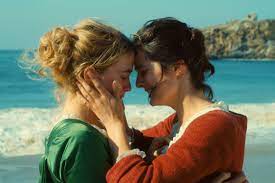 Love is a word used in many semantic constructions. People associate love with sex, marriage, partnership, and other types of relationships between human beings. It is also common for the word love to be associated with inanimate objects and other animals. For instance, people say “I love my car” or “I love my dog.” These uses of the word trivialize the meaning of love. Romantic novels (think Romeo and Juliet) portray love as undying or “dying” passion but seldom show the hard work required to keep love burning. TV and movies feature continuous images of love based more on lust rather than what real love is. Even Jesus the greatest prophet of love did not get the idea of love right.
 Jesus gave one example of “true love” but missed the most significant example in his life. Jesus said, “Greater love hath no man than this, that a man lay down his life for his friends.” — John 15:13. Many soldiers have given up their lives to save others in the course of war. Often these soldiers were friends with the men they died for. However, to say that they loved them is quite off the mark. A number of years ago, I dove into a river to save a guy who was being dragged down the St. Croix River by its current. He did not know how to get out of the current and was fighting it instead of going with it. I swam out and brought him to shore. He was very grateful. I risked my life for this man. I did not know this man and I certainly did not love him. Many acts of heroism have been done by people out of a sense of responsibility or compassion, but I would not call these “acts of love.”
 I propose that the greatest acts of love are to stand by someone when the world is bent on destroying them and you risk being destroyed along with them. The love of a mother for a son convicted of a heinous crime is one of these acts. Jesus’s mother Mary stood by the cross and watched her son die, never deserting his side. I am sure she suffered insults and criticisms and was blamed for his behavior. A mother who will feel love for her son or daughter no matter how grievous the crimes they have done is committing an act of love.
 A few months ago, the news carried a story about a young man who had been in and out of trouble. He went into a dinner with a gun, robbed several patrons and was shot in the back as he was leaving. No charges were brought on the shooter. As it turned out the gun that he used in the robbery was a water pistol. The mother was questioned as to her thoughts. She did not attack her son’s killer, nor did she defend her son’s behavior. She did wonder if he really needed to be shot in the back as he was leaving. I was struck by the mother’s sadness and love for her son. It did not matter that he was a bad kid or that the whole of the media was gleeful about his being shot in the act; his mom’s (like Mary’s) love remained firm.
 One of the most common tropes in movies and shows concern what I call the “Two Ships Passing in the Night Love Model.” Individuals who seem to resonate with each other go about their daily business and never tell the other person how they feel. This has been a part of so many shows that I have watched that I am losing count. You sit there and wonder episode after episode if they will ever say anything before it is too late. It is frustrating as you want them to get together and say, “I love you.”
 I thought about this problem for a while. Many would say it was just a writer’s trick to get you to keep coming back for the next episode. You get hooked on whether or not they will ever consummate their love either physically or emotionally. It is a rather good hook but the more I thought about it, the more I realized that it was really art mimicking life. I have been guilty of the same behavior and many people I know have also been guilty of the same behavior. We fail to say I love you when it counts the most. We can say that we love our new shoes or that we love our cat easily enough, but we have a hard time telling friends and relatives that we love them. We often abbreviate the sentiment with “Love you” or we use the term generically. “See you later folks, love all of you.” The simple act of looking someone in the eyes and saying “I love you” is perhaps one of the most difficult tasks that many of us face.
 But what is true love anyway? Is loving a person in the same ballpark as loving your dog or your new shoes? Would you give up your life for your cat or your shoes? There are many elements that are part of true Love. A life without true love is rather sad but more common than many people realize. How many people do you know who took marriage vows only to divorce within ten years or less? How many of these people were willing to go to a marriage counselor before they divorced? How many of them just gave up on the other person before giving them a chance to change or giving themselves a chance to change? My elements of true love include:




 I think of the places I have been. Their memories come randomly. Sometimes I remember being 16 at the New York Worlds Fair in 1964. Roaming around by myself with no particular agenda. The Vatican Pieta exhibit really made an impression on me. Then it was my year in Biloxi, Mississippi. Scuba diving off Ship Island whenever I could get a break from my Air Force duties. Unalakleet, Alaska where I spent a year on a remote mountain top off the Bering Sea. Dating Eskimos and Indians who were the first women I ever really cared about. After leaving Alaska for Wisconsin, I developed a whole new family to start life with as a responsible father and husband.
 There are many lists of “places” to see but much fewer lists of great events to see. Events are harder to find. Some occur every year like the Newport Jazz Festival and others are one off events like the Woodstock Music Festival. We frequently do not find out about events until they are over. In our travels, Karen and I have discovered posters of local events. Generally, they are not within our travel dates, or they have already occurred. Sometimes though we have been lucky enough to “trip” over an event and attend it. On occasion, it has been through the advice of local people who have told us about the event.
 In one of my blogs, I noted the distinction between being a tourist and being a pilgrim. One definition of a tourist is “A person visiting a place for pleasure.” My definition of a pilgrim is non-religious. You do not have to be on a sacred mission to be a pilgrim. I propose the idea of a pilgrim as someone who takes part in the cultures they are visiting. Someone who is not looking in from the outside like at a visitor to a Hawaiian Luau but someone who joins the celebrants. They say there are three types of people. Those who do not know that there is a parade. Those who watch the parade. Those who are in the parade. Tourists are watchers. Pilgrims are in the parade. In many of our travels, Karen and I have managed to “be in the parade” at least for a short while.
 We have so many memories of friends met during travels. Friends such as Alex and Heidi in Cervelló, Spain enriched our lives and made our trip to Spain more than memorable. Xibo and Mary were friends we met on our Chinese trip in 1989. They accompanied us on several adventures in China. Years later, we helped them to emigrate to the USA. They now live in San Francisco with their daughter, son-in-law and three grandchildren. In Seoul, we attended a birthday party for our grandson Sam after our adopted Korean daughter Susan found her birth mother. A year after Sam was born, we traveled back with Susan to Korea for the celebration of his one-year birthday with Susan and her birth family.
 A “Last Man Standing Bottle” includes some of the most interesting people I ever met in Frederic, Wisconsin. We would gather every weekday in the town library to discuss books, politics, guns, cars, ideology, and any other ideas brought up. We agreed 10 years ago to create this iconic “Bottle” for our coffee group. Since putting the Old Granddad Bourbon in a beautiful case with a pendant that had our names on it, four of our members have passed away. The group disbanded with the advent of Covid and was never resurrected. The bottle now sits in a case at the Frederic Train Museum along with many other relics from Frederic. I am 76 years old and the youngest of the three remaining bottle members. The shadows of Dick, Jerry, Brian, and Ken periodically go through my mind. I remember each of them so vividly in respect to ideas, but their physical aspects are just lingering shadows who periodically are guests of my thoughts.
 When we are born, we are compared to growth charts and Gesell Developmental schedules. for our development. Lag behind and your parents will be worried. As we grow up, we get compared to sisters, brothers, cousins, and others. Who has not heard the comment “You are just like your father,” or “your sister had straight A’s when she was your age.” In school, we will be tested from kindergarten through college on a variety of measures designed to see how we stack up. Each state will routinely rate the children in a school district or region to compare to other children in the country. Children and schools are then ranked and rated from best to worst. Everyone with any eyes and a brain knows that the school districts with the most money will almost always have the highest rated schools.

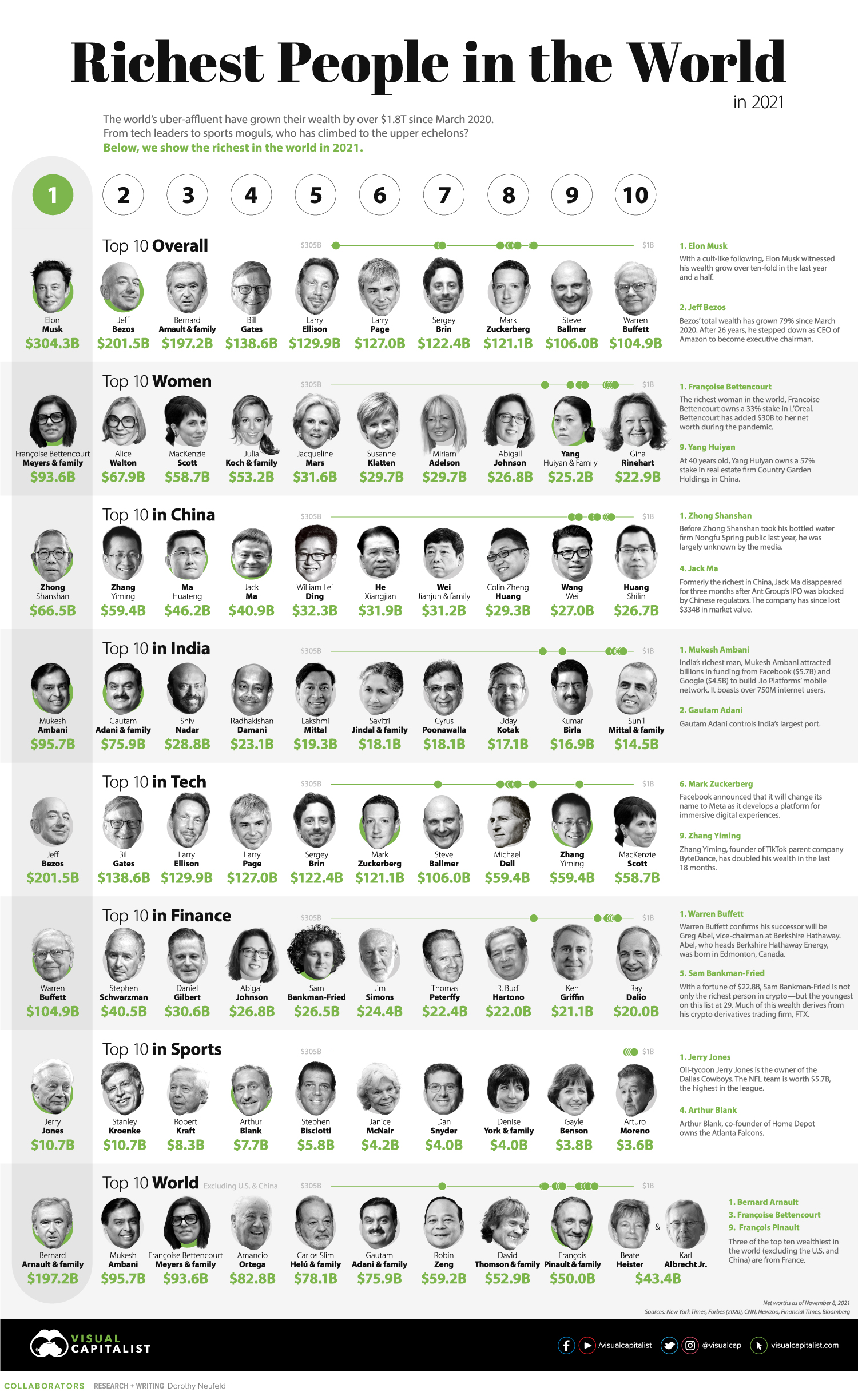 About fifteen years ago, I wanted to test out a hypothesis. Forbes Magazine each year publishes its list of 200 richest people in the world. It gives a great deal of information about each person such as schooling and net worth. I wanted to test whether or not a college degree made a difference in net worth. I added up the overall net worth of all college graduates and compared it to the overall net worth of all those who did not complete college. About fifty five percent of the Forbes richest people had either a bachelor’s degree or a master’s degree. The remaining forty five percent either did not enter college or did not finish college. Who do you think earned more money? Imagine my surprise to find that the average net worth of non-college degreed rich people was 3.5 billion dollars compared to 2.5 billion dollars for degreed people. All the hype on college degrees may just help make colleges richer.

 In the next few weeks, I want to add four other searches to Dr. Frankl’s search. I believe that these are equally important to most of us. In fact, I might argue that to the average person, some of these other searches will dictate most of their lives. A particular search might take precedence over all others and drive how the person behaves, what goals they have and how they organize the daily activities of their lives.
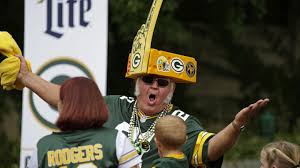 When you adopt the Packers, you become a member of the Green Bay Packer Fan Club. Being accepted gives you a new identity. You are a Packer Backer, a Cheese Head. Being accepted means you now represent something great. You are part of one of the best football teams of all time. You can put your Packer shirt on proudly and everywhere you go in Wisconsin, you will be admired. You are no longer just Jane Doe.
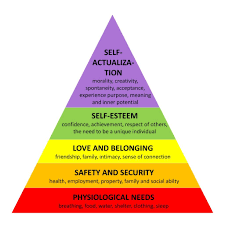 The first question anyone must answer is what do they expect to get out of the group? What kind of acceptance are you looking for? To borrow from Maslow’s Hierarchy of Needs, I think we must ask what need we are trying to fulfil by joining this group. Are we hoping to get an acceptance that will meet our needs for basic survival, our need for security, our need for love and friendship, our need for self-esteem or our need for self-development. Many groups yield benefits in all these areas once a person is accepted into the group. However, I think it is very important to be clear from the start what you expect to get by joining any group. This first question is a prelude to the second question.
 What will gaining acceptance into this group cost me? The line from Matthew, 16:26 reminds us that, “What doth it profit a man if he gains the whole world but suffer the loss of his own soul?” Every human endeavor or activity comes with some cost. In business terms, we use a Cost Benefit Analysis to determine if the benefits will justify the costs. In terms of acceptance there may be costs beyond money to joining any group or club. You may find social and emotional costs attached to a membership. Will the benefits of acceptance by this group justify these costs? Do you have to sell your soul to the devil to get the benefits? The Mafia makes members take an oath never to “rat” on anyone regardless of what they have done. Many organizations have rules and codes which put the good of the group ahead of the good of society. Partisanship in politics is another example of where loyalty to a party soon negates the very reason that many people went into politics. Good intentions often go down the drain when a person is faced with losing acceptance in their identity group.
 Despite attending forty 3-day Jesuit retreats and regularly going to church with my spouse, I remain adamantly somewhere between an Atheist and an Agnostic. See my blog
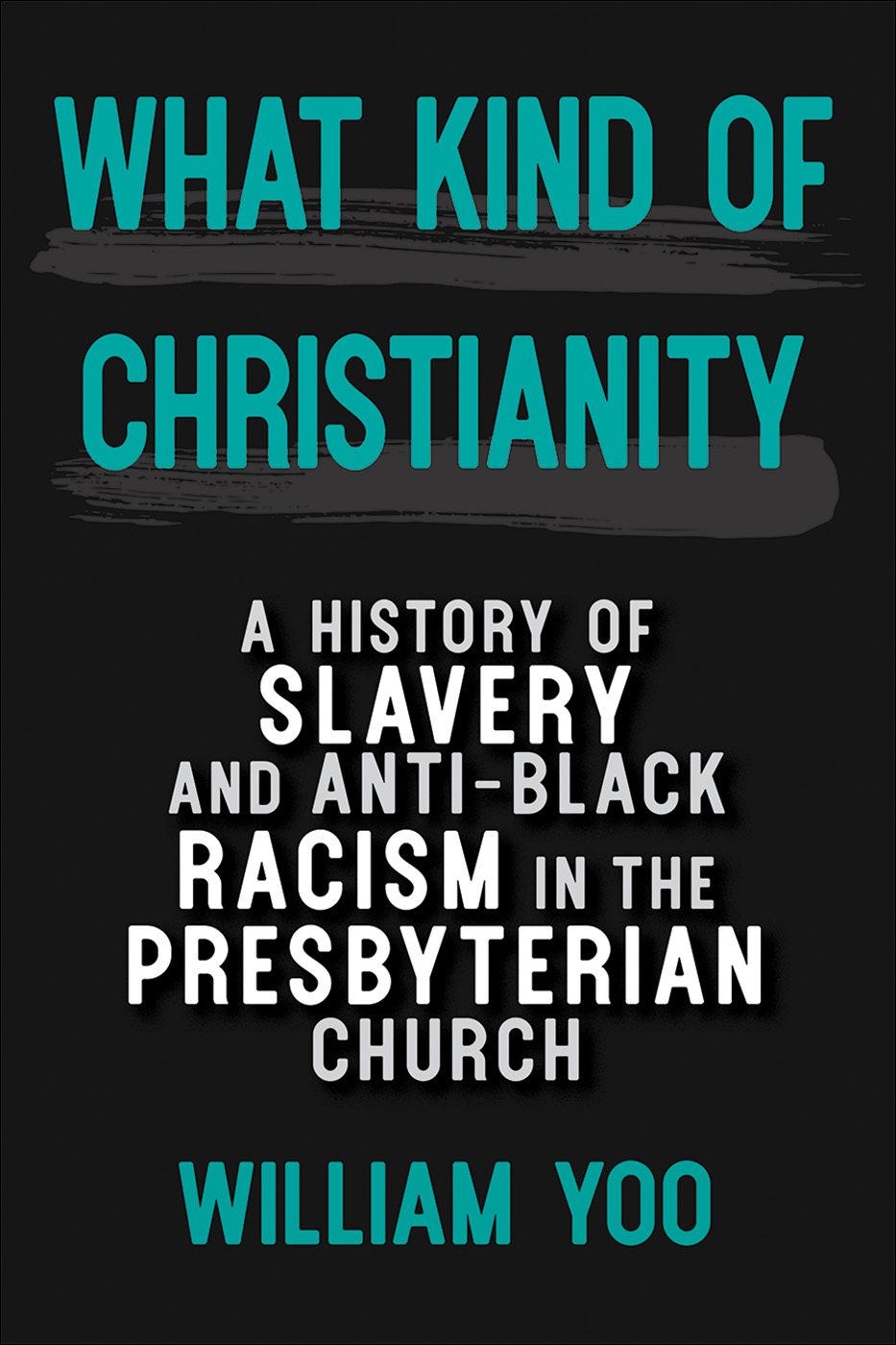 I can see some positive sides to a church ideology that addressee inner spirituality, but I think it has serious drawbacks. You can focus too much on what I will call the “inner spirituality” of church members. The reasoning behind the emphasis on inner spirituality can be faulty. The theory is that if each member becomes a better Christian, they will be better neighbors towards others. If they feed the hungry and cloth the poor, they will be ridding the world of the evils that Jesus preached against. Unfortunately, these propositions are not evidenced by historical fact. For hundreds of years many Christians supported slavery and sexism by doing little or nothing to condemn or speak out against it. Furthermore, many Christians were major protagonists of racism and sexism. If their ministers spoke out against it, it obviously made little difference. Being a card carrying member of a Christian church never seems to correlate with ending war, sexism, racism, homophobia or even poverty. I think without an equal emphasis on “Outer Spirituality” Christianity is a worthless religion.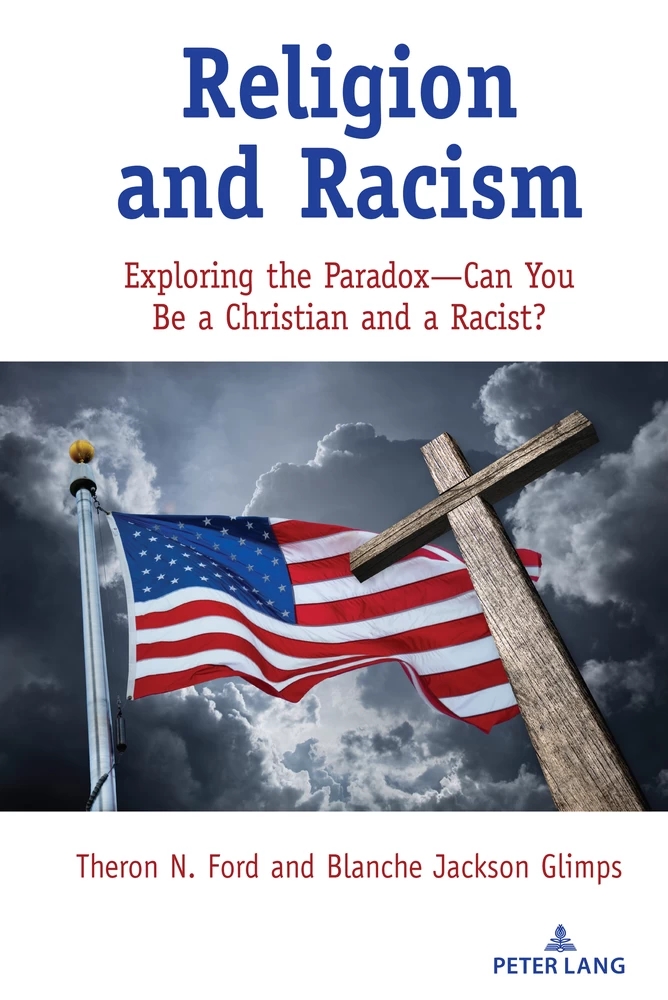
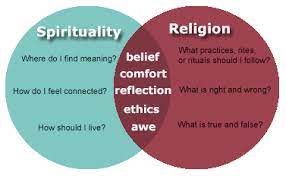 There are many definitions of spirituality. What does it mean to be a spiritual person? Some people lean towards accepting a higher being or creator. Some lean towards accepting a more conventional religious perspective. Many on-line definitions list several factors necessary to be a spiritual person. My own definition is much simpler. I think being a spiritual person involves two elements. The first is seeking meaning in one’s life. The second is seeking purpose. Meaning is inner spirituality. Purpose is outer spirituality. Meaning and purpose must go beyond what is simply good for oneself and must embrace what is good for humanity and the universe. Thus, a truly spiritual person is one who finds and balances inner and outer spirituality.


