
Introduction: (Skip if you have read Part 1 and go to Part 5 below)
A number of years ago, I wrote an article about the famous “Golden Mean” of Greek philosophy. The mean was basically a rule that said the best way of living is to balance extremes. Another way of looking at what this rule implies is that evil or bad things happen when we over do something. We need to take all things in moderation. Thus, drugs, smoking, guns, watching TV etc., are not evil or bad in themselves but when we take them to extremes, they became dangerous and counterproductive.
Life is an ongoing struggle to find our proper balance. However, it may never be a question of equal balance because the proper balance can never be static. There are many dimensions or polarities in life where it is not really a matter of moderation or balance but more a matter of dynamically imposing a temporary order between two extremes. The concept of Hegelian Dialectics comes to my mind as an aide in thinking about this process.
Dialectical thinking can be described as: “The ability to view issues from multiple perspectives and to arrive at the most economical and reasonable reconciliation of seemingly contradictory information and postures.” This is a much more complex process than simply balancing extremes. The more I thought about it the more I decided to add a corollary to the Greek Rule. Since I think time has easily proved the value of the Golden Mean, a corollary by definition is a proposition that follows from and is appended to one already proved. My corollary is as follows:
John’s Corollary:
Anytime, one concept in a set of opposing concepts is allowed to dominate the other concept, extreme dysfunction will result.
I want to discuss this more by using five pairs of concepts that I think are critical to our world today. I want to show you how the distortion created by proponents of each concept is dangerous to life as we know it. I do not use the word dangerous loosely or frivolously or for effect. The battle between these ideas is destroying life as we know it on this planet. The proponents of each side of these polarities seek to destroy the proponents on the other side.
Rather than looking at things from a systems perspective and trying to dynamically adjust the system, opponents are driven to allow one idea to dominate to the exclusion of the other idea. Witness the name calling between conservatives and liberals today. Each side demonizes the other side and assumes God is on their side and Satan is on the other side. Liberals are evil to conservatives and conservatives are evil to liberals.
Here are the five pairs of concepts we will look at in the next few weeks. This week we will look at number three on my list. We have already discussed the “efficiency versus effectiveness” dimension in part one of this blog series and the “growth versus development” dimension in part two.
- Efficiency versus Effectiveness
- Growth versus Development
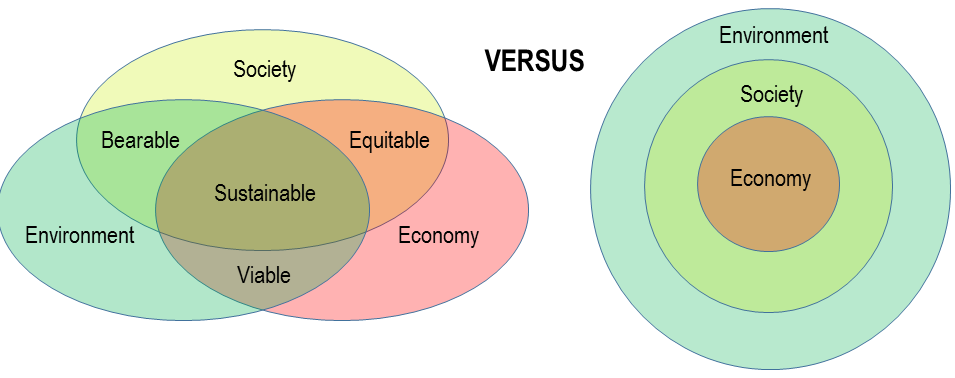
- Society versus the Economy
- Conservative versus Liberal
- Rights of the Individual versus Rights of the Group
Part 5. Rights of the Individual versus Rights of the Group

Gerard Hendrik Hofstede was a Dutch social psychologist who pioneered research into scales that characterize different cultural attributes. He eventually ended up with six dimensions. Using his six dimensions of cultural characteristics, you can profile countries to help better understand what drives their politics and diplomatic relations. (See Hofstede Dimensions) The six dimensions that became integral to his research included one measuring individuality versus Collectivism. Collectivism is simply another word for group self-interest versus individual self-interest. Hofstede studied many countries using various survey techniques and placed each country depending on their orientation somewhere along his scale.
In terms of Individuality versus Collectivism, the United States ranks as one of the highest in individuality.

“Individualism holds that a person taking part in society attempts to learn and discover what his or her own interests are on a personal basis, without a presumed following of the interests of a societal structure.” — Wikipedia
Contrasting the United States with China, we find China (and many other Asian countries) on the other end of the dimension, i.e., China is high in Collectivism or Group orientation and low in Individuality.

“Collectivism is a value that is characterized by emphasis on cohesiveness among individuals and prioritization of the group over the self. Individuals or groups that subscribe to a collectivist worldview tend to find common values and goals as particularly salient and demonstrate greater orientation toward in-group than toward out-group.” — Wikipedia
 The significance of these orientations cannot be underestimated. For instance, we have seen considerable controversy during the Covid Pandemic concerning masks, social distancing, and the closing of public and private venues such as businesses, restaurants, and religious organizations. Many countries have witnessed protests and even riots challenging restrictions in these areas. Basically, I suspect that research will show that countries higher in Individuality have resisted constraints more than countries that are higher in Collectivism or Group Orientation.
In the United States, this orientation towards Individuality has been taken to the extreme as key leaders have acted like morons and spurned the advice of top scientists and medical people. The results have been disastrous. The United States has the dubious distinction of having the worst record of handling the Corona Pandemic in terms of numbers of cases and deaths. This is a prime example of what I am calling Johns Corollary: “Anytime, one concept in a set of opposing concepts is allowed to dominate the other concept, extreme dysfunction will result.”

AUSTIN, TX – APRIL 18: A protester holds up a sign protesting wearing a mask at the Texas State Capital building on April 18, 2020 in Austin, Texas. The protest was organized by Infowars host Owen Shroyer who is joining other protesters across the country in taking to the streets to call for the country to be opened up despite the risk of the COVID-19. (Photo by Sergio Flores/Getty Images)
The dysfunction in the case of the Pandemic has been thousands of deaths that did not have to happen.
Many people in the USA are still protesting their individual rights and will blatantly enter stores and buildings that are marked “Mask Required.” YouTube is full of videos of these “individualists” loudly proclaiming that it is “My right not to wear a mask.”
Collectivism or Group Rights can also be taken to an extreme. When the rights of a group such as a religion or political organization takes precedence over the rights of the individual, we can have instances of fanaticism and cultism. Numerous examples come to my mind. The KKK, Mafia, Anti-Semite Groups, Neo-Nazis groups are all instances of organizations that put the rights of the group over the rights of the individual. Some of these fanatic groups tell would-be members that the only way out of the group is death. There is no room for individuality in these groups. You either do it their way or you suffer dire consequences.
 The Japanese ethic during WWII was one of extreme fanaticism towards the Group Orientation. Few nations had anything even close to the Kamikaze or Banzai attacks that the Japanese army used against their opponents. In these attacks, the individual was expected to die for the good of their country. What differentiated these attacks from other attacks was the wanton disregard for the lives of the soldiers. It was a foregone conclusion that the individual soldier was going to die. Again, we see extreme dysfunction when one element of a dimension is pursued to the detriment of any rational balance.
As I write this blog, my state of Arizona has now taken first place in terms of the increase of deaths and new cases of the Corona virus. Many of the states that eschewed masks, shutdowns, and social distancing requirements followed the examples set by their Republican leaders who in turn followed the example of the man running this country. The United States is in the throes of a disaster made not only by nature but also by the extremism of its belief in the rights of the individual over the rights of the group.

The problems and conflicts between individualism and society have been going on since well before the present crisis. For a good article describing some of the earlier medical confrontations, I have attached an excerpt that I hope will entice you to read the entire article. Failure to learn from the past is a recipe for disaster in the future.
“Across the spectrum of threats to the public health—from infectious diseases to chronic disorders—are inherent tensions between the good of the collective and the individual. To acknowledge this tension is not to foreordain the answer to the question ‘How far should the state go?’; rather, it is to insist that we are fully cognizant of difficult trade-offs when we make policy determinations.” — The continuing tensions between individual rights and public health. Talking Point on public health versus civil liberties by Ronald Bayer, EMBO Rep. 2007 December, 8(12), 1099-1103
 I want to talk about Gratefulness today. It is the first in my list of the Key Seven Virtues that I think are worth developing. Gratefulness is the opposite of ingratitude. It is easy to fall into the trap of being ungrateful. The world besieges us with evidence of our incompetence and faults. Hollywood glamorizes the mundane and makes the rest of us feel inferior in comparison. American Idol becomes the graven image that we now worship. It is not an image of a gold calf or a prophet or a saint. It is the image of success and fame and fortune that we all desire. Even as I write this, millions of people are buying a lottery ticket in the hope of achieving instant wealth. How many of these people are grateful for what they have? I suspect many of them are very grateful in their daily lives, but it makes you wonder how grateful most people are when they will spend their money against all odds to become an overnight millionaire. What don’t they have that they will buy if they do win?
 When I grew up, we always bought the cheapest. Karo syrup instead of Log Cabin, margarine instead of butter, bologna instead of capicola, Welch’s grape jelly instead of Smuckers, Velveeta instead of cheese and so on and so forth. I survived high school on bologna sandwiches, peanut butter and jelly sandwiches and potato sandwiches. Kids would always trade food in the lunchroom but in four years no one in the room would ever want any of my sandwiches. In fairness to my mom, she did the best she could on the meager food budget my father provided. He spent more money at the racetrack, or should I say with the bookies than he did on our household. Thus, I developed no taste for the so-called finer things in life and this extended to my taste in whiskey. As far as I was concerned and even knew, the cheaper the better.
 A long, long time ago, (or so it seems now) and many whiskeys under the belt, Karen and I were returning from a trip to visit our daughter Megan who lived in Chandler. We were at the airport awaiting a somewhat delayed flight. We decided to pass the time in a restaurant near our gate. We sat down at a table and I noticed a flyer on the table advertising three different Tequilas. One glass sold for 2 dollars, another for 5 dollars and the third for 8 dollars. I cryptically remarked that “This is a joke. Only a sucker would pay 8 dollars since there is no difference between the three except the brand names.” Our waitress overheard me and disregarding the caveat that the customer is always right, she intruded and piously announced “You are wrong, there is a big difference. Would you care to try a flight with one of each?” I could not let the challenge go and I warned her that I was not impressed by how much things cost, and I would let her know what I thought. I assumed that I was getting the flight of three for free since it was her challenge, but she brought me the bill later and it included the cost of each drink.


 I thought I would start the year of 2021 off with a positive slant. Namely, some things we can all do or practice to be better people. However, before anyone should pay any attention to what I am about to say, there are several questions they must ask themselves. I would advise you that the veracity and hence credibility of an author is critical to your acceptance of what the author is trying to sell you or convince you of. Do not buy an argument from someone who cannot be trusted. Think about the comment that “If you see the Buddha on the road, kill him.” An uncritical acceptance of any idea is dangerous to your own integrity and responsibility. Hence, the questions I would want answered (If I were you) would be as follows: Who is this writer to say what the “greatest” virtues for a human are? How did he come up with these Seven Virtues? What is the difference between a virtue and a value? Is this an important difference or is he about to sell me another new religion?
 I would like to answer that I am a seeker of truth and knowledge. I am very opinionated, often highly judgmental and have frequently been accused of being a “know it all.” Many people would write my opinions off as being too liberal while others would say that I am too rational. I place great value on being logical and trying to stay open to many possibilities. I have been studying philosophy and religion since I was eighteen. I have no degrees in either. But the number of books and articles and stories that I have read number in the hundreds. I have attended many different worship houses and types of religious services. I was brought up as a Catholic until I rejected its teachings at about the age of 10. When no one would give me a good answer for “Who made God?” I more or less decided that most religions were based on superstitions.
 Given that one could easily comprise a list of ten or perhaps one hundred important virtues, why do I believe that my seven are the seven greatest and most important? How do I have the audacity to make such an assertion? I might have been sitting under an apple tree one day, or perhaps simply thinking about life at one of my yearly silent retreats at the Demontreville Retreat Center, when I compiled a list of seven virtues. While I truly “value” these ideas, I understand them more as virtues than values. I will address this difference later. I decided that I want to live by these virtues. Each day for the last fifteen or more years, I have selected one of these seven virtues to help guide me through the day. Whether it is patience, kindness or courage, each day I start by reflecting on this virtue and trying to make it a part of my life.
 The danger in this discussion lies in your taking a sectarian or religious approach to my writings. I assure you that I am not a religious person. I may be a spiritual person but I do not think of myself in either of these categories. I am an agnostic who wants to live a better life and help build a world that is a better place to live for future generations. Living by these seven virtues is one way I believe I can contribute to this goal.
 If I have satisfactorily answered the questions that I posed above respecting my integrity and credibility, I will now set off to address each of my Seven Virtues and explain why they are so important and the difference that I think they can make in our lives. Look for my virtues over the next several weeks in my blogs.

















 Aging Capriciously