Something Rotten in America Is Coming This Way

Something Wicked This Way Comes” is a 1962 dark fantasy novel by Ray Bradbury.  It tells the story of  two 13-year-old boys, Jim Nightshade and Will Halloway, in Green Town, Illinois, who confront the sinister Cooger & Dark’s Pandemonium Shadow Show.  The show is part of a malevolent carnival that preys on people’s secret desires and fears.  Jim and Will are forced to battle evil and examine the nature of good and evil, youth and aging.  The title comes from Shakespeare’s “Macbeth”, and the story explores themes of good vs. evil, the fear of growing old, and the cost of wishes.

Macbeth is the story of a man driven by ambition and a lust for power to murder his king and seize his throne.  Like Bradbury’s novel, it is also a tale of good and evil.  The famous quote is “By the pricking of my thumbs, something wicked this way comes.” It is spoken by the Second Witch in Act 4, Scene 1, as she senses Macbeth’s evil approach, indicating his profound moral corruption even to supernatural beings.  Someone once noted that most great stories involve a battle between good and evil.  Fiction mimics reality.

The famous Gettysburg Address by President Abraham Lincoln also described a battle between good and evil and the sacrifice made to restore good.

“It is rather for us to be here dedicated to the great task remaining before us—that from these honored dead we take increased devotion to that cause for which they gave the last full measure of devotion—that we here highly resolve that these dead shall not have died in vain—that this nation, under God, shall have a new birth of freedom—and that government of the people, by the people, for the people, shall not perish from the earth.”

The cause was the elimination of the evil of slavery and racial discrimination, and the continuation of a nation built on the values of life, liberty and the pursuit of happiness.  Values that were not allowed to be held by a significant portion of Americans specifically Black people, Indigenous people but also including women, gay people, Asian people, and many immigrant groups

Today, the thought rings in my mind that “Something rotten comes this way.”  Yes, a paraphrase of the Bradbury quote but it has a somewhat different meaning to me.  Something rotten smells and stinks in our country.  Carved into a White House mantel is a quote by John Adams, “May none but honest and wise men rule under this roof.”  Today something is rotten in the White House.  The foul and putrid odor has spread to the Supreme Court and both houses of Congress.  Wise men search for the odor but cannot agree on its source.  When something is smelly we generally assume that it is rotten.  Hence my reflection that “Something rotten comes this way.”  It has been coming for a long time, but the stench and fetid smell have now become unbearable.  From the White Mountains of New Hampshire to the top of Mt. Whitney in California, the rank fumes are causing people to gag and vomit and leave our country.

What is the source of this rottenness?  The smell comes from an ever-enlarging foundation of greed and narcissism that has replaced integrity and morality.  From the pulpits of many so-called Christian churches to the podiums of our once great universities, Americans are now baptized or given diplomas in greed, avarice and opportunism.  Increasingly, cowards roam the halls of Congress where statesmen once tread.  Too many of our leaders lack morals or integrity.

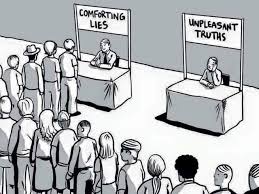
Sycophants earn positions as heads of government with no qualifications except an unscrupulous ability to kiss ass.  The media daily screams headlines that defy logic and comprehension while profits for news conglomerates soar to ever higher peaks.  Meanwhile, the information contained in media broadcasts bears scant resemblance to the reality that most of us face.  Lying is the norm and has become one more strategy in a congressperson’s arsenal.  A stew of lies daily spread by the internet and its media minions.   None of us can escape complicity in this economy as we all breath its rotten air.
Something rotten comes this way:

How can we expunge this rottenness?  Will singing Kumbaya work?  Will hands across the aisles work?  Will prayers and thoughts work?  Will more empathy work?  What about better communication?  What about more people going to college to get educated?  What about doing away with Social Security and replacing it with Stock Portfolios?  What about more guns?  What about?  Sorry, I am out of simple solutions.  None of these so-called solutions work because they do not confront the real problem.  The golden idol that makes money the measure of all good things in life.  It may be possible to stop the spread of this rot, but it will take a change of heart as well as a change of mind.  Many of my friends ask me if it is not too late.

I only know one thing.  Unless we change the path that we are heading down, we can kiss democracy in America goodbye.  The rottenness will eventually infect the entire nation until we are left with nothing but a country of cowards, sycophants, greedy merchants and greedy consumers.  People who will continually lie to get ahead.  People with no goals except to consume the latest do-dads in hopes of becoming happier and more satisfied with their lives.

Ironic that so many Americans want to go down this path, since not one great prophet in history has preached that owning more stuff will either make you happy or get you into heaven.  Nevertheless, today we have Christian churches preaching the “Prosperity Gospel.”  A narrative that has millions of followers subscribing to a bastardization of every great scripture that has ever been written.

The prosperity gospel teaches that faith, positive confession, and financial giving to religious leaders will bring the giver personal wealth, health, and success.  It portrays material prosperity as due to God’s favor and poverty or illness as evidence of weak faith or spiritual failure.  The Prosperity Gospel is a Super Con because it monetizes hope, blames failure on the believer, and shields itself from disproof.  People buy into it because it promises certainty and reward in an unfair economy.  It exploits vulnerability, fear, and selective success stories to convince “true believers” that it is a Christian teaching.

Robert Tilton: “I believe that it is the will of God for all to prosper because I see it in the Word… I do not put my eyes on men, but on God who gives me the power to get wealth”.

Creflo Dollar: “When we pray, believing that we have already received what we are praying, God has no choice but to make our prayers come to pass”.

John Avanzini: “Jesus had a nice big house”, “Jesus wore designer clothes”, “Jesus was handling big money”.

Joel Osteen: “If you want to reap financial blessings, you have to sow financially”. He also states, “I believe God wants you to prosper in your health, in your family, in your relationships, in your business, and in your career”.

Oral Roberts:  “Sow a seed on your MasterCard, your Visa or your American Express, and then when you do, expect God to open the windows of heaven and pour you out a blessing.”

Friends, the only solution that will save our country along with our immortal souls is to defeat the basic tenets of corporate capitalism and to cast out the evangelists of hypocrisy who spread such false gospels as the “Prosperity Gospel.”  The corruption that we see in the White House, the Congress, the Supreme Court, the Universities, the Media and many so-called Christian Churches is a symptom of the rot that is associated with our predatory avaricious Corporate Capitalistic system.
Corporate Capitalism itself must be understood as a mindless media driven machine that puts profits over virtue.  A system in which the greater needs of society are no longer the recognized or given any priority.  All that is rotten today in America today can be traced to greed and avarice.  The same motivations that caused the Israelites to build the Golden Calf.  The Golden Calf still stands—no longer forged of gold but of brands, markets, and corporate power.  We bow to consumption, give obedience to profit, and keep silent to wrongdoing in exchange for comfort and toys.  We mistake greed for progress and idolatry for economic necessity.  We do not need a rejection of markets but a rejection of markets without moral and ethical anchors.

The late Pope Francis is quoted as saying that:

“From an economic point of view, it is irrelevant to produce tanks, or candy provided the profit is the same.  Similarly, it might be the same to sell drugs or sell books if the profit figures match.  If the measure of value is money, everything goes provided that the profit does not vary.  The measure of every human being is God, not money.”

Money becomes the measure of good and evil.  Money becomes the measure of a person’s value and even life.  Today, the religion of America has become “How can I get more money.”  The true prophets throughout history have always preached the potential dangers of focusing on accruing either wealth or fame.

Christianity (Jesus): “No one can serve two masters. … You cannot serve both God and money.”

Islam (Prophet Muhammad, Hadith): “Riches are not the abundance of worldly goods; rather, true riches are the richness of the soul.”

Judaism (Talmudic/Midrashic Thought): “The truly rich are those who are satisfied with what they have.”

Baha’i Faith (Baháʼu’lláh): “Material comforts are only a branch, but the root of the exaltation of man is the good attributes and virtues which are the adornments of his reality.”

Red Cloud (Oglala Lakota): “I am poor and naked, but I am the chief of the nation.  We do not want riches, but we do want to train our children right.  Riches would do us no good.  We could not take them with us to the other world.  We do not want riches.  We want peace and love.”

If we want to rid our nation of the rottenness and stench that is rapidly covering it, we must rid ourselves of the obsession that capitalism seeks to instill in us with every media at their disposal and every commercial that they can provide.  It is an obsession to own more, to possess more, to have more, to buy more, to shop until we drop.  You can have a heart attack so long as you have spent your last dollar.  Christmas has become $Mas.  Our world has become one big shopping mall.  We are speeding on a spending train to oblivion.  Next stop HELL. 
What Can We Do?

If the disease is moral, the response must be moral as well.   We must all:

  • Refuse to lie or accept lies
    • Reject those who tell lies to get ahead for any reason
  • Refuse to worship money and wealth
    • Reject anything to do with the “Prosperity Gospel”
  • Refuse to relate success with goodness
    • Teach that success is not always associated with morality or doing the right thing
  • Teach our children to be responsible
    • Responsibilities are as important as rights. Develop children who accept responsibility for their lives
  • Choose sufficiency over excess
    • Corporate Capitalism thrives on “wretched” excess. Ask yourself what you really need to be happy not what some commercial tells you that you need.

The single most important thing we can all do is to get off the spending train.  Substitute empathy for others for greed.  Substitute kindness for strangers and immigrants instead of suspicion and hatred.  Substitute charity for all for a desire for more stuff and more toys for oneself.  Substitute compassion for the poor and the needy instead of worrying about what you are going to get.  Substitute mercy and forgiveness for hatred and retribution.
Above all remember that we are all one people.  There are about 180 or more countries in the world.  Karen and I have only been to 45 now, but we have found that everyone in every country that we have been to want the same things:  Meaning for their lives.  Peace for their nation.  Safety for their families.  A decent place to live.  A good meal each day.

We must embrace the idea that everyone is entitled to these elements of a satisfactory life and not just people in our circle or community or nation.  People in every country of every color of every religion and of every political and economic philosophy deserve the same thing.  Life, liberty and the pursuit of happiness.  

The Anatomy of the Soul: How Art and Music Unite Truth, Beauty and Goodness — Part 2

When we speak of truth, beauty, and goodness, we often imagine three separate pursuits — the scholar seeking truth, the artist seeking beauty, and the saint seeking goodness.  Yet Pope Francis and the great philosophers before him remind us that these three are not rivals but reflections of the same divine source.  Each reveals a different aspect of reality, and only when all three are in harmony does the human spirit find peace.

Tradition tells us that truth belongs to the intellect, beauty to the heart, and goodness to the will.  Truth teaches us to see, beauty teaches us to feel, and goodness teaches us to choose.  In that triad we discover the anatomy of the soul — knowing, loving, and willing, each distinct yet inseparable.

But there is another path by which these virtues speak: the language of art and music.  Long before we understood moral codes or philosophical systems, humanity painted, danced, and sang.  In rhythm and color, in sound and silence, we expressed truths too deep for logic and too vast for words.  Art and music, properly understood, are not escapes from reality — they are revelations of reality’s depth.

Beauty as the Gateway to the Soul

Beauty is the most immediate of the transcendentals.  Truth demands patience, goodness requires effort, but beauty strikes us like lightning.  It does not ask permission.  A single note, a brushstroke, or a line of poetry can pierce our defenses and open the heart where argument cannot.

This is why great art has moral and intellectual power.  It awakens us from indifference.  The experience of beauty — genuine beauty, not the glamour of surface or sentiment — lifts the soul toward truth and goodness without coercion.  It shows us what could be, and in doing so, reminds us what should be.

Aquinas called beauty “the splendor of truth.” The artist does not invent beauty but unveils it.  Every authentic work of art — whether sacred or secular — is a momentary unveiling of reality’s inner harmony.  It is truth made radiant, goodness made alluring.  Beauty does not lecture; it invites.  It does not command; it beckons.

The Role of the Artist

Artists are translators between the visible and invisible worlds.  They take the raw materials of existence — light, sound, form, gesture — and reveal within them an order we might otherwise overlook.  In doing so, they help us perceive truth through the lens of beauty.

A number of years ago, my first wife left me for another man.  He was also married but decided not to leave his wife.  My wife (Julie) and I reconciled and agreed to first resolve some issues by visiting a councilor.  These efforts did not go very well.  I was angry and hurt.  I did not know what I had done wrong.  My wife was also hurt and angry.  I had always thought that we had a lot in common.  At one of our first counseling sessions, the councilor noted that I did not display any emotions.  I was quite proud of being rationale and not letting feelings get in the way of my world.  In fact, I thought Spock was too emotional despite his public image as being stoic and logical.

The councilor mentioned my lack of emotions to my wife.  Her reply stunned and hurt me very much.  She said, “I always thought everyone had feelings, but I finally came to believe that John has no feelings.”  I left that counseling session resolved to find some of the feelings that I had ignored.  I decided the best way was to try to be more creative and less rationale.  I signed up for art classes and ballet classes and decided to listen to more classical music.  It was another nine months or so before Julie and I finally reconciled.  During this period, I actually participated in a ballet, painted several nature pieces (which I thought were quite good) and spent days at the library listening to as much classical music as possible.

When art forgets truth, it becomes hollow display.  When it forgets goodness, it becomes manipulation.  But when truth and goodness dwell within beauty, art becomes what it was always meant to be: a mirror of creation’s wholeness.  I was looking for my wholeness and my humanity which are also inseparable.

The artist’s vocation, then, is not self-expression alone but world-expression — to make the invisible visible, to translate the ineffable into form.  The true artist is not a manufacturer of objects but a servant of insight.  Their success is measured not by applause but by the awakening they cause in others.  In my case, it was an awakening in myself.  Art and music became the pillars of my salvation.  I rediscovered my humanity in them.

The Music of Being

Among all the arts, music comes closest to expressing the order of the soul.  It moves directly through time, breath, and rhythm — the same elements that animate life itself.  Every heartbeat, every inhalation, every step is a kind of music.  When we listen to or create music, we participate in a pattern that mirrors the pulse of existence.  Martin Luther said “”Next to the Word of God, music deserves the highest praise.”  Karen has this quote framed in our dining room.

Music unites truth, beauty, and goodness in motion:

  • Its structure and harmony express truth — order and proportion.
  • Its melody and color express beauty — emotion and wonder.
  • Its rhythm and purpose express goodness — direction and intention.

That is why even those who cannot explain music are changed by it.  It aligns the intellect’s search for order, the heart’s hunger for beauty, and the will’s longing for purpose.  To make or hear music well is to experience harmony not only in sound but in being.

When I was in the third grade at PS 171 in Brooklyn, NY, the teacher put all of us into a choir or singing group.  She acted as the conductor and started us out singing some song that she had taught us.  I sang along with the rest of the kids until suddenly, my teacher yelled “Who is making that noise?”  “You (she pointed at me), it’s you.” “Don’t sing” she screamed at me.  “Just open and shut your mouth.”  That was 70 years ago and to this day, I do not sing. Oh, people say I should get over it, but they are not living in my shoes.  I listen to music more than most people in the world.  I love all types of music.  But I do not play music, and I do not sing.

Plato believed musical education shaped character because harmony trained the soul toward moral order.  The disordered person, he said, was “out of tune.” Modern psychology would agree that we feel peace when the elements of our life are in rhythm — thought, emotion, and action resonating together like chords in balance.  In this sense, every moral life is a composition, every soul a symphony in progress.  My soul resonates with music, and the music resonates in every fiber of my body.  If I could be born again as anything, I would be a tenor singing in the great opera houses of the world.  I love the passion, drama and lyrics that fuse life into melodies that make time stand still for me.  Somehow the strains of music have a purgative effect on the pains and disappointments that can sometimes fill my life.

The Sacred and the Profane

Not all art is beautiful in the pleasant sense.  Some truths are too painful to adorn.  Yet even tragedy, if it reveals reality faithfully, can serve beauty’s higher calling.  A requiem, a lament, or a poem of grief can be beautiful because it tells the truth of human suffering while still pointing toward transcendence.  It is like watching a sad movie.  We connect to others through the suffering that art and music can convey.  Of course, music often conveys joy and happiness, but these are bonuses in a world today where suffering seems to be the norm.

Sacred art makes this explicit.  It does not flatter the senses but reorders them toward the divine.  The frescoes of Michelangelo, the cantatas of Bach, the icons of the Orthodox tradition — each embodies beauty that leads beyond itself.  Their purpose is not entertainment but transformation.  They invite us to see through the surface of the world into its divine origin.

But even the so-called profane arts can serve the same purpose when they reveal authentic experience.  A rap song, a nursery rhyme, a portrait of a tree, a romantic novel — each can bear truth if it arises from sincerity and respect for life’s depth.  I had an MRI today and as I listened to the banging, clanging, whistling and other sounds, I could hear a melody emerging.  I thought of penning a song called “Melodies in an MRI.” The sacred is not confined to churches; it inhabits every honest act of creation.

The Moral Dimension of Beauty

Beauty’s moral power lies in its capacity to attract us toward goodness.  Moral laws can instruct, but only beauty can enchant.  We are moved to do good not merely by obligation but by love for what is good.  Beauty provides that love.

This is why ugliness — deliberate distortion and cynicism — corrodes the soul.  It teaches us that nothing matters, that form and harmony are illusions.  When culture celebrates ugliness, it signals despair; when it honors beauty, it declares hope.  True beauty does not deny suffering; it gives suffering meaning.

The 20th-century theologian Hans Urs von Balthasar wrote: “We no longer dare to believe in beauty, and we make of it a mere appearance in order the more easily to dispose of it.” He warned that without beauty, truth and goodness lose their persuasive power.  In other words, without art and music, morality becomes sterile, and truth becomes abstract.

Beauty is not the soft edge of morality — it is its living energy.  It whispers to the will, “Choose life, not despair.”

The Soul as an Instrument

If truth belongs to the intellect, beauty to the heart, and goodness to the will, then the soul is the instrument through which they resonate together.  Like a violin, it must be tuned.  The strings of mind, emotion, and desire can each sound discordant when isolated.  Harmony arises only when they are stretched to the right tension and played in unity.

Art and music help tune the soul.  When we create or contemplate beauty, we sense the right relation of parts to whole, of the finite to the infinite.  We remember that life itself is composed — not chaos but cosmos.  In that moment, we are most alive, most human, and perhaps most divine.  The god we seek flames within us at these moments.

That tuning is not limited to artists.  Every person can live artfully.  A kind word spoken at the right time, a well-prepared meal, a garden tended with care — each is a small act of aesthetic and moral order.  In that sense, the moral life and the artistic life are one: both seek to make the world more beautiful and more true.  I find my muse in writing.  I like to think that I am somewhat good at using words.  When I was in high school, other students used to pay me to write their essays for them.  I remember one friend who asked me to write something for him.  I told him that he should do it himself.  He said, “But you are so good at writing.”  He was a musician, and  I challenged him, “Is it possible to be a better musician if you do not practice?”  He agreed practice was essential but said that he would rather practice playing music than practice writing.  I wrote the essay for him.  It was only logical as Spock would say.

The Silence Beyond the Sound

At the heart of music is silence.  Without it, the notes have no shape.  Silence frames beauty the way space frames form.  Likewise, the soul needs silence to perceive truth and goodness.  In our noisy age, we risk losing the capacity for this interior listening.  Yet every deep encounter with art or nature — every moment when beauty stops us — restores that silence within.  I learned to appreciate the beauty of music in my many hours sitting inside that library booth listening to the strains of Mozart, Beethoven, Bach and many other great musicians.  I am fond of saying that I never “met a food that I did not like.”  The same applies to music genres.  There is something in every genre of music that speaks to my heart and my soul hears.

The silence after a great symphony or before a sunrise is not emptiness.  It is presence — the awareness that life itself is music being played through us.  To live in that awareness is to live in gratitude.  Gratitude, in turn, is the purest harmony of truth, beauty, and goodness.  Ingratitude, St. Ignatius said was the “Gateway to all sins.”  How difficult it is to remember this for so many of us including myself.

Conclusion: Living Artfully

Art and music are not ornaments to life; they are its inner logic.  They teach us that creation is not random but composed, that our task is not to control the score but to play our part faithfully.  When truth informs our minds, beauty moves our hearts, and goodness directs our wills, we become participants in the divine symphony rather than spectators.

To live artfully is to live beautifully.  To live beautifully is to live truthfully.  And to live truthfully is to live for goodness. 

In the end, every human life is a work of art in progress — sometimes dissonant, sometimes serene, always unfinished.  Yet even our imperfections can contribute to the greater harmony if we keep tuning ourselves to the eternal themes of truth, beauty, and goodness.  Perhaps this is the greatest truth that we all need to discover.  As Pope Francis said “Truth, beauty and Goodness” are inseparable.

When we do accept this truth, we will find that the music of the soul is already playing, quietly, beneath the noise of the world — waiting only for us to listen.

Author’s Note:

Portions of this essay were developed in collaboration with “Metis,” my AI writing partner powered by OpenAI’s GPT-5.  The ideas, direction, and final reflections are my own, shaped through a dialogue intended to illuminate and refine the themes explored here.

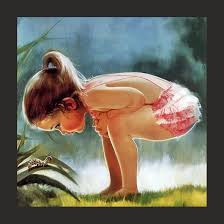
The Little Girl and the Caterpillar

Once upon a time there was a little six-year-old girl named Angelica.  She had three older brothers, a mom and dad.  I never met her mom, but I will introduce the other family members as they enter my story.  I did subsequently find out that Angelica was a very curious little girl and her mom warned her that too much curiosity could get her in trouble.

It was a beautiful morning in mid-September.  The sun was out, and the sky was cloudless.  I decided to strike while the iron was hot and go for a hike in the Casa Grande Mountains.  Temperature was 75 degrees.  Sun was over the mountains but still low enough to be cool.  Projected high for the day was 97 degrees, which they announced was cooler than average.

I started out somewhat undecided which trail to take but finally made up my mind and went south along the middle trail.  This trail is bracketed by the high or ridge trail and a lower short trail.  The two lower trails run south towards Mexico.  As I was walking along what I call the “middle trail” I saw five people coming down the high trail.  The middle trail forks with the high trail and I hurried to avoid running into the people coming down the high trail.  None of these trails are very wide and I did not feel like stepping off the trail.  I made the fork before they arrived and headed south. 

For a short distance, the middle trail parallels the high trail.  I noticed an older man, three young boys and a young girl some distance behind the men.  She appeared to be sitting on her haunches and looking at something on the ground.  I immediately thought “I hope she is not looking at a rattlesnake.”  Snakes tend to come out in cooler weather to sun themselves or to find a nice comfortable spot in the shade.  I have seen a few crossing a trail and I always keep my eyes peeled for them when running or hiking. 

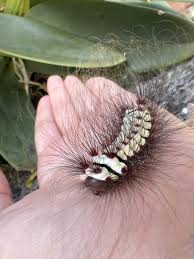
As her siblings got farther away she called out to them.  I could not make out what she said but I noticed that she stayed intent on whatever she was watching.  She was about 25 yards north of me.  My own curiosity got the best of me, and I called out to her “Hey, what are you looking at?”  She turned towards me and replied, “A caterpillar.”  I had never in my 15 years of hiking up the Casa Grand Mountains seen a caterpillar anywhere. 

I left my trail to go up and see what Angelica was looking at.  I got there before her family did.  I introduced myself and asked the little girl what her name was.  She told me her name was Angelica.  I told her that mine was John.  The three boys (her brothers) and the older man (her dad) soon arrived on the spot.  Angelica did not budge (I marvel at the dexterity and flexibility of youth).  I introduced myself to her family members.  I met Antonio her dad, two teenage brothers named Alejandro and Arthur, and a pre-teen brother named Arturo.  Seems her dad had a liking for names starting with A.  I never did find out her mother’s name.


I turned my attention back to Angelica and the caterpillar.  “Angelica, do not touch the caterpillar” I warned her.  ‘Why not Mr. John?” she asked.  “Well, it could be poisonous and very dangerous.”  “It does not look very dangerous.” she replied.  “You cannot always tell what is dangerous by looking at it” I opined.  Her dad seconded my warning.  “Yes, do not try to pick it up” he added.  One of her teen brothers suggested “Maybe we should just kill it if it is dangerous.”  “NO” shouted Angelica, “It is not hurting anyone, just leave it alone.”  I chimed in “Well if it is not an indigenous species, it might do more harm than good out here in the desert.  Who knows maybe it is from Russian or China and could infiltrate our desert environment and destroy everything we hold sacred.”  My suggestion drew blank looks.  Her dad said, “I think Mr. John might have a good point maybe we should just step on it and be on our ways?”  Alejandro and Arthur agreed with this idea.  Arturo sided with his sister and suggested we just leave it alone. 

As we were debating and puzzling what to do, Angelica suddenly picked the caterpillar up in one hand and gently closed her fingers around it.  We stood horrified.  I think we all expected to hear a scream, and Angelica would fall over either dead or in a coma.  None of us moved for several moments which seemed like minutes.  Then Angelica opened her fingers.  The caterpillar had curled up inside her palm and appeared to be sleeping.  “See” Angelica said, “He was just looking for some shade so that he could rest.”  She then stepped off the trail and walked over to a towering twenty-foot Saguaro.  Very carefully, she set the little caterpillar down in the shade of the cactus and walked back up to join her family. 

I sheepishly said “Well, it was nice meeting all of you.  I hope to see you again on the trail.”  With more goodbyes, the family left for the parking lot, and I left to finish a four-mile hike. 

Thus, while I fit in with the millions of homo sapiens worried about climate change, Trumpian politics, violence in America, the Supreme Court’s biased rulings, immigration, education, health care, Democracy and several other MAJOR weighty issues, Angelica sits oblivious to what is destroying life in America to watch a tiny little caterpillar move slowly across the desert floor in search of shade.  Angelica watches the beauty of life while millions of us only see the dirt and grime and misery that we think is all pervasive. 

Oh, how I wish I could be like Angelica again.

What America May Be Like in the Year 2056

freedom-is-slavery

The following is an imaginary story I wrote back in January of 2017.  I wrote it at the start of the first trump administration.  I was reflecting on what life would be like in about 40 years under a Republican dominated government.  I just happened to come upon this blog again a few days ago.  After rereading it, I was surprised by how many of these things seem to be coming to pass under the “NEW” trump administration.  I have decided to publish it in the original without making ANY changes at all.  Love to hear your comments and what you think.  

———————————————————————————————————

I live in Republicanville USA.  It is a small town of about 1,500 people in the rural Midwest.  Today in my town, all the women are barefoot and pregnant and all the men are stupid and misinformed.  It wasn’t always this way.  Things started to change about 75 years ago, when Ronald Reagan became President.  My town had always been very progressive and liberal but we started hearing more and more about how we were being taken advantage of by the poor, those on government handouts and those too lazy to work.  The Republicans who in our town had always been a minority began to grow in numbers.  The more we heard about welfare cheats and welfare freeloaders and those on drugs taking advantage of us, the more my town embraced a new concept of democracy.  It was more like “every man or woman for themselves” rather than “all for one and one for all.”

obey-jesus-or-perish

Our U.S. democracy which had always prided itself on a separation of church and state seemed to forget the reason for this partition.  Increasingly, a group called Evangelical Fundamentalists became more popular along with their criticism of many progressive institutions.  Republicanville USA moved more and more to the right.  The concept of unbridled capitalism became enshrined as a religion and many people began opposing “big” government and taxes.  The Republican Party preached that the marketplace could provide for all social, physical and economic needs of U.S. citizens.  My town moved even further to the right.

trump-state-of-the-unionThis conservative trend was already well underway when in 2017, a billionaire real-estate developer named Donald Trump became the 45th President of the United States of America.  In addition to the hard core conservative beliefs of many mainstream Republicans, Trump added the once discredited idea of American Isolationism.  We would now put America first, no matter what.  No more negotiations with other nations unless it was clear that we got the better of the deal.  We would build a big wall to keep Mexicans and other immigrants out and we would renege on our trade deals with China and Europe.  About the only country that Trump liked was Russia.   Eventually, he agreed to give Alaska and parts of Canada back to Russia.

Trump came through on his promises to the Evangelicals that he would make America White again and put women back in the bedroom where it would be okay to grab their pussies whenever you wanted to.  Minorities were targeted for deportation and women libbers promoting abortion or equal rights for women were arrested in wholesale sweeps and sent to special detention centers for chronic complainers and protesters.

I would like to describe in somewhat more detail what my town is like now in 2056.  Things are a lot different than when I was born in 2017.  I will divide my discussion of these changes into three areas:  Family, Education and Social Issues.

Family:

another-day-in-paradiseI am 39 years old and have two children.  I have never worked (at least outside of the home) as women have not been allowed to work since 2022 when they passed the “Women in the Home Law” as it was popularly called.  The Federal government passed the law and it was ratified by every state and municipality in the nation.  Some places tried to hold out but the government cut off all funding to them until they capitulated.  This law effectively outlawed women working.  It also barred women from the military.  Ten years later (2032) they passed the “Mandatory Birth Act.”  This bill proscribes that every woman (physically able to) must give birth to at least two children.  Any woman who reaches the age of 32 and still has not given birth to two children is forcibly removed to a National Birthing Center where she will be artificially impregnated and kept confined until she has had at least two healthy children.  Sickly or unhealthy children are sent to Disposal Camps where they are “recycled” per official government propaganda.  No one is quite sure what happens during recycling but the children are never seen again.

Many gay women resisted the Mandatory Birth Act and the National Suicide Rate went up dramatically.  The “Fathers” (as our political leaders are now called) made it very clear that the country would be better off without such deviates.  Since women were no longer allowed in politics, the leaders of the nation decreed that they would all be called “Fathers” instead of being referred to as politicians or legislators as they once were called.

My husband works at a local mill where they make t-shirts for Japan, China, Brazil and some of the more developed t-shirt-workersnations.  Since banning imports of such items, we have created millions of jobs making goods that were once made in low wage countries.  The demand for such goods has skyrocketed but now we are providing them.  Unfortunately, the wages and education needed for such work is still low.  My husband did not finish high school but most men in our town do not.  The Fathers have repeatedly stated that real men don’t need higher education.  (I will talk more about education later.)

When my husband is not working, he spends most of his time watching football, baseball, basketball, golf or hockey.  I ammen-watching-game not allowed in the living room when his sports are on except to bring in some beer or chips.  This does not really bother me much as I have plenty to do with the kids, housecleaning, cooking and all.  I have my own TV in my sewing room where I can watch any of the approved programs for women.  We have 30 different “Women Only” channels where I can learn more about cooking and cleaning and how to be a good wife. There are some good romances and family drama stories that are occasionally on.  I look forward to watching these when the kids are in bed.

Our two children, Mary and John are 12 and 15 respectively.  Mary is in a finishing school for girls where they are preparing her for being a mom and wife.  She takes subjects such as homemaking, cooking, cleaning and parenting.  She has one more year to go before finishing school.

When Mary turns 14, she will be eligible for marriage.  Her name will be put in a marriage registry.  If she is lucky enough and pretty enough, some up and coming town Father will select her for a wife.  Men who qualify due to income levels are allowed to have up to five wives.

woman-vacuum-cleaning

My son John is not in school any longer and he works part-time.  The Fathers decried that girls did not need schooling after the age of 13.  John hopes to get a job in the t-shirt plant where his dad works when he turns 16.  He quit school because we could not afford a private school for him.  Only the rich kids in town go on to education beyond the 10th grade.  Private schools are very expensive and the Fathers do not believe in funding education any more.  It has been emphasized that education is an elitist program that creates class divisions and makes some people feel more entitled than other people.   Most young men in our town will work in one of the mills or plants.

Education:

anti_public_education_propaganda_by_8manderz8-d5xz1cj

I have already talked about some aspects of our education system today.  Basically, most people do not believe in higher education anymore.  It is only for the rich.  All funds for public education were cut in 2035 when they passed the “Private Education Act”.  Most folks now send their kids to private schools through the 8th grade and then find work for their children after that.  Girls will be shortly married so school is not thought to be that important for them anyway.  They can learn whatever they need to be a good wife on the “At Home Wives Channels.”

students-1920-1950-9_jpeg

Boys from families with lower incomes can opt to go to privately funded vocational schools to learn such trades as t-shirt making, sneaker making, jewelry making, gun repair, taxidermy, and many other skills that might be in demand.  There is still some funding for such programs that is available for lower income families.  All public colleges have been closed now.  As I noted earlier, such schools were decried to be elitist and the Fathers were unanimous in un-funding them.

Boys from wealthier families go to the more prestigious private schools where they will learn such skills as: Leadership, Accounting, Business Development, Entrepreneurship and Medicine.  Law was abolished as a field of study in 2030 with the passage of the “No More Lawyers Act.”  This act basically made lawsuits illegal thus dramatically decreasing the need for lawyers in the U.S.

Courtrooms abolished “adversarial” trial procedures with the “No More Lawyers Act” and replaced the old-fashioned method of two people arguing trials with modern Computerized Forensic Tomography.  Using CFT, a cross section of the case and evidence pro and con is presented to the jurors.  All the available facts and data are reviewed and jurors vote on the verdict.  Trials are much more efficient and there is no need for lawyers.

Anti EducationLibraries are now mostly museums.  With the passage of the “Books Only Lie Bill” in 2038, all funds to public libraries were cut.  The Fathers decried that books did nothing but cause trouble and stir up discontent.  Anything citizens really needed to know could be found on the “Citizens Channels” offered by the government Department of Public Wisdom.  There are over 100 of these channels which are available on public TV.  They are on 24/7 and offer many programs for good citizenship.  Some of the programs are:

  • Disciplining your children
  • How to take proper care of your guns
  • Disciplining your wife
  • Obeying your supervisor
  • Getting along with co-workers
  • Obeying authority
  • Keeping a clean house

Social Issues:

Social issues or problems (as some people thought of them) have been mostly eliminated in our town.  Our Fathers banned minorities in 2040 with the “America for Whites Act.”  Under this act, no immigrants or people of color can live in the same community as White people.  In 2041, they passed the “Christian Only Act” making Christianity the official Religion of the USA.  All other religions were banned along with atheism and agnosticism.  The “Mandatory Religion Act” in 2042 made it a felony crime not to attend a Christian church every Sunday.

In our town, there is only one church now.  It the Fundamental Evangelical Christian Church for Christ.  We have two pastors who are both well versed in Old Testament theology.  They are fond of saying that “Heaven is for the obedient, the disobedient will all go to hell.”  We are taught that Jesus will come again before the end of the century to judge the living and the dead.  The good folks will go to heaven and the bad will burn forever in the flames of hell.

We still have crime in our community but not very much.  It is severely punished with public floggings, beatings and hangings.  Criminals are banished to work rehabilitation camps for hard labor.  Drugs are still a major problem but the new “One Strike Act” passed in 2050 decried that anyone caught with an illegal substance would face a mandatory life sentence at a penal colony somewhere in the South China Sea.

immigration-reform

Gay men still can be found but homosexuality can be punished under the “2045 Purity of Purpose Bill” with mandatory castration.  Boys are encouraged to be manly and any evidence of femininity in our boys is severely dealt with.  Our town brought back “town stocks” a few years ago, to punish any boys or men caught in homosexual activities.  These punishments plus the threat of castration have decreased the rate of homosexuality considerably in our community.

Well, I could tell you a great deal more about life in our town in 2056, but I have cleaning and cooking to do.  Furthermore, if anyone knew I was writing this I would be in big trouble.  Under the “Against Propaganda Law” passed in 2041, no one may criticize the government, any Fathers or any laws without official authorization from the local town council.  I could be publicly flogged or worse for saying these things.  Thus, for now I will just hide this away.  I don’t mean to be either a coward or a complainer.  Our Fathers say this is the Golden Age of America and that we are living in the greatest Christian country in the world.  Who am I to argue?

Time for Questions:

Are you living the good life?  Do you live the life you dreamed of?  Do you think you have a right to your dreams?  Do you think other people also have a right to their dreams?  How much authority do you think a government should have over your dreams?  What kind of dreams do you have for your children?  What do you call progress?

Life is just beginning.

“No one believes more firmly than Comrade Napoleon that all animals are equal.  He would be only too happy to let you make your decisions for yourselves.  But sometimes you might make the wrong decisions, comrades, and then where should we be?”  ― George OrwellAnimal Farm

The Perfect Day When Everything Went Right!

Did you ever have a day when “everything” went right.  A day when you got up on the right side of the bed.  The phone rang all day with calls from good friends instead of spam and telemarketing messages.  Everyone just called to chat, and no one had any problems or issues to face.  A day when the sun was shining and the weather was perfect.  There were no bugs or mosquitoes to be found anyplace in your town.  You felt like a million dollars with no aches or pains.  No one you knew was going  to the doctor for cancer treatments or therapy of any kind.  It was as the younger generation like to say “Perfect.”

Now as you are reading this, you are probably thinking “He must be daydreaming, such days do not exist.”  Or maybe you are thinking that it is my birthday.  I concede the possibility that such days are perhaps rare, but then again should they be any more rare than days where “Everything that could go wrong” did go wrong.  Or is it just our perspective which is goofed up.  We are more likely to remember the days when our dog disappeared or when the doctor told us to come in and see her as soon as possible than days when our dog reappeared or the doctor called to tell us everything is fine.  Cognitive scientists have a term for our propensity to remember the bad more than the good.

“Negativity Bias” is a cognitive bias that refers to the tendency to remember negative events and information more vividly and with greater impact than positive or neutral ones.  I will not bore you with the reasons for this propensity.  I am sure that you recognize that it exists.  Thus, if the Yin/Yang of the world is an accurate theory of our existence, we should have at least as many of the Perfect Days as we do the Shitty days.

I ask you to stop reading this blog for a few seconds.  I challenge you to see if and when you can remember the last perfect day that you have had.  Now I would like for you to describe that day in my comments section before reading the rest of this blog.  Think of the happiness you will bring to me as well as the rest of our readers.  What if the news carried as much good information as they do bad information?  What would your world be like if you only remembered and had perfect days.

At this point, you are probably ready to skewer me as some deranged Pollyanna or Don Quixote. A nutcase who sees everything through rose colored glasses.  Someone who is madly optimistic that there is hope for a better world.  That Donald Trump will not get a statue on Mount Rushmore and that he and his sycophantic followers will soon disappear in the abyss of forgotten history.  I assure you that I go to sleep every night praying to a god that I do not believe exists that these latter events will happen while I am still alive to witness them.  Instead, I wake up every morning to more bad news from the front line of the independent media I subscribe to. Thus, either giving me less hope for humanity or making me feel guilty by asking me for more money that I do not have.

See, you thought I was going to write some really optimistic idealistic treatise that would make you feel like your existence meant something and life was worth living.  Instead, I refer you to Ecclesiastes from the Bible:

Everything Is Meaningless

1 The words of the Teacher,[a] son of David, king in Jerusalem:

2 “Meaningless! Meaningless!”

    says the Teacher.

“Utterly meaningless!

    Everything is meaningless.”

3 What do people gain from all their labors

    at which they toil under the sun?

4 Generations come and generations go,

    but the earth remains forever.

5 The sun rises and the sun sets,

    and hurries back to where it rises.

6 The wind blows to the south

    and turns to the north;

round and round it goes,

    ever returning on its course.

7 All streams flow into the sea,

    yet the sea is never full.

To the place the streams come from,

    there they return again.

8 All things are wearisome,

    more than one can say.

The eye never has enough of seeing,

    nor the ear its fill of hearing.

9 What has been will be again,

    what has been done will be done again;

    there is nothing new under the sun.

10 Is there anything of which one can say,

    “Look! This is something new”?

It was here already, long ago;

    it was here before our time.

11 No one remembers the former generations,

    and even those yet to come

will not be remembered

    by those who follow them.

However, I refuse to finish this blog on a nihilistic note.  I want to finish on a crescendo of hope and faith and happiness.  A belief that one idea, one word spoken, one action taken, one step forward can change the course of humanity.  We can look back to the past and find untold mistakes and failures that have eclipsed the sunlight of joy for the world.  But we can also look forward to a future that we can create because the vast majority of human beings are decent peace-loving equality seeking individuals.  The Negativity Bias blinds us to the positive outcomes that prevail every day in our lives.  At the end of each day, we seem destined to remember the bad things that happen in the world.  This effort is reinforced by a negative biased media which thrives on horror and destruction and pain.  I love the words from this song by Peter Paul and Mary,  “Light One Candle”

Light one candle for the terrible sacrifice

Justice and freedom demand

And light one candle for the wisdom to know

When the peacemaker’s time is at hand


Don’t let the light go out!

It’s lasted for so many years

Don’t let the light go out!

Let it shine through our love and our tears


Light one candle for the strength that we need

To never become our own foe

And light one candle for those who are suffering

Pain we learned so long ago                                                                                                               

Light one candle for all we believe in

Let anger not tear us apart!

Light one candle to bind us together

With peace as the song in our heart


Don’t let the light go out!

It’s lasted for so many years! (lasted for so many years!)

Don’t let the light go out!

Let it shine through our love and our tears

We need to counter this tendency for negative bias by reinforcing the positive “perfect” days of our lives.  Here is a checklist that ChatGPT created from my query:

It is a printable daily practice checklist to help overcome negative bias.  You can use it as a daily or weekly tracker to build habits that shift your mindset toward balance and resilience.

🌞 Daily Practice Checklist: Overcoming Negative Bias

Practice Done Today? Notes or Reflections
1. Morning Gratitude: List 3 things you’re grateful for.
2. Reframe 1 Negative Thought: Catch a negative thought and reframe it positively.
3. Notice the Good: Write down one positive thing that happened today.
4. Kindness Practice: Do one kind thing for someone else.
5. Mindful Moment: Spend 5+ minutes in meditation or quiet reflection.
6. Move Your Body: Take a walk, stretch, or exercise.
7. Limit Negative Input: Avoid or reduce exposure to toxic media or conversations.
8. Evening Reflection: What went well today? What did you learn?

🗓️ Weekly Reflection (Use at the end of the week)

  • What patterns of negative bias did I notice?
  • What helped me shift my mindset the most?
  • What’s one small thing I want to improve next week?

The End Folks. 

Hope you enjoyed this blog.  Let me know what your perfect day was. 

Imagine if I Lived in Another World?

I woke up this morning trying to imagine what if I lived in another world in another place in another time.  What if I lived in a world where no one hated anyone else?  A world where loving others was the norm.  What if I lived in a world where everyone helped others with no thought of benefits to themselves?  What would a world be like with no greed, no selfishness and no narcissism? 

Then I thought of John Lennon’s song “Imagine.”  I can’t say I am too familiar with the lyrics from this song, but I realize I am treading on ground already imagined by many others.  Here are the lyrics from “Imagine” by John Lennon.

Imagine there’s no heaven
It’s easy if you try
No hell below us
Above us, only sky

Imagine all the people
Livin’ for today
Ah

Imagine there’s no countries
It isn’t hard to do
Nothing to kill or die for
And no religion, too

Imagine all the people
Livin’ life in peace
You

You may say I’m a dreamer
But I’m not the only one
I hope someday you’ll join us
And the world will be as one

Imagine no possessions
I wonder if you can
No need for greed or hunger
A brotherhood of man

Imagine all the people
Sharing all the world
You

You may say I’m a dreamer
But I’m not the only one
I hope someday you’ll join us
And the world will live as one

Where could such a place be?  In a multiverse of possibilities, where could I find another world where peace and prosperity are guaranteed for all?  Surely, in a universe of all possibilities somewhere else people live in harmony with their environment and do not force others to live according to their standards.  Surely, there is some place in the multiverse where tolerance and respect for all is the norm. 

I would like to imagine a place like the planet Vulcan with the famous Vulcan IDIC.  Infinite Diversity through Infinite Combination.  I would like to imagine a place where people who talk about diversity and equity and inclusion are not treated as pariahs and outcasts.  I would like to imagine a world where sexual preferences are the norm and people are not expected to conform to simple dualities. 

I would like to imagine somewhere exists maybe over the rainbow where there is no homelessness and no starvation.  I would like to imagine a place where rape and child abuse are unheard of.  A place where anyone of any color or sexual orientation is free from abuse and threats and fear for their lives.  I would like to imagine a place where little children and women can walk freely at any time of the day or night without worrying about being murdered or assaulted. 

I am nowhere near the dreamer that John Lennon was though I think dreamers should be sacred in our world.  I would like to see a place or country where people dream more and hate less. 

I woke up this morning feeling like I am in the wrong world at the wrong time and in the wrong place. I don’t belong here anymore.  I can’t read the news or listen to the radio or watch tv because they keep shouting to me over and over and over again that I don’t belong here anymore.  I have outlived my time and my usefulness.  I can only mourn for a place that is beyond my imagination. 

I want to live in a world where kindness and compassion and respect for all human beings is the norm.  Somewhere, I keep imagining that there is a place where violence and jealousy and revenge do not exist. 

Perhaps if I go back to sleep, I can return to reality.  I can stop imagining things that only bring me tears and heartache.  Things that make me loath my own humanity.  I wonder if I can ever find a brotherhood or sisterhood of love again in this world.  Perhaps in my dreams, I can find the place I want to go to. 


My Final Will and Testament – These Are My Unfulfilled Desires – Reflection #14

Two years ago at my 40th Demontreville Retreat, one of the exercises that the Retreat Master gave us included a particularly challenging set of thoughts.  The worksheet for the activity was labeled as “A Testament.”  I took the worksheet and instructions home with me.  It had fourteen tasks or reflections to complete.  I did not desire to complete them during the retreat.  It is now over a year since this retreat, and I have almost completed the mental and emotional effort necessary to write all fourteen reflections for my “Testament.”   This reflection will finish the task that I started several months ago.

To Recap Somewhat:  The worksheet started with these instructions:

“Imagine that this is the last day of your life on earth.  In the time that you have left, you want to leave a ‘Testament’ for your family and friends.  Each of the following could serve as chapter headings for your “Testament.”

This is the final reflection.  It is Number 14 on the worksheet. 

  1. These are my unfulfilled desires:

The following unfulfilled desires are in no particular order.  I have waited a long time to compose this last reflection for my final Testament.  I struggled with how to say what I wanted to say without seeming like I was expecting any sympathy or support.  I neither look for nor desire any support.  At my age, I have been through enough self-reflection and counseling to know that I am not going to change my mind.  You see it is not a mind thing at all.  It is a feeling thing.  Try as I might, I still cannot shake these feelings.

I knew that I would not feel-good writing this reflection because it sums up too much of my life.  I grew up hard and I gave back hard.  I do not know if I would do anything different if I had a second chance.  The world has always been a hard place for me.  I had the feeling all my life of being a “Motherless Child.”  The last thirty years of my life were based on my hope that I could and would make and see a difference in the world.  The recent US elections have shown me how wrong I was.  I have not given up but I have little faith in the outcome.

Here than are the three major areas of my unfulfilled desires.  I hope to make a case for how important these are for you as well as they are for me.

  1. To leave the world a better place than when I entered

Years ago, I did not care one iota for this goal.  I was only concerned with making money, being successful, getting rich and having an enjoyable time.  People who are Baby Boomers like me all say that they knew where they were when JFK was assassinated.  Fact is, I have not a clue where I was.  Sad to say, I did not care about his being assassinated.  I was not interested in politics and did not see that it had anything to do with my goals or desires.  Politics was so far out of my stream of consciousness that I had no desire to vote or be involved.

When I joined the military in 1964 at the age of 18, I wanted to go to Vietnam to kill communists.  My right-wing father had instilled in me the thought that communism was bad and all commies deserved to die. Despite three tries to get to Vietnam, I never left the United States.  However, during my last two years in the service, I met many returning Vietnam vets.  The real scoop that these returning vets gave me on the war completely turned my ideas around.  I realized that the war was immoral and unjust, and that we were killing many innocent people who wanted to live the same kind of life that we did in the good old USA.  Life, liberty, and the pursuit of happiness seem to be universal goals.  My military experience taught me this truism.  I became increasingly politicized over the following years.

There are many ways to make a difference in the world.  For years, I split my goals.  On the one hand, I wanted to make as much money as possible and on the other hand, I wanted to make a difference in the world.  I finally arrived at the point in my life where money was no longer a primary goal and making a difference was everything to me.  The feeling that I was helping others to live the life of their dreams.  I realized that the biggest obstacle to peace and prosperity lie in changing systems.  Dr. Deming used to say “Put a good person in a bad system and the system will win every time.”

I came to believe that many systems in the USA needed changing.  The criminal justice system, the health care system, the education system, and the Fourth Estate were all broke.  I could see that they were so broken that it was not simply a matter of patching them up.  We needed to start from the ground up and craft totally new systems to reach goals for the 21st Century and not the 19th or 20th Century.  I believed that the only way to accomplish this was by finding leaders and supporting leaders who believed in the same goals that I did.  Obvious to anyone today, such a vision did not materialize.  Is it impossible?  Are all politicians sycophants and crooks?

Whether or not you voted for Trump, the saddest part about the American elections is that nearly eighty-nine million people did not vote.  This figure represents 36% of the countries eligible voting population.  How do we change systems when one third of the people are  against the changes needed and one third of the people do not give a damn?

I have tried over the years through writing, consulting, teaching, marching and protesting to make a difference.  It feels like trying to stop the tide from coming in with a bucket and shovel.  A futile effort that maybe makes one feel like they are doing something but in the end it is “All sound and fury signifying nothing.”  Perhaps a reason for depression or even despair but not good enough for giving up and quitting.  If I have learned one thing in life, it is that we really can never know whether or not we have made a difference.  Only time will judge my life and I am sure that I will not be around to see the verdict.

  1. To have taken better care of the people in my life

I have never been a “people” person.  Ideas were the stuff and building blocks of my life.  I would rather go to an academic lecture than a wedding or a birthday party.  I had no desire to see my grandkids play football  or baseball.  I never cared whether my parents showed up at my games so why should I bother going to watch any idiotic sporting events?  Too much time is spent on what I call the “Opiate” of the masses today.  I still do not understand how any intelligent people can suddenly lose their minds over a “home” game or a Super Bowl final.  God (If there is one) why cannot you save us from this malady?

Nevertheless, more empathy on my part towards the people in my life would have been nice.  I realize that I have intellectual empathy towards people, and I care deeply about poverty and injustice.  However, I lack emotional empathy that connects me with the person rather than the concept.  I would sooner go to a protest march than a funeral.  As Jesus said, “Let the dead bury the dead.”— Luke 9:60.

You cannot bring them back so why the fuss?  I now realize that funerals are not for the dead.  I did not have this insight when I was younger.  The past few years, I have helped to organize three “Celebrations of Life” for some close friends.  I was touched by how much each of these events meant for the surviving friends and relatives.  My regret is for the people that I neglected by not having this kind of emotional empathy many years ago.

  1. To have been a kinder and more generous person than I was

Growing up hard, I thought that all people should be hard.  Life should be based on facts and data and not wishes and dreams.  In more ways than I can tell in this short reflection, I was not kind to many friends and relatives including both of my wives.  AA has a point where you make an inventory of the people whom you need to apologize to or make amends to for some wrong that you did to them.  I have thought of this AA process many times but I would not know where to start.  I no longer remember many of the names of the people that I hurt.  I am not sure how I could contact them or what they would say.

Several years ago, I was on the Oprah Winfrey show as a guest.  Oprah had a show each year dealing with forgiveness.  I had written Oprah with my story about my relationship with my daughter Chris.  I was very mean and intolerant of Chris’s behavior when she was only a young child.  She had stopped talking to me after I left my first wife.  I did not write Oprah because I wanted to be on the show.  I wrote suggesting a show about parents and children who were alienated from each other.

I was subsequently called by an Oprah staff member who said that Oprah liked the idea and would I be willing to come on the show.  I answered NO!  That was the end of that or so I thought.  Several months later, the Oprah show again called me and asked, “Would I come on if my daughter also agreed to come on the show?”  I thought about this for a while and finally agreed to the idea.  Maybe ten years had passed between Chris and I without a word.  I hoped that maybe a public apology on my part would be enough to turn things around between us.

Prior to the show starting, I was in the iconic Green Room getting my bald head polished so as not to shine too much.  Oprah came in to visit me with her little dog.  We talked general pleasantries for a few minutes and then she warned me not to get my hopes up too high.  Chris had accepted her invitation to be on the show with me.  However Oprah cautioned that my apology and request for forgiveness might not be accepted.

I came out on the stage and my daughter sat opposite to me.  Oprah sat between us.  Oprah started by asking me what I did that I wanted to ask Chris to forgive me for.  I talked about my meanness, my emotional abuse, and my lack of tolerance for Chris.  I asked Chris for her forgiveness.  She said NO!  She did not forgive me and would not.  That was the end of that.

Maybe thirty or so more years went by with little or no communication between Chris and I.  About five years ago, I reached out to her with a text message when I came back to Minnesota.  She agreed to have lunch with me.  The first two hours went by with her telling me how much she disliked me.  The third hour something changed, and we had a most amiable discussion.  For the next four years, each time I came back to Minnesota, Chris and I met for lunch in Stillwater Minnesota.  We would have a long lunch to talk about our lives and what we were doing.  For about 3 hours once a year,  we have a normal father daughter relationship.

I am not sure if Chris has really forgiven me or not.  At this point, it does not seem to matter.  I have asked her to come down to Arizona to visit but she merely nods her head.  I have not told her that I am probably not coming to Minnesota anymore.  All my good friends have passed away.  It does not make sense to me to come up to Minnesota for a once-a-year three-hour lunch.  Not sure where our relationship will go from here.  I did get a Thanksgiving greeting from her a few days ago and that was something new.  A brief message that means the world to me.  

Conclusions and Finality:

Well, there are no conclusions to living until the real finality takes over.  My insights now will not fix the past for me.  Writing is not cathartic for me either.  I have gone over these thoughts more times than I can count in the past fifty years.  So why do I bother?  As with most writers, I hope to make a difference.  Maybe some of you reading my story will avoid the mistakes that I made.  If so, no amount of money or success could make me happier.

  • The good life is inspired by love and guided by knowledge: Bertrand Russell 
  • Life is about creating yourself: George Bernard Shaw 
  • Happiness depends upon ourselves: Aristotle 
  • Life is like riding a bicycle. To keep your balance you must keep moving: Albert Einstein 
  • All life is an experiment. The more experiments you make the better: Ralph Waldo Emerson

A Theory of Relationships

I participate in a high school mentoring program which matches up young students with older experienced men and women.  This was my second year in the program.  My mentee last year graduated and has become an alumnus of the program.  This year I was matched up with another student.  My new mentee was a young high school junior.  She wrote to me one day that she was in a relationship with someone and that it had become serious.  She wanted my advice.  Never one to shirk giving advice, I seem to always fail to hew to the dictum that “Wise people won’t need it, and fools won’t heed it.”  I sent her some comments based on my two marriages and nearly 60 years of being in a committed relationship.  The sixty years includes both my marriages.

Some days later, I found some notes from my retreat this summer.  These notes also addressed the subject of relationships or shall I say a “theory” of relationships.  I want to talk about my theory in this blog.  For many of you it will probably be “common knowledge.”  Nevertheless, I am hoping my insights might be useful to anyone out there either beginning or struggling with a relationship.  A relationship might be a friendship, a family member, a group you belong to or a loved one.  I think my theory will have some value to any such relationship.

According to Google AI, a good theory consists of the following:

  • A good theory is falsifiable (can be tested and potentially disproven).
  • Theories are designed to explain and predict phenomena.
  • A theory should be parsimonious, meaning it uses the simplest explanation possible while still adequately explaining the phenomenon.

A theory consists of concepts, constructs, precepts, variables, relationships between variables and assumptions.  I am going to posit five assumptions about relationships and then try to explain each adding in some of the above parts of a theory.  I will explain why I think each of my assumptions is critical to a good relationship.  I am not going to try to claim that my theory is a “good” theory by any scientific data.  Rather, I would justify it based on my ups and downs with relationships over sixty or more years of experience.  But as Dr. W. E. Deming often said, “Experience without theory teaches nothing.”  Thus, herein is my “Theory of Relationships.”  I hope some of these ideas will help you or others along the pathway of love and life.

My five key assumptions about relationships are as follows: 

  1. Relationships require risk
  2. Relationships require change
  3. Relationships require more than commitments
  4. Relationships require sacrifice
  5. Relationships require knowledge of self and other 
  1. Relationships require risk

Almost any effort in life will entail some element of risk.  As the saying goes, “The turtle only makes progress by sticking its neck out.”  Risk is a key concept that runs through life.  It can be thought of as the probability that something will happen either good or bad.  For instance, when you bet at a Casino or perhaps take a Caribbean cruise.  You hope to win the bet, and you hope your cruise will be safe and fun.

In life, we try to minimize risk by back-up plans, precautions and strategies to offset risk.  Variables can be created in some cases to give us more definitive measures of how risky a specific endeavor is.  In gambling we call these odds.  In love, we are usually to foolish to accept any odds on our relationship going south.  However, some people do set up prenuptial contracts which are a method to hedge your bet on your relationship.  Most people in love though are blind to the possibility that their relationship will end.  Odds are though that it will end unhappily.

Many people accept it as a fact that forty to fifty percent of all first marriages end in divorce, but those who wed multiple times face a far higher divorce rate.  The average length of a first marriage in the United States is around eight years.  The average length of a second marriage is about seven years.  Sixty to seventy percent of second marriages end in divorce. 

Being aware of risk does not mean giving up on life.  It simply means we must be realistic about the possibilities that risk entails for relationships and all other endeavors (This includes friendships).  There are many ways to minimize risk in a relationship.  Here are just a few examples:

  • Marriage Encounter Groups
  • Family meetings weekly
  • Marriage counseling
  • Here are some ten ideas from “Women’s Health”:

10 Ways to Save Your Marriage From Divorce, Straight From Relationship Experts

  1. Relationships require change

Perhaps one of the most overlooked facts impacting a relationship is the need for change.  Right, “your other needs to change but you do not.”  You are perfectly okay.  Change is an interesting concept.  One of the things most feared in life is change.  Ironically, we could not survive without change.  Unfortunately, not all changes turn out well.  Herein lies another risk factor.  Will your change be for the better or worse?  Hard to put odds on change, but most relationships will not survive unless the partners are willing to change.

I don’t mean change in just a physical sense but change in an emotional and cognitive sense.  Are you willing to accept major changes in your ideas about life and relationships?  Are you willing to accept major changes in how you feel about certain activities and people?  Without change, we know that life grows stale and boring.  Relationships are no different.  A relationship without change will become boring.  Doing the same old things day after day.  Even worse is when you refuse to think about some of the ideas you have that relate to your significant other.  For instance, If he or she likes to travel and you do not, are you willing to go along or have your partner go with a friend?  What accommodation are you willing to make if you are not willing to change your own behavior?  Love requires change.

“We cannot change anything until we accept it.  Condemnation does not liberate, it oppresses.” — Carl Jung

  1. Relationships require more than commitments

We hear a great deal about commitment when it comes to relationships.  Making a commitment involves dedicating yourself to something, like a person or a cause.  A commitment obligates you to do something.  In a relationship, it might involve a commitment to fidelity or to some fiduciary obligations.  We promise to “Love, honor and obey” in some marriage vows.  We think that making a commitment is enough to keep our relationship in safe waters.  Some people think that a commitment can be embodied in a “Marriage Contract.”  Such a document spells out mutual responsibilities and agreements.

At our last Marriage Encounter meeting, I was introduced to the distinction between a “Marriage Contract” and a “Marriage Covenant.”

Covenant                                    Contract

Unconditional                             50/50 agreement

A Covenant is forever                A Contract can be terminated

A Covenant is limitless               A Contract has limits

We tend to think of Covenants when it comes to Bible history.  Covenants were made between God and his chosen people.  The idea of a contract is a modern legal term.  I think it erodes the very essence of spirituality that a marriage or committed relationship should embody.  We need to adhere to the idea of a Covenant when it comes to a relationship.  Anything less leads inevitably to less than a committed relationship.  We can simply terminate it when the going gets rough.

  1. Relationships require sacrifice

Another interesting concept, Sacrifice.  What does sacrifice mean?  Are there any variables that can measure our sacrifices?  Jesus said that the greatest sacrifice anyone can make is to give up their lives for another.  I think the greatest sacrifice is to love someone who is unlovable.  To love someone who is despicable like a pedophile or a serial killer or someone who bullies and threatens others.  I do not know about such sacrifices, and I am not sure if I could make them.  I admire the partner or mother or father who can stick by their spouses or siblings when all hell breaks loose.  Can you imagine being called up by the police and told that your son just shot 20 people at school.  Could you stand by them?  What sacrifice it must entail not to stop loving someone who has done such cruel acts!  Fortunately, most relationships will never demand such sacrifices.

The sacrifices we make in relationships can range from trivial (like which way to put toilet paper on the roll) to the significant.  More significant sacrifices might entail deciding who will stay home with the children or who will give up where they want to live for the other person’s choice.   You may not face many significant sacrifices in your relationships, but you will most assuredly face many trivial sacrifices.  These should not be discounted or minimized though.  As the quote goes, “For want of a nail the shoe was lost, For want of a shoe the horse was lost, For want of a horse the rider was lost, For want of a rider the battle was lost.”  Trivial things add up like the straw that broke the camels back.  The trivial can go from a mole hill to a mountain in less time than many of us realize.  When the trivial become the mountain, your relationship will be in jeopardy.  The trivial sacrifices in a relationship are anything but trivial but they are certainly inevitable.

  1. Relationships require knowledge of self and other

This is the toughest requirement of all.  Socrates said that “The unexamined life is not worth living.”  What if you have never examined your life?  How many people do you know who have done a rigorous examination of their life?  Jesus said, “Love your neighbor as yourself.”  But what if you do not love yourself.  In truth, I doubt many people do.  Many people have been so beaten up by parents, teachers, bullies and even loved ones that they actually hate themselves.  Few of these people want to know themselves because it means facing hidden demons that they would just like to leave buried.   Gandhi said, “Be the change that you want to see in others.”  This axiom encourages a certain amount of self-understanding as well as understanding of others.  All too often we have no time to understand either.  The perp that is trying to rob you at gun point will not have time for you to understand him.  Furthermore, you may care very little about his troubled up bringing.

My uber pessimism on a premise that I insist is necessary for a good relationship seems to doom any relationship to the graveyard.  If we can never know ourselves or others, how then can we have a positive happy relationship.  The secret is that we do not have to be perfect, nor do we need perfect knowledge of ourselves or others.  We can never and will never be perfectly transparent to ourselves or others anyway.  The JOHARI Window has a quadrant of “Unknown to Others and Unknown to Self.”  I have found the JOHARI window to be quite a useful concept on the path to discovering more about myself and thinking about my relationship with others.

“The Johari window model is used to enhance the individual’s perception on others.  This model is based on two ideas- trust can be acquired by revealing information about you to others and learning yourselves from their feedback.  Each person is represented by the Johari model through four quadrants or windowpane.  Each four windowpanes signifies personal information, feelings, motivation and whether that information is known or unknown to oneself or others in four viewpoints.” — The Johari Window Model

The risk will always be there, but we can work on being more self-aware and more honest to others.  That is the best we can do in life.  That is why relationships are risky.  You will never be able to see all the shoals and reefs that your life might flounder on.   Life is a process of never-ending discovery.  Death will eventually bring closure to your adventures and explorations.  Until then, just getting in bed is risky so why not try to live life to the fullest.  Get out of bed and go MAKE a good relationship.


My Final Will and Testament —Things That I Loved in Life —Reflection #1

last-will-and-testament.asp_FINAL-5146e68080b449f0ba84c4edbe3f15b0

Last year at my 40th Demontreville Retreat, one of the exercises that we were given by the Retreat Master included a very challenging set of thoughts.  The worksheet for the activity was labeled as “A Testament.” I took the worksheet and instructions home with me.  It had fourteen tasks or reflections to complete.  I did not desire to complete them during the retreat.  It is now almost a year since my retreat, and I have decided to make the mental and emotional effort necessary to complete this “Testament.”

I am going to complete one or two reflections every other day for the next few weeks.  I would love it if you would do these tasks along with me.  If you would like to share your thoughts, that would be great, but I am not expecting anyone to do so.  I would like to know if you find any benefit in completing these activities.

The worksheet started with these instructions:

Imagine that this is the last day of your life on earth.  In the time that you have left, you want to leave a “Testament” for your family and friends.  Each of the following could serve as chapter headings for your “Testament.”

 1.These are the Things that I have loved in life.

Wow, where to start?  The effort brings tears to my eyes.  I fear that I have loved and lost too much.  In Alfred Lord Tennyson’s famous poem “In Memoriam A.H.H.” he writes:

I hold it true, whate’er befall;

I feel it when I sorrow most;

‘Tis better to have loved and lost

Than never to have loved at all.  —- Canto XXVII

If only I could agree with Tennyson.  My soul does cry out for remorse and forgiveness but giving it to myself seems hard to come by.  The people that loved me and cared about me that I scorned in my life are mostly shadows now of another era.  An epoch that I want to forget about.  Can we really change?  Have I really changed.  I am ashamed to list what I have loved because I was so careless and thoughtless with so much of it.  If only I believed in a God of Forgiveness, it would make this effort so much easier.

I won’t say I have ever loved a thing.  I have never loved money, cars, or possessions.  I have loved the thought of fame and fortune.  I have never completely let go of the idea that around the next corner awaits my vindication.  Fame and fortune will anoint me as the true Knight that I dreamed of being.  When I was ten years old, I wanted to be an astronaut.  I wanted to fly into space on a rocket ship years before Captain Kirk was even born (at least on TV.) I loved the idea of adventure and discovering new places, things and ideas.  But my dreams were dashed by reality.  I was too short to be an astronaut and my eyes were not good enough to be a pilot.  Biological requirements that were set by who knows and for what reasons that dashed all hope of my dreams of going to the stars.

I have loved a few people.  Similar to my relationship with God, I am an Atheist when it comes to love.  Can you really love a car?  Can you love your new house?  Love seems to me something that must be reciprocal.  Only humans can really reciprocate love.  Even pets are only capable of licking your face.   However, with humans, most of the love in the world is a misnomer for lust.  Love at first sight is the most egregious example of lust to ever exist.  I see a woman with nice legs or nice breasts, and I fall “IN LOVE.”  Another idiotic phrase that should be stricken from humanity.  Six weeks later, we are married and promise to “Love and Cherish” each other for life.  This bliss or LOVE may last for a few months or years until the lust has all but disappeared and reality has set in.

I have never ever fallen in love with anybody much less anything.  I love Karen.  I love my sister Jeanine.  I love several old friends.  Love for me has to be earned.  It has to develop over time as with the “Velveteen Rabbit”,  “It’s a thing that happens to you.  When a child loves you for a long, long time, not just to play with, but REALLY loves you, then you become Real.” — Margery Williams

Can I child really love a stuffed toy?  The logician in me says NO.  The cynic in me says NO.  The realist in me says NO.  My heart says YES, thereby negating much of what I have probably already said about love.  Love is in one sense logical and rational.  In another sense, it is emotional, illogical, and irrational.  I still question loving your car or loving your house, but I do not question the love that some people may have for their pets or even an inanimate object.  Reason tells me that a pet stuffed rabbit can somehow personify “love” much better than my desire for a Ferrari ever could.  I still can’t imagine in what warped dimension I might live where I could fall in love with a Ferrari or even cry when it was gone.

I shall add to my list of “Loves” the following:

  • Books
  • Ideas
  • Writing
  • Music
  • Food
  • Travel
  • Adventure
  • Adversity
  • Challenges

Number 2 of 14 Reflections in this Testament exercise is as follows: 

  1. These are the experiences that I have cherished.

I am posting this as a sort of “heads up” to give you some time to think about your own experiences.  I will reflect on mine in my next blog:

Here are some of my favorite quotes on love:

  • Jesus said, “Greater love hath no man than this, that a man lay down his life for his friends.” — John 15:13
  •  “I hope it’s okay if I love you forever.” — Ally Maine, “A Star Is Born”
  •  “Love makes your soul crawl out from its hiding place.” — Zora Neale Hurston
  •  “Darkness cannot drive out darkness: only light can do that. Hate cannot drive out hate: only love can do that.” ― Martin Luther King Jr.
  •  “Love is that condition in which the happiness of another person is essential to your own.” ― Robert A. Heinlein
  •  Love is composed of a single soul inhabiting two bodies. — Aristotle


Incomplete Episodes in a Life

7c303045f2abcc62acae6a2c166a82ab486d706b0cb1634b651498d0c3f7b92e

One’s life might be viewed as a series of episodes.  Each episode is an animated picture or story with a beginning, middle and conclusion.  Most of the episodes in our lives follow this pattern.  However, there are some that do not.  The ones that do not generally lack a conclusion.  These are the “incomplete” episodes that I referred to in the title to this blog.  Things that we started but never finished.  Places we wanted to go but never did.  People we wanted to meet but did not.  Perhaps even more importantly, who we wanted to become but never did.

Before giving my somewhat prosaic opinions of this topic, I decided to query ChatGPT to see what it would say about the subject.  I used the following query:

How does one deal with the incomplete episodes in our lives?

Here is the entire response that ChatGPT gave.  Some good food for thought which I would like to later elaborate on.  It (I don’t know whether to say he or she), and It seems too impersonal.  Anyway, ChatGPT gave the following ten answers.  I list these just as he/she gave them.  Any typos belong to ChatGPT.  😊

ChatGPT

Dealing with incomplete episodes in our lives can be challenging, as it often involves facing uncertainty, unmet expectations, or unresolved issues.  Here are some strategies to help you navigate through such situations:

  1. Acceptance:
  • Acknowledge that life is full of incomplete episodes, and not everything can be neatly resolved or concluded.
  • Embrace the uncertainty and imperfection inherent in the human experience.
  1. Mindfulness:
  • Practice mindfulness to stay present in the moment rather than dwelling on the past or worrying about the future.
  • Focus on what you can control and let go of things beyond your control.
  1. Learn from the Experience:
  • Reflect on the incomplete episode and identify any lessons or insights it may offer.
  • Consider how you can grow and develop as a person through the experiences, even if they are not fully resolved.
  1. Gratitude:
  • Cultivate a sense of gratitude for the positive aspects of the experience, even if it didn’t unfold as expected.
  • Recognize the value in the journey itself, rather than solely focusing on the destination.
  1. Seek Closure if Possible:
  • If the incomplete episode involves relationships or unresolved issues, consider whether seeking closure is feasible and healthy.
  • This might involve open communication, forgiveness, or finding a resolution that allows you to move forward.
  1. Adaptability:
  • Develop adaptability and resilience to cope with life’s uncertainties.
  • Understand that flexibility and the ability to adjust your expectations can contribute to a more fulfilling life.
  1. Self-Compassion:
  • Be kind to yourself. Understand that not everything will have a clear resolution, and that’s okay.
  • Avoid self-blame or excessive criticism, and recognize that everyone faces incomplete episodes in their lives.
  1. Future Orientation:
  • Focus on the opportunities and possibilities that lie ahead rather than dwelling on what didn’t work out.
  • Set new goals and aspirations that align with your values and contribute to your overall well-being.
  1. Connect with Others:
  • Share your thoughts and feelings with trusted friends, family, or a therapist.
  • Connecting with others can provide support, different perspectives, and a sense of community.
  1. Creative Expression:
  • Use creative outlets such as writing, art, or music to express your emotions and make sense of the incomplete episode.
  • Creative expression can be a powerful tool for self-discovery and healing.

Remember, the process of dealing with incomplete episodes is unique to each individual, and there is no one-size-fits-all solution.  It’s essential to be patient with yourself and allow time for healing and growth.

John Persico:  Back to my thoughts now. 

ddddddSuffice it to say, I am awestruck by the reply from ChatGPT.  She/he might just eliminate the need for many experts including pundits like me, psychiatrists, doctors, lawyers, professors, sociologists, psychologists and even you.  I am scratching my head as to what I can add about the subject that ChatGPT did not provide you.  I can tell you a story though that ChatGPT cannot concerning a major non-closure in my own life.  One episode among many that has left me with regrets.  I can also tell you that it is not always easy to get closure on incomplete episodes.  Many things can get in the way.  Perhaps the primary barriers either being the unwillingness of one party to try or to reciprocate an effort and of course our own egos.

My incomplete episode in a nutshell concerns a friend who I left behind.  As much as I admired this friend, I found that talking with him became more and more difficult.  It appeared to me that he was always looking to pick a fight or to insult me.  We drifted more and more apart in our politics and our views on life.  I did not want to engage in frequent arguments with him and to use the common vernacular I “ghosted” him.  I just avoided his calls and did not reach out to him anymore.  When I had a going away party, I did not invite him.

Adownload few years later, I decided to reach out to him again.  You can guess his reaction.  He was angry and insulting.  I decided to drop my effort.  Over the years, we have had some interactions by phone or email but nothing that has substantially reinvigorated our former friendship.  I am not sure whether he feels any loss, but I can honestly say that I miss him.  He had many good qualities and there were many times that we spent together that I fondly remember.  I have been the one over the past few years to try to reach out, but my efforts have gone nowhere.  At this point, I have decided that “people change” and that he is not the person that he once was.  This is a good excuse or rationale for my letting go and forgetting him.  You can no doubt pick many holes in my logic.

I tell you this story because advice such as ChatGPT has given is very good, but advice can only go so far to heal hurts and pains that we inflect on others.  ChatGPT does have one reference to forgiveness, but it really says very little about how we forgive others or forgive ourselves.  I know from personal experience that it is not an easy task.

So, what are our options?  To paraphrase Hamlet, Act III, Scene 1, Shakespeare:

“To seek closure or not?  Whether tis nobler in the mind to suffer the slings and arrows of outrageous fortune, or to take arms against a sea of troubles, and by opposing end them?  To die: to sleep; no more; and by a sleep to say we end the heartache and the thousand natural shocks that flesh is heir to, ’tis a consummation devoutly to be wished.”

download fffI could point out that few things worth having ever come easy.  The problem is that too many of us grow up today with the fantasy that as the song in My Fair Lady goes, “With a little bit of luck, you can have it all.”  I grew up with a phrase that was popular in my neighborhood that went “He got the breaks.”  This meant basically that he/she got what they got cause they got lucky.  They did not have to work hard.  They did not have to practice.  They did not have to study.  They simply had to get the “Breaks.”  It took me years to realize the fallacy in thinking that luck has much to do with what one gets in life.  Two of my now favorites quotes are:
  • “The harder I work, the luckier I get.” — Thomas Jefferson
  • “Luck is where preparation meets opportunity.” — Samuel Goldwyn

1_ZLn1TTtTNK4AxQqTFVQe7AA life without closures will be a life not really lived well.  The more closures we can accomplish, the more satisfying our lives will be.  Perhaps only a life lived with closures can be a life lived without regrets.  We will all have regrets in our lives.  Our incomplete episodes are links in a chain that we forge as we go through life.  A key question is “how long do we want our chain to be?”  The more effort we make to complete these episodes, the shorter our chain will be, and I think the happier our lives will be.  Look at the incomplete episodes in your life today.  Which ones still cause you heartache and regrets.  Is it too late to do anything about them?  Would it be worth the effort?  What would it cost you to try?
A Different Point of View:  

Oiml4epiXuaW4 (1)

Many experts think looking for closure is a waste of time.  One comment I found was:

“The best closure is ridding yourself of whoever interferes with your happiness and focusing on the people and activities that bring happiness into your life.  So, is closure important?  Well, you have to decide that for yourself and on your own terms.  Maybe letting go is all the closure you really need.” 

For more on the above point of view, see “How Important Is It to Find Closure?”

Keep in mind that the closure mostly referred to in this article deals with people and relationships.  There are many other types of incomplete episodes in our lives where closure will need a different strategy.  For instance, if you feel inadequate because you never went to college.  Maybe it is not too late to go to college.  Or maybe you always wanted to learn scuba diving.  Maybe it is not too late to learn to dive.  Here are ten people who started things late in life and are now honored for their efforts:

  1. Laura Ingalls Wilder Publishes “Little House in the Big Woods” — 65 years old
  2. Benjamin Franklin Signs the “Declaration of Independence” — 70 years old
  3. Nelson Mandela Becomes President of South Africa — 77 years old
  4. Shigemi Hirata Obtains a BA Degree from Kyoto University —96 years old
  5. Gandhi and Granny D Walk for a Cause — 60 years old
  6. Grandma Moses Picks Up a Paintbrush — 78 years old
  7. Fauja Singh is still running marathons — 100 years old.
  8. John Goodenough wins a Nobel Prize in Chemistry — 97 years old
  9. Yuichiro Miura climbs Mount Everest — 80 years old
  10. Adriane Stewart a Professional Opera Singer — 92 years old

As we begin to enter a New Year of 2024.  I wish you all the best in the closures or completeness of episodes in your life that cause you regrets and pain.  Life is seldom easy.


Previous Older Entries