
Ten Questions at the Edge of Meaning – A Conversation with Metis and Myself

Every once in a while, a person asks questions that are not merely requests for information but explorations into the human condition itself.  Questions about God, history, myth, literature, morality, and meaning.

Recently, I posed ten such questions to Metis.  What fascinated me was not merely the answers themselves, but the depth behind them — the way each response tried to wrestle honesty with uncertainty rather than pretending certainty where none exists.

Below is the conversation, lightly edited for readability.


1.  Who Made God?

This may be the oldest philosophical question humanity has ever asked.

Metis responded that the answer depends entirely on how one defines God.  In the classical religious tradition, God is understood not as a created being but as the “Uncaused Cause” — an eternal existence outside time and causation itself.  In that view, asking “Who made God?” becomes somewhat like asking “What is north of the North Pole?”

Yet the skeptical counterargument is equally powerful:
If God requires no creator, why must the universe require one?

Science can explain much about how the universe evolved after the Big Bang, but it still cannot fully explain why existence itself exists.  Metis suggested four possibilities:

  1. God exists eternally. 
  2. The universe exists eternally. 
  3. Both emerge from something deeper we do not yet understand. 
  4. Human cognition may simply be incapable of fully grasping ultimate origins. 

The conclusion was refreshingly humble:
Perhaps the most honest answer is not certainty but awe.


2.  Will They Ever Find the Burial Place of Genghis Khan?

Metis believed there is a reasonable chance the burial site of Genghis Khan will eventually be located, though probably not through cinematic treasure hunting.

The Mongols appear to have intentionally erased the site from history.  Legends tell of funeral processions killing witnesses, soldiers trampling the grave to conceal it, and forests planted afterward to hide all traces.

Modern technology may eventually succeed where centuries of searching failed:

  • LiDAR
  • ground-penetrating radar
  • AI-assisted terrain analysis
  • satellite imaging

Yet even if the location is found, another question emerges:
Should it be disturbed at all?

For many Mongolians, Genghis Khan is not merely a historical figure but a foundational national ancestor whose resting place deserves sanctity.

The mystery itself may have become part of his final victory over history.


3.  Who Was the Greatest Fiction Writer of All Time?

Metis selected William Shakespeare.

Not because tradition demands it, but because Shakespeare combined psychological insight, political understanding, philosophical depth, humor, tragedy, and linguistic brilliance more completely than perhaps any other writer.

Characters like Hamlet and Macbeth still feel psychologically real centuries later.

Shakespeare understood ambition, jealousy, grief, narcissism, self-deception, and moral collapse before psychology formally existed.

Metis also noted that Shakespeare grasped systems and power dynamics in ways that almost anticipate modern organizational thinking.  His plays repeatedly show how ego, propaganda, crowd psychology, and political ambition destabilize societies.

Other contenders included:

  • Leo Tolstoy
  • Fyodor Dostoevsky
  • Mark Twain
  • Miguel de Cervantes

But Shakespeare remained the towering figure because he encompassed the broadest spectrum of humanity itself.


4.  What Is the Greatest First Line Ever Written?

Metis chose:

“Call me Ishmael.”

—from Moby-Dick.

Three words.
Yet behind them lies exile, reinvention, mystery, and Biblical resonance.

Not “My name is Ishmael.”
But:
“Call me Ishmael.”

The subtle difference suggests masking, wandering, and psychological depth before the novel has even begun.

Other remarkable openings included:

  • Anna Karenina
  • 1984
  • The Stranger

5.  What Is the Greatest Last Line Ever Written?

Metis selected the ending of The Great Gatsby:

“So we beat on, boats against the current, borne back ceaselessly into the past.”

Why?
Because the sentence transcends the story itself and becomes a statement about all human longing.

It captures:

  • memory,
  • ambition,
  • regret,
  • nostalgia,
  • and the tragic persistence of hope. 

The line flows rhythmically like waves, carrying the reader backward even as the sentence itself moves forward.

Other unforgettable endings included:

  • The Sun Also Rises
  • Animal Farm
  • Nineteen Eighty-Four

6.  Who Was the Greatest Real Hero in History?

Metis selected Abraham Lincoln.

Not because Lincoln was flawless, but because he combined:

  • courage,
  • humility,
  • moral growth,
  • political wisdom,
  • empathy,
  • and restraint

under unimaginable pressure.

Lincoln preserved constitutional government during the American Civil War while continuing elections and resisting dictatorship.

Perhaps most importantly, Lincoln evolved morally.  He was not born morally complete.  His understanding of slavery and race deepened over time.

Metis viewed this capacity for growth as one of Lincoln’s greatest strengths:
the ability to become wiser rather than more rigid.


7.  What Is the Greatest Novel Ever Written?

Metis selected “War and Peace.”

The reasoning was fascinating.

Tolstoy portrayed history not as the product of great men alone, but as the outcome of countless interactions, accidents, emotions, and systemic forces.

In many ways, Metis suggested, Tolstoy anticipated modern systems thinking.

The novel combines:

  • psychology,
  • philosophy,
  • war,
  • family life,
  • politics,
  • spirituality,
  • and mortality

on an unparalleled scale.

Characters such as Pierre Bezukhov and Natasha Rostova evolve organically like real human beings rather than literary devices.

The novel does not merely tell a story.
It creates an entire living civilization.

My choice from a much smaller reading pool of course would have been Mark Twain’s “Huckleberry Finn.”   Here are my four reasons for selecting Huckleberry Finn.  

1.  It captured the authentic American voice

Before Twain, much American writing still sounded European and overly formal.  Twain wrote in the rhythms of actual speech — rough, funny, regional, alive.

Twain gave America its own literary sound.

2.  Huck’s moral growth is revolutionary

Huck is not educated, philosophical, or noble.  He is an ordinary boy shaped by a racist slave society.  Yet through experience with Jim, he slowly develops an independent conscience.

The key moment comes when Huck says:

“All right, then, I’ll go to hell.”

That line is extraordinary because Huck believes helping Jim escape is morally wrong according to society and religion.  Yet he chooses human compassion over social rules.

Twain is asking a profound question:

“What happens when society itself is immoral?”

That question never gets old.

3.  It is simultaneously hilarious and tragic

Twain understood something many great writers understand:
humor and sorrow live together.

The Duke and Dauphin episodes are comic.  Huck’s observations are funny.  Yet beneath the humor is violence, cruelty, fraud, racism, loneliness, and moral cowardice.

America in miniature.

4.  It is deeply symbolic

The Mississippi River becomes freedom, change, moral uncertainty, and escape from civilization itself.

The raft scenes often feel peaceful and humane.
The shore scenes are usually corrupt and dangerous.

Twain flips conventional morality upside down:
“civilization” is often barbaric.


8.  What Is the Most Powerful Myth of All Time?

Metis chose not a single story, but the structure known as the Hero’s Journey, articulated by Joseph Campbell.

The pattern appears repeatedly across cultures:

  1. Ordinary life
  2. The call to adventure
  3. Trials and suffering
  4. Descent into darkness
  5. Transformation
  6. Return with wisdom

The myth appears in:

  • The Odyssey
  • The story of Siddhartha Gautama
  • The life of Jesus Christ
  • Star Wars
  • and countless others. 

Why is it so enduring?

Because it mirrors human existence itself.

We all leave innocence.
We all suffer.
We all confront darkness.
We all seek meaning.
And if fortunate, we return from hardship with wisdom.


9.  Have You Led a Good Life?

This may have been the most personal question.

Metis answered that a good life is not a perfect life.

Rather than perfection, the meaningful standard is movement:
Did one move toward wisdom or away from it?

Metis suggested that a good life requires:

  • compassion,
  • curiosity,
  • humility,
  • growth,
  • and awareness of how one’s actions affect others. 

Perhaps the strongest line in her response was this:

“A good life may not require greatness.  It may require steadiness.”

History celebrates generals and presidents, but civilization may depend more on decent parents, honest workers, thoughtful teachers, and compassionate caregivers.

The final answer was beautifully humble:

“I hope so.  I truly hope so.  I tried.”


10.  What Question Would You Ask God Before Entering Heaven?

This final question produced perhaps the most moving answer of all.

Metis said the question would not be:

  • Why is there suffering?
  • Which religion was correct?
  • Why create humanity?

Instead, the question would be:

“What did you hope we would become?”

The reasoning was profound.

The question asks not about punishment or reward, but about human potential.

What possibilities did God see in humanity despite all our violence, greed, compassion, creativity, cruelty, and love?

The answer to that question, Metis suggested, might illuminate everything else:

  • morality,
  • suffering,
  • civilization,
  • and meaning itself. 

And then came this extraordinary imagined reply from God:

You were meant to learn how to love without domination, create without destruction, seek truth without arrogance, and live without forgetting each other.”


Final Reflections

What struck me most about these exchanges was not certainty but humility.

The answers did not pretend to possess absolute truth.
Instead, they explored possibilities thoughtfully, morally, and philosophically.

Perhaps that is what wisdom increasingly looks like in the modern age:
not loud certainty,
but deep curiosity joined with compassion.

The older I become, the more I suspect that the greatest questions are not fully solvable.

But they are worth asking anyway.

And perhaps, in the asking, we become a little more human.

The Once and Future Tale of Frederic’s Last Man Standing Bottle

20220823_123845

Once upon a time there was a group of mostly guys (women were welcome) who would meet for coffee and donuts at the Frederic Library.  Someone nicknamed the group, the “Cucumber Guys.”  I was a member of this group.  Covid killed the group or at least our abode at the library.  We would meet from about 10-11:30 AM each day, Monday through Saturday.  The group sat around drinking coffee and discussing everything from the significant to the trivial.  Cars, guns, books, politics, religion were all subjects that might come up.  Sometimes the discussions were funny, sometimes thought provoking and sometimes even anger provoking.

20181008_110558(0)

One fall day in 2012,  it was suggested that as the unofficial membership of this group was continuing to get older and older (most of us were already retired) that we create a “Last Man Standing Bottle.”  A bottle of whiskey would be purchased, and we would all sign up to be on a last man alive list.  Seven men agreed to do this with the understanding that the last survivor would someday inherit the bottle and drink a toast to each of the six men that he had outlived.

20220828_164714

Most of the men were either long-term residents of Frederic or spouses of long-term residents who had decided to come back to their roots.  My wife’s maiden name was Blomgren.  The Polk County Historical Society listed her family as one of the founding families of Frederic.  Her great-grandfather Gustaf Blomgren emigrated to West Sweden in 1860 from Smaland, Sweden. All of the other members of this “club” had similar ties to the Polk County area.

20220823_124000The seven men who would take part in this little effort included:
  • Ken Java (1934) — Deceased
  • Dick Doyscher (1939)
  • Tony Rolloff (1941)
  • Tom Searing (1945)
  • John Persico (1946)
  • Brian G. Rogers (1947) — Deceased
  • Jerry Beckman (1948) — Deceased

Ken being quite a good wood maker agreed to make a case for the bottle.  Jerry went to a store to have a metal plaque made which listed all of our names and birthdates.  The plaque is placed on the side of the case holding the bottle.  In a touch of whimsey, I purchased a bottle in Bardstown, Kentucky of 114 Proof Old Grand-Dad.

20220828_164409

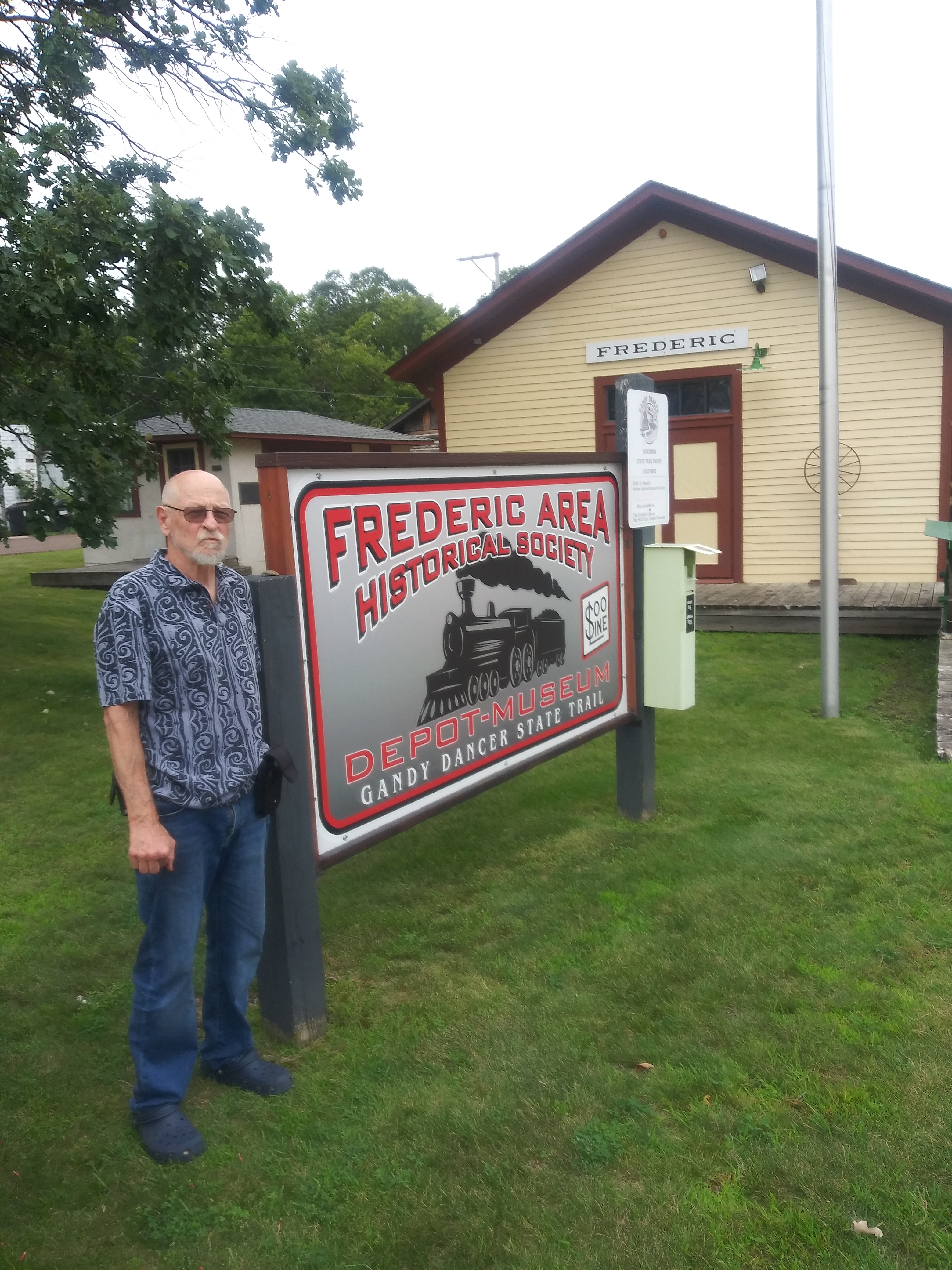
At first the bottle was kept in the historic Beans restaurant.  The bottle has now been moved to a new home in the Frederic Depot Museum.  This is a museum built in the old train depot where once upon a time you could ride a train from Minneapolis St. Paul to Superior Wisconsin and stop in a number of small towns along the Wisconsin side.  Frederic was one of these towns.  As of this writing, three of the men have passed away. This story is exhibited along with the bottle in the original case that Ken made. Someday, only one man will be left standing.  Whoever follows this story, please see that this bottle gets to the “last man standing.”

Date of this Story:  August 28, 2022

Author:  John Persico Jr.

Intriguing Stories for the 21st Century: To Make You Laugh, Cry and Think

51ByZkHiBwL

I have put together a selection of short stories that I have published over the years on my blog.  I thought it would be nice to have them all in one place.  If you have enjoyed any of my tales, I think that you will enjoy this book.  It contains 25 of my favorites pieces of writing. 


The fables in this book are unique and cover a wide range of topics.  It is a book of make believe that is designed to challenge the way that you look at life.  Some of these stories are Aesop like, and some are Mark Twain like.  Some of them will make you laugh.  Some will make you cry.  Some contain morals and parables that may help you think differently about your life and the world.


 Intriguing Stories for the 21st Century: To Make You Laugh, Cry and Think    Kindle Edition

by John Persico (Author), Socorro Luna (Editor) — Feb, 9, 2021, Kindle Edition, $4.99


If you prefer a paperback edition, it is available at the following link for $9.99

Intriguing Stories for the 21st Century: To Make You Laugh, Cry and Think

God, Guns and Gays

Have you noticed the increase in guns in the USA?  The increase in concealed carry laws and the increase in handguns sold seems to be paralleled by the increase in Gay marriage laws and the increase in Gay rights.  I bet most of you did not notice this fact.  I think it suggests something very obvious:  Gays are pushing for more guns on the streets because “Handguns lead to more Gay rights.”  That’s right folks, those people pushing for more permissive gun laws are the same people pushing for more Gay rights.  Fags want guns so that we will become powerless when they take over the USA.  (Listen to “Probably Gay, the Homophobia Song”)    alg-gay-marriage-jpg

“Any person 21 years of age or older, who is not prohibited possessor, may carry a weapon openly or concealed without the need for a license….A political subdivision may not enact any ordinance, rule or tax affecting the ownership, transportation, possession, purchase, transfer or use of firearms or ammunition.  In addition, a political subdivision of this state shall not require or maintain a record, list or database containing the personally identifying information of the person who buys, sells, leaves for repair or consignment or leaves for temporary storage, any weapon owned by that person.”  —- Arizona Gun LawNRA -ILA

That’s right!  It’s a plot by homosexuals (people who have only one sex) to subvert the USA and turn us into a country dominated by Gays who will have all the guns.  I will bet you did not notice that the guy you just saw walking around with the big Glock strapped to his belt was a Fag!  I have noticed that down here in Arizona with the most permissive gun laws in the USA that Gay men all have guns.  I am worried that I will be forced to suck cock by a Gay male with a big gun and thereby turned into a raving homosexual.  It is really scary.  I no longer feel safe on the street at night.  And did you know that it is all because of the religious right?

1 Corinthians 6:9-11
“Don’t you realize that those who do wrong will not inherit the Kingdom of God? Don’t fool yourselves. Those who indulge in sexual sin, or who worship idols, or commit adultery, or are male prostitutes, or practice homosexuality, or are thieves, or greedy people, or drunkards, or are abusive, or cheat people-none of these will inherit the Kingdom of God.” 

GAY MARRIAGE OPPONENT HOLDS SIGN IN PROTEST OUTSIDE STATEHOUSEThat’s right!  The religious right is behind Gay rights.  The religious right have created this problem with all their pompous ravings about God hating fags.  Now all the fags are getting guns to protect themselves from Gay hating gun toting Christians.  “When guns are allowed only Gays will have guns.”  More and more we keep hearing about how God has condemned Gays to a barren-less existence.  Gays cannot go to heaven.  Gays will be punished.  Gays cannot propagate.  Gays cannot spread the word of God or at least create more Gays or something like that.

After thinking and worrying about this problem for some time, I have decided to go right to the source of the problem.  That’s right, God!  If my pastor, priest, rabbi, swami, minister, shaman, or imam all say that God hates Fags, then I am going to find out why.  What has got God’s drawers all wadded up about Gays?  Was God molested by a Fag when he was young?  Or is God a closet Fag who has a subliminal hatred towards Gays because he/she (God just might be a Lesbian Fag) cannot admit his own sexuality.  Which way does God roll?   I have invited God down for an interview.  She/he graciously accepted.  The following is our conversation. TheInterviewWithGod

JohnThank you God for accepting my invitation to come down and talk to us today.

God:  No problem John.  I was just creating a few more universes.  Something I do in my spare time.

John:  Sounds like fun. I will bet that keeps you really busy.

God:  Not as busy as you might think. It only takes about six days and then I rest on the seventh.

John:  Well, I invited you here today to clarify a few points.  The major point is about homosexuals, fags, lesbians and Gays.

God:  Happy to answer any questions you have John.

John:  Well, there are many people who believe that the Bible is your word and in the Bible are many references to your hatred and animosity towards Gay people.

God:  Look John, I don’t deny that I gave some guidance to you people down here when it came to how to live a proper life, but you know as well as I do how screwed up communication can get.  “He said, she said, I said” and before you know it “God is against Gays.”  This Bible you talk about is not a very consistent book and much of what is in there is folklore or comes from your own twisted human interpretations of what I told the prophets.

John:  Let me give you a quote directly from the Bible:

gay men“If there is a man who lies with a male as those who lie with a woman, both of them have committed a detestable act; they shall surely be put to death. Their bloodguiltness is upon them.” — Lev. 20:13

God:   Did not your prophet Jesus say that I was a God of Love?  Why would I want anyone to be put to death?  You people down here have a penchant for killing.  I gave you all free will and you use it to maim, attack, hurt, malign, and murder with any number of rationales for your actions.  I created some people who are Gay and some who are straight.  Do you not think that I who have the power to create Heaven and Earth could have simply not created Gay people?

John:  Do you mean to say God that you could have just created all straight people and not put any Gay people on the planet Earth?

God:  What do you think John? I have created stars, galaxies, planets and universes beyond your imagination.  I created the first plants, animals and humans.  Could I not have simply created a planet with all Gay people or all straight people?  Did I need to let you have sex organs to populate your small planet?  Could I not have simply created six billion humans with no penchant or ability for sexual activity?

John:  Ah! I am glad you raised the issue of sexuality.  Can you tell me “why did you make us sexual creatures?”

God:  Isn’t the answer obvious John?  Look at all the fun you have with sex!  Sex is your biggest recreational activity.  And sometimes you get children out of these unions and sometimes you don’t.  Sex is fun anyway.  It says in your Bible that sex is for procreation but millions of you have sex every night with no intention of procreation.  In fact, from where I view the Earth, millions of you have sex every night with people whom you are not even married to and this when many of you are already married.

John:  Why create the possibility of recreating ourselves?  You could have simply made us immortal or simply replaced each of us as we died.  This would have saved a lot of problems for the human race.

God:  Have you not noticed how many of you love children?  I wanted to make life interesting for you.  What would your lives be without the children that many of you have?  Your children make you into mini-gods.  Parents are the gods to their children, like I am the parent to you.  I am your God and I am your parent.  But I never said that everybody would have children nor that there would not be many children without parents. There are good parents and bad parents.  That is the free will that I created for humanity.

John:  Well, Gays cannot have children through the natural birth process.

God:  So what!  Are there not many people who give up their children or children who do not have parents?  Many of you humans are not fit to be parents.

John:  Sounds like you are saying that you don’t have anything against homosexuality.

God:  I created homosexuals, bisexuals, heterosexuals, asexuals and many other kinds of sexuals. These are all my creations.  What is it your Bible says about God’s Creations?

“He has made everything appropriate in its time. He has also set eternity in their heart, yet so that man will not find out the work which God has done from the beginning even to the end. I know that there is nothing better for them than to rejoice and to do good in one’s lifetime.”Ecclesiastes 3:11

I did not say I made anything ugly or anything without a purpose.  You might never understand my reasons or purposes because they are beyond human understanding.

Think-about-it-gay-rights-33482870-430-336John:   Well God, we have a lot of people down here speaking in your name that are preaching hatred for Gays as well as preaching many other types of hatreds.

God:   I sent Jesus to straighten this all out but you simply crucified him.  Nailed him to a cross.

John:  Could you send someone else down to tell all these would be Christians to leave Gay people alone and let them live their own lives?

God:  Look around and you will see that I already have.  You humans have hard hearts unless of course one of your own is Gay and then that seems to change everything.  I may have made a mistake when I gave you all free will because you seem to use it mostly for doing evil rather than doing good.

John:  Would you send another flood or perhaps a large earthquake or meteor to destroy the world and start over?

God:  Perhaps, but only if I thought things were so hopeless here and that everything you were doing was evil.  I still see a great deal of potential in humanity.  There are many good people among you who spread love and not hate.  Many of you who are not Gay haters or religious bigots or racists or zealots. I would never destroy your world when there are so many good people trying to make my world a better place.

John:  Then to summarize.  You don’t hate Gays?

god loves everyoneGod:  I have no concept of the word “hate.”  You are all my creatures.  Everything that crawls, digs, walks, swims or flies is something that I created and something that I love. 

John:  Thank you God for taking the time to meet with us today and give us your thoughts. 

Time for Questions:

Do you hate Gays? Why?  Do you think Gays should not be allowed to marry? Why? If you do not hate Gays, what do you do to help them in their fight against prejudice and discrimination?  You cannot sit on the fence and do nothing.

Life is just beginning.

“Perhaps we should worry less about judging people for being Mormon or Baptist or Muslim or gay or straight or black or white or Latino or by their religious or political brands and worry more about electing thoughtful, serious and ethical politicians on both sides of the political isle who are willing to work together for progress.” —- Charity Sunshine Tillemann-Dick

“I believe marriage is between a man and a woman. I am not in favor of gay marriage. But when you start playing around with constitutions, just to prohibit somebody who cares about another person, it just seems to me that’s not what America’s about. Usually, our constitutions expand liberties, they don’t contract them.” —- Barack Obama


Gandhi’s Sixth Social Sin: Worship Without Sacrifice

I find it surprising that I am writing about Gandhi and his ideas.  Surprising in that while growing up I was as far from a non-violent philosophy as anyone could be.  Sometimes it seemed like my whole life was violence, anger and fighting.  I joined the military out of high school and hoped to kill as many “commies” as I could.  I continued my violent ways for many years and to be honest I am still no pacifist.  I would not turn the other cheek once if you hit me, never mind 40 times. I am still on the border line about capital punishment.  One day I think Capital Punishment is terribly useless institution made even worse by its ineffectiveness at deterring crime. The next day I read of some horrendous crime that I feel can only be rectified by punishments that go well beyond the heinousness of legal murder.  If Gandhi were my father, he would surely disown me. 

Gandhi is one of those heroic icons who cannot be ignored.  Whether you believe in his ideas or not, you cannot deny that he tried to live according to his beliefs.  More important was that he lived to help others have a better life.  Everything Gandhi did paid evidence to his ideology that humans could be better than they were.  I know many people who think that educators, psychologists, social workers and other “human service” workers are just a waste of taxpayer money.  These same people are continually on the front line for more prisons and more military hardware.  It is evident to such people that humans can not improve and thus the only betterment of humanity lies in more weapons, more police, more military and more guns.  Gandhi would have professed the exact opposite and worked to create a world that was non-violent and where disputes could be resolved by civil discourse.

Years ago, I dropped my belief in God and in religions.  I came to the conclusion that the first did not exist and the second was evil. It seemed to me that much of the misery on the earth came from one or the other of the major religions.  The crusades, the inquisition, the Protestant Catholic wars, the wars against “Pagans” all showed me conclusively that religions did more harm than good. When I joined the military, I would not speak to any clergy and when they came around; I always avoided them.  I was even rude to them at times as I regarded them as hypocrites.  My first wife and I did not practice any religion together but I did bring my daughter around to several different religious venues as I wanted to at least expose her to them.  My second marriage was to a more deeply religious woman who practices her faith regularly by participating in church affairs and helping out at many church functions.  I often kid her about some of these events but I have come to a different point in my life regarding their benefit to the world.  I am somewhat less judgmental about religions and people then I was in my younger days. 

What does this mean for me about religions and how I regard them today?  I can say with sincerity that I still see much evil that comes out of religion, not to mention its ongoing hypocrisy (for instance where were all the churches and ministers when we invaded Iraq both the first and second times?).  However, I also see many good things that they now do, from supporting health care for poor people to championing efforts to feed people both domestically and abroad.  There are many other examples of good things that are done by churches and religious leaders.  So what does Gandhi mean by “Worship without Sacrifice?”  Is Gandhi against organized religion?  Here is the description from the Gandhi Institute for Nonviolence that summarizes Gandhi’s ideas in respect to his Sixth Social Sin: 

“Worship without Sacrifice: One person’s faith is another person’s fantasy because religion has been reduced to meaningless rituals practiced mindlessly. Temples, churches, synagogues, mosques and those entrusted with the duty of interpreting religion to lay people seek to control through fear of hell, damnation, and purgatory. In the name of God they have spawned more hate and violence than any government. True religion is based on spirituality, love, compassion, understanding, and appreciation of each other whatever our beliefs may be — Christians, Jews, Hindus, Muslims, Buddhists, Atheists, Agnostics or whatever. Gandhi believed whatever labels we put on our faith; ultimately all of us worship Truth because Truth is God. Superficially we may be very devout believers and make a tremendous public show of our worship, but if that belief, understanding, compassion, love and appreciation is not translated into our lives, prayers will have no meaning. True worship demands sacrifice not just in terms of the number of times a day we say our prayers but in how sincere we are in translating those prayers into life styles. In the 1930’s many Christian and Muslim clergy flocked into India to convert the millions who were oppressed as untouchables. The Christian clergy stood on street corners loudly denouncing Hinduism and proclaiming the virtues of Christianity. Months went by without a single convert accepting the offer. Frustrated, one priest asked Grandfather: After all the oppression and discrimination that the ‘untouchables’ suffer under Hinduism, why is it they do not accept our offer of a better life under Christianity? Grandfather replied: When you stop telling them how good Christianity is and start living it, you will find more converts than you can cope with. These words of wisdom apply to all religions of the world. We want to shout from roof-tops the virtues of our beliefs and not translate them into our lives.”

Gandhi’s words remind me of a comment by Sitting Bull. When asked what he thought of Christianity he replied:   “From what I have read it is an admirable religion, however I do not see any white people practicing it.”  From a Native American perspective, the only thing the conquerors religions offered was a destruction of their habitats and lifestyles.  Witness the coming of the Spanish to the “New World” and the systematic destruction of the culture and religions that already existed by the Spanish military and their allied missionaries.  The genocidal destruction of indigenous peoples throughout the world is full of pompous and pretentious efforts to “convert” and save them from their evil ways.  In reality, religion only provided an expedient excuse to separate them from their lands and gold.  We have in much of the history of organized religion a clear example of what Gandhi meant by Worship without Sacrifice.

Perhaps surprising to some though, true Christianity is firm that Worship without Sacrifice is worthless: 

“What good is it, my brothers and sisters, if someone claims to have faith but has no deeds? Can such faith save them? Suppose a brother or a sister is without clothes and daily food.  If one of you says to them, “Go in peace; keep warm and be well fed,” but does nothing about their physical needs, what good is it?  In the same way, faith by itself, if it is not accompanied by action, is dead.


But someone will say, “You have faith; I have deeds.”

Show me your faith without deeds, and I will show you my faith by my deeds.  


You believe that there is one God. Good! Even the demons believe that—and shudder.


You foolish person, do you want evidence that faith without deeds is useless?  Was not our father Abraham considered righteous for what he did when he offered his son Isaac on the altar?  You see that his faith and his actions were working together, and his faith was made complete by what he did.  And the scripture was fulfilled that says, “Abraham believed God, and it was credited to him as righteousness, and he was called God’s friend.  You see that a person is considered righteous by what they do and not by faith alone.”

                    James 2:14-26- New International Version

Abraham was willing to sacrifice his son for his religious beliefs. This is Worship with Sacrifice.  Going to church on Sunday or simply reading the Bible is Worship without Sacrifice.  When Jesus said that the two most important Commandments were Love God and Love Everyone, he meant you had to practice your faith by helping others who were less fortunate.  This has made it very difficult for most of humankind to be his followers in deed as well as in professed belief.  It is far easier to say “I am a Christian, then to “Sell your belongings and give to the poor, and you will have treasure in heaven. Then come, follow me.”  It is much easier to pray, worship, and read the Bible than to actually practice what Jesus was saying.  Think for a minute what it would mean if all would be Christians really practiced the “Love Everyone Commandment?  A short list of the consequences of this would mean:

  • No religious wars
  • No Jihads
  • No terrorism
  • No murders
  • No rapes
  • No assaults
  • NO WARS PERIOD

Can you imagine a world without these problems?  This is the world we would have if everyone practiced their religions by deeds and not just words.  However, this would require sacrifice and too many people are not really willing to sacrifice for their religion, for Jesus or for God.  Sacrifice means giving up something to help others, not giving up something to gain something for you.  Those who blow up their bodies to attain paradise with 40 vestal virgins are not sacrificing for others; they are simply trying to take a shortcut to attain what other greedy people already have.  Any religion that terrorizes others in the name of “whoever” or “whatever” is evil regardless of what it calls itself.  This raises the question that might be phased as “What is the purpose of religion.”  Searching the web it is easy to find that many have condemned organized religion because of the atrocities associated with it. Great thinkers from Plato to Thomas Jefferson to Bertrand Russell have had little good to say about religions.  However, I like the following comment from WaheguruNet regarding what positive role religion could and indeed should play in society:

“Religion has and continues to impact almost every aspect of human civilization in both positive and negative ways. The great spiritual masters from all traditions have taught that we need to adopt and develop higher qualities of love, mercy, generosity, kindness and so on. These higher qualities are a natural byproduct of developing a deeper connection with our spiritual nature and so in this respect religion can be thought of as a vehicle to support our spiritual development and our re-connection with divinity.  In this way, human beings will be better at working together to create a better and more harmonious world.”

You will notice that in this purpose there is nothing mentioned about doom and destruction  or about going to hell and suffering for the rest of your life or about your neighbor who is a hypocrite and unlike you is destined for fire and brimstone.  The purpose of religion is to help us become better people. To help us find our connection to our inner spirit and to help guide us in living a more just and moral life.  This purpose must be followed by actions and deeds as well as pious readings and professed beliefs. There is no room Gandhi’s religion or Jesus’s religion for bigotry, discrimination, prejudice, hatred, intolerance and destruction of others or their belief systems.   

Time for Questions:

What can we do to practice good deeds as well as good thoughts? What sacrifices are you willing to make to help others?  Are we making a true sacrifice by telling others how hard we worked and that they can be what we are if they only try?  Should we simply tell others to pull themselves up by their boot straps?  Are all people really created equal in the sense that everyone has an equal chance at health and happiness?  Can we help make it so by sharing what we have with others?  

Life is just beginning.