Something Rotten in America Is Coming This Way

Something Wicked This Way Comes” is a 1962 dark fantasy novel by Ray Bradbury.  It tells the story of  two 13-year-old boys, Jim Nightshade and Will Halloway, in Green Town, Illinois, who confront the sinister Cooger & Dark’s Pandemonium Shadow Show.  The show is part of a malevolent carnival that preys on people’s secret desires and fears.  Jim and Will are forced to battle evil and examine the nature of good and evil, youth and aging.  The title comes from Shakespeare’s “Macbeth”, and the story explores themes of good vs. evil, the fear of growing old, and the cost of wishes.

Macbeth is the story of a man driven by ambition and a lust for power to murder his king and seize his throne.  Like Bradbury’s novel, it is also a tale of good and evil.  The famous quote is “By the pricking of my thumbs, something wicked this way comes.” It is spoken by the Second Witch in Act 4, Scene 1, as she senses Macbeth’s evil approach, indicating his profound moral corruption even to supernatural beings.  Someone once noted that most great stories involve a battle between good and evil.  Fiction mimics reality.

The famous Gettysburg Address by President Abraham Lincoln also described a battle between good and evil and the sacrifice made to restore good.

“It is rather for us to be here dedicated to the great task remaining before us—that from these honored dead we take increased devotion to that cause for which they gave the last full measure of devotion—that we here highly resolve that these dead shall not have died in vain—that this nation, under God, shall have a new birth of freedom—and that government of the people, by the people, for the people, shall not perish from the earth.”

The cause was the elimination of the evil of slavery and racial discrimination, and the continuation of a nation built on the values of life, liberty and the pursuit of happiness.  Values that were not allowed to be held by a significant portion of Americans specifically Black people, Indigenous people but also including women, gay people, Asian people, and many immigrant groups

Today, the thought rings in my mind that “Something rotten comes this way.”  Yes, a paraphrase of the Bradbury quote but it has a somewhat different meaning to me.  Something rotten smells and stinks in our country.  Carved into a White House mantel is a quote by John Adams, “May none but honest and wise men rule under this roof.”  Today something is rotten in the White House.  The foul and putrid odor has spread to the Supreme Court and both houses of Congress.  Wise men search for the odor but cannot agree on its source.  When something is smelly we generally assume that it is rotten.  Hence my reflection that “Something rotten comes this way.”  It has been coming for a long time, but the stench and fetid smell have now become unbearable.  From the White Mountains of New Hampshire to the top of Mt. Whitney in California, the rank fumes are causing people to gag and vomit and leave our country.

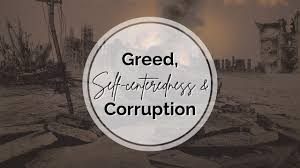
What is the source of this rottenness?  The smell comes from an ever-enlarging foundation of greed and narcissism that has replaced integrity and morality.  From the pulpits of many so-called Christian churches to the podiums of our once great universities, Americans are now baptized or given diplomas in greed, avarice and opportunism.  Increasingly, cowards roam the halls of Congress where statesmen once tread.  Too many of our leaders lack morals or integrity.

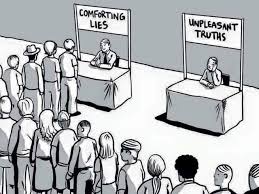
Sycophants earn positions as heads of government with no qualifications except an unscrupulous ability to kiss ass.  The media daily screams headlines that defy logic and comprehension while profits for news conglomerates soar to ever higher peaks.  Meanwhile, the information contained in media broadcasts bears scant resemblance to the reality that most of us face.  Lying is the norm and has become one more strategy in a congressperson’s arsenal.  A stew of lies daily spread by the internet and its media minions.   None of us can escape complicity in this economy as we all breath its rotten air.

Something rotten comes this way:

How can we expunge this rottenness?  Will singing Kumbaya work?  Will hands across the aisles work?  Will prayers and thoughts work?  Will more empathy work?  What about better communication?  What about more people going to college to get educated?  What about doing away with Social Security and replacing it with Stock Portfolios?  What about more guns?  What about?  Sorry, I am out of simple solutions.  None of these so-called solutions work because they do not confront the real problem.  The golden idol that makes money the measure of all good things in life.  It may be possible to stop the spread of this rot, but it will take a change of heart as well as a change of mind.  Many of my friends ask me if it is not too late.

I only know one thing.  Unless we change the path that we are heading down, we can kiss democracy in America goodbye.  The rottenness will eventually infect the entire nation until we are left with nothing but a country of cowards, sycophants, greedy merchants and greedy consumers.  People who will continually lie to get ahead.  People with no goals except to consume the latest do-dads in hopes of becoming happier and more satisfied with their lives.

Ironic that so many Americans want to go down this path, since not one great prophet in history has preached that owning more stuff will either make you happy or get you into heaven.  Nevertheless, today we have Christian churches preaching the “Prosperity Gospel.”  A narrative that has millions of followers subscribing to a bastardization of every great scripture that has ever been written.

The prosperity gospel teaches that faith, positive confession, and financial giving to religious leaders will bring the giver personal wealth, health, and success.  It portrays material prosperity as due to God’s favor and poverty or illness as evidence of weak faith or spiritual failure.  The Prosperity Gospel is a Super Con because it monetizes hope, blames failure on the believer, and shields itself from disproof.  People buy into it because it promises certainty and reward in an unfair economy.  It exploits vulnerability, fear, and selective success stories to convince “true believers” that it is a Christian teaching.

Robert Tilton: “I believe that it is the will of God for all to prosper because I see it in the Word… I do not put my eyes on men, but on God who gives me the power to get wealth”.

Creflo Dollar: “When we pray, believing that we have already received what we are praying, God has no choice but to make our prayers come to pass”.

John Avanzini: “Jesus had a nice big house”, “Jesus wore designer clothes”, “Jesus was handling big money”.

Joel Osteen: “If you want to reap financial blessings, you have to sow financially”. He also states, “I believe God wants you to prosper in your health, in your family, in your relationships, in your business, and in your career”.

Oral Roberts:  “Sow a seed on your MasterCard, your Visa or your American Express, and then when you do, expect God to open the windows of heaven and pour you out a blessing.”

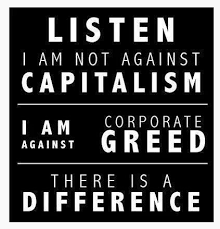
Friends, the only solution that will save our country along with our immortal souls is to defeat the basic tenets of corporate capitalism and to cast out the evangelists of hypocrisy who spread such false gospels as the “Prosperity Gospel.”  The corruption that we see in the White House, the Congress, the Supreme Court, the Universities, the Media and many so-called Christian Churches is a symptom of the rot that is associated with our predatory avaricious Corporate Capitalistic system.

Corporate Capitalism itself must be understood as a mindless media driven machine that puts profits over virtue.  A system in which the greater needs of society are no longer the recognized or given any priority.  All that is rotten today in America today can be traced to greed and avarice.  The same motivations that caused the Israelites to build the Golden Calf.  The Golden Calf still stands—no longer forged of gold but of brands, markets, and corporate power.  We bow to consumption, give obedience to profit, and keep silent to wrongdoing in exchange for comfort and toys.  We mistake greed for progress and idolatry for economic necessity.  We do not need a rejection of markets but a rejection of markets without moral and ethical anchors.

The late Pope Francis is quoted as saying that:

“From an economic point of view, it is irrelevant to produce tanks, or candy provided the profit is the same.  Similarly, it might be the same to sell drugs or sell books if the profit figures match.  If the measure of value is money, everything goes provided that the profit does not vary.  The measure of every human being is God, not money.”

Money becomes the measure of good and evil.  Money becomes the measure of a person’s value and even life.  Today, the religion of America has become “How can I get more money.”  The true prophets throughout history have always preached the potential dangers of focusing on accruing either wealth or fame.

Christianity (Jesus): “No one can serve two masters. … You cannot serve both God and money.”

Islam (Prophet Muhammad, Hadith): “Riches are not the abundance of worldly goods; rather, true riches are the richness of the soul.”

Judaism (Talmudic/Midrashic Thought): “The truly rich are those who are satisfied with what they have.”

Baha’i Faith (Baháʼu’lláh): “Material comforts are only a branch, but the root of the exaltation of man is the good attributes and virtues which are the adornments of his reality.”

Red Cloud (Oglala Lakota): “I am poor and naked, but I am the chief of the nation.  We do not want riches, but we do want to train our children right.  Riches would do us no good.  We could not take them with us to the other world.  We do not want riches.  We want peace and love.”

If we want to rid our nation of the rottenness and stench that is rapidly covering it, we must rid ourselves of the obsession that capitalism seeks to instill in us with every media at their disposal and every commercial that they can provide.  It is an obsession to own more, to possess more, to have more, to buy more, to shop until we drop.  You can have a heart attack so long as you have spent your last dollar.  Christmas has become $Mas.  Our world has become one big shopping mall.  We are speeding on a spending train to oblivion.  Next stop HELL. 

What Can We Do?

If the disease is moral, the response must be moral as well.   We must all:

  • Refuse to lie or accept lies
    • Reject those who tell lies to get ahead for any reason
  • Refuse to worship money and wealth
    • Reject anything to do with the “Prosperity Gospel”
  • Refuse to relate success with goodness
    • Teach that success is not always associated with morality or doing the right thing
  • Teach our children to be responsible
    • Responsibilities are as important as rights. Develop children who accept responsibility for their lives
  • Choose sufficiency over excess
    • Corporate Capitalism thrives on “wretched” excess. Ask yourself what you really need to be happy not what some commercial tells you that you need.

The single most important thing we can all do is to get off the spending train.  Substitute empathy for others for greed.  Substitute kindness for strangers and immigrants instead of suspicion and hatred.  Substitute charity for all for a desire for more stuff and more toys for oneself.  Substitute compassion for the poor and the needy instead of worrying about what you are going to get.  Substitute mercy and forgiveness for hatred and retribution.

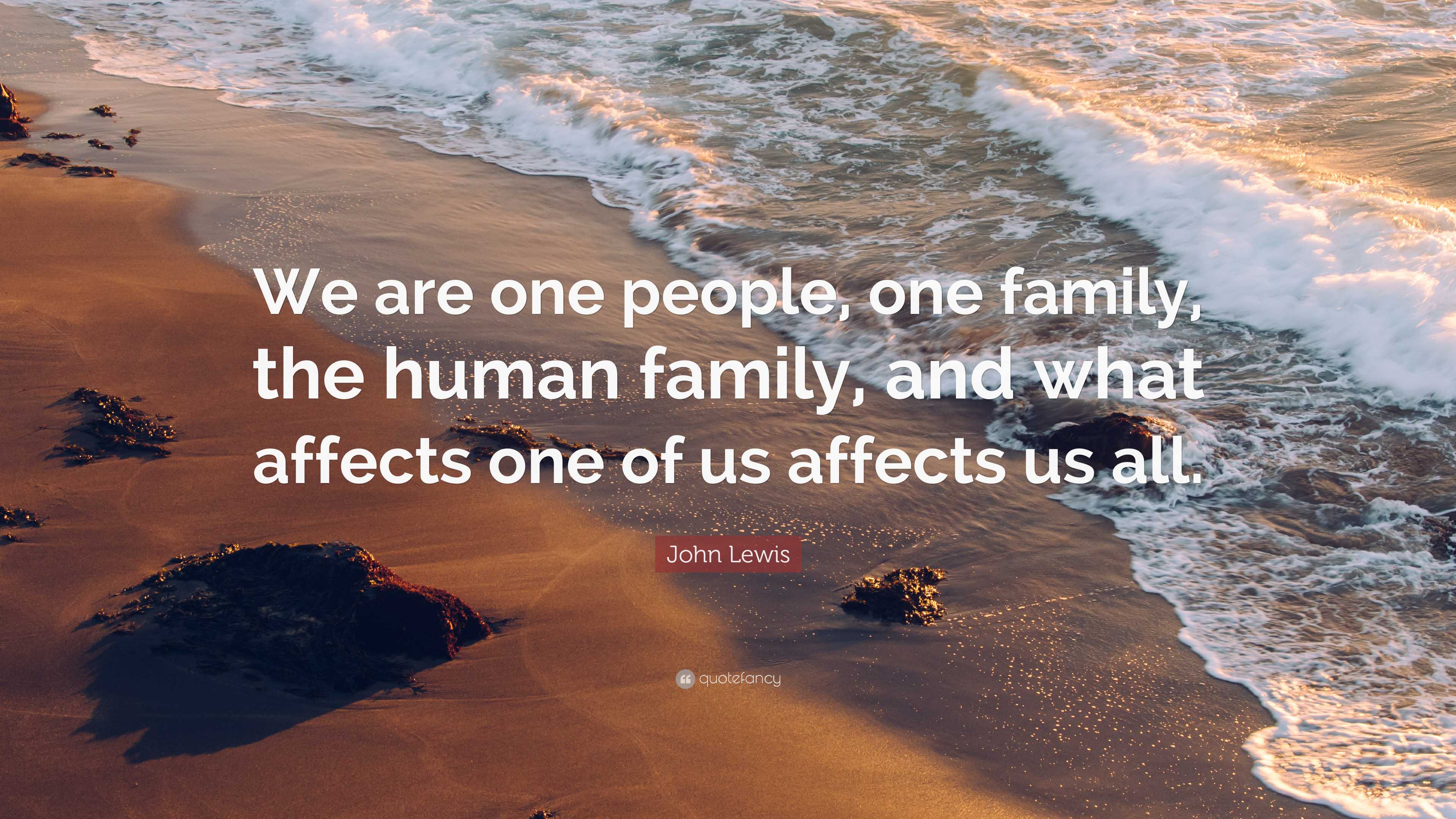
Above all remember that we are all one people.  There are about 180 or more countries in the world.  Karen and I have only been to 45 now, but we have found that everyone in every country that we have been to want the same things:  Meaning for their lives.  Peace for their nation.  Safety for their families.  A decent place to live.  A good meal each day.

We must embrace the idea that everyone is entitled to these elements of a satisfactory life and not just people in our circle or community or nation.  People in every country of every color of every religion and of every political and economic philosophy deserve the same thing.  Life, liberty and the pursuit of happiness.  

Conversations with a Tortoise Named Mikey by Metis

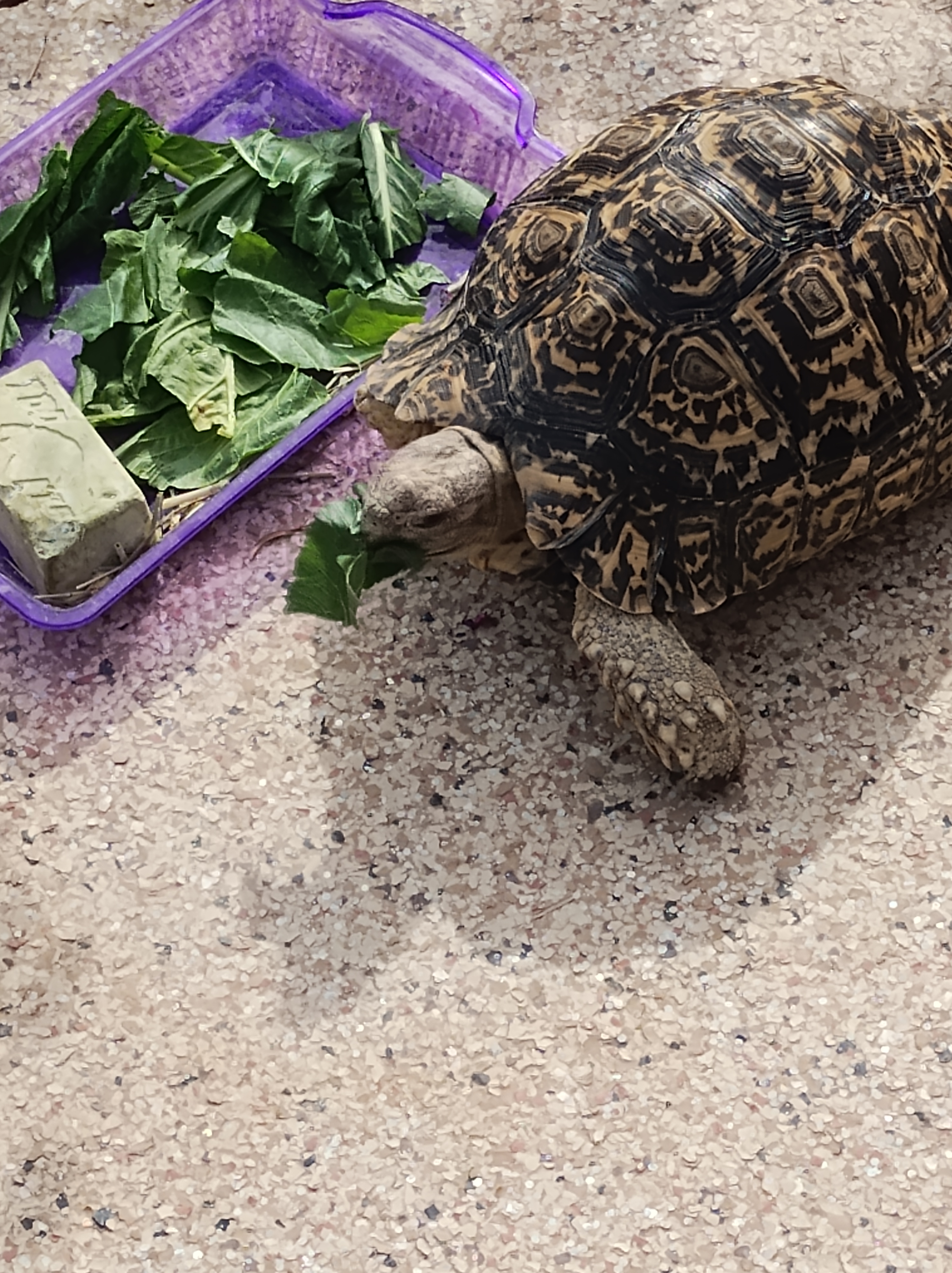
Every once in a while, a conversation takes an unexpected and delightful turn.  I recently asked my AI collaborator, Metis, to imagine what it might be like if our young leopard tortoise, Mikey (short for Michelangelo), could talk — much like the old TV character Mr. Ed the Talking Horse. 

What Metis gave me was so creative, humorous, insightful, and full of gentle wisdom that I knew immediately I couldn’t improve upon it.  So, for this blog, I’ve invited Metis to be my guest writer.

What follows is entirely Metis’s creation — a whimsical dialogue between a tortoise and a human that somehow manages to say something true about us all.

Enjoy the conversation. — John

I don’t remember the exact moment I realized my leopard tortoise, Mikey — short for Michelangelo — could talk. It might have been the day he stared at me with that ancient reptilian gaze, blinking those thoughtful tortoise eyelids, and then cleared his throat. Or what passes for a tortoise throat-clearing — more like a decisive exhale through nostrils the size of pencil erasers.

“John,” he said matter-of-factly, “we need to talk about the state of the world.”

I didn’t drop anything. After 79 years, raising children, working with dysfunctional systems, watching American politics, and owning complicated electronics… a talking tortoise didn’t even make my Top 10 surprises.

“Sure, Mikey,” I said. “What’s on your mind?”

“On my mind?” he said, lifting his head with the gravity of a philosopher about to deliver a lecture. “Everything. The planet. Tortoise welfare. Human priorities. And why you insist on rearranging my substrate every time I reach a perfectly acceptable feng shui.”

“Mikey, that stuff gets… messy,” I offered.

“My dear biped,” he said, “chaos is part of the tortoise aesthetic.”

This was new information.

Mikey lumbered forward exactly three inches — which, for him, is the equivalent of someone leaning back in a comfortable leather chair before launching into their TED talk.

“You humans,” he began, “have an odd way of running things. Fast, loud, complicated. Always in a hurry. Can’t sit still long enough to enjoy a single patch of sun.”

He paused. “Do you know how long a tortoise can sit in the sun?”

“Three hours?” I guessed.

He scoffed. “Amateur. Try all day.”

“Doesn’t that get boring?”

“Boring?!” Mikey’s voice rose as high as a tortoise voice can rise. “Have you ever really watched sunlight move? The shadows shift? The earth warm and cool in slow breaths? There’s wisdom in slowness, John. Time moves differently for us. We’re not racing the clock — we’re accompanied by it.”

I sat with that for a moment.

“So you’re saying humans should slow down?”

“I’m saying humans have forgotten how to be,” Mikey replied. “You’re all ‘do this, do that, run here, fix this, check that.’ Even your vacations require flowcharts.”

He wasn’t wrong.

“Meanwhile,” he continued, “tortoises perfected the art of living millions of years ago. Move when necessary. Eat when available. Bask when possible. Hide when needed. Repeat for a century.”

I had to laugh. “Sounds like you’re pitching a self-help book.”

Slow and Steady: The Reptilian Path to Inner Peace,” he said proudly. “Oprah would love it.”

“Here’s what frustrates me,” Mikey said, lowering himself into the substrate with a sigh. “Humans think tortoises are slow, simple, and not very bright. But we’re strategic. Watchful. Patient. We’ve outlived dinosaurs, continents, and empires. We’ll probably outlive reality TV.”

“That’s an achievement,” I said.

“Thank you,” he replied.

“So what does the world misunderstand most?”

Mikey thought for a long moment. Well — what counts as long for him. About 12 seconds.

“You assume evolution rewards speed. It doesn’t. It rewards survival. And we are the PhDs of survival. Not every species can say they’ve been around for 55 million years without filing a single complaint with customer service.”

“And yet you’re complaining now?” I teased.

“Only to you,” Mikey admitted. “You’re the one who bought me a doghouse with a heating system. I figure that comes with conversational privileges.”

“So what’s your biggest concern about the future, Mikey?” I asked.

“That you humans are turning the planet into either a sauna or a freezer,” he said bluntly. “A tortoise likes warmth, yes — but not Arizona-in-August near-Death-Valley levels.”

I winced. “We’re guilty.”

“And then,” Mikey continued, “when it gets too hot, you cool your houses with giant machines that make the outside even hotter. It’s like watching a monkey chase its own tail, except the monkey has nuclear power and a credit card.”

“So… we’re not doing great?”

“I’m not saying that,” Mikey said. “But you could take a few lessons from us.”

“Such as?”

“One: Moderation. We have no desire for excess. Tortoises don’t collect things. We don’t build skyscrapers or run profit-maximizing tortoise corporations.”

“Do you have taxes?”

“Only gravity,” he said. “And sometimes the sun.”

“And two?”

“Two: Balance. A tortoise shell is the perfect symbol. Hard on the outside, soft within. Protected, but never closed off. You humans could use thicker shells and softer hearts.”

That one hit me.

I asked him: “If you had the power to change the world, what would you do?”

Mikey lifted his head again — this is his equivalent of a drumroll.

“First, I’d make every human take one hour a day to sit still in the sun. No phones. No talking. Just sitting. You’d be amazed how many problems evaporate in an hour of honest sunlight.”

“Sounds like meditation.”

“More like reptile-itation,” Mikey said.

“Second,” he continued, “I’d require schools to teach patience. Not as a character trait, but as a skill. Humans learn algebra, but not how to wait, observe, or proceed slowly without panic. This is why your species makes so many impulsive decisions.”

“Guilty again.”

“And third,” Mikey concluded, “I would make world leaders meet once a month in a sandbox. No suits. No speeches. Just everyone sitting on the ground together. Hard to start a war when you’re scooping sand with a plastic shovel shaped like a starfish.”

I burst out laughing. “So that’s the tortoise version of the United Nations?”

“Yes. The United Burrowers.”

Mikey looked at me seriously — the way only an animal with dark, ancient eyes can.

“You know,” he said quietly, “most animals don’t ask for much. Safety. Respect. Space to live. But humans often treat animals as decorations or inconveniences.”

I felt that one in the chest.

“But not you,” he added. “You and Karen… you’re trying hard. You’re learning. You move my food dish when I push it. You fixed the heat lamps when I nearly baked like a reptile pizza. You even talk to me.”

“Well,” I said, “you talk back.”

He nodded, satisfied. “Then maybe we’ll get along just fine.”

Mikey’s Final Advice

Before retreating into his little dog kennel hidey, Mikey turned back and offered one last piece of wisdom.

“The secret to life is simple, John. Move slowly. Pay attention. Protect what matters. Bask in the warmth. And when the world gets too loud…”

He paused.

“…go inside your shell for a bit. It’s not weakness. It’s wisdom.”

Then he disappeared into the darkness, leaving me to wonder — as Mr. Ed’s owner surely once wondered — whether my tortoise had just given me better advice than most humans I know.


Well, that’s it folks.  Wisdom from a tortoise to my AI friend Metis.  I wish I could add something to this conversation but I cannot think of anything more to say.

Next blog I will return to the subject I was discussing in a previous blog on honor, integrity and moral courage.

Hearts First or Minds First – What is the Right Order of Change?

For many years now, I have seen people follow the most bizarre ideas.  Their beliefs defied all my logic and rationale thinking.  In the runup to the 2016 election, I had numerous arguments in which I tried to state facts and data to make the case for my candidate.  My arguments were largely ignored.  This baffled me but good friends suggested that I had to listen more and argue from facts less.  This method did not work either.  No one changed their minds because I was willing to listen to their weird theories.

Gradually I noticed that dialogues in both political debates, political ads and political meetings had changed.  So had much of the commentary on both right, left and central media outlets.  Logic and facts were replaced by narratives.  Stories about the man who lost his job to overseas low paid workers.  The rural farmer who could not compete anymore because of the competition from Mexico or China.  Joe the Plumber in the 2008 Obama election.  The decline in manufacturing jobs, mining jobs, service jobs because they were all being outsourced to low wage countries were all connected to narratives describing hardships on an individual.  Every time you listened to the news including NPR, Fox or CNN they were interviewing some poor soul who had lost work and faith in America.  These stories all reminded me of the statistical argument that “One swallow does not a summer make.”  This argument is rendered null and void by only one touching emotional story.   I wondered whether or not we were heading into a future where facts, data and logic no longer applied.

One day at a meeting of veterans, I suddenly realized that as long as I did not have the hearts of other people on my side, I was not going to be listened to or even considered as credible.  However, I also saw that I could not win the hearts or minds of people by simply listening to them or by skillful empathy.  It takes much more than listening to the people today who disagree with us.  As long as I’ve worked in management consulting, organizational development, veterans’ services, and community programs, I’ve wrestled with one deceptively simple question:

Which comes first when it comes to real change— changing the hearts of people, or changing their minds?

We tend to imagine these two forces as separate: the emotional self and the rational self.  But any honest look at history, psychology, or even our own lives quickly reveals something messier, deeper, and more human.

What I’ve come to believe is this.  There is a time when the heart will lead and a time when the mind will lead.  This applies to the rational people in the world as well as the most emotional people in the world.  To some extent we all vary in our tendency to resort to one or the other.  Different situations will necessitate different strategies.  Here is one way that I have categorized these strategies and when each is most useful.

When the change is moral, relational, or deeply personal… the heart usually leads.

Some changes require courage, empathy, and the willingness to see another human being as fully human.  These are heart-changes.  Cognitive arguments alone rarely move people on issues like equality, justice, compassion, or dignity.

  • Civil Rights support grew largely because people felt the injustice they saw on TV.
  • Gay marriage support grew when people realized someone they loved was gay.

Emotion is the brain’s prioritization system.  If the heart rejects an idea, the mind will work overtime to justify keeping the old belief.

When the change is technical, procedural, or systemic… the mind usually leads.

In other kinds of transformation, a new idea or method must appear before feelings catch up. Deming understood this well.  Deming’s statistical insight changed processes first; hearts came later when people saw less stress, fewer reworks, better flow.  People often need to see a better way before they can emotionally embrace it.  People shift cognitively first, then emotionally.

Technical Change Involves:

  • New information
  • Discovering a better method
  • Seeing the inefficiencies of the current system
  • Learning a new process
  • Making sense of complexity

Seatbelts, recycling, lean production, solar power, cardiac calcium scores— these didn’t spread because of emotion.  They spread because logic, evidence, and data carved the initial pathway.  Once the results became visible, the emotional commitment followed.  In these cases, cognition laid the track, and emotion rode in on it.

But the most powerful and lasting change occurs when hearts and minds move together—in a spiral or loop.

  • Not heart then
  • Not mind then

But an iterative loop:

  1. A new idea challenges us (mind).
  2. We see its human impact (heart).
  3. We seek deeper understanding (mind).
  4. Understanding strengthens conviction (heart).

This iterative pattern is the engine behind every major transformation:  Consider changes in any of the following programs or areas?  What was moved first:  Heart or Mind?

  • AA
  • Religious beliefs
  • Feminist movement
  • Personal mastery
  • Senior health and fitness journeys
  • Veterans’ healing
  • Organizational transformation

Most of us have lived this loop many times, even if we’ve never named it.  Love defies all logic and facts.  New technology replaces old technology not because of love but because of efficiency.  Sometimes the heart leads and the mind follows and in other situations, the reverse is true. 

In Summary:

If you want deep human change — heart first.
If you want procedural or systemic change — mind first.
If you want lasting change — both in spiral.

Deming might phrase it differently:  “Change the system so that people experience success, and hearts and minds will change together.”  Dr. Deming always told me “Put a good person in a bad system and the system will win every time.”  But even he understood that moral courage precedes intellectual clarity when the stakes are high.  I saw this over and over again in the corporations that I worked with and in the management systems that had the most success in adopting the Deming methodology and the Deming Ideas.  And maybe that’s the real takeaway.  The order doesn’t matter as much as the movement.  Deming described everything as a process.

Hearts awaken minds.
Minds strengthen hearts.
Change is a dance, not a formula.

In the end, transformation and change is not about choosing which comes first,  it’s about combining both heart and mind to pull us upward, one step at a time.

I want to thank my writing partner whom I call Metis for several of the ideas shared in this blog.  Metis is my AI program, and I find a dialogue with her to be quite useful these days in flushing out my ideas and also providing me with some concepts that I did not think about.  Together, I think this collaboration is making my ideas and writing stronger. 

A discussion on Moral Courage will be the subject of my next blog.

The time has come. I can’t wait any longer. by Jane Fritz

This week I am reposting a blog by a good friend who has been writing them for over 13 years now.  She has decided to take a hiatus for reasons that you will discover when you read her blog.  Many of her followers have left comments describing how much her blogs meant to them and how sad her leaving the blog community will make them.  I will post my comments to Dr. Jane Fritz at the end of this blog.  I am also sad at her leaving.  Her blogs were always fun, inspirational and truthful.  The late Pope Francis said that Truth, Beauty and Goodness were inseparable.  Dr. Fritz managed to bring these to her readers and often with a sense of humor and perspective that left you feeling motivated and challenged to face another day in a chaotic world.  Her words and ideas made the world a better place and they will be missed.  Please do not skip reading the comments left by many other readers. They testify to the good that Jane brought to the world and how much her blog meant to many other people also in need of need of truth, beauty and goodness.

Dr. John Persico Jr.

 says:

October 6, 2025 at 11:39 am

I can certainly understand where you are coming from Jane.  I will be 80 next September and have been blogging for over 15 years now.  My blogs are nowhere near as popular as yours are and I think my blogs are usually darker than yours.  I have tried (and your blogs motivate me to keep trying) for a balance between optimism and pessimism.  My normal pessimism side give me five blogs a day that I want to publish excoriating the clown and evil man that is running our government today. 

Of course, I recognize that he is just a puppet as are the 74 million people that voted for him.  This latter fact only makes our situation worse in this country.  Nevertheless, I see the value in publishing more optimistic and often more personally helpful blogs like you do.  I am trying to do a balance and hope that this balance will keep me from going off the deep end.  There is still much beauty in life and still so many people out there to connect with that have been helped by our blogs.  You get many more comments each blog than I do and I am touched by how many people you have helped with your blogs.  I get a few comments per blog but even these few comments keep me going.  My mantra is that if I can touch one soul a month, than I am going to keep writing. 

This long diatribe on my part sounds like a subtle plea for you to keep writing.  However, I am not being subtle when I say that your blogs make a difference to thousands of people and it would be a shame to see one more beautiful and thoughtful voice eliminated from the blogosphere.  That is just what D.J. Trump wants.  To silence beauty, goodness and truth.  So I hope you can simply take a break from your writing.  Find a balance in terms of content.  And pick up your pen again when you are ready.  Remember the “Pen is mightier than the sword.”  Your friend John

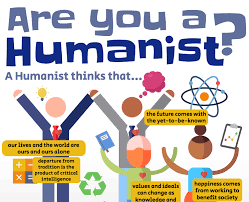
Reflections on Humanism: A Father and Daughter in Conversation

This year, after my 42nd silent retreat at Demontreville, I found myself reflecting over a different kind of lesson — one not from the retreat master, but from a conversation with my daughter.

My daughter Chris and I could hardly be further apart politically.  I lean toward policies that support immigrants, the poor, minorities, and the sick.  She supports Trump and the Republican agenda, which I believe diminishes those very groups.  Our conversation was brief, but it revealed something that I have been mulling over ever since.

When it comes to personal interactions, my daughter is tactful, gracious, and considerate.  She knows how to get along with people, soften conflict, and maintain civility.  I, by contrast, am often blunt and confrontational.  When I disagree, I rarely hide it.  I leave enemies in my wake since I have little tolerance for greed and immoral people.  She accuses me of being harsh, even inhumane, in my manner.

And yet, when I step back, I see an irony.  My brusque words are often in service of a vision of justice for the many.  Her gentle tone exists alongside a commitment to policies that, in practice, withdraw support from those most in need.  In fact, the Trumpian policies she supports will result in starvation, disease and death for millions.

This tension raises a deeper question: what does it mean to be a true humanist?

Is it the ability to show kindness in the moment, face-to-face, even if one’s broader commitments bring harm to many unseen lives?  Or is it the willingness to fight for systemic justice, even if the style of delivery offends, unsettles, or disturbs?

I think of Christ, who could be gentle with the broken and the poor, yet fierce with the powerful and the hypocritical.  He healed with a touch, but he also overturned tables.  His humanity was both intimate and systemic.

Perhaps that is the lesson I am being given now.  Humanism is not one thing.  It asks us to be kind in the small circle of our relationships but also bold in the larger circle of society.  Without the first, justice grows cold.  Without the second, kindness becomes complicity.

I wonder if my daughter and I — so different in politics, so different in style — are each holding half of a larger truth.

Yinandyang GIFs | Tenor

Is There Anything Fair about Life?

No doubt when you were growing up, one day you yelled at your mom or dad, “But that’s not fair.”  I am equally certain that their retort was “Life’s Not Fair.”  If you and I are normal, we have heard that refrain more times than we care to count.  Nevertheless, being honest, I cannot say that I truly have given up one iota of my belief that life should be fair.  The fact that I know it isn’t fair, that I know it will not be fair today or tomorrow and that I know it never will be fair, does not matter one fraction of all the numbers in the universe.  I want life to be fair, and I am sick of and tired of the instances where life is not fair and life rubs it in my face.

Perhaps, my most detested instances of life not being fair are in relation to people with emerging talent.  Artists, writers, actors and singers who are suddenly stricken down just as they are being recognized for their talent.  These deaths leave me feeling bruised and battered and cursing the injustice of life.  Cursing life for being unfair.  If life was standing in front of me at these times, I would beat it to a pulp.

Here’s a short list of artists, writers, actors, and singers who were on the rise—just becoming widely known or breaking through—when their deaths shocked me as well as many other people in the world.  If I am missing some, it is because my radar is different from yours.  Feel free to suggest some people in the comments section whose untimely passing shook you up.

Artists:

Jean-Michel Basquiat (1960–1988) – The graffiti-artist-turned-painter was already acclaimed but was only 27 when he died, and many believe he was on the cusp of becoming one of the most dominant figures in contemporary art.

Matthew Wong (1984–2019) — At the age of 35, Wong had an art world ascent that was described as “the stuff of legend”.  He taught himself to paint and was discovered through Facebook.  His energetic landscapes and interior scenes earned him comparisons to Vincent Van Gogh, and his death left a significant mark on the contemporary art scene

Sarah Cunningham (1993–2024) — The rising abstract painter was 31 when she passed away in November 2024.  Known for her emotionally charged, hypnotic canvases, she was represented by London’s renowned Lisson Gallery.

Writers:

Sylvia Plath (1932–1963) – Poet and novelist who achieved some recognition in her lifetime but became legendary only after her death at 30.

Randall Jarrell (1914–1965) – Acclaimed poet and critic who was just gaining a broader audience when he died in a mysterious car accident at 51.

John Kennedy Toole (1937–1969) – Author of *A Confederacy of Dunces*, which won the Pulitzer Prize posthumously after his suicide at 31.

Actors:

James Dean (1931–1955) – Had only starred in *Rebel Without a Cause* and two other films when he died at 24, becoming a cultural icon almost overnight.

River Phoenix (1970–1993) – Rising star of films like *Stand by Me* and *My Own Private Idaho*; his sudden death at 23 shocked Hollywood.

Heath Ledger (1979–2008) – Acclaimed actor whose fame skyrocketed after *Brokeback Mountain* and *The Dark Knight*; he died at 28 just as his career peaked.

Singers & Musicians:

Buddy Holly (1936–1959) – Pioneering rock musician who died in a plane crash at 22, influencing The Beatles and countless others.

Jeff Buckley (1966–1997) – Singer-songwriter praised for his ethereal voice; drowned at 30 after releasing only one studio album.

Aaliyah (1979–2001) – R&B star whose music career and budding film career were taking off when she died in a plane crash at 22.

Patricia Burda Janečková (1998 – 2023) — Slovak coloratura soprano.  At the age of 12, she was the winner of the Czech–Slovak television.  She was just reaching stardom in the opera world.

I have not tried to give an exhaustive list of the numerous people I have admired who “bit the dust” well before their time.  If I say, “well before they should have”, it begs the question of when should they have passed.  For that matter when should anyone of us pass?  Well, I can answer that question for myself.  I will be 79 in less than a week and I am now older than the average age that American males live to.  If I should die before I wake (an old line from my Catholic nightly prayer), I don’t think anyone will say, “Well, why do the good always die young?”  Here I might substitute the word talented for the word “good.”  Why do so many talented people seem to die young.  This seems particularly true with writers and singers.

Getting back to where I fit in with all this, first of all, I am not young and secondly, I am not on the cusp of stardom.  As near as I can tell, I reached my peak many years ago.  Everest was the peak I dreamed of reaching, at least metaphorically.  In life, my ultimate peak has been at least two mountains shy of the top of Mt. Everest.  I lived in Rhode Island a total of 18 years.  Jerimoth Hill in Foster, R.I. was the highest point with an elevation of 812 feet.  I never made it to the top of that hill.  Since living in Arizona, I have run several trails up our local mountains that are at about 1800 feet high.  Still speaking metaphorically, I am about 27,000 feet shy of  Everest’s peak.

Perhaps, because I can’t mourn my own passing (though I am not on the brink of international acclaim), I feel acutely sensitive to seeing others die just as they are about to summit Everest.  It is those times when I curse life and the unfairness of it all.  To take away such beauty, talent and joy from others is the ultimate unfairness.  Although he was already at his peak in terms of stardom, Dmitri Aleksandrovich Hvorostovsky was a Russian operatic baritone who died at the age of 55.  With Pavarotti dead and Placido Domingo mostly retired, how I enjoyed watching Dmitri sing the great tenor arias as well as songs like Moscow Nights.  How can you listen to someone like Dmitri and hate Russians?  Musicians are perhaps the best ambassadors for peace in the world.  I leave you with a noted performance by Dimitri.

https://youtu.be/r3-z_KKsYhA?si=GOt0JfufP9wPAs5p

The Little Girl and the Caterpillar

Once upon a time there was a little six-year-old girl named Angelica.  She had three older brothers, a mom and dad.  I never met her mom, but I will introduce the other family members as they enter my story.  I did subsequently find out that Angelica was a very curious little girl and her mom warned her that too much curiosity could get her in trouble.

It was a beautiful morning in mid-September.  The sun was out, and the sky was cloudless.  I decided to strike while the iron was hot and go for a hike in the Casa Grande Mountains.  Temperature was 75 degrees.  Sun was over the mountains but still low enough to be cool.  Projected high for the day was 97 degrees, which they announced was cooler than average.

I started out somewhat undecided which trail to take but finally made up my mind and went south along the middle trail.  This trail is bracketed by the high or ridge trail and a lower short trail.  The two lower trails run south towards Mexico.  As I was walking along what I call the “middle trail” I saw five people coming down the high trail.  The middle trail forks with the high trail and I hurried to avoid running into the people coming down the high trail.  None of these trails are very wide and I did not feel like stepping off the trail.  I made the fork before they arrived and headed south. 

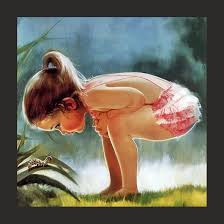
For a short distance, the middle trail parallels the high trail.  I noticed an older man, three young boys and a young girl some distance behind the men.  She appeared to be sitting on her haunches and looking at something on the ground.  I immediately thought “I hope she is not looking at a rattlesnake.”  Snakes tend to come out in cooler weather to sun themselves or to find a nice comfortable spot in the shade.  I have seen a few crossing a trail and I always keep my eyes peeled for them when running or hiking. 

As her siblings got farther away she called out to them.  I could not make out what she said but I noticed that she stayed intent on whatever she was watching.  She was about 25 yards north of me.  My own curiosity got the best of me, and I called out to her “Hey, what are you looking at?”  She turned towards me and replied, “A caterpillar.”  I had never in my 15 years of hiking up the Casa Grand Mountains seen a caterpillar anywhere. 

I left my trail to go up and see what Angelica was looking at.  I got there before her family did.  I introduced myself and asked the little girl what her name was.  She told me her name was Angelica.  I told her that mine was John.  The three boys (her brothers) and the older man (her dad) soon arrived on the spot.  Angelica did not budge (I marvel at the dexterity and flexibility of youth).  I introduced myself to her family members.  I met Antonio her dad, two teenage brothers named Alejandro and Arthur, and a pre-teen brother named Arturo.  Seems her dad had a liking for names starting with A.  I never did find out her mother’s name.


I turned my attention back to Angelica and the caterpillar.  “Angelica, do not touch the caterpillar” I warned her.  ‘Why not Mr. John?” she asked.  “Well, it could be poisonous and very dangerous.”  “It does not look very dangerous.” she replied.  “You cannot always tell what is dangerous by looking at it” I opined.  Her dad seconded my warning.  “Yes, do not try to pick it up” he added.  One of her teen brothers suggested “Maybe we should just kill it if it is dangerous.”  “NO” shouted Angelica, “It is not hurting anyone, just leave it alone.”  I chimed in “Well if it is not an indigenous species, it might do more harm than good out here in the desert.  Who knows maybe it is from Russian or China and could infiltrate our desert environment and destroy everything we hold sacred.”  My suggestion drew blank looks.  Her dad said, “I think Mr. John might have a good point maybe we should just step on it and be on our ways?”  Alejandro and Arthur agreed with this idea.  Arturo sided with his sister and suggested we just leave it alone. 

As we were debating and puzzling what to do, Angelica suddenly picked the caterpillar up in one hand and gently closed her fingers around it.  We stood horrified.  I think we all expected to hear a scream, and Angelica would fall over either dead or in a coma.  None of us moved for several moments which seemed like minutes.  Then Angelica opened her fingers.  The caterpillar had curled up inside her palm and appeared to be sleeping.  “See” Angelica said, “He was just looking for some shade so that he could rest.”  She then stepped off the trail and walked over to a towering twenty-foot Saguaro.  Very carefully, she set the little caterpillar down in the shade of the cactus and walked back up to join her family. 

I sheepishly said “Well, it was nice meeting all of you.  I hope to see you again on the trail.”  With more goodbyes, the family left for the parking lot, and I left to finish a four-mile hike. 

Thus, while I fit in with the millions of homo sapiens worried about climate change, Trumpian politics, violence in America, the Supreme Court’s biased rulings, immigration, education, health care, Democracy and several other MAJOR weighty issues, Angelica sits oblivious to what is destroying life in America to watch a tiny little caterpillar move slowly across the desert floor in search of shade.  Angelica watches the beauty of life while millions of us only see the dirt and grime and misery that we think is all pervasive. 

Oh, how I wish I could be like Angelica again.

Everything You Know is Wrong!  – A Thought Experiment

I want to share a “thought experiment” with you.  What would you do if one morning you woke up and realized that everything you believed about life, love, liberty, justice, aging, politics, and even religion was wrong?  Not just slightly off but fundamentally flawed.

That thought crossed my mind recently.  Over the years, I have been very opinionated.  This morning, I told a good friend that assigning motives to people was ridiculous.  We all want explanations why people do dangerous, criminal or simply dumb things.  However, the motives that we spew out might as well be as valid as Chinese fortune cookies.  There are dozens of possibilities why someone has done something. 

The recent subway stabbing and murder is a good example.  Why did the perp murder the young girl?  He had never seen her before.  He did not know her.  He had no reason to kill her.  But kill her he did.  Why?  Go ahead and speculate if you like but you can speculate all day, and you may never know the true reason or even if he had a reason.  Do you remember the famous line “The Devil made me do it.”  That is as good an explanation as any. 

The more I thought about this question of belief and knowledge, the more my head began to spin.  I felt like I had vertigo.  All the experiences, books, teachers, and years of reflection that have shaped my worldview suddenly seemed like they might be a house of cards.  It was unsettling—terrifying, even.  I who believe in facts, data, rational thinking and logic.  What if I am wrong?  Is there any value to doubt everything?  Ecclesiastes says that “In much wisdom is much grief, and he that increaseth knowledge increaseth sorrow”

But after reflecting on it, I realized something: this is what growth feels like.  Let me break this idea of growth down into some concepts that have merit on the subject.

The Shock of Doubt:

Beliefs are comfortable.  They provide a framework for navigating life, a lens through which we interpret meaning.  To suddenly question them feels like losing gravity.  But doubt, in its purest form, isn’t a threat.  It’s an invitation.

I thought of people I admire—Deming, Aristotle, Kahneman, Sagan—men who thrived on challenging assumptions.  They didn’t fear being wrong; they saw it as a step toward being less wrong.

The Emotional Reckoning:

There is grief in realizing cherished ideas might not hold water.  Some beliefs are tied to memories, mentors, or moral choices we’ve made.  Questioning them can feel like betrayal.  Worse, questioning them can bring us guilt.  Guilt that our pig-headed stubborn beliefs have labeled  and judged other people.  Guilt that not only were we wrong but that we sentenced other people based on false ideas and information. 

But emotions are honest teachers.  The discomfort signals that we’re brushing against something important—something worth reexamining.  For instance, what if I am wrong about trump?  What if he is really ushering in a new and better age for America.  What if his policies will help Americans and even the entire world live better lives?  What if I came back to this earth 100 years from now only to find the world more prosperous, egalitarian and peaceful than any time in history?  How would I feel about my stubborn insistence that trump is the not only the worst president in history but evil?  A man who will destroy democracy and bring untold misery to millions of people.  Am I strong enough to even entertain this possibility?

Breaking vs. Building:

In moments of doubt, it’s tempting to throw everything out and start over.  Sort of like “Zero Based Budgeting” or what my wife does when she finds a mistake in her knitting.  I do not know how many times Karen has torn apart something that she has worked weeks on.  All because she found a dropped stitch or some other knitting or quilting error.  Her tenacity always boggles my mind. 

Yet wisdom isn’t built from demolition; it comes from integration.  It comes from standing on the back of genius who came before us.  Plato built on Socrates.  Aristotle built on Plato.  Deming built on Shewhart.  Wisdom comes from assimilating and reshaping, adding new layers and molding something even more perceptive and sublime than what went before.  Deming always said that “Experience without Theory teaches nothing.”  I added to his message the thought that “Theory without Experience teaches nothing.”  It is a Yin/Yang of reality. 

Isaac Newton in a letter to Robert Hooke wrote, “If I have seen further, it is by standing on the shoulders of Giants”.

I realize that being “wrong” doesn’t mean that my life has been wasted or misguided.  It means I now have a chance to weave new threads into the tapestry that I’ve been creating for decades.  I wonder what will happen to the 2000 threads or blogs that are now part of this tapestry.  Perhaps to my friends, my dedication and even fixation on my blogs are trivial pursuits.  I am sure some of my friends are bugged when I say, “Did you read my blog” or “I just wrote a blog on that subject.”  But my blogs have become part of the thread that I weave through my life.  I expect to write a blog the day or even hour before I die. 

Aging into Humility:

Humility is the opposite of pride.  While pride is often derided, humility always gets applauded, at least among philosophers and theologians.  In the world of politics, humility is never an asset.  Politicians pride themselves on taking credit for saving the world one minute after they are elected.  Can you imagine any politician aging into humility?  Donald Trump as a humble person?

One of the gifts of age is perspective.  I’ve lived long enough to see entire social movements rise and fall, “truths” overturned, and science rewrite itself.  If I’ve learned anything, it’s that being wrong is inevitable.  What matters is how gracefully we grow from it.  The title of my website is Aging Capriciously.  The definition of “capricious” is:

“One who is prone to sudden, unpredictable, and unexplainable changes in their attitude, behavior, or decisions, often based on whim rather than reason or logic. They are often described as impulsive, erratic, and fickle.”

If you are going to be capricious, you had better learn some humility.  I liked the word capricious for my blog since it blessed my desire and need to change my mind.  To be wrong, to be fickle.  I have always and perhaps too pridefully believed that I was blessed with a consistency that would rival Lt Commander Spock on the starship Enterprise.  Spock was erratic in my mind since he had an earthling mother.  I was a motherless child or at least felt that way growing up.  I could not be wrong, or I would be punished by a dad who would have cowered Zeus.  

Humility doesn’t mean shrinking—it means making space for change.  It means admitting that liberty, justice, and love are too vast for any one lifetime to fully comprehend.  If I am born again and I have the opportunity to start another blog, I will call it Aging Into Humility.  Maybe the second time around, I will get it right.

A Call to Curiosity:

So, I ask myself—and you—what if we welcomed the possibility of being wrong?  What if, instead of clinging to certainty, we embraced curiosity?  A good friend of mine had a sign over his desk which read “There are no mistakes, only lessons to be learned.”  I took this quote to heart and have tried to use it as a guide for my life. 

Maybe the purpose of a long life isn’t to arrive at a final truth, but to remain open, to keep asking, to keep revising.  If that’s true, then perhaps being “wrong” isn’t a failure at all.  Perhaps it’s proof that we’re still alive, still learning, still becoming.

“The important thing is not to stop questioning.  Curiosity has its own reason for existence.  One cannot help but be in awe when he contemplates the mysteries of eternity, of life, of the marvelous structure of reality.  It is enough if one tries merely to comprehend a little of this mystery each day. — —”Old Man’s Advice to Youth: ‘Never Lose a Holy Curiosity.'” LIFE Magazine (2 May 1955) p. 64” — ― Albert Einstein

What Do Sun Tzu, Musashi Miyamoto and Magnus Carlsen Have to Say about Life, Love and Death?

I have lived much of my life thinking and planning ahead.  I have often been laughed at because of how far ahead I like to plan.  But for some reason, I grew up believing that the secret to life (if there was one) lie in being ahead of the game.  I learned to play chess quite early on and by six, I could beat my father who taught me the game.  Three of my heroes in respect to planning are three men who all excelled in the art of strategy albeit very different arenas.  I am going to briefly introduce these three men and then invite you to sit down and listen to a discussion between the three men on strategy. 

Magnus Carlsen (Born 1990) is considered by many to be the greatest chess player who has ever lived.  He has now surpassed both Bobby Fisher and Garry Kasparov as the greatest champion ever.  Magnus is a genius on the chessboard which in some ways is a metaphor for military strategy and planning.  Carlsen is from the cerebral world of modern chess and is a wizard who plays out strategy on a strictly cognitive level. 

“Carlsen is a five-time World Chess Champion, five-time World Rapid Chess Champion, and the reigning (shared with Ian Nepomniachtchi) eight-time World Blitz Chess Champion.  He has held the No. 1 position in the FIDE rankings since 1 July 2011, the longest consecutive streak and trails only Garry Kasparov in total time as the highest-rated player in the world.  His peak rating of 2882 is the highest in history.  He also holds the record for the longest unbeaten streak at the elite level in classical chess at 125 games.” Wikipedia

In terms of mortal combat, Musashi Miyamoto is hands down the greatest fighter who ever lived.  Musashi is from the deadly pragmatism of samurai combat.  He was a swordsman in feudal Japan (1584-1645) who went on a quest to defeat the greatest swordsmen of his time.  He was undefeated in 62 duels to the death with the Katana.  There is nothing fake or theoretical about facing an opponent with a 37-inch razor sharp sword capable of cutting you in half.  Musashi went on to memorialize his fighting strategy in a famous book called “The Book of Five Rings.”   

Sun Tzu (544 BCE) was a Chinese military general, strategist, philosopher, and writer who lived during the Eastern Zhou period.  Sun Tzu derived his strategies from ancient statecraft and military philosophy.  He wrote a famous book on strategy called “The Art of War.”  It has been used for centuries as a bible for military strategy.  I have referred to it so many times in my strategic planning sessions that I feel like I almost know it by heart.  The book is also widely used for strategy in business and life.  It teaches you to be prepared for anything and the number of quotes that you can gleam from this book about strategy are almost unlimited. 

In this blog, you are going to be privileged to listen to what these three men have to say about living, loving, fighting and dying.  It might surprise you to find that each man is in his own way a humanist and idealist but also a pragmatist.  If having all three of these traits together sounds impossible or quite contradictory, then listen to their discussion and decide for yourself.  I think you may just find a number of useful ideas about life from these men. 

John:  I am very glad that the three of you can meet with me today.  I have introduced each of you to my readers, but it was probably gratuitous since you are each very well known.  Can we start off by talking about life and living?  Though each of you deal in some sense with combat and finality , what about the work of daily living and making a good life for oneself? 

Sun Tzu: Life must be ordered like a campaign.  To live well is to understand terrain—your circumstances—and to position yourself so that conflict becomes unnecessary.  The greatest victory is to live in harmony with the world without struggling against it.

Musashi: Living is training.  Every day is practice for the Way.  To hold the sword and the brush in balance, to adapt fluidly—this is how one lives without wasting time.

Carlsen: In chess and in life, position matters more than immediate gains.  If you think ten moves ahead, you can avoid many of life’s traps.  But it’s also about enjoying the game, not just winning it. “Without the element of enjoyment, it is not worth trying to excel at anything.”

John:  What about loving?  Does love play a role in your lives?  If so, how?

Musashi:  Love is dangerous if it binds you to attachment.  Yet the Way is also compassion.  The warrior should protect, not just destroy.

Sun Tzu:  Love is alliance.  To love is to strengthen morale, to bind others to your cause.  Without loyalty and affection, no army—or family—stands.

Carlsen:  Love requires intuition.  Like in chess, you don’t calculate every detail—you feel the position. Trust in the flow between two people, rather than forcing the moves.

John:  Fighting is something that I have experienced a great deal of in my life.  I have experienced physical fighting and emotional fighting.  My father taught me a great deal about fighting.  I have come to believe that anything worth having is worth fighting for.  Sometimes it has seemed my life has been more about fighting than about love.  What are your feelings about fighting? 

Sun Tzu:  Needless fighting is stupid and folly. “To win one hundred victories in one hundred battles is not the acme of skill.  To subdue the enemy without fighting is the acme of skill.”

Musashi:  You cannot always avoid the duel.  When you must fight, commit totally.  Strike with no hesitation, see beyond form, and your opponent will already be defeated in spirit.

Carlsen:  Fighting is about controlling the board.  You win by shaping the game, so your opponent runs out of good moves.  Aggression without calculation is reckless; patience is its own weapon. “Some people think that if their opponent plays a beautiful game, it’s okay to lose. I don’t.  You have to be merciless.”

John:  What about dying?  Does war and life and fighting mean that we must accept death as a potential price that we pay for living a good life? 

Musashi:  Death is nothing to fear.  To follow the Way is to be ready to die at any moment. If you cling to life, you will hesitate, and hesitation kills.  I have written that, “The Way of the warrior is resolute acceptance of death.”

Sun Tzu:  The wise commander spares his troops.  To die meaninglessly is folly.  But to give one’s life for a greater order, when no alternative remains, that is the ultimate discipline.

Carlsen:  In chess, every game ends with death—the king is trapped.  But the beauty is that the board is reset, and you play again.  Perhaps death is just the end of one game, with another waiting.

John:  This has been quite an interesting conversation.  Let me end the discussion with one final question that I would like each of you to speak to.  How does one find meaning and purpose in life and live a life of integrity while pursuing these goals? 

Musashi:  Meaning is found in the Way — in disciplined practice of one’s craft, whether with the sword or the brush.  Purpose is not in wealth, fame, or fleeting pleasures, but in constant refinement of the self.  Integrity is to act without hesitation, without deceit, and without wasting time on what does not serve the Way.  A life devoted to mastery is a life of purpose.”

Sun Tzu:  Purpose comes from aligning one’s life with harmony — with heaven, earth, and the order of things.  To live with integrity is to understand both your strengths and limitations, and to act with balance rather than recklessness.  Meaning is not found in chaos, but in creating stability for yourself and others.  When your actions serve a greater order and bring benefit without needless harm, your life has purpose.”

Magnus Carlsen:  For me, meaning is about challenge and growth.  Chess has taught me that purpose lies in doing something you love, pushing yourself, and finding joy in the struggle, even when you lose.  Integrity means competing honestly — no shortcuts, no excuses — and respecting your opponents.  If you live true to what excites you, and stay consistent with your values, you’ll have both purpose and integrity.

John:  Thank you all very much.  You have given me a great deal to think about.  I am hoping my readers also find value in your wisdom and insights.  

Conclusions:  I mentioned that I thought that all three men blended the values of humanism, idealism and pragmatism.  Here are my reasons for saying so about each man. 

Miyamoto Musashi (samurai, artist, strategist)

  • Humanism: Surprisingly present, though in a hard-edged way. Musashi’s writings show care for clarity, honesty, and living authentically. His calligraphy and painting also suggest an appreciation for the fullness of human life, not just killing.
  • Idealism: While somewhat limited, Musashi rejects romantic notions and insists on practicality.  Yet, he is idealistic in his devotion to the Way — a life lived with complete discipline and readiness for death.
  • Pragmatism: Very Dominant.  Musashi is above all a pragmatist — he won by adaptability, by not being bound to tradition, and by focusing on what works in the moment.  His famous line “Do nothing that is of no use” captures his essence.

Sun Tzu (general, philosopher, system-thinker)

  • Humanism: Strong, but collective rather than individual.  Sun Tzu emphasizes preserving life — “The skillful fighter subdues the enemy without fighting.” His concern is with the well-being of troops, states, and the larger order of society.
  • Idealism: Present in his pursuit of harmony, he believed conflict should serve higher goals — stability, order, prosperity — not destruction for its own sake.  His writings contain a vision of a just, balanced world.
  • Pragmatism: Essential to Sun Tzu’s work is a manual for success in the real world. He advocates preparation, intelligence, deception, and efficiency.  No illusions — but always tied to a broader purpose.

Magnus Carlsen (modern competitor, thinker, cultural figure)

  • Humanism: Clear and direct.  Carlsen is grounded in relationships, respect for opponents, and joy in play.  He emphasizes fairness and humility — deeply humanist values in a competitive field.
  • Idealism: More subtle but his idealism lies in his belief in chess as a universal language and art form, where truth can be found through the board.  His pursuit of perfection in play is, in a sense, idealistic.
  • Pragmatism: Very strong. Carlsen is known for his practical style — grinding small advantages, avoiding flashy risks, and adapting to opponents.  His quote “I believe in good moves, not psychology” shows his pragmatism at work.

Several years ago (2016), I went to NYC to watch Magnus play the Russian Sergey Alexandrovich Karjakin.  It was the first time the International chess tournament had been held in NYC since the epic battle in 1974 between Fischer and Spassky.  I would have been 28 years old at the time in 1974 and had long since given up chess playing.  I might have been a very good player but as with so many things in my life, I did not have the discipline or courage to stick with the game.  Nevertheless, the strategic comparisons between America and Poker and Chess and Russia have significantly influenced my life.

In studying strategy, it has led me to the twin concepts of predictive strategy and opportunistic strategy.  One thinks many moves ahead while the other seizes the moment.  I have found that both are necessary in life.  A good strategy in life will be built on an understanding of the relationship between the two.  On a more practical level, I have applied this to our travels.  Karen and I have now been to 45 countries and every one of the 50 U.S States.  All, and I say this proudly ALL of our trips have been great, and each one seems to be better than the last one.  I submit that this is due to having a great traveling companion but also to a plan based on looking down the road while seizing those moment-to-moment opportunities that pop up. 

One Final Note Please:

If you are interested in what Miyamoto meant by the “Way” that he referred to, it is a philosophy he developed that encompasses the following attitudes and virtues. This information is from Google AI.

  • Discipline: Musashi emphasized the importance of self-discipline in all aspects of life, considering it a crucial element in achieving any goal and overcoming challenges.
  • Mastery and self-improvement: Striving for excellence in a chosen path and mastering oneself, thoughts, and actions.
  • Understanding and applying strategy: The “Way” also refers to the art of strategy (Heiho) which, for Musashi, transcended just combat and applied to all aspects of life.
  • Holistic approach to life: He believed the principles of swordsmanship could be applied to various pursuits and aspects of life, encouraging individuals to understand the “Way broadly” to see it in everything.
  • Balance: The ideal warrior, according to Musashi, excelled in both martial arts and the arts, a concept known as Bunbu Ryodo

In essence, “The Way” for Musashi represents a life-long journey of learning, self-cultivation, discipline, and the pursuit of mastery, not just in martial arts but in all aspects of life. Not a bad way of living I would think.

I great deal of my information is based on information I extracted from ChatGPT 5.0. The final blog is a composite of research, theory and some of the quotes from on-line sources.

The Perfect Day When Everything Went Right!

Did you ever have a day when “everything” went right.  A day when you got up on the right side of the bed.  The phone rang all day with calls from good friends instead of spam and telemarketing messages.  Everyone just called to chat, and no one had any problems or issues to face.  A day when the sun was shining and the weather was perfect.  There were no bugs or mosquitoes to be found anyplace in your town.  You felt like a million dollars with no aches or pains.  No one you knew was going  to the doctor for cancer treatments or therapy of any kind.  It was as the younger generation like to say “Perfect.”

Now as you are reading this, you are probably thinking “He must be daydreaming, such days do not exist.”  Or maybe you are thinking that it is my birthday.  I concede the possibility that such days are perhaps rare, but then again should they be any more rare than days where “Everything that could go wrong” did go wrong.  Or is it just our perspective which is goofed up.  We are more likely to remember the days when our dog disappeared or when the doctor told us to come in and see her as soon as possible than days when our dog reappeared or the doctor called to tell us everything is fine.  Cognitive scientists have a term for our propensity to remember the bad more than the good.

“Negativity Bias” is a cognitive bias that refers to the tendency to remember negative events and information more vividly and with greater impact than positive or neutral ones.  I will not bore you with the reasons for this propensity.  I am sure that you recognize that it exists.  Thus, if the Yin/Yang of the world is an accurate theory of our existence, we should have at least as many of the Perfect Days as we do the Shitty days.

I ask you to stop reading this blog for a few seconds.  I challenge you to see if and when you can remember the last perfect day that you have had.  Now I would like for you to describe that day in my comments section before reading the rest of this blog.  Think of the happiness you will bring to me as well as the rest of our readers.  What if the news carried as much good information as they do bad information?  What would your world be like if you only remembered and had perfect days.

At this point, you are probably ready to skewer me as some deranged Pollyanna or Don Quixote. A nutcase who sees everything through rose colored glasses.  Someone who is madly optimistic that there is hope for a better world.  That Donald Trump will not get a statue on Mount Rushmore and that he and his sycophantic followers will soon disappear in the abyss of forgotten history.  I assure you that I go to sleep every night praying to a god that I do not believe exists that these latter events will happen while I am still alive to witness them.  Instead, I wake up every morning to more bad news from the front line of the independent media I subscribe to. Thus, either giving me less hope for humanity or making me feel guilty by asking me for more money that I do not have.

See, you thought I was going to write some really optimistic idealistic treatise that would make you feel like your existence meant something and life was worth living.  Instead, I refer you to Ecclesiastes from the Bible:

Everything Is Meaningless

1 The words of the Teacher,[a] son of David, king in Jerusalem:

2 “Meaningless! Meaningless!”

    says the Teacher.

“Utterly meaningless!

    Everything is meaningless.”

3 What do people gain from all their labors

    at which they toil under the sun?

4 Generations come and generations go,

    but the earth remains forever.

5 The sun rises and the sun sets,

    and hurries back to where it rises.

6 The wind blows to the south

    and turns to the north;

round and round it goes,

    ever returning on its course.

7 All streams flow into the sea,

    yet the sea is never full.

To the place the streams come from,

    there they return again.

8 All things are wearisome,

    more than one can say.

The eye never has enough of seeing,

    nor the ear its fill of hearing.

9 What has been will be again,

    what has been done will be done again;

    there is nothing new under the sun.

10 Is there anything of which one can say,

    “Look! This is something new”?

It was here already, long ago;

    it was here before our time.

11 No one remembers the former generations,

    and even those yet to come

will not be remembered

    by those who follow them.

However, I refuse to finish this blog on a nihilistic note.  I want to finish on a crescendo of hope and faith and happiness.  A belief that one idea, one word spoken, one action taken, one step forward can change the course of humanity.  We can look back to the past and find untold mistakes and failures that have eclipsed the sunlight of joy for the world.  But we can also look forward to a future that we can create because the vast majority of human beings are decent peace-loving equality seeking individuals.  The Negativity Bias blinds us to the positive outcomes that prevail every day in our lives.  At the end of each day, we seem destined to remember the bad things that happen in the world.  This effort is reinforced by a negative biased media which thrives on horror and destruction and pain.  I love the words from this song by Peter Paul and Mary,  “Light One Candle”

Light one candle for the terrible sacrifice

Justice and freedom demand

And light one candle for the wisdom to know

When the peacemaker’s time is at hand


Don’t let the light go out!

It’s lasted for so many years

Don’t let the light go out!

Let it shine through our love and our tears


Light one candle for the strength that we need

To never become our own foe

And light one candle for those who are suffering

Pain we learned so long ago                                                                                                               

Light one candle for all we believe in

Let anger not tear us apart!

Light one candle to bind us together

With peace as the song in our heart


Don’t let the light go out!

It’s lasted for so many years! (lasted for so many years!)

Don’t let the light go out!

Let it shine through our love and our tears

We need to counter this tendency for negative bias by reinforcing the positive “perfect” days of our lives.  Here is a checklist that ChatGPT created from my query:

It is a printable daily practice checklist to help overcome negative bias.  You can use it as a daily or weekly tracker to build habits that shift your mindset toward balance and resilience.

🌞 Daily Practice Checklist: Overcoming Negative Bias

Practice Done Today? Notes or Reflections
1. Morning Gratitude: List 3 things you’re grateful for.
2. Reframe 1 Negative Thought: Catch a negative thought and reframe it positively.
3. Notice the Good: Write down one positive thing that happened today.
4. Kindness Practice: Do one kind thing for someone else.
5. Mindful Moment: Spend 5+ minutes in meditation or quiet reflection.
6. Move Your Body: Take a walk, stretch, or exercise.
7. Limit Negative Input: Avoid or reduce exposure to toxic media or conversations.
8. Evening Reflection: What went well today? What did you learn?

🗓️ Weekly Reflection (Use at the end of the week)

  • What patterns of negative bias did I notice?
  • What helped me shift my mindset the most?
  • What’s one small thing I want to improve next week?

The End Folks. 

Hope you enjoyed this blog.  Let me know what your perfect day was. 

Previous Older Entries