Requiem for America:  Our Battle with Fate

fortune

I wrote this blog seven years ago about the time that Trump assumed the office of the President of the United States of America.  As I stumbled across it again, I could not help feeling that nothing has changed in this country.  Therefore I am posting this blog again in the futile hope that one voter might read it and change his or her mind.

January 21, 2017

Many of you have no doubt heard the tone poem by Carl Orff titled Carmina Burana.  One of the famous parts of this musical piece is taken from a poem called “O Fortuna.”  It is a Medieval Latin poem written early in the 13th century.  I started thinking about it today as Trump became the 45th President of the United States of America.  I have never much believed in fate, preferring to think that we are masters of our own destiny and fate be dammed.  But as the inexorable reality of the inauguration kept intruding on my existence, I was forced back to the conclusion that perhaps fortune does rule the world.  (To listen click here O Fortuna)

Like the moon you are changeable,
ever waxing and waning;
hateful life first oppresses and then soothes as fancy takes it;
poverty and power it melts them like ice.

I loathe this greedy narcissist.  I loathe his values.  I loathe his words.  He represents everything I hate in myself and in humanity.  We keep trying to destroy the racism and fear and prejudice that we are brought up with but fate impels us to confront a world that seems to thrive on such iniquities.  My relatives, my friends, my co-workers —- they voted for this reprobate and now exult in his coronation.  I stand impotently on the sidelines questioning (as many Jews in the Holocaust questioned) why God has deserted us.  Have we committed some grave sin worthy of the future that fate now seems to have assigned us?

Trying against
Fate – monstrous and empty,
you whirling wheel,
you are malevolent,
well-being is vain and always fades to nothing,
shadowed and veiled you plague me too;
now through the game I bring my bare back to your villainy.

My good intentions.  My desire to be tolerant and virtuous.  My goal to treat others with compassion and kindness all seem to melt in the face of a Fate that decries a monster who will now rule over us.  I hear the voices that say “give him a chance.”  I wonder what chance they want.  A chance to create more greed.  A chance to create more racism.  A chance to create more sexism.  Have we not enough bigotry in this country?  Have we not enough inhumanity towards others?  We created the Atom bomb.  We created the Hydrogen Bomb.  We created weapons of biological and chemical warfare that can destroy millions.  We take no heed whether they kill children or innocents.  We are now all guilty in our incessant warfare.  The only thing that counts is creating more efficient means of murdering people.

Fate is against me in health and virtue,
driven on and weighted down,
always enslaved.
So at this hour without delay pluck the vibrating strings;
since Fate strikes down the strong man,
everyone weep with me!

I wake up disbelieving that I live in this reality.  I joke that I am in Wonderland and whatever one believes is the reality that exists.  But I did not believe in this reality.  I have done everything that I thought I could to help make the world a better place.  I thought my friends and family and neighbors wanted the same world that I wanted.  It seems clear now that we did not share the same reality.

I curse the fate that has brought our nation to this point.  I curse the people that voted for this Frankenstein.  I curse the party that nominated this abomination.  Deep inside, I wonder what I did to contribute to this horror.  Does my own hate somehow create the fate that I seek to escape from?

Abraham, John, Robert and Martin all dead — killed by that coward called fate.  But let us not forget Jimmie Lee Jackson and Clyde Kennard and Juliette Hampton Morgan and James Reeb and Jonathan Myrick Daniels and Viola Gregg Liuzzo and Vernon Dahmer and Oneal Moore and George Lee and Harriet and Harry Moore.  They also were martyrs.  They also died fighting fate.

Do not believe that the good die young.  The good die pregnant with a dream for a better world.

Time for Questions:

So what is left?  Nihilism?  Apathy?  Hate?  Bitterness?  Resistance?  Fight?  Hope?  Will a dream for a better America arise from the ashes of despair?

Life is just beginning.

“I will permit no man to narrow and degrade my soul by making me hate him.”  —   Booker T. Washington

fortune

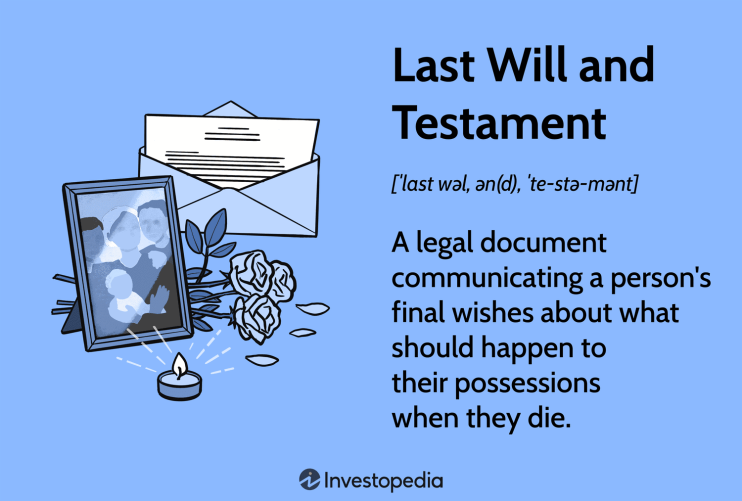
My Final Will and Testament – Insights – Reflection #5

transfrom-data-actionable-insights

Last year at my 40th Demontreville Retreat, one of the exercises that we were given by the Retreat Master included a very challenging set of thoughts.  The worksheet for the activity was labeled as “A Testament.” I took the worksheet and instructions home with me.  It had fourteen tasks or reflections to complete.  I did not desire to complete them during the retreat.  It is now almost a year since my retreat, and I have decided to make the mental and emotional effort necessary to complete this “Testament.”

The worksheet started with these instructions:

Imagine that this is the last day of your life on earth.  In the time that you have left, you want to leave a “Testament” for your family and friends.  Each of the following could serve as chapter headings for your “Testament.”

5.  These are ten of the greatest Insights that I have gained in the School of Life.

Friends are like flowers:

I have realized that friends are like flowers.  They grow, they bloom and then some of them wither away over time.  Some friends are like Perennials.  They live for more than two years. They grow back each year as we renew them.  They may bloom for many seasons.  Over and over again.  Other friendships are more like Annuals.  Annuals have a much more limited life cycle.  Sometimes, they are over in less than a year.  They are beautiful when they last but somehow they are never destined for longevity.

Cowards die many times before their deaths:

A line from Shakespeare’s “Julius Caesar” that I have used my entire life to remind me that fear can be death.  Fear can stop us from trying new things, going to new places and enjoying life.  True, fear is a warning.  However, fear can also be paralyzing.  You have heard it said that some people are afraid of their shadows.  As we get older, life closes in on us.  Unless we can keep pushing back the boundaries, we will end up in a coffin long before it is our time.

Live for today.  Take one day at a time: 

So easy to say.  So hard to do.  All the great prophets in history have given paeans to the virtue of living one day at a time.  Jesus said “”Therefore do not worry about tomorrow, for tomorrow will worry about its own things.  Sufficient for the day is its own trouble.”— Mathew, 6:34.  Buddha said, “Don’t get caught in the past, because the past is gone.  Do not get upset about the future, because the future is not yet here.  There is only one moment for you to be alive, and that is the present moment.” — Knowing the Better Way to Live Alone.  The Muslim preacher, Hasan al-Basri said, “The world is three days: Yesterday, with all that was in it, has gone.  Tomorrow, you may never see it.  As for today, it is yours, so work on it.”  There are many more admonitions to live in the moment.  Still, easier said than done.

I wake up making my lists each day.  I plan some of them one week, one month, and even years out.  Will those days ever come?  The older I get, the less likely it is that a ten-year plan will ever come to fruition.  It makes sense to live in the moment.  Except, what about the grasshopper and the ants?  They stored up grain for the future, while the grasshopper fiddled and danced.  Who starved?  A good friend of mine complains that it is not fair that state parks and other such venues do not operate on a first come first served basis.  Today, if you do not plan for the future, you may not get a campground.  Not planning for a future can mean even more dire prospects than not getting a campsite.  It might mean not having any retirement money.  It might mean not having any resources for health care and other necessities.  There must be a balance between living for today and planning for tomorrow.  Does anyone know a sure fire way to find that balance?  Here is what ChatGPT said in response to my query:

Balancing living for today and planning for tomorrow can be a delicate act, but it is achievable with mindful practices and habits.  Here are some strategies that can help:

Set Clear Goals: Define your long-term goals and break them down into smaller, manageable steps.  This helps you focus on the present while keeping an eye on the future.

Prioritize Your Time: Make a list of your daily activities and prioritize them based on importance and urgency.  This ensures you are spending time on what matters most, both for today and for your future.

Practice Mindfulness: Mindfulness techniques, such as meditation and deep breathing, can help you stay present and enjoy the moment without constantly worrying about the future.

Create a Balanced Schedule: Allocate specific times for work, relaxation, hobbies, and social activities.  This ensures that you are enjoying life now while also dedicating time to your future goals.

Financial Planning: Save and invest wisely to secure your future, but also set aside some money for leisure and experiences that bring you joy today.

Stay Flexible: Life is unpredictable, and plans may change.  Being adaptable allows you to enjoy the present while being prepared for future changes.

Reflect Regularly: Take time to reflect on your progress and adjust your plans as needed.  Regular reflection helps you stay aligned with your goals and make necessary changes.

Seek Balance in Health: Take care of your physical and mental health through regular exercise, a balanced diet, and sufficient rest.  Good health enables you to enjoy the present and ensures longevity.

Enjoy Small Moments: Find joy in everyday moments and appreciate the present.  Whether it’s a walk in the park, a good meal, or time with loved ones, these moments are valuable.

Continuous Learning: Invest in your personal and professional growth by learning new skills and acquiring knowledge.  This not only prepares you for the future but also enriches your present life.

By integrating these practices, you can create a harmonious balance between living in the moment and planning for the future.

It took ChatGPT all of about one minute to come up with the above list.  Pretty amazing isn’t it.  I only wish I were as smart as she/he is.

Kindness is more important than knowledge:

This is a lesson that has taken me many years to learn.  “Chicken Soup for the Soul” was a pivotal event in my life.  The stories started me thinking more about kindness and less about acquiring a great deal of knowledge.  I once thought that knowledge was everything.  Knowledge was the path to virtue according to the Bible.  Knowledge was power according to Sir Thomas Hobbes.  Knowledge comes from a different place than kindness.  Knowledge is necessary to make a living, but kindness is necessary to make a life.  A human being must be more than just a collection of ideas and theories.  We must be able to show compassion and empathy for other human beings and other creatures.  Kindness will make more of a difference to the world than the Encyclopedia Britannica ever did.

We do not age like a fine wine, we age like bananas:

Whoever came up with the trope about aging and fine wine must never have grown old.  The older I get, the more wizened I get.  My wine is getting moldy.  My face is getting wrinkled.  Like an aging banana, I now am getting more and more black spots on my skin.  Nobody throws a fine old wine away, but in a few years, just like a rotten old banana, my carcass will be disposed of.  I am softer and mushy now.  I once was firm and hard.  Who likes a mushy old banana?

Don’t rely on Hope:

Hope may spring eternal in the human breast but hope never accomplished anything.  It takes effort to make a life.  It takes effort to go to work every day.  It takes effort to do anything worth being done.  You can hope your life away.  Hope is a seasoning for life.  You can season the meat, but you must then cook it.  Hope can help you to have faith that you can change the world, but hope is not enough to get the job done.  Patrick Henry spoke about “hugging the delusive phantom of hope.”

You can hope to win the lottery but unless you buy a lottery ticket, you have no chance of winning the jackpot.  Hope can be a motivator, but running the 100-meter dash of life takes moving your legs to get to the finish line.  Keep hope in perspective but don’t let hope become your whole life.

Life is about trying to make a difference:

We wake up each morning and what do we do?  We say a prayer maybe.  Maybe we have breakfast.  We take a shower.  We write a few lines.  We go to work.  What is the purpose of our life?  If it is not to make a difference in the world, I don’t know what it is for.  Is it simply to live another day?  Is it just to have fun? “God Forbid” to quote Patrick Henry again.  If the meaning of our lives is not to make a difference in the world, I don’t know what we exist for.

Sadly, we may never know if we make a difference.  We are not born with a difference gauge that tells us which of our efforts is the most effective.  Faith can make a difference here.  Mother Teresa was once challenged by a reporter who asked her, “How do you know you are making any difference with all your poverty and charity work?”  Mother Teresa replied, “I am not called upon to make a difference, I am called upon to have faith.”  Faith guides us down the path of hope but we must be propelled by a desire to see a better world if not for ourselves than for our children.

Progress is made by people, ideas, and technology:

There are many theories of human progress.  Karl Marx believed that materialism was the prime motivator and engine for change.  “The essential condition for the existence, and for the sway of the bourgeois class, is the formation and augmentation of capital; the condition for capital is wage-labor.” — The Communist Manifesto, Karl Marx.  Despite the fact that Marx has been refuted more times than I can count, his problem came not from his perspective, it came from his limitations of perspective.  He was not able to see the difference that ideas, people, and technology could and do make on the world.

The argument as to which drives progress is really a chicken and egg dilemma.  Or maybe it is more like a giant Mobius strip.  Great men come up with great ideas which create great technology which creates new material goods which lead to new leaders who have new ideas for more progress.  Around and around we go, but we always remain in one plane.  A Möbius strip is a one-sided surface with no boundaries that looks like an infinite loop.  Progress comes from going around and around and around.  All the elements of the universe help motivate us around this single plane.

Whatever can be done, can also be undone:

The pundits are telling us that if Trump gets reelected he will abandon and even destroy all the foundations for democracy that still exist in the USA.  His first attempt at doing so fell short but together with his minions, he will take another shot at it.  Americans are deluded into thinking that democracy is indestructible.

Democracy is a set of ideas which when put into action creates a system of government.  Sometimes this system works very well but often it is dysfunctional.  Democracy has no guarantee of success if people no longer believe in the set of ideas that defined their democracy.  There are only twenty or so true democracies in the world today out of over 180 different governments.  “The Economist Democracy Index rates countries on the state of their governing system each year.  In the latest published edition, corresponding to the year 2022, only 24 countries in the world have been rated as ‘full democracies’, representing 8% of the world’s population.”The State of Democracy, April 2023

It is by no means inevitable that democracies will be created in the world or that they will be sustained.  History has shown us over and over again that great empires fall, and democracies may not survive.  Human beings seem to have an equal propensity to favor authoritarian governments as they do democratic governments.  Recent events in the USA cannot be denied.  America is full of people who do not believe in democracy and who would favor a tyrant and bully like Trump being elected for life.

Love surpasses everything:

If making a difference is the ultimate purpose of life than love is the ultimate meaning of life.  We often love not too well and not too wisely, but love is the soul of our existence.  Deprive humans of love and you deprive humans of the only thing that really matters in this world.  A lonely life is one that saddens all of us.  How many people live such lives?  What can we do to help others who are not loved or who cannot share love with others?  If we can stop manufacturing bombs and bullets to murder others, we might be able to work towards creating a world based on love.  We may have faith and we may have hope, but unless we mix the ingredients for love and share them with others, love will remain only a dream.

Next Reflection:    

6.  These are the Risks I took.


My Final Will and Testament —Things That I Loved in Life —Reflection #1

last-will-and-testament.asp_FINAL-5146e68080b449f0ba84c4edbe3f15b0

Last year at my 40th Demontreville Retreat, one of the exercises that we were given by the Retreat Master included a very challenging set of thoughts.  The worksheet for the activity was labeled as “A Testament.” I took the worksheet and instructions home with me.  It had fourteen tasks or reflections to complete.  I did not desire to complete them during the retreat.  It is now almost a year since my retreat, and I have decided to make the mental and emotional effort necessary to complete this “Testament.”

I am going to complete one or two reflections every other day for the next few weeks.  I would love it if you would do these tasks along with me.  If you would like to share your thoughts, that would be great, but I am not expecting anyone to do so.  I would like to know if you find any benefit in completing these activities.

The worksheet started with these instructions:

Imagine that this is the last day of your life on earth.  In the time that you have left, you want to leave a “Testament” for your family and friends.  Each of the following could serve as chapter headings for your “Testament.”

 1.These are the Things that I have loved in life.

Wow, where to start?  The effort brings tears to my eyes.  I fear that I have loved and lost too much.  In Alfred Lord Tennyson’s famous poem “In Memoriam A.H.H.” he writes:

I hold it true, whate’er befall;

I feel it when I sorrow most;

‘Tis better to have loved and lost

Than never to have loved at all.  —- Canto XXVII

If only I could agree with Tennyson.  My soul does cry out for remorse and forgiveness but giving it to myself seems hard to come by.  The people that loved me and cared about me that I scorned in my life are mostly shadows now of another era.  An epoch that I want to forget about.  Can we really change?  Have I really changed.  I am ashamed to list what I have loved because I was so careless and thoughtless with so much of it.  If only I believed in a God of Forgiveness, it would make this effort so much easier.

I won’t say I have ever loved a thing.  I have never loved money, cars, or possessions.  I have loved the thought of fame and fortune.  I have never completely let go of the idea that around the next corner awaits my vindication.  Fame and fortune will anoint me as the true Knight that I dreamed of being.  When I was ten years old, I wanted to be an astronaut.  I wanted to fly into space on a rocket ship years before Captain Kirk was even born (at least on TV.) I loved the idea of adventure and discovering new places, things and ideas.  But my dreams were dashed by reality.  I was too short to be an astronaut and my eyes were not good enough to be a pilot.  Biological requirements that were set by who knows and for what reasons that dashed all hope of my dreams of going to the stars.

I have loved a few people.  Similar to my relationship with God, I am an Atheist when it comes to love.  Can you really love a car?  Can you love your new house?  Love seems to me something that must be reciprocal.  Only humans can really reciprocate love.  Even pets are only capable of licking your face.   However, with humans, most of the love in the world is a misnomer for lust.  Love at first sight is the most egregious example of lust to ever exist.  I see a woman with nice legs or nice breasts, and I fall “IN LOVE.”  Another idiotic phrase that should be stricken from humanity.  Six weeks later, we are married and promise to “Love and Cherish” each other for life.  This bliss or LOVE may last for a few months or years until the lust has all but disappeared and reality has set in.

I have never ever fallen in love with anybody much less anything.  I love Karen.  I love my sister Jeanine.  I love several old friends.  Love for me has to be earned.  It has to develop over time as with the “Velveteen Rabbit”,  “It’s a thing that happens to you.  When a child loves you for a long, long time, not just to play with, but REALLY loves you, then you become Real.” — Margery Williams

Can I child really love a stuffed toy?  The logician in me says NO.  The cynic in me says NO.  The realist in me says NO.  My heart says YES, thereby negating much of what I have probably already said about love.  Love is in one sense logical and rational.  In another sense, it is emotional, illogical, and irrational.  I still question loving your car or loving your house, but I do not question the love that some people may have for their pets or even an inanimate object.  Reason tells me that a pet stuffed rabbit can somehow personify “love” much better than my desire for a Ferrari ever could.  I still can’t imagine in what warped dimension I might live where I could fall in love with a Ferrari or even cry when it was gone.

I shall add to my list of “Loves” the following:

  • Books
  • Ideas
  • Writing
  • Music
  • Food
  • Travel
  • Adventure
  • Adversity
  • Challenges

Number 2 of 14 Reflections in this Testament exercise is as follows: 

  1. These are the experiences that I have cherished.

I am posting this as a sort of “heads up” to give you some time to think about your own experiences.  I will reflect on mine in my next blog:

Here are some of my favorite quotes on love:

  • Jesus said, “Greater love hath no man than this, that a man lay down his life for his friends.” — John 15:13
  •  “I hope it’s okay if I love you forever.” — Ally Maine, “A Star Is Born”
  •  “Love makes your soul crawl out from its hiding place.” — Zora Neale Hurston
  •  “Darkness cannot drive out darkness: only light can do that. Hate cannot drive out hate: only love can do that.” ― Martin Luther King Jr.
  •  “Love is that condition in which the happiness of another person is essential to your own.” ― Robert A. Heinlein
  •  Love is composed of a single soul inhabiting two bodies. — Aristotle


Don’t Wait to Tell Them!

images

Tell them that you love them

Don’t wait to tell them

Tell them now

Tell them how much they mean to you

Tell them how much you admire them

Don’t wait to tell them

Tell them now

Tell them how special they are

Tell them how special they make you feel

Don’t wait to tell them

Tell them now

Tell them how beautiful they are

Tell them how intelligent they are

Don’t wait to tell them

Tell them now

Tell them today

Tell them this morning

Don’t wait to tell them

Tell them now

Tell them why they are special

Tell them why you need them

Don’t wait to tell them

Tell them now

Tell them how much you love them

Tell them why you love them

Don’t wait to tell them

Tell them now

Tell them how they brighten the world for you

Tell them how they brighten the world for others

Don’t wait to tell them

Tell them now

Tell them everyday

Tell them when you wake up

Tell them before you go to sleep

Don’t wait to tell them

Tell them now

Don’t be stingy with your praise

Let your praise be efficacious

Let your praise be effusive

Don’t wait to tell them

Tell them now

Share the light of your love

Share the beauty of your love

Don’t hide one atom of your love

Don’t wait to tell them

Tell them now

Tell them what is in your heart

Tell them what is in your head

Tell them what is in your soul

Don’t wait to tell them

Tell them now

Tell them as though your life depended on it

Tell them as though you may never see them again

Don’t wait to tell them

Tell them now

Don’t wait until they can’t hear you say it

Don’t wait until you have to say, “I wish I had told them”

Don’t wait until it is too late

Don’t wait to tell them

Tell them now

Please, for your sake and theirs

Don’t wait to tell them

Tell them Now!

The above thoughts came to my mind one day after noticing how much people liked being given a compliment, told that they were loved or admired for something that they had done.  It positively makes people beam and warm inside when you praise or acknowledge them.  There is nothing you can do for anyone as powerful as telling them why you love them or what makes them special.  I was told many years ago that praise is free and hugs are free so why be stingy with them.  I found as I got older that it was easy to keep these thoughts inside myself.  If I did let them out, I would abbreviate what I felt for someone without going the extra inch to say why or how I felt that way about them.  Many precious moments where I missed the opportunity and it will never be recovered.  Don’t wait until you are 77 to discover the power of sharing your love and your feelings for others.

images (1)


I don’t want to have to say goodbye to you, someday – by Kevin Holten

im-grieving

Mr. Holten was kind enough to grant me permission to reprint an article that he wrote as a columnist for a number of major newspapers.  I was very moved by his article about grieving and the death of a loved one.  I have written many blogs on the subject of love, death, dying and loneliness over the past 13 years but none of them come close to the images and memories that Kevin’s article evoked in me when I read his piece.  It is simple and short but quite poignant and moving.

The Following Story is by Kevin Holten:

If I was going to write a love song, this is what the title and/or chorus would be: “I can’t love you, because I don’t want to have to say goodbye to you someday.”

You see, on earth, love hurts.  Which seems so wrong because, if anything shouldn’t hurt, it should be love.

Which reminds me to ask you this question: Do you know what the most painful thing in life is?  It’s when there’s nobody left.

My grandmother died on her 99th birthday.  She laid in her hospital bed, the day before, with her arms held upward. And my mother had enough insight to ask her what she saw.

“My sisters,” she replied. They were beckoning her.

“If you want, grandma,” my mom said to her, “you can go with them.  We’ll be okay here.”

And the next day, on her birthday, as winds fueled another winter storm, she did just that.

Thinking back now, it hurts to think of how lonely she might have been.  As the youngest of 12 kids, she’d outlived them all.  Plus, her husband and my uncle, her son.

Oh sure, she had my dad (her son), my mother, us kids, and many grandkids. But no one to share the very early years.

And it must have been so different early on, when she was growing up and surrounded by so many brothers and sisters with so many kids, and even nieces and nephews almost her age.  There was no direction that she could look and not have family in sight.

Of course, I’m sure she thought it would be that way forever.  But nothing on this earth lasts forever.  Instead, it never lasts long enough.

My mom’s dad used to tell me the same thing when I was a kid.  “Yah, yah,” he’d say, “they’re all gone now.

He lived to be 96, and this was a man with six kids and plenty of grandkids to pack a house every holiday.  But he had no one there to talk about the very early years.  The “Olden Days” as they used to call them.  And I know that had to hurt.

“I can’t love you because I don’t want to have to say goodbye someday.”

As I look at him now, at the images stored in my mind, I can see that he felt alone, even in that crowd.

One day some years ago my dad and I drove out to where he, his brother and my grandparents lived when he was in grade school, high school and when he went off to war.  It was by then a barren farm/ranch yard on a hilltop with the only mementos being rusty tin cans and grandma’s old cook stove on a rock pile.

Some tears snuck out of my dad’s eyes while we were there that day.  Because, after all, there was no one else left who also knew about the things that took place there when he lived there.  He was with me.  But he was alone.

Irish poet and writer, Brendan Behan, once said that at the innermost core of all loneliness is a deep and powerful yearning for union with one’s lost self.

That’s it isn’t it?  When someone close to you dies, the part they have of you dies too.

To Hope or Not to Hope?  That is the Question

  •  Hope is the most useless concept in the English language!
  •  Without Hope people will perish!

Which of the two above ideas is true?  Is Hope a useless idea or is Hope essential for human progress and prosperity?  In my blog this week, I would like to explore each of these ideas and then you can make up your mind which point of view you choose to accept.

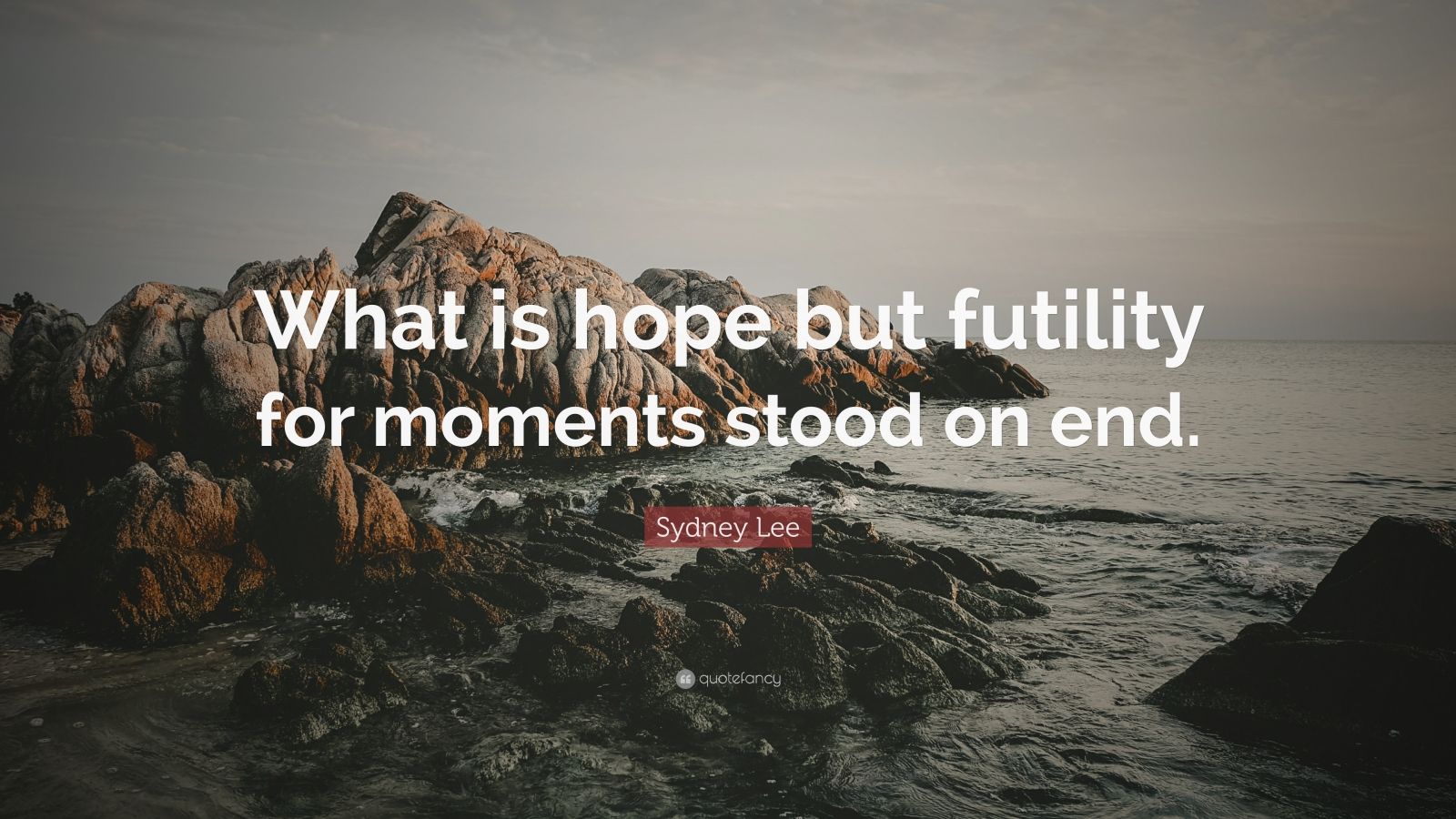
2813565-Sydney-Lee-Quote-What-is-hope-but-futility-for-moments-stood-on

Hope as Useless Concept:

If you believe in Hope, you have to believe in God or a higher power because Hope nullifies any effort on your part to change anything.  For instance, I say “I Hope to win the lottery.”  This is nothing short of wishing for a miracle or wishing that a higher power will take favor on me and overcome the billion to one odds against my ticket winning.  Or I might say “I Hope my children will grow up and be happy and prosperous.”  What power can make this happen except an all-powerful entity that many call God?  If I am hoping for my children to be happy it appears that I can do nothing more to make this happen than to sit on a rock and repeat “Hope, Hope, Hope, over and over again.

When did Hope ever change anything.  Change takes effort both mentally and physically.  Hope relies on something ephemeral that will happen to spontaneously make things better.  “I Hope I will do well on the test tomorrow.”  As Yoda said about the word “Try”, “There is no try, there is either DO or DO NOT.”  Hoping will never get you good grades.  Study, practice, and more study are the only things that have ever led to good grades.  Do you get to Carnegie Hall by Hoping?  The trope that Carnegie Hall puts on their refrigerator magnets and tote bags reads “How do you get to Carnegie Hall?  Practice, Practice, Practice.”  It does not say “How do you get to Carnegie Hall?  Hope, Hope, Hope.”

Perhaps Hope is an idea supported by those who want to keep the masses quiet and lazy.  Karl Marx said that “Religion is the opiate of the Masses.”   I have often said that today “Sports is the opiate of the masses.”  Hope is simply another opiate.  We can keep hoping that Donald Trump will not be elected.  We can keep hoping that the Israeli Palestinian problem will be resolved.  We can keep hoping that our lives will be healthy.  We can hope all day long and nothing is going to happen unless we get off our butts and fight to change things.

Generative AI defines Effort as follows:

“Effort is the physical or mental activity needed to achieve something.  It can also refer to the use of energy to get something done, or the exertion of strength or mental power.”

Effort means doing something.  Either you use your brain, or you use your muscles, but you do something that leads to a desired outcome.  Hope does not imply any such effort.  Here are three AI definitions of Hope:

“As a noun, hope is a feeling that something good will happen or be true.  It can also mean a desire accompanied by expectation, or the thing that one has a hope for.”

“As a verb, hope means ‘to expect with confidence’ or ‘to cherish a desire with anticipation’.”

“In the Bible, hope is a confident expectation of what God has promised.  It is a confident expectation and desire for something good in the future, with moral certainty.”

So, Hope comes down to an expectation or feeling.  An expectation or feeling that without any effort on your part, God, or something else is going to provide you with some desired outcome.  To win that lottery, all you need to do is Hope long and hard enough and you will be rewarded with tons of cash.  I only Hope you do not spend it all in one place.

To sum up, those who Hope for what they want are living in a fool’s paradise of dreams and wishes.  I would expect that the same people who put all their faith in Hope also believe in the Tooth Fairy, the Easter Bunny and Santa Claus.  I have already mentioned a belief in a benevolent God that begs credibility and reality.

download (1)

Hope as Essential for Happiness and Progress:

How could we ever make progress without dreams and wishes?  Who would ever have the motivation to try anything or to make any effort if they were not fueled by Hope.  By a belief that their efforts would and could achieve a desired effect.  The Bible says that “Without Hope, the people will perish.”  Can you imagine a life without Hope?  It would be a sad cruel world if people could not at least believe that tomorrow may be better than today.  That tomorrow could bring an end to the wars and violence that plague our world.

All good things must have Hope behind them.  I married my present wife with the Hope that I could do a better job on this marriage than I did on the first.  I started college after being a terrible student in high school with the Hope that I would have the focus and discipline at 25 years of age that I did not have when I was fourteen years old.

There are many pragmatic concepts that we can use as rules or guides for our lives.  Some of them make good sense.  Some do not.  Hope does not lend itself well to pragmatism.  Hope is of the soul and spirit and not of the brain and intellect.  Great minds may say that Hope is for fools, but many of our “great minds” tend to be bigger fools because they ignore the emotional needs of people.  Hope is food for the spirit and soul just as ideas and theories are food for the mind.  People need both a heart and a brain to live.  Without Hope, there is no heart.

I am sure that you are familiar with the popular author Robert Fulghum.  I think his first book was “All I Really Need to Know I Learned in Kindergarten.”  This was a book of short essays written with some great insights and a very imaginative sense of humor.  One of the quotes from this book that pertained to the concept of Hope was this bit of wisdom:

“I believe that imagination is stronger than knowledge.  That myth is more potent than history.  That dreams are more powerful than facts.  That Hope always triumphs over experience.  That laughter is the only cure for grief.  And I believe that love is stronger than death.”

To sum up, Hope comes from the heart.  Without Hope we are not human beings.  With no hope we are little more than automatons.  Robots will probably never be able to hope.  They are quite logical.  A robot can waste no effort on Hope.  Can you imagine Commander Spock from the original Star Trek series exclaiming, “Gee, I Hope we can get back to the ship in one piece.”  Spock would never have issued such a plea, but Bones or Dr. McCoy would be quite comfortable with the sentiment.  Kirk on the other hand would be too busy dashing about to worry about Hope either for better or worse.

Conclusions:

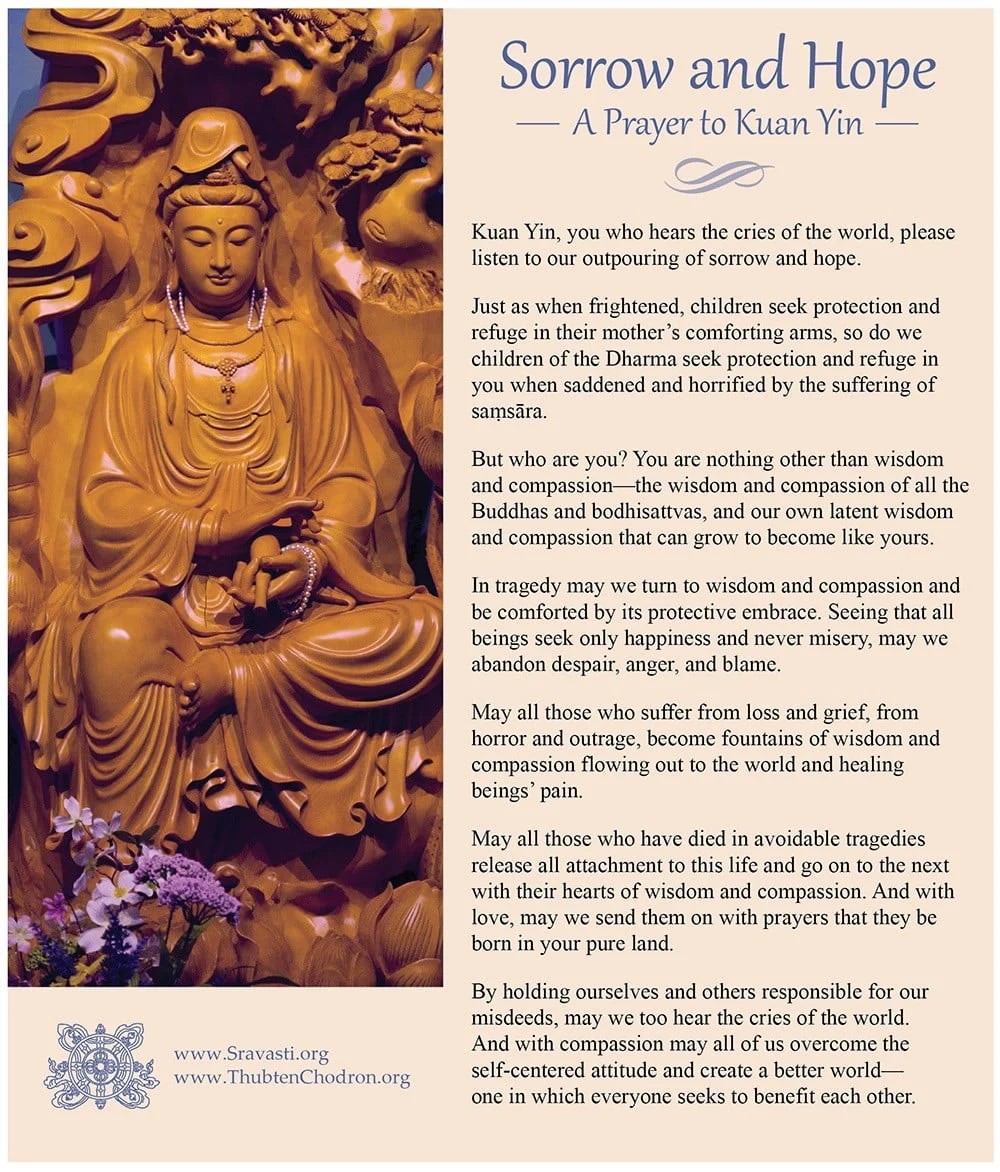
What do you think friends?  Do we strike Hope from our vocabulary and set off for a brave new world with logic and knowledge or do we take a moment each day for a prayer of Hope.  What if a prayer blended both points of view?  In case you do want such a prayer, here is a Buddhist prayer that I think would help your soul and spirit without stepping too hard on your faith in logic and knowledge.   — Sorrow & Hope: Prayer to Kuan Yin, Mar 31, 2018,  Dharma Insights, News

news-kuanyin-prayer-apr18-longer3

Incomplete Episodes in a Life

7c303045f2abcc62acae6a2c166a82ab486d706b0cb1634b651498d0c3f7b92e

One’s life might be viewed as a series of episodes.  Each episode is an animated picture or story with a beginning, middle and conclusion.  Most of the episodes in our lives follow this pattern.  However, there are some that do not.  The ones that do not generally lack a conclusion.  These are the “incomplete” episodes that I referred to in the title to this blog.  Things that we started but never finished.  Places we wanted to go but never did.  People we wanted to meet but did not.  Perhaps even more importantly, who we wanted to become but never did.

Before giving my somewhat prosaic opinions of this topic, I decided to query ChatGPT to see what it would say about the subject.  I used the following query:

How does one deal with the incomplete episodes in our lives?

Here is the entire response that ChatGPT gave.  Some good food for thought which I would like to later elaborate on.  It (I don’t know whether to say he or she), and It seems too impersonal.  Anyway, ChatGPT gave the following ten answers.  I list these just as he/she gave them.  Any typos belong to ChatGPT.  😊

ChatGPT

Dealing with incomplete episodes in our lives can be challenging, as it often involves facing uncertainty, unmet expectations, or unresolved issues.  Here are some strategies to help you navigate through such situations:

  1. Acceptance:
  • Acknowledge that life is full of incomplete episodes, and not everything can be neatly resolved or concluded.
  • Embrace the uncertainty and imperfection inherent in the human experience.
  1. Mindfulness:
  • Practice mindfulness to stay present in the moment rather than dwelling on the past or worrying about the future.
  • Focus on what you can control and let go of things beyond your control.
  1. Learn from the Experience:
  • Reflect on the incomplete episode and identify any lessons or insights it may offer.
  • Consider how you can grow and develop as a person through the experiences, even if they are not fully resolved.
  1. Gratitude:
  • Cultivate a sense of gratitude for the positive aspects of the experience, even if it didn’t unfold as expected.
  • Recognize the value in the journey itself, rather than solely focusing on the destination.
  1. Seek Closure if Possible:
  • If the incomplete episode involves relationships or unresolved issues, consider whether seeking closure is feasible and healthy.
  • This might involve open communication, forgiveness, or finding a resolution that allows you to move forward.
  1. Adaptability:
  • Develop adaptability and resilience to cope with life’s uncertainties.
  • Understand that flexibility and the ability to adjust your expectations can contribute to a more fulfilling life.
  1. Self-Compassion:
  • Be kind to yourself. Understand that not everything will have a clear resolution, and that’s okay.
  • Avoid self-blame or excessive criticism, and recognize that everyone faces incomplete episodes in their lives.
  1. Future Orientation:
  • Focus on the opportunities and possibilities that lie ahead rather than dwelling on what didn’t work out.
  • Set new goals and aspirations that align with your values and contribute to your overall well-being.
  1. Connect with Others:
  • Share your thoughts and feelings with trusted friends, family, or a therapist.
  • Connecting with others can provide support, different perspectives, and a sense of community.
  1. Creative Expression:
  • Use creative outlets such as writing, art, or music to express your emotions and make sense of the incomplete episode.
  • Creative expression can be a powerful tool for self-discovery and healing.

Remember, the process of dealing with incomplete episodes is unique to each individual, and there is no one-size-fits-all solution.  It’s essential to be patient with yourself and allow time for healing and growth.

John Persico:  Back to my thoughts now. 

ddddddSuffice it to say, I am awestruck by the reply from ChatGPT.  She/he might just eliminate the need for many experts including pundits like me, psychiatrists, doctors, lawyers, professors, sociologists, psychologists and even you.  I am scratching my head as to what I can add about the subject that ChatGPT did not provide you.  I can tell you a story though that ChatGPT cannot concerning a major non-closure in my own life.  One episode among many that has left me with regrets.  I can also tell you that it is not always easy to get closure on incomplete episodes.  Many things can get in the way.  Perhaps the primary barriers either being the unwillingness of one party to try or to reciprocate an effort and of course our own egos.

My incomplete episode in a nutshell concerns a friend who I left behind.  As much as I admired this friend, I found that talking with him became more and more difficult.  It appeared to me that he was always looking to pick a fight or to insult me.  We drifted more and more apart in our politics and our views on life.  I did not want to engage in frequent arguments with him and to use the common vernacular I “ghosted” him.  I just avoided his calls and did not reach out to him anymore.  When I had a going away party, I did not invite him.

Adownload few years later, I decided to reach out to him again.  You can guess his reaction.  He was angry and insulting.  I decided to drop my effort.  Over the years, we have had some interactions by phone or email but nothing that has substantially reinvigorated our former friendship.  I am not sure whether he feels any loss, but I can honestly say that I miss him.  He had many good qualities and there were many times that we spent together that I fondly remember.  I have been the one over the past few years to try to reach out, but my efforts have gone nowhere.  At this point, I have decided that “people change” and that he is not the person that he once was.  This is a good excuse or rationale for my letting go and forgetting him.  You can no doubt pick many holes in my logic.

I tell you this story because advice such as ChatGPT has given is very good, but advice can only go so far to heal hurts and pains that we inflect on others.  ChatGPT does have one reference to forgiveness, but it really says very little about how we forgive others or forgive ourselves.  I know from personal experience that it is not an easy task.

So, what are our options?  To paraphrase Hamlet, Act III, Scene 1, Shakespeare:

“To seek closure or not?  Whether tis nobler in the mind to suffer the slings and arrows of outrageous fortune, or to take arms against a sea of troubles, and by opposing end them?  To die: to sleep; no more; and by a sleep to say we end the heartache and the thousand natural shocks that flesh is heir to, ’tis a consummation devoutly to be wished.”

download fffI could point out that few things worth having ever come easy.  The problem is that too many of us grow up today with the fantasy that as the song in My Fair Lady goes, “With a little bit of luck, you can have it all.”  I grew up with a phrase that was popular in my neighborhood that went “He got the breaks.”  This meant basically that he/she got what they got cause they got lucky.  They did not have to work hard.  They did not have to practice.  They did not have to study.  They simply had to get the “Breaks.”  It took me years to realize the fallacy in thinking that luck has much to do with what one gets in life.  Two of my now favorites quotes are:
  • “The harder I work, the luckier I get.” — Thomas Jefferson
  • “Luck is where preparation meets opportunity.” — Samuel Goldwyn

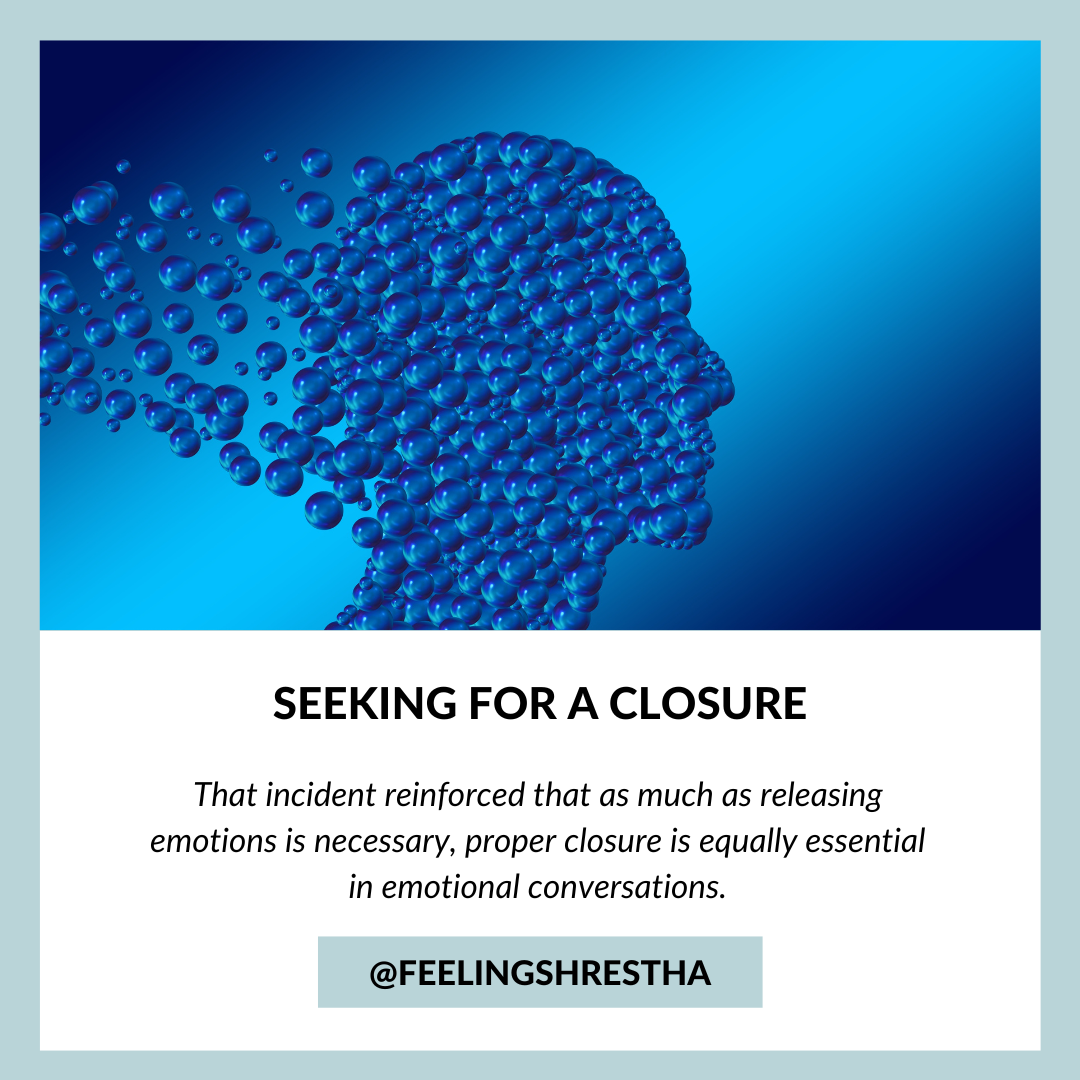
1_ZLn1TTtTNK4AxQqTFVQe7AA life without closures will be a life not really lived well.  The more closures we can accomplish, the more satisfying our lives will be.  Perhaps only a life lived with closures can be a life lived without regrets.  We will all have regrets in our lives.  Our incomplete episodes are links in a chain that we forge as we go through life.  A key question is “how long do we want our chain to be?”  The more effort we make to complete these episodes, the shorter our chain will be, and I think the happier our lives will be.  Look at the incomplete episodes in your life today.  Which ones still cause you heartache and regrets.  Is it too late to do anything about them?  Would it be worth the effort?  What would it cost you to try?
A Different Point of View:  

Oiml4epiXuaW4 (1)

Many experts think looking for closure is a waste of time.  One comment I found was:

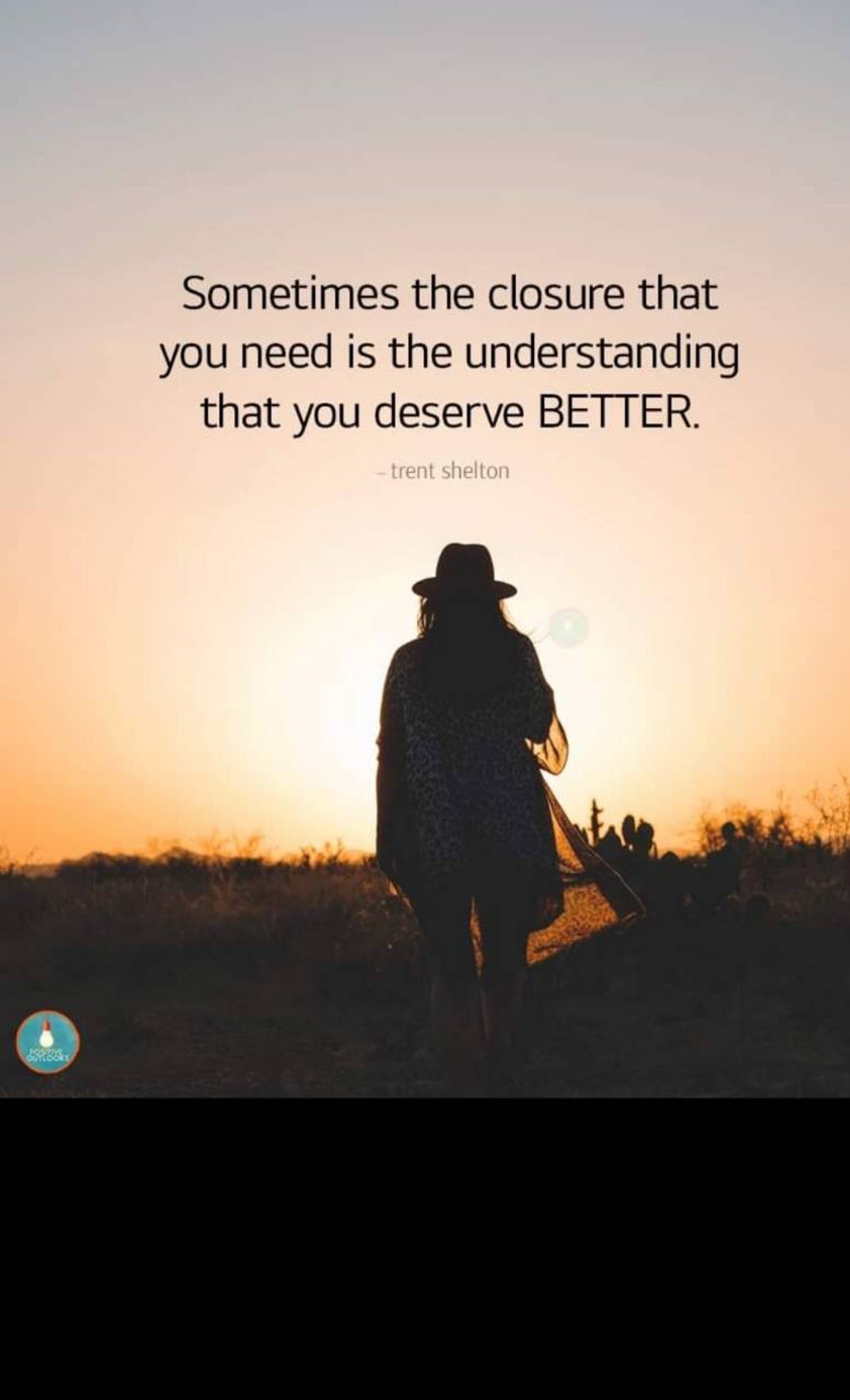
“The best closure is ridding yourself of whoever interferes with your happiness and focusing on the people and activities that bring happiness into your life.  So, is closure important?  Well, you have to decide that for yourself and on your own terms.  Maybe letting go is all the closure you really need.” 

For more on the above point of view, see “How Important Is It to Find Closure?”

Keep in mind that the closure mostly referred to in this article deals with people and relationships.  There are many other types of incomplete episodes in our lives where closure will need a different strategy.  For instance, if you feel inadequate because you never went to college.  Maybe it is not too late to go to college.  Or maybe you always wanted to learn scuba diving.  Maybe it is not too late to learn to dive.  Here are ten people who started things late in life and are now honored for their efforts:

  1. Laura Ingalls Wilder Publishes “Little House in the Big Woods” — 65 years old
  2. Benjamin Franklin Signs the “Declaration of Independence” — 70 years old
  3. Nelson Mandela Becomes President of South Africa — 77 years old
  4. Shigemi Hirata Obtains a BA Degree from Kyoto University —96 years old
  5. Gandhi and Granny D Walk for a Cause — 60 years old
  6. Grandma Moses Picks Up a Paintbrush — 78 years old
  7. Fauja Singh is still running marathons — 100 years old.
  8. John Goodenough wins a Nobel Prize in Chemistry — 97 years old
  9. Yuichiro Miura climbs Mount Everest — 80 years old
  10. Adriane Stewart a Professional Opera Singer — 92 years old

As we begin to enter a New Year of 2024.  I wish you all the best in the closures or completeness of episodes in your life that cause you regrets and pain.  Life is seldom easy.


What is a Humanitarian?

maxresdefault

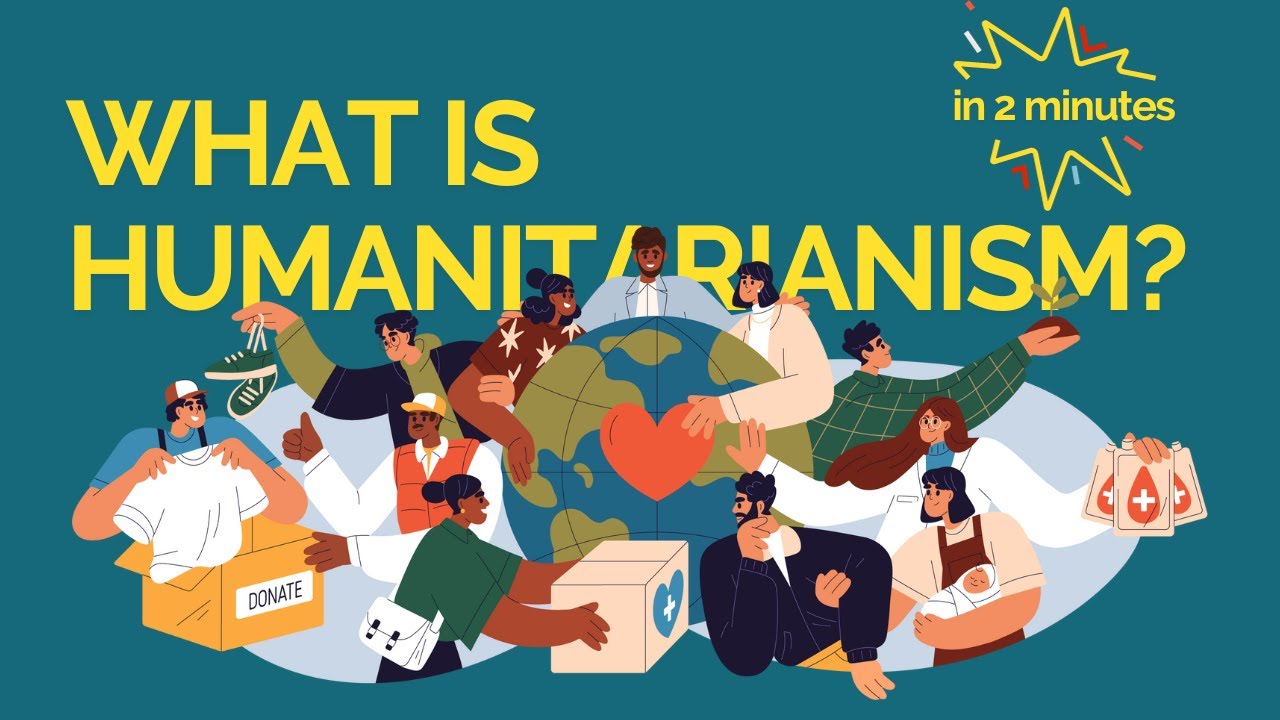
It is not unusual to hear someone refer to the need for more humanity.  We often hear about “Calls” for humanitarian needs.  But what does it mean to exercise humanity?  What are our humanitarian needs?  Who is a real humanitarian?  Should we all strive to be humanitarians?  Can you get a diploma or a degree in humanitarianism?  My Google AI program gave me the following definition for a “humanitarian”:

A humanitarian is a person who is concerned with the welfare of others.  They may work to improve the happiness and health of people.    Humanitarians can be volunteers or paid employees.”

Humanitarian-Charter-cartoons-6

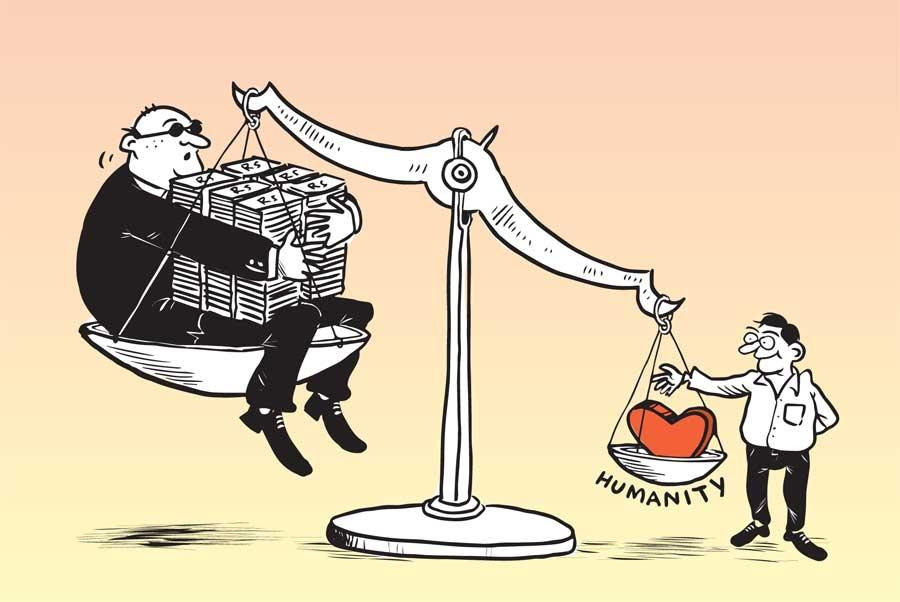
The last few years in the USA, Humanitarians and humanitarianism seem to be in scarce supply.  More people are concerned with how much they can buy and the fact that “Black Friday” is fast approaching than they are with improving the happiness and health of other people.  I find it very confusing that a large portion of Americans claim that the USA is a Christian Nation or that it should be.  My reading of the Bible gives me a different understanding of what a Christian is and how they behave.  Recently, I discovered the term “Cultural Christians.”  A “Cultural Christian” is a Christian by birth.  Someone who is born into a family of Christians or is baptized into a Christian denomination shortly after their birth.

Calling upon my AI program again, a “Cultural Christian” is defined as, “Someone who identifies as a Christian but doesn’t have a personal relationship with Jesus.”  In other words, a Cultural Christian does not have a clue as to the teachings of Jesus Christ or any other Christian prophet, Saint, or proselytizer.  Ironic isn’t it that many of these same people call on the name of Jesus to save them.  I suspect that if Jesus were alive today, he would ask them to repent before they went to hell.  A song (You Don’t Love God If You Don’t Love Your Neighbor) that I recently heard by Rhonda Vincent has the following lines:

There are many people, who will say they’re Christians

And they live like Christians on the Sabbath day

But come Monday morning, till the coming Sunday

They will fight their neighbor all along the way

Oh, you don’t love God

If you don’t love your neighbor.

Gérôme_-_La_rentrée_des_félins_1902-1-of4o8rppoxx3zn8toq8ws79zz8zqsftfoxkhwq8olkTwo thousand years ago, the Roman Empire started its decline after having been the greatest empire that the world had yet seen.  Many historians point to the decadence of the Roman Empire during its decline.  “Decadence” is defined by the Oxford On-Line Dictionary as, “Moral or cultural decline as characterized by excessive indulgence in pleasure or luxury.”  The Romans had their “Bread and Circuses.”  The Oxford Dictionary defines “Bread and Circuses” as, “A diet of entertainment or political policies on which the masses are fed to keep them happy and docile.”  For many, football and politics are the bread and circuses or our American Empire.  I think the rot and decay in America today goes much deeper than that.  Here is my list of some of the decadence that I see in the USA today:
  • Excessive consumerism and a frenzy to have bigger and bigger stuff
  • Excessive shopping till we drop, more and more stuff
  • Excessive eating leading to mega levels of obesity in America
  • Excessive time spent watching TV, movies, and other entertainment
  • Obsession with sports and team affiliation from grade school to the NFL
  • Excessive casino gambling
  • Pull tabs, scratch offs, lotteries
  • Drugs and alcohol addiction
  • Greed and more greed. Forever, cutting taxes so the greedy can have even more and the poor and needy can have even less
  • And now we have added “On-line Sports Betting.”

You Don’t Love God If You Don’t Love Your Neighbor

If you gossip about him, if you never have mercy

If he gets into trouble, and you don’t try to help him

Then you don’t love your neighbor

greed versus humanity

The more I write this blog, the more I think of the prophet Jeremiah.  Jeremiah constantly called upon the Israelites to turn away from their wicked ways and dependence upon idols and false gods and return to God.  For his troubles, Jeremiah was stoned to death.  But Jeremiah did more than just rail against sin and evil.  He also tried to give hope to his countrymen.  He promised that a “New Covenant” was coming to all those who followed God’s laws.  This covenant would supersede the old Mosaic Covenant.  Instead of inscribing his law upon tablets of stone as in the Mosaic Covenant, God would write his law upon the hearts of men.  Jesus said at the last supper, “This cup is the new covenant in my blood.”  — (Luke 22:20)

In the holy Bible, in the book of Matthew

Read the 18th chapter in the 21st verse

Jesus plainly tells us that we must have mercy

There’s a special warning in the 35th verse

Oh, you don’t love God

If you don’t love your neighbor

If you gossip about him, if you never have mercy

If he gets into trouble, and you don’t try to help him

Then you don’t love your neighbor

And you don’t love God.

neighbor_slide_title

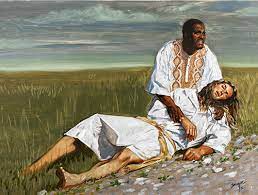
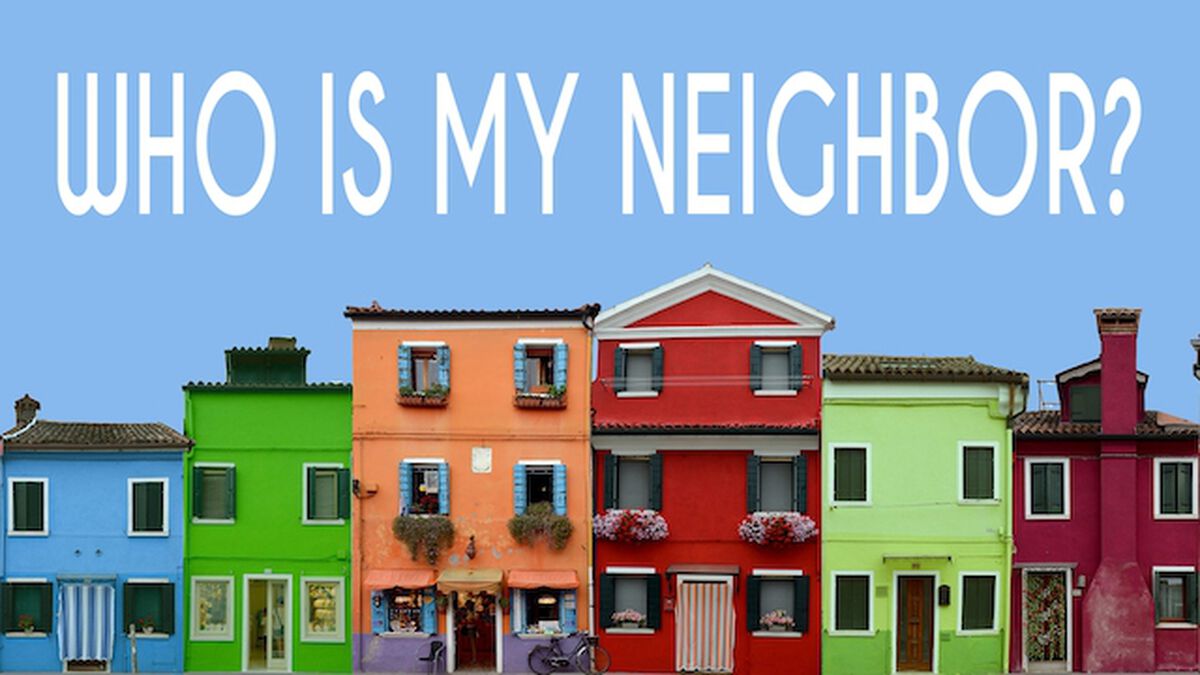
You may well ask, Well “Who is my neighbor?”  Jesus answered this question in his story about the Good Samaritan.  Jesus tells the parable of the Good Samaritan (Luke 10:29–37) and makes it clear in this parable that our neighbor is anyone around us, regardless of their ethnic, religious, or socio-economic status.  I have a T-Shirt that I like which reads, “God Bless Everyone:  No Exceptions.”  I have had many people come up to me and tell me how much they like this blessing.

the good samaritanI have another T-Shirt where I list the “No Exceptions” groups that somehow seem to be conveniently overlooked by many Cultural Christians.  The major fallacy that many Christians seem to observe is to define their neighbors as either someone in their own church or in their own social group.  When Jesus included the Samaritans who were an outcast group at the time as his neighbors, this should have made it clear that you must go beyond your tribe or friends to include other nations, other ethnicities, other religions, and other people with different beliefs as your neighbor.

There’s a God Almighty, and you’ve got to love him

If you want salvation and a home on high

If you say you love him while you hate your neighbor

Then you don’t have religion, you just told a lie

Oh, you don’t love God

If you don’t love your neighbor.

Well, we are almost at the end of my story.  Not much else to say is there?”  Just one last thought to leave you with.  Please feel free to share this with others.

  • If you love things more than you love people,
  • if you love money more than you love people,
  • if you love ideology more than you love people,
  • if you love tv, gambling, sports, and movies more than you love people,
  • If you love drugs and alcohol more than you love people,
  • then I think Jesus would say that:
  • “You Don’t Love God.”

 My thanks to Rhonda Vincent for her song and the lyrics in this blog.  You may listen to her song at:  https://www.youtube.com/watch?v=IR2rpVd5Lwo


Hatred Burning Brightly in the World

HATE_Retail_Pledge_Thumb

I hate Jews.  I hate Muslims.  I hate Christians.  I hate Buddhists.  I hate Republicans.  I hate Democrats.  I hate communists.  I hate fascists.  I hate capitalists.  I hate lazy people.  I hate ambitious people.  I hate fat people.  I hate skinny people.  I hate Chinese people.  I hate Americans.  I hate Russians.  I hate Europeans.  I hate Black people.  I hate White People.  I hate dumb people.  I hate smart people.  I hate racists.  I hate sexists.  I hate old people.  I hate young people. I hate Anthony Blinken.  I hate Donald Trump.  I hate others.  I hate everyone.  I hate myself.

What If?

What if you woke up tomorrow and everyone in the world had decided not to hate?  What if when you rolled out of bed, you thought, “There is no one in the world that I hate?”  What if when I rolled out of bed, I put all my hate aside?  What if no one in the world hated anyone else?  What if you and I and all our friends made a choice to not hate other groups or other people?

hate image

Isn’t hate a choice?  Does anyone force us to hate other people? 

What if we agreed today to make the choice and promise not to hate anyone else ever again? Maybe ending hate is the only way to end war and violence.

I promise that I will not hate anyone else again for as long as I live.

IMG_2486

“I imagine one of the reasons people cling to their hates so stubbornly is because they sense, once hate is gone, they will be forced to deal with pain.” — James Baldwin, The Fire Next Time

“I will permit no man to narrow and degrade my soul by making me hate him.”   ― Booker T. Washington

“So I have learned it the hard way that if you love, it is your decision.  If you hate, it is your decision.  I am almost non-existent as far as my side is concerned: neither am I a partner in your love, nor am I going to be a partner in your hate.”  — OSHO

“It is the hatred of the migrant, the terrorist, and the drug dealer – all portrayed as sociopaths – that evokes an acerbic form of nationalism, one that is not rooted in love of one’s fellow human beings but in hatred of the outsider.  Hatred masquerades as patriotism while the size of the national flag grows and the enthusiasm for the national anthem increases by decibels.” — The Intimate Embrace between Liberalism and the Far Right, by Vijay Prashad, 11/23

I Wonder as a I Wander

20210524_1igantiusstars

I have always loved the phrase “I wonder as I wander out under the sky” from a song written by American folklorist and singer John Jacob Niles.  It was first sung in 1944 by Pvt. Cecil Gant.  The record made it to number one on the Juke Box Race Records chart in 1944 and 1945.  It has probably been sung over a billion times and is a favorite among Christians during the holiday season.  The lyrics are as follows:

I wonder as I wander out under the sky

That Jesus my Savior did come for to die

For poor ordinary people like you and like I

I wonder as I wander out under the sky

Now many of you would know that I profess to be part Atheist and part Agnostic, so Jesus is not my savior.  However, I regard him as a great prophet and teacher of the human spirit.  Seldom have I read anything as significant as the Eight Beatitudes that Jesus gave in a sermon.  These eight messages tell us much about the man and speak volumes in terms of how we need to treat other human beings:

  1. Blessed are the poor in spirit: for theirs is the kingdom of heaven.
  2. Blessed are the meek: for they shall possess the land.
  3. Blessed are they who mourn for they shall be comforted.
  4. Blessed are they that hunger and thirst after justice: for they shall have their fill.
  5. Blessed are the merciful: for they shall obtain mercy.
  6. Blessed are the clean of heart: for they shall see God.
  7. Blessed are the peacemakers: for they shall be called the children of God.
  8. Blessed are they that suffer persecution for justice’ sake, for theirs is the kingdom of heaven. — Matthew (5:3-10).

I wonder many nights when I am out under a clear sky.  I wonder what it all means.  I wonder what I am here for.  I wonder about friendship and loyalty.  I wonder about integrity and politics.  I wonder about the world and the climate.  I wonder if wars and murders will ever end.  I wonder if prejudice and discrimination will ever cease.  I wonder if abuse to women and gender-diverse people will ever end.  I wonder if religions will stop persecuting other religions.  I wonder if it was all worth living for.

A wise person once said that there are two “What Ifs.”  One deals with fear and can be paralyzing and enabling, “What if this happens?”  “What if I should fall or break a leg?”  “What if things should go wrong?”  The other “What If” deals with wonder and can lead to positive and rewarding insights.  Insights that raise life and humanity up and create a better world.  “What if we did this instead of this?”  “What if we could have peace instead of war?”  “What if we could eliminate the need for guns and weapons?”  “What if we valued humanity more than we valued money?”

I wonder what would happen if we chose hope and love over fear and greed.  I wonder as I wander out under the stars what life on this planet COULD be like.

Previous Older Entries Next Newer Entries