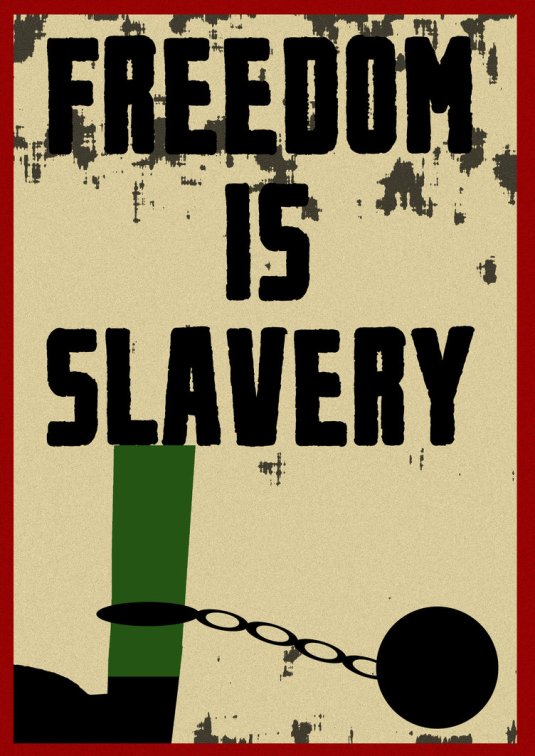
What America May Be Like in the Year 2056

freedom-is-slavery

The following is an imaginary story I wrote back in January of 2017.  I wrote it at the start of the first trump administration.  I was reflecting on what life would be like in about 40 years under a Republican dominated government.  I just happened to come upon this blog again a few days ago.  After rereading it, I was surprised by how many of these things seem to be coming to pass under the “NEW” trump administration.  I have decided to publish it in the original without making ANY changes at all.  Love to hear your comments and what you think.  

———————————————————————————————————

I live in Republicanville USA.  It is a small town of about 1,500 people in the rural Midwest.  Today in my town, all the women are barefoot and pregnant and all the men are stupid and misinformed.  It wasn’t always this way.  Things started to change about 75 years ago, when Ronald Reagan became President.  My town had always been very progressive and liberal but we started hearing more and more about how we were being taken advantage of by the poor, those on government handouts and those too lazy to work.  The Republicans who in our town had always been a minority began to grow in numbers.  The more we heard about welfare cheats and welfare freeloaders and those on drugs taking advantage of us, the more my town embraced a new concept of democracy.  It was more like “every man or woman for themselves” rather than “all for one and one for all.”

obey-jesus-or-perish

Our U.S. democracy which had always prided itself on a separation of church and state seemed to forget the reason for this partition.  Increasingly, a group called Evangelical Fundamentalists became more popular along with their criticism of many progressive institutions.  Republicanville USA moved more and more to the right.  The concept of unbridled capitalism became enshrined as a religion and many people began opposing “big” government and taxes.  The Republican Party preached that the marketplace could provide for all social, physical and economic needs of U.S. citizens.  My town moved even further to the right.

trump-state-of-the-unionThis conservative trend was already well underway when in 2017, a billionaire real-estate developer named Donald Trump became the 45th President of the United States of America.  In addition to the hard core conservative beliefs of many mainstream Republicans, Trump added the once discredited idea of American Isolationism.  We would now put America first, no matter what.  No more negotiations with other nations unless it was clear that we got the better of the deal.  We would build a big wall to keep Mexicans and other immigrants out and we would renege on our trade deals with China and Europe.  About the only country that Trump liked was Russia.   Eventually, he agreed to give Alaska and parts of Canada back to Russia.

Trump came through on his promises to the Evangelicals that he would make America White again and put women back in the bedroom where it would be okay to grab their pussies whenever you wanted to.  Minorities were targeted for deportation and women libbers promoting abortion or equal rights for women were arrested in wholesale sweeps and sent to special detention centers for chronic complainers and protesters.

I would like to describe in somewhat more detail what my town is like now in 2056.  Things are a lot different than when I was born in 2017.  I will divide my discussion of these changes into three areas:  Family, Education and Social Issues.

Family:

another-day-in-paradiseI am 39 years old and have two children.  I have never worked (at least outside of the home) as women have not been allowed to work since 2022 when they passed the “Women in the Home Law” as it was popularly called.  The Federal government passed the law and it was ratified by every state and municipality in the nation.  Some places tried to hold out but the government cut off all funding to them until they capitulated.  This law effectively outlawed women working.  It also barred women from the military.  Ten years later (2032) they passed the “Mandatory Birth Act.”  This bill proscribes that every woman (physically able to) must give birth to at least two children.  Any woman who reaches the age of 32 and still has not given birth to two children is forcibly removed to a National Birthing Center where she will be artificially impregnated and kept confined until she has had at least two healthy children.  Sickly or unhealthy children are sent to Disposal Camps where they are “recycled” per official government propaganda.  No one is quite sure what happens during recycling but the children are never seen again.

Many gay women resisted the Mandatory Birth Act and the National Suicide Rate went up dramatically.  The “Fathers” (as our political leaders are now called) made it very clear that the country would be better off without such deviates.  Since women were no longer allowed in politics, the leaders of the nation decreed that they would all be called “Fathers” instead of being referred to as politicians or legislators as they once were called.

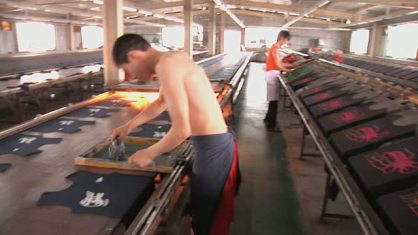
My husband works at a local mill where they make t-shirts for Japan, China, Brazil and some of the more developed t-shirt-workersnations.  Since banning imports of such items, we have created millions of jobs making goods that were once made in low wage countries.  The demand for such goods has skyrocketed but now we are providing them.  Unfortunately, the wages and education needed for such work is still low.  My husband did not finish high school but most men in our town do not.  The Fathers have repeatedly stated that real men don’t need higher education.  (I will talk more about education later.)
When my husband is not working, he spends most of his time watching football, baseball, basketball, golf or hockey.  I ammen-watching-game not allowed in the living room when his sports are on except to bring in some beer or chips.  This does not really bother me much as I have plenty to do with the kids, housecleaning, cooking and all.  I have my own TV in my sewing room where I can watch any of the approved programs for women.  We have 30 different “Women Only” channels where I can learn more about cooking and cleaning and how to be a good wife. There are some good romances and family drama stories that are occasionally on.  I look forward to watching these when the kids are in bed.

Our two children, Mary and John are 12 and 15 respectively.  Mary is in a finishing school for girls where they are preparing her for being a mom and wife.  She takes subjects such as homemaking, cooking, cleaning and parenting.  She has one more year to go before finishing school.

When Mary turns 14, she will be eligible for marriage.  Her name will be put in a marriage registry.  If she is lucky enough and pretty enough, some up and coming town Father will select her for a wife.  Men who qualify due to income levels are allowed to have up to five wives.

woman-vacuum-cleaning

My son John is not in school any longer and he works part-time.  The Fathers decried that girls did not need schooling after the age of 13.  John hopes to get a job in the t-shirt plant where his dad works when he turns 16.  He quit school because we could not afford a private school for him.  Only the rich kids in town go on to education beyond the 10th grade.  Private schools are very expensive and the Fathers do not believe in funding education any more.  It has been emphasized that education is an elitist program that creates class divisions and makes some people feel more entitled than other people.   Most young men in our town will work in one of the mills or plants.

Education:

anti_public_education_propaganda_by_8manderz8-d5xz1cj

I have already talked about some aspects of our education system today.  Basically, most people do not believe in higher education anymore.  It is only for the rich.  All funds for public education were cut in 2035 when they passed the “Private Education Act”.  Most folks now send their kids to private schools through the 8th grade and then find work for their children after that.  Girls will be shortly married so school is not thought to be that important for them anyway.  They can learn whatever they need to be a good wife on the “At Home Wives Channels.”

students-1920-1950-9_jpeg

Boys from families with lower incomes can opt to go to privately funded vocational schools to learn such trades as t-shirt making, sneaker making, jewelry making, gun repair, taxidermy, and many other skills that might be in demand.  There is still some funding for such programs that is available for lower income families.  All public colleges have been closed now.  As I noted earlier, such schools were decried to be elitist and the Fathers were unanimous in un-funding them.

Boys from wealthier families go to the more prestigious private schools where they will learn such skills as: Leadership, Accounting, Business Development, Entrepreneurship and Medicine.  Law was abolished as a field of study in 2030 with the passage of the “No More Lawyers Act.”  This act basically made lawsuits illegal thus dramatically decreasing the need for lawyers in the U.S.

Courtrooms abolished “adversarial” trial procedures with the “No More Lawyers Act” and replaced the old-fashioned method of two people arguing trials with modern Computerized Forensic Tomography.  Using CFT, a cross section of the case and evidence pro and con is presented to the jurors.  All the available facts and data are reviewed and jurors vote on the verdict.  Trials are much more efficient and there is no need for lawyers.

Anti EducationLibraries are now mostly museums.  With the passage of the “Books Only Lie Bill” in 2038, all funds to public libraries were cut.  The Fathers decried that books did nothing but cause trouble and stir up discontent.  Anything citizens really needed to know could be found on the “Citizens Channels” offered by the government Department of Public Wisdom.  There are over 100 of these channels which are available on public TV.  They are on 24/7 and offer many programs for good citizenship.  Some of the programs are:

  • Disciplining your children
  • How to take proper care of your guns
  • Disciplining your wife
  • Obeying your supervisor
  • Getting along with co-workers
  • Obeying authority
  • Keeping a clean house

Social Issues:

Social issues or problems (as some people thought of them) have been mostly eliminated in our town.  Our Fathers banned minorities in 2040 with the “America for Whites Act.”  Under this act, no immigrants or people of color can live in the same community as White people.  In 2041, they passed the “Christian Only Act” making Christianity the official Religion of the USA.  All other religions were banned along with atheism and agnosticism.  The “Mandatory Religion Act” in 2042 made it a felony crime not to attend a Christian church every Sunday.

In our town, there is only one church now.  It the Fundamental Evangelical Christian Church for Christ.  We have two pastors who are both well versed in Old Testament theology.  They are fond of saying that “Heaven is for the obedient, the disobedient will all go to hell.”  We are taught that Jesus will come again before the end of the century to judge the living and the dead.  The good folks will go to heaven and the bad will burn forever in the flames of hell.

We still have crime in our community but not very much.  It is severely punished with public floggings, beatings and hangings.  Criminals are banished to work rehabilitation camps for hard labor.  Drugs are still a major problem but the new “One Strike Act” passed in 2050 decried that anyone caught with an illegal substance would face a mandatory life sentence at a penal colony somewhere in the South China Sea.

immigration-reform

Gay men still can be found but homosexuality can be punished under the “2045 Purity of Purpose Bill” with mandatory castration.  Boys are encouraged to be manly and any evidence of femininity in our boys is severely dealt with.  Our town brought back “town stocks” a few years ago, to punish any boys or men caught in homosexual activities.  These punishments plus the threat of castration have decreased the rate of homosexuality considerably in our community.

Well, I could tell you a great deal more about life in our town in 2056, but I have cleaning and cooking to do.  Furthermore, if anyone knew I was writing this I would be in big trouble.  Under the “Against Propaganda Law” passed in 2041, no one may criticize the government, any Fathers or any laws without official authorization from the local town council.  I could be publicly flogged or worse for saying these things.  Thus, for now I will just hide this away.  I don’t mean to be either a coward or a complainer.  Our Fathers say this is the Golden Age of America and that we are living in the greatest Christian country in the world.  Who am I to argue?

Time for Questions:

Are you living the good life?  Do you live the life you dreamed of?  Do you think you have a right to your dreams?  Do you think other people also have a right to their dreams?  How much authority do you think a government should have over your dreams?  What kind of dreams do you have for your children?  What do you call progress?

Life is just beginning.

“No one believes more firmly than Comrade Napoleon that all animals are equal.  He would be only too happy to let you make your decisions for yourselves.  But sometimes you might make the wrong decisions, comrades, and then where should we be?”  ― George OrwellAnimal Farm

Virtues, Values, Morals and Ethics:  What are the differences and Who Cares?

The older I get, the more questions concerning virtues, values, morals and ethics concern me.  Like most people, I thought that I learned what these concepts meant through church, parents, school, books, fairy tales and movies.  What I never really learned was: 1. Why are they important?  2. What do they mean for society?  3. Why should we care about the differences?  4. How do they actually play out in real life?  Real life meaning in war, in peace, in times of societal disasters and even in everyday living.  Now with a few years left in my life, I am immensely concerned with the above questions. 

I started reading more about virtues and values and morals and ethics a few years ago and did not make even a slight dent in the literature.  Recently, I looked into YouTube to see what some videos had to say about the same questions I am concerned with.  I found more videos to watch than I could review if I lived 100 more years.  Nevertheless, I spent some time scanning a few of these videos to see what other writers had to say about virtues, values, morals and ethics.  After reviewing these videos, I decided I would just wing it from my own perspective and experience.  In this blog, I will try to answer each of the questions I posed based on my own experiences.  Before we begin, I would like to provide a very simple definition for each concept.  No ChatGPT or Google here.  This is my own simple and probably not very profound definition of each.  

Virtue:  A gift to be earned.  Examples, “Patience, Honesty, Faith”

Value:  Something we think is important or worthwhile.  Examples, “Happiness, Love, Frugality”

Moral:  A principle we want to live by.  Example, “Do unto others etc.”

Ethics:  Principles others think we should live by.  Examples, “Always respect your customers”

 1.  Why are they important?

The simplest but most compelling answer to this question is that they help you to lead a happier, more fulfilling life.  People adhering to these concepts will have character and integrity and be both respected and admired.  They may not make you rich.  They may not make you famous.  But true happiness does not come from fame and fortune.  Here are some quotes that I like on happiness:

“True happiness is not attained through self-gratification, but through fidelity to a worthy purpose.” – Helen Keller

“Happiness is not something ready-made.  It comes from your own actions.” – Dalai Lama

“Happiness is when what you think, what you say, and what you do are in harmony.” – Mahatma Gandhi

“Happiness is a warm puppy.” – Charles M. Schulz

“It is not how much we have, but how much we enjoy, that makes happiness.” – Charles Spurgeon

You might be asking yourself “Well, do we really need to pay attention to each of these concepts?”  Why not just worry about virtues or ethics?  My answer is yes.  We need to pay attention to all four of these concepts because they work together.  Like a car needs a transmission, engine, battery and wheels to get anyplace, you cannot become the person you want to be if you ignore any of these ideas. 

You cannot be virtuous and have shallow values.  You cannot have great values but no ethics.  You cannot have ethics but no morals.  We need to understand and embrace all four of these concepts.  Values and ethics deal more with external influences on our lives while virtues and morals come more from inside us and deal with our own abilities and character.  Can you have good character and embrace “bad” actions?  Can you have “bad” character and pursue good actions?  I think the answer to both these questions is “very unlikely.”  Actions flow out of character and character is developed by actions. 

2.  What do they mean for society?

First let me ask you a few questions and see if your thinking about these questions answers my question above.  Are you happy with the way people drive on the freeways today?  Do you feel that politicians and leaders today really care about you and the country?  Do you think that poverty and homelessness are inevitable or that good leadership could help to amend these problems?  Is a good leader ethical, moral, virtuous and guided by good values?  Do you think the above problems can be taken care of simply by higher incomes and fewer taxes? 

Now, I would ask you to go back to my question number 2 and take a few minutes to think of how you would answer it.  What would it mean for society if everyone practiced good virtues, morals, ethics and values?  Would we have as much unhappiness in society as we seem to have today?  Would our crime rate be high?  Would we constantly be involved in fighting wars in other countries? 

“Virtue does not come from wealth, but wealth, and every other good thing which men have comes from virtue.”  Socrates

“No people can be great who have ceased to be virtuous.”  – Samuel Johnson

A country cannot subsist well without liberty, nor liberty without virtue.”Daniel Webster

The first principle of value that we need to rediscover is this: that all reality hinges on moral foundations.  In other words, that this is a moral universe, and that there are moral laws of the universe just as abiding as the physical laws.  –  Martin Luther King Jr

Once upon a time, I thought that the most important thing I could teach in schools would be critical thinking skills.  However, after having been teaching since 1975 in every class from kindergarten to Ph.D. programs, I have come to believe that the most important thing I can teach is an appreciation of these four concepts.  I have no illusions that I can or should force any particular virtue or values or ethics or morality down anyone’s throat.  I think that while each of these concepts is universal, each person must identify his/her own ideas and beliefs that are most important to them.  I have my list of virtues and morals that I try to live by.  Each day, I start out with a little prayer to remind myself to practice a particular virtue.  Today it was patience.  Tomorrow it will be kindness.  I do an inventory at the end of each day wherein I ask myself “how did I do today on my virtue.” 

As for morals, I have several principles that I try to live by.  I have listed five of my most important moral principles below.  You may have five, ten, fifteen or twenty that you believe in and not one that matches any of mine.  I think that what is important is that each of your principles is a building block for positive character.  A character that other people can admire but even more importantly, a character that you can be proud of. 

  • Do no harm to others
  • Stand up for what I believe
  • Do unto others as they would have done unto them
  • Demonstrate integrity in all I say and do
  • Do not be afraid to do what is right

 3.  Why should we care about the differences between these concepts?

Dr. Deming was famous for his quote that, “Experience without theory teaches nothing.”   I strongly support his axiom.  What it means is that if you keep doing something and it works or perhaps does not work, without an underlying theory of causality, you will never understand what factors or actions have resulted in your success or failure.  Without understanding these factors, it may be difficult to replicate your success but also likely you will not be able to improve on it. 

For instance, what if people seem to shy away from me and dislike me?  Or what if I seem to aggravate people but I cannot figure out why?  Going to school to study psychology or reading “How to Win Friends and Influence People” by Dale Carnegie might be just the theory that you need to better understand yourself and your behavior.  Socrates said, “Know Thyself” and also that, “The Unexamined Life is Not Worth Living.”  Reflection and knowledge can lead to wisdom and wisdom will help you to lead a good life.

I also support the opposite belief, that “Theory without experience teaches nothing.”  You can read all the psychology books you want but unless you act on your theories, you will also learn nothing.  You cannot understand an apple or a steak without biting into it.  We must couple action with theory in our lives, or we risk going through life with a tank ½ full.

4.  How do these concepts play out in real life? 

This is a very challenging question.  I can tell you that in my life I tended to ignore the theory part in favor of experiences.  I learned a great deal through the proverbial trial and error, but my life has been in the past like a rubrics cube that came apart and I could not put it back together again.

I did not understand the relationship between the concepts we are discussing now and how they could and should play a role in my life.  I looked for a better more meaningful life by working harder, making more money and acquiring more diplomas and certificates.  Only in the past few years have I began to understand that without a firm grounding in morality, ethics, values and virtues, I could never live a life that measured up to my goals and aspirations.  These concepts form the bedrock and foundation for a life that exemplifies integrity and character. 

“Despotic power is always accompanied by corruption of morality.” – Lord Acton

“Where the roots of private virtue are diseased, the fruit of public probity cannot but be corrupt” –  Felix Adler

“Moral decline has become a growing concern in many societies around the world.  As the traditional values and principles that guide human behavior weaken, we see a shift in attitudes, actions, and even societal structures.  This decline in ethical standards, often characterized by increasing selfishness, dishonesty, and a lack of accountability, has widespread implications for individual lives, families, communities, and nations.” – Virtuous Magazine, 10-9-24

“Those who conduct themselves with morality, integrity and consistency need not fear the forces of inhumanity and cruelty.” –  Nelson Mandela

Conclusions:

I wrote this blog because as many people have attested to, there is an alarming decline in morality, ethics, values and virtues in our world today.  Many people now subscribe to an opportunistic philosophy which states that “If it is not illegal, than I can do it.”  To these people, it does not matter who they will harm by their actions.  The only things that matter are their own personal wants and desires.  Some people have referred to the present generation as the “entitlement” generation.  Others call our present times a time of Amorality.  Amorality is between immorality and morality, but it does not denote a Golden Mean.  Rather it is more like a zombie state that ignores the negative effects of a lack of morality on society.  It ignores the harm that Amorality does to individuals in any society. 

Opportunism, Amorality and Entitlement have become strong values for many in American society.  In this respect, I see them as “bad” values.  The difference between Good Values and Bad Values might seem to be merely a matter of opinion but I disagree.  I have argued in my previous blog that there are Bad Laws and Good Laws.  So too there are Bad Values and Good Values.  Bad values devalue life, liberty and the pursuit of happiness for private profit and gain.  The opposite is true of Good values.  Good values enhance life, liberty and the pursuit of happiness for the greatest number.  James Madison said that a Democracy is a “Rule of the Majority with a concern for the Minority.”  What we see in America today would seem to be the rule of an Oligarchic Rich Elite exploiting minorities for their own benefit.  Perhaps more emphasis on morals, values, virtues and ethics in the media and press and less emphasis on violence and mayhem could reposition our country.  I think many of us would like to live in a nation that is based on empathy and compassion for all rather than revenge and retribution for those who are more vulnerable, poor or less powerful.

The Diagram that I used in this blog was created by Sudir Vigneshwar.  He has a very good blog on the subject of Morality and Virtue at his website.  I think the diagram depicts in a model what I have been saying in so many words.   Look for 

The Moral Alignment Scale: In Depth Conversations on Morality with an A.I.

This Bond of Men – By J. Persico and R. Casey

Johnston HS Baseball Team 19631963 Johnston High School State Baseball Champions
Some stories shout to the world to be told.  Other stories whisper.  This story is of the latter kind.  It took place back in 1963 in a small obscure part of the world called Johnston, R.I.  Far overshadowed by events like the Kennedy assassination and the Vietnam war, I hardly noticed it occurred.  I would not even be telling you this story now were it not for some recent events involving the men whom it happened to.

Partly it is a David versus Goliath story.  We all like these stories and they grab our attention because we love to see the little guy kick the big guy’s butt.  Perhaps the two most famous stories I can recall in this vein are the defeat of the Russian Hockey team by the US team in the Olympics.  On Feb. 22, 1980, the United States beat the Soviet Union 4-3 in an ice hockey game at the Lake Placid Olympics.  It was one of the biggest upsets in sports history.  They called this the” Miracle on Ice.”  The USA team went on to win the gold medal.  Herb Brooks, the coach. was from Minnesota and was well known in our town of St Paul.  He died in a car accident in 2003 and was posthumously inducted into the Hockey Hall of Fame in 2006.

The second story which most of us know is the story of Muhammed Ali versus Sonny Liston.  Sonny Liston or the “Bear” as he was known was a terrifying hulk of a man whom it was said had killed men in the ring with one punch.  Muhammed Ali (Cassius Clay at the time) was a young promising upstart of a boxer with quick hands and an even quicker mouth.  He disturbed boxings notion of what a fighter should be and do and most boxing fans wanted to see him get his head handed to him and fully expected that he would.

The fight for the Heavyweight Championship of the world was held on February 25, 1964, in Miami Beach, Florida.  Muhammed Ali (an 8–1 underdog) won in a major upset.  This fight turned the boxing world upside down.  It became one of the most controversial fights in the sport’s history.  “Sports Illustrated labeled it as the fourth greatest sports event of the twentieth century.” — Wikipedia.

The first fight between Ali and Liston barely registered on my antenna at the time.  I was finishing high school and wondering what I was going to be when I grew up.  I had little or no chance of going to college and was considered one of the biggest disappointments at my high school.  I was attending Johnston High School where the event that I am about to describe took place.  It happened nearly sixty years ago in 1963.  I am telling you this story now not because it is simply another David beats Goliath tale but because the story happening after this event is even more significant than the event itself.

Johnston High School opened in 1960.  My family had just moved from Woonsocket, R.I. to Johnston R.I. for reasons that I will never know.  In the years that followed, I went from being an A student to a student barely passing my classes.  Teachers and other students regarded me as intelligent but lacking discipline.  In my four years of high school, I achieved only one noticeable success.  I did not join any clubs.  I played no sports.  I participated in no school activities.  I went to no school sporting events.  I took no doe eyed damsels to a single prom.  I was twice arrested.  Once for breaking and entering and once for drag racing on a public highway.  My single success in high school was derided by the head of the English department as “A dark day for Johnston High School.”  I won first place in a school-wide writing contest that I had loudly insulted and laughed at.

Johnston was actually “West Providence” by another name.  It lay between the borders of Massachusetts and Connecticut.  It would take you less than an hour to drive across the middle of R.I.  We had North Providence, South Providence, and East Providence but no “West” Providence.  Instead, we had Johnston.  I often assumed Johnston was simply an afterthought or a poor stepchild for R.I.  Comprised mostly of working-class blue-collar Italians, it was just a suburb of Providence.  In 1952 when this story really begins, Johnston was a rural area with dirt roads, streams, and many farms.  Today the population is over 30,000.

My friend Bob thought the town was a great place for kids to grow up.  It had a volunteer fire department, a “keystone” cops police department, and an average school system although no high school until 1960.  The town had approximately 5000 residents.  Today the town has almost 30,000 residents.  The most important (For this story anyway) part of the town was its recreation department.  It offered barebones opportunities in respect to sports but it had managed to establish a little league baseball association and a teener league baseball association.   You probably do not remember now but back in the fifties “Baseball” and not football was the “All American Sport.”

1958 Little League

1958 Little League in Johnston R.I.

Every kid wanted to be like Joe DiMaggio (1936-1951) or Mickey Mantle (1951-1968) or Whitey Ford (1961-1965).  Trading cards of baseball players were like finding gold and young boys spent hours collecting and trading their cards to get their favorites.  The American historian Jacques Barzun said, “Whoever wants to know the heart and mind of America had better learn baseball.” 

Before Johnston High School opened, most of the kids in Johnston went to other high schools around the state.  In 1963, Johnston H.S. was barely three years old.  It had maybe 400 students enrolled.  It had no history of “Esprit de Corp” or reputation for anything.  Nevertheless in 1963, Johnston H.S. won the R.I. State High School Baseball championship.  At the time, there was no divisions by size for the finals in baseball, so Johnston won against much bigger and well-established high school teams.  It was pitted against a Goliath (La Salle Academy) in the semi-finals for the State Championship.

La Salle Academy is a private Roman Catholic college preparatory school run by the Institute of the Brothers of the Christian Schools in Providence, Rhode Island.  It was founded by the Christian Brothers in 1871.  Today it has an enrollment of 1,478 students in the sixth through twelfth grades, and hosts sixty-four teams in 18 sports.  In May 2005, Sports Illustrated magazine cited La Salle for having the best athletic program in Rhode Island.  The schools list of alumnae would stagger you and take up the rest of this story.  The same is true for its list of State Championships in football, baseball, soccer, and other sports.  Back in 1963, any notion or idea that Johnston High School could beat La Salle in anything would have drawn hysterical laughter.  The odds would have been fifty to one against it.

Johnston High School beat La Salle Academy 2-1, in a best-of-three state final series.  The Johnston Panthers then proved that the win over La Salle was no fluke and beat Barrington High School 5-0 for the Final Championship.   A miracle perhaps but the real miracle took place in the years following this event.

Athletics and the sports world in general love to regale the public with stories of how sports have made a difference in the lives of others.  I am sure that you have heard how sports builds character and helps to mold the lives of young people.  As often as we may have heard these claims, we have seen repeated stories of spoiled young athletes.  Athletes who think the world owes them something and who squander any character building that their coaches might proclaim.  I am critical of the ability of sports to instill character, but I also stand ready to acknowledge that there are instances where it does happen.  That is the moral of this story.  A time when character was developed.

In 1963, fourteen ragtag baseball players, two team managers and two young coaches banded (nay bonded) together to put together a championship team.  That this event has been little heralded and perhaps less remembered by most of the world is not important.  For the players on this team, it was a galvanizing influence on their lives.

Several years ago, a popular novel was the “Band of Brothers.”  This story told of the bonds that were forged in the military during combat among the men of a platoon.  There have been many tales of battlefield bonds that were forged between men of great diversity in ethnicity and ideology.  The battlefield is a catalyst for such bonds.  To some extent, a team represents the possibility for such bonds.  A popular trope is that “There is no I in team.”  Unfortunately, there are too many I’s in too many teams.

I knew many of the men that played on the Johnston baseball team of 1963.  It may seem callous of me to say this, but I doubt that any of them were MLB material.  One outstanding player on the team was kicked off by Coach Edward Di Simone for swearing.  Di Simone said that the athlete, Robert Casey, was the most gifted man he had ever coached.  Unfortunately for Bob, there was too much “I” in his demeanor at the time and he left the team for good.  Later in life, Bob proved the words of Di Simone many times over by repeatedly winning the R.I. Handball Championship.  Handball is not a team sport.

Bob and coach Di Simone later became good friends and maintain a friendship to this day.  Bob Casey also remained friends with several of the men on the baseball team whom he had once played with.  Why did this team of average players go on to win against teams with players who did go to the major leagues?  I think it attests to the fact that Di Simone created a true team with men who bonded together with a common passion to play and minus the common passion to stand out and be a “superstar.”  They were men who looked up and listened to coach Di Simone.  The lack of ego among the players contributed to a desire to work together.  As D’Artagnan said in the “Three Musketeers”, “All for one and one for all.”  Senator Hubert Humphrey said that “Democracy is a system that achieves extraordinary results with ordinary people.”  Great teams like the ones that Di Simone and Brooks coached were remarkable because they created bonds that laid a foundation for extraordinary results with ordinary men.

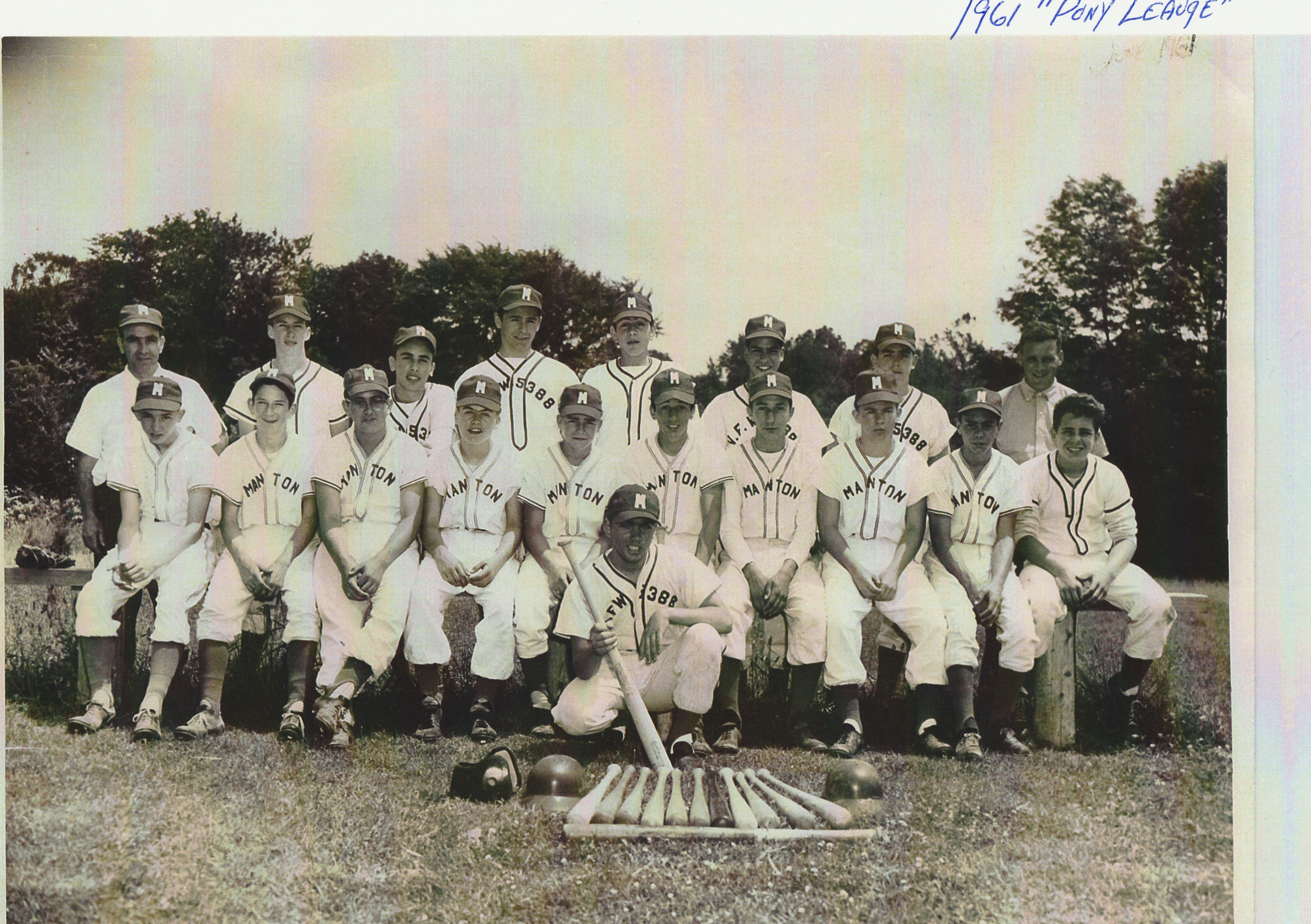
1961 Pony League

1961 Teener or Pony League 

The bonds that developed between the men on the Johnston High School Baseball team were forged over many years of playing together.  Years before any of them would step foot in Johnston High School, these boys had played together in the Johnston Little League and then the Johnston Teener League.  They had learned to work together.  They had learned what strengths and what weaknesses each player had.  There were no super stars in the group.  Just a bunch of kids who loved to play the game of baseball and wanted to excel at everything they did.

Coach Eddie Di Simone was recently out of college and only about ten years older than most of his players in 1963.  He inherited a group of boys who had been playing baseball together for nearly five years.  Bonds had already started to develop but these were honed and polished by Coach Di Simone.  He believed that it was not enough to be a good ball player.  He strove to instill in his team his belief in four main values.  These were Simplicity, Honesty, Integrity, and Fair Play.

Coach Di Simone believed in these values, and he wanted his players to believe in them.  He demonstrated them on the playing field both with his own behavior and with his expectations for the team.  He was someone who practiced the values that he taught his players.  Imagine any Coach today kicking one of his best players off the team for swearing?  Coach Di Simone knew that after life with baseball, each of these men would go out to face a very different playing field.  On the “field of life” his values of simplicity, honesty, integrity, and fair play would be much more valuable than skills at hitting, throwing, catching, and running bases.

Sixty years later many of the surviving members of the Johnston High School Panthers baseball team are still meeting regularly with their former Coach Di Simone to remember the day that they won the championship.  However, they celebrate the specific day and its memories of winning less than they do the events that followed.  They have not been “stuck” in the past of 1963 when they put on their cleats, took their bats and gloves, and walked out on the ball field.  They have not spent the past sixty years trying to relive their “glory” days as it seems so many former high school athletes do.  What they celebrate when they meet with their former coach and now friend is the bond that was forged between the team and its Coach Di Simone.  It is a bond of men forged over a fire of values.  The values learned on the playing field helped to make the members of the 1963 Johnston High School championship team into the successful men that they have become in life.  That is the real story here.

Coach Di Simone is now 89 years old.  Amazingly, 12 of the original 14 team members remain alive and in their late seventies.   A few weeks ago, at one of their meetings they bestowed a plaque on Coach Di Simone commemorating the 1963 championship and what Coach Di Simone has meant to them.  As I write this, there are plans for a December meeting at Coach Di Simone’s house and dinner afterwards.  The affection for their former coach is very evident in his former players.  (NOTE:  This meeting took place in December of 2022)

The end to this story will be written in the future.  To paraphrase Abe Lincoln, “The world will little note, nor long remember what I say here, but it should never forget the real reasons why these men became who they are today.”  In a world awash with narcissism and egotism, it is comforting to find that upstanding values can still be the basis for an unshakeable bond between people as well as a basis for successful lives.

By the way, if you want to have some fun, see how many of the players you can recognize on the above pictures who are in each picture.  It is interesting to see the changes from “Kids” to “Young Men.”

Appendix: Date:  April 10, 2023

I have listed the names of the 14 men that were on the original 1963 Championship team along with their two coachs.

  • Kenneth J. Ainley, first base
  • Thomas J. Donnelly, third base
  • Richard A. Esposito, utility
  • William G. Geremia, utility
  • Alex M. Giarrusso, catcher
  • Frank E. Jasparro, left field
  • Scott Moore, pitcher
  • James J. Petteruti, center field
  • Daniel Pisaturo, third and second base
  • Ronald P. Ricci, utility
  • Edward A. Skovron, second base and shortstop
  • Melvin D. Steppo, third base
  • David P. Taraborelli, right field
  • Michael R. Ursini, utility
  • Coach Ed Di Simone
  • Coach Bob Smith

The Seven Greatest and Most Important Virtues for Humanity

christian_virtueI thought I would start the year of 2021 off with a positive slant.  Namely, some things we can all do or practice to be better people.  However, before anyone should pay any attention to what I am about to say, there are several questions they must ask themselves.  I would advise you that the veracity and hence credibility of an author is critical to your acceptance of what the author is trying to sell you or convince you of.  Do not buy an argument from someone who cannot be trusted.  Think about the comment that “If you see the Buddha on the road, kill him.”  An uncritical acceptance of any idea is dangerous to your own integrity and responsibility.  Hence, the questions I would want answered (If I were you) would be as follows:  Who is this writer to say what the “greatest” virtues for a human are?  How did he come up with these Seven Virtues?  What is the difference between a virtue and a value?  Is this an important difference or is he about to sell me another new religion?

Taking each question as noted, who am I?  What credibility do I bring to the subject? 

The-Virtue-ContinuumI would like to answer that I am a seeker of truth and knowledge.  I am very opinionated, often highly judgmental and have frequently been accused of being a “know it all.”  Many people would write my opinions off as being too liberal while others would say that I am too rational.  I place great value on being logical and trying to stay open to many possibilities.  I have been studying philosophy and religion since I was eighteen.  I have no degrees in either.  But the number of books and articles and stories that I have read number in the hundreds.  I have attended many different worship houses and types of religious services.  I was brought up as a Catholic until I rejected its teachings at about the age of 10.  When no one would give me a good answer for “Who made God?” I more or less decided that most religions were based on superstitions.

I continue to read and study and write in the hope and belief that continuous learning is critical to living a good life.  As Socrates noted “An unexamined life is not worth living.”  I want to examine all aspects of existence.  From good to evil, from logical to emotional, from predictable to unpredictable.  I want to understand and comprehend all of the mysteries of the universe.  Nevertheless, I am not trying to be omnipotent nor do I think that anyone can or will ever understand all that the universe holds.  The quest is the most important thing, but the results of the journey are also very important.  My goal is to dream the impossible dream.  I am dedicated to the idea that truth and knowledge will bring me closer to being able to live this “impossible” dream.  As the song notes:

To dream the impossible dream
To fight the unbeatable foe
To bear with unbearable sorrow
To run where the brave dare not go

To right the unrightable wrong
To love pure and chaste from afar
To try when your arms are too weary
To reach the unreachable star (From Man of La Mancha (1972) music by Mitch Leigh and lyrics by Joe Darion)

How did I derive these Seven Virtues?

In all honesty, seven is a good number for any set of factors since most humans can only remember between five to nine random numbers.  Seven is the mean for a large proportion of the human race in terms of memory capacity.  We note that many cultures have used seven as a sort of “perfect” number for deriving sets of values, ideas, virtues, and even mundane things like phone numbers and license plate numbers.

virtues_listGiven that one could easily comprise a list of ten or perhaps one hundred important virtues, why do I believe that my seven are the seven greatest and most important?  How do I have the audacity to make such an assertion?  I might have been sitting under an apple tree one day, or perhaps simply thinking about life at one of my yearly silent retreats at the Demontreville Retreat Center, when I compiled a list of seven virtues.  While I truly “value” these ideas, I understand them more as virtues than values.  I will address this difference later.  I decided that I want to live by these virtues.  Each day for the last fifteen or more years, I have selected one of these seven virtues to help guide me through the day.  Whether it is patience, kindness or courage, each day I start by reflecting on this virtue and trying to make it a part of my life.

How does my list compare to other lists?  One of the most famous lists of seven virtues is the Catholic Hierarchy of Virtues.  The top three in the Catholic Hierarchy are Faith, Hope and Love.  Of these, my list includes Faith and Love, though I use the term compassion rather than love. The next four in the Catholic Hierarchy are justice, wisdom, moderation and courage.  My list includes courage but not wisdom, justice or moderation.  This is not to say that I do not think these are important, but my list is based on feelings more than knowledge.  This is somewhat ironic since I believe that knowledge and wisdom are two of the keys to understanding life.  However, l cannot argue with the question: “What wisdom is there that is greater than kindness?”  Comparing my list to the Catholic list, I realize that I am emphasizing feelings over thinking.  I am emphasizing the heart over the brain and love over logic.  My final list of seven virtues includes the following:

  • Gratefulness
  • Forgiveness
  • Patience
  • Kindness
  • Faith
  • Compassion
  • Courage

Over the next several blogs, I will present each of these as virtues and explain why they are important and how we can go about integrating them in our lives.  I know and believe that we will all live better lives if we are living a life based on virtue.

What is the difference between a Virtue and a Value?  Is it important?

I would like to include the following excerpt from an article by Iain T. Benson called “Values and Virtues:  A Modern Confusion.”

“Now George Grant, the Canadian philosopher, whom I mentioned a while ago, made this point in an important comment on a CBC radio program a few years ago.  Here is what he said, “values language is an obscuring language for morality, used when the idea of purpose has been destroyed. And that is why it is so widespread in North America.” In North America, we no longer have any confidence that there are any shared purposes for human life. We don’t. It is that dramatic. Consequently, we cannot order any human action towards an end, because all means are related to ends.” 

Looking at the Oxford Dictionaries definitions of these two terms will also shed some light on the differences.

  • Virtue is defined as follows:
  1. Behavior showing high moral standards: paragons of virtue
  2. Quality considered morally good or desirable in a person: patience is a virtue
  3. A good or useful quality of a thing: Mike was extolling the virtues of the car
  • Value is defined as follows:
  1. The regard that something is held to deserve; the importance, worth, or usefulness of something: your support is of great value
  2. The material or monetary worth of something: prints seldom rise in value equipment is included up to a total value of $500
  3. The worth of something compared to the price paid or asked for it: at $12.50 the book is a good value

I think it is easy to see from these definitions that a value is generally something we attach to a product or service.  A virtue is more often attached to a behavior or character trait.  We value things, while we practice virtues.  A man or woman may be virtuous but we would not say they are “valuous”, in fact the word does not even exist.  We might say they were valuable, but then we would probably not be talking about their character but addressing their instrumental worth to us.  Therefore, I have labeled these critical seven behaviors as virtues.

-The-12-Lakota-Virtues-native-pride-33907515-700-630The danger in this discussion lies in your taking a sectarian or religious approach to my writings.  I assure you that I am not a religious person.  I may be a spiritual person but I do not think of myself in either of these categories.  I am an agnostic who wants to live a better life and help build a world that is a better place to live for future generations.  Living by these seven virtues is one way I believe I can contribute to this goal.

My Vision for my life is “To live a healthy useful and wise life.”

My Mission is “To live one day at a time.  To be the best person I can be each day and to do the best I can each day to do good for the world.”   I hope I sometimes achieve at least some of these goals.

virtue is doing itIf I have satisfactorily answered the questions that I posed above respecting my integrity and credibility, I will now set off to address each of my Seven Virtues and explain why they are so important and the difference that I think they can make in our lives.  Look for my virtues over the next several weeks in my blogs.

Time for Questions:

What do you think of my list of seven?  What would you change?  Do you have your own list that you live by?  Why or why not?

Life is just beginning.

Just as treasures are uncovered from the earth, so virtue appears from good deeds, and wisdom appears from a pure and peaceful mind. To walk safely through the maze of human life, one needs the light of wisdom and the guidance of virtue.  — Buddha

What Needs to Be Done Starting in 2021 – IMHO

download

Getting Trump and his Senate sycophants out of office is only the first step in making America the country it needs to be.  The following is an agenda that I think would help to exceed the dreams of our founders and would meet the needs of citizens who want to live in a country characterized by true equality, true freedom, and true justice.  These items should be our “Second” priority after getting Trump out of office.

  • Universal day care for all working parents
  • Develop a National Agency Against Racism and Sexism
  • Low cost Internet for all citizens
  • Term Limits for all National political offices – 2 six-year terms maximum. No holding any public office for ten years after
  • Expand Affordable Care Act to insure healthcare for all citizens
  • Major Education Changes – develop a 21st century education system (see my blog on this subject)
  • Infrastructure Plan (Biden Plan a Start)
  • Start Closing Military Bases overseas
  • Major Campaign Funding Reform
    • Repeal Citizens United
    • Abolish Lobbying
  • Limit Executive Privilege and Executive Orders
  • Limit for Supreme Court Tenure to 15 years
  • Restore fair representation by eliminating gerrymandering
  • Abolish the electoral college
  • Reform corporate law to restore the balance of power between workers and management.
  • Adopt a plan for immigration based on care and compassion for all human beings
  • Reform the criminal justice and legal system
  • Ensure that LGBTQ citizens have the same rights as all other citizens in the USA
  • Reform tax law so that it is equitable and fair
  • Work international to establish a global mandate for a stable climate that will include efforts on climate restoration, climate mitigation and environmental sustainability

f228fe4403ce11b951226c0049a137f5

What are the Myths and Realities of Marriage? — Part 2

Last week we looked at what I called the “Cons” or negative assumptions about marriage.  This week, we will look at some “Pros” or positive assumptions that one can make about marriage.  I offer both sets of assumptions with the thought in mind that “The truth will set you free.”  Marriage is not all sweet and sugar but neither is it all sour and vinegar.  A good marriage has its ups and downs but a really happy marriage will have more ups than downs.  Most happy marriages are based on a set of realistic assumptions concerning what marriage is all about and what it takes to make a good marriage.

  1. Marriage is a means by which two people can in time learn the true meaning of love.

Most of us are pretty young when we get married.  With the exception of second marriages, where naiveté can be attributed to a rebound effect, most naiveté in a first marriage is due to youth and inexperience.  Many second marriages show that often older people are no wiser than younger people.  Love in a first marriage is more about passion and infatuation than about true love.  Saying “I love you” about someone you hardly know means about the same as saying “I love my new car.”  You cannot really love anything or anyone until you have some history with that person.

Love is a learned trait.  Most of the time, we use love in a very simplistic and general manner.  Jesus said “True love is the willingness to lay down your life for another.”  I disagree with this definition.  I think this kind of love can be a form of courage or bravado even without any notion of love whatsoever.  How can you love anyone whom you do not know?  I might be willing to risk my life to save someone who is drowning in a frozen lake, but it would be ridiculous to think I love that person.

True love is closer to a passion that is based on respect and admiration and gratitude.  When you first marry anyone, all three of these traits may only exist in very rudimentary states.  Time and shared experience help bring more perspective to each of them.  Over time, we begin to respect each other as we learn more about each other and how we treat life.  We begin to admire our partners more as we see how they cope with problems and as we both sacrifice our own needs for the good of each other.  Gratitude is the highest state of love in a marriage.  When you are truly grateful for your partner and when you feel this gratitude in your entire being, you have arrived at the shore of true love.

“True love doesn’t happen right away; it’s an ever-growing process. It develops after you’ve gone through many ups and downs, when you’ve suffered together, cried together, laughed together.” — Ricardo Montalban

  1. Marriage is a system for raising a new generation that will carry on the best values of the old generation.

Parents have a responsibility to raise children who have sound moral, ethical and personal values.  Each new generation builds on the shoulders of previous generations.   It would be foolish to think that the values of the past should all be the values of the next generation.  The needs of each new generation demand new values to cope with problems and issues that could not have been foreseen by previous generations.  Nevertheless, there are many values and ideas from the past that an emerging generation should have knowledge and insight of.  Lessons from the past can help to inform the future and mistakes from the past can still have meaning and relevance to issues that are current today.

Parents have an obligation to help insure that any children that they are responsible for, whether adopted, natural birth or foster children, learn a set of values that will help them to be people who understand the concepts of discipline and integrity.  Too many parents see their children as means to their own end or as “mini” friends.  Helicopter parents, soccer moms and sports dads are all manifestations of parents who have little idea about their real obligations towards their children.   Such parents want to be “best” friends with their children instead of fathers and mothers.  Even worse, are the parents who want to live vicariously through their children and dream that their kids will live the lives that they wanted to live.

“To let them go on believing that the world is safe, that they will be provided for and achieve worthwhile things even if they remain stupid, shirk integrity, despise courtesy, and act only from self-interest, that they ought to rely on those stronger, smarter, and more able to solve their problems, would be the gravest disservice: to them, and to society as a whole.”  —  J. Aleksandr Wootton

  1. Marriage is a potpourri of passion, ecstasy, happiness, sadness, grief, anger and challenge.

I may be repeating myself here, but I want to emphasize that all marriages will have good days and bad days.  Some of the bad days will be due to poor judgement, selfishness and poor planning.  They are days that could have been in the range of your ability to change.  Other bad days will have little or nothing to do with you.  Friends will die.  Relatives will get sick.  Accidents will happen.  You and your partner will grow old.  You will have no control over any of these things.

Whether or not you can change things, what matters the most is that you and your partner can support each other through the ups and downs.  You need to expect that bad things will happen to good people.  When they do, how will you support the other person?

A number of years ago, my wife and I went scuba diving for the first time.  We had both received our PADI certification and done a few lake dives.  We decided to visit the Caribbean and do some scuba diving there.  We went to an island off the coast of Belize called Caye Caulker.  We found a dive shop on the island and scheduled a day of diving for a day or so after we arrived.   Karen had not had any experience with ocean diving.  I had done quite a bit of diving but it was many years before.

We suited up and went down.  We were partners on this dive and that meant that we would have each other’s back.  Karen has more problems with buoyancy control than I do but we finally got her weights adjusted correctly and down we went.  We descended with six or so other divers and the dive master.  We had a great time though Karen kept trying to bob up instead of down.  When it was clear that we had little oxygen left we decided to come up.  We signaled the dive master and most of the group also headed back to the dive boat.  We had stayed above 120 feet so the bends were not really a concern.  We still wanted to ascend slowly though as it always is a good idea to observe this protocol.  I rose with Karen until we reached the surface.  The water was pretty choppy on top.

When we hit the surface, I was feeling tired and I headed to the boat.  I totally forgot Karen and I took my tanks up and got on the boat. When I looked back to see how Karen was doing, she was still in the water. She was tired and having a hard time getting her tanks off.  Some of the other people were in the water and they came to help her.  She finally made it back in the boat very tired and exhausted and somewhat scared.  I felt really bad.  I had deserted her and thought only about myself.  It was somewhat hard for me to get out of the water and on the boat by myself but it was next to impossible for Karen.  I did not think about her and I felt guilty for the rest of the day.  I promised her and myself that from then on, I would make sure she was on the boat before I tried to get out.

It is not always easy to look after another person.  It is very easy to put our needs first and our partners needs second.   A key dilemma of marriage is how to put both needs first or how to know when one needs to go first and the other can go second.  Marriage presents us with endless possibilities to work on this problem.  Sometimes we will succeed and sometimes we will fail.  However, as with any worthwhile endeavor, the trick is to keep trying, keep working on things and when you fail to try again and to never give up.  The effort to care for another person builds trust in a relationship and this trust is the foundation for a good marriage.  Layer it with respect, admiration and gratitude for each other and you will live “happily ever after.”

“Love never gives up, never loses faith, is always hopeful, and endures through every circumstance.”  — I Corinthians 13:7

Time for Questions:

Have you ever been in love?  How many times?  What do you think love is?  What do you think true love is based on?  How does one create true love?

Life is just beginning.

“You can trust us to stick to you through thick and thin – to the bitter end.  And you can trust us to keep any secret of yours – closer than you yourself keep it.  But you cannot trust us to let you face trouble alone, and go off without a word.  We are your friends, Frodo.” — ― J.R.R. Tolkien,