Last year at my 40th Demontreville Retreat, one of the exercises that we were given by the Retreat Master included a very challenging set of thoughts. The worksheet for the activity was labeled as “A Testament.” I took the worksheet and instructions home with me. It had fourteen tasks or reflections to complete. I did not desire to complete them during the retreat. It is now almost a year since my retreat, and I have decided to make the mental and emotional effort necessary to complete this “Testament.”
The worksheet started with these instructions:
Imagine that this is the last day of your life on earth. In the time that you have left, you want to leave a “Testament” for your family and friends. Each of the following could serve as chapter headings for your “Testament.” This is Reflection Number 10 on the worksheet.
- These are the Scripture Texts that have touched and helped me.
My being an Atheist some people might think that I would have a hard time with finding Scriptures that have touched me. In truth, it is one of the easiest reflections for me to think about. I have so many wonderful parables from the New Testament and many proverbs and wisdom from the Old Testament that I use to guide my life and decisions. I see the Bible as another source of great wisdom that has been compiled over the ages. It is a combination of history, storytelling and profound thoughts compiled into one large book. I do not view the Bible as infallible or “The Word of God” unless I use that interpretation very loosely. If there is a God, perhaps he does reside in all of us and all of us are “Children of God.”
In 1775, Thomas Paine wrote a short essay criticizing slavery and reflecting on “Pretended” Christians who could support such a practice. His words were:
“to catch inoffensive people, like wild beasts, for slaves, is a height of outrage against humanity and justice, that seems left by heathen nations to be practiced by ‘pretended’ Christians.” — African Slavery in America, 1775
Today we have a system that seems somewhat analogous to the system of “Pretended Christians” that Thomas Paine described 250 years ago. “Pretended Christians” who can support a man and party that attacks, insults, abuses, and maligns minorities, immigrants, women, disabled people, and veterans. A man who swears vengeance against the people who disagree with his policies. A man who pays no attention to Scripture which says:
“Dearly beloved, avenge not yourselves, but rather give place unto wrath: for it is written, Vengeance is mine; I will repay, saith the Lord. Therefore, if thine enemy hunger, feed him; if he thirst, give him drink: for in so doing, thou shalt heap coals of fire on his head. Be not overcome of evil but overcome evil with good.” — Romans 12:19-21 King James Version
Many of the people insulted by this man continue to feel that he is some sort of Christian Savior. A man who will restore Christianity as the Mother Religion of America. A position for religion that not one of the 56 signers of the Declaration of Independence, our Founding Fathers either desired or supported. We have a country full of people who want to call America a Christian nation but who neither practice nor believe in one iota of what Jesus of Nazareth taught and died for. We have a nation full of “Pretended Christians.” I do not pretend to be a Christian or a Saint or a Holy Man. God (If he/she exists) save me from these “Pretended Hypocritical Christians.”
The following are four of the scripture quotes that have had the most influence on my life. I will briefly describe the impact that each has had on my thoughts and behaviors.
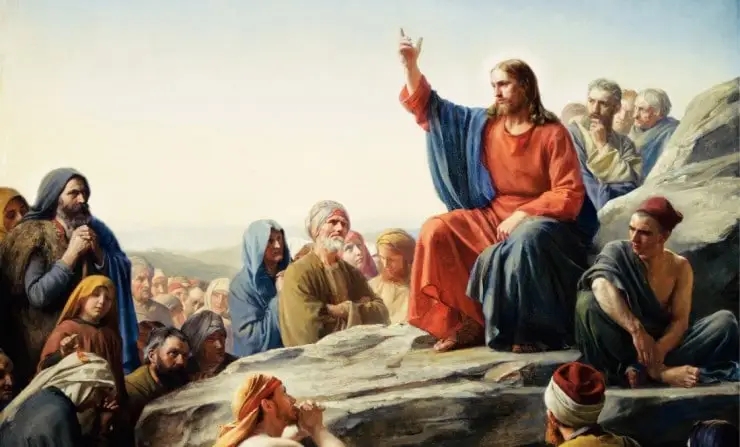
- What doth it profit a man if he gain the whole world but suffer the loss of his own soul? — Matthew 16:26
The first Jesuit retreat that I did at Demontreville in 1984, upon entering the grounds I saw the larger-than-life sized statue of Saint Ignatius Loyola, the founder of the Jesuit Order. He stands on a large concrete pedestal. I was forty years old at the time and just finishing my Ph.D. degree. I was hungry for fame and fortune and success. During the retreat, I walked up to the statue and discovered the words “What doth it profit a man if he gain the whole world but suffer the loss of his own soul?’ written on the base of the pedestal. These words are perhaps the most profound words I have ever heard in my life. I went back several times during the retreat to read and reflect on these words. Over the past forty years or so, despite these words being etched in my brain, I always go to see the statue of St. Ignatius and silently repeat these words to myself several times.
My first visit to these words did not stop me from chasing what some call the elusive gods of fame and fortune. Over the years, my chasing has become less vigorous, but the goal posts still exist in my mind. Part of me longs to carry the football over the goal line and to hear the roar of the crowd and bask in shouts of “hurrah” and “you’re the greatest.” The fortune part has never really mattered as much to me as the adulation and recognition that I still thirst for. Thus, every year that I go back to Demontreville, (this will be my 41st retreat), I will make my pilgrimage to the statue to restore my commitment to the fact that fame and fortune are no substitute for the real nutrients that nurture the soul. No amount of fame and fortune can substitute for integrity, compassion, kindness and charity towards others.

- Therefore, do not worry about tomorrow, for tomorrow will worry about its own things. Sufficient for the day is its own trouble. — Matthew 6:34
Another phrase from the teachings of Jesus as marked down by Matthew. Throughout history, this same thought has been voiced by most of the great prophets, thinkers and philosophers. “Live each day one moment at a time.” “Live in the now.” “Be mindful of today.” Doing so is akin to walking a tightrope. It requires a sense of balance. We must plan for the future, but we must also live one day at a time. How to find that balance is a Herculean task. A second Herculean task is maintaining our balance. These two tasks are by far more difficult in the modern world than slaying the Nemean lion or capturing the Cretan bull. Hercules managed to complete 12 very difficult tasks. I have yet to manage completing even one of my two challenges. I suppose I will be working on “Living in the Now” for the rest of my days.

- Vanity of vanities, says the Preacher, vanity of vanities! All is vanity. — Ecclesiastes 1
The Book of Ecclesiastes is reported to have been written by King Solomon. Solomon as you know was one of the wisest men in history. He was granted wisdom by God because Solomon did not ask for fame or fortune.
“And God said to Solomon: Because this was in your heart, and you have not asked for riches or wealth or honor or the life of your enemies, nor have you asked for long life; but you have asked for wisdom and knowledge for yourself, that you may judge My people over whom I have made you king.” — (2 Chronicles 1:11-12 NKJV)
Buddhism, Advaita, Zen and other religions talk about the major problem that leads to all of humanities other problems being what psychologists call our Ego. Solomon called it vanity. Some might call it self-conceit, narcissism, self-centeredness, self-absorption, me-ism or egotism. Its all the same. People become the center of the universe. I saw a sign the other day that read “When I am not the center of the universe, people become human.” This is another difficult battle to overcome. We can focus only on our own needs or desires, or we can expand our awareness to notice the needs and desires of other people.
The Eight Beatitudes given by Jesus in his famous Sermon on the Mount are the greatest exposition of our responsibility to other people that has ever been written. Jesus elucidated what are called the Eight Beatitudes. I will not list them all as they are easy to find on Google. These eight thoughts clearly define how we should treat other people. I often wonder why so many “Pretended Christians” want to put up the 10 Commandments from the Old Testament, when their Jesus gave them the 8 Beatitudes to obey. I have actually read that many “Evangelicals” believe that the 8 Beatitudes are wimpy. The lack of respect for the man that founded Christianity is beyond belief.
I try ever day to remember that I am not the center of the universe. The world does not revolve around me. For every one of my rights, there is a responsibility. I need to look out for others and to help those in need, be they gay, women, immigrants, minorities or even right-wing bigots. They are all part of the human race. To paraphrase Ben Franklin, “Either we all work together for a better world, or we shall surely all perish together in ways that none of us desire.”
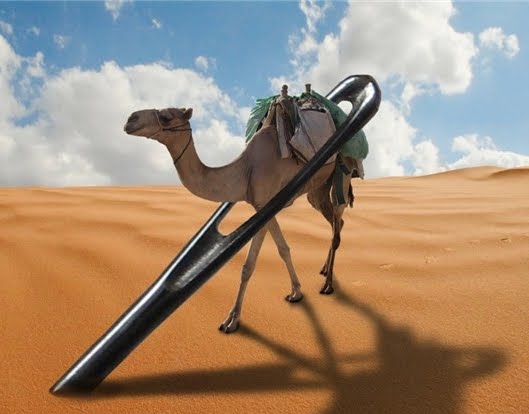
- It is easier for a camel to go through the eye of a needle than for a rich man to go to heaven. — Mark 10:25
My friend Kwame says that we should be grateful that we are not rich. Money is a corrupting influence. It is somewhat like a drug. It is addictive. The more you get the more you want. The more you have the more you need. Another friend of mine whom I met in China told me before we left Shanghai in 1989 that we were rich. I explained that we were not rich, but very middle class. In fact, we were definitely not even upper middle class. Xibo said, “you are rich to us in China. You have nice house, and you can afford to travel to distant countries.” Xibo’s comments were very accurate, and they had the effect of making me realize just how selfish I often am. I am bemoaning my mundane middle-class status when to most of the rest of the world, I am regarded as rich. Never mind regarded. I am rich to possibly 90 percent of the world.
I am told by biblical interpreters that Jesus never said “rich people were bad” or that rich people could not go to heaven. What Jesus did say and used many parables to illustrate the fact was that it would be hard for rich people to get to heaven. Money is a heavy load to carry, and it corrupts. Lord Acton said that “Power corrupts, and absolute power corrupts absolutely.” The same can be said of money, “Money corrupts, and excessive money corrupts excessively.”
Regard the quest for money in the USA today. Everyone wants more than they have. We worry about Inflation, about immigrants stealing our jobs, about the Chinese sending too many products to us. On the other hand, billions of dollars are now spent on people trying to get rich quick through pull-tabs, lotteries, online gambling and now sports betting. The mania for money is fueled by the incessant celebrities, media influencers and TV shows touting the “Lifestyles of the Rich and Famous.” The airwaves, newspapers, Internet and all of our media are full of non-stop advertising. “Shop till you drop” should be the title of a song or at least put on the US dollar bill right under George Washington’s picture.
To be mindful of what I have I keep repeating this thought in my head. ‘It is easier for the camel than the rich man to get to heaven.” By the way, I do not believe in heaven or hell but I take it metaphorically that it is better for the human race if I try to be the camel and not rich and greedy.
Next Reflection:
- These are things that I Regret about my life.
 Last year at my 40
 Am I a very happy person? Most of my friends would probably say no. My sufferings though are mostly self-inflicted. My thoughts on the life that I should have lived haunt me. Try as I might I can’t let go of the things I fucked up in this world. I can’t even forget the teacher in the third grade who told me to, “Shut my mouth and stop singing.” Seventy years later and it feels like if I try to sing, something awful will happen to me. I would rather jump off of a cliff than sing a note.
 One day, I had to go out to do a repo on a guy who bought a TV set and was not making his payments. I went to the poor section of town and walked up to the address I had been given. It looked like maybe a three-room small bungalow. The yard was gated, and I looked for a dog. Not seeing any, I opened the gate and walked up to the front door. There was a screen door. The main door was open, and I could see into the house. I knocked loudly on the door as there was no doorbell. I could see a living room and a kitchen. Out of the kitchen, a large man started coming to the door. As he drew closer, I could see he had no legs. He was missing both legs and was walking with two crutches. He asked me what I wanted. I hesitated and then answered “Sorry, I must have the wrong house.” I went back to my office and quit the same day. I figured he needed the TV more than my company needed the money. I could not do a job that required me to take from poor people what little they had in life.

 Despite attending forty 3-day Jesuit retreats and regularly going to church with my spouse, I remain adamantly somewhere between an Atheist and an Agnostic. See my blog
 I can see some positive sides to a church ideology that addressee inner spirituality, but I think it has serious drawbacks. You can focus too much on what I will call the “inner spirituality” of church members. The reasoning behind the emphasis on inner spirituality can be faulty. The theory is that if each member becomes a better Christian, they will be better neighbors towards others. If they feed the hungry and cloth the poor, they will be ridding the world of the evils that Jesus preached against. Unfortunately, these propositions are not evidenced by historical fact. For hundreds of years many Christians supported slavery and sexism by doing little or nothing to condemn or speak out against it. Furthermore, many Christians were major protagonists of racism and sexism. If their ministers spoke out against it, it obviously made little difference. Being a card carrying member of a Christian church never seems to correlate with ending war, sexism, racism, homophobia or even poverty. I think without an equal emphasis on “Outer Spirituality” Christianity is a worthless religion.
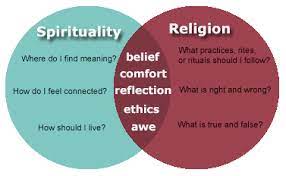 There are many definitions of spirituality. What does it mean to be a spiritual person? Some people lean towards accepting a higher being or creator. Some lean towards accepting a more conventional religious perspective. Many on-line definitions list several factors necessary to be a spiritual person. My own definition is much simpler. I think being a spiritual person involves two elements. The first is seeking meaning in one’s life. The second is seeking purpose. Meaning is inner spirituality. Purpose is outer spirituality. Meaning and purpose must go beyond what is simply good for oneself and must embrace what is good for humanity and the universe. Thus, a truly spiritual person is one who finds and balances inner and outer spirituality.


 There are beauty products, breast enhancements, hair implants, plastic surgery, expensive cars, perfume, jewelry, large homes, designer clothes, college degrees and many other products or services designed to help you feel less inadequate and more adequate. We all want to feel adequate which means we must somehow learn to escape or jettison our inadequacy paradigms. The marketplace strategy involves spending huge amounts of money on a regular basis to escape the “inadequacy paradigm.” This strategy is often a failure as money and products cannot provide for real happiness or address some of the cultural biases, prejudices, racism and bigotry that contribute to the “inadequacy paradigm.”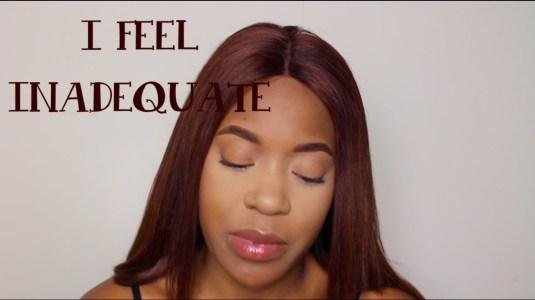
 If you have not read Hofstadter’s “Anti-Intellectualism in America Life” I heartily recommend it. I have often joked that the worst discrimination in America seems to be saved for people who think. Many companies trumpet their desire for “out of the box” thinkers. This is usually nothing more than a well parroted display of self-deception. What Human Resources and the company are really looking for is “people who fit in.” People who are iconoclasts, people who are critical thinkers, people who rock the boat “need not apply here.”
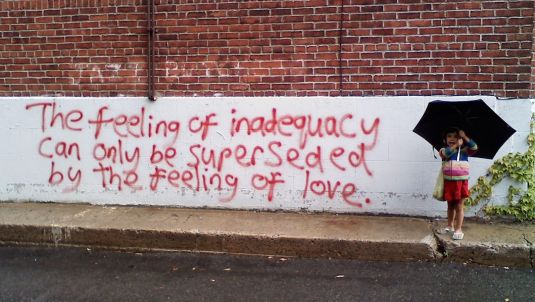 We have a pervasive problem that I labeled the “Inadequacy Paradigm.” Much of it is caused by racism, xenophobia, prejudice, stereotypes and bigotry. The majority of it is systemic and will need major changes in policies and institutions in this country to eliminate. However, it is felt on a very personal level. Feelings of inadequacy may be conveyed by others and cultural mores but they are received by an individual who assimilates these feelings into their psyche. Thus, inadequacy becomes a personal problem and not simply a social problem. Inadequacy is not “out there” it is right inside. The vast numbers of suicides in our society are testament to the inadequacy that many of our fellow citizens feel. This includes Whites as well as minorities.

