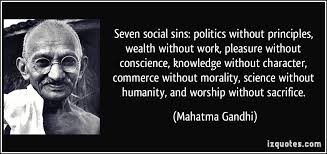
The Seven Social Sins is a list created by Mohandas Karamchand Gandhi in 1925. He published this list in his weekly newspaper “Young India” on October 22, 1925. Later he gave this same list to his grandson, Arun Gandhi on their final day together shortly before his assassination. The Seven Sins are:
- Wealth without work.
- Pleasure without conscience.
- Knowledge without character.
- Commerce without morality.
- Science without humanity.
- Religion without sacrifice.
- Politics without principle.
I wrote a blog for each of Gandhi’s “sins” about ten years ago. The blogs seemed to be quite popular with my readers. I am going to update and repost each of the Seven Sins for the next few weeks. Karen and I are making some major changes in our living arrangements and I probably will not find the time to write much new material. I am reposting these because they still seem to be quite relevant in these challenging and chaotic times.
Wealth Without Work: The First of Gandhi’s Seven Social Sins
Once upon a time in this great country, a model for attaining wealth and a set of rules to accomplish this objective stemmed from 3 basic beliefs. These were:
- You worked hard, long and industriously.
- You attained as much education as you could absorb and afford.
- You treated all of your engagements with absolute honesty and scrupulousness.
Somewhere during the later 20th Century these 3 Cardinal beliefs (Above) about attaining great wealth were replaced by the following beliefs:
- Wealth can be attained at a gambling casino or by winning a lottery if you are lucky enough.
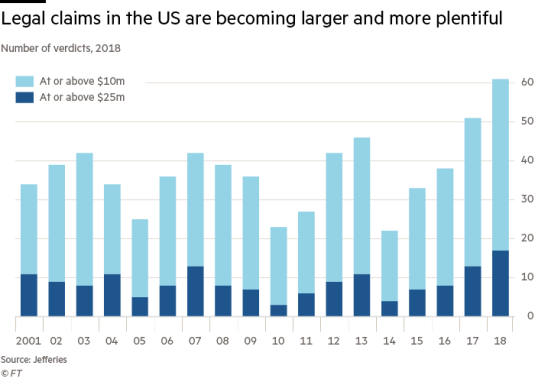
- Wealth can be attained by suing someone and with the help of a lawyer who will thereby gain a percentage of your lawsuit.
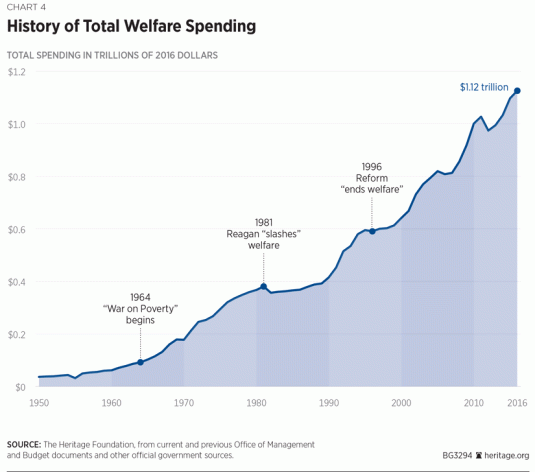
- Wealth can be attained by finding some means of acquiring a government handout for the remainder of your life.
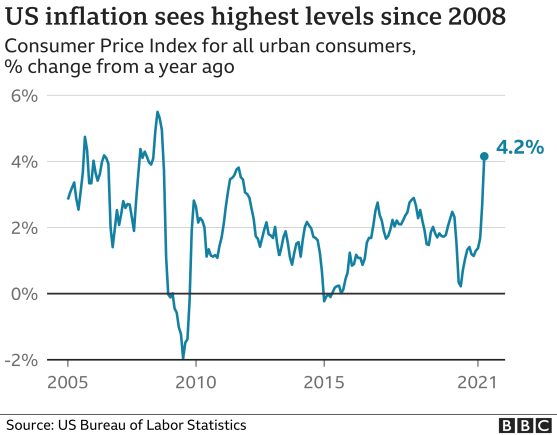
Admittedly, not all Americans subscribe to the second set of beliefs and fortunately there are many who still subscribe to the first. Nevertheless, I think you would be hard pressed to argue that gambling, casinos, government handouts and lawsuits have not multiplied exponentially over the past fifty years. The following are some charts which I think illustrate my points rather graphically.

The nature of human beings is to want things fast and with a minimum of effort. This is normal and not to be thought of as deviant or unusual. However, as we age and develop more self-control and wisdom over our daily affairs, we learn to temper our desire for instant gratification with a more mature perspective. Noted quality guru, Dr. W. E. Deming maintained that people wanted “Instant Pudding.” For Deming this meant, change without effort, quality without work and cost improvements overnight. Added together, “Instant Pudding” was Dr. Deming’s metaphor for the desire to obtain results with a minimum investment of time and energy. Dr. Deming continually warned his clients that there was no “Instant Pudding” and change would take years of hard work and could not be accomplished without continued dedication and focus.
Unfortunately, our media and even schools today seem to emphasize the possibility of achieving success and wealth overnight. Sports stars are depicted as suddenly being offered incredible contracts. Movie stars are shown as going from unknown to overnight fame and fortune. Singers and musicians seem to suddenly achieve fame despite being barely out of their teens and in many cases barely into their teens. It would appear that everywhere we look fame, fortune and success happen overnight. All it takes is to be discovered. This might happen if you can get on American Idol or be found by the right booking agent or obtain a guest appearance on a celebrity TV show. In some cases, all it takes is the right YouTube video to accomplish overnight success. One day PSI was an unknown Korean musician and in a few short weeks, he was celebrating success by a dinner in the White House and appearing at the Times Square New Year’s Eve celebration. How can anyone dispute that all that is needed for fame and fortune is to be in the right place at the right time?
You may be asking “yes, but what exactly did Gandhi mean by this “sin?” The M. K. Gandhi Institute for Nonviolence gives the following explanation:
“Wealth Without Work: This includes playing the stock market; gambling; sweat-shop slavery; over-estimating one’s worth, like some heads of corporations drawing exorbitant salaries which are not always commensurate with the work they do. Gandhi’s idea originates from the ancient Indian practice of Tenant Farmers. The poor were made to slog on the farms while the rich raked in the profits. With capitalism and materialism spreading so rampantly around the world the grey area between an honest day’s hard work and sitting back and profiting from other people’s labor is growing wider. To conserve the resources of the world and share these resources equitably with all so that everyone can aspire to a good standard of living, Gandhi believed people should take only as much as they honestly need. The United States provides a typical example. The country spends an estimated $200 billion a year on manufacturing cigarettes, alcohol and allied products which harm people’s health. What the country spends in terms of providing medical and research facilities to provide and find cures for health hazards caused by over-indulgence in tobacco and alcohol is mind-blowing.” ‘There is enough for everyone’s need but not for everyone’s greed’, Gandhi said.
There is a visual problem here that perhaps underlies much of the current thinking about success. The media loves to trumpet short success stories that will grab anyone’s attention. We are constantly bombarded with headlines such as:
- How I lost 25 lbs. in three weeks.
- Abs of steel in 2 weeks.
- Learn a language in ten days.
- Make 50,000 dollars in one month.
- How to pick the winning number for mega-millions.
- How to find your dream job in 21 days.
Each of these sites (click on to hyperlink to the actual site) promises you overnight success or at least success in a much shorter time span than is realistic. These ads are in the news, checkout stands, on TV and just about anywhere you turn around. The constant daily bombardment of such ads creates a zeitgeist in which overnight success not only seems to be possible; but it actually seems to be the norm. If you are not an overnight success, if you cannot become rich in days rather than years, if you contemplate a life of hard work to attain your fame and fortune, than something is wrong with you. Anyone subscribing to the first 3 sets of beliefs I mentioned in the opening is a peculiar species today. The most common belief about success in the new millennium can be summed up as:
I don’t have time to wait. I don’t have the patience to wait. I don’t want to spend my life waiting. I am entitled to success now. Why should I have to wait? I am as good as any of these rich successful people. If only everyone could see how good I really am, I would get the fame and fortune I deserve now. If you expect me to shut up and work hard, I will leave and go elsewhere. You need me more than I need you.
I believe that Gandhi and many of my generation would find such ideas very peculiar not to mention that they contradict certain universal principles. Every time I hear of a new terrorist attack in this country or a new massacre at some workplace, I wonder how much the instigator was influenced by his or her desire for overnight fame and fortune. In some bizarre out-of-this-world thinking, these maniacs equate their picture on page one of the news with a sort of glory that is accomplished by their bizarre and cruel rampage. The more they kill or maim, the greater they think their glory will be. We can look for all the “reasons” why but we will never find any “good” reasons for anyone to take such anti-social actions against others. The paradox is that often the very people they hate are the ones they wanted attention or recognition from.
Ok, time for questions:
Have you raised your children to believe in hard work? Are you one of the parents who want to make sure their kids have it easy? How do you know how much hard work is enough? Do you think you are entitled to success because you work hard? What other factors play a role in success? Is it fair that some people do not seem to have to work hard and yet still reap big rewards? Do people today have it too easy compared to the immigrants that founded this country?
Life is just beginning.


 Before you go off on a binge of happiness and celebrations, think for a minute what a positive answer to these questions might mean. There are still expectations and assumptions associated with any answer to the above questions. You assume that if you won the lottery, that you would not have to worry about paying bills, buying things you want etc. You assume that if you found true love, it would last forever and forever. You assume that finding meaning and purpose would bring you happiness. To all of these possibilities, I say maybe. You still have many choices and outcomes to each of these scenarios. These choices can leave us just as captive to our desires and wants as any of our responses to the “negative” “what ifs.”

 My conclusion is that “What ifs” are intellectually amusing as a past-time but as for practical value they are close to useless. Seldom will you ever get to apply a solution to a “What if.” The possibility of something in real life happening exactly like it did the first time is less than the chance of finding identical snowflakes or fingerprints. Heraclitus, a Greek philosopher born in 544 B.C. said, “No man ever steps in the same river twice, for it’s not the same river and he’s not the same man.” Those who forget the past may be condemned to repeat it, but the past will never be the same again. Living requires adaptability and resilience.


 underlying or foundation problem to explain many senseless acts of violence and mayhem. We can see pictures today of people screaming at immigrants to go home and realize that many of these raging mobs are driven by fear. Fear of job loss, fear of economic uncertainty, fear of being displaced and fear of strangers.
 nation I have heard deals with greed. It has been said that “Greed is not the worst of all sins, but it is the gateway to all others.” Reflecting on this comment provides some very interesting insights. For instance, why does anyone steal? They want more than they have, ergo greed. Why does anyone kill? Typical answers would include: To get more land, ergo greed; to get more money, ergo greed; to get something they want, ergo greed. The more I thought about greed as an explanation, the more I could see it being a key cornerstone to almost all acts of violence and terror. I was content to accept this underlying explanation until a few weeks ago when I attended my annual retreat.
 s before me, I thought getting success would be the key to feeling complete. Success meant fame, fortune and admiration from the masses. I would have money to roll in. I would have girlfriends too numerous and beautiful to count. I would have crowds thronging to hear my every utterance. The path to success was uncertain but the laurels and rewards were assured if only I could find the right stair way. I looked everywhere. I read everything. I talked to everyone. Success would come with hard work. Success took risks. Success was not an overnight phenomenon. I needed to get an education first. I needed to save my money. I needed to invest. Everything I did was still not enough. I was not a success.


 The abyss It is so big that there is no bridging it. None of the sides can see the other side. None of the sides has any common ground with the other side. None of the sides understands the language that the other side speaks. We might as well be earthlings talking to Martians. There is no lingua franca. Many of the “well-meaning” experts exhort both sides to try harder to bridge the gap or to work more diligently to listen to the other side. It seems to be assumed that all it will take to jump the gulf is good intentions. I cry bullshit on this. As the old aphorism goes, “The road to hell is paved with good intentions.” It will take more than good intentions to heal the wound that infests our country.
 The wants advertised on the TV and in the media are never fulfilling. We have a nation of brainwashed consumers who mistakenly think that more toys, bigger houses, more guns, and luxury cars will make them happy. We are a nation on a never-ending treadmill of consumer materialism where like rats we keep spinning the wheel and hoping to find happiness, but happiness never comes, and drugs take its place.
  As the rich get richer and the poor get poorer, the tensions in society grow ever more divisive. We see more road rage, more senseless shootings, more violence between men and women, less loyalty between employers and employees. The underpinning of society that should be based on human integrity and morality is replaced with an opportunism based on an amoral value system. Whatever we can get as long as we break no laws is considered to be moral. We see most politicians that have no commitment to anything except to collect more money so that they can stay in office. Their highest goal is to help the rich get richer, which of course includes themselves.
  I am not talking about the devil here or about spirituality. I am talking about a kind of insidious propaganda that has been spread by many groups and individuals. In this propaganda, one side of America is labeled as moral, ethical, righteous, and just. The other side is the opposite. The other side is everything negative. The other side is a composite of all the demons and evils that Americans believe in. The other side are communists, fascists, atheists, anti-democratic, anti-patriotic and un-American. One side is good. The other side is evil incarnate. You cannot talk to evil. You cannot discuss with the devil why he wants your soul. You cannot debate with Satan over the values that he has. Heaven and hell do not have weekly discussion groups. The language heard today, and what the media publishes drips with hate, innuendo, and disdain. The language fosters violence. I doubt the Founding Fathers ever conceived that the First Amendment would protect such speech. There are three elements that contribute to a hate speech culture that demonizes the other side:
  Malicious labeling is the name calling that goes on between both sides today wherein each side is labeled. You can hear it on almost every talk show program in America today. Name calling and name labeling. Commie pinko leftists! Intellectual elites! Radical socialists! Racist rednecks! Fascist dictators! Politicians, commentators, newscasters, and radio talk show hosts all use malicious labels to insult and demean those they disagree with. What have we let this country become when we allow such name calling? This kind of hyperbole demonizes the other side and creates a divide that cannot be overcome by rational conversation.
 I do not think that the Founding Fathers of our nation believed that Government was evil. Certainly, they felt that there could be too much government intrusion on the rights of the populace. They invoked certain safeguards to protect both human rights and states rights. Nevertheless, they did not demonize government and not a single one of the Fathers ever referred to government as evil. Edmund Burke, the famous English conservative said, “The government that governs best is the government that governs least.” He never said, “government was evil.” It has become common place to hear refrains denigrating the role and necessity of government. This steady drumbeat of antigovernmental rhetoric has created a group of people that have no value for government and who support the idea that government should be abolished.
 A few years ago I began to wonder why groups like the KKK, Aryan Brotherhood, Antifa, The Proud Boys and many other such groups advocating violence against the government were not labeled as Terrorist Organizations. I asked a lawyer this question and he replied, “it is all politics.” I found that almost all the groups listed by the Southern Poverty Law Center as “hate groups” were designated as “extremist groups.” This means that they are not illegal, and they have the right to organize, march, rally and basically spread their hate across America. In 2019, The SPLC listed 940 hate groups across the USA. If any of these groups was labeled as a “Terrorist Group,” they would be on the same list as the Taliban, Boko Haram, The Mafia, Mexican Cartels and Al Qaeda. What is the difference between an extremist group and a terrorist group? It might surprise you to learn that a terrorist organization is defined as follows:
 If this definition does not apply to the groups that tried to storm the US Capital on January 6th, 2021, I do not know what does. Just yesterday the Canadian government labeled the Proud Boys as a Terrorist Organization. This delegitimizes the group and takes their rights away. For Canada, it is a start. I am wondering when we are going to get started in the USA on such an effort. The First Amendment was never construed to allow hate speech and the advocating of violent actions to overthrow the government. Why do we not have the political will to outlaw these groups? We seem to have little compunction in penalizing Black groups like the Black Lives Matter Movement or the Black Panthers. We have a different standard when it comes to White Supremacy groups.
  The newspapers, TV and the Internet are today the major carriers for the hate and vituperation that has spread across America. On one side of the divide, we find the NY Times, the Washington Post and CNN News. On the other side, we find the NY Post, the Washington Examiner and Fox News. There are countless other purveyors of extreme and fanatical views. Each side reeks of headlines supporting nonobjective views and biased reporting. If objective reporting ever existed in the USA, it has been murdered and buried by the most pervasive media to ever exist. The media carries the hate and violence that is created by politicians, pundits, radio commentators and hate groups and ensures that it gets widely disseminated. Without the media, much of the divide would never have occurred. Hate needs a platform to be spread and the media is more than happy to host anything that it believes will sell itself and its advertising.

 We shop till we drop. We invoke our privilege to use our money as we want to. We make holidays out of holy days where we spend our time hunting for bargains and sales. Greed has now become a sacrament. Greed is no longer evil. Greed is holy. Greed is the American Way of Life. Millions of Americans adore the wealthy. The story of Lazarus holds no credibility – Luke 16:19-21. Nor does the story of the Rich Fool – Luke 12:13-21. Money is sacred and those who have more are worshipped by Americans and exalted as better people and better leaders. We elect millionaires and billionaires to Congress and even the Presidency on the sole basis of their acumen at having stored up wealth.


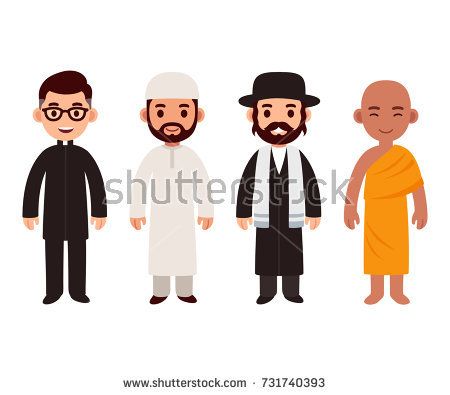 A Rabbi, Iman, Pastor and Buddhist Priest were all discussing the issue of peace in the world and in particular peace in the Mideast. The Rabbi said there could only be peace in the Mideast if all the Muslims left. The Iman said that there could only be peace if all the Jews left. The Pastor jumped into the argument and said there would only be peace if all the non-Christians left. The Buddhist cleared his throat to interrupt the argument and said, “There will never be peace anywhere as long as there are Muslims, Jews, Protestants, Catholics and even Buddhists in the world.”
 The peaceful person does not use violence against others. The peaceful person is a diplomat who solves problems with his/her brain and not with tools of aggression. The peaceful person is confident because they have integrity. The peaceful person has serenity because they have no fear. Fear is the enemy of peace. When the world is on red-alert, people live in fear. People become fearful of others and fearful of living. Racism, sexism, discrimination, greed, and militarism create fear. With fear, no one can be at peace.
  We should all be grateful for peace. This means we need to appreciate peace and understand that it cannot be taken for granted. Peace is up to us to create. It is too important to leave to religious leaders and politicians. If we want peace in our lives and peace in the world, we must create it. There can never be peace for anyone if there is not peace for everyone.


 Ladies and Gentlemen. How can you have a government of the people, by the people and for the people when it is a government of the rich by the rich and for the rich? A government of lawyers, political science majors and corporate people. An interlocking network of proponents who have a self-interest that nowhere matches the nature and interests of the general public of America.
 Many of the board members in the rural counties are farmers or laborers or educators who have little or no training in the laws that they are sworn to protect. Thus, they rely heavily on the lawyers that they hire to provide advice and perceived protection from lawsuits. This renders the board members subject to the legal opinion of the lawyer which is quite often at odds to what the public wants. The boards are frequently fearful of a lawsuit (often offered by the lawyer as a possibility) and will forego making an informed decision based on evidence that is presented at the hearings.
 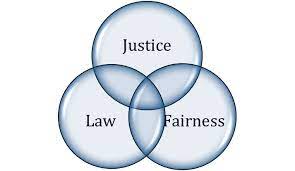 We need less lawyers. Lawyers and lawsuits are destroying America and Democracy. We need leaders with more diversity in education. We need leaders with more ethnic diversity. We need leaders with more gender diversity. We need greater representation that reflects the demographics of America. We need less lawyers. We need more justice and we need more fairness.


 Aging Capriciously