The Tragic Deaths of Ananias and Sapphira:  What This Story Tells Us about the Decline and Fall of Religion.

ANANIAS_AND_SAPPHIRA1.280200851_stdIn the Acts of the Apostles (part of the New Testament) Chapter 5, there is the story of two members of the early Christian church which was thought important enough to merit inclusion in the Bible.  To summarize the story:  these two members (Ananias and Sapphira) sold some property which they owned and instead of contributing 100 percent of the proceeds, they elected to keep some of it aside for themselves.  This may have been in violation of a sense of community and common property that the early Church was fostering since the story seemed important enough to put down in text.  (You may enjoy listening to the following song while reading this blog “The Ballad of Ananias and Sapphira”)

After being confronted by the apostle Peter, both Ananias and his wife Sapphira died on the spot.  What I find most interesting about this story is the significance and interpretation that is given by many Christian leaders to this event.  I think these interpretations may tell us more about religion and why people are backing away from churches then any of the more common reasons given for the decreasing numbers of people who now belong to an organized church.  For instance, many theorists say that the lack of religion today is due to or at least correlated with a more highly educated work force. Others say, the lack of religious affiliation has to do with the sexual emancipation of men and women, thus freeing them from the demands and control of an organized church.  I think there are more fundamental reasons and this story illustrates them very well.  I would like to contrast my “heretical” view of what this story means with a common view espoused by one religious leader in an article called  “5 THINGS GOD TEACHES US IN THE TRAGIC DEATHS OF ANANIAS & SAPPHIRA” by  Pastor J.D. on November 20, 2013

Pastor J.D.

  1. In the church, there are two kinds of people, and it’s nearly impossible to distinguish them from the outside.

On the outside, Ananias and Sapphira look just like another church member named Barnabas (introduced in Acts 4). Barnabas had just sold his property and brought the money to the apostles, and to the casual observer, Ananias and Sapphira were doing the same thing.

But deep in their heart lingered a love of money and a desire for people’s praise.  So they conspired together to present a portion of their money while passing it off as the entire amount. This is worlds apart from the attitude of Barnabas, but looks very similar.

John’s Interpretation: 

ananisas gravesYou mean that there are only two kinds of people in church?  One good and the other bad?  Why are the bad people going to church anyway if they are bad?  How is the church helping these “bad” people?  People who have a love of money and a desire for praise are bad?  That means about 95 percent of the human race are bad.  If all that religion can do is condemn “bad” people, why bother to go to church?  To be “Good,” you must tithe, build churches, give large donations and upon your death leave large grants to your church.

Pastor J.D.

  1. We cannot hide from God.

It may be difficult for us to distinguish between a truly repentant heart and a seasoned faker, but nothing is hidden from God. The Holy Spirit knows our thoughts as if they were being played through a loudspeaker or being displayed on a screen.

That is why despite fooling everyone else, Ananias and Sapphira were still found out. There are no locked doors or hidden closets for the Holy Spirit.

John’s Interpretation:

god sees everythingGod is even worse than big brother. Big brother can be hacked and still has blind spots in his/her surveillance techniques.  God sees all and knows all.  Do not try to hide anything from God.  God has nothing to do but spy on us night and day.  24/7 God is spying.  Do not do anything that would offend God or he/she will know and your secrets will be shared with the universe.  Since your church is your organized representative of God on earth, you should not try to hide anything from your church.  Be sure to send copies of your annual tax returns to your local parish or pastor.

Pastor J.D.

  1. The closer we are to grace, the greater the offense of sin.

Not everyone who lies gets struck down immediately for their sin. So why did Ananias and Sapphira? A couple of reasons:

First, their deaths—like much in Acts—serve as a sign. God takes something that is true in the kingdom of God and puts it on physical display. We see this most often through the healing miracles, but it is equally true of this judgment.

God doesn’t do this with everyone who lies to the Holy Spirit today. But that should not cover up the fact that this death is a picture of how God feels about it. It is a glimpse of the future judgment for all who share in the heart of Ananias and Sapphira.

Second, Ananias and Sapphira had seen the activity of the Holy Spirit so closely that the seriousness of the sin increased. Think of it like the temple: the closer you are to the holy place, the more significant is every blemish.[1]

These people had seen the mercy of God firsthand. Ananias’ name, in fact, means, “God is merciful.” They had likely been witness to the death of Christ itself! And yet despite being recipients of such great grace, they spurned it for the praise of men. Do not take holy things lightly!

John’s Interpretation:

lying tonguesDon’t bother trying to be better; you can never be good enough. Furthermore, it is worse to screw up if you are better than if you had not even tried.  Whatever happened to forgiveness of sin?  In this story, it seems there is no room for repentance.  Tolerance is non-existent.  No one mourns the deaths of Ananias and Sapphira.  Where is the compassion and forgiveness that Jesus preached?  It would seem that even at this early date, the newly formed Christian church has soon forgotten the key messages of Jesus.

Pastor J.D.

  1. Fear is a part of worship.

Unsurprisingly, these dramatic deaths caused a great deal of fear (Acts 5:5, 11). But we may be shocked to see that even in light of this, “more and more people believed in the Lord” (Acts 5:14). Fear is an integral part of worship.

For those of us familiar with the idea of an infinitely loving God, this is a jarring realization.  But God’s love only makes sense when we know the magnificence of his glory and the might of his power. That is why John Newton wrote, “Tis grace that taught my heart to fear.”  As the fear of God increases, so does the sense of his love, because we understand more fully what we have been saved from.

My favorite definition of the fear of God is awe mixed with intimacy.  We are invited into the closest possible relationship with God, but this intimacy must never overshadow the majesty of who God is.

John’s Interpretation:

god_hates_lies_button-p145912936367763508t5sj_400Wow, this is really hard to understand much less accept.  Fear is a part of God?  God wants us to be afraid of him/her because we are more likely to be saved if we are afraid?  As I am more afraid of God, he will love me more? What kind of crazy mixed up logic is this?  Where did Jesus preach this or say anything close to this?  What is it we will be saved from if only we are afraid?  Maybe, this is why psychopaths commit crimes that are so heinous? They have no fear so why should they give a damn?  If you are fearless, you have no problem with God.  This sounds like a good prescription for a fascist dictatorship.  Just keep the people scared and they will stay in line.  God and fascism according to the Christian church must have a lot in common.  No wonder most religions hate communism so much.  Ironic, that so many communist regimes have also used fear to keep people in line. What ever happened to the saying that “You catch more flies with honey then you do with vinegar?”  What many religions seem to be saying is that if you scare people to death, they will donate more to the church.

Pastor J.D.

  1. Sin is a deadly serious matter to God.

If we’re honest, many of us find God’s actions here offensive—but that merely reveals our ignorance of our sin and God’s holiness.  We shouldn’t ask the question, “Why did they die?” Instead we should wonder, “Why do we remain alive?”

Yes, God is patient with us and slow to anger.  But as R.C. Sproul says, we forget that God’s patience is designed to lead us to repentance, not to become bolder in our sin.  If Jesus really went through the tormenting hell of the cross to redeem us, and we neglect that in pursuit of our sin, what will it be like to stand before God? “How shall we escape if we neglect such a great salvation?”(Hebrews 2:3)

 John’s Interpretation:

Sinner ParkingGod hates sin and hate sinners?  In this case, he/she hated sin enough to kill two members of the church whose sin was keeping back some of their money and lying about it.  Wow, this is really scary.  If God can just strike any of us dead for such a trivial offense, imagine what he/she will do to most of us for the daily offenses we make. When you think of the Ten Commandments or Eight Beatitudes, you should be really scared.  Any second now, most of the human race will be struck dead for failing to comply or live up to these standards.  When you think about how many people covet their neighbor’s property, commit adultery, or lack humility or charity, you may wonder that anyone on earth is still alive.

Conclusions:

Well, you may and will draw your own conclusions but my conclusions are to ask why anyone would belong to any organized religion that subscribed to a single one of the beliefs that were noted by Pastor J. D.  If you want to look for reasons why people are less church going or less religious today, you have simply to look at these five beliefs about God and sin that Pastor J.D. has noted.  Who in their right mind, would want to belong to any group that felt this way about humanity and sin?

By the way, these five beliefs noted are not atypical or unique.  When I was researching the symbolism and meaning of the story of Ananias and Sapphira, I found many similar interpretations by other religious leaders.  (See Dan Stevers – The Grim Tale of Ananias & Sapphira)

Most of the interpretations support the idea of an intolerance that was in the early Christian church from the very beginning.  This is not to say that all religions do not share similar intolerances.  My best guess is that any system of organized belief is by its very nature “intolerant” of competing or contradictory belief systems.   One can only hope that we are not all killed instantly for our failures to comply with whatever belief system we are associated with.  Most systems other than religion find it more expedient to kill by innuendo and ostracism then to have God strike you dead immediately.  You lose less members that way.

Time for Questions:

What is sin?  Who are the real sinners in the world?  Do you know any sinners? Are you a sinner?  What do you do to atone or repent for your sins?  There are three things we must do for forgiveness:

  1. Sincerely admit, apologize and show regret for our sins
  2. Listen to the pain and misery that our sins have caused.
  3. Make appropriate amends for our sins to the victims.

Life is just beginning.

If you think that anything under the sun is new, you have only to compare the story of Ananias and Sapphira to this recent headline about churches that plunder their parishioners:

How passing the plate becomes the ‘Sunday morning stickup’” by John Blake, CNN, June, 14, 2015

Pain and Suffering:   Can We Still Be Happy?  

(The Suffering Song by the Willard Grant Conspiracy)  A great song to listen to while you read my blog today.

pain-logoI want to talk about pain and suffering.  These are subjects that are not addressed in most Western schools or colleges.  In fact, they are hardly even addressed in Western theology.  No one gives you the real scoop on pain and suffering.  They seem to be taboo subjects in Western Culture.  In “On Death and Dying,” Elizabeth Kubler Ross talked about the stages of grief that we confront when faced with the loss of a loved one.  This was a revolutionary book.  The subject of death seems to go along with pain and suffering.  However, while we now have grief counselors and bereavement counselors who are sectarian as well as secular in orientation, the medical profession seems to leave pain and suffering to the religious realm.  Most pronouncements about suffering from the theological domain seem to reflect such thoughts as follows:

“Suffering is no longer viewed as God’s divine lightning bolt intended to punish or curse the afflicted, but is understood as a divine context that is intended to radiate the glory of His love and mercy. As this reality crystallizes in the heart, people’s view of God changes. Where their Gospel-void interpretation once influenced their conclusion of God as the arbiter of pain as a means to justice, they now understand their pain as a means to understand His infinite grace resulting in the freedom to genuinely conclude He is truly a God that is good. They realize His mercy flourishing through suffering in that they were desperate in their weakness for the imputed righteousness of Christ, and that God was eager to offer it as a means to magnify His infinite love for them as they endure life in a fallen world.”  — How the Mercy of God Flourishes in Suffering

Perhaps such sentiments help the true believers, but they do little or nothing to slake my pain.  Maybe that is why Oxycodone and Percocet are more widely reached for these days than the Bible.  Pious sentiments notwithstanding, when I am in pain, I want relief.

Let’s back up a minute or a mile though.  If you are under thirty, you are probably asking “What is he talking about.”   I understand the sentiment.  Before I started to deal with pain more frequently in my life, I ignored these subjects just as I ignored the subject of aging or getting old.  When you are young and healthy, why think about pain and suffering?

Here is my answer.

There are several good reasons to address these issues but the primary one concerns your ability to keep joy and happiness in your life along with the inevitable pain and suffering you are going to experience.  The only question about the issue of pain is whether it will be over in a microsecond (as in a sudden heart attack or a car accident) or whether you will experience pain and suffering for many years of your life.

When I talk about pain and suffering there are three types or categories that you can experience.  You can experience any of these at any time in your life but you will most likely experience them as you get older.  The three areas in which we all experience pain and suffering are:

  • Cognitive or mental suffering
  • Emotional suffering
  • Physical suffering

Mental suffering concerns the thoughts, expectations and ideas that you have about life.  Pessimists suffer more in this area than optimists.  People with great faith may find their faith misplaced and suffer real anguish over their doubts.   The suffering and pain in this area is caused by our belief systems and how we define the world and reality.  You can change your belief system but you will always have some system that is subject to challenge and disconfirmation.

[As an aside here, I hate those snake oil sales people that ask you to “Defy your age.”  Check into their pitches and they will tell you that you can defy the aging process but of course it will cost you about $3000 dollars for their initial evaluation and about $1500 dollars per month thereafter in supplements.   My experience is that you can accomplish the same thing with a $30 dollar per month gym membership, an annual physical and depending on your needs maybe $100 dollars a month in supplements.]

Nevertheless, hormones, weight training, body building, aerobics and boot camps are not going to prevent pain and suffering.  They are not going to prevent physical or mental or emotional suffering.  This is THE simple fact that needs to be repeated and understood.

The second type of pain and suffering is emotional.  The death of a loved one.  Unrequited love.  Failure to accomplish our goals.  Disappointment with your favorite football team.  There are hundreds of sources out there that instill emotional pain in our lives. This was one reason that Buddhism is absolutely on the mark and addresses a subject that is seldom taught in Western culture.  This is the centrality of suffering and pain in our lives from the time we are born until the time we die.

Alone among the world’s religions, Buddhism locates suffering at the heart of the world. Indeed according to Buddhism, existence is suffering (dukkha). The main question that Guatama (c.566 BC – c.480 BC), the traditional founder of Buddhism, sought to answer was: “Why do pain and suffering exist?” Buddhism

figure skating fallThe third type of pain and suffering is physical.  We know as we get older that we get more aches and pains.  Athletes start at an early age experiencing the pain of broken bones, sprained muscles, torn ligaments and sometimes worse.  Many people work in dangerous professions where the risk of physical injury is a daily part of their lives.  Several diseases which cause great pain do not differentiate between old age and youth.  Nevertheless, the specter of pain and suffering is much more evident for those of us who have passed sixty.  Whether it is a relative who has died or a friend who has died in a car accident, it hardly seems that a week goes by without someone either Karen or I knows who is now in the hospital or morgue.

While I don’t want to belabor the point.  I had surgery to have my prostate removed over a year ago now and then subsequently (perhaps because of the weakened tissue), I had to go in for hernia surgery.  Both of these were very painful but nowhere near as painful as the infection I had from a tooth implant which for some reason my body rejected. Thus, for the past two years, I have had an uncomfortable level of pain and suffering on a daily basis.  I have also watched my lover and best friend get more aches and pains as each day goes by.

There are those who describe “old age” in glowing terms: “Sageing not Aging”, “Growing old like a fine vintage wine” or “Positive Aging.”   There are dozens of books out there touting us to grow older and wiser or older and more graceful or older and more fulfilled.  There are a growing number of books promoting the new theory of “anti-aging.”  If these pundits are trying to put a shine or marketing spin on growing old, they are doing us a grave disservice.

Jan-88-The-Old-Age-of-an-Eagle-is-Better-than-the-Youth-of-a-Sparrow-copyAging is not a positive experience nor is it fun or painless.  Aging is a process of gradually losing both mental and physical capabilities.   At young womansome point in the aging process, you will experience increasing levels of pain and suffering.  You will not become a fine wine but more likely will be like an overripe orange or an overripe banana.  You will become shrunken and shriveled.  Your body will ache more in the mornings and after moderate exercise and just before you go to bed.  Physical infirmities that once took only a day to recover from will now takes weeks, assuming you will ever recover from them.   You will suffer increasing cognitive decline as you become more forgetful and you will eventually experience some degree of dementia or worse Alzheimer’s disease.  You will suffer emotional pain as your friends and loved ones depart the earth before you do.  Karen and I have now set up a funeral budget to cover donations and costs associated with deaths that are becoming a routine part of our lives.

Please accept what I have said as the truth.  The truth will liberate you.  Only the truth here will set you free.  By accepting the truth about aging, you will be free to find the joy and happiness that perhaps you have never found in your life.   By accepting death, you can liberate yourself from fear and worry.   My Aunt Mary Leone will be 101 this coming year.  She had a wonderful 100th birthday party last year.  She was recently asked “How old do you feel?”  She replied:  “I only feel about 85 or so.”

I want to tell you the following story about her. 

One Christmas Eve eight or nine years ago, My Aunt Mary was 92 years old and was having dinner with my sister, myself and some other family members.  After dinner, I was sitting with my aunt, who is also my godmother, and I asked her what she was going to do on Christmas Day.  She replied “I am going to help serve dinner to the elderly people at the Senior Center.”  I thought this was really funny and I replied:  “Aren’t you elderly Aunt Mary?”  She thought about this question for a few seconds and replied “Gee, I never think of myself as elderly.”

My Aunt has lost all of her siblings, her husband, most of her friends from childhood and two children.  Yet, she has more friends now than I do.  When I queried her about how she does this, she simply stated “Well, I like people and just continue to need them in my life.”  Her friends are now “elderly” who are younger than she is but old by many definitions.

One of my favorite magazines is the International Travel News.  This is simply the best news magazine for serious travelers in the world.  I was first told about this magazine by my good friend Dr. Hana Tomasek over 20 years ago.  It has helped me to plan trips to over thirty different countries and each trip was better than the last one.   I still get this magazine and peruse it monthly for ideas on new trips and exciting places and events to visit.  This month’s edition had an article that caught my eye called:  Learning Mandarin at 76.  I quote from the article:

“After attempting to learn Spanish and Portuguese in many countries in Central and South America and taking a crack at Russian in Ukraine; I decided it was time to try Chinese, specifically Mandarin.  I knew that, at age of 76, it would be a challenge, but what the heck?  You are only young once.”  —- Ralph McCuen

Mr. Ralph McCuen went to China where he studied for a month at a Chinese language school.  Costs of transportation, food, lodging, flights and all incidentals were less than $5,000 dollars.  Judging from the article, he had a fantastic vacation, learned to speak some Chinese and acquired a great deal of understanding about Chinese culture.  He sums the article up by stating:

“They (The Chinese) want the same things Americans want:  Peace, plus an opportunity for them and their children to create a better word.” 

Ralph is (in my mind) an older man who is living and not dying.  We die when we stop living.  We stop living when we are too afraid to try new ideas or adventures.  We are already dead when all we want to do is sit on the porch until we expire or become too senile to move.

My original conjecture was “Can we grow older and still have joy and happiness along with our inevitable pain and suffering?”  I have offered two examples of individuals who are enjoying life along with their pain and suffering as evidence that this is possible.  I am sure that both my Aunt Mary and Mr. McCuen have had their share of pain.  However, it has not stopped them from enjoying life and continuing to face its challenges.

examine-quotes-5I ask you to think of others who exemplify the principles I am promoting here and post them in the comments section.  I know that there must be thousands of people out there like my Aunt Mary and Ralph who are not letting the pain of aging take away their joy of living.  I think such stories are very inspirational and in the long run they will go further than hormone therapy to help us stay happy.  I can only hope that I will be able to emulate such role models as I get older.  I already think it is very funny that I get a senior discount at the movies and some other venues when I am only 68.  How many more perks await as I get older?

I will conclude this blog with some advice from Osho on the nature of pain in our lives and how to deal with it.

“It is very simple — pain is there because pleasure is there.  Pleasure cannot exist without pain.  If you want a life that is absolutely painless, then you will have to live a life that is absolutely pleasureless; they come together in one package…..Pain makes you very alert and pain makes you compassionate, sensitive to others’ pains too.  Pain makes you immense, huge, big.  The heart grows because of pain.  It is beautiful, it has its own beauty.  I am not saying seek pain; I am only saying that whenever it is there, enjoy that too.” —-Fear by Osho

One final story to end on.  Two years ago while with Karen at Kentucky Music week, I stopped by a local Wal-Mart to pick up some snacks from their deli department.  I particularly like the Southern Wal-Marts because some of them will carry fried chicken livers and gizzards in their deli departments.  I know these are not heathy but I have no desire to live forever and will occasionally indulge in such delicacies.  Longevity be damned.

main-qimg-772143a82f19373444e6cbb23a98a544Anyway, there was a young man who came to the deli counter and asked me what I wanted.  I told him a ½ lb. of the fried gizzards and a ½ lb. of the fried chicken livers.  I asked him how he was doing and he said “great.”   I replied “Yep, it’s always a great day if you can put two feet on the side of the bed when you get up and not have any pain.”   His response surprised me.  He replied “It’s a good day anyway.”  I went away thinking what a positive attitude to life this young man had.  Much more wisdom then I had at his age.  He was absolutely right.  Life is good anyway, regardless of all the pain and suffering. 

Time for Questions:

How do you cope with the pain and suffering in your life?  How have you prepared your children to deal with the pain and suffering that they will experience?  Do you agree that we can still experience joy and happiness regardless of our pain and suffering?  Do we have to deny reality to accomplish this?

Life is just beginning.

“Should you shield the canyons from the windstorms you would never see the true beauty of their carvings.” ― Elisabeth Kübler-Ross


What the Hell Do We Need Morality For?

morals and ethics

This blog is about the subject of morality.  Once upon a time, they taught morality in school and in church.   The first system of morality that many older Americans were exposed to was probably the “Ten Commandments.”   This was a code of rules given to the Israelites by Moses on Mount Sinai.  I have always thought it ironic that a set of morals from the “Old Testament” was supposed to be the foundation for a Christian America.  Even today, advocates of this code of morality want to hang it in town halls, schools, courts and government centers.  This is a part of the Bible that promoted an “eye for an eye” and stoning adulterers.

Jesus did say “Think not that I am come to destroy the law, or the prophets: I am not come to destroy, but to fulfill” (Matthew 5:17).  Jesus added at least one commandment to all others that was even more valuable than the ten TenCommandmentsMoses gave.   Jesus said, “A new commandment I give to you, that you love one another; as I have loved you, that you also love one another” (John: 13:34).  I would be much more in favor of seeing this posted in my neighborhood than the Ten Commandments.

Perhaps even more importantly in terms of a system of morality, Jesus gave a sermon where he proposed what has been called:  The Eight Beatitudes:   (Click here to hear the The Beatitudes Song

Blessed are the poor in spirit, for theirs is the kingdom of heaven.

Blessed are they who mourn, for they shall be comforted.

Blessed are the meek, for they shall inherit the earth.

Blessed are they who hunger and thirst for righteousness, for they shall be satisfied.

Blessed are the merciful, for they shall obtain mercy.

Blessed are the pure of heart, for they shall see God.

Blessed are the peacemakers, for they shall be called children of God.

Blessed are they who are persecuted for the sake of righteousness, for theirs is the kingdom of heaven.  —- Gospel of St. Matthew 5:3-10

It is my opinion that the Eight Beatitudes constitute one of the greatest systems of morality to come out of the Bible.  I would rather see these taught (if we are going to teach a system of morality) than the Ten Commandments.  I would also not mind these being posted in schools and other public places whereas I am sick and tired of those who want to post the Ten Commandments.

I noted that once upon a time, we taught morality in schools and churches.   Actually, we not only taught morality but morality was also imbued in our social fabric by many traditional stories and the media.  Children from an early age were exposed to Fairy tales, Uncle Remus stories, Aesop Fables, and Tales of the Arabian Nights.  These stories were full of morals on how to live and behave properly.  Early TV was also full of morality tales.  Shows like Father Knows Best, Leave It to Beaver and Andy Griffith each week clearly conveyed stories of morality and what was right and what was not right in terms of behavior.

sin-guilt-causes-body-pain-sicknessSomeplace along the way, we started losing our sense of morality.  Some have blamed it on becoming a multi-cultural environment.  Some have blamed it on the decline of religion and church going.  Some have blamed education while still others have blamed progress and a business culture that has no room for strict morality.  I am not sure what the actual cause was.  I am more concerned that it did happen.  Studies have shown that our culture has become more amoral than moral and that narcissism now plays an increasing role in our society.  People are less moral and more self-centered than ever before in the history of this country.  A book by Joel Marks (Ethics without Morals: In Defense of Amorality -Routledge Studies in Ethics and Moral Theory, 2012) is one of several that makes an argument for amorality:

“In clear, plainspoken, engaging prose, Joel Marks presents the case for abandoning belief in morality. Anyone who wants to defend the practice of making moral judgments will have to confront the issues Marks raises, and the alternative to morality he proposes.” – Mitchell Silver, University of Massachusetts, Boston, USA 

In the book “The Moral Fool: A Case for Amorality (2009)” the author Hans-George Moeller advances the following case for amorality:

“Justice, equality, and righteousness—these are some of our greatest moral convictions. Yet in times of social conflict, morals can become rigid, making religious war, ethnic cleansing, and political purges possible.  Morality, therefore, can be viewed as a pathology—a rhetorical, psychological, and social tool that is used and abused like a weapon.”

In an article “Why Is Narcissism Increasing Among Young Americans?”  by Peter Gray in Freedom to Learn (2014), Gray notes the following:

“For the past three decades or a little more, researchers have been assessing both narcissism and empathy using questionnaires developed in the late 1970s.  Many research studies have shown that scores on these questionnaires correlate reliably with real-world behavior and with other people’s ratings of the individuals.  For example, those who score high in narcissism have been found to overrate their own abilities, to lash out angrily in response to criticism, and to commit white-collar crimes at higher rates than the general population.[1]  Those who score low in empathy are more likely than the average person to engage in bullying and less likely to volunteer to help people in need.[2.]

Over the years, these questionnaires have been administered to many samples of college students, and analyses that bring all of the data together reveal that the average narcissism score has been steadily increasing and the average empathy score has been steadily decreasing ever since the questionnaires were developed [3.]  The changes are highly significant statistically and sufficiently large that approximately 70 percent of students today score higher on narcissism and lower on empathy than did the average student thirty years ago.

What accounts for this historical rise in narcissism and decline in empathy?  There is no way to know for sure, based on the data, but there are lots of grounds for speculation.”

I think we have thrown the proverbial baby out with the bath water.  I agree we need to keep the State separate from the Church.  I also agree that we don’t need the Ten Commandments as the foundation for moral thought in America.  Nevertheless, I do believe that we all need a code of morality to live by.  Whether it be Christian, Buddhist, Confucian, Agnostic, Atheist, Islamic, Jewish, Hindu, Baha’i, or other, we need a set of morals as a template and foundation for our behavior.  We need a baseline that each of us can start from so that we can assess what is good and what is right.  We need to have some system of ideas about what is correct behavior and how we should live in a socially interconnected world.

When I was a kid, (somewhere along the way) I was taught the Seven Deadly Sins.  Sometimes they were called the Seven Deadly Vices or the Seven Cardinal Sins.  I assume that since I attended a Catholic school, it went along with the teaching.  The Seven Deadly Sins included the following:

  • Lust
  • Gluttony
  • Greed
  • Sloth
  • Wrath
  • Envy
  • Pride

7 deadly sins

Some of you might think that this list is old fashioned or out of date.  How could this set of implicit moral values make a difference in our society?  They are so old; do they really have any relevance anymore?

Take a close look around you at the world.  You have only to look for a few minutes to persuade yourself that these “sins” are at the top of the list of major problems.  Greed, envy, gluttony and lust appear pervasive in our culture.  (See my series on Gandhi’s Seven Social Sins) TV shows, movies, magazines, radio, supermarkets, superstars, sports, credit services, escort services, pornography, Las Vegas all portray an American brand of materialism that is nothing short of sick.  Get it now, get it fast, and get more and moreMore is better!  Bigger is better!  Shop till you drop!  He who has the most toys wins!

“If necessity is the mother of invention, then surely greed must be the father. Children of this odd couple are named: Laziness, Envy, Greed, Jr., Gluttony, Lust, Anger and Pride.”  ― John R Dallas  Jr.

Black Friday ( The day after Thanksgiving in the USA) is only a small manifestation of the greed, lust and sloth that has infected our society.  How many Americans have a regular exercise schedule?  How many obese citizens can you count on the street each day?  How many Americans spend more each week then they earn?  How many Americans will go in debt this Holiday Season to spend money that they don’t have on gifts and toys?  Where is the self-restraint that is necessary to push oneself away from the table or shut the TV off and say “Enough.”  It barely seems to exist.  Is it any wonder that so many countries have a very negative stereotype of the “average” American?  We appear to be a group of people who have lost our moral compass.

ARTICLE 29 —  The Universal Declaration of Human Rights

  • You have a responsibility to the place you live and the people around you-we all do. Only by watching out for each other can we each become our individual best.

At this point, you well may be asking “What right does he have to be so damn moralistic?”  Didn’t Jesus say “Let he who is without sin cast the first stone?”  “Are you so perfect that you have a right to look down on other people?”  “Who does he think he is, Jonathan Edwards?”  “I don’t need anyone telling me my faults.”  “I get enough negativity from work without having to get it from you.”

Please allow me to clarify a few misconceptions.  In some religious circles we are all sinners.  Since I am agnostic, I don’t subscribe to a religious view of sin.  My use of the terminology is borrowed from the religious sphere since I think that the concept of sin has a very useful connotation if we can free it from some of the pejorative and negative associations with which it is fettered.  First of all, I do not believe that you will go to hell for committing these Seven Sins.  Second, you will not be a bad or evil person because of them.  Third and accentuating the positive, you may be happier and healthier if you are more aware of these “sins” and can do a better job of examining the role that they play in your life.  My bringing these “sins” out is to help us all become more aware of the morality that we have allowed to become obscured in our daily lives.

There are only two mistakes one can make along the road to truth; not going all the way, and not starting.  —-Buddha

We have had a decline in morality that started over one hundred years ago and it still seems to be declining.  More people are worried about their taxes increasing then the poverty facing many people in this country.  More people are worried about their security then the number of people going to jail every day for victimless crimes.  More people are worried about the price of gasoline then the pollution we send into the atmosphere every day.  Self-centeredness has become a dominant fixture of the American landscape.  “Greed is Good” says Ivan Boesky and everyone applauds.

If you look for truth, you may find comfort in the end; if you look for comfort you will not get either comfort or truth only soft soap and wishful thinking to begin, and in the end, despair.   — C. S. Lewis

Why do I think we should care about morality? 

goodevilWithout morality, we are not even as good as animals.  Animals eat, drink, sleep, procreate and fight when they have to.  They do not do it simply to hurt other animals or to wage war against groups or individuals that they cannot tolerate.  Animals care for their young and exhibit many characteristics of moral behavior.  In captivity, animals may display much more aggressive behavior.  For instance, Orcas in the wild have never been observed to kill other Orcas.  This is not the case for Orcas in captivity.  There is no such thing as civilization without a commitment to moral and ethical behavior.  Even animal societies are proof of this.

“I am Envy, begotten of a chimney-sweeper and an oyster-wife. I cannot read, and therefore wish all books were burnt; I am lean with seeing others eat – O that there would come a famine through all the world, that all might die, and I live alone; then thou should’st see how fat I would be! But must thou sit and I stand? Come down, with a vengeance!”  ― Christopher MarloweDoctor Faustus

Without morality, we have no compass to define what is good behavior and what is bad behavior.  We are reduced to the level of opportunists willing to take advantage of anyone and anything that suits our ends.  Listen to the current debate on the use of torture and the recent CIA report and you will find numerous “experts” advocating that the “ends justify the means.”  One man on NPR noted that he thought we should ask the victims of the Twin Trade Towers what they thought about the use of torture to capture Osama Bin Laden.   John McCain (May he Rest in Peace) once said it best when he opined in Congress (12-9-14) that “”Our enemies act without conscience. We must not.”  Nevertheless, he was opposed by his own party in his opposition to torture and in fact to even releasing the CIA Tortmoralityure Report. 

Many Republicans argued against releasing the report, especially as the threat of the Islamic State in Iraq and Syria grew and U.S. intelligence officials had warned that its release could cause backlash from nations and groups hostile towards the nation.   American embassies in the Middle East had been put on heightened security alert for its release.

McCain replied that “This report strengthens self-government and, ultimately, I believe, America’s security and stature in the world.”  (CNN 12-9-14)

Finally, without morality, there is no way to transmit values from one generation to another.  A lack of morality has led to the increase in amorality that is now symptomatic of our society.  Amorality is a set of beliefs which deny the value of morality or at best are indifferent to morality.  A rock is amoral.  It is neither good (moral) or bad (immoral) but may be used for either purpose.  Anything or anyone without a conscience is amoral.  It is a fine line and one that is very easy to trespass between amoral and immoral.  Many people today may think their behaviors are amoral when actually they could better be described as immoral.  Harken back to the Seven Deadly Sins and ask yourself, how many of these vices are amoral?  Are greed, gluttony, lust and wrath amoral?   Can anyone with a good conscience say it is okay to partake in these vices?

“Seven deadly sins,
seven ways to win,
seven holy paths to hell,
and your trip begins

Seven downward slopes
seven bloodied hopes
seven are your burning fires,
seven your desires…”
― Iron Maiden

Time for Questions:

What is your moral code? What are the three most important morals in your life?  Do you think everyone should have an explicit moral code?  Why or why not?  Do you know many amoral people?  What do you think about amorality?  When is it justified?  What do you think the world would be like if everyone was amoral?  Would it be a better world or worse? Why?

Life is just beginning.

“Remember tonight… for it is the beginning of always”  ― Dante Alighieri

The Ninth Greatest Mystery of All Time:  What is Life?

lifePeculiar that question is!  Perhaps it is the most peculiar of all the mysteries.  Life is life is it not?  I am either dead or alive.  When I stop living my heart stops beating.  I stop breathing.  My mind dies.  Rigor mortis sets in and my limbs become rigid.  My body begins to decay — BUT STOP– We are describing death not life.

Life is joy.   Life is action.   Life is love.  Love is friendship.  Love is compassion.  Life is charity.  Life is pain and life is pleasure.  Life is complex and life is simple.  Life is toil and life is rest.

In the famous story Frankenstein by Mary Shelley, a number of graves are robbed to provide body parts for a scientific experiment.  The goal of the experiment is to create life.  The patched up body is connected to a bunch of electrodes which are connected to some electrical conductors that are fed by huge electric generators.  At some point in the experiment, the generators explode amidst a large amount of sparks and electrical charges.  Somehow this has the effect of giving life to the dead body which is subsequently named Frankenstein monsterFrankenstein after the scientist who created him.  Of course, a body that is stitched together with multiple body parts lacks a certain symmetry that is considered necessary for human beauty.  Thus, Frankenstein is labeled a monster since he does not conform to traditional norms in terms of his physical appearance.

It is interesting that we find electricity to be connected with life.  Atoms resonate at a certain speed and when they stop resonating death ensues.  If we can mix the right ingredients in a petri dish or a test tube (some call it primal soup) and then run an electric current through it, will we create life?  We have described life earlier but we did not really describe life.  What we described were the symptoms of life, the effects of life.  Animation as opposed to stagnation.  Life is movement.  Death is stillness.  But what is life itself?  What is that spark that we think is connected to an electrical current?

See http://whatislife.stanford.edu/LoCo_files/What-is-Life.pdf  — This is the famous lecture given by Erwin Schrödinger in 1943 at Trinity College in Dublin.

While we live, we defy the logic and order of the universe.  We defy entropy and we defy chaos.  We defy all the known laws of existence.  On this planet, third from the Sun in a not so unique solar system in one of a zillion galaxies in perhaps one of a zillion universes, life has sparked.  Was it electricity, solar energy, geothermal heat, magnetic waves, primal radiation, DNA or will power?  What was the key which created animation from inanimate matter?

Genetics pioneer J. Craig Venter announced Thursday that he and his team have created artificial life for the first time.  Using sequences of genetic code created on a computer, the team assembled a complete DNA of a bacterium, then inserted it in another bacterium and initiated synthesis, or in Venter’s words “booted up” the cell.  In a statement, Venter called the results “the proof of principle that genomes can be designed in the computer, chemically made in the laboratory and transplanted into a recipient cell to produce a new self-replicating cell,” controlled only by the synthetic genome.   Time.com: Scientist creates life.

So we have self-replicating computer cells, interesting but the snag is that they started with a living cell.  They created a new cell out of an already living cell.  Quite a feat but not the same as creating life.  If we are going to create life, it seems we must first find out what life is.  Philosophers, scientists, generals and theologians will all have a different definition of life.

Socrates:  Life is honesty. Life is integrity.  Life is the search for truth.  Life is understanding yourself.

Edwin Schrödinger:  Life seems to be orderly and lawful behavior of matter, not based exclusively on its tendency to go over from order to disorder, but based partly on existing order that is kept up.

General George S. Patton Jr.:  Better to fight for something than live for nothing.

St. Thomas Aquinas:  The soul is like an uninhabited world that comes to life only when God lays His head against us.

DNASeems kind of funny, that no one whether they are a philosopher or scientist can answer the question “what is life?”  Well, they actually do answer the question, but it really tells us little or nothing about what “life” is.  Is life some type of electricity, organic plasma, atoms with a soul, a spirit or the breath of God?  What magic elixir or unknown form of energy renders inert matter into something living, learning and loving?  We can create babies but we cannot figure out how life begins or where the will to live comes from.

“It is interesting that Hindus, when they speak of the creation of the universe do not call it the work of God, they call it the play of God, the Vishnu lila, lila meaning play. And they look upon the whole manifestation of all the universes as a play, as a sport, as a kind of dance — lila perhaps being somewhat related to our word lilt”  — Alan Wilson WattsZen and the Beat Way

I remember years ago (from biology) that it was thought that the smallest unit of life was the cell.  Bacteria were considered to be alive but viruses were in some kind of limbo.  I still don’t really understand this since viruses seem to be doing the same think humans do: Replicating, killing and dying.  Here is what they say about viruses:

Viruses, like bacteria, are microscopic and cause human diseases. But unlike bacteria, viruses are acellular particles(meaning they aren’t made up of living cells like plants and animals are), consisting instead of a central core of either DNA or RNA surrounded by a coating of protein.

Viruses also lack the properties of living things: They have no energy metabolism, they do not grow, they produce no waste products, and they do not respond to stimuli. They also don’t reproduce independently but must replicate by invading living cells.

cold-virus-virus-The above sounds like a reasonable argument to make that viruses are not “living” in the same sense that cellular creatures are.  Nevertheless, they replicate, die and seem to have some will to live or at least as much will as many humans have.  If we assume that the opposite of living is dead, viruses are certainly not dead.  If one were to ask what the “life force” in a virus was or what motivates a virus to take over another organism’s cells, one would have to know what creates life.  The same problem with defining the life force in humans applies to viruses.

“For about 100 years, the scientific c community has repeatedly changed its collective mind over what viruses are. First seen as poisons, then as life-forms, then biological chemicals, viruses today are thought of as being in a gray area between living and nonliving: they cannot replicate on their own but can do so in truly living cells and can also affect the behavior of their hosts profoundly. The categorization of viruses as nonliving during much of the modern era of biological science has had an unintended consequence: it has led most researchers to ignore viruses in the study of evolution. Finally, however, scientists are beginning to appreciate viruses as fundamental players in the history of life.”  — http://www.scientificamerican.com/article/are-viruses-alive-2004/

So, where does that leave us with the initial question “What is life.”  I think the answer must remain we don’t know.  Is it willpower?  Is it a germ that we have not found yet?  Is it some chemical that when mixed with something else creates animation and sentience?  Is it some mysterious force in the universe that we have not yet identified?  Why are animals alive and rocks dead?  Could this mysterious force create “living rocks.”

I promised an answer to the 12 greatest mysteries of all time when I started this series of blogs.  In each one to date, I have attempted to provide some sort of an death-07answer.  Until now, I was fairly happy with my responses to each question.  This ninth question has me stumped.  I cannot think of any place to find an answer.  What makes life for humans may not be the same thing that makes life for a virus or a bacterium.  Goats and dogs might have very different definitions of life but seldom write books or poems about their feelings.   We may someday find out how to extend life but I think we are a long way from finding out what creates life.

“To be alive, it seemed to me, as I stood there in all kinds of sorrow, was to be both original and reflection, and to be dead was to be split off, to be reflection alone.”  ― Teju ColeOpen City

Time for Questions:

What do you think creates life?  Do you think humans will ever be able to create life? Why or why not?  What do you think living means?  Do you live to the fullest or do you take life for granted?  What is the secret to your life?  If you could redo one thing in your life, what would it be?

Life is just beginning.

“The beginning is always today.”  ― Mary Shelley

The Third Greatest Mystery of All Time – Is There Life After Death?

No one or at least hardly anyone wants to die.  Suicides included, no one really wants to die earlier than they expect to.  We don’t choose death, we chose life.  We want immortality.  We want to live forever and ever.  Ideally, we would like to live forever in a young, healthy and happy state, surrounded by our friends and loved ones.  Let all our enemies perish and if there is a hell, let them go there, while we go to heaven.

“Surely God would not have created such a being as man, with an ability to grasp the infinite, to exist only for a day! No, no, man was made for immortality.” — Abraham Lincoln

lifeafterdeath.headThe question that we all ask at some point in our lives is: “What’s next?”  After this life, is there another life?  Some like Houdini said he would come back if he could.  There is no reported evidence that he managed to succeed.  Thus, even the great Houdini himself could not manage the feat!  Two years ago, I attended a séance in Kentucky.  There were about 20 of us at this séance and two young girls were the intermediaries or mediums.  We were at the old Wickland mansion in Bardstown Kentucky where a young slave woman had once lived along with three former Kentucky governors.  Somehow, these two young local women had found a “channel” to this former slave and were able to converse with her.  We were all there with the expectation that the “channel” could be opened and we could somehow share in this supernatural experience.

This blog is best read while listening to Jonas Frisk sing Wings of Eternity (click on link)

Lights flickered, candles glowed, one of the young girls (they were twins) seemed to go into a trance.  Pretty soon, her interlocutor (an older woman who communicated with the young girls when they were communicating with the former slave) told us that Sally (I am using fictitious names here) was now in touch with Anna the former slave woman.  Sally appeared to be talking to Anna.  Our interlocutor asked if we had any questions that we wanted to ask Anna.  Several people volunteered questions and Sally gave replies that Anna told her in response to the questions.  The séance went on for about an hour with each person taking turns to ask questions and communicate with the dead.  After Anna went back to wherever dead souls go, we all adjourned to the upstairs dining room for coffee and snacks.

“If you were to destroy the belief in immortality in mankind, not only love but every living force on which the continuation of all life in the world depended, would dry up at once.” — Fyodor Dostoevsky

I would guess about half of the attendees felt they had communicated with the dead while half of us thought it was mostly entertainment and acting.  Perhaps the life-after-deathsisters really believed that they were talking to the dead, but believing and reality are two different things.  I saw no evidence of any dead person talking or of any real communication with the hereafter.  Thus, the question “is there life after death.”  The evidence all suggests no. No life. No immortality. No heaven. No hell. No coming back. No eternity no ever after.

“I sent my Soul through the Invisible,
Some letter of that After-life to spell:
And by and by my Soul return’d to me,
And answer’d: ‘I Myself am Heav’n and Hell”
― Omar Khayyam

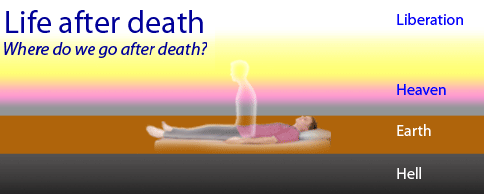
But what if we have the wrong conception of life after death?  What if we think that life after death is going to be some continuation of life as we have conceived it on earth.  Whether we return sentience or we morph into frogs or some other species, we are all basing our ideas of the hereafter on concepts we are familiar with.  We are thinking about “life after death” as strictly a continuation of life on earth.  Some of us think we will be sitting at the right hand of God and listening to his or her speeches on ethics.  Some of us think we will be playing around with 20 vestal virgins.  Some us think, Jesus Christ will be walking around and talking about faith, hope and charity with us.  Some of us think, we will be reunited with our loved ones. (If this latter case is true, I feel sorry for Mickey Rooney who had 8 wives).  Some us think we will born again as a prince or frog depending on the life we lived on earth.  Each of these conceptions is a continuation of our ideas of life as we know it now.  But what if there is another type of sentience?

life after death 1We all know that as humans we can only hear and see a small spectrum of the sound and light frequencies.  There are frequencies both above and below our normal hearing ranges.  What if the same was true of our thought ranges?  What if there were ranges of thought well above what we can think and perhaps well below?  Ideas and concepts that are hidden to us because they are out of our ability range.  We cannot fathom what it would mean to think differently because we think as rational human beings.

“I would love to believe that when I die I will live again, that some thinking, feeling, remembering part of me will continue. But as much as I want to believe that, and despite the ancient and worldwide cultural traditions that assert an afterlife, I know of nothing to suggest that it is more than wishful thinking.” ― Carl Sagan

What if there was some other type of thought besides rational thought?  Let me give an example of what this might mean.  Let us go back to Houdini and his inability to communicate after death.  Houdini dies with the desire to commune back to earth if possible.  However, upon death, his thought patterns become vastly different from anything we can conceive of.  Houdini’s life force lives on but his rational thought has been replaced by something else.  Houdini’s new thought processes see no value or reason or desire to communicate with human beings.  We cannot conceive of thought patterns like this because they are beyond our range of understanding.

“There is no such thing as magic, supernatural, miracle; only something that’s still beyond logic of the observer.” — Toba Beta

If such thought patterns can exist, perhaps sentience after the death of our mortal lives on earth can go on.  However, it will not be anything that we long for or 1251950806_Life-after-deathdream of today.  We will not become angels or born again as frogs or toads.  If life after death does exist, it must be something totally alien and foreign to any conception that we have of it now.  Present conceptions of heaven and hell notwithstanding, I believe that  life will go on and must go on, but any continuation of life in terms of immortality and eternity seems well beyond either our desires or ability to understand.   I love the idea that I will meet up with Socrates and Plato and Aristotle and be able to discuss philosophy and ethics with them.  However, I cannot put much faith in such a possibility.  Desires of humans often seem to trump logic.  We all want immortality, but it is either reserved for the gods or life as we cannot begin to comprehend it.

“Oh how wrong we were to think immortality meant never dying” — ― Gerard Way

Time for Questions:

Do you believe in life after death? What kind of life do you think exists after death? How did you arrive at this perspective?  What if someone convinced you that there was no life after death? How would this change your life? Why?

Life is just beginning.

Grow Old Along with Me

We think of growing old and we think of aged people, old people, retired people, elderly people, nursing home people and dying people.  When we think of growing old, we don’t think of babies, teenagers, young people and college students.  Ironic in a way, since everyone from birth to death is growing old or is at least growing older.  Perhaps that is the difference.  Growing old seems to Imagemean aged.  Growing older is a process while growing old denotes a physical condition.    Old means droopy skin, failing health, difficulty walking and a general decline in one’s ability to be mobile.  To some, old is a state of being or as others would say a state of mind.  Call old what you will, but none can deny the physical deterioration that comes with growing older.

In the Velveteen Rabbit, as the stuffed toy rabbit grows older, he becomes more and more worn and raggedy.  Despite his aging, the rabbit becomes more and more loved by the boy who has become his constant companion through the years.  The love of the boy eventually makes the ImageVelveteen Rabbit “real.”  Regardless of the rabbit’s becoming threadbare, torn and disfigured, the Velveteen Rabbit gains a persona that can only be understood by someone who values longevity, companionship and friendship.

Of course, we all value companionship and longevity; many people in our lives are like the Velveteen Rabbit.  Our sisters and brothers, our grandfathers and grandmothers, our mothers and fathers and our good friends and spouses; will all become older and older and older.  Eventually, they all become aged, misshapen, wrinkled and decrepit.  But if they have been good companions through the years, we are blind to their aging process.  We only see the love and caring that they have shown us.  We are blind to their difficulty with hearing and their inability to keep up with us.  We only see the person who was kind and thoughtful to us.  We are blind to their infirmaries and disabilities.  We only see the person who took care of us and helped us in our time of need.

I sometimes look at my spouse Karen who has put on pounds and wrinkles and walks slower than she used to.  Over the years, she has become more and more beautiful.  Looking back, I am not sure Karen was real to me when we were first dating and even married.  It has taken nearly 30 years of togetherness for Imageme to more fully appreciate the person that she is and it is still a process that is evolving.  The commitments that she makes to others often go beyond my understanding.   The kindness and compassion that she shows to those who are in need is more than touching.  The many ways she sacrifices what she wants so that she can help me get what I want have all made Karen real to me.

One of the saddest things, you hear at funerals, is the comment “I wish I had spent more time with them.”   It is probably inevitable that we feel this way.  Having pondered this comment over many wakes and funerals, I wonder if more time would really have made a difference.  I rather think it would be the “quality” of time we spent with others.  You may think that I am simply citing a cliché “quality of time?”  What is this elusive quality of time?  Some examples from my own life with Karen illustrate this concept for me.  Perhaps for you it will be different:

  • Sharing meals together
  • Going to hospital visits together
  • Sharing back rubs and massages
  • Reading together
  • Traveling together
  • Shopping together
  • Spending quiet time together
  • Being concerned with each other’s work
  • Helping each other whenever we can
  • Checking in each day to see how the other is doing
  • Always hugging and greeting each other when going or coming
  • Taking care of each other when sick

My list might seem trivial to you.  Your list might be very different.  Nevertheless, what if we spent the time with our loved ones that enabled all of us to say when they are no longer with us that:  “I am glad I spent the time with them that I did.”   Is the time we spend watching TV or football or golfing, or fishing so precious that we could not have spent a little more time growing older with our loved ones?

Image

We are inundated with emails, text messages, advertisements, news, news and more news.  Our minds and brains are saturated with people beseeching us to buy, sell, rent, borrow, donate, loan or vote.  The rest of our time, we are numbed by media depictions of trivia, deprivations and horror.   We are fascinated by Hollywood, Bollywood and royalty.  For many of us, Princess Kate is more real than our own brother or sister.

When Princess Diana was killed, I remember seeing a co-worker who had a shrine in her cubicle for the Princess.   Princess Diana was one of the most popular people in the world.  She was real for many because they lived her life with her.  Recent polls show ImagePrincess Kate is now as popular as Diana once was.  The media is making Kate real for us just as it once did for Diana.  The sad part of this is not that we identify with and make these people real, it is that we fail to make the truly important people in our lives real.  How much do you know about the lives, wishes, hopes, dreams and fears of the really important people in your life?  Do you get as much news about and with them as you get about Princess Kate?

GROW old along with me!   (From Rabbi Ben Ezra by Robert Browning)

The best is yet to be,

The last of life, for which the first was made:        

Our times are in His hand    

Who saith ‘A whole I planned,                 

Youth shows but half; trust God: see all, nor be afraid!’

I think we fail to teach our children the value of time.  We teach the value of money, but we neglect to teach the value of time.  It might be argued that money and time are valued according to their scarcity.  To the young, time is plentiful and money is scarce.  To the old, time is scarce and money is (if not plentiful) at least often more abundant.  If this argument is correct, then it would be a waste of time trying to teach the value of either time or money.  Their value is fixed according to age.  I disagree with this argument.

ImageI think if you look closely, many older people have never valued time as much as they still value money.  And many young people fully understand the value of time and would readily put it over the lure of more and more money.  If this is so, then it suggests that the value of each is not fixed by age but by some mental process perhaps not fully understood.  If a mental concept or construct is at work here, it can be modified or changed by reason and logic.   I may be justified in thinking that young children need to be told that time is valuable and that in many cases it is not fungible.  You can never replace or substitute money or goods for the time that you did not spend with your family, friends or loved ones.

Time has every right to be as respected a discipline as the study of money.  In capitalism, money becomes King, money is good. We pervert nature by upending the true value of things. Tangibles become more important than intangibles.  Goods become more important than services.  Greed becomes more important than charity.  Youth becomes more important than experience.

Aristotle was right in his use of the Golden Mean concept to show how to create a balance that was harmonious with the world.  ImageAnything taken to extremes becomes evil or distorted.  Time and money are the pivots upon which the world rotates.  They must be kept in harmony.  We have lost our balance though and let money become the sacred source of happiness and success.  Perhaps the really wealthy people are the ones with more time.  Why wait until retirement to become truly wealthy?

Time for Questions:

Do you have a balance in your life between time and money?  Do you keep the really important things in your life in proper perspective?  Do you value time as much as you value money?  Do you think we need to do more to help have a balance in our country?  Are you willing to share your time with others?  How about your money?

Life is just beginning. 


The Death of a Loved One.

I have been asked to write a blog dealing with the death of a loved one. As I have grown older, I have suffered the loss of many a friend and relative. That is a price that we pay for living too long. There are other prices but perhaps none as steep as this one. A friend of mine has joked about my rather cavalier attitude towards death. She has summed up my comments as “Well, we are all going to die sometime.” I realize that my comment and attitude is not very consoling. However, for me it has been a convenient shortcut to simply acknowledging death and moving on. I have also noted that it seems hardly a week has gone by in my last twenty years that I have not witnessed the death of someone who has been a friend or relative. I doubt whether my life is much different than others unless I am a more astute observer of death or unless I am simply less caring.

I read the book “On Death and Dying” many years ago. The stages of grief that were identified as something we all go through upon the loss of a loved one are perhaps interesting and even useful but in some ways are very similar to my comment in that knowing the stages may not be very consoling. It is one thing to have an intellectual knowledge of death but an altogether different thing to have a personal emotional experience of death. For instance, despite all the deaths I have witnessed including my parents many friends and most of my relatives, I have never experienced the death of a life partner. I have gone through a divorce after 16 years but a divorce is not the same as death. True, it encompasses a degree of pain and loss and suffering but I cannot quite equate that with dealing with the loss of a close personal partner that one has lived with for most of their life. I think this would be a very different experience. Whether or not it was expected or unexpected would have some influence on how one dealt with it but maybe less than one would think. The aspect of “expectedness” is another intellectual concept which does not deal with the emotional relevance of death.

One day I was coming in to see Karen, my spouse who loves to sleep late. She is normally a very late sleeper and I am not usually too concerned when she sleeps in. However, it grew quite a bit later than usual and I decided to “peek” in to see how she was doing. When I looked at her prone body, she did not appear to be breathing. I immediately put my head to hers to see if I could detect any breath. I could not. My immediate reaction was to panic and shake her. I started crying. Suddenly she turned over and asked “What was wrong.” I was beyond relief. In that single moment of thinking she had passed away, I had experienced a degree of pain, sorrow, suffering and loss that I have never emotionally experienced before. Karen and I have been living together since 1989 and going together since 1983. I know that someday we will part and on an intellectual basis, I have accepted the inevitability of it. However, I suddenly found that I have not accepted the inevitability on a personal emotional basis and I wonder now if I ever will be able to.

I have to say I do not cry very much but I did that morning. I seldom cry at funerals but I cried at my Dad’s funeral, Sister Giovanni’s funeral and a few friends whose services touched me quite a bit. I have cried every time I have read or seen a production of the “Little Match Girl.” I have cried over the song “Sometimes I feel like a motherless child.” There is something that evokes sorrow in me that has more to do with loneliness than death. I have never seen any scales of loneliness related to the death of a loved one but I might assume that some correlation did exist. I have a 98 year old Aunt and God-Mother who is one of the most positive older people I know. She has lost two of her three sons and her husband of over 60 years. She continues to love life and other people. I asked her three years ago how she keeps such an attitude when she has seen almost all of her friends and loved ones pass away. Her reply was that she simply makes new friends. I am sure she loved her sons and husband as much as the next wife and mother but she simply chooses to move on. I contrast this with a comment that I heard about Thomas Jefferson who felt that at the 50th anniversary of the Declaration of Independence he was no longer a part of this life. The following is a quote by Jefferson on aging:

1815 February 5. (to John Vaughn). “…nothing is more incumbent on the old, than to know when they should get out of the way, and relinquish to younger successors the honors they can no longer earn, and the duties they can no longer perform.”

I see a vast difference between Jefferson’s attitude on aging and my Aunt’s attitude (at least as reflected in this quote.) My Aunt has not gotten out of the way. She still performs duties and tasks to help others. Indeed, that Christmas when I was talking to her, she was leaving after dinner to serve meals to the elderly at an “Old Folks Home.” I jokingly asked her if she was not “Old” and she pensively replied “Why I guess I am, I just never think about it.” She lives in the present and maybe that is the elusive secret of happiness or satisfaction. Osho says that for too many of us the only thing that exists is the Past or Future. We are either so busy trying to recapture memories of “better” times or else we create possible futures that we hope will bring us “better memories” than we had. I have noticed that all of the great religious leaders have stressed the importance of living in the present. Jesus said:

“Therefore I tell you, do not worry about your life, what you will eat or drink; or about your body, what you will wear. Is not life more than food and the body more than clothes? 26 Look at the birds of the air; they do not sow or reap or store away in barns, and yet your heavenly Father feeds them. Are you not much more valuable than they? 27 Can any one of you by worrying add a single hour to your life?” Matthew 6:25-34

Buddha noted: “Do not dwell in the past, do not dream of the future, concentrate the mind on the present moment.” I could give writings upon writings that speak of the need to live in the present but would this help you deal with the loss of a close personal partner? Good advice seldom deals with emotions. What then to say to anyone who suffers a loss of someone they have lived with, loved with and known for most of their lives? Perhaps nothing! Maybe this is just the time to be with this person. I would suspect that the feelings of loneliness would be almost overpowering. Is it any wonder so many people seem to die shortly after the death of a long term partner? What can you really say in the face of what this person is going through? Almost anything will sound cold or trite. Just feel for a second what this person must now be feeling.

Most of what we desire in life can summed up as: Fame, fortune or power. We strive to accomplish as much wealth, attention or power as we can. We think these three goals will bring us the happiness and security that we all seek. Deep down inside we are all insecure insignificant beings who feel that somehow money, fame or power will bring us the significance that assuages our sense of loneliness and inadequacy. But it never does. The nearest anything ever comes to doing this for us, short of an emotional and spiritual awakening is the love of a close personal partner.

I would not trade all the fans, all the Facebook friends, all the media glory, all the TV fame, all the money in the world or the highest office in the world for the love of my partner Karen who intimately knows me and cares about me. Karen brings me coffee, bandages my cuts, asks me how I am doing and what is wrong, cuddles with me for no reason, walks with me, consoles me when I am feeling inadequate, supports my stupidity, tolerates my quirks and even my sometimes meanness and poor dispositions. How many of the Rich and Famous have anyone in their lives like I do? Those of you who have or had had a long time personal partner or loved one know what I am talking about. How to lose such a partner and go on with life? I am sorry if I do not know the answer or the secret. Give up or trudge on? Can you make a difference for others? Can you help share the pain and help others deal with the pain you are now feeling? What can you leave the world after your partner leaves you?

If you have had a partner like I have, you have experienced the greatest gift in the world. That this gift will someday be taken away from you is inevitable. That it will cause you great pain and sorrow is perhaps also inevitable. In the end, we come back to the beginning. Life goes on. You were loved and you were needed. There are others who are not loved and who could benefit from your love. There are others who are not needed and who could benefit from being needed by you. The biggest gift we can ever give others is the gift of ourselves. When a gift has been taken away from us perhaps it is time for us to find a way to give a gift of ourselves.

Time for Questions:

What is your experience with death and dying? How have you handled the death of a loved one? How have you helped others who are going through this pain? What will you need when you lose your partner or a close loved one? Can you share any experiences with others who might benefit from your experience?

Life is just beginning.

Next Newer Entries