The Road to Trumps Success Began 4,500 Years Ago

egypt-cairo-pyramids-of-giza-and-camels-2

I wrote this blog 8 years ago.  It is even more relevant now than it was then to explain the larger forces behind Trump’s success.  You have only to see the phalanx of billionaires standing behind Trump to know what I am talking about.  I hope that some day people will see the “bigger picture” and stop looking at the minor forces than are playing a role in politics today.  The bigger picture is more chilling and portrays a world in which we are all nothing more than pawns for the corporations who really run the world.

First Posted:  2017, Shortly after Trump was elected President in 2016: 

The journey of Donald Trump from businessman to the head of the largest corporate state in the world did not as many assume start just 12 months ago.  In fact, the roots of Trumps ascendancy can be traced back to at least 2,500 BCE.  Never before in history, has anyone with a business background and so little experience in either politics or military become the leader of a major state.  However, we did not see the buildup to this happening because most of the time we are focused on short-view trends and we miss entirely the long term trends that entail even more potent forces at play.

In numerous attempts to explain the election of Trump, most pundits have looked to the micro forces, such as international trade, disillusion among blue collar White males, the Affordable Care Act, distrust of Hillary Clinton, Russian interference in the election, White backlash and rising income inequality.  While these forces might explain Trump’s election they do not explain why America has now seen fit to elect a businessperson with no political experience as its 45th President.

In fact, the election of a person with a business background to run the country represents a major shift in power that has been taking place for nearly fifty years and can be linked to other power shifts since the beginning of recorded history.  In this blog, I will explain how and why we now find America being run by the elite of corporate America.  To do this, we must go back to the ancient Egyptians.

In approximately 2,500 BCE, the Pharaoh Khufu built the largest of the Pyramids known as the Great Pyramid of Giza as a burial chamber.  The Great Pyramid was the tallest man-made structure in the world for more than 3,800 years.   It was one of three large pyramids built in the Giza complex.  Then as now, humans marked their sovereignty by creating tall structures to show their power and prestige.  This phenomenon has been so consistent that it provides an insight into the sovereign powers that rule that planet and the various power shifts that have occurred throughout history.

sovereign-buildings

I mean to use the term sovereign to express the possessing of supreme or ultimate power.  For nearly 3,000 years, Kings, Pharaohs, Dictators, Emperors and those born of royal blood who were “related to Gods” were the ultimate sovereigns over most of humankind.  The early Romans and Greeks made some attempts to commute the power of their rulers by selecting some representatives of the population but these were generally of royal blood themselves and seldom of plebeian birth.  Julius Caesar who tried to be a “man of the people” was himself born into a patrician family.

Around the fall of the Roman Empire in 400 CE, sovereign power shifted from the nobility to the Catholic Church (at least in Europe).  Bear in mind that the shifts I refer to did not take place overnight.  These transitions in power took place gradually over decades and with many tug of wars between the transitioning sovereigns.  It was Pope Leo (440 CE) who first asserted Papal primacy and he was supported by the Romans because of the political chaos in the West.  Pope Gelasius I (492 CE) declared that priestly power was abpower-of-the-popesove kingly power.  The Pope was supreme and no appeals could be made for his decision.  Sovereign power had now shifted to the clergy of the Roman Catholic Church.
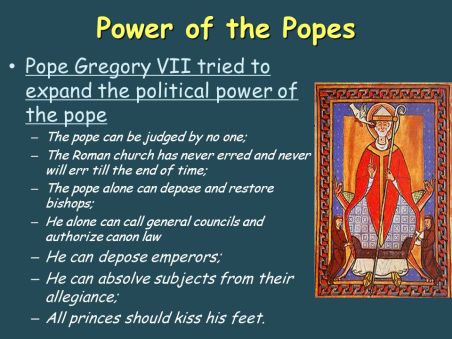
Throughout most of Europe, the clergy and other minions of the Catholic Church assumed roles of leadership and sovereignty.  As the power of the church grew, so did the churches, cathedrals and basilicas which they built.  Each one was larger than the last one and all were designed to be larger than any buildings of the nobility or royalty.  The Church catheldralmanifested its power in the grandeur and elegance of its buildings.

The Catholic Church remained the dominant sovereign power in Europe until the reign of Pope Boniface VIII.  The clash of the Church to remain dominant over the newly emerging nation/state rulers took place in an epic battle between Pope Boniface VIII (1294 734-conflict-church-monarchs-12-638CE) and King Phillip IV of France.  Several other skirmishes had already taken place between Popes and rulers in the decades preceding with the battles seesawing back and forth.  However, the decisive battle for sovereignty was between Pope Boniface VIII and King Phillip IV.  It was vicious and at times bloody.  It saw the end of Church sovereignty and the beginning of the
sovereignty of nation/state rulers.   Boniface was captured by forces loyal to Philip and was beaten and nearly executed.  He was released from captivity after three days and died a short time later.  His defeat marked the end of the power of the Church to rule and the rise of the power of rulers of nation/states.

There are four characteristics of a nation/state.  These are:

  • Defined territory
  • Self-Rule (Sovereignty)
  • Some form of organized government
  • A population of people sharing a national identity

versailles-and-giverny-day-trip-in-paris-115463During the period of nation/state rulers, they built some magnificent buildings such as Versailles in France, Castello Del Valentino in Italy, the Palace of Placentia in London and the Schönbrunn Palace in Vienna.  If not the largest buildings in each country, they dwarfed in overall grandeur and size the churches that had been built by the clergy.  The period of nation/state rulers lasted from about 1400 CE to the middle of the 19th century.

The power of most of these nation/state rulers (usually with some pedigree of nobility) began to wane as the people in each country demanded more and more input into economic and political decisions.  Eventually, the nobility in most European countries were forced to make concessions to the idea of democratic or at least some form of republican rule.  The transition from rulers to republics was insured by the rise of a new class which we today call politicians or bureaucrats.  In time, these professional politicians became sovereign and replaced the old style rulers by virtue of a concept called elections or voting.  No one voted for Henry the VIII of England or Czar Nicholas II of Germany or King Ferdinand of Spain, but with the emergence of State governments, politicians and bureaucrats would become the new sovereigns.

how-bureaucrats-captured-government

The rise of most modern states started about the mid seventieth century.  Increasingly, although rulers in many nations could still be very powerful and even dictators, there was now some agency in every country that attempted to provide a balance to the ruler’s power.  In England, they established a parliament in 1706 that was later characterized by a House of Lords and a House of Commons.  In France, they created a National Assembly in 1791.  In Germany, they established a parliament in the 1870’s.  By the beginning of the 20th Century, although many nations had still kept their nobility as a form of tradition, most of the reins of government were in the hands of bureaucrats or elected officials.  Prime Ministers and Presidents had replaced Kings and Queens in the political decision making process.

national-capitolThe new sovereigns started building.  No more castles or palaces were built to house the new rulers.  Instead, capitals, state houses and mansions would be the new domiciles for politicians and bureaucrats.  Government leaders were no different though than Kings and Clergy when it came to siting their residences.  They also sought the high ground to place their buildings on.  The tallest buildings in the land now belonged to the Government.  This situation would not last very long.  Even more changes were taking place.  In a few short years, nations would no longer have an exclusive on sovereignty.  A new challenger was rapidly emerging.

capitalists

The new challenger started to emerge with the first corporations which began over a thousand years ago.  However, until the power of mercantilism started to become critical to state and military power in the late 16th century, the early corporations were rather toothless.  An excellent book titled Power Inc. covers the rise of the modern corporation in much more detail than I shall go into here.  The book by David Rothkopf is fittingly subtitled:  “The Epic Rivalry between Big Business and Government–and the Reckoning That Lies Ahead.”   

“In his new book, Power, Inc., David Rothkopf sounds an alarm.  He argues that thousands of private actors who he calls “super citizens” now hold greater power than most countries in the world.  He notes, for instance, that corporations have grown to the point where roughly the richest two thousand are more influential than 70-80 percent of the world’s nations. Walmart, for example, has revenues higher than the GDP of all but 25 nations.” — Roy Ulrich, the Huffington Post

The capitalistic industries wasted no time in starting to construct new buildings that would soon dwarf all of the previous tombs, castles, cathedrals and capitals throughout the world.  These buildings are so tall that they have been labeled as “skyscrapers.”  The world’s first skyscraper was the Home Insurance Building in Chicago, erected in 1884-1885.  Its 138 foot peak would be dwarfed by skyscrapers today.  The Flatiron Building in NYC was built in 1902 and is twenty floors high and 307 feet to its peak.  The Empire State Building was built in 1931 in NYC and for many years it was the tallest building in the world standing over 100 stories and 1400 feet in height.

With the rapid economic development of many former third world countries there has been a proliferation of corporate skyscrapers with many countries vying for the honor of having the tallest building in the world.  Searching on Google for the “tallest buildings in the world” one finds the following information for buildings over 300 meters tall:

“As of 2016, this list includes all 135 buildings (completed and architecturally topped out) which reach a height of 300 meters (984 ft.) or more as assessed by their highest architectural feature.” — Wikipedia

skyscrapersThe list includes skyscrapers built in China, United Arab Emirates, Dubai, South Korea, Taiwan, Malaysia, Russia and several other nations.   Perhaps presaging the emergence of China and Asia as the dominant world economies, Asia is already assuming the role of having many of the largest buildings in the world.  What we are witnessing is a contest of global economies vying for supremacy in terms of world economic sovereignty.  An interesting aside is that the world currency is considered a reflection of the nation that is the most powerful in this arena.  To date, the United States still holds that distinction but many are predicting the demise of the US dollar as the standard for world currency.

tpp-free-trade

But what does this have to do with Trump you may be starting to ask?  What does commercial sovereignty have to do with political sovereignty?  The answer to the second question is everything.  The major reason for the success of the Allied powers in both WWI and WWII was the economic might of the United States.  Economic power translates into military power and military power translates into political power.  This fact has been recognized for over 500 years now.  Spain’s ascendancy to a world power was built on its confiscation of wealth in the New World.  Hitler recognized that Germany could not be a dominant world power without confiscating the wealth of Jewish citizens and also of its neighboring countries.

“Great Britain was once a dominant military force in the World while it had a dominant economy.  At the start of the First World War, it devalued its exchange rate.  By the end of the War, owing to its military expenditure, it had large trade deficits and falling gold reserves.” — Buoyant Economies

The question of Trump brings a larger issue to the fore.  Generally, we have seen that as the dominant world power shifts, the leadership shifts along with it.  The features of buildings as a representation of power has followed these shifts.  However, in terms of the new power of corporations, it would seem that the buildings have been created before the shift in leadership.  That is until Trump became President of the United States of America.

a-corporate-worldIs Trump’s election an anomaly or does it truly represent the emergence of corporate power into the political arena?  My view on this is that Trump’s election is merely the tip of the iceberg.  For over 20 years now the United States has been electing more and more political leaders who are not politicians.  I am considering someone as not a politician if they are people who have not made a career of politics.

Many business people are jumping right into the political arena without experience in either local, state or federal government.  The founder of Electronic Data Systems, Ross Perot may be remembered by many voters as the ultimate tycoon-turned-politician.  Perot ran for president in 1992 and 1996 as a third-party candidate.

An article written in 2010 before Trump had become a candidate stated the following concerning the election of corporate people to public office:

“Whoever believes politics is big business must have seen this coming. The high levels of accountability from running a corporation and high expectations of seeking a seat in government have many parallels.  Amid this confluence of business and political streams, Chief Executive magazine dubbed 2010 “a high-water mark for the CEO as candidate.”

More than 40 business magnates – the presidents and founders of banks, restaurants and tech giants – are running for seats on Capitol Hill or for governor’s offices in 25 states. And looking ahead Donald Trump says he is “absolutely thinking about” a 2012 presidential bid.” — Ten Business Leaders with Politics in their Blood, by Bill Briggs

During the Republican runoff to the nomination of Trump, we saw Carly Fiorina who was a former CEO also emerge as a potential candidate.  We now have ten governors with no former elected government service.  Seven former US presidents with business experience have all been elected in the 20th or 21st century.  The following chart shows the net worth of the wealthiest senators in the US. Congress as of 2012.senator-net-worth

The next chart shows the average net worth of 90 incoming freshman representatives to the 113th US Congress

January 3, 2013 to January 3, 2015

Year Number of Freshmen Reports Average Net Worth Change from previous year
2011 90 $7,835,242 —-

More data can be found at Ballotpedia at https://ballotpedia.org/Main_Page

the-50-richest-people-on-earthMy point here is that most millionaires make their money in business.  On the 2016 Forbes lists of richest 400 people in the world, richest billionaires in the world and richest people in the world, the majority (about 2/3) have made their money in business.  Furthermore, they are self-made in that they did not inherit their fortunes.  Perusing Forbes, it is clear that the dominant path to becoming rich is to sell something that people want at a price they can afford.

It is clear that wealth accumulated to a business background has increasingly become a stepping stone to politics and political leadership.  Trumps presidency is the crown on the new sovereignty.  Business leaders are now rapidly replacing politicians and bureaucrats in the area of political leadership.  Already Trump’s nominees include the chief executive of Exxon Corporation; the chief executive of CKE Restaurants; the former chief executive of the World Wrestling Entertainment; a former Goldman Sachs executive; a billionaire investor; a right wing media executive and a former chief executive of Nucor Corporation.  These are only a few of the still to come appointments that Trump will make.

corporate-powerIt is my prediction that business leaders will continue to make the transition to political leadership.  The business model is now the sovereign model for world power.  The power of the state has been usurped by the power of big business.  Global power is corporate power.  The public is sick of career politicians.  The common people bring a (perhaps unfounded) belief in the power of business to save the world.  Considering that we have tried the power of academia, the power of science and the power of big government to save the world, perhaps the power of business can do better.  One might argue that they can at least do no worst.

Conclusion:

From Khufu to Trump, we have now briefly (my apologies for many simplifications and no doubt omissions in history) covered 4,500 years of political and economic history in a short seven or so pages.  I can see the great historians and economists of the world having fits at my narrative. Nevertheless, my thesis remains.  Simply put Trump is now the successor to Khufu, Caesar, Pope Boniface, Henry the VIII, Bismarck, Churchill and Roosevelt.  Big business is now the dominant sovereign power in the world.  How long will it last?  How long will it take all politicians to be replaced by business people?  I have no answers to these questions; but one must assume that somewhere down the road, another sovereign power will emerge or may already be emerging.  Until then, be prepared for most decisions to have a “let’s make a deal” flavor to them.

Time for Questions:

How long will the reign of big business last?  How long will it take politicians to all be replaced by business people?  Will business succeed in making the world a better place?  Why or why not?

Life is just beginning.

“I spent 33 years and 4 months in active military service . . . And during that period I spent most of my time as a high-class muscle man for Big Business, for Wall Street and the bankers. In short, I was a racketeer, a gangster for capitalism.

Thus, I helped make Mexico and especially Tampico safe for American oil interests in 1914. I helped make Haiti and Cuba a decent place for the National City Bank boys to collect revenues in. I helped in the raping of half a dozen Central American republics for the benefit of Wall Street.

I helped purify Nicaragua for the international banking house of Brown Brothers in 1902–1912. I brought light to the Dominican Republic for American sugar interests in 1916. I helped make Honduras right for American fruit companies in 1903. In China in 1927, I helped see to it that Standard Oil went on its way unmolested.

Our boys were sent off to die with beautiful ideals painted in front of them. No one told them that dollars and cents were the real reason they were marching off to kill and die.”
― General Smedley Butler

“Our aim is not to do away with corporations; on the contrary, these big aggregations are an inevitable development of modern industrialism, and the effort to destroy them would be futile unless accomplished in ways that would work the utmost mischief to the entire body politic. We can do nothing of good in the way of regulating and supervising these corporations until we fix clearly in our minds that we are not attacking the corporations, but endeavoring to do away with any evil in them. We are not hostile to them; we are merely determined that they shall be so handled as to serve the public good. We draw the line against misconduct, not against wealth.”
― Theodore Roosevelt

What Next after Trump’s Victory?

First, we all want to know why and how Trump won.  Herein is a brief summary of some of the major reasons given by numerous analysts for Trump’s victory.  
 
“Sexism, racism, young males, rural angst, religion, Gaza, immigration, incel men, despair, Democrats off message, Biden, education level, conservative white women, inflation, right wing billionaires, Christian nationalists, desire for an anti-establishment figure, desire for change.” 
 
I have probably missed a few.  
 
The main reason I see is that Trump reflected 21st Century American values. Greed and narcissism among a large percentage of our populace who don’t want anything or anyone to get in the way of their shopping. They looked at Trump and saw themselves and their own values. 
 
The following quote was from a Salon newsletter.  
 
“This 2024 election is a referendum on the character of the Trump-voting public, and let’s not make it nice. They place minimal value on respect for truth and democratic institutions. They are more interested in punishing other people than in advancing the common good. They have a remarkable tolerance for crass and bullying behavior, care little for empathy and ethics, and are incapable of weighing basic facts.”
 
After reviewing many of the analyses of why Trump won, most of us are wondering what “next steps” could, should and will be.  My response to the election of Trump will be along the lines of the following:
 
Many of the comments I have read concerning the election reflect the dilemma between being and doing. I am going to try a middle ground. I want to avoid any savior complex as well as a “hopeless” complex. Not sure how I will manage it yet. In TQM we used the Pareto principle to attack problems.  We called it the 80/20 rule.  Twenty percent of your problems give you 80 percent of your headaches.  Thus, we always used some criteria to prioritize problems before starting to fix anything. 
 
My priorities stem from my reflections on comments as well as some of the demographics on voting during the election.  For instance, 110 million eligible people did not vote, 53 percent of White women voted for Trump, men (includes Black, White and Latino) preferred Trump 55 to 42 percent and 10 million fewer people voted Democrat than in 2020.  (Numbers behind the vote) After contemplating the meaning of these statistics and more, my top priorities would be:
 
1. Pure self interest/greed
2. Sexism
3. Anti-Establishment feeling
 
Not sure how to deal with any of these. Greed and sexism have been around since Moses. Best path may be grass roots action to educate people on economics. One thing for sure. Mainstream media is useless. It is strictly bent on making money. 
 
Peace, Wisdom and a Long and Healthy Life,

John,

The Politics of Cultural Despair

It is despair that is killing us. It fosters what Roger Lancaster calls “poisoned solidarity,” the intoxication forged from the negative energies of fear, envy, hatred and a lust for violence.

The Mourning After – by Mr. Fish

In the end, the election was about despair. Despair over futures that evaporated with deindustrialization. Despair over the loss of 30 million jobs in mass layoffs. Despair over austerity programs and the funneling of wealth upwards into the hands of rapacious oligarchs. Despair over a liberal class that refuses to acknowledge the suffering it orchestrated under neoliberalism or embrace New Deal type programs that will ameliorate this suffering. Despair over the futile, endless wars, as well as the genocide in Gaza, where generals and politicians are never held accountable. Despair over a democratic system that has been seized by corporate and oligarchic power.

This despair has been played out on the bodies of the disenfranchised through opioid and alcoholism addictions, gambling, mass shootings, suicides — especially among middle-aged white males — morbid obesity and the investment of our emotional and intellectual life in tawdry spectacles and the allure of magical thinking, from the absurd promises of the Christian right to the Oprah-like belief that reality is never an impediment to our desires. These are the pathologies of a deeply diseased culture, what Friedrich Nietzsche calls an aggressive despiritualized nihilism.

Donald Trump is a symptom of our diseased society. He is not its cause. He is what is vomited up out of decay. He expresses a childish yearning to be an omnipotent god. This yearning resonates with Americans who feel they have been treated like human refuse. But the impossibility of being a god, as Ernest Becker writes, leads to its dark alternative — destroying like a god. This self-immolation is what comes next.

Kamala Harris and the Democratic Party, along with the establishment wing of the Republican Party, which allied itself with Harris, live in their own non-reality-based belief system. Harris, who was anointed by party elites and never received a single primary vote, proudly trumpeted her endorsement by Dick Cheney, a politician who left office with a 13 percent approval rating. The smug, self-righteous “moral” crusade against Trump stokes the national reality television show that has replaced journalism and politics. It reduces a social, economic and political crisis to the personality of Trump. It refuses to confront and name the corporate forces responsible for our failed democracy. It allows Democratic politicians to blithely ignore their base –  77 percent of Democrats and 62 percent of independents support an arms embargo against Israel. The open collusion with corporate oppression and refusal to heed the desires and needs of the electorate neuters the press and Trump  critics. These corporate puppets stand for nothing, other than their own advancement. The lies they tell to working men and women, especially with programs such as the North American Free Trade Agreement (NAFTA), do far more damage than any of the lies uttered by Trump.

Oswald Spengler in “The Decline of the West” predicted that, as Western democracies calcified and died, a class of “monied thugs,” people such as Trump, would replace the traditional political elites. Democracy would become a sham. Hatred would be fostered and fed to the masses to encourage them to tear themselves apart.

The American dream has become an American nightmare.

The social bonds, including jobs that gave working Americans a sense of purpose and stability, that gave them meaning and hope, have been sundered. The stagnation of tens of millions of lives, the realization that it will not be better for their children, the predatory nature of our institutions, including education, health care and prisons, have engendered, along with despair, feelings of powerlessness and humiliation. It has bred loneliness, frustration, anger and a sense of worthlessness.

“When life is not worth living, everything becomes a pretext for ridding ourselves of it … ,” Émile Durkheim writes. “There is a collective mood, as there is an individual mood, that inclines nations to sadness. … For individuals are too closely involved in the life of society for it to be sick without their being affected. Its suffering inevitably becomes theirs.”

Decayed societies, where a population is stripped of political, social and economic power, instinctively reach out for cult leaders. I watched this during the breakup of the former Yugoslavia. The cult leader promises a return to a mythical golden age and vows, as Trump does, to crush the forces embodied in demonized groups and individuals that are blamed for their misery. The more outrageous cult leaders become, the more cult leaders flout law and social conventions, the more they gain in popularity. Cult leaders are immune to the norms of established society. This is their appeal. Cult leaders seek total power. Those who follow them grant them this power in the desperate hope that the cult leaders will save them.

All cults are personality cults. Cult leaders are narcissists. They demand obsequious fawning and total obedience. They prize loyalty above competence. They wield absolute control. They do not tolerate criticism. They are deeply insecure, a trait they attempt to cover up with bombastic grandiosity. They are amoral and emotionally and physically abusive. They see those around them as objects to be manipulated for their own empowerment, enjoyment and often sadistic entertainment. All those outside the cult are branded as forces of evil, prompting an epic battle whose natural expression is violence.

We will not convince those who have surrendered their agency to a cult leader and embraced magical thinking through rational argument. We will not coerce them into submission. We will not find salvation for them or ourselves by supporting the Democratic Party. Whole segments of American society are now bent on self-immolation. They despise this world and what it has done to them. Their personal and political behavior is willfully suicidal. They seek to destroy, even if destruction leads to violence and death. They are no longer sustained by the comforting illusion of human progress, losing the only antidote to nihilism.

Pope John Paul II in 1981 issued an encyclical titled “Laborem exercens,” or “Through Work.” He attacked the idea, fundamental to capitalism, that work was merely an exchange of money for labor. Work, he wrote, should not be reduced to the commodification of human beings through wages. Workers were not impersonal instruments to be manipulated like inanimate objects to increase profit. Work was essential to human dignity and self-fulfillment. It gave us a sense of empowerment and identity. It allowed us to build a relationship with society in which we could feel we contributed to social harmony and social cohesion, a relationship in which we had purpose.

The pope castigated unemployment, underemployment, inadequate wages, automation and a lack of job security as violations of human dignity. These conditions, he wrote, were forces that negated self-esteem, personal satisfaction, responsibility and creativity. The exaltation of the machine, he warned, reduced human beings to the status of slaves. He called for full employment, a minimum wage large enough to support a family, the right of a parent to stay home with children, and jobs and a living wage for the disabled. He advocated, in order to sustain strong families, universal health insurance, pensions, accident insurance and work schedules that permitted free time and vacations. He wrote that all workers should have the right to form unions with the ability to strike.

We must invest our energy into organizing mass movements to overthrow the corporate state through sustained acts of mass civil disobedience. This includes the most powerful weapon we possess – the strike. By turning our ire on the corporate state, we name the true sources of power and abuse. We expose the absurdity of blaming our demise on demonized groups such as undocumented workers, Muslims or Blacks. We give people an alternative to a corporate-indentured Democratic Party that cannot be rehabilitated. We make possible the restoration of an open society, one that serves the common good rather than corporate profit. We must demand nothing less than full employment, guaranteed minimum incomes, universal health insurance, free education at all levels, robust protection of the natural world and an end to militarism and imperialism. We must create the possibility for a life of dignity, purpose and self-esteem. If we do not, it will ensure a Christianized fascism and ultimately, with the accelerating ecocide, our obliteration.

All Aboard for a Ride on the Trump Mobile

The Trump mobile is the limousine that Trump drives.  I will describe it in this blog.  If you board his vehicle, he will take you on a ride to autocracy and xenophobia.  To a land bereft of Democracy or anything pertaining to the values and virtues of the Founding Fathers.  Lets look at the construction of this vehicle from the ground up.

There are four tires that the Trump mobile rolls on.  One tire is Christian Nationalism.  This is the belief that the Christian religion should become the religion of the USA.  It is the belief that Christianity is superior to all other religions and that the Christian God is the only true God.  Christianity needs to infiltrate our government and our schools.  Christian Nationalists want to do away with the separation of church and state and put the 10 Commandments and Bibles in every institute of education in America.  America will become a Theocracy like Iran and Israel.

A second tire that the Trump mobile rides on is White Supremacy.  This tire is constructed of layers of belief that White people need to remain the supreme governing group in the USA.  It supports the idea that White people are superior in morals, intellect and aspirations to all other ethnic groups.  By virtue of being White, you are entitled to rule over inferior races which includes everyone on earth who is non-White.

The third tire constructed for the Trump mobile is Sexism.  This tire promotes the inferiority of women to men.  Women were brought into being by a creator not to lead men but to follow men.  A women’s main role is to bear children that will continue the dynasties started by men.  Women should always remain subservient to men from the bedroom to the kitchen.

The fourth tire for the Trump mobile is Racism and Xenophobia.  This tire is built up from layers of fear and loathing for other races and cultures.  This tire rolls on the belief that White people must prevent race mixing.  Allowing relationships with other races will dilute the pure heritage of the White genotype.  Anyone different such as Gays, minorities, disabled people or indigenous people must be eliminated from the White gene pool.

Moving on to the major power for the Trump mobile we come to the engine and the fuel supply.  The engine is composed of 8 cylinders of greed, avarice, acquisitiveness, covetousness, graspingness, cupidity, materialism, and possessiveness.  The fuel that feeds the engine delivers power from the promise of Tax Breaks and Trickle-Down Economics.  A fuel that will help the rich and many others find ways to buy more stuff.

Then we come to the transmission for the Trump mobile.  No limousine can move until the power is transferred to the wheels from the engine.  In the case of the Trump mobile, the two main cogs in the transmission are fear and hate.  Fear and hate convey the power to the wheels.  Fear of others who may try to take away the values promoted by Trump and his followers.  Hate for those who are different and who may try to block the desires of Trump and his supporters.

The vehicle is of course driven by the charismatic Donald Trump who is the only one on the whole planet capable of steering the limousine in the RIGHT direction.  Trump was sent by the Christian Nationalist God to drive the Trump mobile to a paradise on earth ruled by White Christian people.  People who believe in the superiority of Whiteness and a White God with blond hair and blue eyes who will smite the enemies of Trump and his supporters.

The fronts seats of the Trump mobile are filled with sycophants who bless Trump and regard him as a savior.  Leaders of the Republican party, rich billionaires, media propagandists and young sexy women all get to ride in the front seats.  The back seats are full of Trump supporters who hope someday to ride in the front seats.  These are men and women who feel cheated by their government and society of their rightful place in life.  They believe that someday Trump will anoint them as faithful followers and allow them to join Trump in his paradise on earth.  They believe that the Trump mobile will take them there.

All aboard please.  The Trump mobile is leaving soon. 

The Real Reason Why Trump Supporters Worship Trump!

maxresdefault

You have read all the books.  You have heard all the theories.  Why do people support Trump?  But every time you listen to Trump, you shake your head wondering “why, why, why?”  Why would anyone support such a low life despicable character or should I say lack of character.  The experts, his “old” friends, his relatives and the left-wing keep coming up with more theories to explain the Trump phenomenon.  How could anyone support a man with no ethics?  An adulterer, liar and slanderer who is also greedy, avaricious and felonious.  A man who has already served one term in the highest office in the world with disastrous results and if his luck holds out may just serve another term.  How, how, how you ask is this possible?  How could 74 million people vote for such a person?

The books and pundits have proposed so many theories for the above questions during the last four years that it would make your head spin.  Going to Google, I found 111 books about Trump.  Most of these books are not favorable but a few are.  (See bibliography of Donald Trump).

There are other theories that have not been enshrined in a book yet.  A recent one that I heard had to do with virility.  Some scientists looked at the US States with the highest Viagra usage and found that the degree of Viagra sold correlated positively with the votes for Trump in that State.  The higher the usage of Viagra, the more men voted for Trump.  Ergo, the theory is that men who can’t get an erection are more likely to vote for Trump.  Needless to say, these “scientists” need to have their heads examined IMHO.  So why do people support Trump?  The other question is “why can’t any facts, data, evidence or Trump pronouncements change their minds?”  Lets start with the first question.

Why Do People Support Trump?

The answer lies in a John Denver song called, “Country Roads, Take Me Home”

Almost Heaven, West Virginia

Blue Ridge Mountains, Shenandoah River

Life is old there, older than the trees

Younger than the mountains, growin’ like a breeze

Country roads, take me home

To the place I belong

West Virginia, mountain mama

Take me home, country roads

All my memories gather ’round her

Miner’s lady, stranger to blue water

Dark and dusty, painted on the sky

Misty taste of moonshine, teardrop in my eye

maxresdefault (1)

Trump supporters want to go back to the “good old days.”  The days when Whites governed.  Blacks and other minorities knew their places.  Women worked in the kitchen and bedroom and had children.  Men were the breadwinners and on a miners, truck drivers, postal workers, or other blue-collar job could raise a family of six and still have a few bucks left over to go down to the local pub after work for a couple of brews with buddies.

You did not have to be politically correct around gays who were called fags, or disabled people who were called gimps.  Mexicans came over to do the farm work and went back to Mexico.  Other minorities were given visas and possibilities of becoming US citizens but in much smaller quantities than for White Europeans.  School is where you went to get a diploma, play sports and maybe go to college.  No one was worried about being shot in a mass shooting.  Guns were plentiful but were mainly used for hunting and target practice.  Shooting someone for taking your parking space, was unheard of.  (Man killed during fight over parking spot)

It was a time when the USA ruled the roost.  China, Russia, Korea and the Mideast did not dare or would not dare to challenge us.  We had a cold war but until Vietnam, we had peace and prosperity.  Religion was a place that taught morals and values.  The separation of church and state was still believed in by most people.  The TV show “Happy Days” captures some of the nostalgia for the “Good Old Days.”  Days that might have been very happy for some Americans but definitely not for others.  It was also a time of Jim Crow laws that relegated many African Americans to the “back of the bus” and to less than second rate jobs and education.

images

Unfortunately, the Democrats do not understand the Right-Wing nostalgia for the past.  Harris intones “We will not go back.”  She may win over minorities and progressive White people with this message but not with Trump supporters.  It is the opposite of what Trump is promising.  it conflicts with Trump’s message.  Some have interpreted Trump’s message to “Make America Great Again” as a code for “Make America White Again.”  I believe a more accurate interpretation for his followers would be to “Take America Back Again.”  Back to Happy Days, back to a John Denver valley of peaceful tranquility.  Harris wants to go forward but Trump supporters are cautious, going forward to what?  Artificial Intelligence?  Mars Expeditions?  More fake internet information?  More wars in unknown parts of the world like Gaza and the Ukraine?  I want to go home.  I want to go home.

I hear her voice in the mornin’ hour, she calls me

The radio reminds me of my home far away

Drivin’ down the road, I get a feelin’

That I should’ve been home yesterday, yesterday

Country roads, take me home

To the place I belong

West Virginia, mountain mama

Take me home, country roads

 In my next blog, I will answer the second question that I posed above: “Why can’t any facts, data, evidence or Trump pronouncements change a Trump supporters mind?” 


Can We Be Justified for Intolerance Towards Intolerance?

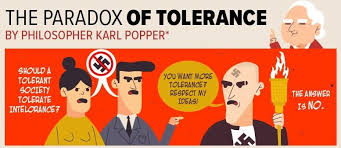
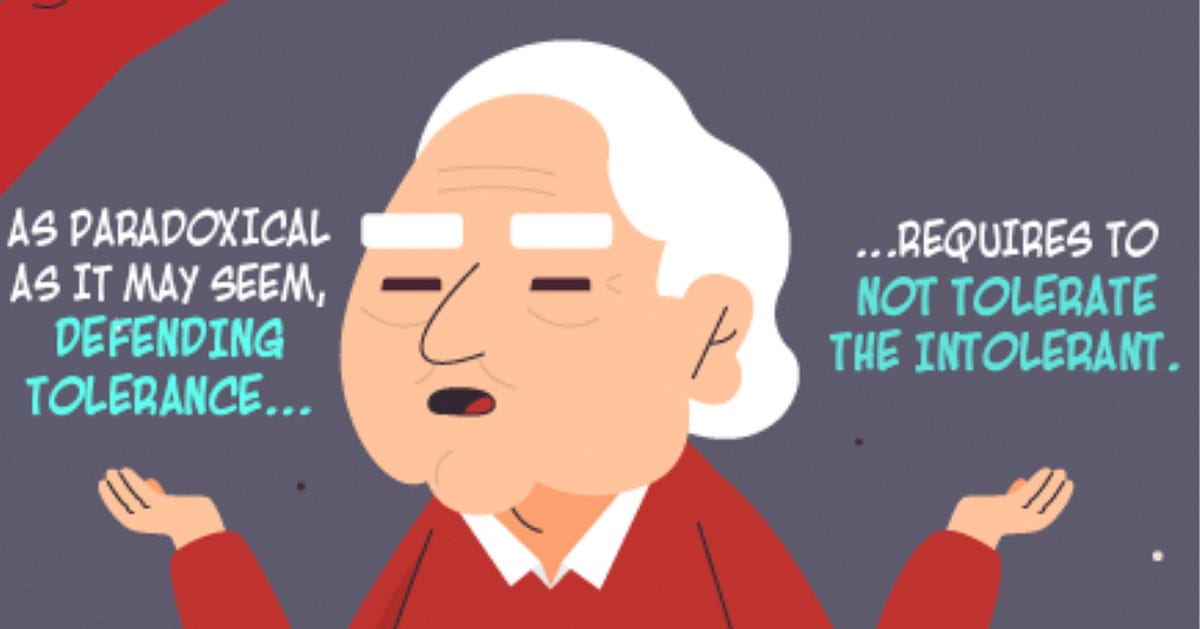
Many years ago, the famous philosopher Kark Popper created what has been called the “Paradox of Tolerance.”

Karl Popper wrote that, “if we want a tolerant society, we must be intolerant of intolerance”.  This is known as the “Paradox of Tolerance”, which is the idea that a society must be intolerant of intolerance in order to maintain tolerance.  As with any paradox, this is very confusing.

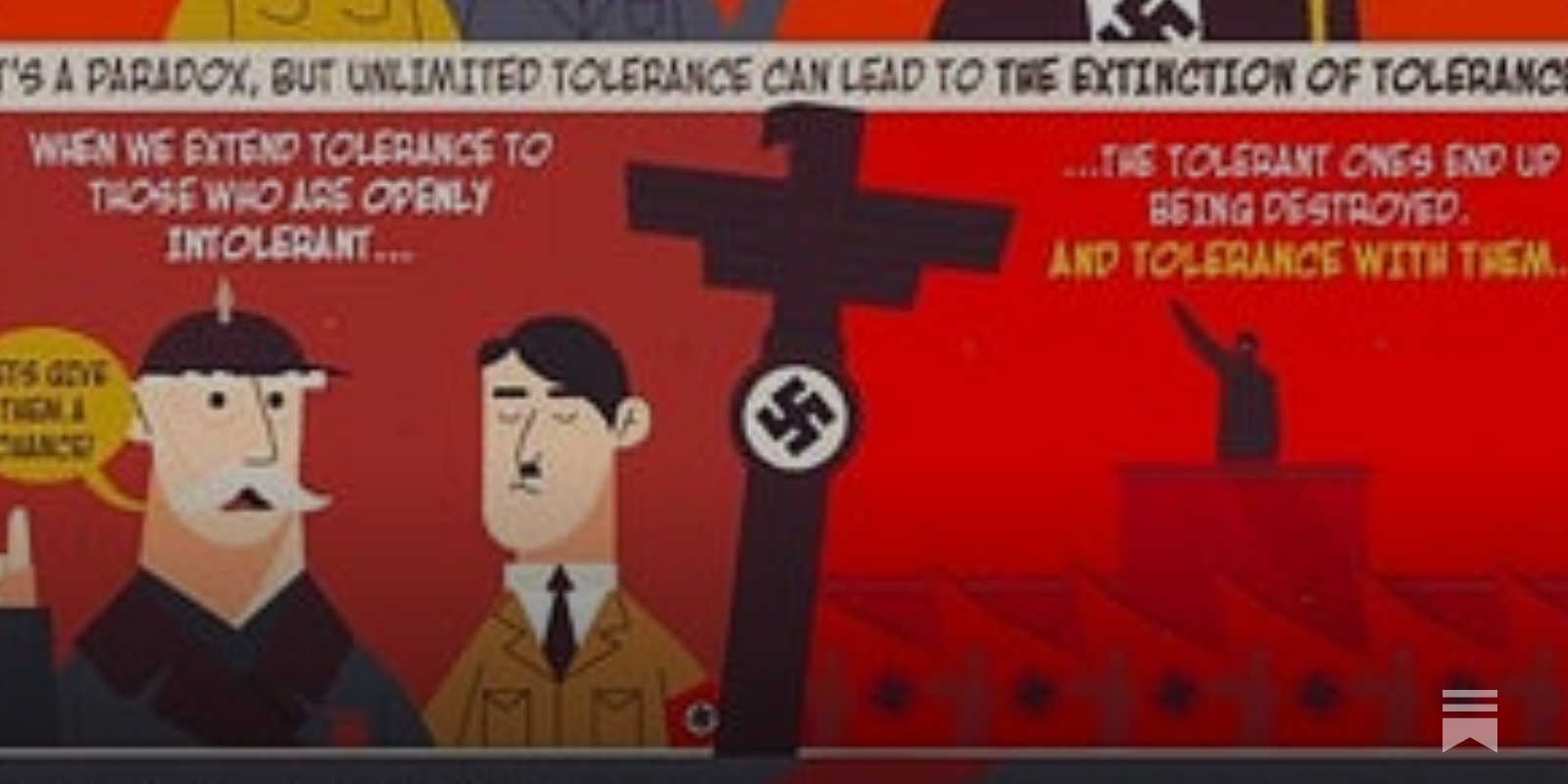
“Popper explained that unlimited tolerance can lead to the destruction of tolerance.  He said that a tolerant society should be prepared to defend itself against intolerant views, and that the right to suppress intolerant views should be claimed if necessary.  However, he also said that suppressing intolerant views through force is unwise unless they are unwilling to engage in rational argument.”  —- From Search Labs | AI Overview

Recently, I came across a rather long academic article which I think supports a justification for Popper’s viewpoint.  Albeit I think this article provides a more nuanced explanation for being intolerant of intolerance.  I have decided to post this article since I think the times demand that we understand this perspective.  I believe it is a focal point worth fighting for.  You may disagree but the analogy of how Hitler took power is I think quite relevant and worth thinking about.  Here in its unabridged form is the entire article.  I would love to hear what you think, so please leave a comment or two.

What are the Limits of Toleration? By Tamar Lagurashvili

University of Tartu, Institute of Government and Politics, Graduate Student

Introduction

Tolerance is considered to be one of the cornerstones of modern liberal democracies, thus having acquired different implications across the countries, which ultimately leads to the ambiguity of the concept itself. In order to avoid further misunderstanding, we should clearly define what is meant in tolerance and why it is crucial not to mix this term with the words having similar connotations. Yossi Nehushtan (2007:5)  offers an obvious distinction between the value-based liberal tolerance and rather neutral tolerance, which finds more similarities with indifference rather with toleration itself. Concerning its linguistic origin, author refers to the Latin word tolerabilis, which means to lift an object, clearly implying to the burden to be carried by one, who tolerates certain unacceptable behavior, act or opinion. Within this context, we should refer to Michael Sandel (1996),  who differentiates liberal non-judgmental toleration from judgmental toleration. While looking closely at these concepts, we can see that in the case of former, person (tolerant) tolerates certain opinion, act or behavior without judgmental evaluation simply because he does not care or he respects others’ privacy and thus, refrains from any kinds of interference. Albeit that, refraining from interfering in other people’s private life is an integral part of modern liberalism, definition provided above does not correspond with the tenets of tolerance.

As Heywood (2015:251)  rightly mentions, tolerance should be distinguished from permissiveness, indifference and indulgence, since being tolerant inherently implies to the fact that a tolerant person faces moral difficulties to put up with certain behavior or act, but does so for the sake of different reasons. Being tolerant means that a person has to impose certain restrictions on him/herself in order to avoid to openly interfere in others’ life when there is something to be disliked, disparaged or disapproved. Toleration with its basic definition can be considered as truly moral value, supporting a peaceful coexistence of the different individuals, but whether there are certain cases, where intolerance is morally/pragmatically justified is major concern of this paper.

Why do we tolerate?

Rainer Frost (2008:79-82) while touching Pierre Bayle’s Reflexive theory of Toleration, talks about three different reasons or factors, which trigger toleration among majority and minority groups. First he mentions permission conception, according to which the majority gives minority a right to live according to their customs, but toleration is possible when the “difference” of minority is contained to certain limits and does not cross the borders of private life. As an early and most vivid example of permission conception Frost names the Nantes Edict of 1598, which granted the Calvinist Protestants of France substantial rights in private as well as in public spheres.

Second way of toleration is coexistence concept, which resembles to pragmatic tolerance to be discussed bit later. In this case, avoiding conflict and paving way towards peaceful coexistence is what matters, but unlike the previous situation, here we face not the relation between the ruling majority and minority, but rather two groups wielding equal powers, thus requiring making some concessions for the sake of preventing clash of interests. If we attempt to apply this concept to real life, we can think of Somalia, who has been torn apart by three different clans ruling in three regions of Somalia, therefore hindering country’s normal development. Bearing in mind that Somalia is characterized by distinctive homogeneity (Guardian Africa: 2015),  one can assume that it is not different beliefs and traditions, which impede toleration among the clans, but the economic benefits they can reap from the permanent state of conflict.

Third conception is based on the principle of respect, thus implying to the fact that toleration requires acknowledging the fact that everyone is equal and deserves equal political and legal rights.

As one can see Frost’s approach towards toleration is rather a combination of pragmatic and moral values, since it fosters cooperation between majority and minority and upholds egalitarian values. Kristie McClure (1990:361-391)  puts forward John Rawls’s understanding of toleration within his notion of “ justice as fairness”, according to which toleration carries distinctively pragmatic connotation, namely the one of social conditions, which not only helped to put an end to the religious wars in Europe, but to transform religious toleration into certain form of social practice. John Locke’s work Letter Concerning Toleration is deemed to be a milestone in understanding the tenets of toleration. Locke comes from the assumption that we are all created by God and thus, our “Highest Obligation” should rest on the understanding of others’ differences for the sake of our moral obligation and love (Frost 2008). Later on Locke argues about the possible relation between the tolerant and one to be tolerated, excluding the possibility to give superiority to any church, since it will lead to persecution and monopolization of power.

One can consider that by proposing to give each and every church equal power as searching for  the only true religion is futile and will exacerbate conflict between different religious groups, Locke somehow offers the coexistence concept elaborated earlier. Even though toleration is a God-given virtue, Locke still talks about its possible limits, which in his case is restricted to two kinds of groups: “A church that assumes the power of being able to excommunicate a king or that claims political and religious authority over its members…” and the atheists, as: ”They are not at all to be tolerated who deny the Being of a God” (Frost: 91-92).

Nehushtan, like Frost points out three different reasons of why people generally tolerate: tolerance as right, pragmatic tolerance and tolerance out of mercy. First he touches upon tolerance from the standpoint of rights and argues that no matter how repulsive person’s behavior or opinion can be, harm inflicted to that person cannot be justified on the grounds of personal autonomy developed by Joseph Raz . Author stresses particular importance on the pragmatic side of toleration and develops the ideas very similar to Frost with an additional insight of reciprocity and proportionality, which will be discussed later on. His third point argues that people with physical and/or mental disabilities might be exposed to more toleration than usual, regardless their repulsive behavior.

Can toleration be limited?

Tolerance with its underlying principles and applicability clearly upholds democratic values and strengthens personal autonomy, which constitutes one of the cornerstones of the liberal democracies. Albeit that tolerance is widely considered as “moral virtue”, would we go further and suggest that tolerance can be applied to each and every circumstance regardless the fact who should be tolerated? This question is examined in the works of many political scientists, including Andrew Heywood, who even though stresses importance of the political pluralism, openly talks about those political parties, which are clearly distinguished with hate speech and bigotry, thus threatening the democratic values, should not be tolerated and permitted to the political spectrum, since as author suggests: ”toleration is not granted automatically, it has to be earned” (Heywood: 256).

I would suggest that reciprocity, as a crucial feature of toleration substantively defines the nature of its applicability, which means that in certain exceptions, where we have to deal with a massive surge of intolerance, clearly undermining the democratic values and endangering the sovereignty of state, toleration should be limited. Heywood calls an example of Nazi Germany, where after the failure of Munich Putsch, Hitler and his collaborators were still allowed to pursuit their political activities legally, which ultimately led to the disastrous consequences. It seems that reciprocity plays an integral part in understanding the limitations of tolerance, so clearly expressed in the work of Nehushtan, who also talks about proportionality, which mainly focuses on the costs and benefits of limiting toleration. We could start by recalling Rawls, who suggests that:” it seems that an intolerant sect has no title to complain when it is denied an equal liberty”( Rawls 1999:190).  While analyzing Rawls’s words, we can assume that those intolerant groups, which openly threaten state sovereignty and democratic values in general, should not be treated in a tolerant manner, but how can intolerance be expressed when it comes to politics? Should we ban such intolerant political parties and prevent them from entering parliament?

Should we hold a peaceful campaign, during which we will expose true information about the intolerant party’s real intentions and the scope of possible harm in case of proliferation the intolerant ideas? Deciding upon the methods of expressing intolerance is rather individual and as Nehushten suggests, is rooted in the principle of proportionality. According to the author, while working on the scope of intolerance, one should take into account the nature of intolerance and the response towards it, since if an act of intolerance takes place in parliament for example, an intolerant response should be formulated within the realm of politics and not in the private life. On the other hand, amount and nature of intolerant response should not exceed the original intolerance and what is of core importance- intolerant response should inflict minimal harm to the democratic values and human rights, because otherwise we will face counter-productivity. Fintan O’Toole (1997:346)  raises another interesting question concerning the limits of tolerance based on assumption that excessive freedom of certain group might threaten collective good, thus requiring to impose certain restrictions on that group’s excessive liberty. Therefore, certain amount of intolerance towards the groups, who wield the power in order to prevent them from abusing/manipulating this power, is justified.

Nevertheless, author calls an example of Bernard Shaw’s criticism of the Christian Golden Rule (according to which we should treat others as we would like to be treated), providing the heterogeneous nature of the society, where what one person considers benign for him/herself, might be perceived as totally evil by other. Author suggests that even though there might be a society with relatively homogeneous religious beliefs, the applicability and interpretation of the customs and beliefs might considerably vary (O’Toole: 347). Therefore, we should not expect that toleration will be upheld as universal value across different societies, but what author explicitly refers to is the nature of harm inflicted by the intolerant groups, which morally and pragmatically justifies adequate intolerant response.

Conclusion

Tolerance, as one of the tenets of modern liberal thought,  cannot be applied universally to every situation, without taking into account the nature of an opinion, behavior or act to be tolerated and the amount and nature of harm done to the society followed by intolerance.  We can assume that intolerance is justified on the grounds of reciprocity i.e. as Heywood stated, tolerance should not be granted automatically and it requires certain effort to be excerpted by the groups demanding tolerance and proportionality, which implies that there should be balance between the original intolerance and its corresponding intolerant response. Even though tolerance constitutes a major tenet of modern liberal democratic states, where each and every individual is endowed with personal autonomy and a right of individual liberty, preventing certain individuals from infringing others’ private life, there are some exceptional cases, where intolerance can be justified. Even though individual liberty is an integral part of the democratic societies, my essay primarily focused on the limits of tolerance at the political level, where we might face much more disastrous results in case of allowing unlimited tolerance towards the intolerant groups. Having tolerant attitude is vital in pluralist societies, but when national sovereignty and democratic values are endangered due to the nature and amount of intolerance exposed to the wide public, appropriate intolerant response should be nurtured taking into account the costs and benefits of such response.

Bibliography

Frost, Rainer. “Pierre Bayle’s Reflexive Theory of Toleration.” In Toleration and Its Limits, edited by Melissa S. Williams and Jeremy Waldron. New York University Press, 2008.

Heywood, Andrew. Political Theory: An Introduction. Palgrave, 2015.

McClure, Kirstie M. Difference, Diversity and the Limits of Toleration. Sage Publication, 1990.

Nehushtan, Yossi. “The Limits of Tolerance: A Substantive-Liberal Perspective.” 2007.

O’Toole, Fintan. “The Limits of Tolerance.” By Fintal O’Toole and Lucy Beckett. Irish Province of the Society of Jesus, 1997.

A Vote for Donald Trump is a Vote for Hatred, Bigotry and Fear.

blog-punch1

I wrote the following blog 8 years ago when Trump was first running for president against Hillary.  Nothing has changed about Trump or his supporters.  The only thing you need to change as you read this blog is the name.  Substitute Kamala Harris for Hillary and you have the same story and script being rerun in 2024.  If you agree with the thoughts in this blog, please share.  Our liberty and democracy are at stake in this election.  Make no doubt about it.  This is not hyperbole.  Trump and his authoritarian supporters will destroy every value that this country was built on.  It has never been a perfect country but under Trump it will become a dictatorship of rich plutocrats.  

Here is the start of my 8 year old blog. 

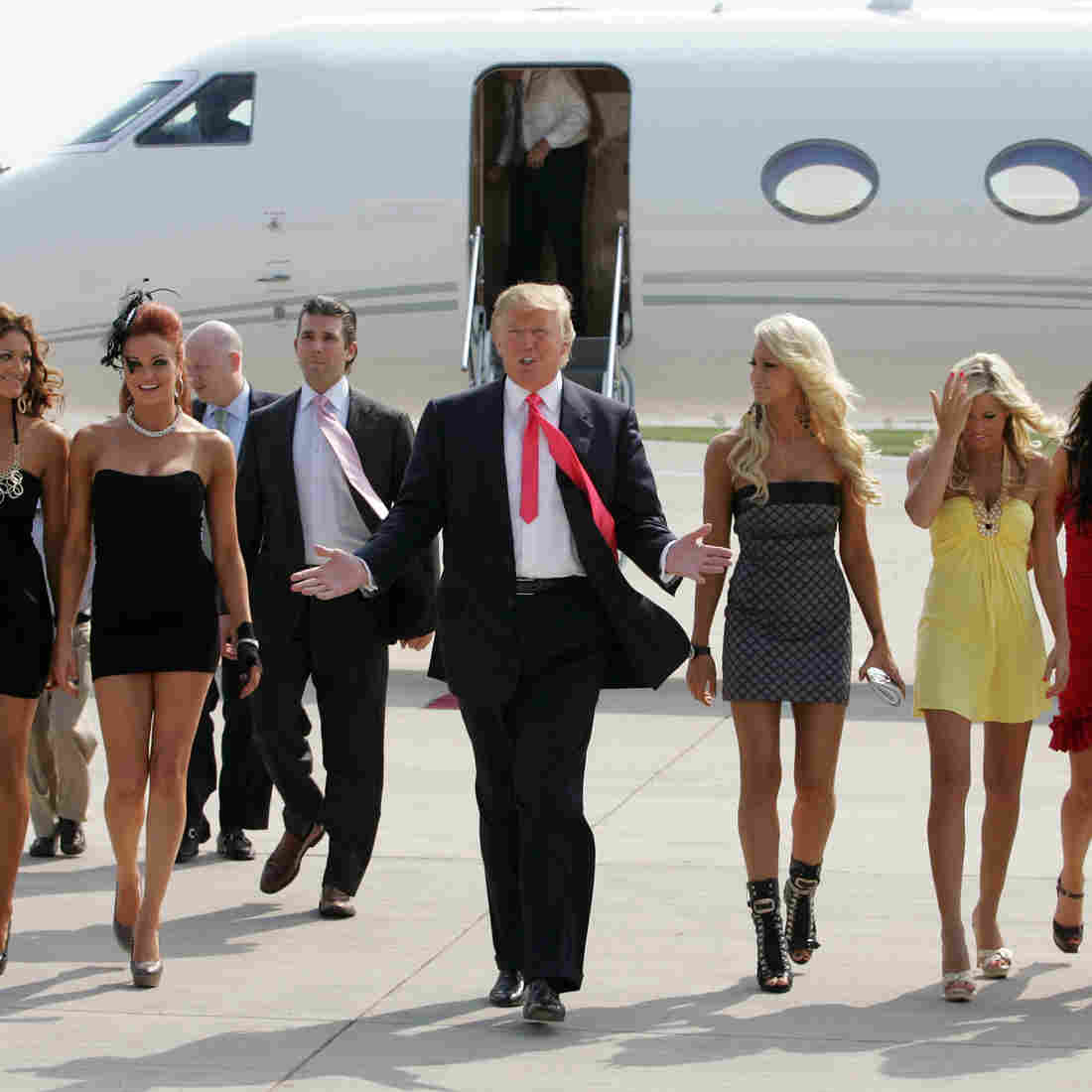
Donald Trump is a greedy rich racist sexist bigoted homophobic coward and boor. However, Donald Trump is not America.  Donald Trump is a reflection of the worst elements of humanity rolled into one human being.  I know many people who have elements of Donald Trump in their personalities.  I know racists. I know sexists. I know greedy rich and greedy poor people.  I know bigots and I know people who are homophobic.  I know many cowards who will not bother to stand up for their ideas or the rights of other people.  Donald Trump is unique in that he manages to roll all of the negative characteristics of humanity into one persona.

“The great secret of true success, of true happiness, is this: the man or woman who asks for no return, the perfectly unselfish person, is the most successful.” — Swami Vivekananda

crooked-hillaryDonald Trump is not America.  Donald Trump is a creation of a media empire that is out of control.  A media that trends sensationalism, exploitation, fear and paranoia to feed a 24/7 system of so called news reports.  A system of glitz, glamour, ads, sound bites, commercials, sex appeal and worthless trivia that has little or no educational or informational value.  It is a system that neither informs nor educates.  It is a system that thrives on the likes of Donald Trump.  It is a system that thrives on the exotic, the unusual, the strange, the bizarre, the kinky, the outlandish and the far out.  Donald Trump is all of these things but he is not America.
“If people in the media cannot decide whether they are in the business of reporting news or manufacturing propaganda, it is all the more important that the public understand that difference, and choose their news sources accordingly.” — Thomas Sowell

sex-imagesDonald Trump is not even a real Republican.  The party he claims as his own is one he and his small band (less than 9 percent of the total registered voters in the USA)* has managed to co-opt.  The Republicans that I have called friends over the years want nothing to do with him.  They are as appalled as the Democrats are at Donald Trumps rise to popularity in the media polls.  Americans however should not be surprised at this.  It is not the first time that a fraud, demagogue and charlatan has captured the media stage.  Looking back through US history, we can find similarities between Donald Trump and the likes of Aaron Burr, The Know Nothing Party, Huey Long, The Silver Shirts, and of course Joseph Mc McCarthy.   None of my Republican friends would avow affiliation with any of these characters.   They are not America and neither is Donald Trump.

“Find out for yourself what is truth, what is real. Discover that there are virtuous things and there are non-virtuous things. Once you have discovered for yourself give up the bad and embrace the good.”   — The Buddha

trump-and-putinEvery country in the world has its right and left-wing extremists.  It has been this way for hundreds of years.  Fortunately, in the USA, our political system usually kicks out the extremists and the middle ground or centrists have always trumped the left and right-wing fanatics.  Due to our political system, we have escaped such maniacs as General Franco, Benito Mussolini, Joseph Stalin and Adolf Hitler.  There are many drawbacks to our political system and chaos often seems to be a major characteristic of it.  There are many people who would discard such a system in favor of stability and security.  These people would buy such a political system at the cost of freedom and liberty.  In many nations throughout the world, citizens select benevolent dictators rather than trying to deal with the vagaries and uncertainties that are often characteristic of a US style democracy.
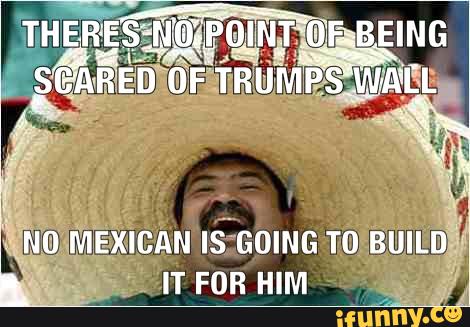
Donald Trump would have Americans believe that he will bring us stability and prosperity, but at what cost?  Donald Trump would build a huge wall to keep out immigrants.  Donald Trump would build Internment Camps for American Muslims.  Donald Trump would outlaw Gay marriage.  Donald Trump would create a police state to keep in check unruly minorities.  Donald Trump would insure that a woman’s place was back in the kitchen.

“In all things I have shown you that by working hard in this way we must help the weak and remember the words of the Lord Jesus, how he himself said, ‘It is more blessed to give than to receive.” — Acts 20:23

Donald Trump promises to make all Americans rich.  That is how he is buying the support of a small minority of foolish Americans.   Donald Trump says “I am rich.  I know how to run things. I can make you rich too.  Look at how much money I have.”  And people believe him:  “Donald Trump will Make America Great Again means Donald Trump will make us all rich like he is.”  Well, he will promise to make every American rich.  That is the benefit he is promising for anyone is willing to vote for him.  All it will cost America is the cost of one giant prison system.

trump-wallDonald Trump says that he will create the largest wall that the world has ever seen, but it won’t keep out immigrants.  It will only keep out ideas and innovation.  Donald Trump supporters include the misguided and fearful who believe that if we only had less poor people, less immigrants, less refugees, less minorities, less disabled people and less women in power that “America Would Be Great Again.”  This is a delusion held by those who dream of a bygone era when “Father knew best, Blacks knew their place and women stayed in the kitchen.”  The myth of “The Good Old Days” is almost impossible to kill in a population fed on media mediocrity and where real history is either not taught or understood.  Donald Trump will not bring back the “good old days” because the good old days where not really that good.  Donald Trump will not “Make America White Again.”

A man asked Muhammad what was the mark whereby he might know the reality of his faith. Muhammad said, “If thou derive pleasure from the good which thou hast performed and thou be grieved for the evil which thou hast committed, thou art a true believer.” The man said. “In what doth a fault really consist?” Muhammad said, “When action pricketh thy conscience, forsake it.” — Sayings of the Prophet

hate-speechWhat all of Trump’s bombastic speeches fail to note is that America is still great.  Unfortunately, the things that make America great are hidden behind the media pronouncements of Donald Trump and his ill-advised followers. The ceaseless stream of bad news, crime, bizarre and weird news that titillates so many also deprives us of being a well-informed populace.   In addition, our outlandish media system simply serves to hide the many great values that the USA stands for.

Most Americans and by this term I will include North America, Central America and South America, i.e., US Citizens, Mexican Citizens, Canadian Citizens and Citizens from Central and South America are decent law abiding compassionate and loving people.  The majority of the people I know or have met in Canada, the USA, Mexico, Central and South America will help their fellow human beings.  They are good Samaritans who will give some of what they have to provide for others in need.  They are not greedy or bigots or racists or sexists.  They are people like you and me who care for their neighbors, their country and their environment.  They are not Donald Trump supporters.

“Before someone will get the guts to monitor your life, he must get the keyboard of humility. To be a humble person, is a priority in leadership!” — Israelmore Ayivor

The media and its fascinations with the likes of Donald Trump obscure the good that abounds in our nations.  The media obscures the daily good deeds and charities that are done in the name of love and compassion for others.  People like Donald Trump are raised on soap boxes and the ceaseless barrage of hateful comments from him and his followers hides the voice of the majority.  Donald Trump and his followers are the minority.

“It’s easy to stand in the crowd but it takes courage to stand alone” — Mahatma Gandhi

trump-bankrupt-americaThe message of hatred and intolerance that spews daily from Trump is something that one could pity Trump for if it were not so dangerous and belligerent.  It is hard to feel sorry for the bully that is kicking other people when they are down.  Somewhere though, we know that such bullies are really cowards. Their intolerance and lack of compassion towards others is driven by fear and insecurity.  No matter how big and bad the bully seems, they are the biggest cowards in the playground.  It is time to put Donald Trump and his followers in their places.  There is no room in America for bigots, sexists and racists who are intolerant of and lack compassion for others. We need to keep America great by letting the world see the true values that guide our nations and not the distorted hate filled messages that the media loves to display.

“We shall listen, not lecture; learn, not threaten. We will enhance our safety by earning the respect of others and showing respect for them. In short, our foreign policy will rest on the traditional American values of restraint and empathy, not on military might.”   — Theodore C. Sorensen

We are a few weeks short of Election Day.  The Trump bandwagon has already exploded.  Hillary has been asked what she will do to unite the country.  Unfortunately, stupidity and greed and hate cannot be united with honesty, integrity and compassion.  We will be left with an underbelly of nearly 30 percent of American voters who have supported Trump.  For whatever reason, (it really does not matter) we have millions of Americans who will vote for a man who has no qualifications to be a humane being never mind President of the United States of America.  We will have to take the problem of his supporters very seriously or risk a rerun of this past election.  I think I am on firm ground when I say that four things must happen to change in America:

  1. We need to insure a pathway to success for all Americans by creating a system of lifelong learning and job training.
  2. We need to change our political system and start by establishing term limits. I would support a system of a single term of six years for all representatives, senators and the President.
  3. We need to break up the monopoly that a few media giants have on the news. We need more integrity in journalism and not a system that is built on sensationalism and exploitation.  The news should inform people and help people make better decisions.
  4. We need a better system for establishing the credentials of candidates for office. The system of debates that we watched the past year did little or nothing to help people decide who was the most qualified candidate and what their concrete policies were.

Time for Questions:

Will you help get out the word?  Will you promise to speak out against Trump and his lack of morality and values?  Will you be sure to register to vote this election?  Will you educate yourself on the candidates and vote on the basis of values and not fear?  Will you help the world to see that Donald Trump Is Not America?

Life is just beginning.

“Americans need to educate themselves, from elementary school onward, about what their country has done abroad.  And they need to play a more active role in ensuring that what the United States does abroad is not merely in keeping with a foreign policy elite’s sense of realpolitik but also with the American public’s own sense of American values.”  — Mohsin Hamid

10- 22-2016.  Breaking News!!!  Trump unveils his 100 day plan in final policy speech.

His 100 day plan: Put women back into the kitchen by repealing Roe Versus Wade. Eliminate income inequality by giving more money and tax breaks to the rich hoping some of it will “trickle” down. Build up a military that is already as large as the next ten largest militaries in the world COMBINED. Put more people in prison who are trying to get into this country for a better life. We already have the largest prison population in the world. Sue his accusers for having the temerity to call him on his sexual predation and assaults. Build a big big wall to employ millions of laid off American workers. Finally, REPEAL Obama Care and replace it with something Great. Any more NEW FUCKING IDEAS MORON?

The Supreme Court Has Murdered the Constitution  — BY RYAN COOPER   JULY 4, 2024

images

Constitutional fetish worship has been a feature of American politics from practically the moment it was enacted. This document, entirely by accident, serves as a core source of government legitimacy, despite the fact that it was hurriedly slapped together over a few months and never worked as intended, not even at the beginning.

It would be a good thing if we had less reverence for the Constitution, allowing us to go about perfecting it democratically, through a deliberative process of representatives of the people. Instead, we get the worst of all possible worlds: a culture of Constitution worship that resists change, yet also massive alterations to the founding document, entirely from unelected men and women in robes.

In short, if you want to change the Constitution, you get the Supreme Court to rewrite it for you. That only requires five justices to exercise the rule-by-decree powers they have arrogated to themselves, instead of the incredibly cumbersome amendment process requiring two-thirds of the Senate and House, and three-quarters of the states, which is impossible in our hyper-polarized times. As Thomas Jefferson once wrote, under judicial review, the Constitution “is a mere thing of wax in the hands of the judiciary, which they may twist and shape into any form they please.”

Now, one of the central arguments in favor of judicial review is that it is necessary to protect individual constitutional rights from being eroded by the legislature. So let’s look at both sides of the equation, read through the Constitution, and compile a non-exhaustive list of the ragged holes the Supreme Court has blasted in it, through action or inaction.

Article I, Section 1: “All legislative Powers herein granted shall be vested in a Congress of the United States…” The Court has gradually stolen this power from Congress over the years. The recent decisions Relentless v. Department of Commerce and Loper Bright Enterprises v. Raimondo, in which the Court seized control of the entire administrative state, are just the capstones.

Article I, Section 2: “The House of Representatives shall be composed of Members chosen every second Year by the People of the several States…” In Alexander v. South Carolina State Conference of the NAACP, the Court has signed off on egregious gerrymandering so “the People” in an increasing number of Republican states have little or nothing to do with who is elected to the House.

Article I, Section 3: The last paragraph in this section makes clear that the formal punishment for impeachment is only removal from office and prohibition from holding office again, but also that “the Party convicted shall nevertheless be liable and subject to Indictment, Trial, Judgment and Punishment, according to Law.” This language obviously takes for granted that presidents can be prosecuted for criminal acts, which the Roberts Court has recently forbidden (see below).

Article I, Section 4: “The Times, Places and Manner of holding Elections for Senators and Representatives, shall be prescribed in each State by the Legislature thereof; but the Congress may at any time by Law make or alter such Regulations…” Sorry Congress, no election regulations if John Roberts doesn’t like them. In Shelby County v. Holder, which removed most of the strictures preventing southern states from engaging in Jim Crow-era voter suppression, Roberts didn’t even bother to cite the Constitution. Afterwards, of course, southern Republicans immediately started disenfranchising minorities once more.

Article I, Section 7: This grants the House the famous power of the purse, stipulating that “All Bills for raising Revenue shall originate in the House of Representatives.” Except not anymore, at least if you’re President Donald Trump, in which case the Roberts Court will kindly let you steal $6 billion from the military to build random sections of border wall.

Article I, Section 8: This enumerates Congress’s powers that, once again, are now possessed by the judiciary. The legislature can make rules if and only if they don’t run afoul of the Court’s political views.

Article II: This entire article, which outlines the fairly modest explicit powers of the president, is dead, dead, dead. In Trump v. United States, Roberts has anointed the president as a king formally above the law, immune from prosecution for everything he does as president, and who can therefore imprison or murder his political opponents with impunity. Roberts may as well have dug up James Madison’s corpse and micturated directly into the eye sockets.

That said, it’s still worth emphasizing that the Court has also deleted both of the Constitution’s anti-bribery clauses for the president. Article I, Section 1 says the president “shall not receive within that Period any other Emolument from the United States, or any of them,” while Article II, Section 9 says that no one holding federal office can “accept of any present, Emolument, Office, or Title, of any kind whatever, from any King, Prince, or foreign State.”

In office, Trump funneled unknown but vast quantities of federal money, as well as that of foreign governments, into his own pockets through his various properties. The Roberts Court deliberately ran out the clock on a case invoking the Emoluments Clause on Trump and then dismissed it, making it clear that it’s fine and dandy for the president to loot the government, or take massive bribes from foreign powers.

Article III: It’s worth noting there is no explicit mention of judicial review in the Constitution anywhere.

Article IV, Section 4: This says the “United States shall guarantee to every State in this Union a Republican Form of Government,” but again, the Court has not only stood aside as Republicans set up flagrantly rigged, authoritarian state election systems, but also helped them out.

The total abolition of Article II is certainly the worst thing the Roberts Court has done by a wide margin.

On to the Bill of Rights! First Amendment protections for freedom of worship, speech, and the press are under an all-out assault from right-wing state legislatures. The “ten commandments” (not the actual ones, incidentally) are being set up on government property across several states. Bigoted restraints on the speech rights of teachers and professors have swept the country. Mississippi is persecuting reporters for uncovering flagrant welfare fraud on the part of the state Republican regime. The Court is doing nothing about any of this.

The Second Amendment is not so much dead so much as metastasized in the Roberts Court petri dish, cancer-like, into a sweeping grant of gun rights that every one of the founding fathers would have regarded with slack-jawed horror. It obviously does not protect, and was not intended to protect, an individual right to own as many fully automatic weapons as you like in preparation for your upcoming workplace massacre. But under the Roberts Court that’s what it has become.

The Fourth Amendment’s protection of unreasonable searches and seizures has been steadily eroded by the Court. Any savvy law enforcement officer can easily search your property or read your private communications.

The Fifth Amendment’s requirement that no one be deprived of “life, liberty, or property” without due process of law does not apply to growing categories of citizens. President Obama set up a drone assassination program that killed American citizens, while Trump sent a straight-up death squad to summarily execute the leftist Michael Reinoehl after he shot and killed a far-right activist during an altercation, and Trump repeatedly boasted about it. Again, the Court did nothing in either case.

The right guaranteed in the Sixth and Seventh Amendments to fair jury trials for accused criminals is a dead letter. More than 95 percent of criminal cases end in a plea bargain. The Eighth Amendment protection against cruel and unusual punishment is a dead letter too, especially if you happen to be homeless. Right-wing states can torture people to death with the Court’s blessing.

The Fourteenth Amendment is mostly toast. As to Section 1, states are abridging the “privileges and immunities” of citizens right and left, due process protections are increasingly abridged, and numerous groups, from transgender people to pregnant women and others, are suffering explicit legal discrimination without so much as a peep from the Court. Section 2, which requires that states which disenfranchise their citizens lose representation in the House, has never been enforced. The Roberts Court recently deleted Section 3, which forbids traitors and rebels from serving in the government, once again to protect Donald Trump from accountability.

The Fifteenth Amendment’s prohibition against disenfranchising people based on race is gone. Not only will the court happily allow GOP states to gerrymander their Black citizens into permanent electoral irrelevance, as noted above the Court also prohibits Congress from doing anything about it.

I could go on, but the point is made.

The total abolition of Article II is certainly the worst thing the Roberts Court has done by a wide margin. It is the worst Supreme Court decision since Plessy v. Ferguson or perhaps even Dred Scott v. Stanford. The intention, obviously, is to pave the way for a Trump dictatorship, like some Enabling Act passed before Hitler actually took power. But it’s in keeping with the thrust of Roberts’ jurisprudence since the moment he was confirmed.

It all calls to mind Alexander Hamilton’s famous argument in Federalist #78 that the judiciary “will always be the least dangerous to the political rights of the Constitution; because it will be least in a capacity to annoy or injure them,” in that it controls neither the military nor the budget. The “general liberty of the people can never be endangered from that quarter,” he concluded.

Standing hip-deep in the shreds of constitutional rights that John Roberts and his corrupt, illegitimate cronies have torn up, we can conclude that Hamilton was utterly, completely wrong. But he was right that the Court only has power insofar as Congress and the president agree they do. Perhaps it’s time to reconsider that state of affairs.

Ryan Cooper is the Prospect’s managing editor, and author of ‘How Are You Going to Pay for That?: Smart Answers to the Dumbest Question in Politics.’ He was previously a national correspondent for The Week.


Requiem for America:  Our Battle with Fate

fortune

I wrote this blog seven years ago about the time that Trump assumed the office of the President of the United States of America.  As I stumbled across it again, I could not help feeling that nothing has changed in this country.  Therefore I am posting this blog again in the futile hope that one voter might read it and change his or her mind.

January 21, 2017

Many of you have no doubt heard the tone poem by Carl Orff titled Carmina Burana.  One of the famous parts of this musical piece is taken from a poem called “O Fortuna.”  It is a Medieval Latin poem written early in the 13th century.  I started thinking about it today as Trump became the 45th President of the United States of America.  I have never much believed in fate, preferring to think that we are masters of our own destiny and fate be dammed.  But as the inexorable reality of the inauguration kept intruding on my existence, I was forced back to the conclusion that perhaps fortune does rule the world.  (To listen click here O Fortuna)

Like the moon you are changeable,
ever waxing and waning;
hateful life first oppresses and then soothes as fancy takes it;
poverty and power it melts them like ice.

I loathe this greedy narcissist.  I loathe his values.  I loathe his words.  He represents everything I hate in myself and in humanity.  We keep trying to destroy the racism and fear and prejudice that we are brought up with but fate impels us to confront a world that seems to thrive on such iniquities.  My relatives, my friends, my co-workers —- they voted for this reprobate and now exult in his coronation.  I stand impotently on the sidelines questioning (as many Jews in the Holocaust questioned) why God has deserted us.  Have we committed some grave sin worthy of the future that fate now seems to have assigned us?

Trying against
Fate – monstrous and empty,
you whirling wheel,
you are malevolent,
well-being is vain and always fades to nothing,
shadowed and veiled you plague me too;
now through the game I bring my bare back to your villainy.

My good intentions.  My desire to be tolerant and virtuous.  My goal to treat others with compassion and kindness all seem to melt in the face of a Fate that decries a monster who will now rule over us.  I hear the voices that say “give him a chance.”  I wonder what chance they want.  A chance to create more greed.  A chance to create more racism.  A chance to create more sexism.  Have we not enough bigotry in this country?  Have we not enough inhumanity towards others?  We created the Atom bomb.  We created the Hydrogen Bomb.  We created weapons of biological and chemical warfare that can destroy millions.  We take no heed whether they kill children or innocents.  We are now all guilty in our incessant warfare.  The only thing that counts is creating more efficient means of murdering people.

Fate is against me in health and virtue,
driven on and weighted down,
always enslaved.
So at this hour without delay pluck the vibrating strings;
since Fate strikes down the strong man,
everyone weep with me!

I wake up disbelieving that I live in this reality.  I joke that I am in Wonderland and whatever one believes is the reality that exists.  But I did not believe in this reality.  I have done everything that I thought I could to help make the world a better place.  I thought my friends and family and neighbors wanted the same world that I wanted.  It seems clear now that we did not share the same reality.

I curse the fate that has brought our nation to this point.  I curse the people that voted for this Frankenstein.  I curse the party that nominated this abomination.  Deep inside, I wonder what I did to contribute to this horror.  Does my own hate somehow create the fate that I seek to escape from?

Abraham, John, Robert and Martin all dead — killed by that coward called fate.  But let us not forget Jimmie Lee Jackson and Clyde Kennard and Juliette Hampton Morgan and James Reeb and Jonathan Myrick Daniels and Viola Gregg Liuzzo and Vernon Dahmer and Oneal Moore and George Lee and Harriet and Harry Moore.  They also were martyrs.  They also died fighting fate.

Do not believe that the good die young.  The good die pregnant with a dream for a better world.

Time for Questions:

So what is left?  Nihilism?  Apathy?  Hate?  Bitterness?  Resistance?  Fight?  Hope?  Will a dream for a better America arise from the ashes of despair?

Life is just beginning.

“I will permit no man to narrow and degrade my soul by making me hate him.”  —   Booker T. Washington

fortune

WHY?  Oh WHY? Oh WHY?

why-1780726_640

“WHY did this happen?” is a question that seeks reasons and meaning for an event.  Some answers to this question include:

“It happened because God/Allah/etc. willed it”

“It happened because that’s the way the stars aligned”

“There is no reason, it just happened”

WHY did Oswald kill Kennedy?  WHY did the shooter in Las Vegas kill 60 people?  WHY do people support someone like Trump?  WHY do we allow Israel to have nuclear weapons but not other nations in the Mideast?  WHY did a nice person like that ever marry a real jerk?  WHY did the chicken cross the road?  From the sublime, to the peculiar to the mundane to the trivial, we are obsessed with knowing WHY?  We must have a reason WHY.

The police call it motive.  If a crime happens today, someone will scourer Facebook, Twitter, Instagram, TicTok, and other social media to find out “WHY?”  WHY did they do it?  What was their motive?  WHY would a 47 year old married woman with three children who was a teacher have sex with a seventeen year old in the back seat of her husbands car?

When we don’t know WHY, we either begin a useless search for the reason or we brush it aside.  Your young child asks you WHY and you reply, “Because I told you to.”  Your employee asks you WHY and you respond, “Because I am the boss.”  You want to know WHY they laid you off or WHY you were fired, and you get a reply like “We had a reduction in force.”  You want to know “WHY” you were defriended on Facebook or WHY you did not get the job you applied for or WHY your good friend died so young or a million other WHYs.   No one stops to think, there is no sense in asking WHY?  In all probability, any WHYs you come up with will be suppositions, hypotheses, conjectures or out and out myths.

We are diseased with asking WHY.  We do not want to accept an arbitrary and capricious universe.  Even the great Einstein rejected Quantum Theory because it was built on the concept of indeterminacy.  Ironic, that so many people initially rejected Einstein’s theory of Relativity because it lacked absoluteness and determinacy.  Today, we still have a rebellion going on in morality in terms of whether or not there is any absolute morality or is all morality relative.  It is easy to posit a WHY if you have a solid concept of morality that you can refer to.  The favorite one among religious people is the concept of sinner.  A sinner is anyone who ruptures the boundaries of your own avowed religion.

So I run to the Lord

Please hide me, Lord

Don’t you see me prayin’?

Don’t you see me down here prayin’?

But the Lord said

Go to the Devil, the Lord said

Go to the Devil

He said go to the Devil  — Sinner Man by Nina Simone

I told a friend of mine the other day that I did not want to go to heaven.  “WHY,” he asked?  “Because.” I replied, “What if Adolph Hitler and Donald Trump are both there?”  I think the WHYs around such a situation would drive me to hell.

Another friend of mine is always good for theories on WHY people do things.  We discuss lots of problems in the world and he loves to seek out facts and evidence that might help to explain WHY.  He is driven to make sense of a nonsensical random capricious world that is frustrating.  Perhaps most frustrating is that just when we are beginning to realize that there are no answers to the WHYs of the world, suddenly an answer emerges or at least appears to.

The answer all depends on numbers.  A WHY can be found if enough people are willing to accept the explanation.  WHYs have a democratic aspect that has nothing to do with logic.  For instance, the question I raised above about WHY anyone would support Donald Trump has spawned a cottage industry of books purporting to provide WHYs to the Trump sycophancy.  From racism, to sexism, to caste, to identities, to religion, to abortion, to greed, to fear, to being rural, to the electoral college, there have been over fifty books dedicated to theories to describe WHY any rational human being would vote for Trump.

71K5t+FhguL._AC_UL640_QL65_

I asked ChatGPT “WHY would anyone vote for Donald Trump.”  Here is what she/he said:

ChatGPT:

“People vote for political candidates for a variety of reasons, and the decision to vote for Donald Trump in particular can be influenced by a range of factors.  Some voters are drawn to his positions on certain issues, such as immigration, trade, or foreign policy.  Others appreciate his outsider status and his perceived willingness to challenge the political establishment.  Additionally, some voters may feel a strong connection to his personality, viewing him as a strong leader who speaks his mind.”

“It’s also important to consider the broader political and cultural context in which elections take place.  Factors like party loyalty, economic conditions, perceptions of the opposing candidate, and regional or demographic influences can all play a role in why someone might choose to vote for a candidate like Donald Trump.”

I think this is a very good answer, but somehow it lacks a definitive characteristic.  I don’t want a hodgepodge of reasons WHY.  I want to know “THE WHY.”  All of the mitigating factors above are mere hypotheses.  If your neighbor has a Trump Flag flying outside his/her house or your cousin says that “I am going to vote for Trump no matter what he does”, the above reasons given by ChatGPT are not going to do much for you.  The problem with finding an answer to WHY is that it is like the Russian dolls.  One WHY is embedded in another WHY.  We want the bottom WHY but then the dolls become more like an onion.  You can peel the onion all day long and eventually there is nothing there.  If you are looking for a core seed or a core reason to explain all the other WHYs, you will soon be grasping nothing but air.  For instance:

“WHY did you vote for Donald Trump?”

“Because he is a Republican.”

“So, you voted for Trump because he is a Republican and you support the Republican party?”

“YES.”

“WHY do you support the Republican party?”

“I have always supported it.”

“WHY”?

“Well, my mother and father were both Republicans.”

“WHY”?

“I don’t know, they always were so I am too.”

“What if Trump decided to become a Democrat again, would you still vote for him?”

“Yes, I would.”

“So, it really has nothing to do with his party affiliation?”

“I guess not.” 

“Thank you for your cogent explanation.” 

Where oh where can I find the real reason WHY the world is so screwed up?  And what if it is not?  What does that mean for the universe?

29116_SB_text

“Excerpt from ‘Suzie Bitner Was Afraid of the Drain’ by Barbara Vance.”

PS:

WHY are poems so confusing?

Previous Older Entries Next Newer Entries