
Have you ever felt that you were not pretty enough, smart enough, coordinated enough, talented enough, handsome enough, strong enough or fast enough? If so, you were suffering from the “inadequacy paradigm.” A paradigm is a model or template for thought or behavior. Feeling inadequate is one of the major paradigms of American society. The marketplace wants you to feel inadequate because then they can sell you products and services that will make you feel “ADEQUATE.”
 There are beauty products, breast enhancements, hair implants, plastic surgery, expensive cars, perfume, jewelry, large homes, designer clothes, college degrees and many other products or services designed to help you feel less inadequate and more adequate. We all want to feel adequate which means we must somehow learn to escape or jettison our inadequacy paradigms. The marketplace strategy involves spending huge amounts of money on a regular basis to escape the “inadequacy paradigm.” This strategy is often a failure as money and products cannot provide for real happiness or address some of the cultural biases, prejudices, racism and bigotry that contribute to the “inadequacy paradigm.”
“A fascist is one whose lust for money or power is combined with such an intensity of intolerance toward those of other races, parties, classes, religions, cultures, regions or nations as to make him ruthless in his use of deceit or violence to attain his ends.” — Henry A. Wallace
When I was growing up in New York City during the fifties, many of the popular singers were Italian. There was Fabian, Frankie Avalon, Connie Francis, Dion, Dean Martin and many others. Most of the famous male singers had traditional Italian good looks being tall dark and handsome. My father (6’ 4” tall) fit this model but my mother was Irish. I (much to my chagrin) took after my mother. I was short (5’ 8”) light skinned, brown thin hair with very nondescript looks. No woman ever looked at me twice in high school. I did inherit a good brain and cannot attest which side it came from. Nevertheless, brainy nerdy intellectual guys had no more demand among the attractive high school girls in the fifties and sixties than they do now. Beauty would seem to always trump brains in our society.
Now there are many different aspects or subdivisions of the “inadequacy paradigm.” There is a division for Blacks, Latinos, women, disabled, intellectuals, old people and of course poor people. If you belong to any one or more of these categories there are special rules that will be directed to you to help you feel even more inadequate than average. (Racism and Xenophobia create their own paradigms of inadequacy which go well beyond Madison Avenue but are supplemented by Madison Avenue to a large degree). As a White male growing up in an Italian neighborhood, my complaints will not doubt seem trivial to individuals in these other “inadequacy categories.” Let’s look at each group and see if we can perhaps walk a mile in their shoes. What would it be like if you were in one of these other categories. Now, one caveat must be shared. If you are White and rich, you will probably be able to escape the most noticeable effects of the “inadequacy paradigm.” For rich White folks, money provides a means to ameliorate the more consequential effects of inadequacy. Money can’t buy you love but it can buy you many other things to make you feel better.
African Americans:
What is it like growing up Black in America in the 21st Century? Has years of Affirmative Action, Civil Rights and even a Black President mitigated the effects of the “inadequacy paradigm” for our African American citizens?
I decided to approach a Black man who was walking down my street. I started to walk towards him and I yelled out “Hey, I need to talk to you.” He immediately threw up his hands, laid on the ground and starting shouting “Hands up, don’t shoot.” I hollered out “I am not a cop.” He got to his feet and said “Sorry, just an instinctive reaction. How can I help you?” “Well, I said, I just wanted to ask you what it was like being “Black in America today?”
Brian Lipscomb, IT Professional and Web Programmer/Website Designer
“Once I got off a trolley in downtown Philadelphia and accidentally bumped into an older White woman. She immediately said “Here! Take my purse! Just don’t hurt me!” I was shocked. I couldn’t believe that she thought I was going to rob her. When walking down the street, if a White woman is walking in my direction, they often cross the street or clutch their purse more tightly as I approach. I guess I’m numb to it now, because I expect it. I think that’s the sad part. There is nothing post-racial about our society. Racism and prejudice have just become more subtle, more nuanced.”
Latinos:
Many Latino people in the USA have been residents since before the Pilgrims arrived. With the annexation of Mexican Territory after the Mexican American War and the subsequent Gadsden purchase, many former Mexican citizens elected to become American Citizens. The border between Mexico and the US was porous for many years with much travel back and forth.
Many Mexican Americans have families and friends still living in Mexico. There has always been a White bias towards Mexican Americans and others from south of the border but recently this bias seems to have escalated. Part of the reason for this lies in the drug wars but much of it is rooted in a xenophobia directed to Latinos who do not have traditional Northern European customs. Latinos have become an increasingly larger segment of the population in many Southwestern cities.
But what is it like being a Latino? We know that with the election of Donald Trump and his talk of building a border wall and deporting “Latino Rapists” that he has fanned the fears of xenophobia common among many Southwestern Whites. There is no doubt that numerous Latino people residing in the Southwest and other parts of the USA are now uncertain about their future as US citizens.
Brittany Escalera, College Student
“Being born in the United States, I am automatically a citizen. I am an American. But according to society, I’m “too” Mexican to be American. My complexion is too dark to be American. My dark hair and dark eyes are too Mexican to be American. I’m Mexican, therefore, I can’t be American…. Yet it’s not always just the language barrier that is a struggle, there are constantly stereotypes and racial slurs being put on us everyday. Being from the south, I had to work extra hard at breaking this. No not all Mexican’s are illegal. Sorry Trump, we are not all the criminals, drug dealers and rapists that you claim us to be.”
Women:
Of course, I cannot speak for being a Woman in America. But I do not have to be female to see that Women must also suffer from the “inadequacy paradigm.”
“As Sheryl Sandberg and Adam Grant pointed out in a recent New York Times op-ed, when male executives speak up, they receive 10% higher competence ratings; when female executives do the same, their ratings from their peers are 14% lower. Similarly, when male employees offer ideas, they receive higher performance evaluations; when women offer the same ideas, managers’ perceptions of their performance remain unchanged.” — What’s holding women back?
If the bias in the workplace is not bad enough to insult many women, the bias they face in the home is even worse. The rates of domestic abuse and rape in American society are shameful. But perhaps the worse indicator of the “inferiority paradigm” for women lies in the number of women who think they deserve such treatment.
“The cultural acceptance of spousal abuse can be so pervasive that in some countries, large majorities of women say it’s acceptable. In Rwanda, 96 percent of women say the practice can be justified, according to the World Values Survey. About two-thirds of women in India and South Africa feel the same way. The attitude is also held by large shares of women in countries across the religious and cultural spectra — China, Egypt, Iraq, Nigeria, Peru, the Philippines and Uzbekistan, to cite a few.
Even in countries where the vast majority of women don’t approve of spousal abuse, the share that do find it potentially acceptable isn’t exactly tiny. It’s about 1 in 10 in the U.S. and about 1 in 5 in Germany.” — Alarming Number Of Women Think Spousal Abuse Is Sometimes OK — NURITH AIZENMAN
Many women are now worried in the USA due to the election of a President who openly bragged about his right to grab a women’s “pussy” because he was rich and privileged. Many of his supporters were men and women who belong to fundamentalist religions that believe women have no place in politics or in the business world and that their only role is to bear children for men. Thus, after years of battling to achieve equality with men, women now face the prospect of losing many of the hard-earned rights that they fought for and won.
Disabled:
One of my best friends committed suicide about a year ago. He was a Cerebral Palsy victim who had dedicated his life to helping fight for more rights for disabled people. He walked crablike and had to use walking sticks to keep his balance. His head was always cocked at an odd angle due to his disability. He was two years younger than I was and died at the age of 67. Brian took his own life because he could fast see a time approaching when he would no longer be able to live on his own. Brian was a fiercely independent man who struggled to obtain dignity in a society that does not always respect people who are disabled.
I first saw Brian when he would come into the town bakery to buy donuts or for lunch. I was usually sitting with a bunch of locals who knew Brian and several had gone to school with Brian. I was uncomfortable with the way they seemed to greet Brian and their response towards him. It became disagreeable enough to me that I stopped my morning coffee sessions with this group. Instead, I found a group of people at the library who met for coffee each day. Brian was among the group at the library and we became good friends.
Brian told me many stories of how he was treated as though he was mentally disabled rather than physically disabled. On several occasions that we went out together, it was clear that people wanted to avoid dealing with Brian. For Brian, it must have felt like being a leper. I am sure that much of the bias towards Brian was not intentionally hateful. Nevertheless, it still was difficult for Brian to deal with. Brian wanted to be treated as a normal person and not someone with a disability. His strong desire to be normal ultimately led to his ending his life.
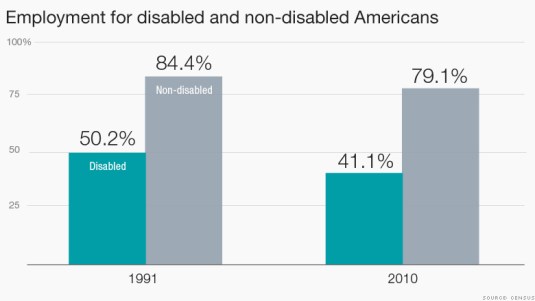
The following chart shows the changes in employment for disabled people in the USA since 1991. Notice the “progress” is backwards.
Intellectuals:
 If you have not read Hofstadter’s “Anti-Intellectualism in America Life” I heartily recommend it. I have often joked that the worst discrimination in America seems to be saved for people who think. Many companies trumpet their desire for “out of the box” thinkers. This is usually nothing more than a well parroted display of self-deception. What Human Resources and the company are really looking for is “people who fit in.” People who are iconoclasts, people who are critical thinkers, people who rock the boat “need not apply here.”
Intellectuals include nerds, free thinkers, geeks and anyone who works with ideas as opposed to building things or throwing things. Academics are often lumped in with this category since most people assume an academic to be a brilliant thinker. This is very often a misplaced assumption. People in the arts including music and theater are often very intellectual but they somehow manage to escape the opprobrium reserved for pure thinkers.
If you think I am exaggerating on the bias that is reserved for intellectuals, you should turn on any right wing talk show like Rush Limbaugh or Sean Hannity and listen to them for a while. It won’t be long before they are attacking commie pinko faggot intellectuals for all the problems in America.
“There is a great superficiality in today’s evangelical world. Many Bible-believing Christians share the contemporary case for self-gratification, emotionalism, and anti-intellectualism. Many people who believe in the Bible have never read it.” — Gene Edward Veith Jr.
I must mention one of the dumbest stupid-ass TV shows I have ever seen. It is the epitome of anti-intellectualism in America today. It is called the “Big Bang Theory.” It is supposedly about genius and of course the geniuses in this show have Ph.D.’s but absolutely no common sense or interpersonal skills. They are also geeky with no athletic skills and about zero muscle mass on their puny frames. This show portrays how much of America views intellectuals.
“Our big mistake in modern intellectualism is first and foremost its lack of nuance. We have made science synonymous with atheism – a presupposed conception and yet, another means to non-sequiturs – and therefore, to a number of enthusiasts determined to go the further, anti-theism. Hereby let us observe that science has long served best and should be, if none other, the one discipline, if at all possible, free of potential ideology, religious or anti-religious, and/or biased presupposition in order to maintain the authenticity and the reliability of its nature.” —– Criss Jami
Elderly:
Every so often, my wife and I like to go to a Pow Wow. I remember one of the first we went to and they had a free dinner for all attendees. As we stood in line waiting our turn to get up to the food table, a young man came up and said “Oh Elders go to the front of the line.” I said “I am not a Native American.” He said “It did not matter” and escorted my wife and I to the front of the line with the other Elders. Other Pow Wows that I have attended have had a special line for Elders. I was pretty much blown away by this deference. It was totally unexpected but greatly appreciated.
Many venues and shops have discounts for seniors or “Senior Days” where food is cheaper or there are discounts for those over fifty-five or sixty. I am not impressed by these as you and I know it has nothing to do with “respect” for the elderly. It has more to do with getting more of our money. Respect for the elderly seems to be dwindling the older I get.
Both my wife and I have noticed that increasingly when we go to a clinic anymore with a health problem such as a sore hip or sore shoulder, we often get responses like “Oh, it is just part of getting old, you will just have to live with it.” Instead of investigating to see if some our problem might be amenable to treatment, we are simply told to more of less “suck it up.”
“There is also a lack of recognition of the positive contributions that elderly people make to society. The amount of unpaid childcare provided runs into the tens of billions. Without this form of labor, fewer parents could work and gain fulfillment in their jobs. Indeed, as some local authorities have recognized the 60 plus generation offer a huge reservoir of untapped energy for the voluntary sector.” — Why do we treat elderly people so badly? — By Paul Donovan
Poor:
The “poor” otherwise known as lazy, drug addicts, stupid, trailer trash, welfare bums, welfare cheats, handout recipients, bag people, curb people and homeless. The poor in America are thought by many to be poor by choice and not by chance. This makes it much easier to denigrate them and to blame them for their poverty. When someone picks their lifestyle, it is much harder to be sympathetic for the choices they have made.
In 1978, I had finished my Master’s Degree in Counseling and I took a position as a Manpower Counselor II with the State of Wisconsin in the Department of Industry Labor and Human Relations or DILHR as it was known then. My job entailed working with the WIN or Work Incentive Program to help families who were receiving welfare (AFDC or Aid to Families with Dependent Children) find gainful employment so they could get off Welfare. I also worked with the Indochinese Refugee Assistance Program (IHRAP) and the Labor Education and Advancement Program (LEAP) to help mainly Southeast Asian refugees in the IHRAP program and women and minorities in the LEAP program find jobs. I worked with several other job training programs as well. The bottom line of all my programs and effort was to help people find employment by which they would become self-sufficient.
Now there are two interesting points I want to make gleaned from my two years working in these programs with mostly poor and under-privileged people.
- None of the programs really went far enough in their benefits or stipends or financial assistance to really help as much as was needed by my clients.
I am not going to say that many benefits were not helpful. We could offer financial incentives to employers, daycare benefits, transportation help and even some educational benefits. These were in addition to the monthly welfare checks that many families were receiving. Nevertheless, the key to getting off welfare was to provide enough education to help the client to break out of the cycle of poverty. Only education would help those who wanted to climb the proverbial “ladder of opportunity.” Unfortunately, the ladders that were being provided never seemed to have enough rungs in them. Whether through stupidity, frugality or simply underestimating what was needed, many people could not get enough help to break out of poverty.
- Ninety Percent of my clients wanted to get off Welfare.
There is a pernicious and vicious myth that most people on Welfare like it and want to stay on it. Nothing, could be further from the truth. I worked with hundreds of Welfare clients and the clear majority (90 percent or better) wanted to find a good job and become self-sufficient.
Yes, I encountered some Welfare cheats and some Welfare dependent people who had little or no incentive to gain employment and lose their Welfare checks. However, these were a small minority of the clients that I saw in my two years working with the WIN program. Even these individuals often had severe handicaps either physically or mentally which would have made holding gainful employment near impossible. The average person does not realize how many barriers and hardships face some of the poor in this country.
“Saving our planet, lifting people out of poverty, advancing economic growth… these are one and the same fight. We must connect the dots between climate change, water scarcity, energy shortages, global health, food security and women’s empowerment. Solutions to one problem must be solutions for all. — Ban Ki-moon
Conclusions:
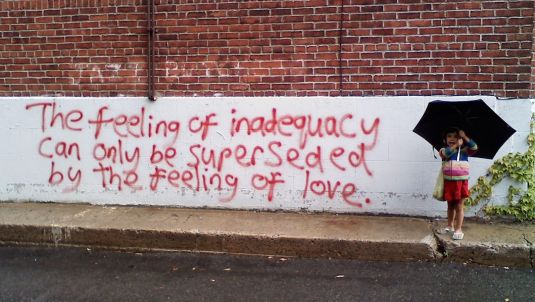 We have a pervasive problem that I labeled the “Inadequacy Paradigm.” Much of it is caused by racism, xenophobia, prejudice, stereotypes and bigotry. The majority of it is systemic and will need major changes in policies and institutions in this country to eliminate. However, it is felt on a very personal level. Feelings of inadequacy may be conveyed by others and cultural mores but they are received by an individual who assimilates these feelings into their psyche. Thus, inadequacy becomes a personal problem and not simply a social problem. Inadequacy is not “out there” it is right inside. The vast numbers of suicides in our society are testament to the inadequacy that many of our fellow citizens feel. This includes Whites as well as minorities.
- Suicide is the tenth leading cause of death in the USA
- 44,000 people die every year by suicide (2015)
- White males accounted for 7 of 10 suicides in 2015.
What can we do to overcome these problems? Clearly education and social support systems must be developed and deployed. If we see the problem of inadequacy as something that is “not my problem” nothing will be done. We have people who refuse to spend one dime of their taxes to help others because of selfishness and greed. We have many who want to label America as a Christian nation, but they do not practice Christianity.
Any church that does not practice tolerance for the oppressed, charity for the poor and compassion for the needy, regardless of what religion they belong to, should not call themselves a Christian church. They should call themselves a HATE church. Hate leads to prejudice and bigotry and these are the primary factors in the Inadequacy Paradigm. Destroy prejudice and bigotry and we will create a society with many more well-adjusted people.
Time for Questions:
What makes you feel inadequate? Why? What do you do about it? How do you think you could help others who feel inadequate?
Life is just beginning.
“I have had to experience so much stupidity, so many vices, so much error, so much nausea, disillusionment and sorrow, just in order to become a child again and begin anew. I had to experience despair, I had to sink to the greatest mental depths, to thoughts of suicide, in order to experience grace.” — Hermann Hesse

 Once upon a time, there was a group of creatures called humans. They evolve and live out their lives on a place they call Earth. Earth is basically a spheroidal rock that revolves around a Class 3 star (called a sun) in a galaxy named the Milky Way. No humans know where they came from, how they developed or why. This is a subject of endless debate and speculation that has led to a plethora of social organizations which humans call religions.


 ure Report.


