3525 – Friday, September 6, 2019 — Those Were the Days My Friend!

maxresdefault

My blog this week is based on a song that was made popular by Mary Hopkin’s in 1968.  The original writer was Gene Raskin.   Gene added English lyrics to a Russian song called “By the long road” which was composed by Boris Fomin (1900–1948).  The song in its many manifestations had continued to be about reminiscence and youthful idealism.  In my version below, I have taken some liberties with the lyrics and have added my thoughts on age and youthful idealism.   If you care to listen to the Hopkin’s song while reading my blog, click on the following link and then return to my site. 

https://www.youtube.com/watch?v=QptZ8tYZAkE

Once upon a time we shared a dream
When we believed that we were special
And we laughed away our evenings
Thinking of the success that would bring us great esteem

I grew up loving science and mathematics.  In the late fifties and early sixties, the space age was just beginning.  I wanted to be a part of the new wave of exploration and I dreamed of becoming an astronaut.  I read books on physics and relativity and quantum theory.  I believed that knowledge was the key to achieving my dreams.  Somehow, I never thought that my desires were above my head or possibilities.

Those were the days my friend
We thought they’d never end
We’d dream and dream forever and a day
We’d live the life we choose
We’d fight and never lose
For we were young and sure to have our way

When I finished high school. I knew what Harvard and Brown and Yale stood for.  If you had money or were the siblings of any alumnus, you could apply to one of them.  If your father was a postal worker and your mother a part-time clerk at Woolworth, you had neither pull nor money.  The money probably mattering only slightly more than the connections or pull one needed to get into an Ivy League school in the sixties.  Truth be told, I did not even have the money or grades to get into a state college.  Without a college education, my dreams of becoming a pilot or an astronaut were shear fantasy.

A few weeks after high school, the only real possibility I had for a future was in the United States Military.  The war in Vietnam was starting to ramp up when I graduated in 1964 and it was said that the service would take a warm body.  I applied and did very well on the military exams.  I decided that I liked the Air Force uniform better than the Navy, Army or Marine uniforms.  Up and away on my first airplane ride to Lackland AFB for basic training.

Then the busy years went rushing by me
I lost my starry notions on the way
If by chance I’d see you in the city
We’d smile at one another and we’d say

Those were the days my friend
We thought they’d never end
We’d dream and dream forever and a day
We’d live the life we choose
We’d fight and never lose
For we were young and sure to have our way

I married while still in the service.  I was only 21 and my wife Julie was only 20.  Julie was several months pregnant when we married.  Somewhere along the way she became very sick and was diagnosed with Systemic Lupus Erythematosus.  She spent several months in the University of Minnesota hospital while pregnant with our first-born child Christina.  Christy arrived while Julie was still in the hospital and in 1968 I was ordered by a young nurse to help out in the delivery room.  Thus, I was on the forefront of the new age for fathers and husbands.  Something, I was reluctant at the time to join.

Those were the days my friend
We thought they’d never end
We’d dream and dream forever and a day
We’d live the life we choose
We’d fight and never lose
For we were young and sure to have our way

The years have flown by since then.  Many friends have either passed away or orbited out of my universe.  My first marriage ended in divorce.  My daughter has not spoken to me for nearly twenty years now.  My dreams of business success have become so much flotsam in a sea of failed possibilities.  Always told how smart I was, my intelligence never seemed to add up to anything that I could put in the bank.  Dreams of greatness in some non-financial endeavor (which became my fallback position) are now floating away alongside of my business aspirations.

Just tonight I stood before my mirror
Nothing seemed the way it used to be
In the glass I saw a strange reflection
Was that broken person really me

I am now fighting the battle of growing old.  Energy forfeiting time to naps.  Days spent in a doctor’s office.  Buying sympathy cards by the dozen.  Learning to be a caregiver.  Dealing with an ever-increasing number of aches and pains.  Muscles that do not respond or recover as quickly.  Friends that spend what seem like long hours describing medical conditions and treatments.  Loved ones that I worry about more and more.  Trying to figure out what is appropriate for the next funeral.  Wondering if there is something else besides “My condolences” that I can say.

Through the parlor door there came familiar laughter
I saw your face and heard you call my name
Oh my friend I am a great deal older but no wiser
For in my heart, the dreams are still the same

My dreams, I never gave up on you.  I substituted hard work and determination for luck and chance many years ago, but they did not prove a path to you.  You might think me shallow or that I abandoned you, but nothing could be farther from the truth.  Hardly a day goes by when I don’t think about giving you one more shot.  I ask myself if ten years is enough, for that is about what I have left.  My self-bribe is that it is never too late as long as I do not give up hope.  But is my heart really in it?  Do I want you bad enough to keep on fighting for you?  I somehow sense a certain futility, like taking another turn at bat is not going to get me a home run.  Hard to admit, but maybe I never was and never will be a home run hitter.  Is this a battle that I am going to lose in this life?

Those were the days my friend
We thought they’d never end
We’d dream forever and a day
We’d live the life we choose
We’d fight and never lose
For we were young and sure to have our way

Those were the days, oh yes those were the days!


3528 – Tuesday, September 3, 2019 — Love versus Hate:  Does Hate Trump Love?

love versus hate

God calls us to love others, just as he loves us.  We show love to others by forgiving, accepting and honoring them.  —  From a quote in a Lutheran Church Brochure

Pick up a newspaper any day of the week.  How much love do you see?  Very little I would bet.  How much hate?  Pages and pages of hate.

  • Man kills seven and injures 31 with assault rifle.
  • Woman with five DUI’s kills mother and daughter in auto crash.
  • Israeli bomb attack kills fifteen jihadists.
  • Terrorist bomb kills 35 soldiers in Iraq.
  • Trump encourages beating up protesters.

I propose that you will find at least ten times more hate in the news than you do love.  But that is not news to you or anyone else, is it?  Newspapers exist to sell advertising, and nothing sells like hate, violence, gore, mayhem and disasters.  The crème de la crème is reserved for serial killings, mass killings and family murders.  Local news is full of crime stories from places that are thousands of miles away and that no one has ever heard of.  Bad news and hate crowd out the good and love that society has.  In a way it is ironic, since so many people in the world regard themselves as Christians.  Christianity professes to follow the teachings of a man named Jesus Christ.

Jesus Christ (for those of you who might be unfamiliar with him) was a big advocate of love and peace.  Jesus told his followers “A new command I give you: Love one another.  As I have loved you, so you must love one another.”  — John 13:34.  Jesus is also reputed to have said “Love your enemies and pray for those who persecute you.”  — Mathew 5:44.  Another irony, considering that numerous Christian churches have supported racism and hatred towards Blacks and other minorities.

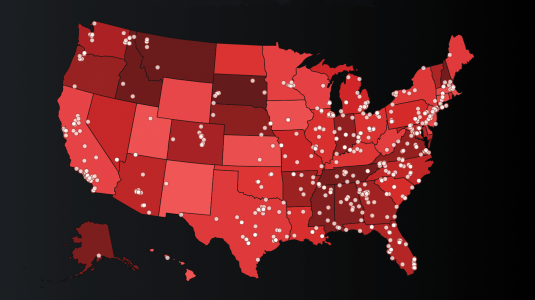
One would think that particularly in those parts of the United States dominated by Christian churches, love would blossom like a million flowers.  You would expect that in the so called “Bible Belt” you would see evidence of love and not hate everywhere you look.  If any place was against prejudice, discrimination, bigotry and ill will towards their fellow human beings, it should be in the Bible Belt.  Another irony, since according to the Southern Poverty Law Center, the South has more hate groups than any other area of the United States.  Even more confusing, are the Christian ministers who preach hate and use Christs name to justify it.  This is a recent map of hate groups in the USA.

ir166-hate-map-launch

A few Sundays ago, Pastor Joe Major of Louisiana’s Faith Baptist Church gave a guest sermon at the Philippines church of Pastor Logan Robertson.  You’ll never guess what Major talked about.  In a sermon titled “Make the World Straight Again,” Major told the raucous crowd about how all homosexuals were inherently pedophiles and that’s why they deserved to be executed.  Several years past, the Rev. Steven Anderson quoted passages from the Old Testament to the congregation of his Faithful Word Baptist Church about the kinds of people God hates in Tempe Arizona.  Anderson told worshipers he interprets these passages to include Mr. Obama and that he prays for the president’s death.  Is it ironic that Anderson believes he is a Christian and promotes hate in the name of Jesus?

But enough looking at hate, what about love?  Can we find examples of love in the world?  Do we even know what love really is?  We all know the quote about “love is kind, love is patient, etc.”  But what is the difference between love and compassion or between love and mercy or between love and charity?  What about the role of forgiveness?  Can we have love without forgiveness?  Should we forgive everyone?

“If you do away with the yoke of oppression,

with the pointing finger and malicious talk,

and if you spend yourselves in behalf of the hungry

and satisfy the needs of the oppressed,

then your light will rise in the darkness,

and your night will become like the noonday.  —

Isaiah, 58:9-10

Love can not exist in the dark.  Hate brings the dark.  Love is extinguished by hate. In order to have love, you must eliminate hate.  The two cannot go together.  Love opens the door.  Hate closes the door.  Love leads to mercy.  Hate leads to revenge.  Love leads to compassion.  Hate leads to scorn.  Love leads to forgiveness.  Hate leads to vendettas.  Love leads to charity.  Hate leads to greed.   If you want to bring love into the world, you must work to eliminate hate.  Love cannot blossom in a soil that is contaminated with the poison of hate.

I think we are love deprived today.  I mean real love.  Not love of things.  I love my car.  I love my new watch.  I love my blender.  This is not love.  This is idolatry.  It is a Madison avenue con that has been foisted on us to buy stuff and more stuff.  No where in the world do people own more stuff than in America.  Rich or poor in this country, we all have the disease of stuff.  We buy and sell and buy more stuff.  A t-shirt exhorts us to “shop till we drop.”  The midnight madness sales during the Holiday seasons are an ironic example of what it means to be really crazy.  Ironic, because when things matter more than people, we have a world that is truly mad and insane.  We have a world without love.

“Darkness cannot drive out darkness; only light can do that.  Hate cannot drive out hate; only love can do that.” — Martin Luther King


3535– Tuesday, August 27, 2019 — Four Young Boys Growing Up in America, Part 2

images

Twenty years have gone by since we have left our four young men.  They have now each reached their 32nd year of life.  Not one of them will see their 33rd year of life. 

Whitaker had achieved everything his parents had wanted him to.  He had gone to college, taken over the family business, got married to a beautiful young debutante and now had two young children.  The oldest, a girl, was nine years old and a boy seven years old.  Whitaker loved his wife and children very much.  Like his parents, Whitaker joined the prestigious country club and was head of the planning committee for events.  

The investment business was going very well, and his many clients were always pleased with the way that that their accounts were growing.  Whitaker seemed to have a magic touch.  Everything that was bronze or copper, he could turn into silver or gold.  His family life was also picture perfect.  Two very well-mannered children and a stay at home wife who alternated time between home and working on various local committees to help the less fortunate in the community.   

It was a beautiful Saturday morning in May.  Apple blossoms were blooming, his wife was planning a dinner that evening with some club friends and his kids had their usual Saturday morning league sports.  Whitaker had breakfast with his family and kissed each of them goodbye.  He took his golf bag and left for the country club.  There was some business to attend to with the planning committee he told everyone and if he had enough time, he might get in a round of golf. 

manual safety

Whitaker arrived at the club around 9 AM.  He greeted some friends upon arrival and then went up to an office that he kept in a private room at the club.  He entered the office and locked the door.  He walked over to his desk and sat down.  From a locked drawer in his desk, he removed a Ruger 9 mm automatic pistol.  He looked at it for a minute as though undecided but finally he flicked the safety off.   Whitaker put the gun to his head and pulled the trigger.  He died instantly.  Club members hearing the loud report rushed up to the room.  They had to batter the door down and when they entered, they found Whitaker slumped over his desk and quite dead. 

Jamal was heading to the country club about the time that Whitaker decided to depart this life.  Jamal had gone to college and obtained a law degree.  He had married the woman of his dreams and now had a set of five-year-old twin girls.  Jamal was a brilliant orator and could remember facts and figures that would astonish his listeners.  His law firm had prospered, and he now had two partners and more clients than even they could handle. 

Jamal had moved from the inner city to a well-manicured upscale home in the elite section of town.  He had a swimming pool, jacuzzi, a three-car garage and two large stone fireplaces.  Although never much of an athlete, he had taken up golf and joined the most prestigious country club in the city. 

This Saturday morning, he had packed his bags in an old beater car that he kept, kissed his wife and kids goodbye and headed off for a round of golf at the country club.  Despite having a Porsche, he always felt more comfortable in the old beater.  He told himself that driving it would keep him humble and help him to remember where he had come from.  He did not want to have his newfound wealth and status go to his head. 

As he headed to the country club through the expensive homes and gardens that dominated this area of town, he soon noticed a police car following closely behind him.  Then, the lights started swirling and the sirens started blaring.  “Pull over” a voice from the police car demanded.   Jamal pulled to the curb as did the police car.  A uniformed officer came over to Jamal and asked him what he was doing in this area.  Jamal still unperturbed, replied that he was going to play golf at the country club. 

The officer had received word of a shooting at the club and seeing a black man in an old car driving through this area had raised his suspicions.  “Step out of the car please,” he asked.  This was a little too much now for Jamal.  “Sir, I am a lawyer and I belong to the local country club.  What do I need to step out for?”  “Because I told you to sir,” replied the officer. 

Jamal had not been treated this way in a long time.  He was now feeling pretty angry, not to mention the potential embarrassment at being put up against his car within one mile of his country club.   Jamal spoke “I am not getting out of this car.”  The officer now quite irritated, unbuckled and drew his 10 mm Glock.  “Get out of the car, right now,” the officer demanded.

glock

Jamal swung the car door open, stepped out and started to walk away.  The officer shouted “Stop, Stop, Stop.”  Jamal either not hearing or not caring continued on walking down the street.   Suddenly, three loud blasts echoed throughout the neighborhood as the officer pulled the trigger of his pistol three times.  Each shot hit Jamal squarely in the back.  The first shot was enough though since it went through Jamal’s scapula, then his heart and lodged against a rib.  The next two shots were superfluous as Jamal was already dead when he hit the ground.  

Robert was fed up with life.  Nothing had gone right for him.  He had flunked out of high school and then got kicked out of the Army because of some asshole with more stripes than he had.  He had got married and had three children.  He came home early one day from a construction job and found his wife in bed with his best friend.  She took the kids and left.  Truth be told, he did not really give a dam.  His wife was an asshole, his best friend was a jerk and his kids were a pain in the butt. 

Things were looking up though.  It was Saturday.  The weather was fine, and he had the day off from his new job at the nearby cement plant.  The outdoor rifle range had opened.  Robert had bought a new rifle and was excited about taking it to the range and trying it out.  It was a Kel-Tec RDB 5.56 Bullpup.  Robert had purchased an optional fifty round magazine and one thousand rounds of ammunition.  He thought it would be more than enough ammo for a fun morning at the firing range. 

Robert arrived at the range and found that all twenty-four firing lanes were already occupied.  He looked around for the Range Master to see if he might have any idea when a lane would be opened.  It was a new Range Master, whom Robert did not know.  He was surly and brusque and replied that he did not have the slightest idea when a firing lane would open.  His manner really pissed Robert off.  Robert told him “I have been a member of this range for ten years; you should be more respectful to members.”  The Range Master laughed and told Robert that as far as he was concerned, he could take his business elsewhere. 

Something snapped at that moment in Robert.  Everywhere he turned, people treated him with disrespect and like he was dirt.  This was the final straw.  He would show the world that he was somebody and that no one could push him around.  Robert packed up his rifle and ammo and left.  He had made a decision that would change his life forever.

bullpup

Robert drove to the large indoor shopping mall just a few miles from where he lived.  He knew it would be packed on a Saturday morning.  He arrived and parked in a handicapped parking lot.  “Fuck, them too” he thought as he walked away and left the keys in the car.  He entered the mall through a side door and proceeded to take an escalator to the top floor.  Upon getting up to the second level, he took the gun off of his shoulder and surveyed the tableau in front of him.  Lots of kids with their moms.  Mothers pushing strollers.  Fathers walking holding their young children.  Teenagers hanging out with their friends and their ever-present cell phones.  “Fuck them all,” reflected Robert as he aimed his rifle at a nearby couple on the first floor and started pulling the trigger.

As soon as the first shots rang out, pandemonium reined.  Parents screamed and kids were running everywhere.  Robert kept aiming and firing, rather heedless of whom he was firing at.  Fortunately, security guards were close to where Robert sat and seeing him, they quickly opened fire.  Robert had already killed six people and wounded at least twenty-five others.  He knew his time was up, but he reflected, he would go out on his own terms.  He put the Bullpup under his chin and pulled the trigger.  The rifle blew the top of his skull off and Robert died instantly. 

Jack woke up this beautiful Saturday morning thinking how wonderful life was.  He had a great wife and a young five-year-old son.  His career since finishing college had gone very well.  He worked for a successful computer firm and had recently been promoted to a district manager position.  He lived in a nice house in a modest suburban neighborhood, not far from where he had grown up. 

He was making a list of chores to do this Saturday when his wife asked him if he could run a few errands for her.  She had the job of doing the Sunday fellowship snacks for their local church and was going to be busy doing some baking this day.  Would Jack get some more sugar and eggs at the local grocery store?  “Sure” Jack said.  He started to get his keys when his young son began to shout “Daddy, daddy, can I go with you.”  “Of course,” replied Jack. “Get your coat and let’s go.”

They climbed in the car and drove to the supermarket where Jack quickly found the sugar and eggs and some other food items.  Upon heading back to the car, Jack told his son: “Lets go to the mall and we will find a nice birthday gift for your mom since her birthday is next week.  You can help me to pick it out.”  His young son thought that was a fun idea and both dad and son headed for the nearby mall.

Upon arriving at the mall, they walked down a large open aisle looking in store windows along the way.  Jack requested his son to keep his eyes open for something that he thought his mom would like.   A loud sound like thunder broke the thoughts going through Jacks’ head.  Jack quickly realized that the echoing sounds were the sounds of gunfire.  He pushed his young son down on the floor and threw his body over his son. 

556

That was the last effort that Jack ever took in this life.  A 5.56 caliber bullet entered Jack’s front chest and penetrated his heart.  His young son felt the life go out of his father and started crying.  When the medics arrived, Jack had been dead for ten minutes. 

  • More than 38,000 men, women, and children are killed with guns each year in the United States.
  • Over 85,000 people are injured every year.
  • More than half of all gun deaths are suicides.
  • Among high-income countries, the United States accounts for 80 percent of all gun deaths in the world, 86 percent of all women killed by guns, and 87 percent of all children younger than 14 who are killed by guns.

  Giffords-Stats-Page-Breakdown


3539– Friday, August 23, 2019 — Four Young Boys Growing Up in America, Part 1

images

Once upon a time, there were four boys.  Their names were Jack, Whitaker, Jamal and Robert.  They were born and growing up in the United States of America.  The land of the free and the home of the brave.   Each boy was now entering his twelfth year of life.  Each boy lived within ten miles of the other boys.

Jack was a white boy.  His mother was of Italian heritage and his father’s descendants were from Ireland.  Both of Jack’s parents were Catholic.  Jack’s mother worked as a cook in a small little bakery in the town where they lived.  Their town was actually now a suburb as the nearby city had grown large enough to encompass most of what had once been a small town.  Jack’s father was a computer systems analyst working in the nearby city.  He had gone to a local community college where he finished a two-year program in IT. 

Jack went to a public school close to his home.  Most of his school population was white but there were a few black students at the school.  Jack was a friendly kid who never started fights or picked on anyone.  Jack was an average student and seldom got A’s on any subjects.  On the whole, Jack was just another average white boy in a school full of other average white boys.  His parents were hopeful that he would go to college and find a career with good prospects.  His parents had already started a college fund for Jack and believed that with some scholarships and loans, Jack would be able to afford the local public college. 

Jack was taught that he would be successful if he worked hard, was honest and got a good education.  Jack was taught to respect all people and that he should never judge anyone by the color of their skin but only by what was inside of them.  Jack grew up with a modest number of toys and once in a while even had a few designer clothes to wear. 

Whitaker was a white boy.  His mother was Scottish, and his father was English.  It was said that his parents could both trace their heritage to some of the original Mayflower colonists.  His parents were Presbyterian.  Whitaker’s mother was a lawyer in a large law firm in the city.  Whitaker’s father was a wealthy investor and a business owner in the city.  They lived in an exclusive gated community within the same small town as Jack and his parents.  Though their paths never crossed. 

Whitaker went to a private school in a nearby suburb.  Whitaker was a rather moody boy, but he excelled in sports and was on the A list for most of his subjects in school.  His parents shopped at an expensive supermarket and at the high-end retail stores in the city.  Both parents drove Porsches and belonged to an exclusive private country club.  They believed that wealth had its privileges and they had many influential friends.  They had no doubt that when it came time for Whitaker to go to college (There was never any question of whether or not he would go) that they could get him into either Yale or Harvard. 

Whitaker was taught that people got what they deserved in life.  If you worked hard and smart than you would get ahead.  If you did get ahead, it was because you earned it and you should never be ashamed of taking the lead or getting more of the good life.  Whitaker was taught that life was on the whole fair and that people should not be judged by what color they were but what they had achieved in life.  It was up to each individual to forge their own destiny.  He did not worry about clothes or toys since he simply needed to ask for what he wanted, and he would get it. 

Jamal was a black boy.  His mother and father had both grown up in the same city where they now lived.  Jamal’s grandparents had grown up in the deep south and it was said that his great-grandparents had worked as slaves on some plantation in Georgia.  Jamal’s mother and father belonged to an African Episcopal Methodist church in the city.  Jamal’s mother worked as a licensed practical nurse (LPN) in the local hospital.  Jamal’s father was an electrician in the same hospital and a member of the International Brotherhood of Electrical Workers (IBEW).

Jamal went to a public school in the city which was forty percent black, ten percent Latino, five percent Asian and forty-five percent white.  Jamal was well liked in school and looked forward to going to school each morning.  Jamal had friends from many different backgrounds.  He was an exceptional student.  He loved math and science.  He was good in sports but would rather hang out with the nerds than with the jocks.  Jamal dreamed of going to college and was hopeful that someday he would be able to get into college. 

Jamal was taught to be courteous to all people and that in the final result it was what was in someone’s heart and not what they wore or the color of their skin that mattered.  He was also taught that life was not fair.  He was cautioned to be careful when around white people especially white police officers.  Jamal learned that black people were not always treated like white people but that he should not let this discourage him.  He could still make something of himself in the world, but it would take more effort on his part.  

Robert was a white boy.  Robert did not know much about his father.  He left when Robert was still a baby.  Robert grew up with a stepfather who told him that his birth father was a loser and a boozer.   Robert’s stepfather was a construction worker in the city.  He worked a great deal and when he wasn’t working, he mostly listened to football and baseball games.  Once in a while, he would take Robert to the shooting range with him.  He told Robert that it was very important to learn how to shoot so that he could protect himself. 

Roberts mother was a recovering alcoholic.  She worked part-time as a nurse-aide in a local assisted living center.  She thought that her genealogy was a mixture of French, German, Irish and even some Native American heritage although she was not certain of the amounts.  She loved her son very much but was usually working when he came home from school.  She would have liked to help him more with his school work, but her shift work made that very difficult.  Robert’s parents were hard working individuals but neither of them had much education or love for learning.  They did belong to a local evangelical church where they took Robert every Sunday. 

Robert went to a public school in the city.  It was the same school that Jamal attended.  Robert stayed with mostly the white boys.  He loved sports but did not have much use for any of the academic subjects.  He was typically disruptive in his classes, usually because he was bored.  He saw little relevance in the academic subjects that he could apply to his life.  He knew his mother wanted him to go to college.  Robert thought that he would really like to be a pro football player and that perhaps he could get into college on a sports scholarship and play football.  If not, he might go into the United States Army. 

Robert was taught not to take any shit from anyone.  He was taught that people will take advantage of you if you let them.  He learned in church school that Christians had built America and that immigrants were people who wanted something for nothing.  Robert was taught to be careful about what he said about other people because the government was politically correct, and it was not OK to say the truth about women and minorities.  Saying the truth could result in people looking down on you.  Thus, it was best to keep your mouth shut unless you were with other god-fearing Christian white people. 

TO BE CONTINUED IN PART TWO NEXT WEEK:


3543– Monday, August 19, 2019 — Muhammad and the Christian Money Lender

koran

My name is Muhammad.  I was born in 570 CE.  My father died the year before I was born.  My mother died when I was only six years old.  I was raised by a succession of family members until I was in my teens.  I was then sent to live with my uncle Abu Talib.  My uncle was a merchant and it was hoped that I could learn a commercial trade from him.   We traveled far and wide over many of the trading routes between the Indian Ocean and the Mediterranean Sea.  When I was eighteen, I decided that I had learned enough from my uncle and that it was time to go out on my own.  This story is about how I became an independent trader.

arabic rugs

It was a beautiful sunny morning in early March.  I had decided to walk to the market place in Jeddah near where I was staying to see what wares and goods were for sale.  It had become my intention to buy and sell rugs.  I loved the beauty and craftsmanship that went into an Arabian rug.  I could always feel proud that these were my products and that I was making the world a more beautiful place by sharing these fine Arabian rugs with others.  I never lied to my clients and I never made false or exaggerated claims to any people.  I was given the nickname “al-Amin” meaning faithful or trustworthy.

I was walking around the market place perusing the various wares of the other merchants.  In one of the alley ways I noticed a booth with a sign that read: “المال للإقراض “ or “Money for Lending.”  Suddenly, I had an idea.  If I could borrow some money, I could afford to buy a few more rugs.  Typically, I was short of money to buy enough rugs for a trip.  It would be much more worthwhile going on a caravan with enough rugs for my potential buyers.

The_Moorish

I walked up to the booth and greeted the merchant.  “Ahlan wa Sahlan”, I said.   He replied: “Ahlan wa Sahlan, my name is Musa.  I am a Christian money lender and I am happy to make your acquaintance.  How can I help you?”

I thought about his question for a brief second.  “I would like to borrow some money to help finance my rug business.  I can only afford a few rugs now but if I had more money, I could buy some extra rugs.”

The money lender looked at me very carefully and then answered: “It will take two things before I can give you some money.  The first is the collateral for the money that you need.”

“I am not familiar with the term collateral Sir,” I responded. “What is collateral?”

“Well, it is something that you give me so that if you fail to pay me back the money that I lend you, I will be able to sell your collateral and recover my money.  It might be some jewelry or gold or rugs that you will provide me to keep until you repay me.”

“Mr. Musa, I do not have any collateral that I can give you.  I only have my good name.  I am known far and wide as an honest merchant who never cheats anyone.  I always ask a fair price for my goods.  People call me ‘al Amin’ because I always pay my debts and I am very trustworthy.”

“Hmm” said Mr. Musa.  “I guess I can ignore the first requirement for my money since you have such a good honest reputation.  Now all we need to agree on is the interest that you will pay me for the loan.  Would you agree to pay me back at five percent per month of the total amount that I lend you?

“Mr. Musa, I do not understand this interest. What is the interest for?”

“It is my profit or commission for helping you with my money.”

“Sir, did you not say that you are a Christian and are not Christians followers of Jesus Christ?”

“Yes, young man, I am a Christian and I am a believer in Jesus.  But what does Jesus have to do with us doing business.”

“Well sir, I thought Jesus taught his followers to help the poor and needy.  Did he not say, ‘Give to everyone who asks you, and if anyone takes what belongs to you, do not demand it back?’ Then why Mr. Musa would you want to take money from me for helping me?”

“Young man, you do not understand the ways of the world.  Many things are spoken by the prophets, but one does not always live by their words.  In a perfect world, I suppose one could follow the path trod by Jesus, but Jesus did not live in our times.  If you do not feel that my terms are fair, then you do not have to borrow my money.  Truth be told, there are not many other money lenders in this bazaar who will lend you money at any better rates.”

“Mr. Musa, I am very disappointed in the Christianity that you profess.  I think that this idea of interest is very unneighborly and even seems to me to be greedy.  I think a religion should not allow such greed to exist.  If I were establishing a religion, I would make it a sin to charge interest to help others.”

“O ye who believe! Devour not usury, doubling and quadrupling (the sum lent). Observe your duty to Allah, that ye may be successful.”  — Qur’an (3:130

Muhammad went on his way and left the merchant looking puzzled and scratching his head.  “There goes a man who will never amount to anything” thought Mr. Musa.

“The invention of money opened a new field to human avarice by giving rise to usury and the practice of lending money at interest while the owner passes a life of idleness.” — Pliny the Elder

“It is easier for a camel to pass through the eye of a needle than for a rich man to enter the kingdom of God.” — Mark 10-25


3547– Thursday, August 15, 2019 — Buddha and the Duck   

buddha

My name is Siddhartha Gautama.  I was born into a rich family.  I was living a life of privilege with servants and maids to cater to my every whim.  I had no need to work to earn money since we had more gold than we knew what to do with.  My days were full of eating, drinking, playing and indulging my whims.  As I grew older, I could see that my life was going nowhere.  It had no meaning or purpose beyond my daily pleasures.  I soon decided that I must leave home to find out what life was really about.  I left home when I turned twenty.  My goal was to find the true meaning and purpose of my life.

It was a sweltering day in July, and I was trudging down yet another long dusty road somewhere between China and India.  I had been walking unnamed roads for many months now.  The only meaning I was finding was the dust and sweat covering my skin from my exertions on these unpaved rural roads.  I was getting more and more depressed as my journey now seemed fruitless.  I was about to conclude that life was hopeless and that I would never find my meaning or purpose.

As I came over a rise in the road, I saw a duck waddling across the road.  I called out in jest “Hey, Mr. Duck why are you crossing the road?”  I started to laugh when all of a sudden, I thought I heard the duck say, “Why do you think stupid?”  Clearly taken aback, I looked around to see where the voice had come from.  “What are you looking for dummy?”  This time I was sure that the duck was talking, and it was looking directly at me.  I began to think that the summer sun was addling my brain.  I spoke “Ducks cannot talk.  You are an illusion.”  “Well, now” said the duck, “another human who thinks they know everything.”

duck on road

“Okay, just supposing that you really are able to talk, why are you talking to me.”  “Well, you asked me your dumb question, so I thought that I would reply to you.  Most of the time, it is not worth bothering talking to humans since their only thoughts are about sex, food, drink and money.”

“I am not like everyone else.  I am traveling in search of the meaning and purpose of life and particularly my own life.  I do not care about sex, food, drink or money.”

“Ha” said the duck.  “You think that you are so special that you have a meaning or purpose ordained by the gods for your existence.”

“Well, you raise an interesting point Mr. Duck.  I simply assumed that we all had a purpose for existence.”

“You humans are always assuming things.  You think that the world and everything in it are made for your purposes.  You believe that you are the center of the universe and everything revolves around you.”

“I think instead of crossing this road, I will also journey down the road and look for the meaning and purpose of my life” said the duck with a funny cackling laugh.

“You are making fun of me” I replied.

“Why is it funny to think of ducks looking for the purpose and meaning of their lives?  Should it be any funnier than humans looking for the purpose and meaning of their lives?”

“You humans are all the same.  You think that you are so important.”

“But what,” I replied, “If there is no purpose or meaning to anyone’s life?”

“Maybe, there would be no worry, no power trips, no greed, no lust, no hate, no war” replied the duck.

“Are you saying that the problems humans have come from a search for meaning and purpose?”

“I am not saying anything.  I am only walking to the other side of the road.  I will be on my way again.  I hope you have a good day.”

“Good day to you as well Mr. Duck.”

The duck continued on his way across the road and through the brush until he was no longer visible to me.  His last question had left me in a quandary.  What if all of my discomfort and unhappiness came because I was searching for meaning and purpose?  What if these were truly irrelevant concepts to the universe?  What if I stopped this search and could simply BE as the duck was?  Eat when I was hungry.  Sleep when I was tired.  Walk when I felt like it.  What would a life without purpose and meaning be like?

Free the mind from disturbances.  Get rid of entanglements.  To simply be.

“Teach this triple truth to all: A generous heart, kind speech, and a life of service and compassion are the things which renew humanity.” — Buddha

“Life has no meaning.  Each of us has meaning and we bring it to life.  It is a waste to be asking the question when you are the answer.”  — Joseph Campbell


3551– Sunday, August 11, 2019 — Win- Lose or Can Win-Win Save Us?

Garage-1-e1555891834482

Here is a question for you.  It deals with the following hypothetical situation.

You are at a garage sale.  You do not know the seller.  You spot a vase that he/she has marked for sale. The price is $5 US dollars.  However, you suddenly realize that it is an ancient antique Chinese vase and you know that it is worth at least $50,000 US dollars.  What do you do?

  1. Buy the vase for $5 dollars and sell it for as much as you can.
  2. Tell the buyer that the vase is worth at least $50,000 dollars.

I have asked many people this question.   A good friend of mine says he would tell the seller.  He maintains that honesty and not taking advantage of people is the right thing to do.  Another gentleman, whom I met at my three-day Jesuit retreat this year, proudly told me that it is a case of Caveat Emptor.  He would buy the vase for five dollars and sell it for at least $50,000 dollars.  Just as an aside, my friend who would tell the seller the value of the vase drives a used pick-up truck which he bought for under $10,000 dollars.  I noticed my acquaintance at the retreat drove off after the retreat in a $75,000-dollar Porsche Cayenne.  Not sure what to make of this contrast but it is interesting.

Many people have taken one side or the other on this issue.  I was running the other day and suddenly I thought “I would buy it for $5 dollars, sell it for $50,000 dollars and then split the $50,000 dollars with the original seller.”  The original seller would be happy, and I would be happy.  I realized that with a little thought, I had come up with a win-win and not a win-lose situation.  I wondered why I had not thought about this solution at first.  No one I had described the situation to had thought about it either.   It made me reflect about a number of battles that I have seen over the years while living in the Wisconsin North Woods.  These “battles” have often become quite acrimonious with a great deal of animosity and bitterness between the combatants.

  1. The battle between Indians and locals over fishing rights.
  2. The battle between snowmobilers and cross-country skiers.
  3. The battle between power boaters and canoers.
  4. The battle between bicyclists and ATV riders.

The most recent battle up here in Northern Wisconsin is over CAFO’s (Concentrated Animal Food Operations) versus small family farms.

586CoverHeadline

In each case, the situation plays out as follows.  1st. We have the hostility between the two groups or sides over some interests or goals.  2nd. We have a town council meeting called to help ameliorate the conflict.  3rd. Each side gets to air their grievances or make their claims for their group at the council meeting.  4th.  The town council comes up with a solution that a:) neither side is happy with or b:) one side wins and the other side loses.  Seldom if ever is there a recourse to a win-win scenario.

Now my ex-wife once explained to me before our divorce that there is not always a win-win solution.  I concede that is the case.  However, I will also argue that all too often we do not sit down with the other side and look for a win-win solution.

Further hampering the problem, is that these issues often become political.  The Governor, Mayor or some other political authority will convene a committee to study the issue.  The committee will seldom be knowledgeable experts or authorities, but instead will consist of a group of people with political influence or with a vested interest in a particular outcome (usually having to do with financial interests.”

firstsupercommittee1

A case in point is the recent committee that was convened by the Governor of Arizona to come up with a DCP (Drought Contingency Plan).  After twenty years of ignoring the water problem in Arizona, the Governor was forced by the Federal Government to come up with a written plan to better manage the dwindling water supply in Arizona.  Arizona’s Governor appointed thirty-eight members to the steering committee.  It was billed as a “bipartisan” committee of citizens with a broad range of perspectives on the water issue in Arizona.  The committee was divided into the following groups:

  • Municipal leaders from cities and public works groups (8 members)
  • Agricultural interests (6 members)
  • Home Builders/Development (5 members)
  • Tribes (3 members)
  • Industrial (1 member)
  • NGO (1 member)
  • Miscellaneous (3 members)
  • Legislative Leadership (4 members)
  • Central Arizona Project Board Champions (2 members)
  • Governor’s Office (2 members)
  • United States Bureau of Reclamation (1 member)

Two co-leaders were selected to run the steering committee.

If you look at the backgrounds of the committee members, you will find mostly managers, lawyers and career politicians.  There is a scattering of individuals with some background in conservation, but they are a small minority.  Fifteen of the committee members are politicians.  What you will not find in any noticeable numbers are biologists, conservationists, environmentalists or ecologists.  The very experts that one would think would be more important to solving a water crisis than for instance five real estate developers.  Speaking of real estate development, after the committee finalized their plan, the Pinal Council for Economic Development stated: “There is no reason to stop economic development in Arizona.  We have plenty of water.”

RPAC_large

Sierra Club lobbyist Sandy Bahr said that the plan, far from being groundbreaking, represents another run at “business as usual” for the state.  As the Arizona version of the drought plan is now written, she says it’s propping up what she sees as unsustainable growth and unsustainable farming practices.  Many critics have noted that the plan has little or no conservation component.  It is a plan to subsidize more water drilling in the aquifer.

My contention is that we need win-win solutions.  We cannot ignore economic development, but neither can we ignore our environment.  We cannot sacrifice the future for the present or vice versa, sacrifice the present for the future.  However, the solution to many of our problems requires a win-win format that is not governed by money and political interests.  If our country keeps allowing the politicians and lawyers to make the rules, we are surely headed down the path of oblivion.  There is an anti-intellectualism and anti-science bias in this country which I believe is gradually destroying our ability to make decisions based on science and facts.

“The citizen cannot cease to need or to be at the mercy of experts, but he can achieve a kind of revenge by ridiculing the wild-eyed professor, the irresponsible brain truster, or the mad scientist, and by applauding the politicians as they pursue the subversive teacher, the suspect scientist, or the allegedly treacherous foreign-policy adviser.”  — Richard Hofstadter


Jesus:  An Untold Story

1407048-watch-out-that-no-one-deceives-you-fit_400_400

My name is Jesus.  The story I am about to tell you is true.  It happened to me one sunny day in June.  I had risen early that morning and my apostles were either out with their fishing or others were still in their beds.  I had been notified the day before that a friend of my grandmother’s was ill and most likely dying.  I decided to visit her and see if there was anything that I could do to ease her suffering.  She was an elderly woman and I doubted whether I could help her very much, but I thought I would at least try.  Her name was Ketziah.  She was named after one of Job’s daughters who was a distant relative.  I had not seen her since I was a little boy.  I remember her as a fun loving and very happy woman.

My journey started out in Nazareth.  Ketziah lived in Cana, a journey of about 10 km.  Walking, slowly, I thought it would take me about 2 hours to arrive there.   I left early to avoid the daytime heat which in June can reach 95 degrees or more.  The road to Cana passes through flat agricultural land and pasture lands.  Dotted with a few olive groves and many flocks of sheep, I was enjoying a quiet reprieve from the usual chatter with my apostles and particularly the throngs that often gathered around me when I preached.

I started to pass through a small rocky outcrop when suddenly a rough bearded man jumped out from behind a large boulder.  “Stop” he yelled.  I greeted him with the traditional greeting of “Shalom.” I asked him what he wanted and how I could be of any help to him.  He replied, “Your money or your life.”  I answered, “I am very sorry stranger, but I have very little money to give you.  I have less than a quarter shekel and I need that to buy lotion for a dying woman.”

“I don’t care about the dead, only the living.  And since I am living, I want whatever money you have, or you will surely forfeit your life today.  If you die, it will be senseless, since I will get your money anyway.”

barabbas

I stared at the stranger and suddenly I could see the future.  Our lives were intertwined in ways that I would never have imagined.  I spoke “Stranger, I have the gift of seeing the future.  Some people say that I am a prophet and that when I call upon my Father, he can make things happen.”  I see that you and I will have business together in the future.”

“I do not care about the future or the past, I only care about today.  And today, you are here with some money and I am here with some hunger for food.  I am beginning to tire of this conversation.  You had best decide shortly which is more valuable to you, your money or your life.”

“Stranger, my life is forfeit anyway, for so it has been prophesized.  But your life is hanging in the balance.  If you kill me today.  You will surely lead a short life.  If you let me pass, you will live to an old age, albeit your life will never be a happy one.”

“Friend, you make me laugh.  Are you saying that if I kill you, you will somehow find a way to kill me?”

“No, I am saying that our fortunes are intertwined, and that I will someday give up my life for yours.  If you kill me today, it will never happen, and you will die sooner than you would like.  Your death will be very unpleasant.”

The bandit thought about this situation for several minutes.  What had at first appeared to be a rather risk-less endeavor had now turned into a situation with conceivably frightful consequences.  If this man could really see the future, his own death might depend on what he did at this present moment.  Were the few coins this goy had really worth the chance that killing him might bring his own death?

“I have thought about your words friend and I have decided it is too nice a day to kill you.  I will let you be on your way.  Just remember to be grateful to me for my kindness and offer whatever prayers you can for my long and healthy life.”

“Stranger, I assure you that today, you have saved your own life as well as mine.  We part now but we will meet again.   Please tell me your name before we go our own ways.”

Friend, everyone knows my name.  I am famous far and wide.  I am the spawn of the devil and the bane of rich people throughout the land.  I have taken more shekels from taxpayers and Pharisees and hypocrites than I can count.”

“I am the son of the father.  My name is Barabbas.”


3563– Tuesday, July 30, 2019 – Can We Ever Really Find Ourselves?

identity-confusion

Over the years, I have often found myself searching:  Sometimes for my purpose in life, sometimes for the meaning of my life, sometimes for who I really am.  Goals, strategies, plans for my life always seem to revolve around the answers that I find to these questions.  Sometimes these questions seem like fantasies or to paraphrase the famous nihilist philosopher Max Stirner: “Wheels in my Head.”  My wheels spin around and around and around and I wonder if I ever come back to a new place or am I just a hamster on a spinning wheel.

It is very difficult to know anyone else.  I frequently attribute motives and behavior to others based on a very weak assessment of their intent.  We all want to know why someone did something and we assume that if we can only find the right information, we will be able to understand why.  Why did he do this?  Why did she do that?  We are sure the answer must exist.  If only, they had left a note or a manifesto.

43b6c74b38e5a7ad6e42b8d8aefa4d83

Can we ever learn the real motives of others?  Is it ever possible to walk a mile in anyone else’s shoes?  Do they really know why?  I wonder if it is even possible to know our own selves let alone anyone else.

It is difficult to look into our true selves since a great deal of our ego and self-image is based on skewing the results of what we find.  We paint ourselves as better than we might really be.  We look into a mirror and seldom see how much we have aged.  We look into our hearts and perhaps never see how hard they have become.

I think I am smart and wise, but more often I am just very judgmental.  What seems as a positive trait to me can and does come across as presumptive and derogatory of others.  I prefer to think of myself as intelligent and not judgmental.

I pride myself on being competent.  I always finish what I start.  I believe that I do a good job at everything I do.  But I am dismissive of quitters and I am a perfectionist who looks down at the work of others.  I have very little compassion for people who I think are fuck-ups.  I prefer to think of myself as competent and not compassionless.

I think I am pretty tough.  I am no wimp.  I can take pain, high temperatures, low temperatures, rain or hail and I will slog through the muck and mire with the best of them.  But I am defensive and thin skinned.  It takes very little to rub me the wrong way and then I will launch a withering attack designed to protect myself and preserve my image.  I prefer to anoint myself as tough and not defensive.

Self_searching-_HsT-73x60x2

I take no shit from anyone.  I speak my mind.  I voice my concerns and I will defend my positions regardless of who I am dealing with.  Be it boss, client, spouse or friend, I stand up for what I believe.  I often seem angry.  I can be mean, sarcastic and ill-spirited towards friends and foe alike.  I am heedless of when I say things and how I say things.  I am more concerned with being right than understanding what right is.  I prefer to think of myself as a man of integrity and not an angry man.

xnrq9416

I am a very resourceful person.  No matter what the situation, I can usually find a solution to a problem.  I pride myself on being quick thinking and creative.  Pride can lead to intolerance and I am cold to those whom I think are incompetent or who do not measure up to my standards.  I prefer to think of myself as resourceful and not cold-hearted.

3044af939a80652fe5cbabec143b3874

I love creative adventures and delight in coming up with new ideas for places to visit, things to see and events to attend.  I am always on the lookout for novelty and adventure.  Karen lists this as one of the things that she loves about me and how it keeps our relationship interesting.  Talking about places that I have been and things that I have done can be boastful and off-putting to many people.  Who besides Karen and I care that we have been to thirty-three countries?  Seldom, do our children, let alone our friends, want to see all the pictures of the latest trip we have taken.  I prefer to think of myself as adventurous and not boastful.

I pride myself in having a wide range of knowledge about many different subjects.  I read a great deal and I spend a significant amount of time studying and learning about new ideas and new things.  I have always enjoyed being on the forefront of new technology.  To some, I am too opinionated and think I know more than I really do.  Some see my search for knowledge as a way to be superior to other people.  I prefer to think of myself as knowledgeable and not opinionated.

soul-searching-ii

I think I have a great deal of insight into human nature and I think that I am very tolerant as a result of these insights.  Nevertheless, there seems to be a large group of people who think I am intolerant of their views and opinions.  I am often seen as too opinionated and dismissive of contrary viewpoints.  I prefer to think of myself as insightful and not opinionated.

I am John Persico, a man of intelligence, competence, toughness, directness, resourcefulness, creativity, knowledge and insightfulness.  To others, I am John Persico, a judgmental man who is often without compassion, defensive, angry, cold, boastful, opinionated and intolerant.

Who is the real me?  Like Jekyll and Hyde, who will I be today?  Does anyone see the real me?  Do I see the real me?  Is there a real me?  Am I a chameleon or totally schizophrenic?

“A self is not something static, tied up in a pretty parcel and handed to the child, finished and complete.  A self is always becoming.” — Madeleine L’Engle,  “A Circle of Quiet”


3568– Thursday, July 25, 2019 – What the Democrats Must Do to Win!

There is a simple truth that seems to be ignored about politics and elections.  The reason we vote for someone is because of what we think they will do for our country, our family, our friends and our own lives.  We do not vote for someone simply because they are Black, White, Indian, Asian or Latino.  We do not vote for someone just because they are old, young, middle aged or because they are poor, middle class or rich.  We do not vote for someone because they are Catholic, Evangelical, Muslim, Jewish or Protestant.  Some of these factors may play an ancillary role in our voting preferences but the two major reasons we vote for someone are these:  First, as I have said already:  “Is the message that we hear from the candidate in terms of what they will plan to do if elected and how we see those plans either hurting or harming our lives.”  The second reason we vote for someone concerns whether or not we trust them to deliver on their plans and promises.  Regardless of what they promise, we are not going to vote for someone who we do not believe can deliver the goods.

If the Democrats want to win the upcoming election, they must accomplish three major tasks:

  1. They must consolidate their candidate options
  2. They must consolidate what they claim they will do if elected
  3. They must create an appeal that transcends major partisan and factional differences in this country.

I will briefly address each of these tasks.

Consolidate the candidate options and selection process:

The Democrats currently have a three-ring circus with 24 candidates.  This situation will eventually lead to a knockdown, drag-em through the mud free for all.  Notwithstanding the fact that all of these candidates will spend millions of dollars that could be better spent later on in the election by focusing on one candidate and getting out the vote.

The Democrats need to create a system like the Vatican uses to select a new Pope.  Major party leaders caucus with potential candidates.  The top two selections then move on to regionally selected caucuses designed to reflect a broad base of opinion across American politics.  The two candidates are paired down to one at the National Convention where the final candidate is selected by the usual methods of speeches and caucusing.

Consolidate the plans and goals for the party and candidate:

Every candidate has to have a plan and a promise to deliver this plan.  Right now, we have 24 candidates all promising the world to the American Public:  Free health care, free tuition, forgiveness of student loans, reparations for African Americans, redistribution of the wealth.  These freebies are just what got the Democrats saddled with the moniker of “Tax and Spend” in the first place.  Furthermore, these promises insult the intelligence of the American voter.  We all know that deficits are running to astronomical highs and that if you give someone money, it must come from someone else.

The candidate promises and plans must reflect the party platform.  Likewise, the Democratic party must accept and support the candidates plan.  The plan must be simple, bold and memorable and must cut across partisan and narrowly focused interests.  I suggest that four issues would create a base that would excite and motivate a large majority of the American public to vote Democratic.

  1. Minimum wage

Increase minimum wage. This is the wedge to continue subsequent strategies to reduce the widening gap between the rich and the poor.  Talk in terms about money that the average person who does not have a degree in economics can understand.

  1. Improve the Affordable Care Act

The ACA was a start to creating a better health care program for a large percentage of people who could not afford it.  Most Americans realize that the system has its faults but just like with Social Security, they do not want to abandon it, they simply want to see the faults addressed. Do not talk about creating a new system. Talk about improving the existing system.

  1. Term limits

I am a progressive but I have talked to people from Arizona to New York who include evangelicals, 2nd amendment supporters, conservatives, Tea Party members and anti-immigration people.  We have vast differences on major issues, but one issue where I have found common ground with all of these disparate people is on the issue of “term-limits.”  On this issue, I find near universal agreement that we need limits on how long people can serve.  There are many benefits from term limits including:  Minimizing the influence of money and lobbyists, reducing the role of money in campaigning and getting new ideas into the political stream.  The Democrats should take up the challenge and have the guts to pursue an issue that will have profound effects on the political process in this country.  One or two terms and no reelection down the road.

  1. Accessible voting

The past few decades have seen increased efforts to narrow the scope of participation on our political process.  Americans want a fair and equitable system of electing its representatives.  Many people now realize that politicians have gamed the system.  This has included efforts by both Democrats and Republicans to tilt the rules and table in their favor.  This has to be addressed and should be a primary goal of the Democrats to create a level playing field.

Create an appeal that transcends major partisan and factional differences in this country.

Calling people deplorables is not going to unite this country and will only create more division in a country already divided beyond anything comparable in its history except perhaps the Civil War.  If we want to unite Americans, we must talk to people that we do not like.  We must look past differences and find similarities.  We must speak out against injustices regardless of which side of the political spectrum they are on.  We must be fair and open minded and willing to reach compromises for the greatest good.

It was said that “Politics is the art of compromise.”  There is no room in government for rigid vows and oaths on political issues.  Democrats must condemn these practices and take the high road.  I have heard it said that we must find the person who can defeat Trump.  Speaking for myself, I don’t give a dam who can defeat Trump if they do not have the morals and ethics that I expect in myself and my friends.  Trump can win another four years before I will vote for someone simply because they “may defeat” Trump.

This is my plan for the Democrats.  Call me idealistic but I think that unless the Democrats can be idealistic, they will go down in defeat.

To fight for the right
Without question or pause
To be willing to march into Hell
For a heavenly cause

And I know if I’ll only be true
To this glorious quest
That my heart will lie peaceful and calm
When I’m laid to my rest

The Impossible Dream — Music by Mitch Leigh and lyrics by Joe Darion


Previous Older Entries Next Newer Entries