Autobiographies from the Dead — Jesus Christ the Martyr

black jesus

I am adding a few new autobiographies to my series.  I had stopped with seven, but it seems appropriate to add several more.  Thus, I really should not have said that this series will end since so many “dead” people still have stories to tell.  If you have not read my other “Autobiographies,” I strongly urge you to do so and add your comments or thoughts to their stories.  I know many of the “dead” will appreciate your perspectives.

38000-christian-denominations-good-luck-choosing-the-right-oneThis week, you will hear from one Jesus of Nazareth.  He has been called by many names including: Messiah, Emmanuel, Christ, Lord, Master, Logos (the Word), Son of God and by himself more often The Son of Man.   He is often credited with being the founder or perhaps foundation for a popular religion called Christianity.  Today, it is difficult to see the link between the teachings of Jesus and many of these so-called Christian religions.  I have it on good authority that Jesus never ever preached killing anyone and yet many of these so-called Christian religions are continually waving a banner of mayhem and destruction at those who think differently than they do.  Anyway, it is time to let Jesus speak for himself.

Jesus Christ the Martyr

I never thought it would end like this.  Where are my followers?  Where are my disciples?  Only my mother, my sister and Mary watched me die.  All the rest – gone – all have deserted me.  The crowds I taught, the people I healed, yet they chose me to die over a thief and a murderer.

Jesus or Barabbas

I repeat:  My God, My God, why did thou forsake me?

What did I do to deserve this?  Toward the end, I could see it coming.  I wanted to have it pass by me, but I could not deny my beliefs or still my voice.  They were constantly trying to silence me.  Finally, they arrested me on “Trumped” up charges of sedition and blasphemy.  It was called blasphemy to try and tell the truth to people.  It was called sedition to try and address unjust laws.  The rulers of my time incited the people with lies against me and turned many of my followers into haters.

Jesus-being-flogged

Who would have ever thought that I, a man of peace and tolerance, would be stripped, beaten, tortured and nailed to a cross to die.  It was a painful death.  The thirst, the suffocation, the spear piercing my body were unbearable.  I cried out in vain:

EliElilema sabachthani!

The crowds laughed at me.  The soldiers mocked me.  My close family looked on while my followers hid in the shadows and in their homes.  I felt abandoned by all.  All my good works.  All my thoughts and ideas.  All that I preached and dreamed and hoped for now seemed in vain.

Jesus with Mary at the cross

I started my mission for those who were forgotten or persecuted.  I taught the sick, the poor and the outcasts that they were truly loved.  Our leaders despised and looked down on these people.  I taught them what would later be called the Eight Beatitudes.  My principles of life were all summed up in these Eight Beatitudes.  I never denied the Ten Commandments, but the Eight Beatitudes are my legacy to the world.  They represent the sum of my teachings and the goals of my life.deny god by your actions

Everywhere I look today, I see my principles torn and shredded by tyrants, by demagogues and even by people who profess to be my followers.  I have yet to see my Beatitudes enshrined in bronze as is so often the case with Moses and the Ten Commandments.  Why have they forgotten my most important teachings?  When will my teachings be placed in courtyards and on billboards?  Why are they anathema to so many people?


Let me explain what each of the Eight Beatitudes mean.  My body and soul will not depart this world until I have accomplished this task and until humanity embraces the ideas I gave my life for.

Blessed are the poor in spirit, for theirs is the kingdom of heaven. 

christ says help the needy.I am talking about greed here.  I am talking about wanting more and more regardless of the effects it has on the earth.  I am telling you that happiness does not come from having more of things.  The only true happiness comes from helping others.  It is better to share with others who are needy than to amass a fortune that you cannot take with you.  Those who berate the tax collector and call him a sinner and cheat are no better than the tax collector.  Indeed, those who refuse to pay their fair share for the life they are given are worse than the tax collector.  

Blessed are they who mourn, for they shall be comforted. 

god told me to hate youI am talking about sin here.  I am talking about grieving your mistakes and injustices towards others.  No one can walk in this world without hurting others either deliberately or by mistake.  But the people who will be comforted in the next world are those who regret their mistakes and injustices and ask for forgiveness.  They are the people who acknowledge their sins and mistakes and try to make amends.  I was not perfect, and no one born of this world is perfect.  The good and just man admits his vices and tries to overcome them.  The good and just man tries to make amends to the people he has hurt or abused.

Blessed are the meek, for they shall inherit the earth. 

child-for-hours-simply-because-hes-a-muslim-youre-not-13669022The narcissist and the man full of hubris will do injustice to all they meet.  The narcissist thinks that the world revolves around his needs, wants and desires, and is content to ignore the needs and wants and desires of others.  The man of hubris is overly prideful and arrogant and thinks that he has earned the right to have more than others.  Both feel that everyone else is there to serve their needs and that their needs come before the needs of anyone else.  The injustice done by these beliefs amounts to a mountain of intolerance and discrimination towards anyone who is perceived as inferior or beneath their consideration.  For this reason, I say “Do not look upon yourself as being better than others.  Remember that there but for the grace of God, would you go.”

Blessed are they who hunger and thirst for righteousness, for they shall be satisfied. 

The righteous man looks for justice.  The righteous man looks for what is good in the confucious on good thoughtsworld.  No one who is not seeking righteousness and justice can expect to find peace.  I say that your task is to look for justice where there is injustice.  To look for goodness where there is wickedness.  You can never complete your search.  Your hunger will never be sated.  Your thirst will never be quenched.  Each generation must take up the search because evil is in our own hearts.  Only by looking to replace evil with justice and righteousness can the evil that is within us be banished.  We are all born with original sin, but the righteous man is the one who overcomes their sinfulness by replacing it with a goodness that transcends earthly needs and desires.

Blessed are the merciful, for they shall obtain mercy. 

christians and gaysThose who show mercy towards others will have mercy shown towards them.  I lived in a time when lepers, Samaritans, non-Jews and many others were thought to be unworthy of mercy.  Mercy was always for those in our own tribe.  This meant mercy for Jews if you were a Jew.  Mercy for Romans if you were a Roman.  No mercy was to be shown to the poor for they were lazy.  No mercy was to be shown to the sick because they were sinners.  No mercy was to be shown to those of other religions because they were “non-believers.”

I say that those who only show mercy to those of their own tribe, only to those who are like them, will never have mercy shown towards themselves.  I have said before that:

“If you love those who love you, what credit is that to you?  Even sinners love those who love them.  And if you do good to those who are good to you, what credit is that to you? Even sinners do that.  And if you lend to those from whom you expect repayment, what credit is that to you?  Even sinners lend to sinners, expecting to be repaid in full.  But love your enemies, do good to them, and lend to them without expecting to get anything back.  Then your reward will be great, and you will be children of the Most High, because he is kind to the ungrateful and wicked.  Be merciful, just as your Father is merciful.”

Blessed are the pure of heart, for they shall see God. 

fakechristiansI say to you that the pure of heart are those with integrity and character.  They are without selfishness and seek primarily to do good for others regardless of the cost to themselves.  They are not opportunists who try to squeeze the most for themselves at every turn of events.  Neither are they sycophants who yield their ideas and actions to others so they can creat more profit for themselves.  The pure of heart are not greedy.  They are not profit driven.  They are not out for fame and fortune.  The pure of heart care only about the good they can do for others.  Others include the entire human race and not simply those who belong to their tribe or religion or country.  Those who put humanity above patriotism, humanity above family, humanity above friendships and humanity above self will surely see God.

Blessed are the peacemakers, for they shall be called children of God. 

peacemakersRage, jealousy, ingratitude, intolerance, bigotry and fear are the enemies of peace.  Those who want peace must be willing to beat their swords into plowshares.  If you follow my Beatitude, you will disarm yourself.  You will throw down your guns.  You will deactivate your nuclear weapons.  You will turn your armies for war into armies for education.  There is no peace possible in aggression.  There is no peace possible in hatred.  There is no peace possible in defensiveness.  The only path to peace is to turn the other cheek.  How many times have I said you must do this to find peace?

“You have heard that it was said, ‘An eye for an eye and a tooth for a tooth.’  But I say to you, do not resist the one who is evil.  But if anyone slaps you on the right cheek, turn to him the other also.  And if anyone would sue you and take your tunic, let him have your cloak as well.   And if anyone forces you to go one mile, go with him two miles.   Give to the one who begs from you, and do not refuse the one who would borrow from you.”

I will someday be extolled for giving my life so that others may be saved.  It will be said about me that “He gave his body and blood so that they may have eternal life.”  Yet, I see a world now where people are so afraid of each other that they carry concealed weapons, where they lock people up for the slightest offenses and where they have weapons to destroy the entire planet many times over.  I do not see a peaceful people.  I do not see peaceful governments.  I do not see peaceful leaders.  I do not even see peaceful Christian churches.

Blessed are they who are persecuted for the sake of righteousness, for theirs is the kingdom of heaven. 

Martin_Luther_King_1872702iActions speak louder than words.  All those who cry out “Lord, lord” will not enter into the kingdom of heaven.  What good is the salt if it has lost its taste?  Those who speak beautiful words will not enter my kingdom without beautiful deeds to match their words.  I spoke out my ideas and thoughts. I challenged the powers that were corrupt.  I was taken up to the mountain and promised fame and fortune and power by Satan if I renounced my beliefs, but I remained steadfast.  I was persecuted and crucified, but I never renounced my beliefs.  How then do you think you will be saved by being nice to others and by silencing your thoughts in the face of evil?  No one who speaks my name should expect to escape persecution.  There is no change without struggle and oppression.

These are my Eight Beatitudes.  These are my meanings for each of them.  If you want to follow me, follow my teachings.  Do not say “I am a Christian and follower of Christ” when you reject any one of these Beatitudes.

I must leave this this place now.  I cannot rest in peace.  My body has been stolen and taken to some hidden place.  But my body is only temporal.  It is my soul that now cries out for justice.  But it is not the justice of revenge or the justice of retribution, it is the justice of love.

They believe I will come again.  I hear their words praying for the Second Coming of Christ.  It is impossible.  I cannot come back to a people who practice hate and vengeance and violence in my name.  My soul will roam this planet for all eternity if my name continues to be blasphemed by the hypocrisies of those who say, “Lord Lord” or “Jesus is my Savior.”

Jesus looking at the earth

I go now, but I go to ask my Father “why?”  What was this all for?  Is there some difference on earth that I do not see or was it all in vain?  Please Father, help me to understand.

Time for Questions:

Are you a Christian?  Why or why not?  If you follow Christ, what difference have you made in the world?  How are you helping the poor, the sick and the needy?  Do you have to be a Christian to help others?  Have you read the “Parable of the Good Samaritan?”  Who was his brother?  Who are you brother or sister to?  Who do you hate?  Why?  What would Jesus say?

Life is just beginning.

A prayer of St. Francis of Assisi:

“Lord, make me an instrument of your peace; where there is hatred, let me sow love; where there is injury, pardon; where there is discord, union; where there is doubt, faith; where there is despair, hope; where there is darkness, light; and where there is sadness, joy.”

“O Divine Master, grant that I may not so much seek to be consoled, as to console; to be understood, as to understand; to be loved, as to love; for it is in giving that we receive, it is in pardoning that we are pardoned, and it is in dying that we are born to eternal life.” Amen.


Unbecoming a Victim: Or how to stop complaining and make a difference

Life’s not fair!  I never get any breaks! Other people have all the luck!  The world is crap and there is nothing anyone can do about it!  It’s not my fault. Why did he/she get the job and not me? (Listen to the Power of Responsibility as you read my blog today)  Do-You-Have-a-Victim-Mentality-at-Work

If you have ever made any of the above comments, rest assured, you are probably normal. It is called feeling like a victim or wallowing in self-pity. From time to time, we all engage in victim-hood. However, if your entire life is dominated by feelings of regret, remorse and envy, you are not just engaging in a bout of self-pity, you are embracing full-on victim-hood. We all feel like victims from time to time. That is normal. But if you are thoroughly convinced that you are a victim, you need help. The world has too many too many real victims, it does not need pseudo victim. This blog is about how to avoid embracing a victim mentality and the key factors necessary to overcome such a mentality.

First, let’s look at two key questions:

  1. What is a victim?

As I am describing it here, I am not talking about victims of torture, oppression, starvation, crime, disease, pestilence or any phenomenon that is beyond the ability of an individual to evade. I am talking about a mindset that occurs when we fail to take responsibility for our actions and the consequences of our actions and behaviors on others. You probably know some people who you would describe as having this mentality. My wife Karen says she defines a victim as “someone whose problems are always someone else’s fault. They also seem to need problems and will create them if they don’t have them.”  hero versus victim

“Your complaints, your drama, your victim mentality, your whining, your blaming, and all of your excuses have NEVER gotten you even a single step closer to your goals or dreams. Let go of your nonsense. Let go of the delusion that you DESERVE better and go EARN it! Today is a new day!”  ― Steve Maraboli

We see many people who cannot find any good in the world since they are so busy feeling sorry for themselves that they cannot see the blessings that they have. I find many right-wing Christians to be prime exemplars of this victim mentality. They are so convinced that the world is evil and will end any day. The “anti-Christ” is coming and then the world will be destroyed and all the evil in it. Such people seem to revel in the idea of an apocalypse which will wipe the entire world out and only spare the “good” people. Of course, these right-wing fundamentalist Christians are the “good” people who will be spared.

  1. Why do people choose a victim mentality?

I believe the answer to this question is that it absolves the “victim” of responsibility. They can blame God, the world, other people, nature, the weather or DNA for their failures. Never having to take responsibility is a panacea for those with a victim mentality. It is easier to do nothing when any effort is predestined to fail.

“Life is not compassionate towards victims. The trick is not to see yourself as one. It’s never too late! I know I’ve felt like the victim in various situations in my life, but, it’s never too late for me to realize that it’s my responsibility to stand on victorious ground and know that whatever it is I’m experiencing or going through, those are just the clouds rolling by while I stand here on the top of this mountain! This mountain called Victory!” ― C. JoyBell C.

Overcoming the Victim Mentality:

The antidote to a victim mentality consists of four vaccines. They are as follows:

  • Moral Courage
  • Moral Reasoning
  • Moral Universalism
  • Moral Responsibility

Anyone of these four vaccines can keep you from becoming a whining victim. Taking all four together, will help you to become independent and strong. You will be a winner instead of a victim. We need to give our children these vaccines at an early age, but it is seldom done. It seems as though we must find them on our own later in life or else we flounder through life succumbing to the victim mentality until we find one or more of them.

Moral Courage:

moral courageTo dream the impossible dream, to fight the unbeatable foe, to go where no one has gone before is courage. To stand up for what you believe, to right the unrightable wrong, to boldly speak out against injustice. This is courage. There is physical courage as is manifested in a war or sports or extreme athletic challenges. Moral courage is of the heart and soul. Bothe moral courage and physical courage result in action. One of my favorite quotes is as follows:

“The test of courage comes when we are in the minority. The test of tolerance comes when we are in the majority.”Ralph W. Sockman

Moral courage does not exist by just talking about it or complaining about things. Moral courage is an attempt to make a difference by taking some decisive action. You speak out against prejudice, bigotry, hatred, racism, injustice and stupidity. You do more than read the newspaper and bemoan the sad state of the world. The life of the prophet Mohammed provides many examples of moral courage:

“Before claiming Prophethood, the Prophet Muhammad, upon him be peace and blessings, was well off and had a respected place among his community. However, he had to confront all kinds of hardships and persecutions after Prophethood and spent for his cause whatever he had. His enemies slandered him, mocked him, beat him, expelled him from his homeland and waged war on him. He bore all such cruel treatments and hostilities without complaint and asked God Almighty for the forgiveness of even his enemies.”The Way to Truth 

Moral Reasoning:

devil_angelMoral reasoning occurs when you question right and wrong. Moral reasoning is a cognitive action that takes place when you question standards, conventions, group reasoning, and crowd think. Moral reasoning is the questioning of social and cultural standards. Jesus of Nazereth gave many examples of moral reasoning during his life.

“Woe to you, teachers of the law and Pharisees, you hypocrites! You give a tenth of your spices—mint, dill and cumin. But you have neglected the more important matters of the law—justice, mercy and faithfulness. You should have practiced the latter, without neglecting the former. You blind guides! You strain out a gnat but swallow a camel (Matthew 23:23-24).” 

Jesus is making an important distinction here between convention and morality. We often confuse justice with legality. The inability to understand the difference and its moral relevance is a failure of moral reasoning. Throughout his ministry Jesus gave many examples of moral reasoning.

Moral Universalism:

Hans Kung was a Roman Catholic priest who was stripped of his license to teach theology by the Catholic Church for criticizing the concept of papal infallibility.

“In the early 1990s, Küng initiated a project called Weltethos (Global Ethic), which is an attempt at describing what the world’s religions have in common (rather than what separates them) and at drawing up a minimal code of rules of behavior everyone can accept. His vision of a global ethic was embodied in the document for which he wrote the initial draft:, Towards a Global Ethic: An Initial Declaration.”Wikipedia

responsibilityKung’s life demonstrates a strong moral believe in the universal principles that underlie all religions. My religion is not better than your religion and all of the worlds’ great religions have a core of morality and ethics which are admirable and worth following. When we find one religion fighting with another religion or one advocate maintaining the superiority of their religion over another, we have a counter example of moral universality.

Moral universalism is an important element in overcoming victimhood. One cannot believe that their religion is superior to another religion without eventually succumbing to the rampant persecution complex that seems typical of so many religious people. I was taught when I grew up that I would go to hell if I ever stepped in a Synagogue or Temple.   Karen was taught that as a good Lutheran she should never date a Catholic. Baptists denigrate other Protestants while Muslims and Christians act as though they were worshipping different Gods. Jesus and Mohammed had a deep respect for all religions because they were wise enough to perceive the universality of religion.

Moral Responsibility:

moral responsibilityThe famous poet John Donne is perhaps best known for one of his lines that goes: “Never send to know for whom the bell tolls, it tolls for thee.”   Donne well understood the idea that we are all interconnected and we all have an incomprehensible interdependency such that anyone’s death affects us all. The same is true with morality. A key tenet of Buddhism is the moral responsibility that everyone on the earth faces for social and political actions.

 “Today we have become so interdependent and so closely connected with each other that without a sense of universal responsibility, irrespective of different ideologies and faiths, our very existence or survival would be difficult” – (Dalai Lama, 1976)

Of the four vaccines that are critical for overcoming a victim mentality, it is my opinion that a sense of moral responsibility is the most important. If I could only receive one vaccine, I would choose to be vaccinated with moral responsibility. A sense of moral responsibility allows us to help others who are in need. Charity, love, compassion and kindness are all nurtured by a sense of moral responsibility. As they say: “what goes around comes around.” When we do “good” for others, we do good for ourselves. By identifying with the pain and injustices that others suffer, we forget our own problems and we understand that we can make a difference in the world. No one who believes in their ability to make a difference in the world can suffer from a victim mentality.

Time for Questions:

Are you a victim or a hero? How often do you feel hopeless? What do you do about your feelings of hopelessness? How do you overcome feeling like a victim? Do you think people have a choice of how they feel? Why or why not?

Life is just beginning.

“Most things, even the greatest moments on earth, have their beginnings in something small. An earthquake that shatters a city might begin with a tremor, a tremble, a breath. Music begins with a vibration.”  -― Lauren Oliver


A Conversation between Satan and God

god-and-satan

Satan and God were sitting on a rock one day having a discussion about the human race.

Satan said to “God, I need some more souls in hell.  I think we have played this game with humanity for long enough.  Let’s end it and start a new game.”

God said:  “Well, I could be talked into that.  How would you suggest we end it?

Satan:  “We can divide up the human race.  You take the good ones and I will take the bad ones.”

God:  “Who would you include among the ‘bad’ ones?”

Satan:  “I will take all the people who never promoted peace and who sowed the seeds of hate and bigotry among humanity.”

God:  “They are all you want?”

Satan:  “Well, I would also like all the greedy ones who never did anything to help anyone else but who collected as much wealth as they could and would not share it with anyone else.”

God:  “Does this include all the greedy people who were against taxes to help the poor and needy?”

Satan:  “Of course.”

God:  “That’s not fair.  There would hardly be anyone left for me.”

Satan:  “Do you remember a long time ago when you gave Lot the deal with finding ten good people and you would save the cities of Sodom and Gomorrah from your wrath.  Your angels could not find even ten people for you to spare.  That was a good day for me.”

God:  “You have had many good days since we started this game.  Do you think perhaps it’s all your fault?  You are constantly sowing greed and hate.”

Satan:  “Guilty as charged but do you remember the Parable of the Seeds?  Some fell on good soil and grew and some fell on bad soil and did not grow.  My efforts would be fruitless were not humans so ripe for plucking and beguiling.”

God:  “Still, sometimes, I think you have been overzealous.  I gave humans free will when I created them and this has come back to bias our game.”

Satan:  “Please, now is not the time for hindsight.  I warned you about this when you created them but you were ever the optimist.”

hell_lavapitSatan:  “Do you want to concede and I will just take them all down to Hell?”

God:  “Do you have no mercy and compassion in you someplace?

Satan:  “You created me and now you extol me to be compassionate and merciful.  Those are traits best left for you and your saints.  I have no heart or soul so how can I care about anything much less human beings.”

God:  “Would you like to start over.  I can always recreate you.”

Satan:  “Thanks, but I am fine.  I like myself just the way I am.  I see no need for pity, love, kindness, or any of the other traits that you gave to humans.  Much good it has done them.”

godGod:  “The interesting thing about humans is not their stupidity and evilness.  It’s the surprising amount of love that they can sometimes show for others.  I am ever the optimist.  That is my role, to be the Eternal Optimist.  I have had hopes since the first cave men and since Moses and Socrates and Jesus and Mohammed and Gandhi and King and Mandela that humans have a spark in them.  A spark that when ignited can change themselves and the world into something beautiful.  Something that is so beautiful, it is even beyond anything I might have created.”

Satan:  “Yes, and then they turn right around and burn it down again.”  Hardly a day goes by on earth, when there is not some riot or war or holocaust or massacre or murder.”

God:  “It seesaws back and forth.  For over 100,000 years now, we have played this game and just when I think, I might win, someone or something evil seems to possess humans that I would never have thought of.”

Satan:  “Right, and you would like to blame me for it, but you gave them free will.”

God:  “The game would have been too predictable without free will.”

Satan:  “You keep hoping they will believe in you someday.  How many times have we had this discussion and yet we keep playing this game.”

God:  “Would you deny me the chance to win.”

chess-for-humanity-1Satan:  “You know I don’t care one way or the other.  I have no feelings to be hurt.  I cannot gloat or feel any satisfaction.  Whenever, a new soul comes down to Hell, it is no sense of pride or satisfaction to me.  These humans seem to mistake my logic and justice for evil.  I am the parent who dispenses the discipline and they see me as the mean and cruel one.”

Satan:  “From a purely logical viewpoint, I do not know why you subject yourself to this.  I see your pain and heartache whenever you lose one to me.  Why go on like this?  It will never be any different.  I get them for a thousand or so years and then I send their cleansed souls back to earth and in a short time they are back down again to Hell.”

God:  “I have no limits to my forgiveness.  They pray to me regularly for forgiveness and I forgive them.”

Satan:  “Yes, but even before they ask for forgiveness, they ask for their daily bread.  It is the only thing they can think about, eating and drinking and sex.”

God:  “You forget the good ones.  The mothers that devote their lives to their children.  The soldiers that forfeit their lives on the battlefields.  The fathers that work two jobs to support their families.  The martyrs who give their lives for their faith.  The blessed who are humble.  The peacemakers who face scorn and ridicule to end war.  The charitable who give the shirt off their backs to help those in need.”

Satan:  “Yes, and for every good one, there are ten evil ones.  That is why I want to end this farce.  How many souls must I take down to Hell, before you concede that humans are hopeless?”

God:  “Perhaps if I send another prophet or messiah to spread my message, we could turn the game around?”

Satan:  “You have sent dozens of prophets and many messiahs and it has made no difference.  They end up scorning or murdering your prophets and messiahs.  They would not follow your message if they could find the tablets that you etched in stone and gave to Moses.”

God:  “I don’t want to win for my sake.  I fight for love and peace and justice and beauty.  These are the things that bring color to the universe.  Without these, you have a bland shade of grey.  You have a sterile meaningless bunch of rocks.  You have never understood this because you see everything through pure logic and no emotions.”

Satan:  “When you created me, you thought that such a being as I am would be superior to one that could be swayed by emotions and feelings.  Now you criticize me for doing my job?”

God:  “I did not realize how monotonous and tedious the universe would be without feelings.”

Satan:  “It does not seem like you can have it both ways.  You want to create a world without evil and based on compassion and love and yet you give humans the ingredients that foment hatred and bigotry.”

God:  “Do you not think we have made any progress since the first humans were created?  I have infinite patience.  We can play the game for eons but I will win someday.”

Satan:  “And is it worth it?  How much pain and misery and suffering must you endure dealing with these humans?”

God:  “True, they have tried my patience at times.  But just when I might be willing to concede to you, I see justice and love blossoming some place and it makes the battle worth winning.  As their creator, I cannot turn my back on these humans.  There is no limit to my forgiveness.  I am not driven by logic as you are.  I am the mother who cannot give up on her children regardless of how many times they make mistakes.”

satan-imageSatan:  “But they never learn. They are shortsighted, petty, vindictive and greedy.  Do you really think they care about your teachings or precious commitment to love and peace?  They would rather fight wars and dominate others.  They even fight wars in your name.  Their religions scream for violence over other religions.  Their leaders preach victory over other nations.  Their minion’s rape and pillage in the name of some esoteric ideology.  They all believe they are superior to each other.  They send their own children to die in wars of so called freedom and liberation.  They abuse and murder their own spouses at alarming rates.  They teach their offspring at an early age to be intolerant of other races.  And they pray in your name for the power to be successful in all of these efforts.  They invoke prayers to you before murdering millions.  How can you listen to these prayers and want to help these hypocrites.”

God:  “Being in charge of Hell does not help you to see any positives in the universe.  You have a very difficult job.”

Satan:  “We make a good team.  You, the everlasting optimist, full of hope and love.  Me, the ultimate logician, ever ready to exact justice for evil done.”

Satan:  “They will destroy themselves anyway and then what.  Did you know that the earth was warming up at an alarming rate?”

God:  “Of course.”

Satan:  “It is not your doing, right?”

God:  “No, I have nothing to do with it.”

Satan:  “And yet they blame you for it.  The last thing in the world they want to admit is that it might be their fault.  That all of their pollution, oil burning, fossil fuel burning and carbon emissions is changing their climate.  They deny any responsibility for it.  I thought they would destroy the world with nuclear weapons, but they somehow avoided doing that.  Now, they are working to destroy it by overheating it.  I don’t think it will be long before the game is over.”

gods-voice-vs-satans-voiceGod:  “You count them out too fast.  The clock was close to 12 with nuclear weapons but as you noted, they carefully avoided destroying themselves.  They are often very shortsighted and many of them will never be long-term thinkers.  However, there are enough who care and who are passionate enough about others to help save humanity.  I can’t help being filled with astonishment at the love that humans frequently have for each other.”

Satan:  “Yes, but it always seems to entail some crisis to bring it out.”

God:  “That is true.  But it shows that there is hope.  And even if there is only 1 human being still alive who cares about others, that is enough for me.  The game will go on.”

Satan:  “Well, how about a cap of another 10,000 years. I am tired of being the gatekeeper of Hell and punishing evil and wrongdoers.  I do not have your patience.”

God:  “Done, we will give humanity another 10,000 years and see how they are doing then.”

Satan:  “I have a feeling we will be having this same conversation in another 10,000 years.”

Time for Questions:

What would you like to tell God if you could?  Do you believe in God?  Why or why not?  Does the concept of God make a difference in the world?  Why? For better or worse?

Life is just beginning.

“Satan, on the contrary, is thin, ascetic and a fanatical devotee of logic.  He reads Machiavelli, Ignatius of Loyola, Marx and Hegel; he is cold and unmerciful to mankind, out of a kind of mathematical mercifulness.  He is damned always to do that which is most repugnant to him: to become a slaughterer, in order to abolish slaughtering, to sacrifice lambs so that no more lambs may be slaughtered, to whip people with knouts so that they may learn not to let themselves be whipped, to strip himself of every scruple in the name of a higher scrupulousness, and to challenge the hatred of mankind because of his love for it–an abstract and geometric love.”
― Arthur KoestlerDarkness at Noon


Hillary versus Bernie:  Why I Don’t Feel the Bern!

Vote HillaryOver the past few months, the vitriol between Hillary supporters and Bernie supporters has increased in both intensity and animosity.  I have had numerous arguments with Bernie supporters.  I suspect many of them were once my friends and are now no longer so.  This is interesting since you would think that we would have more in common than not.  It would not surprise me if you were a Republican or Trump supporter and banished me from your Facebook, Twitter or any other list of friends that you maintained.  However, it seems sad that so much rancor has been generated by the Hillary/Bernie battle as to result in lost friendships when we have so much in common.   I must take some of the responsibility though since I am not and never will be one to shy away from a fight.  If a fight is what you want, I will give it to you and no holds barred.  I support my candidate and I will explain my reasons but when you get personal or insulting that is the end of the line.  It would seem to be a line that is easily crossed and that reasons and emotions are two very different things.

This past week, a good friend of mine sent me the following attached letter.  It was written eight years ago.  He was supporting Hillary (The establishment figure) and I was supporting Barack (the outsider).  I hope some of my Bernie supporter ex-friends will read this blog but I sort of doubt it.  I would like for them to see that I have supported outsiders as well as insiders and my support of Hillary has nothing to do with supporting the establishment or not supporting the establishment.  Indeed, I would argue that my logic for supporting Hillary today is very similar to my logic for supporting Barack eight years ago.  How can this be?  How does one justify supporting an “establishment” figure when most of my work and writings have been anti-establishment?  Well, a quote that comes to mind is as follows:

“A foolish consistency is the hobgoblin of little minds, adored by little statesmen and philosophers and divines.  With consistency a great soul has simply nothing to do.  He may as well concern himself with his shadow on the wall.  Speak what you think now in hard words, and to-morrow speak what to-morrow thinks in hard words again, though it contradict everything you said to-day. — ‘Ah, so you shall be sure to be misunderstood.’ — Is it so bad, then, to be misunderstood?  Pythagoras was misunderstood, and Socrates, and Jesus, and Luther, and Copernicus, and Galileo, and Newton, and every pure and wise spirit that ever took flesh.  To be great is to be misunderstood.”  —- Ralph Waldo Emerson,

I rather think I might be misunderstood by my allegiance to Hillary, but if I can stand for even a brief moment of time in the shadow of such as Socrates and Pythagoras, I will die a sublimely happy man.  In the letter below, you will see that my friend has laid out his very practical and logical reasons for supporting Hillary.  He acknowledges my candidate (Obama) but does not try to disparage or denigrate him.  This is an apt lesson that many Bernie supporters might pay attention to.  I don’t remember any of my friends calling Obama a liar or evil.  Many felt that he was unrealistic but they did not disparage his character to the extent that Republicans and some Bernie supporters have been disparaging Hillarie’s character.  If you think you are going to win me over with such attacks, you do not know me very well.  Anyway, here is the letter my friend, the Hillary supporter, wrote me eight years ago while I was then in the Obama camp.  BTY, I also voted for President Obama four years later and still have no regrets.  History will remember him as a great man, a great leader and a great president.

Hi John,

How are you doing? You know I miss speaking with you as well. There’s night time talk show here in Philadelphia. They address diverse topics. The host, Dr. Maz, reminds me a lot of yourself regarding his tone, and speed of speech. Of course, I believe that you could do a much better job because of your wit and broad range of interests. This might be something that you could look into.

Well, this certainly has been an interesting political campaign these past 2 years. I must admit that I voted for Hillary at the NJ Democratic Primary. I’ve listened closely to both people, and I believe that Hillary is the person who is most likely to bring change needed to this nation. I don’t see trying to recapture the 90’s as moving backward, but rather as retreat to a solid foundation on which one can move forward.  No change happens by itself, and one person can change little. Anyone who has tried to run an organization knows how consensus is essential to getting anything done.

One can look with pride at what our ex-presidents have accomplished after leaving office. Jimmy Carter, George Bush, and Bill Clinton have accomplished near miracles. Their experience, their contacts, and their savoir faire have changed ideas into reality. I don’t believe that those same men could have been as successful if they tried to accomplish the same tasks in their 40’s. Not because of the age but because skill takes time.

When I listen to Obama, I too am enthralled. I remember the speech Ted Kennedy gave at Robert Kennedy’s funeral. He said “Some men speak of the way things are and wonder why. My brother spoke of things that never were and asked “why not? “ I do believe in inspiration, and do believe that leadership can do wonders. But also know that this nation has done nothing of consequence to restrain the violence that is being done to Arab people around the world by the United States.  Do you expect these same people who acquiesce not only to an insidious apathy but the mindless shelling of their own tax money to promulgate a hell on earth? You think Obama’s pipe dreams will be realized? We can’t even shut down Gitmo!

My friend, Dave P, who passed away 2 years ago used to explain his reluctance to embrace radical change like this. He would say that the USA is like a large ship of state. When you want to change its direction it must be done in very small increments over a long period of time with a great deal of planning.  To do otherwise could harm the vessel and sabotage the voyage.  Radical change can not be applied to a large ship.

If I were to vote with my heart, I would have voted for Dennis Kucinich. I am in complete agreement with him, even with regard to UFO’s.  I did as much in 2000 when I voted for Ralph Nader.  These past 7 years have made me take my vote much more seriously.  If change is to come, it has to come from the ground up. My pipe dream is that as I get nearer to retirement that I will become more politically active and begin to advocate a progressive agenda at a local level.

A United States where the grass roots of the people embraced this agenda would bring far more success to an Obama presidency.  Perhaps our best shot would be the ideas of Dennis Kucinich advocated by Obama to a populous prepared to accept such changes.

Well, John, sorry it took so long to get back to you but I knew that some time should be set aside to explain myself.  There’s really so much to talk about. I don’t have a cell anymore. I do still have my home phone, 856.xxx.xxxx. I became a grand-father last year. My son, R, had his son, R. Wonderful, wonderful.

Take care of yourself, and I hope to hear from you soon.

Your friend,

Greg

————————————-

Well, it is now eight years later and today I am supporting Hillary.  The reasons I did not support her eight years ago had nothing to do with her being evil or mean or a liar.  In fact, if you believe this propaganda about her then go ahead and vote for Trump, because you deserve him.  Here is what I recently wrote to one friend who seemed sincere in understanding why I am supporting Hillary:

My reasons are as follows:  1. I cannot support most of the prevalent Republican policies ergo I need to support someone on the other side.  Either Bernie or Hillary would do here.  2. I think Bernie has been given a pass by the Republicans since they see Hillary as the biggest threat, thus I think that Bernie would soon be slaughtered when they labelled him a Commie and/or Socialist which the majority of Americans either do not support or could not tell the difference between.  Thus, he would be defeated in the general election and we could get Trump.  3. I think Hillary is a highly intelligent well qualified candidate for the POTUS.  I think she has been subjected to a double standard in which opportunistic aggressive competitive male behavior is called leadership but the same in a woman makes her a bitch or mean spirited.  Finally, I think her being labeled as a liar is part of the Republican smear campaign that has been targeted towards her for the past 4 years.  I think all politicians lie and prevaricate and she is no worse and perhaps a lot better than most.  I am voting for her not just on her character but on her policies which I think will move this country in a progressive direction.  I hope that explains my position.

My friend made several good points in his letter above about change.  Heraclitus said that you can never step in the same river twice.  Is it irony now or has the water changed?  I think times have changed.  I have obviously changed my mind.  While, I regret losing friends over this difference, I am more troubled by the Bernie people who say they will not vote or will vote for Trump before they will ever vote for Hillary.  Sometimes half a loaf is better than no loaf.  William James said:

“I am done with great things and big things, great institutions and big success, and I am for those tiny, invisible molecular moral forces that work from individual to individual, creeping through the crannies of the world like so many rootlets, or like the capillary oozing of water, yet which if you give them time, will rend the hardest monuments of man’s pride.” 

We need visions like both Bernie and Barack brought to their campaigns.  However, we also need a large dose of pragmatism to make these visions a reality.  Rome was not built in a day.  If the people energized by this present campaign (even those who support Trump or those who support Bernie) truly want to make this country GREATER than it ever was, if they truly want to create a fair and just society, if they truly want to create a land where all its citizens are happy and prosperous, then the only way they will ever be able to do this is by staying engaged in the political process.  Coming out every four years, regardless of how much passion and how much zeal you bring to the process, will not change the systems in our country that so badly need to be changed.

I have written about many of these needed changes in my blogs.  I have put forward many progressive ideas which I hope someday will be propagated in the Congress, legislatures and courts of this land.  Reading my blogs, some might say I am too idealistic.  I would probably agree but I am not running for office.  I am trying to be a herald whose ideas might someday resonate throughout this nation and speak loudly to the American people of the changes we need.  Read some of my following blogs and see what you think.

https://agingcapriciously.com/2014/12/01/social-legacy-systems-how-they-block-change-and-prevent-progress-part-1-education/

https://agingcapriciously.com/2014/12/08/social-legacy-systems-how-they-block-change-and-prevent-progress-part-2-the-legal-correctional-system/

https://agingcapriciously.com/2015/09/27/we-need-a-fair-immigration-policy-not-an-anti-immigration-policytru/

https://agingcapriciously.com/2015/11/09/towards-a-policy-of-diplomacy/

https://agingcapriciously.com/2015/01/12/when-the-truth-will-not-set-you-free-part-1-of-2-parts/

Time for Questions:

How much time do you spend on politics?  Do you speak your peace or do you avoid confrontations?  How do you tell when you should speak up or shut up?  Can we be too political?  Can we be political and still be civil and respectful to others?

Life is just beginning.

“Revolution is about the need to re-evolve political, economic and social justice and power back into the hands of the people, preferably through legislation and policies that make human sense.  That’s what revolution is about.  Revolution is not about shootouts.”  — Bobby Seale


Autobiographies from the Dead – Chima the Slave

For the next several weeks, my blogs are going to consist of “autobiographies” written by some very special people.  They have one thing in common.  They are all dead.  Some have a burial place and some were simply discarded like pieces of trash.  Their stories will be told by the deceased themselves.  They cry out from the fields, rivers and graveyards to speak.  I have heard their cries.  They want me to tell their stories to you.  They want you to know what their living and dying was for.  This week, Chima will tell you the story of his life and death.

Chima the Slave

igbo boyMy name is Chima.  My slave name is Julian.  My family and I were Igbo people.  I was 9 when I was brought to the United States.  My father and mother also came with me.  We were captured one night by Arab slave traders who sold us to the British slavers.  The year was 1790.  We were chained together with other Igbo tribe members and forced to walk many miles to the coast of Africa. Slaves_ruvuma

Once on the coast we were loaded like cargo into the hulls of the British slave ships.  Nearly 600 of us were loaded onto one slave ship.  As we were loaded into the vessel, we were branded with red hot irons on our arms or chests or legs with the marks of various slave owners.  We were crammed so close together below decks that there was no room to move or change position.  We sat between each other’s legs and could not lie down.

Freed-Slave-Ship-by-Granger-in-Fine-Art-America-665x385There were numerous pails placed among us to use for feces and urine.  Several people were selected to dump the pails overboard each day.  Usually they were overflowing before they could be dumped.  The smell was horrible.  Many of the people selected to dump the pails overboard never returned.  We often heard how they had jumped overboard to drown rather than return to the hull.  Other slaves were then selected to replace them.

We were fed on deck twice per day.  We ate rotten meat and a mixture of oats and gruel.  We were given water to wash our food down with.  The amount of food was never quite enough to make one feel satiated and there was always a gnawing sense of hunger that was pervasive among us.  Many of use died from starvation or dehydration.  The slavers deliberately underfed us in the belief that the stronger of us would survive and bring better money at the auctions.

Slave-hung-on-ship-1Some of my tribal members tried to attack our captors.  This would end in either being thrown overboard or hung upside down from the Yard Arms until they died from starvation or dehydration.  Screams and cries were a constant sound at all times of the day from sick or hungry slaves.  My father died from some disease before we reached shore.  Diseases were rampant aboard ship and no one received any treatment.  Smallpox and scurvy were the most common disease killers.  Probably one third of all the slaves who boarded our ship died before we reached port either through starvation, beatings, suicide or disease.

slave-auction-virginia-PMy mother and I were still together when we reached the harbor in Charleston, South Carolina.  We were brought to an auction house with many other slaves and placed into large rooms with no furniture or windows.  We were kept locked in these rooms like animals in a pen.  They discussed whether to sell my mom and I separately or together and it was decided that because of my age, they would keep us together for a while.

cottonculture-1875After some White people purchased us, we were loaded onto a cart with the other purchased slaves and taken on a two day journey to our new home.  We arrived at a large white building with big columns set in the middle of a large field.  In the field and around the house were many other slaves and White people riding large black horses.  The horse riders all carried whips and riding sticks.  We heard constant yelling and orders which we later learned were instructions to speed up and work harder.

born-in-a-tar-paper-shack1_scruberthumbnail_3My mom and I were brought to a single room shack where an old Black woman lived.  She was given instructions to wash us and show us what the rules were around the plantation.  She was told to get us out in the fields as old slave womansoon as possible and to show us how to pick and tend the crops.  Anna, as she was called, told us that she had lived on this plantation for over fifty years now.  She told us we would both be field hands and that if we worked hard enough we might someday become workers in the big white house.

I first ran away ten years later.  I was nineteen years old.  I did not get very far as some other field workers yelled to the Master that I was running off.  When they caught me, I was tied to a large oak tree and given twenty five lashes.  I was warned never to try it again.  As soon as my wounds healed, I ran away again.  I ran away at least five more times in the next three years.  Each time I got further and further from the plantation.  Each time I was caught the beatings got more severe.  They hung me by the neck once for about three minutes before cutting me down.  I was told that the next time I ran, the hanging would be for real.

My mom and some of my slave friends told me to never quit or give up.  “No matter what they do to you” said my mom, “never give up your freedom.”

I have heard tell of how happy slaves are and how much better off we are on the farms then if we were left on our own.  I never met a happy slave.  I never met a slave who did not want their freedom.  I never met a slave who did not want to go back to their home in Africa.  If we were so happy on the plantations, why do they beat us, chain us, brand us and torture us?

Slave_Hung_1I see my body now hanging from the trees.  It looks like a big celebration going on beneath me.  My eyes are bulging out, my skin is flayed off my loins and I am bleeding from many wounds made by the whips and dogs.  Some people are throwing rocks and sticks at me while other people look like they are having a picnic with their families on blankets below where I am hung.  I see a large pile of sticks being placed under me.  I assume they are going to burn my body now.  It won’t matter much to me because I am already dead.  My soul left my body several minutes ago and I am simply dead meat hanging there.  I am finally free.

I am wondering what I ever did to these people to make them hate me so much.  Why do they treat us as like animals when we have souls and dreams just like they do?  I have heard that White people fought for their freedom and declared the following:

“We hold these truths to be self-evident, that all men are created equal, that they are endowed by their Creator with certain unalienable Rights, that among these are Life, Liberty and the Pursuit of Happiness.” 

How could any people who believed in the above saying treat other human beings as we were treated?  The phase says “all men.”   Was I not a man?  Were my people not men and women?  Did we not want to have happiness and liberty?   How could we have a life and happiness if we were treated as animals and beaten and chained and whipped daily?  I do not understand.

Furthermore, the White people on our plantation all said that they were Christians.  They said they believed in a God who wanted peace and love among all people.  I heard it said that their savior (whom they wanted us to believe in) was a savior of compassion and mercy and forgiveness.  But these people never showed my people any love or mercy or compassion or forgiveness.  They treated us with contempt and scorn and intolerance and hatred.  Everything they showed us was the opposite of what they said their savior stood for.

They have lit the pile of sticks below me now and they are burning my body.  The smell is awful and many people in the crowd are holding their noses while many others are laughing and patting each other on the back.  It is time for me to leave.  I want to go find their God.  I need to see why he would let my people be treated like this.  What have I done to deserve such a fate?   Maybe he will be able to explain it to me.

Time for Questions:

Do you think the slave were happy down on the plantation?  Do you think the Confederate flag is about “heritage and not hate?”   Do you practice tolerance and love to only people of your own color or do you love all people regardless of color?  Why or why not?  What do you do to help fight racism and discrimination?  Do you think it is only a Black fight?”

Life is just beginning.   For some people anyway!

The facts cited below are from:  Center for American Progress

  1. While people of color make up about 30 percentof the United States’ population, they account for 60 percentof those imprisoned. The prison population grew by 700 percent from 1970 to 2005, a rate that is outpacing crime and population rates. The incarceration rates disproportionately impact men of color: 1 in every 15 African American men and 1 in every 36 Hispanic men are incarcerated in comparison to 1 in every 106 white men.
  2. According to the Bureau of Justice Statistics, one in three black mencan expect to go to prison in their lifetime.Individuals of color have a disproportionate number of encounters with law enforcement, indicating that racial profiling continues to be a problem. A report by the Department of Justice found that blacks and Hispanics were approximately three times more likely to be searched during a traffic stop than white motorists. African Americans were twice as likely to be arrested and almost four times as likely to experience the use of force during encounters with the police.
  3. Students of color face harsher punishments in school than their white peers, leading to a higher number of youth of color incarcerated.Black and Hispanic students represent more than 70 percentof those involved in school-related arrests or referrals to law enforcement. Currently, African Americans make up two-fifths and Hispanics one-fifth of confined youth today.
  4. According to recent data by the Department of Education, African American students are arrested far more often than their white classmates.The data showed that96,000students were arrested and 242,000 referred to law enforcement by schools during the 2009-10 school year. Of those students, black and Hispanic students made up more than 70 percent of arrested or referred students. Harsh school punishments, from suspensions to arrests, have led to high numbers of youth of color coming into contact with the juvenile-justice system and at an earlier age.
  5. African American youth have higher rates of juvenile incarceration and are more likely to be sentenced to adult prison.According to the Sentencing Project, even though African American juvenile youth are about 16 percent of the youth population, 37 percent of their cases are moved to criminal court and 58 percent of African American youth are sent to adult prisons.
  6. As the number of women incarcerated has increased by 800 percentover the last three decades, women of color have been disproportionately represented.While the number of women incarcerated is relatively low, the racial and ethnic disparities are startling. African American women are three times more likely than white women to be incarcerated, while Hispanic women are 69 percent more likely than white women to be incarcerated.
  7. The war on drugs has been waged primarily in communities of color where people of color are more likely to receive higher offenses.According to the Human Rights Watch, people of color are no more likely to use or sell illegal drugs than whites, but they have higher rate of arrests. African Americans comprise 14 percentof regular drug users but are 37 percent of those arrested for drug offenses. From 1980 to 2007 about one in three of the 25.4 million adults arrested for drugs was African American.
  8. Once convicted, black offenders receive longer sentences compared to white offenders.The U.S. Sentencing Commission stated that in the federal system black offenders receive sentences that are 10 percentlonger than white offenders for the same crimes. The Sentencing Project reports that African Americans are 21 percent more likely to receive mandatory-minimum sentences than white defendants and are 20 percent more like to be sentenced to prison.
  9. Voter laws that prohibit people with felony convictions to vote disproportionately impact men of color.An estimated 5.3 million Americans are denied the right to vote based on a past felony conviction. Felony disenfranchisement is exaggerated by racial disparities in the criminal-justice system, ultimately denying 13 percentof African American men the right to vote. Felony-disenfranchisement policies have led to 11 states denying the right to vote to more than 10 percent of their African American population.
  10. Studies have shown that people of color face disparities in wage trajectoryfollowing release from prison.Evidence shows that spending time in prison affects wage trajectories with a disproportionate impact on black men and women. The results show no evidence of racial divergence in wages prior to incarceration; however, following release from prison, wages grow at a 21 percent slower ratefor black former inmates compared to white ex-convicts. A number of states have bans on people with certain convictions working in domestic health-service industries such as nursing, child care, and home health care—areas in which many poor women and women of color are disproportionately concentrated.

O Ye of Little Faith – What is the Role of Faith in our Lives?

Please listen to Pete Seeger’s rendition of: “You Gotta Walk That Lonesome Valley” for a musical version of what Faith is really about. Read the comments about Pete Seeger. He was a prime example of a man that had Faith.

faith_hope_loveWe now come to the first of the three major theological virtues.  For some reason, I decided to start with the second and end with Love.  As I thought about preparing this blog on Faith, I asked myself the question, “what is the difference between Faith and trust?” Perhaps there is not a difference.  I thought about how we use the words in common language. For instance we might use trust in English as follows:

  • Trust me!
  • Do you trust yourself?
  • Have a little trust in me.

Now if you try substituting the word “Faith” for trust, it is obvious that in the first two instances, it just does not fit:

  • Faith me!
  • Do you Faith yourself?
  • Have a little Faith in me.

You will notice that in the third instance, you can substitute the word Faith for the word trust. A grammarian would quickly note that the word Trust can be used either as a noun or a verb whereas the word Faith is primarily a noun and cannot usually be used as a verb.

It might be interesting to compare dictionary definitions of Faith and trust.

Faith: http://www.merriam-webster.com

  • Strong belief or trust in someone or something
  • Belief in the existence of God : strong religious feelings or beliefs
  • A system of religious beliefs

Trust: http://www.merriam-webster.com

  • Assured reliance on the character, ability, strength, or truth of someone or something
  • Dependence on something future or contingent :  hope
  • Reliance on future payment for property (as merchandise) delivered : credit <bought furniture on trust

childs trustI think you can readily see that there is a certain degree of overlap between the two concepts. However, Faith generally seems to convey a more sectarian or theological concept of belief whereas Trust is generally used in more secular terms. Thus, we don’t “trust” God but we have Faith in her. Faith seems to be a term that is not contingent upon any kind of physical or logical proof. We might not trust a person with our money without proof that they are “bonded” or trustworthy, but we would not expect such displays of material evidence when it comes to having Faith in God. So what is the relevance to this in our lives? What good is Faith if we can substitute trust for Faith and have more security in the long run?

He replied, “Because you have so little faith. Truly I tell you, if you have faith as small as a mustard seed, you can say to this mountain, ‘Move from here to there,’ and it will move. Nothing will be impossible for you.” — Matthew 17:20

faith mlk quoteThe answer seems to be (IMHO) that sometimes we can trust without evidence but generally we are better off trusting with some element of surety that can mitigate the risk of our Trust being unfounded or mistaken. Whereas, there is little or no evidence that can prove your need or desire to have Faith. You must have Faith like a parent has love for a child. It is unconditional. You have Faith simply because you want to believe. You have Faith because you accept something without conditions. You need no proof or evidence to support your Faith. Is this a good thing or a bad thing?   Should you have Faith without proof? What would a life without Faith be like? Would we be safer or happier with less Faith?

“On a long journey of human life, faith is the best of companions; it is the best refreshment on the journey; and it is the greatest property.” — Buddha

faith and flyingBuddha thought that Faith is a companion that we cannot ignore on our journey through life.   There is a story about Mother Teresa that when she was visiting Iowa many years ago and was being interviewed by a somewhat cynical journalist; she was asked if she really thought she was making a difference to the poor in India. Her reported reply was “I am not called upon to make a difference. I am called upon to have Faith.” If that sounds somewhat evasive, consider the following professionals who toil diligently and with great dedication:

  • Teachers
  • Doctors
  • Psychologists
  • Writers
  • Philanthropists
  • Artists

There are no doubt dozens of other professionals who toil in areas that are not readily amenable to evidence that they are “making a difference.” As an educator and consultant, I can readily attest to the fact that seldom if ever is there “evidence” or concrete proof that my actions and thoughts have made a difference on my students or clients. Most of us work on day after day, motivated by one force and one force only. That force is the power of Faith.

You must not lose faith in humanity. Humanity is an ocean; if a few drops of the ocean are dirty, the ocean does not become dirty.” — Mahatma Gandhi

awesomepoweroffaith2_tEach time I write a blog, I write with the hope that something I say will help someone have a better day or lead a better life. I have now written over 700 blogs and I have received about two dozen or so letters or emails telling me how much they appreciate my writing or how much it has helped them. The percentage of letters received is about 3.4 percent of the blogs I have written and whose readers have been moved to write to me or drop me a comment. And that is fine. People are busy and many times the thought of writing to a writer is something that readers never think of.

Fortunately, the 3.4 percent of respondents have been more than enough to help me keep my Faith. (Should I really need such sustenance if I have Faith?) Yes, I have Faith that my writing is making a difference to the world but alas, I have no proof for the empiricists, the materialists or the skeptics. I have to ask you as well as myself to believe that I am. It is Faith that keeps me motivated. Without Faith, life would appear to be a futile waste of time. Faith helps us to carry on when everything and everyone is saying to quit. The woman in the life raft, the athlete with a severe injury, the parents with a disabled child, the poor fighting hunger, the righteous fighting injustice are all sustained by the power of Faith.

“Faith can believe everything that we say.  Belief can increase the strength Of Faith.  Belief is pure, Faith is sure.  Belief looks around To see the truth.  Faith looks within not only to feel the truth But also to become the truth.” —- Sri Chinmoy

Time for Questions:

What do you have Faith in? What helps you to maintain your Faith? Where would you like to have more Faith? Do you think we have too much or too little Faith in the world?

Life is just beginning.

“Faith is to believe what you do not see; the reward of this faith is to see what you believe.” —- Saint Augustine


When the TRUTH Will Not Set You Free!  Part 2 of 3 Parts  

Last week we started a search for Truth which took us from the Trial of Socrates to The Extermination of Native and Indigenous Peoples.   At the end of this journey, I am sure you were no closer to the Truth than I was.  Thus, I think we should continue our search through history and through the next five egregious injustices in my list to see if somewhere within these abominations of human behavior we can find the Truth.   We seek a Truth that is so compelling, so momentous and so significant that it has allowed our leaders and greatest thinkers to commit such heinous crimes against humanity in the name of Truth and justice.  (Click on the title to listen to Aye Khuda’s Song The Ballad of Inhumanity)   turth picture

Surely, with the wisdom of hindsight, there is no one who would disagree that every one of the items on my list is a sad commentary on the human race.   Let us move on then and see what insights the next events we examine might shed on the ultimate Truth which we all seek.  We move forward in history, with the hope that perhaps in this journey, we will find the ultimate Truth.  Just like Diogenes, we must have patience and keep seeking.  By the way, did Diogenes ever find an honest man?  I don’t think he did.

  1. Reign of Terror
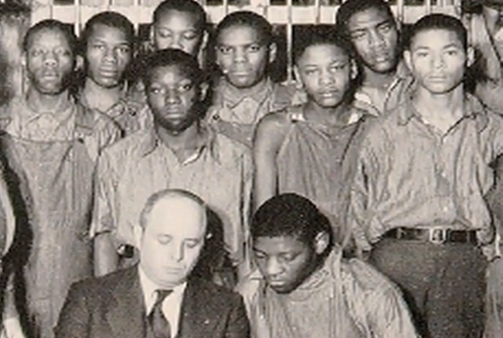
  2. Scottsboro Boys
  3. The Holocaust
  4. The Khmer Rouge Genocide
  5. Roman Catholic Sex Abuse Scandals

The Reign of Terror:  Part of the French Revolution

The Reign of Terror lasted from 1793 to 1794.  Can you think of a more horrible epithet for a period of time that should have been characterized by unbridled optimism?   It was a period of time in France that (though it took place about 14 years later in France) was born of dreams and aspirations that were similar to the American Revolution.  In final outcomes, no two events could have turned out more dissimilar.  In the beginning though, there were similarities.  In both France and America, a king and tyrant would be overthrown.  In both nations, the goal was to establish a democracy.  In both the USA and in France, it was to be a rule of the people, by the people and for the people.  And in both cases, it was a revolution that started out based on the liberal and enlightened ideals of such thinkers as:  Rousseau, Locke and Voltaire.  And that is where the similarities end.   5_-the-reign-of-terror-1

In America, we ended up with a democratic system of government and no king or dictator.  France went on to establish a dictatorship under Napoleon Bonaparte and lopped off the heads of over sixteen thousand people and another twenty five thousand by other means.  Whereas in the USA, we exported the Tories (those who sided with England) to Canada and elsewhere, during the French Revolution, anyone not labeled a “patriot” was subject to arrest and execution whether they were “citizens’ or not.  The very leaders of the French Revolution were one by one called out for treason and executed.  This included such famous names as:  Saint-Just, Carnot, Danton, Marat, and Robespierre.  No one in France was safe from the guillotine.  Here was an erstwhile revolution for liberty, fraternity and equality that turned into a debauchery of power hungry madmen secretly harboring dreams of glory and fame.  Want happened to the Truth?  Who knew the Truth?  The basic Truths of the philosophical founders of the French Revolution include the following:

John Locke:  “All mankind… being all equal and independent, no one ought to harm another in his life, health, liberty or possessions.”

Jean Jacques Rousseau:  “What wisdom can you find that is greater than kindness?

Voltaire:  “What is tolerance? It is the consequence of humanity. We are all formed of frailty and error; let us pardon reciprocally each other’s folly – that is the first law of nature.”

These hardly seem like Truths that would lead anyone to rampant executions but perhaps the Truths of the leaders of the Revolution did not really derive from the Truths of their philosophical founders.  Let us look at the Truths of some of the French leaders and see what their Truths were:

Louis Antione de Saint-Just:  “The vessel of Revolution can arrive at port only on a sea reddened by torrents of blood.”

Lazare Carnot:  “The General Order is always to maneuver in a body and on the attack; to maintain strict but not pettifogging discipline; to keep the troops constantly at the ready; to employ the utmost vigilance on sentry go; to use the bayonet on every possible occasion; and to follow up the enemy remorselessly until he is utterly destroyed.”

Georges Jacques Danton:  “In revolutions authority remains with the greatest scoundrels.”

Maximilien Robespierre:  “To punish the oppressors of humanity is clemency; to forgive them is cruelty.”

Is it just me or does there seem to be a major disconnect between the Truths of the philosophers and the Truths of the political leaders?  Does it seem funny that a revolution that was started to pursue a rule of law for the common everyday person was soon taken over by fanatics and extremists?  In this day of rampant terrorists, it would appear that the worst terrorists of the French Revolution became their leaders.  Is it everywhere the same that Truth gets coopted by the fanatics and terrorists or is the French Revolution simply an aberration?  Could it be that the Truths of Rousseau and Locke were actually lies and the Truths of Carnot and Danton were the real Truths?  Must Truths ever be colored in blood and gore?  Let us move on to look at another regrettable episode in human history and see what light if any on the Truth it may shed.

The Scottsboro Boys:

ScottsboroNine African American youths tried and convicted for the alleged rape of two White women while on a train ride to find work in 1931.  This travesty of American justice took place in Alabama during the height of Jim Crowism.  Many people recognized that these “boys” as they were called were being railroaded to justice.  They were tried a total of three times.  Twice by all White juries and once by a jury that included a single African American member.  (How would you like to have been that minority juror?)  In each case, they were all found guilty.  Some of the “boys” were subsequently pardoned, yet all but two served lengthy prison sentences.

What was their crime?  Rape you say?  The rape of two white tramps who were probably screwing the daylights out of every male they met regardless of color?  Or was it two white Women who represented the flower of Southern gentility?  The chivalry of the Southern gentleman coming to the aid of his White magnolia blossom to insure her continued unblemished purity.

Yes, this trial was more than a trial for the rape of two women, this trial represented the rape of the entire South.  Every White male in a Southern state was raped by these “colored boys.”  Such a mockery of Southern chivalry could not go unpunished.   The Truth of the color line must be established once and forever and what was this Truth?  For the Blacks and for the Whites, the Truth was very different.  Here were the Black Truths:

Black Truth:  Southern White slave masters have been raping Black women since the first slaves were offloaded to American shores.

Black Truth:   A large number of White women were more than willing to go to bed with an African American male.

Black Truth:  A White jury would never free a Black person of a crime against Whites.

The Truths for Southern Whites looked like this:

White Truth: If we could lynch these Black bastards, we would.

White Truth:  It’s alright for a White man to screw a Black woman but it’s not alright for a Black man to screw a White woman.

White Truth:  We have two sets of justice down here, one for White people and one for niggers.

Times have changed. Black people have made progress right?  Of course they have you say!  Does not the USA now have a Black president?  Although, he is also half White so why is he not a White President?  However we also have Ferguson Missouri, Eric Garner and thousands of African American males in prison for drug crimes that a White person would not have been convicted for.  We daily witness protest marches against police profiling and the shooting of poor young African American “boys.”  Time marches on and the Truth still remains somewhat murky.

The Holocaust:

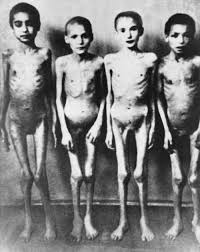
holocaust childrenThe Holocaust was the systematic murder of Jews by the Nazis for the sole reason that they were Jewish.  They were not a burden on the society.  They were not a primitive culture.  They were not a class of deviates or criminals.  Indeed, they were shopkeepers, bankers, manufacturers, educators, musicians, philosophers and scientists. The Jews in Europe were probably the best educated and most prosperous ethnic group that existed in Europe.  Why the Holocaust?  Why the crematoriums?  Why the Gas Chambers?  Why? Why? Why?  This question has been asked thousands and thousands of times.  Hundreds of books have been written asking and looking for an answer to this question.

Now it may be noted that a “Holocaust” does not strictly apply to the Jewish slaughter and that there have been other holocausts in history.  Earlier I noted the massacre of Armenians by the Turks.  The systematic murder of Cambodians by the Khmer Rouge, the Rwandan Massacres and the genocide that took place between the Bosnians and the Serbs.  So what is the difference between the Jewish Holocaust and these no less horrible episodes?  Let us look at the definitions that have been applied to the following terms:

Genocide is defined as:  “The deliberate and systematic extermination of a national, racial, political, or cultural group.”  (Dictionary.com)

Holocaust is defined as:  “The systematic mass slaughter of European Jews in Nazi concentration camps during World War II (usually preceded by the).” (Dictionary.com)

The Holocaust has been labeled as a unique instance of genocide.  It is certainly a specific example of genocide that was perpetrated against a targeted group of people.  One might argue that there is no commonality between the Holocaust and these other examples of genocide, however I think they would be on shaky grounds.  In all cases, it could be argued that the perpetrators felt somehow threatened by their victims and decided that only by killing their chosen victims could their threat be eliminated.  Nevertheless, in no other examples except for the Jewish Holocaust was the entire legal, judicial, legislative, military and political apparatus of an entire State brought to bear against the victims.  Furthermore, the furtive and secretive nature of the Nazi slaughters were without precedence.  They clearly recognized that their mass murders were immoral and evil and they took major steps to prevent the world from learning about these atrocities.  So did the Nazis have a set of Truths that they were following in the murders of their victims?  What were the Jewish Truths that they followed as they attempted to take part in the German culture?  Let’s listen to some of the Nazis leaders to see their Truths:

Hitler:  “The personification of the devil as the symbol of all evil assumes the living shape of the Jew.” 

Himmler:  “We know that these clashes with Asia and Jewry are necessary for evolution.”

Goebbels:  “I am of the opinion that the greater the number of Jews liquidated, the more consolidated will the situation in Europe be after this war.”

Rosenberg:  “Since Germany with its blood and its nationalism has now broken for always this Jewish dictatorship for all Europe and has seen to it that Europe as a whole will become free from the Jewish parasitism once more, we may, I believe, also say for all Europeans: For Europe the Jewish question is only then solved when the last Jew has left the European continent.”

We must look to some of the Jewish leaders and spokespeople to see what their Truths were.  What beliefs and ideologies could have persuaded the Jew to live, work and die for a country that would eventually seek to totally and permanently eradicate their very existence?  But of course, only after stealing everything they owned and even taking their victims hair and teeth to recycle for the greater good of the true German Master Race.

Robert Weltsch:  “They accuse us today of treason against the German people: The Nationalist-Socialist Press calls us the ‘enemy of the Nation,’ and leave us defenseless. It is not true that the Jews betrayed Germany. If the Jews have betrayed anyone, it was themselves. Because the Jew did not display his Judaism with pride, because he tried to avoid the Jewish issue, he must bear part of the blame for the degradation of the Jews.”

Mordechai Chaim Rumkowski:   “I thought that would be the end of it, that after that, they’d leave us in peace, the peace for which I long so much, for which I’ve always worked, which has been my goal. But something else, it turned out, was destined for us. Such is the fate of the Jews: always more suffering and always worse suffering, especially in times of war.”

Jewish Saying:  “If a Goy strikes you, bow your head and he’ll spare your life

Anne Frank:  “In spite of everything, I still believe that people are really good at heart. I simply can’t build up my hopes on a foundation consisting of confusion, misery, and death. I see the world gradually being turned into a wilderness, I hear the ever approaching thunder, which will destroy us too, I can feel the sufferings of millions and yet, if I look up into the heavens, I think that it will all come right, that this cruelty too will end, and that peace and tranquility will return again.”

Simon Wiesenthal:  “For me the Holocaust was not only a Jewish tragedy, but also a human tragedy. After the war, when I saw that the Jews were talking only about the tragedy of six million Jews, I sent letters to Jewish organizations asking them to talk also about the millions of others who were persecuted with us together – many of them only because they helped Jews.”

The Jewish Truths seem to me to bear absolutely no resemblance to the Truth of the Nazi Fascists.   In America, we lost over 400,000 soldiers in our efforts to wipe the Nazi butchers off the face of the earth.  Nothing infuriates me more than seeing some miscreant wearing a Nazi swastika or sporting a Nazi tattoo.  The Nazis made a sacrament out of murder and torture and created altars where they could worship their blasphemous sacraments at.  Their altars were their crematoriums and death chambers.  It is a sad Truth that we still have Nazis and Nazi sympathizers walking the face of the earth.  But let us journey on through history.  With only two events left in my list, it would be irresponsible to forego the lessons that they might still hold for us.

The Khmer Rouge Genocide

The Khmer Rouge regime arrested and eventually executed almost everyone suspected of connections with the former government or with foreign governments, as well as professionals and intellectuals. Ethnic Vietnamese, ethnic Thai, ethnic Chinese, ethnic ChamCambodian Christians, and the Buddhist monkhood were the demographic targets of persecution. As a result, Pol Pot is sometimes described as “the Hitler of Cambodia” and “a genocidal tyrant.” Martin Shaw described the Cambodian genocide as “the purest genocide of the Cold War era.”

Ben Kiernan estimates that about 1.7 million people were killed.[6] Researcher Craig Etcheson of the Documentation Center of Cambodia suggests that the death toll was between 2 and 2.5 million, with a “most likely” figure of 2.2 million. After 5 years of researching some 20,000 grave sites, he concludes that, “these mass graves contain the remains of 1,386,734 victims of execution.”  (From Wikipedia)
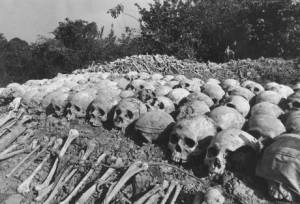
khmer-rouge-skullsThe most startling fact or perhaps we should say Truth about the Khmer Rouge Massacres is that they went on virtually unheralded and unnoticed by the Western world.  There was little outcry or call for intervention by any Western government.   In the USA, virtually no press covered these events while they were happening.  How could nearly two million people be exterminated without the United Nations, The United States or any other Western country raising an outcry against such an atrocity?   The Truth, which few dare say, seems to be that Asian lives (much live African lives) do not matter as much in the West as European or American lives.  Witness the recent Charlie Hebdo murders.

On January 7th 2015, two masked men entered the offices of the journal paper Charlie Hebdo and murdered in cold blood twelve of the staff.  The reason for the murders is alleged to be retailiation for the depiction of the prophet Mohammed in unseemly portrayals by the satirical magazine.  The manhunt went on for three days for the killers and resulted in thousands of newscasts, broadcasts, newspaper articles, radio announcements etc. that continued 24/7 non-stop until the killers were found and eliminated.

The Western press had a field day with the event.  It became a bigger star than the Super Bowl.  I looked at CNN on my IPAD one day and the first 16 of 55 articles all had to do with the Charlie Hebdo murders.  The 26th article that CNN published two days ago noted the massacre of 2000 Nigerian men, women and children by the terrorist group Boko Haram.  Sixteen articles on the murder of 17 French citizens and one article on the massacre of over 2000 Nigerian citizens.  Does this suggest a different Truth for the murder of Africans versus Europeans?  On Sunday, heads of state from across Europe, Africa and the Middle East flew into Paris to take to the streets alongside an estimated 1 million people in the city — including the entire French government to protest the Charlie Hebdo killings.  Republicans in the USA are criticizing President Obama for not having sent a high enough official to attend the march.

“I’m for truth, no matter who tells it. I’m for justice, no matter who it’s for or against.”Malcolm X

Where is the march and protests for the Nigerians who have been murdered?  Where is the outcry for the massacre in Nigeria?  Where is the manhunt for the Boko Haram terrorists?  Where are the thousands of articles and newscasts doing a minute by minute and hour by hour summary of the search for the Nigerian killers?  Dare I suggest the Truth that African lives do not matter as much as European lives?

African lives, Asian lives, Mexican lives, European lives, American lives, we can put them on a scale and measure the value to the news and media.   Do the news report the news or do they make the news?  If the news paid more attention to the rest of the world, would we see the importance of “other” lives?  Would “other” lives ever matter as much as European and American lives?  What is the Truth here?  Perhaps our last case to be examined will finally allow the Truth to emerge.  One more to go before we discover the “final” Truth!

Roman Catholic Sex Abuse Scandals

I confess that I grew up in an Italian Catholic family.  I went to a Catholic boarding school for 4 years and went to Catholic Church until I was sixteen.   I have since regularly attended a yearly Jesuit Retreat for the past thirty three years.  During all of this time, my experiences with the Catholic Church have been positive.  I am an agnostic by way of coming to have a different understanding of faith and religion but not because I was ever abused or mistreated by any clergy.  I state these facts so no one will misunderstand my intentions in discussing the issue of the Catholic Church hiding its pedophiles.

“There is nothing more deceptive than an obvious fact.”Arthur Conan Doyle

catholic-church-priest-sexual-abuse-scandal-cartoon-vatican-action-pinata-blind-leading-blind-hypocrisyWhile there are some who argue that the number of priests identified as pedophiles is about the same as in the general population, this argument entirely misses the point.  The key point of the issue for those who were abused is that they were relating to a select group of individuals who ostensibly were selected, trained and promoted to positions of authority because they could be trusted.  The fact that this was not the case was only one half of the problem.  The other half of the problem was that the Catholic hierarchy refused for years to acknowledge the problem and indeed grossly exacerbated the problem by hiding and protecting the deviant priests.  Thus, not only the pedophile priests were guilty of a crime but the Church leaders themselves were guilty of deception, fraud, immorality and the concealment of major crimes.

When we look closely at this situation then, we have three sets of Truth.  The Truth of the Pedophiles.  The Truth of the Catholic leadership and the Truth of the abuse victims.  Where should we start?  Let’s look first at the truth of the victims.

Rita Milla – Victim: 

“The 28th of January 1978 was when I was first raped,” said Milla, now 51, as she sat Thursday in the Wilshire Boulevard office of civil rights attorney Gloria Allred.

“Every year on that day it kind of freaks me out,” she said. “I started feeling like when I was 18 when this stuff was going on – the same feelings, the guilt and the hating myself.” I became very depressed and for three or four days I just wanted to hide out. I just wanted to throw up.

Mark Murray – Victim:

“They know that the abuse that happened by priests at Roe Head was then covered up. They know that the priests that abused children were moved on to other positions. Positions where they would not cause concerns or problems for those that moved them.”

Boy X – Victim at the Comboni Mission:

“Sometimes I think what would have happened if Fr. Pinkman had not turned his back on me that day on that railway platform. What if he had approached me and put his arms around me and told me he was sorry.  It would have meant the world to me. I would have forgiven him there and then. It would, to a great extent, have lightened that burden on my back, that devil I’ve been carrying all my life.  I really believed that Fr Pinkman cared for me, maybe I needed to believe that. Even after he had turned away from me that day. I still believed he cared. I realize now that he never cared at all.”

The Truths of the victims are rather hard to understand.  Unless one has gone through what they have, it is difficult to fathom the pain and anguish that the pedophiles reeked on their victims.  But let us be fair.  We must also listen to the Truth of the pedophile priests.  Perhaps their Truth will be all that is necessary to set the victims free.

Father Shawn Ratigan

“Prison is hell,” Ratigan said. “I know I deserve 15 years, but 50 years? Come on, I don’t think so.” 

Father Oliver O’Grady

“I want to promise myself this is going to be the most honest confession of my life,” O’Grady said in the film. “And in doing that, I need to make a long journey back, understanding what I did and to acknowledge that.  And in some ways make reparations for that.”  [O’Grady was the subject of the 2006 Oscar-nominated documentary Deliver Us from Evil.  In the film, he admits to molesting dozens of children and writes apology letters to some of them.]

 Fr Curtis Wehmeyer:  (Wehmeyer pleaded guilty and was sentenced to five years)

The priest had quietly admitted to touching one boy’s genitals on more than one occasion, masturbating in front of them and possessing pornographic photos and movies showing nude prepubescent boys alone and engaged in sexual acts with each other.  ( Minneapolis Star Tribune:  February 1, 2013) 

Finally, there is the Truth of the Roman Catholic Leadership in terms of what they believe about these cases of abuse and rape.

Todd Tamberg – The Archdiocese of Los Angeles:

Speaking about the film (Deliver Us From Evil), Archdiocese spokesman Tod Tamberg, who viewed the film prior to its debut, sent a statement saying it is “primarily based on anti-Church assertions by plaintiff’s attorneys who stand to gain financially and on the self-serving comments of former priest O’Grady, a sick, twisted monster and, like most molesters, a master manipulator.”

Bishop Robert Finn:  (Sorry no direct quotes here, but actions may speak louder than words).

A computer technician working on Father Rattigan’s laptop in December 2010 found hundreds of troubling images of young girls and reported it to officials with the Catholic Diocese of Kansas City-St. Joseph.  Instead of turning the photos over to police or reporting suspicions about Ratigan, Bishop Robert Finn of the Kansas Diocese sent Ratigan away for psychiatric evaluation and later ordered him to stay at a convent where he could say Mass for the sisters and stay away from children.

The Vatican:

“Regarding accusations against a cardinal, we remind everyone that, in the Church, only the pope has the authority to accuse a cardinal,”   (Pope Benedict had censured Cardinal Christoph Schönborn of Vienna, who last month publicly accused another cardinal of covering up sexual abuse)

I think it is fairly easy to sum up the truths of the various parties.  I wish I could have included all of the comments and dialogue that were possible but the comments I included reflect to some extent the overall tone of the parties involved.

The victims felt betrayed, abused and guilty.   Perhaps the victim’s Truths were as follows:

  • I must have done something to deserve this abuse
  • I really thought they loved and cared for me
  • Why didn’t anyone come to my aid?

The guilty pedophile priests engaged in active denial or a sense of indignation that they needed to be found guilty for something that to them was an inalienable right.  The right to abuse, molest and rape young girls and boys.  Their Truths would sound like this:

  • I did not do anything to really hurt anyone
  • Why is everyone upset over nothing?
  • I do more good than harm so why am I being prosecuted?

Finally, the Officials of the Church share a large portion of the blame and responsibility for these acts. They hired these priests, promoted them, protected them and even went so far as to engage lawyers in efforts to cover up these crimes.  Their Truths would include:

  • We are above the law
  • No one was really hurt
  • We can’t afford to accept any responsibility for the crimes committed

Conclusion to Part 2:

I think I am finding (and I assume you might also be finding) that truth is a very ephemeral, elastic and slippery quality.  Nevertheless, despite its elusive attributes, after spending over 2500 years looking at some of the most atrocious and egregious events in history, we should be at the point of finding the Truth.   Alas, I think we have run out of time and space in this blog.   I had thought we could wrap things up and conclude at this point but I think with all the time and energy we have already dedicated to our search, it would be hasty and premature to conclude at this point.  There are a number of observations that warrant attention and I will discuss these in the Part 3, the final part in our search for the Truth.

Time for Questions:

What are your thoughts at this point in our search for the Truth?  What observations can you share in my comments section?  Please add your voice to the search.  Your opinions are valuable and the more brains the better.  We all need to hear from each other or there is no Truth to be shared.

Life is just beginning.

“We must pass through the darkness, to reach the light.”   ― Albert Pike

What the Hell Do We Need Morality For?

morals and ethics

This blog is about the subject of morality.  Once upon a time, they taught morality in school and in church.   The first system of morality that many older Americans were exposed to was probably the “Ten Commandments.”   This was a code of rules given to the Israelites by Moses on Mount Sinai.  I have always thought it ironic that a set of morals from the “Old Testament” was supposed to be the foundation for a Christian America.  Even today, advocates of this code of morality want to hang it in town halls, schools, courts and government centers.  This is a part of the Bible that promoted an “eye for an eye” and stoning adulterers.

Jesus did say “Think not that I am come to destroy the law, or the prophets: I am not come to destroy, but to fulfill” (Matthew 5:17).  Jesus added at least one commandment to all others that was even more valuable than the ten TenCommandmentsMoses gave.   Jesus said, “A new commandment I give to you, that you love one another; as I have loved you, that you also love one another” (John: 13:34).  I would be much more in favor of seeing this posted in my neighborhood than the Ten Commandments.

Perhaps even more importantly in terms of a system of morality, Jesus gave a sermon where he proposed what has been called:  The Eight Beatitudes:   (Click here to hear the The Beatitudes Song

Blessed are the poor in spirit, for theirs is the kingdom of heaven.

Blessed are they who mourn, for they shall be comforted.

Blessed are the meek, for they shall inherit the earth.

Blessed are they who hunger and thirst for righteousness, for they shall be satisfied.

Blessed are the merciful, for they shall obtain mercy.

Blessed are the pure of heart, for they shall see God.

Blessed are the peacemakers, for they shall be called children of God.

Blessed are they who are persecuted for the sake of righteousness, for theirs is the kingdom of heaven.  —- Gospel of St. Matthew 5:3-10

It is my opinion that the Eight Beatitudes constitute one of the greatest systems of morality to come out of the Bible.  I would rather see these taught (if we are going to teach a system of morality) than the Ten Commandments.  I would also not mind these being posted in schools and other public places whereas I am sick and tired of those who want to post the Ten Commandments.

I noted that once upon a time, we taught morality in schools and churches.   Actually, we not only taught morality but morality was also imbued in our social fabric by many traditional stories and the media.  Children from an early age were exposed to Fairy tales, Uncle Remus stories, Aesop Fables, and Tales of the Arabian Nights.  These stories were full of morals on how to live and behave properly.  Early TV was also full of morality tales.  Shows like Father Knows Best, Leave It to Beaver and Andy Griffith each week clearly conveyed stories of morality and what was right and what was not right in terms of behavior.

sin-guilt-causes-body-pain-sicknessSomeplace along the way, we started losing our sense of morality.  Some have blamed it on becoming a multi-cultural environment.  Some have blamed it on the decline of religion and church going.  Some have blamed education while still others have blamed progress and a business culture that has no room for strict morality.  I am not sure what the actual cause was.  I am more concerned that it did happen.  Studies have shown that our culture has become more amoral than moral and that narcissism now plays an increasing role in our society.  People are less moral and more self-centered than ever before in the history of this country.  A book by Joel Marks (Ethics without Morals: In Defense of Amorality -Routledge Studies in Ethics and Moral Theory, 2012) is one of several that makes an argument for amorality:

“In clear, plainspoken, engaging prose, Joel Marks presents the case for abandoning belief in morality. Anyone who wants to defend the practice of making moral judgments will have to confront the issues Marks raises, and the alternative to morality he proposes.” – Mitchell Silver, University of Massachusetts, Boston, USA 

In the book “The Moral Fool: A Case for Amorality (2009)” the author Hans-George Moeller advances the following case for amorality:

“Justice, equality, and righteousness—these are some of our greatest moral convictions. Yet in times of social conflict, morals can become rigid, making religious war, ethnic cleansing, and political purges possible.  Morality, therefore, can be viewed as a pathology—a rhetorical, psychological, and social tool that is used and abused like a weapon.”

In an article “Why Is Narcissism Increasing Among Young Americans?”  by Peter Gray in Freedom to Learn (2014), Gray notes the following:

“For the past three decades or a little more, researchers have been assessing both narcissism and empathy using questionnaires developed in the late 1970s.  Many research studies have shown that scores on these questionnaires correlate reliably with real-world behavior and with other people’s ratings of the individuals.  For example, those who score high in narcissism have been found to overrate their own abilities, to lash out angrily in response to criticism, and to commit white-collar crimes at higher rates than the general population.[1]  Those who score low in empathy are more likely than the average person to engage in bullying and less likely to volunteer to help people in need.[2.]

Over the years, these questionnaires have been administered to many samples of college students, and analyses that bring all of the data together reveal that the average narcissism score has been steadily increasing and the average empathy score has been steadily decreasing ever since the questionnaires were developed [3.]  The changes are highly significant statistically and sufficiently large that approximately 70 percent of students today score higher on narcissism and lower on empathy than did the average student thirty years ago.

What accounts for this historical rise in narcissism and decline in empathy?  There is no way to know for sure, based on the data, but there are lots of grounds for speculation.”

I think we have thrown the proverbial baby out with the bath water.  I agree we need to keep the State separate from the Church.  I also agree that we don’t need the Ten Commandments as the foundation for moral thought in America.  Nevertheless, I do believe that we all need a code of morality to live by.  Whether it be Christian, Buddhist, Confucian, Agnostic, Atheist, Islamic, Jewish, Hindu, Baha’i, or other, we need a set of morals as a template and foundation for our behavior.  We need a baseline that each of us can start from so that we can assess what is good and what is right.  We need to have some system of ideas about what is correct behavior and how we should live in a socially interconnected world.

When I was a kid, (somewhere along the way) I was taught the Seven Deadly Sins.  Sometimes they were called the Seven Deadly Vices or the Seven Cardinal Sins.  I assume that since I attended a Catholic school, it went along with the teaching.  The Seven Deadly Sins included the following:

  • Lust
  • Gluttony
  • Greed
  • Sloth
  • Wrath
  • Envy
  • Pride

7 deadly sins

Some of you might think that this list is old fashioned or out of date.  How could this set of implicit moral values make a difference in our society?  They are so old; do they really have any relevance anymore?

Take a close look around you at the world.  You have only to look for a few minutes to persuade yourself that these “sins” are at the top of the list of major problems.  Greed, envy, gluttony and lust appear pervasive in our culture.  (See my series on Gandhi’s Seven Social Sins) TV shows, movies, magazines, radio, supermarkets, superstars, sports, credit services, escort services, pornography, Las Vegas all portray an American brand of materialism that is nothing short of sick.  Get it now, get it fast, and get more and moreMore is better!  Bigger is better!  Shop till you drop!  He who has the most toys wins!

“If necessity is the mother of invention, then surely greed must be the father. Children of this odd couple are named: Laziness, Envy, Greed, Jr., Gluttony, Lust, Anger and Pride.”  ― John R Dallas  Jr.

Black Friday ( The day after Thanksgiving in the USA) is only a small manifestation of the greed, lust and sloth that has infected our society.  How many Americans have a regular exercise schedule?  How many obese citizens can you count on the street each day?  How many Americans spend more each week then they earn?  How many Americans will go in debt this Holiday Season to spend money that they don’t have on gifts and toys?  Where is the self-restraint that is necessary to push oneself away from the table or shut the TV off and say “Enough.”  It barely seems to exist.  Is it any wonder that so many countries have a very negative stereotype of the “average” American?  We appear to be a group of people who have lost our moral compass.

ARTICLE 29 —  The Universal Declaration of Human Rights

  • You have a responsibility to the place you live and the people around you-we all do. Only by watching out for each other can we each become our individual best.

At this point, you well may be asking “What right does he have to be so damn moralistic?”  Didn’t Jesus say “Let he who is without sin cast the first stone?”  “Are you so perfect that you have a right to look down on other people?”  “Who does he think he is, Jonathan Edwards?”  “I don’t need anyone telling me my faults.”  “I get enough negativity from work without having to get it from you.”

Please allow me to clarify a few misconceptions.  In some religious circles we are all sinners.  Since I am agnostic, I don’t subscribe to a religious view of sin.  My use of the terminology is borrowed from the religious sphere since I think that the concept of sin has a very useful connotation if we can free it from some of the pejorative and negative associations with which it is fettered.  First of all, I do not believe that you will go to hell for committing these Seven Sins.  Second, you will not be a bad or evil person because of them.  Third and accentuating the positive, you may be happier and healthier if you are more aware of these “sins” and can do a better job of examining the role that they play in your life.  My bringing these “sins” out is to help us all become more aware of the morality that we have allowed to become obscured in our daily lives.

There are only two mistakes one can make along the road to truth; not going all the way, and not starting.  —-Buddha

We have had a decline in morality that started over one hundred years ago and it still seems to be declining.  More people are worried about their taxes increasing then the poverty facing many people in this country.  More people are worried about their security then the number of people going to jail every day for victimless crimes.  More people are worried about the price of gasoline then the pollution we send into the atmosphere every day.  Self-centeredness has become a dominant fixture of the American landscape.  “Greed is Good” says Ivan Boesky and everyone applauds.

If you look for truth, you may find comfort in the end; if you look for comfort you will not get either comfort or truth only soft soap and wishful thinking to begin, and in the end, despair.   — C. S. Lewis

Why do I think we should care about morality? 

goodevilWithout morality, we are not even as good as animals.  Animals eat, drink, sleep, procreate and fight when they have to.  They do not do it simply to hurt other animals or to wage war against groups or individuals that they cannot tolerate.  Animals care for their young and exhibit many characteristics of moral behavior.  In captivity, animals may display much more aggressive behavior.  For instance, Orcas in the wild have never been observed to kill other Orcas.  This is not the case for Orcas in captivity.  There is no such thing as civilization without a commitment to moral and ethical behavior.  Even animal societies are proof of this.

“I am Envy, begotten of a chimney-sweeper and an oyster-wife. I cannot read, and therefore wish all books were burnt; I am lean with seeing others eat – O that there would come a famine through all the world, that all might die, and I live alone; then thou should’st see how fat I would be! But must thou sit and I stand? Come down, with a vengeance!”  ― Christopher MarloweDoctor Faustus

Without morality, we have no compass to define what is good behavior and what is bad behavior.  We are reduced to the level of opportunists willing to take advantage of anyone and anything that suits our ends.  Listen to the current debate on the use of torture and the recent CIA report and you will find numerous “experts” advocating that the “ends justify the means.”  One man on NPR noted that he thought we should ask the victims of the Twin Trade Towers what they thought about the use of torture to capture Osama Bin Laden.   John McCain (May he Rest in Peace) once said it best when he opined in Congress (12-9-14) that “”Our enemies act without conscience. We must not.”  Nevertheless, he was opposed by his own party in his opposition to torture and in fact to even releasing the CIA Tortmoralityure Report. 

Many Republicans argued against releasing the report, especially as the threat of the Islamic State in Iraq and Syria grew and U.S. intelligence officials had warned that its release could cause backlash from nations and groups hostile towards the nation.   American embassies in the Middle East had been put on heightened security alert for its release.

McCain replied that “This report strengthens self-government and, ultimately, I believe, America’s security and stature in the world.”  (CNN 12-9-14)

Finally, without morality, there is no way to transmit values from one generation to another.  A lack of morality has led to the increase in amorality that is now symptomatic of our society.  Amorality is a set of beliefs which deny the value of morality or at best are indifferent to morality.  A rock is amoral.  It is neither good (moral) or bad (immoral) but may be used for either purpose.  Anything or anyone without a conscience is amoral.  It is a fine line and one that is very easy to trespass between amoral and immoral.  Many people today may think their behaviors are amoral when actually they could better be described as immoral.  Harken back to the Seven Deadly Sins and ask yourself, how many of these vices are amoral?  Are greed, gluttony, lust and wrath amoral?   Can anyone with a good conscience say it is okay to partake in these vices?

“Seven deadly sins,
seven ways to win,
seven holy paths to hell,
and your trip begins

Seven downward slopes
seven bloodied hopes
seven are your burning fires,
seven your desires…”
― Iron Maiden

Time for Questions:

What is your moral code? What are the three most important morals in your life?  Do you think everyone should have an explicit moral code?  Why or why not?  Do you know many amoral people?  What do you think about amorality?  When is it justified?  What do you think the world would be like if everyone was amoral?  Would it be a better world or worse? Why?

Life is just beginning.

“Remember tonight… for it is the beginning of always”  ― Dante Alighieri

Social Legacy Systems: How They Block Change and Prevent Progress: Part 2- The Legal Correctional System

Responsible_Prison_Reform-e1373996928213No set of institutions in America are more in need of reform than our legal correctional systems. No systems in America cost the taxpayer more money with less return or value to the taxpayer than our prisons and correctional related systems. No institutions in American cause more misery and heartache than our courts, legal system and correctional institutions. Together, our courts, legal systems and correctional systems cost the American taxpayer well over $100 billion dollars a year. The Economics of the American Prison System”  (Listen to Wake Up Dead Man) as you read my blog today. 

And what do we get for this “investment?”

  • Within three years of being released, 67% of ex-prisoners re-offend.
  • Within three years of being released 52% are re-incarcerated
  • The rate of recidivism is so high in the United States that most inmates who enter the system are likely to reenter within a year of their release.
  • In 2008, one of every 48 working-age men (2.1 percent of all working-age men) was in prison or jail.
  • In 2008, the U.S. correctional system held over 2.3 million inmates, about two-thirds in prison and about one-third in jail. 450px-Incarceration_rates_worldwide
  • Non-violent offenders make up over 60 percent of the prison and jail population. Non-violent drug offenders now account for about one-fourth of all offenders behind bars, up from less than 10 percent in 1980.
  • The total number of violent crimes was only about three percent higher in 2008 than it was in 1980, while the total number of property crimes was about 20 percent lower. Over the same period, the U.S. population increased about 33 percent and the prison and jail population increased by more than 350 percent.
  • Crime can explain only a small portion of the rise in incarceration between 1980 and the early 1990s, and none of the increase in incarceration since then. If incarceration rates had tracked violent crime rates, for example, the incarceration rate would have peaked at 317 per 100,000 in 1992, and fallen to 227 per 100,000 by 2008 – less than one third of the actual 2008 level and about the same level as in 1980.

These facts are from “The High Budgetary Cost of Incarceration” by Schmidt, Warner and Gupta, 2010

US_criminal_justice_cost_timeline

These facts have not gone unnoticed by state legislatures and politicians.

“In 2013, 35 states passed at least 85 bills to change some aspect of how their criminal justice systems address sentencing and corrections. In reviewing this legislative activity, the Vera Institute of Justice found that policy changes have focused mainly on the following five areas: reducing prison populations and costs; expanding or strengthening community-based corrections; implementing risk and needs assessments; supporting offender reentry into the community; and making better informed criminal justice policy through data-driven research and analysis. By providing concise summaries of representative legislation in each area, this report aims to be a practical guide for policymakers in other states and the federal government looking to enact similar changes in criminal justice policy.” Vera Institute of Justice     US_incarceration_timeline-clean.svg

I have written about this problem before. See my blogs (The Law Enforcement Legal-Judicial Correctional Complex and Lucy in the Sky with Diamonds or “How did our drug laws get so crazy?” It is not a new problem and in the years since I published my first article on it, it has only gotten worse. I published my first article on this issue back in 1995. In it, I applied the concepts of process and quality improvement to the criminal justice System. My article was published in a journal of pro’s and con’s on the justice system. Subsequently, I was asked to speak at a correctional conference in Minnesota and to explain the concepts that I had outlined in my paper.

The conference was attended by hard Right and hard Left people: Correctional Officers, Wardens, Prison Reform Advocates, and Relatives of both victims and prisoners. The Right wanted stronger sentencing guidelines and tougher police policies. The Left wanted more humane treatment for prisoners and more focus on rehabilitation. Each group had read my paper and each group thought I was “on their side.” The fact of the matter was, each side was wrong. I was not on either side. Tougher sentencing (which seems to have won out) has only resulted in prison reasonshigher levels of incarceration, less feeling of safety in society, higher costs and no appreciable decrease in drug usage or correctional costs. The Left may have lost in terms of policy but their solutions would not have fixed the system either. You do not get a better system by fixing defects after they are created. Process improvement focuses on going upstream and preventing defects, not warehousing and reworking them. It became clear as I tried to explain concepts of process control, six sigma system capability, rework, redesign and systems analysis, that I was speaking Greek to the participants, both Left and Right. Neither side had a clue as to what I was talking about. I suspect each side was disappointed that they had not found a new advocate.

“A new scientific truth does not triumph by convincing its opponents and making them see the light, but rather because its opponents eventually die, and a new generation grows up that is familiar with it.” ― Max Planck,

People in the old paradigm cannot see the new paradigm. Both sides might as well have been deaf and mute while I was speaking since the concepts I introduced were so foreign to them. I noted that the Correctional System needs reform. This was an understatement. The Correctional and Legal systems in America need nothing less than a major paradigm shift. Or to put it another way, we need a revolution in thinking about crime, incarceration and justice. Einstein noted that: “We cannot solve problems by using the same kind of thinking we used when we created them.” We need new thinking and new ideas. We need creative inspired leaders who are willing to break with conventions and boldly go “Where no one has gone before.” This kind of courage is sadly lacking in our political leaders today.

If I had to give my talk over again today, I would not talk about process control or process improvement. I would simply talk about the need for a paradigm shift. I would try with all my might to get the fish to see the water, to get the birds to smell the air and to get the people there to see the failure of the present paradigm. I do not need to recite the facts again. They have been repeated ad nausea. The problem is getting people to open their eyes. More prisons do not mean more safety. Longer sentences do not mean less crime. Tougher policing does not mean less violence on the streets. Witness the wave of protests rocking America today following the Eric Garner, Michael Brown, Akai Gurley, Tamir Rice and John Crawford III shootings by police. Every one of these names represents a killing by a police officer of an unarmed Black man or Black child. To date, not one killing has resulted in the indictment of a single police officer. The apparent message this sends is that: “Black men are guilty until proven innocent and that that they are so dangerous that they need to be shot first and asked questions of later.”

Bill James in his book “Popular Crime” provides the following observation:

“What we are doing, in a sense, is making ourselves constantly more aware of the threats and dangers around us, and then erecting security walls as if these threats were closing in on us, when in reality, we are pushing them further and further away.” P-96

James consistently provides evidence that we are safer and crime is lower than it has ever been in the history of this country. A point I made in my blog Are We Living in More Dangerous Times?  , see Part 1 and Part 2 with numerous statistics from the FBI and other agencies. Nevertheless, as the media treats us to a steady crescendo of violence and terror on the news, radio and TV, it is hard for anyone to feel like they are really safer or that they are less likely to be murdered in their sleep. Gun sales, concealed carry weapons and ammunitions sales have increased dramatically in the US in the past ten years. Smith and Wesson’s stock price has gone from 1.65 per share in 2004 to over $9 per share in 2014.

“The “Concealed Carry Permit Holders Across the United States” report from the Crime Prevention Research Center released Wednesday (July 10, 2014) analyzed parallels between a 22 percent drop in the overall violent crime rate in the same time period in which the percentage of the adult population with concealed carry permits soared by 130 percent.

The report finds that 11.1 million Americans now have permits to carry concealed weapons, which are up from 4.5 million in 2007. This 146 percent increase parallels a nearly one-quarter (22 percent) drop in both murder and violent crime rates during the same time period.” —  Number of Permits Surges as Crime Rate Drops

Citizens, police, homeowners, retired people, elderly, minorities and even children are walking the streets with their weapons in Condition O. That is cocked and ready to fire. Only the slightest provocation is needed to shoot. A dark figure lurking in a hallway, a man running towards us down the street, someone knocking on our front door late at night and the response is “shoot, shoot and shoot.” The reaction is even more rapid when the “allegorical” assailant is a minority or a stranger.

We need a paradigm shift. We are going in the wrong direction. We are safer and more secure than ever before, but we are walling everyone away who pose even the most minimal threat to our security. We are walling ourselves away behind security fences, gated communities, threat detection systems, private police forces, concealed weapons and reduction of liberty and spontaneity. We don’t feel safer and we are more suspicious of outsiders and strangers. We resent immigrants and foreigners and anyone who is different from us. Send them all back. The hell with sanctuary or diversity! America for people that look like me, act like me and think like me.

Build more prisons!  Invoke the three strike rule!  Make it a two strike rule!  Get tough on crime!  Platitudes like these get voters on the side of security and restraint. No new taxes does not apply to building new prisons. The contradiction between liberty and safety is ignored. Fear drives irrational behavior. Everyone develops blinders as the police go about harassing would be criminals or even suspected criminals or anyone who even looks suspicious.  “Thank God, once we lock them away, we can throw away the key and not have to deal with them anymore!  If only we could put all the “suspects” away, we good people could go about our lives feeling safe and free from the possibility of crime and violence.”

“By age 23, almost a third of Americans have been arrested for a crime, according to a new study that researchers say is a measure of growing exposure to the criminal justice system in everyday life.” — http://www.nytimes.com/2011/12/19/us/nearly-a-third-of-americans-are-arrested-by-23-study-says.html?_r=0

Time for Questions:

How safe do you feel: On the street, in your home, late at night, at a movie concert? What makes you feel safe? Have you ever been arrested? Do you know anyone in jail? Can you think of a way that prisons could be eliminated? Do you know how many people are in prison for non-violent crimes? What if they were doing public service instead? What can you do to help bring about prison reform? Are you happy with the present system?

Life is just beginning.

“A moment’s beginning ends in a moment” ― Munia Khan


The Tenth Greatest Mystery of All Time:  Do Weapons Prevent or Create Violence?

peace textGuns don’t kill people, people do!  Obama wants to take our weapons away so the Communists can take over the country.  A well-regulated militia, being necessary to the security of a free State, the right of the people to keep and bear arms, shall not be infringed. We have the right to defend ourselves.  What if someone attacked us and we had no means of self-defense?  Ridiculous, you cannot eliminate weapons.  If we did not have guns and missiles, people would kill each other with sticks and stones.  They always have and they always will.  You can’t eliminate violence by taking people’s weapons away!  Or can we?   (Listen to Give Me Love by George Harrison)

“If everyone demanded peace instead of another television set, then there’d be peace.”  ― John Lennon

There are several paths to take that would help us solve this mystery.  We could look at all the time spent in current and previous wars and compare that to periods of time when the earth was relatively peaceful.  We could look at countries where dollars spent on weapons are high and compare war or violence in those countries to their counterparts where dollars spent on weapons on low.  We could look at the per capita number of weapons in various countries and compare that to crime rates.  Unfortunately, each of these we are warapproaches has been tried and they actually prove very little.  For the most part, it would be a toss-up for each approach.  Those in favor of weapons would argue that without them, there would have been even less peace and those against weapons would argue that the weapons caused the wars, violence and crime in the first place.  They might say “Can you imagine ISIS attacking with flowers and cotton balls?”

“Dad, how do soldiers killing each other solve the world’s problems?”  ― Bill WattersonCalvin and Hobbes: Sunday Pages 1985-1995

Looking at the role of weapons in violence actually misdirects us from a more important question. The more important question is how effective are weapons at resolving violence?  While it can be conceded that weapons do not create violence, are they the most effective means of dealing with violence?  It has often been said that “war is a continuation of politics by other means.”  It might even be more true to say that war represents a failure of politics and a resort to violence to solve problems.  So who is right?  Were Gandhi and King right or were Generals Sheridan and Patton right?  There has been some research which might cast light on this second question.

non violenceResearchers Maria Stephan and Erica Chenoweth show that non-violent movements are twice as effective in achieving their political goals as violent movements. For example, in Timor-Leste, where violent revolution failed, non-violent tactics secured independence and the country now earns a peace score of “high” in the GPI. (Timor-Leste scores 1.95; a score of one is perfectly peaceful.) When people choose non-violent movements they may be improving the structures that support peace in the long run even when governments respond violently in the short run.  http://economicsandpeace.org/

Let’s take a hypothetical case.  Paul and Mohammed are arguing over whose religion is best.  Paul is a Christian and Mohammed is a killed manMuslim.  The argument gets more and more heated until Paul slanders the prophet Mohammed and calls him a pedophile.  Mohammed fires back that Jesus Christ was a fake and not the son of God.  Paul is armed with a concealed carry permit and carries a Glock 36 in a concealment crew neck shirt.  Mohammed is carrying a small 6 inch Jambiya in the waistband of his trousers with a special quick draw holster concealed under his shirt.

“Peace cannot be kept by force; it can only be achieved by understanding.”  ― Albert Einstein

Paul throws the first punch at Mohammed who is knocked to the floor.  Mohammed starts to get up and reaches for his Jambiya.  Paul upon seeing the blade being pulled out of Mohammed’s waistband, draws his Glock.  Mohammed (still feeling the effects of Paul’s punch) lurches forward.  Paul aims and fires three times hitting Mohammed in center mass and right arm.   Mohammed dies almost instantly from a hit to the heart.

anger-cycle-3When the police arrive, Paul is very sorry. He did not mean for this to escalate as it did.  The police charge Paul with manslaughter.  Paul goes to court and is found not guilty.  Paul is then charged in a civil lawsuit with a wrongful death claim and found guilty.  The financial costs of Paul’s argument are well over 100 thousand dollars.  The mental and emotional strain to Paul and his family are incalculable as are the losses to Mohammed’s wife and children.

The strongest defenses to a murder charge are provocation and Self-Defense. If the defendant acted completely in self-defense, this fact may relieve the defendant of all criminal liability. If it does not relieve the defendant of all liability, self-defense at least may reduce the charge from murder to manslaughter. Provocation rarely results in complete absolution, but it may reduce the defendant’s criminal liability.

Now let’s rerun the same scenario with a few minor changes.  Paul is not carrying a gun and Mohammed is not carrying a knife.  The same argument ensues and Paul punches Mohammed.  Mohammed rises shakily from the ground and stumbles to his feet.  Mohammed is too disoriented to counter-attack and has no training in hand to hand combat.  He has no knife to rely on.  Instead, Mohammed asks Paul “Why did you hit me?”  Paul, now on the down stage of the Anger Cycle is feeling remorseful and says “I am really sorry.  I don’t know what got over me.  I did not appreciate your calling Jesus a fake.”  Mohammed says “well, you insulted the Prophet but I did not hit you.”  Both men go their own way vowing never to talk to each other again.  No police have been called and the only physical damage is a sore jaw for Mohammed.

“An eye for an eye will only make the whole world blind.”  ― Mahatma Gandhi

Road-RageAt this point, you might be laughing at my scenarios and decrying their likelihood.  However, I have been in many situations where fighting has occurred and the second scenario was the more likely of the two if no weapons were involved.  Put weapons into the mix, add alcohol and I guarantee you will be looking at the first scenario.  Add alcohol san weapons to the second scenario and you will simply have two drunks cursing each other but going home physically sound.

So, what role do weapons have in peace making?  Did the Russians not nuke us because we had a greater nuclear deterrent?  Quite likely this was the case during the Cold War.  However, what if neither side had nuclear weapons, or bombers or aircraft carriers or machine guns or hand grenades or napalm or bio-chemical weapons?  What if diplomacy and persuasion and peaceful non-violent protest were the only weapons to grace each side?  Would the world be more peaceful or simply less violent?  What is the difference you may ask?  A good question.

Peace can be defined:  A state of mutual harmony between people or groups, especially in personal relations.

Non-violence can be defined as:  The policy, practice, or technique of refraining from the use of violence, especially when reacting to or protesting against oppression, injustice, discrimination, or the like.

gun store 047Peace is never likely to exist perpetually.  People, nations, religions, ethnic groups will always have a degree of enmity between them.  Peace will be cyclical as the nature of the world is in most things.  Periods of civility will be interspaced with periods of incivility.  But incivility does not have to turn into violence.  Without weapons of mass destruction, without weapons of mayhem, without weapons of killing, people may be more likely to find non-aggressive means of settling disputes. The disputes will most certainly arise but a focus on peace as opposed to aggression can mean that we minimize violence and decrease the amount of murder and wars that our societies have seen since the first cave-people.  We must substitute non-violence for violence and teach peace and not war.

Time for Questions:

Do you feel peace in your life?  Are you confident in walking the streets at night?  Do you worry about road rage?  Do you carry a concealed weapon?  If so, does it make you safer?  What would it take to make you feel like the world is a safe place?  Do the Army, Navy, Air force and Marines help you to feel safe at night?

Life is just beginning.

“The artist is always beginning.  Any work of art which is not a beginning, an invention, a discovery is of little worth.”  ― Ezra Pound

Previous Older Entries Next Newer Entries