
I am definitely biased when it comes to literature. Without reading, books, magazines, articles, stories, plays, parables, and fables, I do not know what my life would be. There are few things that enrich life more than the written word. Movies, plays, and videos would be nothing if there were no words to go along with them. Even sports and athletic events are heavily dependent on the written word. Talk show hosts, TV actors, comedians and many other performers hire dozens of writers to script plots and routines that are the life blood of the entertainment industry.
I woke up this morning thinking how to convey the value of literature. There is so much that I could say. There is so much that needs to be said. The question is how best to do justice to the world of literature and to keep this blog from becoming a book. The thought came into my mind, that literature is everything to me from A to Z. This gave me the idea to use the alphabet as a device to convey the importance literature has had for me. But more importantly I want to inspire you as I have been inspired by the many books that I have read over the years. I want to briefly touch on how they have enriched my life.
For each letter of the alphabet, I will try to note a few authors or books that I have read and what they have meant to me. Some of my authors will be fiction writers, some poets, some non-fiction writers but each has left me with a piece of the puzzle. The puzzle I refer to involves the existential quest to find the meaning of life. I suppose that I may never find the meaning, but literature has helped create many of the puzzle pieces for me. I am still struggling to put them all together. The process is more fun than getting the finished puzzle.
A –
Aesop, Alistair MacLean, Agatha Christie, and August Wilson. A few of the many authors whose writings have enriched my life. From drama to morals to spies, I am sure that everyone has been exposed to these writers, perhaps without realizing it. Numerous shows and movies have been based on their literature. A is a good place to mention the following question, “What is the difference between someone who does not know how to read and someone who knows how but does not read?”
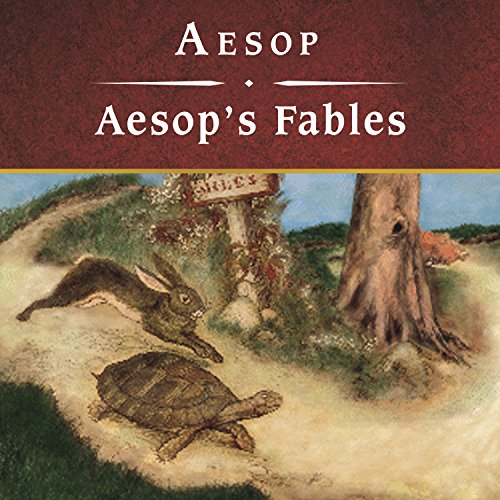 Several of my stories have been influenced by Aesop’s stories. When growing up, I loved reading stories of foxes, rabbits, scorpions, and other animals that Aesop used in his writing. His parables and morals still guide my life in a myriad of ways. I watched a few of August Wilson’s plays that were performed at Penumbra Theater in St. Paul, MN. It was my introduction to the world of African American literature which was sorely missing in our education system. For a good escape into the world of murder, drama and spies, MacLean and Christie cannot be beat. On countless rainy and often sunny days as well, I have curled up and said, “To hell with the world. I am dropping out for a few hours into a world of fantasy.”
B –
I could speak of many authors here but nothing in literature has spawned more stories or ethics or plays or even religions than the Bible. If you peruse my blogs, you will find at least a dozen stories that I have written that have been based on biblical sources. There are many authors involved in the Bible. The Bible notes for different books either who was the author or who they think the author might have been. In many cases, the authors are unknown.

Is the Bible fiction or non-fiction is a question that would create great dissention depending on who you asked? Many would say that the Bible was the literal truth given by God to prophets to pass down to humanity. Others would say, it was a series of stories that were embellished in the telling. Neither of these issues ever bothered me. The point is that the Bible is one of the greatest books in history, if not the greatest. It has history, drama, murder, sex, morals, and good advice all wrapped up in one binder. Read it and you will see why some people say that it is the only book they read.
C –
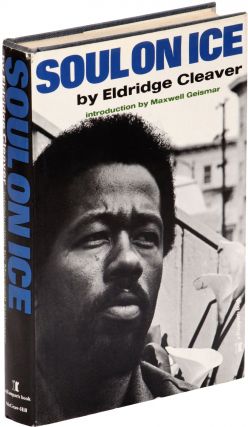 Camus, Eldredge Cleaver, and Cervantes could not be more different. Camus the existentialist. Cleaver the revolutionary. Cervantes the dreamer. What puzzle pieces they inspired in me. Hard to find out how they fit together but in the grand scheme of things, I would not leave any of them out. Cleaver wrote, “Soul on Ice.” One of the most inspiring prison writings ever written.
“From my prison cell, I have watched America slowly coming awake. It is not fully awake yet, but there is soul in the air and everywhere I see beauty…. I was very familiar with the Eldridge who came to prison, but that Eldridge no longer exists. And the one I am now is in some ways a stranger to me.” — Eldridge Cleaver, Soul on Ice, 1968
Camus helped me to understand Existentialism from an applied perspective. A great deal more helpful than a strictly theoretical understanding. Cervantes created a character that I would like to be. A man forever hopeful and willing to battle the world regardless of the forces arrayed against him. A man willing to “dream the impossible dream.” If only, I can retain Quixote’s optimism until the day I am no more.
D –
Dostoevsky, Dickens, and W. E. Deming. I knew Dr. Deming personally. I had dinner with Dr. Deming and took several clients to visit him at his home in Washington, D.C. I helped out at several of his five-day seminars. My first job after completing my Ph.D. degree was attained by reading his book, “Quality, Productivity and Competitive Position.” A tour de force that would revolutionize American business. A book that told me that 95 percent of what I learned in graduate school was wrong. I learned more from Dr. Deming than I learned from all the great professors who wrote so many of the textbooks that I had been studying for 5 years. Dr. Deming told me I wasted my time. I was loath to accept his finding but gradually came to realize that he was right. Eventually, the blinders were lifted from my eyes and I could see the truth of American business. The truth that Dr. Deming had tried to share with the world.
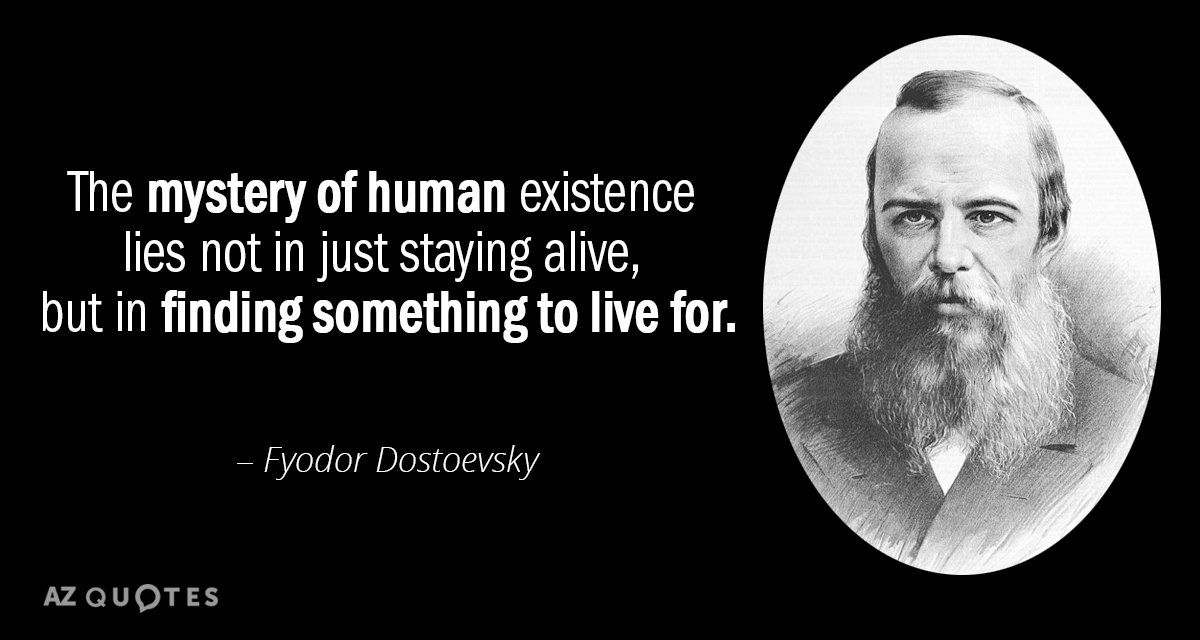
I cannot say that I have read all of Dostoevsky’s or Dicken’s works. What I can say is that few writers I have read have been more articulate about the human condition than these two authors. They are natural born psychologists. Their insights into people are so profound that it seems a mystery to me that anyone could as accurately portray humanity as they have done in their writings. It is not really stories that they tell so much as creating a picture of the inner souls of their characters. It is easy to describe the outward characteristics of a character but much more difficult to portray their inner characters. Both Dickens and Dostoevsky portray humans at their best and at their worst. Reading either of them is better than reading a textbook on human psychology or taking a Psych 101 class.
E –
Jacques Ellul. Jacques wrote the “Technological Society.” I read this book in 1982 when I started graduate school. There are many books that describe the “what” of technology. Books that talk about computers, software, hardware, and the impact that they will have on society. The central premise of Jacque’s book is this: “In our technological society, technique is the totality of methods rationally arrived at and having absolute efficiency (for a given stage of development) in every field of human activity.” Not exactly what we read about or think about when we hear the word technology.
But technology is technique. It is not simply something electrical or digital. Technology is a philosophy of life. Ellul showed me the deeper meaning and relationship between life and gadgets. Society is influenced by technology in more ways than I could ever have imagined. Understanding technology has given me the ability to appreciate both its pro’s and con’s. There is always a downside as well as an upside to new gadgets, particularly things like social media, the internet, and computers. Each of these technologies have impacted our lives both for good and bad.
F –
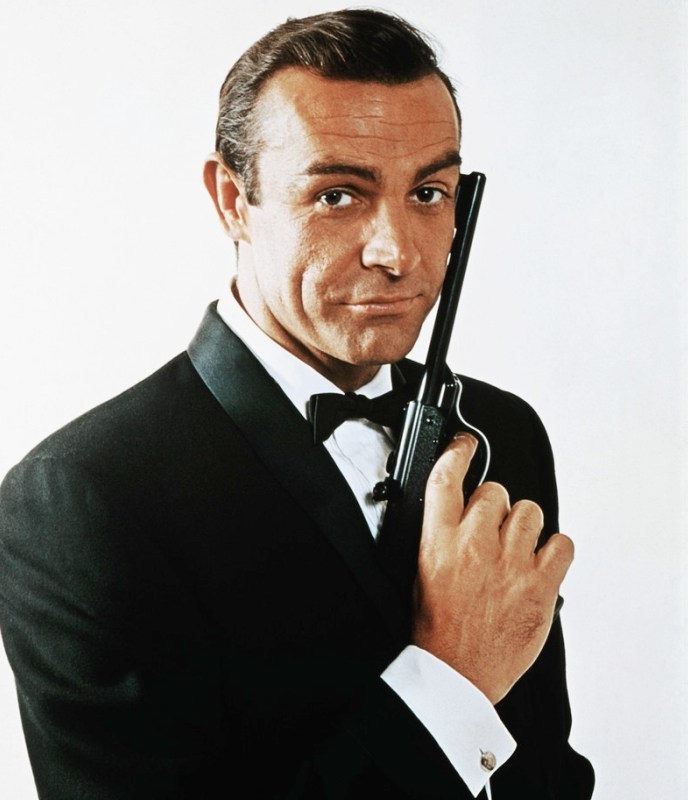 Anatole France and Ian Fleming. I discovered Fleming’s books on James Bond, after I saw the hit movie “From Russia with Love.” I subsequently read every one of Fleming’s books and have seen every movie in the Bond franchise. I loved the character so much I continued to read “Bond” books even when they were written by other approved writers. I was attracted to the character who was everything I wanted to be. Handsome, rugged, dashing, brave, a man’s man and a woman’s man as well. I will never forget the line from one of Fleming’s books, “Boredom is the worst curse of all.” Eventually, I outgrew James Bond but there will always be a part of me that wonders what it would be like to live in his world.
France on the other hand gave me a different view of the world. I read several of his books during the early seventies when I was in my socialist learning stage. I identified with many of his ideas. France was awarded the Nobel Prize in 1921. His books were often both ironic and satirical. He approached subjects steeped in religion with a perspective that might have seemed atheistic. He challenged us to think of God and Satan and their relationship together. I think many of my blogs have been influenced by France. Particularly my blog titled, “A Conversation between Satan and God.”
G –
 J. K. Galbraith, Goethe, and John Gardner. Perhaps my favorite story as well as my favorite opera are based on a man selling his soul to the devil in return for some privilege. Goethe wrote the story and called it Faust after a learned man who wanted more than knowledge. Gounod did the opera based on Goethe’s story. Many other stories have been based on the idea of a bargain between Satan and humans. One other that I have always liked was “The Devil and Daniel Webster.” It told the story of a New Hampshire farmer who sold his soul to the Devil in exchange for success. When the devil came to collect his due, the farmer called on Daniel Webster to defend him. This story ended happily as opposed to Goethe’s story which has a tragic ending.
Like many people, I would like to be more successful, more famous, and more admired. Would I sell my soul to the Devil? There have been times in my life when I would gladly have sold it. I am at a point now where fame and fortune do not mean as much. If I have a soul, I will depart this world with it intact.
J. K. Galbraith was a noted economist and Harvard Professor. In his book, “The New Industrial State,” he supported much of what Dr. Deming had to say about American business. I was particularly struck by Galbraith’s denunciation of MBA programs. Deming also detested these programs and argued that they were destructive for American business. Galbraith has been lionized and villainized. Anyone with the audacity to challenge the inherent greediness of Capitalism cannot expect to win friends. My thinking on Capitalism reflects what I have learned from both Deming and Galbraith.
John Gardner wrote several of my favorite stories. He was a professor of literature well known for his writing and critiques. Just when I thought I could learn everything from philosophy, I find a writer who mercilessly skewers philosophy with a character based on Socrates. Agathon is a wise cynic who knows all about the world but nothing about life. Gardner also wrote “Grendel” which was the Beowulf story told from the perspective of the beast. Gardner had a unique way of turning things inside out and getting you to see an entirely different perspective. His books often dealt with issues of morality, freedom, and justice. From Gardner I leaned that life is seldom simple and when we look at the world it becomes complex and contradictory.
H –
Chris Hedges. Hedges wrote the “Empire of Illusion.” This book portrays the American Dream as an illusion. Hedges disparages the idea that America is exceptional and that we live in the land of the free and the home of the brave. The book was published in 2010 and clearly outlines the descent of America into Trumpism. On its webpage, Amazon summarizes the main theme of Hedge’s book as:
“A prescient book that forecast the culture that gave rise to Trump — a society beholden to empty spectacle and obsession with image at the expense of reality, reason, and truth.”
No society can make progress if illusions and fantasies guide its policies rather than truth and knowledge. America today seems to be sorely lacking in truth or knowledge. Morris Berman another critic of American culture gave up on changing anything in this country and moved to Mexico and off the grid. I question every day pre-Trump and post-Trump whether America is on an unstoppable downhill slide and if there is anything I can do about it. Will I be able to help make a difference and steer this country towards the dreams and values that it was founded on? I wrote sixteen Anti-Trump articles dealing with the menace and danger that he held for America. A president who represented everything that was bad for the future of our country. He lost the election but how can anyone forget that 75 million Americans voted for him.
I –
 Ivan Illich and Washington Irving. When I was in my undergraduate program in education which I started in 1971, I decided to read as much of the counter-education literature that I could find. My most memorable readings were “Pedagogy of the Oppressed” by P. Freire, “How Children Fail” by John Holt and “Deschooling Society” by Illich. I have read many more books on education since the 70’s but it seems to me that nothing new has been added to the schooling critique leveled by these educators. Schools are still failing students and society. Educators are like fish. They live up to the Chinese saying that “The fish are the last ones to see the water.” I have written numerous critiques of the education system in America as have many other educators, but nothing changes. The solutions to the problems that ail our education system are rooted in a theory of education that was appropriate 100 years ago but is now obsolete.
“School prepares people for the alienating institutionalization of life, by teaching the necessity of being taught. Once this lesson is learned, people lose their incentive to develop independently; they no longer find it attractive to relate to each other, and the surprises that life offers when it is not predetermined by institutional definition are closed.” ― Ivan Illich,
Washington Irving wrote my favorite ghost story. The “Legend of Sleepy Hollow” still scares and thrills anyone reading it. Sit outside in the fall just before Halloween on a dark night in the woods and read this story. Keep looking over your shoulder in case the Headless Horseman is out for his night ride. Perhaps you will see Ichabod Crane running pell-mell through the woods to escape the Horseman. This is only one of many great stories that Irving wrote. I learned to brave the night woods knowing that I was a friend of Irving.
J –
 Carl Jung was one of the many theorists I studied at the University of Wisconsin for my M.S. degree in Counseling. Carl Jung was one of the acolytes of Freud along with Alfred Adler, Wilhelm Reich, Otto Rank, and his daughter Anna Freud. Each follower eventually broke with Freud and founded their own school of psychology. Jung started the most esoteric and enigmatic of these schools. His philosophy or methods are called Jungian Analysis and appeal to many people due to his emphasis on the interpretation of dreams, archetypes, and symbolic behaviors. Jung gave me an appreciation for the elements in life that we might simply write off as useless or meaningless. To undergo a dream interpretation can be a very life changing experience. I discovered that there is no single path to self-awareness and psychological health. Different schools of therapy appeal to different people and each may be effective.
K –
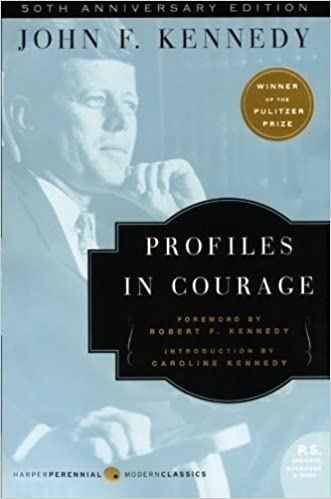 John F. Kennedy, Ezra Klein, and Daniel Kahneman. What do a President, Journalist and Nobel Prize winner in Economics have in Common? I learned from Kennedy’s “Profiles in Courage” about what integrity really means. Kennedy may not have written much of this book but the lives of the people he shares puts an exclamation point on the values that JFK had for this country.
I read Kahneman and Tversky’s “Judgement Under Uncertainty” in 1982 when I was in graduate school for my Ph.D. degree. Years later they would win the Nobel Prize for Economics after having totally changed the way we think about and understand human economic behavior. Much of the theory I was exposed to in graduate school was proven wrong by the research that Kahneman and Tversky conducted. I learned a new way to think about economics and organizational behavior from this book.
Klein’s book “Why We’re Polarized” takes a more nuanced and data driven look at the gap that is separating Americans today. He avoids the nauseous palliatives and bromides offered by so many writers on this subject. You could fill an entire library bookshelf with all the authors telling us why Americans are divided and angry and how we can solve the problem. Almost all see the division as a major problem. Not Klein though. He suggests it might be inevitable. His book is laced with data proving that this divide did not just spring up with Trump but has its roots many years before Trump was on the radar. One might say that Klein proves the adage that, “Those who forget the past are condemned to repeat it.”
So what do these three authors have in common besides a last name that begins in K? The answer is that each man has helped me to think about life in America and what it could be with more intelligent reflection and commitment to the values that our Founding Fathers promoted. Economics is worthless without social commitment and social commitment is shallow without a strong economic system. The principles of economics are not iron clad laws but continue to be better understood. No doubt many years from now, we will see much of our economic decision making through a new set of lenses. Kahneman has been a major force in the evolution of economic thinking. Kennedy and Klein show us what is possible with integrity and intelligent thinking applied to politics and governance.
L –
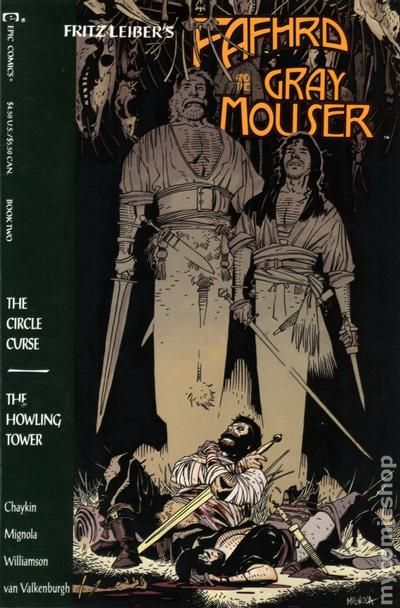 R. D. Laing and Fritz Leiber. Do you know Fafhrd and the Gray Mouser? If not, you are missing two of the most interesting and funny characters in the genre called Sword and Sorcery. Fritz Leiber coined the phrase “Sword and Sorcery” and helped birth an entire new form of literature. When we think of fantasy, most often we think of Lewis Carroll’s, “Alice in Wonderland.” This classic story is imbued with fantasy and magic, but no one actually does any magic in the story. Magic is limited to Alice’s dreaming. Many fairy tales have more actual magic than Alice in Wonderland. Tolkien’s “Hobbit and Ring Trilogy” come to mind.
When we think of Science Fiction, a more modern form of fantasy, we think of Star Wars and stories that blend fantasy and science. Sword and Sorcery is different. It blends heroic fantasy with magic. Magic is the exact opposite of science. The Marvel character, Dr. Strange is one of the few Marvel characters to blend fantasy with magic or the occult.
“So tell me, giant philosopher, why we’re not dukes,” the Gray Mouser demanded, unrolling a forefinger from the fist on his knee so that it pointed across the brazier at Fafhrd. “Or emperors, for that matter, or demigods.”
“We are not dukes because we’re no man’s man,” Fafhrd replied smugly, setting his shoulders against the stone horse-trough. “Even the duke must butter up a king, and demigods the gods. We butter no one. We go our own way, choosing our own adventures—and our own follies! Better freedom and a chilly road than a warm hearth and servitude.” — “Swords in the Mist”
R. D. Laing was a psychologist. When I was in school for my graduate degree in counseling psychology, as I often did, I sought out the unconventional theorists. Besides Wilhelm Reich, and Thomas Szasz, Laing was one of the most unconventional thinkers in the field of psychology. Much as Thomas Kuhn became a target for many in science because of his radical thinking on science and paradigms, Laing also became the target of many in his field who felt threatened by his critique of psychology. And well they should have for Laing challenged some of the major theories prevalent in the field at his time:
“Laing maintained that schizophrenia was “a theory not a fact”; he believed the models of genetically inherited schizophrenia being promoted by biologically based psychiatry were not accepted by leading medical geneticists. He rejected the “medical model of mental illness.” – Wikipedia
To go where no man has walked before, one does not have to go to Mars or another planet. There are plenty of places in the human mind where few dare tread. You go to these places at a risk to your sanity and reputation. The status quo must protect itself and people who move to a different drummer or question common assumptions are treated as an invading virus that must be eradicated. The normal system has no room for mutations. You will be barraged by assaults from those in the system who have no desire to change. Vested interests will marshal their big guns to eradicate you if you think differently. You will begin to question your own sanity. Only the strong can survive.
M –
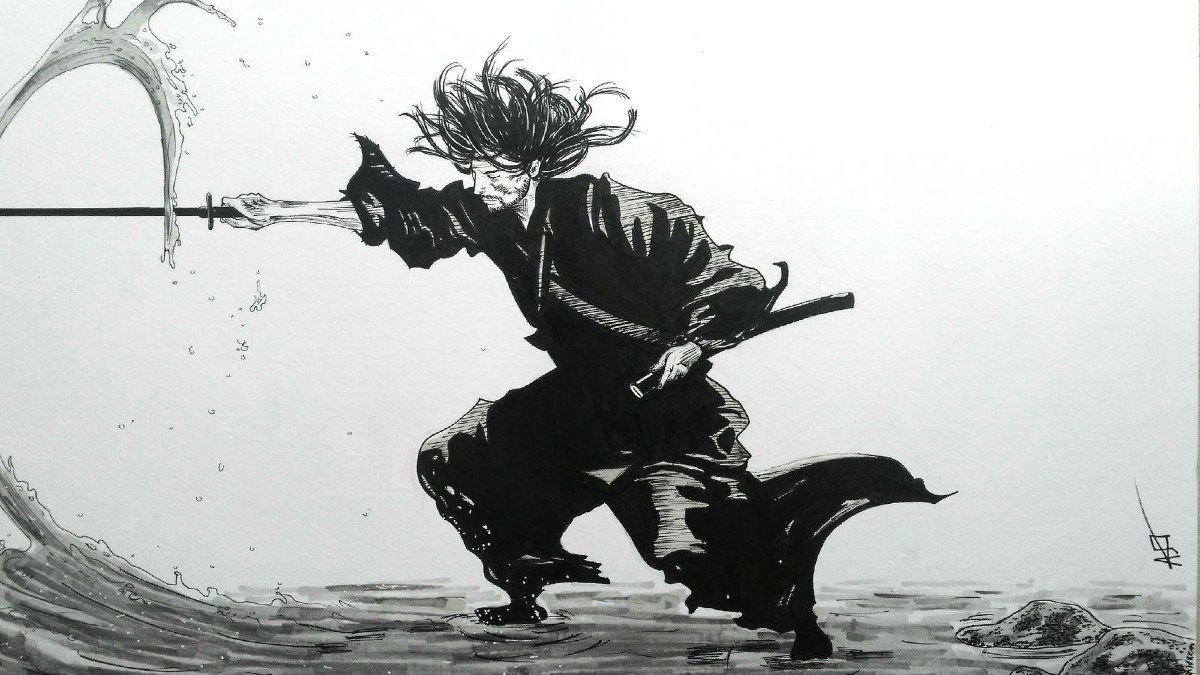
Miyamoto Musashi, C.W. Mills and Yukio Mishima. Two out of three in this group are Japanese. I wonder if there are more last names starting with M in Japan? Musashi was the greatest swordsman who ever lived. He wrote philosophy with his sword. His “The Book of Five Rings” blends swordsmanship and strategic thinking for anyone who wants a practical philosophy for success. Some people talk about success but Musashi put his life on the line over thirty times fighting opponents in duels to the death. His ideas about life and death are forged in a crucible of reality that few of us could ever comprehend, much less undertake.
 Mishima was an author, poet, actor, and modern-day samurai who wanted to reinstate the Bonsai spirit in Japanese Culture. After WWII, Americans occupied Japan and did everything they could to drive out the Samurai attitudes and policies that dominated Japan the previous fifty years or so. Mishima created a group of followers who thought that they could overthrow the elected Japanese government and restore the old ruling order. He greatly overestimated support for his ideas and after a failed rebellion he committed Seppuku or Hari Kari as it is also known. I read a few of his novels and came to appreciate his writing and even his politics to some extent. In his “The Sailor Who Fell from Grace with the Sea” he states that “living is merely the chaos of existence.” He has also noted that “I still have no way to survive but to keep writing one line, one more line, one more line….” A sentiment that I think anyone serious about literature would surely appreciate.
C. W. Mills was a sociologist, professor, and author. He became famous for many of his writings on Organization Theory. By the time I was in graduate school, pursuing my degree in Organization Theory, he was no longer a popular theorist. His writings were no longer mandatory readings. I suppose I chose to read him since he had long since fallen out of favor. My habit again of looking at those who are lepers in the establishment.
Mill’s, “The Power Elite” dispelled my nascent socialist leanings by clearly disputing the idea of a cabal of rich capitalists plotting to take over the world. The ideas he had on bureaucracy as internalized social control had also been expounded by Max Weber. When I was employed as a consultant at Pearl Harbor Naval Shipyard in 1989, I augmented the prevailing quality theories I endorsed with the theories of Mills and Weber. Mills died in 1962 at the age of 45 and Weber died in 1920 (Of the Spanish Flu) at the age of 56. Neither man lived a long life, but their ideas were as valid in the 1980s, and even today as when they were written almost one hundred years ago now.
Conclusions:
I am halfway through the alphabet, and I realize that this blog is much too long. After writing A-M, I do not think either you are I have the fortitude for N-Z. I will offer to send you my list of authors for these letters. People like Nietzsche, OSHO, Plato, Poe, Roddenberry, Idries Shah, Tolkien, Twain, Voltaire, Alice Walker, Mary Wollstonecraft, Yeats, and Emile Zola all made a big difference on my views of the world and thereby on my life. But for now, this is enough. If I have not yet convinced you of the importance of reading and literature both for pleasure and for learning, I am doomed to a hell for poor writers and debaters. It will fall to a “better man than I” to convince you that reading is essential for a good life.
What is the difference between someone who can read and does not and someone who does not know how to read? – Answer: NOTHING!

 Thus, the question arose in my mind about the difference or relationship between appreciation and gratitude. Perhaps this is like asking how many angels can dance on the head of a needle, but I thought the question deserved some reflection. Is the relationship between gratitude and appreciation similar to the relationship between tolerance and respect?
 If you do not like to try new things, you should not travel. One of my mottos is “I have never met a food I did not like.” Karen and I eat at street vendors. We often shop locally and pick out foods that we do not even know what they are. When we were on Naxos, we found a meat market. We entered and were greeted with a variety of skinned animals hanging from hooks. There were no labels on these various creatures. We assumed they sold the meat in kilos, so we asked for a ½ kilo of this and ½ kilo of that. We decided that we would take the meats or whatever they were back to our little apartment and cook them. We figured that once we did this, we might be able to guess what we were eating. This was many years ago and I do not think we ever figured out what we were eating. The food was good and twenty-five years later we are alive and kicking. It was a great adventure. One that we have replicated many times.
 I was forty years old before I had my first trip out of the USA. I had always wanted to travel and my four years in the military had not provided me the opportunity to travel. Later on, I became so busy with school and work that traveling seemed like a remote luxury. One day I was on a plane coming back from Thompson, Manitoba. (Canada does not count as foreign travel.) I had been working with a mining client that week and was now headed home. Next to me sat a young woman holding a travel guide to Spain. It was May and schools were getting out for the summer. I remarked “Are you going to Spain?” “Yes,” she replied. “Oh”, I said, “you must be very excited.” She answered somewhat petulantly, “No, I went there last summer but my parents wanted me to go again since I am studying Spanish.”
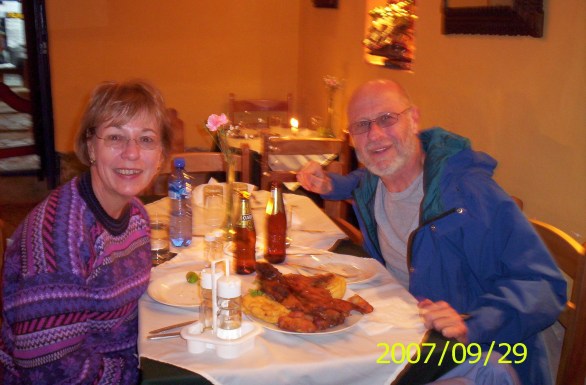 I did not say anymore to the young woman, but I thought “My, would I love to go to Spain or anyplace for that matter.” Then and there in that moment, I made up my mind. Karen and I were going to travel. We were going to see the world. When I arrived home, I shared my decision and determination with Karen. She was delighted but wondered how we would manage it. We have since been to 33 countries for a total of about 25 or more trips. We like to go to one country and see various sections of it rather than trying to see the whole of Europe or Asia in one trip. Usually we go for three weeks or so. We are very budget oriented and try to behave like pilgrims rather than like tourists. Our trips are usually a balancing act between being a pilgrim and being a tourist.



 “What do you need help with?” asked Mr. Bullfrog.
 Mr. Bullfrog thought about this for a while. In some respects it made good sense, but he still could not see that the rewards outweighed the risks. He had read Dr. Persico’s book on strategy several years ago and applied many of the ideas to his own life. One of the key concepts concerned risk mitigation. One should always access the gain of an action against the inherent risks associated with the action. Mr. Bullfrog concluded that the risks still outweighed the gain. “What is in it for me,” asked Mr. Bullfrog?
 About halfway across the pond, Mr. Bullfrog suddenly dived beneath the surface of the water. The scorpion was flung into the water. Mr. Bullfrog paddled a few yards underwater and then came up. When he came to the top, he heard the scorpion pleading “Why have you done this? We had a deal.”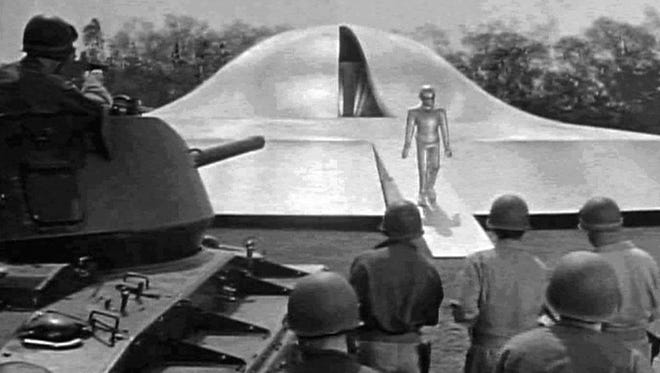
 The color of its trunk was somewhere between blue and green as its hues ebbed and flowed. One minute it looked blue and the next minute it looked green. The most striking feature of all was in the middle of its trunk about five feet above the floor. It had a large round eye about 9 inches in diameter. There was no mistaking it as an eye since it included a large red pupil, a green cornea, and a yellow sclera. The pupil was about two inches wide and the cornea was about four inches wide. The eye seemed to follow every movement in the room and when you looked at it, the alien seemed to be able to look right through you as though it was reading your mind.




 “You have taken my space craft to one of your many military bases. Some of you wish to stop me from leaving. That is impossible. I have no desire to harm any of you. I have already repaired my vessel and it is back in orbit. I will go to my ship. Perhaps you will see me again in the future if you survive. I doubt it. Goodbye.”

 When I grew up, the only art in our house was an Elvis on velvet painting that my mother had hanging over the living room sofa. We also had a wooden ship with metal sails and a clock that did not work built into the side of the ship. It was featured prominently on the mantle over our fake fireplace. Our furniture would have done the Salvation Army proud. I do not remember any other art besides Elvis displayed on our walls, floors, or ceilings. Neither my father or mother had any interest in art. My mother liked Elvis and that is why she got the painting.
  When I think back upon my schooling, I do not recall ever having had a single class in art appreciation. We would occasionally go on field trips but usually to a library or a science museum. No one in my schools acknowledged the world of art. For blue collar kids like myself, the world of art had little relevance or practical use. Everyone knew that artists died poor. The great Van Gogh sold only one picture in his lifetime and that to a relative. The purchase of art was for the rich, spoiled, eccentric scions of old aristocratic families with more money than they knew what to do with.
  When Karen and I first moved down to Arizona, we took a day to go and visit Scottsdale. Scottsdale is a wealthy upper-class community. Scottsdale is generally considered the most affluent large city in Arizona. The average income of a Scottsdale resident is $51,564 a year. The US average is $28,555 a year. According to Zillow.com, the typical price of a home in Scottsdale is $582,292. We walked around the downtown portion of Scottsdale and expected to see the usual mix of clothing stores, jewelry shops, antique shops, and restaurants. We were not surprised except when it came to the antique shops.

 Art reflects the beauty that life holds. Paintings portray ideals and impressions that intrigue and magnify the senses. Sculptures mirror the objects in our world that mystify us or that remind us of magnificent events. Pictures bring us to other places and times that would be forgotten without the images the photographer captures. Art does not attempt to simply mirror reality; it attempts to augment and enhance reality. Art can be a caricature which like a Rorschach text enables us to see many different visions. Art is a realization of values, norms, pain, happiness, the past, the present and the future. Art can simultaneously create fantasy and reality.
 You may be rightly thinking, “But what good does art do me if I cannot afford to even walk into an art shop?” I often asked myself this same question. Why look at stuff that I could not afford? It took me years before I even ventured into an art museum. I have since visited the Louvre while in Paris and many other museums in the USA and in Europe. My attitude is now one of gratefulness that someone has purchased these magnificent works of art to share with the public. The vast majority of us could never begin to afford the pricelessness of these museum pieces. I strongly encourage you to visit an art museum sometime.
  When it comes to art that I would like to own, it is simply a matter of what I can afford. The art world is full of overpriced works of art. Many would rebel at my labeling art this way. My critics would say that it was high priced and not “over” priced. That may well be. I have talked to a number of artists and the vast majority do not get paid for the value of their efforts and creativity. However, just like in athletics, a few stand out and are disproportionally rewarded for their efforts.


 This type of courage is the most obvious and perhaps least subtle. The mountain climber, the motorcycle racer, the football player, the sky diver all display what to some of us would seem to be a reckless disregard for life. Each of these individuals risk life and limb for either fame, fortune, fun or to achieve some goal. Often money is the least of their motivations for risking their lives. These people do things that leave most of us awestruck but also inspired. We watch their events on TV, in the movies and at live shows. We never fail to be impressed by the exploits and daring do that such individuals undertake. Risk is the hallmark of their efforts and we note that many of them pay for their risky behaviors. Death is an ever present companion for these people. Somehow though, they rise above the fears that chain the rest of us to the TV and they are out there doing what many of us only do in our dreams.
 What do you do when someone tells you that your ideas are stupid and that you will never amount to anything? If you are like most of us, you give up and go on to something else. The person with intellectual courage though is different from the rest of us. They don’t give up on their ideas. They plod forward in the face of distain, insults and criticism. Many times they are dead and buried before the value of their ideas are recognized. Darwin, Mendel, Pasteur and Copernicus were all ridiculed and ostracized for many years before their ideas were accepted. Socrates was executed for his ideas. Indeed, here is what Socrates said at his trial:
 I have a good friend of mine who will not go to funerals. They make him feel very sad and he tries to avoid such feelings. No one of us likes to feel sad. It takes a kind of courage to go to a funeral. What do you say at a funeral to the friends and relatives of the departed one? How do you act? What if you did not know the person very well? There are many ways to feel embarrassed or like a fish out of water at a funeral. Easier to stay home then go. But it takes a certain kind of courage to deal with emotional risk. Any courage is difficult because of the risk. Emotional risk entails looking stupid, feeling stupid or having to deal with difficult feelings. A person with emotional courage confronts these situations with a degree of bravery and élan that escapes many of us.
 One of the greatest fears that many people have is called “stage fright” or fear of public speaking. Many professional speakers and actors/actresses feel significant stage fright. Actress Carol Burnett was so nervous that she threw up before many of her performances. Most of us would never think of getting up on a stage. I know that people call it stage fright, but it is not really about the stage, it is really about us. Who wants to look stupid and particularly in front of hundreds or people? It takes emotional courage to deal with life. All of us have it, but we often choose not to exercise it. We simply spend our lives trying to avoid situations that might make us look dumb or embarrass ourselves. The people with emotional courage deal with these situations and take the risk that the rest of us hide from.
 The world is full of examples of moral courage. However, to my way of thinking, the amount of moral cowardice far outweighs the shining examples of moral courage. The number of Martin Luther Kings, Gandhis, Mandelas, Parks, Kellers and Kyis are dwarfed by the number of moral cowards who turn the quote I noted above around. These are the people who when in the majority would tyrannize the minorities. They are the moral cowards who use their positions to foster hatred and bigotry and intolerance towards the disadvantaged and weak. They prey on the sick and
 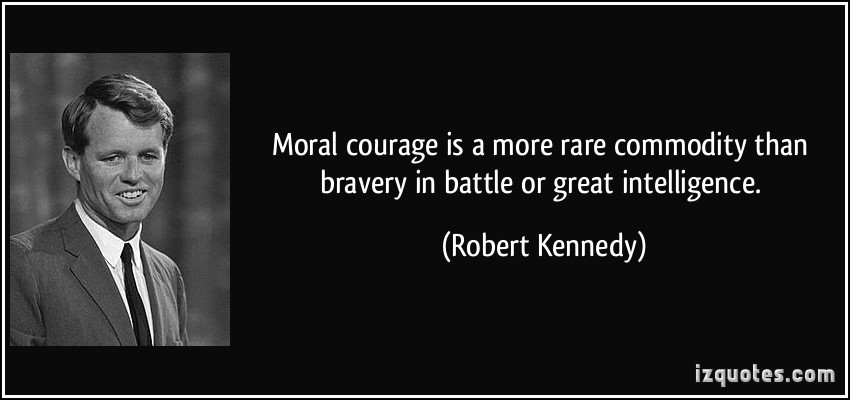 hungry and would deny benefits or help to anyone who is not a member of their tribe or affiliation. They go through life pretending to be good people and deluding themselves that they are.
 Nevertheless, in the face of all this iniquity, the majority of humankind has a spiritual courage that defies logic. The majority of people want to do good for the world. The majority of people are good and most people try to leave the world a better place then they found it. This is truly an amazing observation. More people are spiritual heroes than not. Every day those who have the courage and strength to get out of bed and to start a new day show a sense of spiritual courage. It would be easier to hide and to do nothing then to face the daily rigors of life on our planet. Yet, that is what the majority of people do each day. They get out of bed. They go to work. They volunteer. They innovate and create. They campaign for their ideals. They build. They love. They pay taxes. They die. And the cycle starts all over again for the next generation.

 One day a young student came to me and complained that he felt that his rights had been violated. At the time, I took any students complaints very seriously particularly when it concerned rights. I listened to his problem and asked him what he wanted me to do about it. He asked if I would intercede on his behalf with Sister Giovanni, who was our principal. I wanted to show the young man that I was concerned and caring and so I agreed to carry his problem to Sister G as she was known. She was feared and loved by almost all students so it did not surprise me that he thought I might have more luck with Sister G than he would have.
  I went to Sister G’s office and knocked on her door. She opened it and welcomed me in. We exchanged some pleasantries and she asked me what I needed. I began to explain the issue that the student had brought to me. Sister G listened attentively. When I was done, she smiled and nodded reassuringly. I thought “Great, I have been successful.” She then spoke, “This is your first year teaching right John?” “Yes, it is,” I answered. “Well, I have heard the issue and I may address it later, but I want to give you an important piece of advice now. Students just like the majority of people will always demand their rights, but they seldom demand their responsibilities.” Then, she gave me the philosophy that I have never forgotten. “John,” she continued, “for every right there is always a responsibility.” That was the end of our discussion.

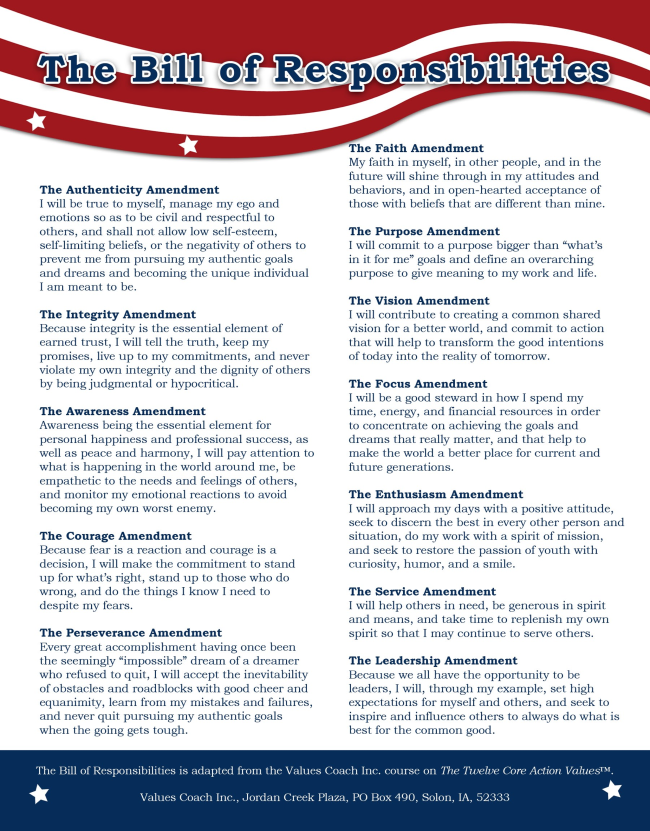
 What is the solution to the problem that we are facing today? A poisonous cultural stew of narcissism and entitlement driven by a rights only oriented mentality that thinks they are above responsibilities. I have reached the point in this essay where it would be easy to say, “Sorry, I don’t have the answer.” Or else, I could now list several bromides which may or may not have much effect. I have the following solution which I believe in 100 percent. I doubt that it would be acceptable to Americans as too many people have grown privileged, lazy, and indulgent in this country.
  My solution is for a National Required Service (NRS) that starts at the age of 18 for every man and woman in America. Upon finishing high school and before starting college, every American would need to attend the National Required Service. They would have two options. The first option would be to choose between a two-year service or a four-year service. A two-year service would be the minimum. The advantage of a longer service would lie in the educational benefits that would accrue. Serve two years and you would receive two years of financial credit towards any public education institution of your choice in the country including vocational education as well as liberal arts. Choose a four-year tour of service and you would receive four years of financial credit towards the public institution of your desire.
 Faith is number five of my seven essential virtues for leading a happy and successful life. Every Friday I start my day with the following prayer:
 I decided that I must first understand what Faith really means. To do this, it is helpful to deconstruct how we think about Faith and how we use the word. I thought about how we use both Trust and Faith in common language. For instance we use trust in English as follows:
 I think you can readily see that there is a certain degree of overlap between the two concepts. However, Faith generally seems to convey a more sectarian or theological concept of belief whereas Trust is generally used in more secular terms. Thus, we don’t “trust” God but we have Faith in her. Faith seems to be a term that is not contingent upon any kind of physical or logical proof. We might not trust a person with our money without proof that they are “bonded” or trustworthy, but we would not expect such displays of material evidence when it comes to having Faith in God. So what is the relevance to this in our lives? What good is Faith if we can substitute trust for faith and have more security in the long run?
 The answer seems to be (IMHO) that sometimes we can trust without evidence but generally we are better off trusting with some element of surety that can mitigate the risk of our trust being unfounded or mistaken. Whereas, there is little or no evidence that can prove your need or desire to have Faith. You must have Faith like a parent has love for a child. It is unconditional. You have Faith simply because you want to believe. You have Faith because you accept something without conditions. You need no proof or evidence to support your Faith. Is this a good thing or a bad thing? Should you have Faith without proof? What would a life without Faith be like? Would we be safer or happier with less Faith?
 Fortunately, the 3.4 percent of respondents have been more than enough to help me keep my Faith. (Should I really need such sustenance if I have Faith?) Yes, I have Faith that my writing is making a difference to the world but alas, I have no proof for the empiricists, the materialists or the skeptics. I have to ask you as well as myself to believe that I am. It is Faith that keeps me motivated. Without Faith, life would appear to be a futile waste of time. Faith helps us to carry on when everything and everyone is saying to quit. The woman in the life raft, the athlete with a severe injury, the parents with a disabled child, the poor fighting hunger, the righteous fighting injustice are all sustained by the power of Faith.
 Faith can believe everything

